






15 Results for "

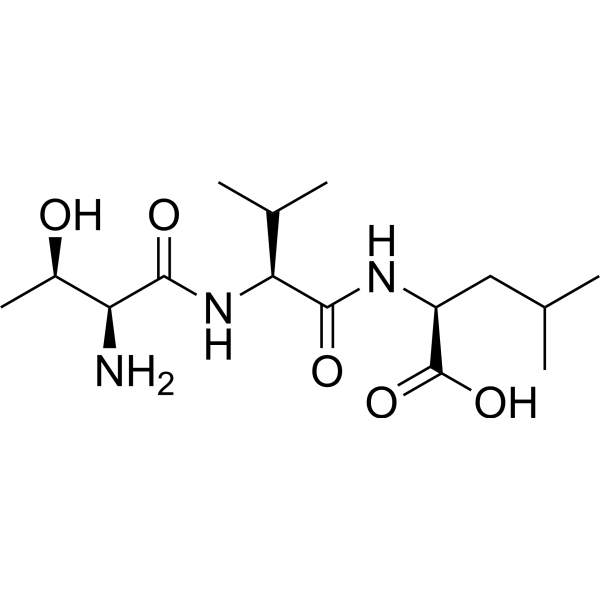
Thr-Val-Leu

" in MedChemExpress (MCE) Product Catalog:
Products (15)

15 Results for "Thr-Val-Leu" in MCE Product Catalog:

Cat. No.: HY-148337
CAS No.: 66317-22-4
Target:  

Inhibitory Antibodies

Research Areas:  

Others

Thr-Val-Leu is a central nervous system tripeptide and reduces Thr-Val-Leu content in schizophrenic brain tissue .
loading...
    loading...
3
3 Cited Publications
Cat. No.: HY-P1077
CAS No.: 145224-99-3
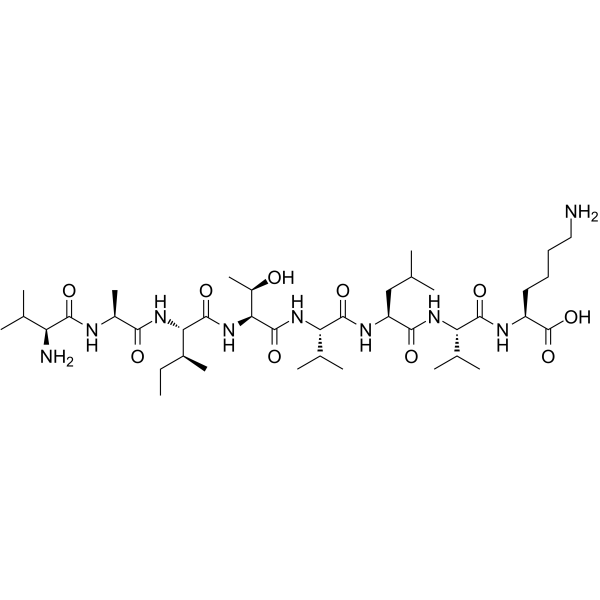
CALP1 is a calmodulin (CaM) agonist (Kd of 88 µM) with binding to the CaM EF-hand/Ca 2+-binding site. CALP1 blocks calcium influx and apoptosis (IC50 of 44.78 µM) through inhibition of calcium channel opening. CALP1 blocks glutamate receptor channels and blocks a store-operated nonselective cation channel. CALP1 activates CaM-dependent phosphodiesterase activity .
loading...
    loading...
3
3 Cited Publications
Cat. No.: HY-P1077A
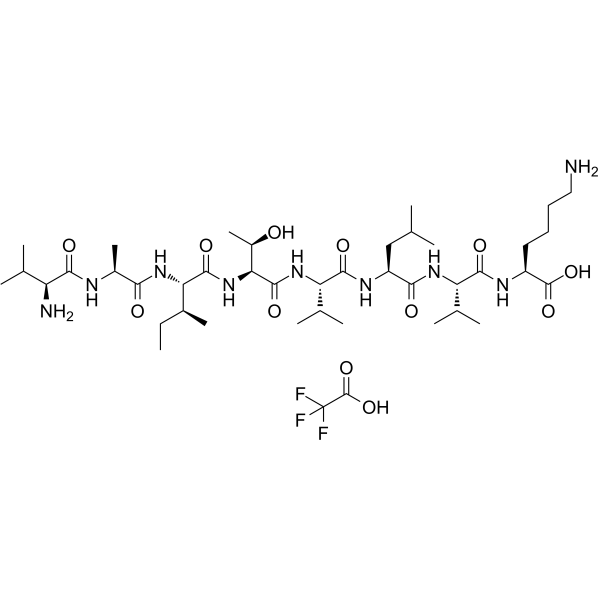
CALP1 TFA is a calmodulin (CaM) agonist (Kd of 88 µM) with binding to the CaM EF-hand/Ca 2+-binding site. CALP1 TFA blocks calcium influx and apoptosis (IC50 of 44.78 µM) through inhibition of calcium channel opening. CALP1 TFA blocks glutamate receptor channels and blocks a store-operated nonselective cation channel. CALP1 TFA activates CaM-dependent phosphodiesterase activity .
loading...
    loading...
Cat. No.: HY-P0238
CAS No.: 93755-85-2
Target:  

Bombesin Receptor

Research Areas:  

Cancer

Gastrin-Releasing Peptide, human (GRP) belongs to the bombesin-like peptide family, and is not a classical hypothalamic-hypophyseal regulatory hormone since it plays only a perfunctory role in the mediation of pituitary hormone release.
loading...
    loading...
Cat. No.: HY-P5366
Target:  

Liposome

Research Areas:  

Others

PEP1 is an amphipathic α-helical peptide containing 31 residues. The interaction of PEP1 with POPC-supported lipid bilayers (SLBs) is concentration-dependent: at low concentrations, it inserts into SLBs to generate compressive stress; at medium concentrations, it saturates the membrane surface to maintain constant stress; and at high concentrations, it solubilizes SLBs. PEP1 can be used for research on the mechanism of membrane-peptide interactions .
loading...
    loading...
Cat. No.: HY-P3576A
Biotin-Gastrin Releasing Peptide, human TFA is a biotinylated gastrin releasing peptide (GRP). Gastrin-releasing peptide (GRP) is a neuropeptide with growth-stimulatory and tumorigenic properties .
loading...
    loading...
Cat. No.: HY-P10862
Target:  

Exosomes Virus Protease

Research Areas:  

Infection Cancer

AH-D peptide is a brain-penetrant antiviral agent disrupting highly curved lipid membranes. AH-D peptide exhibits broad-spectrum antiviral activity against ZIKV, Dengue virus, Chikungunya virus, yellow fever virus and Japanese encephalitis virus, with
IC50
values of 11.9, 12.5, 35.7, 206 and 136 nM, respectively. AH-D peptide reduces the viral load in the brain, suppresses inflammation, protects neurons, and does not damage the blood brain barrier. AH-D peptide restores antitumor immunity by decreasing circulating PD-L1 + exosomes, reducing intratumoral immunosuppressive cells (regulatory T cells, myeloid-derived suppressor cells), and enhancing T cell function. AH-D peptide inhibits membrane-enveloped viruses and cancer cell metastasis in vivo. AH-D peptide exhibits no immunogenicity and has negligible effects on normal tissues. AH-D peptide can be used for research in Zika virus and other mosquito-borne viruses, cancer immunotherapy and metastasis .
loading...
    loading...
Cat. No.: HY-P10862A
Target:  

Exosomes Virus Protease

Research Areas:  

Infection Cancer

AH-D peptide TFA is an antiviral peptide that selectively disrupts membrane structures within the size range of exosomes, inducing T-EXO depletion and enhancing cancer immunotherapy .
loading...
    loading...
Cat. No.: HY-P3383A
Synonyms: PL-5 acetate
Target:  

Bacterial

Research Areas:  

Infection

Peceleganan (PL-5) acetate is an artificial antimicrobial cecropin A (1-10) × melittin B (3-18) hybrid (10+16)-peptide analogue. Peceleganan acetate inhibits wound infection .
loading...
    loading...
Cat. No.: HY-P10560
CAS No.: 955937-87-8
Research Areas:  

Others

M918 is a cell-penetrating peptide. M918 is internalized by cells through endocytosis and can effectively penetrate a variety of cells in a non-toxic manner. M918 can be used in gene therapy and drug delivery system research .
loading...
    loading...
Cat. No.: HY-P5615
CAS No.: 1235883-67-6
Target:  

Bacterial

Research Areas:  

Infection

XT-2 peptide is an antimicrobial peptide derived from skin secretions of Xenopus tropicalis. XT-2 peptide has strong activity against E.coli, the vaule of MIC is 8 μM .
loading...
    loading...
Cat. No.: HY-103285
CAS No.: 74815-57-9
Synonyms: Porcine gastrin-releasing peptide 27
Research Areas:  

Cancer

GRP (porcine) (Porcine gastrin-releasing peptide 27) is the putative mammalian analog of Bombesin (HY-P0195). GRP (porcine) activates the release of a number of gastroenteropancreatic (GEP) peptides into the peripheral circulation. GRP (porcine) stimulates gastrin release and exocrine pancreatic secretion. GRP (porcine) is a useful marker of neuroendocrine differentiation in many tumors .
loading...
    loading...
Cat. No.: HY-P3576
Biotin-Gastrin Releasing Peptide, human is a biotinylated gastrin releasing peptide (GRP). Gastrin-releasing peptide (GRP) is a neuropeptide with growth-stimulatory and tumorigenic properties .
loading...
    loading...
Cat. No.: HY-P5693
Target:  

Bacterial CMV HSV

Research Areas:  

Infection

HBA(111-142), an antimicrobial peptide, is a C-terminal 32-mer fragment of alpha-hemoglobin. HBA(111-142) has antibacterial activity against the ESKAPE panel of pathogens. HBA(111-142) forms amyloid fibrils, and has antiviral activities. HBA(111-142) inhibits measles and herpes viruses (HSV-1, HSV-2, HCMV) .
loading...
    loading...
Cat. No.: HY-P10492
Target:  

Inhibitory Antibodies

Research Areas:  

Others Metabolic Disease

Tregitope 289 is a peptide derived from the Fc region of immunoglobulin G (IgG) and is a highly conserved T cell epitope that stimulates the expansion of natural regulatory T cells. Co-delivery of Tregitope 289 with type 1 diabetes (T1D) antigens delays the development of hyperglycemia and reduces the incidence of diabetes in the NOD mouse model. Tregitope 289 can be used to study T1D and other autoimmune diseases .
loading...
    loading...
  • 1

