
9 Results for "

airway obstruction

" in MedChemExpress (MCE) Product Catalog:
Products (9)

9 Results for "airway obstruction" in MCE Product Catalog:

1
1 Cited Publications
Cat. No.: HY-108858
CAS No.: 143831-71-4
Synonyms: rhDNase
Research Areas:  

Inflammation/Immunology

Dornase alfa (rhDNase) is a recombinant human deoxyribonuclease I (rhDNase) that can specifically degrade extracellular DNA. Dornase alfa catalyzes the cleavage of DNA released by neutrophils in respiratory mucus, reduces sputum viscosity, thereby improving mucus clearance efficiency, reducing airway obstruction and alleviating inflammatory responses. Dornase alfa can be used to improve lung function (such as FEV_1) in cystic fibrosis (CF), reduce the risk of acute pulmonary exacerbations, and has good in vivo tolerability. Dornase alfa acts locally on the respiratory tract through aerosol inhalation, specifically improving the high viscosity of mucus caused by DNA accumulation and related respiratory symptoms .
loading...
    loading...
Cat. No.: HY-105999
CAS No.: 158921-85-8
Purity:  99.81%
Target:  

Ser/Thr Protease

Research Areas:  

Inflammation/Immunology

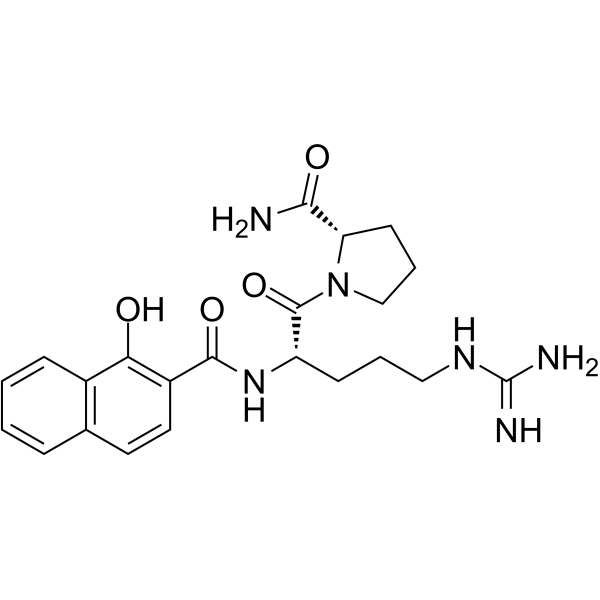
APC 366 is a selective inhibitor of mast cell tryptase (Ki=7.1 μM). APC 366 inhibits antigen-induced early asthmatic response (EAR), late asthmatic response (LAR), and bronchial hyperresponsiveness (BHR) in a sheep model of allergic asthma .
loading...
    loading...
Cat. No.: HY-175873
Research Areas:  

Inflammation/Immunology

AD109 is a combination of the selective norepinephrine reuptake inhibitor Atomoxetine (HY-107370) and the antimuscarinic agent Aroxybutynin (HY-B0267C). AD109 shows orally active significantly and reduces the apnea-hypopnea index .
loading...
    loading...
Cat. No.: HY-W747594
CAS No.: 121055-10-5
Target:  

Potassium Channel

Research Areas:  

Neurological Disease

SDZ PCO 400 is a potassium channel modulator that relaxes airway smooth muscle and reverses airway obstruction caused by intravenous bronchospasmodics .
loading...
    loading...
Cat. No.: HY-105999A
CAS No.: 178925-65-0
Target:  

Ser/Thr Protease

Research Areas:  

Inflammation/Immunology

APC 366 hydrochloride is a selective inhibitor of mast cell trypsin activity. APC 366 hydrochloride is able to inhibit trypsin-induced histamine release in human tonsil and lung cells. APC 366 hydrochloride may have important applications in regulating allergic reactions and inflammation .
loading...
    loading...
Cat. No.: HY-158333
CAS No.: 88579-39-9
Target:  

Mucin

Research Areas:  

Others

Tasuldine is a mucolytic agent, which decreases the sialomucin content of mucus, improves mucociliary and cough clearance .
loading...
    loading...
Cat. No.: HY-184870
CAS No.: 31621-87-1
Target:  

Others

Research Areas:  

Inflammation/Immunology

Polydioxanone is a colorless, crystalline semi-crystalline thermoplastic poly (ether-ester) bioabsorbable polymer. Polydioxanone serves as a hemostatic agent, biodegradable agent, degradant, lumen patency maintainer, as well as a temporary inducer of tracheal tissue injury and inflammation. Polydioxanone controls bone bleeding in biocompatible matrices, degrades via random hydrolytic scission and end-chain scission, with accelerated degradation occurring at pH <1.67, maintains tracheal lumen patency, and induces reversible tracheal epithelial necrosis, inflammation, fibrous tissue hyperplasia, and goblet cell hyperplasia. Polydioxanone can be used in research on bone bleeding, non-malignant tracheal stenosis, tracheobronchial stenosis, tracheobronchomalacia, and airway obstruction associated with vascular compression .
loading...
    loading...
Cat. No.: HY-129785
CAS No.: 162141-96-0
CP-220629 is a potent inhibitor of PDE4, with the IC50 of 0.44 μM. CP-220629 is efficacious in the guinea pig aerosolized antigen induced airway obstruction assay (ED50 2.0 mg/kg) .
loading...
    loading...
Cat. No.: HY-165508
CAS No.: 84233-61-4
Synonyms: CO-1177 free acid
Target:  

Others

Research Areas:  

Infection

Nesosteine (CO-1177) free acid is a regulator of airway secretions that can improve the transport of respiratory mucus. Nesosteine free acid has the function of promoting mucociliary clearance and enhancing the efficiency of mucociliary clearance. Nesosteine free acid also increases the speed of mucus transport, which helps to accelerate the discharge of mucus in the respiratory tract, relieve airway obstruction, and improve respiratory function. Nesosteine free acid can be used to study respiratory diseases such as chronic bronchitis accompanied by abnormal mucus secretion .
loading...
    loading...

