17 Results for "

alkyne handle

" in MedChemExpress (MCE) Product Catalog:
Products (17)

17 Results for "alkyne handle" in MCE Product Catalog:

Cat. No.: HY-W588704
CAS No.: 54447-68-6
Research Areas:  

Others

4-Azidobutyric acid is a click chemistry reagent featuring azide and carboxylic acid moieties. The carboxylic acid group can conjugate with alcohols or amides, while the azide group serves as a click chemistry handle to react with terminal alkynes or strained cyclooctynes. 4-Azidobutyric acid also acts as a PROTAC linker for the synthesis of PROTACs .
loading...
    loading...
Cat. No.: HY-145383
CAS No.: 2599839-59-3
Purity:  ≥95.0%
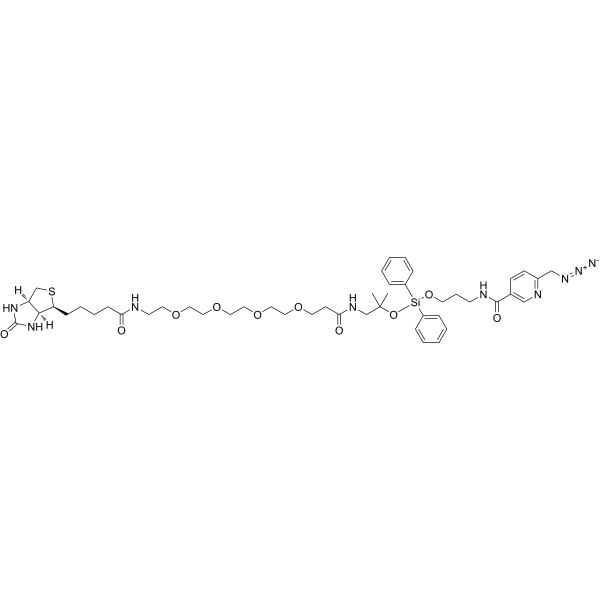
Biotin-PEG4-dialkoxydiphenylsilane-picolyl azide is a clickable, acid-cleavable biotin-picolyl azide. Biotin-PEG4-dialkoxydiphenylsilane-picolyl azide is an enrichment handle of cell surface glycoproteins for protein labeling . It contains an azide group and can undergo copper-catalyzed azide-alkyne cycloaddition (CuAAc) with molecules containing alkyne groups. It can also undergo ring strain-promoted alkyne-azide cycloaddition (SPAAC) with molecules containing DBCO or BCN groups.
loading...
    loading...
Cat. No.: HY-151761
CAS No.: 2084913-49-3
Purity:  99.69%
Target:  

ADC Linkers

Research Areas:  

Others

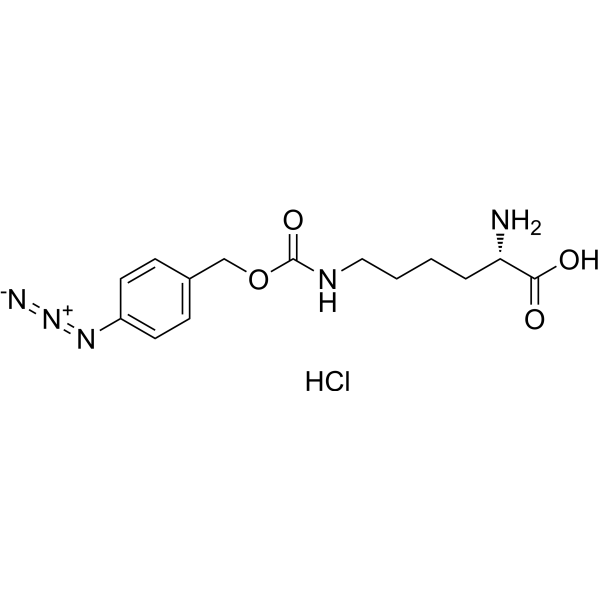
H-L-Lys(4-N3-Z)-OH hydrochloride is a click chemistry reagent containing an azide group. H-L-Lys(4-N3-Z)-OH hydrochloride contains a lysine-modified azide moiety and as a bioorthogonal ligation handle. H-L-Lys(4-N3-Z)-OH hydrochloride is an infrared probe and a photo-affinity reagent . It contains an azide group and can undergo copper-catalyzed azide-alkyne cycloaddition (CuAAc) with molecules containing alkyne groups. It can also undergo ring strain-promoted alkyne-azide cycloaddition (SPAAC) with molecules containing DBCO or BCN groups.
loading...
    loading...
Cat. No.: HY-170757A
Research Areas:  

Others

Spermidine-alkyne trihydrochloride is a Spermidine (HY-B1776) derivative endowed with an  alkyne handle. Spermidine-alkyne trihydrochloride is a Spermidine probe, which can be used for the determination of the Spermidine binding to cellular proteins .
loading...
    loading...
Cat. No.: HY-D2750
CAS No.: 2669097-38-3
Sulfo-Cy5 Picolyl Azide is a fluorophore featuring a sulfonate group and an azide. Azide groups are click chemistry handles which are reactive towards terminal alkynes and strained cyclooctynes such as BCN or DBCO. Cy5 is a cyanine dye with excitation and emission maxima at 651 nm and 670 nm respectively. The sulfonate group on the Cy5 dye increases this compound’s water solubility.
loading...
    loading...
Cat. No.: HY-151679
CAS No.: 1446511-14-3
Target:  

ADC Linkers

Research Areas:  

Others

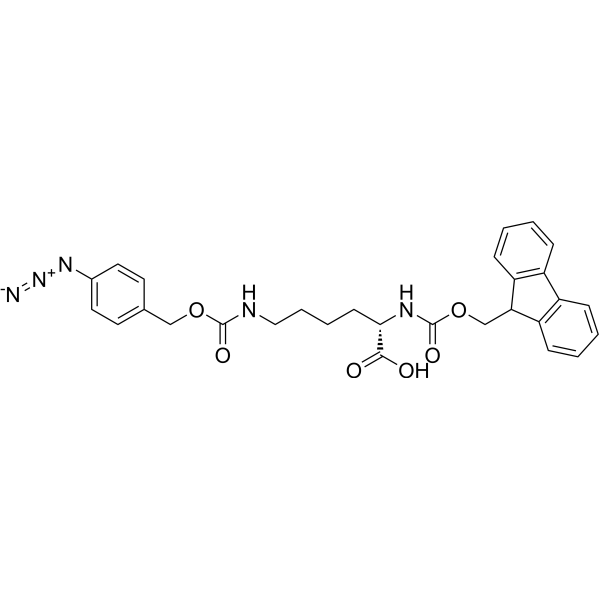
Fmoc-L-Lys(4-N3-Z)-OH is a click chemistry reagent containing an azide group. Fmoc-L-Lys(4-N3-Z)-OH acts as Lysine building-block for SPPS containing an Azide moiety as a bioorthogonal ligation handle, an infrared probe and a photo-affinity reagent. It can be decaged by trans-cyclooctenols via a strain-promoted 1,3-dipolar cycloaddition . Fmoc-L-Lys(4-N3-Z)-OH is a click chemistry reagent, it contains an Azide group and can undergo copper-catalyzed azide-alkyne cycloaddition reaction (CuAAc) with molecules containing Alkyne groups. It can also undergo strain-promoted alkyne-azide cycloaddition (SPAAC) reactions with molecules containing DBCO or BCN groups.
loading...
    loading...
Cat. No.: HY-164209
CAS No.: 2249926-65-4
Target:  

ADC Linkers

Research Areas:  

Others

DBCO-PEG3-C1-acid is an antibody–drug conjugate (ADC) linker, which is used as a reaction handle for strain-promoted azide-alkyne click reaction .
loading...
    loading...
Cat. No.: HY-151687
CAS No.: 1454816-10-4
Target:  

ADC Linkers

Research Areas:  

Others

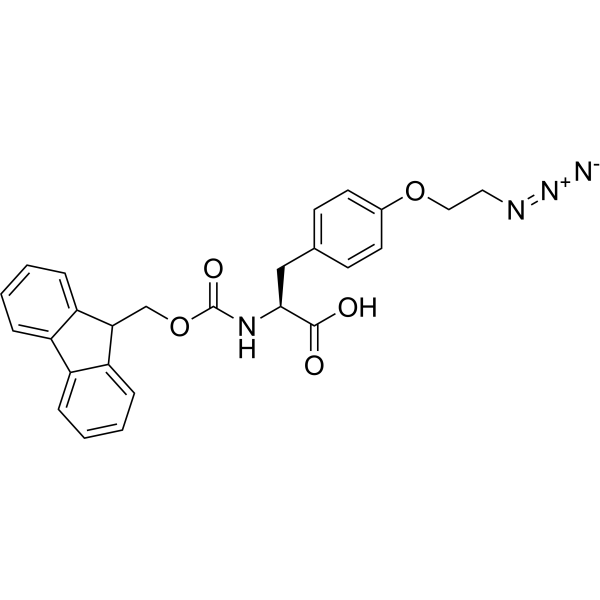
Fmoc-L-Tyr(2-azidoethyl)-OH is a click chemistry reagent containing an azide group. Fmoc-L-Tyr(2-azidoethyl)-OH is unnatural Fmoc-protected Tyrosine derivative bears an azidoethyl substitution as reactive handle e.g. for biorthogonal conjugations, via a Cu(I)-catalyzed 1,3-dipolar Click cycloaddition with alkynes. And azido-UAAs can be employed as IR reporters . It contains an azide group and can undergo copper-catalyzed azide-alkyne cycloaddition (CuAAc) with molecules containing alkyne groups. It can also undergo ring strain-promoted alkyne-azide cycloaddition (SPAAC) with molecules containing DBCO or BCN groups.
loading...
    loading...
Cat. No.: HY-170757
CAS No.: 1627941-31-4
Research Areas:  

Others

Spermidine-alkyne is a Spermidine (HY-B1776) derivative endowed with an  alkyne handle. Spermidine-alkyne is a Spermidine probe, which can be used for the determination of the Spermidine binding to cellular proteins .
loading...
    loading...
Cat. No.: HY-W190836
CAS No.: 182347-24-6
Research Areas:  

Others

Azide-PEG2-Tos is a small PEG linker featuring an azide and a tosylate. Tosylates are good leaving groups which are easily displaced by nucleophiles while azide is a click chemistry handle which is used to react with terminal alkynes or strained cyclooctynes.
loading...
    loading...
Cat. No.: HY-D3265
IR 650 Alkyne is a near-infrared fluorescent probe. The click chemistry reaction handle of IR 650 Alkyne is a terminal alkyne, which can undergo a 'copper-catalyzed alkyne-azide cycloaddition' reaction. Ex = 651nm, Em = 668nm.
loading...
    loading...
Cat. No.: HY-P11857
Target:  

Cathepsin

Research Areas:  

Inflammation/Immunology

Alkyne-GRWHPM-CONH-NH-CMK is a covalent Cathepsin S inhibitor (IC50=82 nM). Alkyne-GRWHPM-CONH-NH-CMK has an N-terminal alkyne handle for CuAAC functionalization that engages off-target protein disulfide isomerase PDIA1. Alkyne-GRWHPM-CONH-NH-CMK can be used for the research of autoimmune disorders .
loading...
    loading...
Cat. No.: HY-185948
Target:  

Phosphoramidites

Research Areas:  

Others

Alkyne-modifier dT Phosphoramidite is a functionalized phosphoramidite monomer that can be used in DNA solid-phase synthesis to attach a terminal alkynyl (-C≡CH) handle at a specific position on the oligonucleotide chain.
loading...
    loading...
Cat. No.: HY-D3253
IR 650 azide is a near-infrared fluorescent probe. The click chemistry reaction handle of IR 650 azide is a terminal azide, which can undergo a 'copper-catalyzed alkyne-azide cycloaddition' reaction. (Ex = 633nm, Em = 647nm)
loading...
    loading...
Cat. No.: HY-D3254
IR 650 picolyl azide is a near-infrared fluorescent probe. The click chemistry reaction handle of IR 650 picolyl azide is a terminal picolyl azide, which can undergo a 'copper-catalyzed alkyne-azide cycloaddition' reaction. (Ex = 650nm, Em = 670nm)
loading...
    loading...
Cat. No.: HY-L258
432 compounds

In modern medicinal chemistry and chemical biology research, alkyne (-C≡C-) structures play an important role in click chemistry, bioorthogonal labeling, and the construction of functional molecules due to their unique linear geometry and high reactivity. In particular, driven by the development of copper-catalyzed azide-alkyne cycloaddition (CuAAC) and copper-free click reactions (SPAAC), terminal alkyne groups have become important “chemical handles” for building complex biomolecular systems.

The MCE Alkyne Compound Library contains 432 compounds designed for the construction of click chemistry reaction systems and the development of diverse functional molecules. In drug discovery, these structures serve as key reactive sites that can efficiently undergo click reactions with azide groups, enabling modular assembly of PROTAC molecules, construction of ADC linkers, and rapid synthesis of bioorthogonal labeling probes. In addition, alkyne groups exhibit high stability, mild reaction conditions, and excellent biocompatibility, allowing them to maintain reactivity in complex biological environments. This contributes to improved efficiency and controllability in drug development, making them indispensable chemical building blocks in modern drug design and functional molecular engineering.

Cat. No.: HY-D3348
Target:  

Fluorescent Dye

Research Areas:  

Others

Rhodamine picolyl azide is a fluorescent dye that enables visualization of protein labeling via click chemistry. The detection mechanism of Rhodamine picolyl azide is based on bioorthogonal click chemistry: Rhodamine picolyl azide reacts with the alkyne group on affinity-based protein profiling probes (ABPs) attached to labeled target proteins; this conjugation allows subsequent fluorescence imaging of proteins separated by SDS-PAGE .
loading...
    loading...
  • 1

