Search Result
Results for "
carboxyl groups
" in MedChemExpress (MCE) Product Catalog:
167
Biochemical Assay Reagents
3
Isotope-Labeled Compounds
| Cat. No. |
Product Name |
Target |
Research Areas |
Chemical Structure |
-
- HY-141540
-
|
|
Biochemical Assay Reagents
Endogenous Metabolite
|
Others
|
|
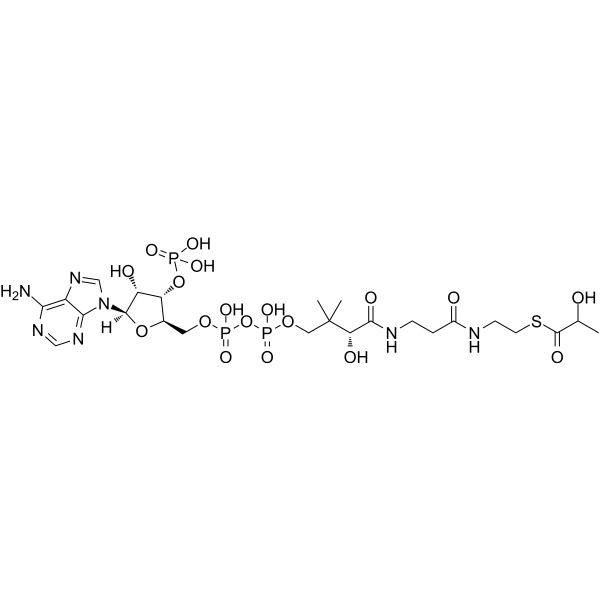
Lactyl-CoA is an acyl-CoA formally condensed from the sulfhydryl group of CoA and the carboxyl group of lactic acid, also known as lactyl-CoA. Lactyl-CoA is essential for the biosynthesis of biodegradable and biocompatible lactic acid-based copolymers .
|
-
-
- HY-W005627
-
-
-
- HY-N2436
-
|
Tartaric acid
|
Biochemical Assay Reagents
|
Others
|
|
2,3-Dihydroxysuccinic acid (Tartaric acid) is an organic acid containing two hydroxyl groups and two carboxyl groups. 2,3-Dihydroxysuccinic acid exists in various stereoisomers and is widely used in food, pharmaceutical, chemical, and other fields .
|
-
-
- HY-Y0801
-
|
|
Drug Metabolite
|
Others
|
|
2,6-Dihydroxybenzoic acid is an aromatic compound containing phenolic hydroxyl groups and carboxyl groups, and it is a secondary metabolite of Salicylic acid (HY-B0167). 2,6-Dihydroxybenzoic acid is also present in olive oil wastewater .
|
-
-
- HY-Y0102
-
|
2-Mercaptobenzoic acid
|
Biochemical Assay Reagents
Drug Intermediate
|
Infection
|
|
Thiosalicylic acid (2-Mercaptobenzoic acid) is an organosulfur compound bearing both sulfhydryl and carboxyl functional groups. Thiosalicylic acid acts as a desulfurizing agent. Thiosalicylic acid also serves as a ligand to synthesize azosulfonamide derivatives with antibacterial and antifungal activities, as well as their Fe 3+, Cu 2+ and Hg 2+ chelates .
|
-
-
- HY-168940B
-
|
|
Drug Intermediate
|
Cancer
|
|
NH2-PEG2000-COOH is a heterofunctional polyethylene glycol with one amino terminal group and one carboxyl terminal group. NH2-PEG2000-COOH reacts with N-succinimidyl-6-maleimidohexanoate to introduce a maleimide terminal group, followed by conjugation with thiolated RGD peptide via a thiol-maleimide coupling reaction to synthesize RGD-PEG-COOH. NH2-PEG2000-COOH can be used in cancer research .
|
-
-
- HY-W090309
-
|
|
Biochemical Assay Reagents
|
Others
|
|
Monosodium 2-sulfoterephthalate is an oxygen-containing organic linker and coordination ligand. Under hydrothermal conditions, Monosodium 2-sulfoterephthalate binds to Cr 3+ ions via deprotonated carboxyl groups to form the MIL-101 (Cr)-SO3H metal-organic framework. Monosodium 2-sulfoterephthalate also adopts monodentate and hexadentate linkage modes with Er III ions, respectively, thereby forming monomeric and polymeric Er III compounds .
|
-
-
- HY-P3208B
-
|
|
Biochemical Assay Reagents
|
Others
|
|
Endoproteinase Lys-C (MS grade) is a hydrolase that cleaves peptide bonds at the carboxyl side of lysine residues. Endoproteinase Lys-C (MS grade) causes non-specific hydrolysis of peptide bonds linked to the carboxyl groups of non-lysine residues, resulting in partial cleavage at these sites .
|
-
-
- HY-W004289
-
|
|
Drug Derivative
|
Others
|
|
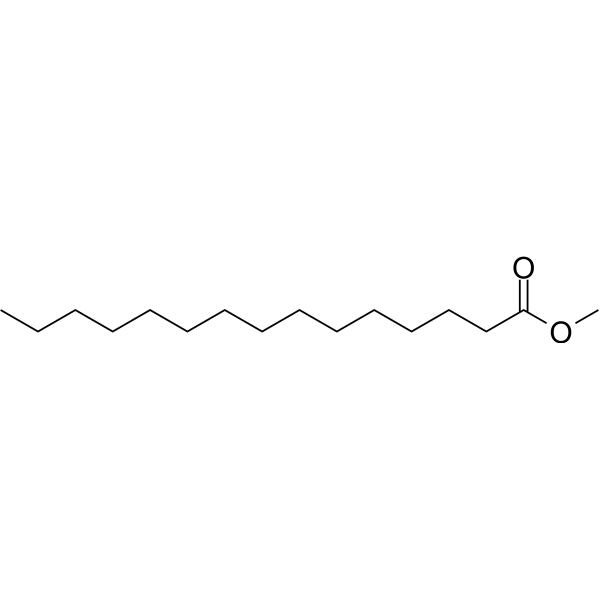
Methyl pentadecanoate is a fatty acid ester that can be isolated from extracts of L. wallichi. Methyl pentadecanoate is formed by the condensation of the carboxyl group of pentadecanoic acid with the hydroxyl group of methanol .
|
-
-
- HY-W016012
-
|
H-Glu-Glu-OH; Glutamyl-glutamic acid
|
Amino Acid Derivatives
|
Others
|
|
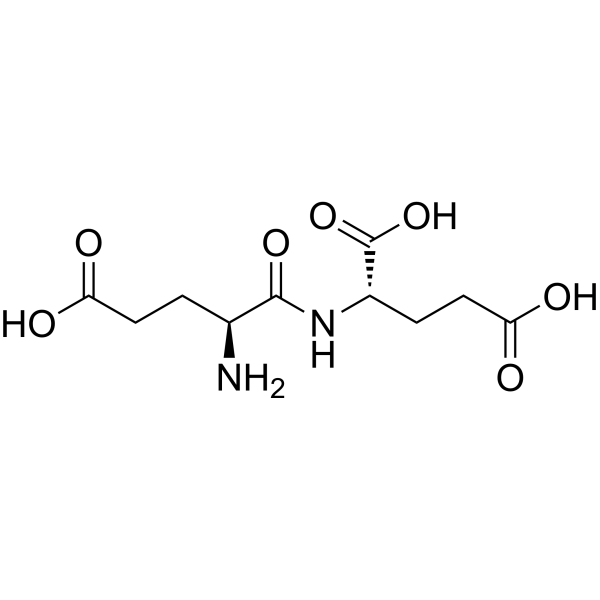
Glu-Glu is a glutamic acid derivative containing amino and carboxyl groups. Glu-Glu is an analogs of acidic tripeptide and can contribute to calcium absorption .
|
-
-
- HY-174921A
-
|
|
Biochemical Assay Reagents
|
Others
|
|
Maleimide-PEG2000-COOH is a PEG derivative composed of Maleimide (HY-W007324), PEG units and carboxyl (-COOH). Carboxyl can easily form a stable amide bond with amino groups or an ester bond with hydroxyl groups. Maleimide forms a stable thioether bond with sulfhydryl (-SH) .
|
-
-
- HY-W1048549A
-
|
HOOC-PEG2000-Thiol
|
Biochemical Assay Reagents
|
Others
|
|
HOOC-PEG2000-SH (HOOC-PEG2000-Thiol) is a reactive thiol PEG derivative with a terminal carboxyl group. The carboxyl group can react with amine or hydroxyl groups to form a stable amide bond or an unstable ester bond. The PEG linkage between the thiol and carboxyl groups has good water solubility, flexible linker distance and higher stability .
|
-
-
- HY-21983
-
|
|
Amino Acid Derivatives
|
Others
|
|
O-Acetyl-N-[(1,1-dimethylethoxy)carbonyl]-L-threonine is a compound containing both an amino group and a carboxyl group.
|
-
-
- HY-W460072
-
|
|
Biochemical Assay Reagents
|
Others
|
|
tert-Butyl 7-hydroxyheptanoate is a linker with a hydroxyl group and a t-butyl ester. The hydroxyl group allows for further derivatization or replacement with many other reactive functional groups. The t-butyl protected carboxyl group can be deprotected under acidic conditions.
|
-
-
- HY-W190877
-
|
SH-PEG1-COOH
|
Biochemical Assay Reagents
|
Others
|
|
Thiol-PEG1-acid (SH-PEG1-COOH) is a PEG derivative consisting of a thiol (-SH), 1 PEG unit, and a carboxyl (-COOH). The thiol is a highly reactive chemical group that can react specifically with a variety of molecules to form stable covalent bonds. The carboxyl group can easily form stable amide bonds with amino groups, and can also form ester bonds with hydroxyl groups.
|
-
-
- HY-174926A
-
-
-
- HY-W041983
-
-
-
- HY-134428
-
|
|
Endogenous Metabolite
|
Metabolic Disease
|
|
Arachidonoyl coenzyme A lithium is an unsaturated fatty acyl coenzyme A, formed by the condensation of the thiol group of coenzyme A with the carboxyl group of arachidonic acid .
|
-
-
- HY-W1048549C
-
|
HOOC-PEG5000-Thiol
|
Biochemical Assay Reagents
|
Others
|
|
HOOC-PEG5000-SH (HOOC-PEG5000-Thiol) is a reactive thiol PEG derivative with a terminal carboxyl group. The carboxyl group can react with amine or hydroxyl groups to form a stable amide bond or an unstable ester bond. The PEG linkage between the thiol and carboxyl groups has good water solubility, flexible linker distance and higher stability .
|
-
-
- HY-W190921
-
|
|
Biochemical Assay Reagents
|
Others
|
|
t-Butyl 3-(hydroxypropoxyl)-propanoate contains reactive hydroxyl and t-butyl protected carboxyl moieties. The hydroxyl group can react to further derivatize the compound. The t-butyl carbonyl group can be deprotected under acidic conditions.
|
-
-
- HY-W1048549E
-
|
HOOC-PEG20000-Thiol
|
Biochemical Assay Reagents
|
Others
|
|
HOOC-PEG20000-SH (HOOC-PEG20000-Thiol) is a reactive thiol PEG derivative with a terminal carboxyl group. The carboxyl group can react with amine or hydroxyl groups to form a stable amide bond or an unstable ester bond. The PEG linkage between the thiol and carboxyl groups has good water solubility, flexible linker distance and higher stability .
|
-
-
- HY-P0181
-
|
|
Tau Protein
|
Neurological Disease
|
|
Microtubule-associated protein tau (26-44) is a synthetic peptide chain with an amine group attached to glutamine and an carboxyl group attached to lysine.
|
-
-
- HY-174921B
-
|
|
Biochemical Assay Reagents
|
Others
|
|
Maleimide-PEG3400-COOH is a PEG derivative composed of Maleimide (HY-W007324), PEG units and carboxyl (-COOH). Carboxyl can easily form a stable amide bond with amino groups or an ester bond with hydroxyl groups. Maleimide forms a stable thioether bond with sulfhydryl (-SH) .
|
-
-
- HY-174921C
-
|
|
Biochemical Assay Reagents
|
Others
|
|
Maleimide-PEG5000-COOH is a PEG derivative composed of Maleimide (HY-W007324), PEG units and carboxyl (-COOH). Carboxyl can easily form a stable amide bond with amino groups or an ester bond with hydroxyl groups. Maleimide forms a stable thioether bond with sulfhydryl (-SH) .
|
-
-
- HY-174921
-
|
|
Biochemical Assay Reagents
|
Others
|
|
Maleimide-PEG1000-COOH is a PEG derivative composed of Maleimide (HY-W007324), PEG units and carboxyl (-COOH). Carboxyl can easily form a stable amide bond with amino groups or an ester bond with hydroxyl groups. Maleimide forms a stable thioether bond with sulfhydryl (-SH) .
|
-
-
- HY-157204
-
|
|
Hapten
|
Others
|
|
ZEp is a zearalenone (ZEN) immunohapten activated by conversion of the carboxyl group to the corresponding N-hydroxysuccinimide ester for use in immunoassays .
|
-
-
- HY-W888710D
-
|
Folate-PEG2000-COOH
|
Biochemical Assay Reagents
|
Others
|
|
FA-PEG2000-COOH (Folate-PEG2000-COOH) is a Folic acid (HY-16637)-modified PEG derivative containing a carboxyl group (-COOH). The carboxyl group can easily form a stable amide bond with an amino group, or an ester bond with a hydroxyl group. Folic acid (-FA) has a high affinity for the folate receptor and can be used to target cell membrane receptors for drug delivery .
|
-
-
- HY-W888710E
-
|
Folate-PEG3400-COOH
|
Biochemical Assay Reagents
|
Others
|
|
FA-PEG3400-COOH (Folate-PEG3400-COOH) is a Folic acid (HY-16637)-modified PEG derivative containing a carboxyl group (-COOH). The carboxyl group can easily form a stable amide bond with an amino group, or an ester bond with a hydroxyl group. Folic acid (-FA) has a high affinity for the folate receptor and can be used to target cell membrane receptors for drug delivery .
|
-
-
- HY-W1048574I
-
|
OHC-PEG3400-carboxyl
|
Biochemical Assay Reagents
|
Others
|
|
OHC-PEG3400-COOH (OHC-PEG3400-carboxyl) is a PEG derivative with a linear heteroterminal bifunctional structure of aldehyde and carboxylic acid groups. OHC-PEG3400-COOH can be used for drug delivery .
|
-
-
- HY-W1048574E
-
|
OHC-PEG20000-carboxyl
|
Biochemical Assay Reagents
|
Others
|
|
OHC-PEG20000-COOH (OHC-PEG20000-carboxyl) is a PEG derivative with a linear heteroterminal bifunctional structure of aldehyde and carboxylic acid groups. OHC-PEG20000-COOH can be used for drug delivery .
|
-
-
- HY-W174661
-
|
|
Biochemical Assay Reagents
|
Others
|
|
tert-Butyl 6-hydroxyhexanoate is a linker with a hydroxyl group and a t-butyl ester. The hydroxyl group allows for further derivatization or replacement with many other reactive functional groups. The t-butyl protected carboxyl group can be deprotected under acidic conditions.
|
-
-
- HY-174930
-
|
|
Biochemical Assay Reagents
|
Others
|
|
Amino-PEG41-alcohol is a PEG derivative consisting of an alcohol, PEG unit and an amino group. The amino group can react with other chemical groups (such as carboxyl, aldehyde, etc.) to form stable chemical bonds .
|
-
-
- HY-105549
-
|
|
Antibiotic
|
Infection
|
|
Quinacillin is a compound that undergoes hydrolysis catalyzed by penicillinase. Quinacillin is irreversibly covalently bound to proteins via its β-lactam carboxyl group .
|
-
-
- HY-155455
-
|
|
Hapten
|
Inflammation/Immunology
|
Hapten Dca is an immunizing hapten. Hapten Dca is activated by a solution of N, N′-disuccinimidyl carbonate. Hapten Dca with a carboxyl functional group is conjugated to proteins .
|
-
-
- HY-174364E
-
|
|
Biochemical Assay Reagents
|
Others
|
|
Alkyne-PEG20000-COOH is a heterobifunctional PEG crosslinker that can be used to attach functional PEG to biomolecules, particles, and other material surfaces. The carboxyl group can react with the amine group to form a stable amide bond .
|
-
-
- HY-174364C
-
|
|
Biochemical Assay Reagents
|
Others
|
|
Alkyne-PEG5000-COOH is a heterobifunctional PEG crosslinker that can be used to attach functional PEG to biomolecules, particles, and other material surfaces. The carboxyl group can react with the amine group to form a stable amide bond .
|
-
-
- HY-W1048549H
-
|
HOOC-PEG1000-Thiol
|
Biochemical Assay Reagents
|
Others
|
|
HOOC-PEG1000-SH (HOOC-PEG1000-Thiol) is a reactive thiol PEG derivative with a terminal carboxyl group. The carboxyl group can react with amine or hydroxyl groups to form a stable amide bond or an unstable ester bond. The reaction of the carboxyl group allows the amine or hydroxyl group to be converted into a free thiol with a linear PEG linkage. The generated thiol group can be used to modify the surface of gold nanoparticles or participate in other PEGylation reactions. The PEG linkage between the thiol and carboxyl groups has good water solubility, flexible linker distance and higher stability .
|
-
-
- HY-W1048549J
-
|
HOOC-PEG40000-Thiol
|
Biochemical Assay Reagents
|
Others
|
|
HOOC-PEG40000-SH (HOOC-PEG40000-Thiol) is a reactive thiol PEG derivative with a terminal carboxyl group. The carboxyl group can react with amine or hydroxyl groups to form a stable amide bond or an unstable ester bond. The reaction of the carboxyl group allows the amine or hydroxyl group to be converted into a free thiol with a linear PEG linkage. The generated thiol group can be used to modify the surface of gold nanoparticles or participate in other PEGylation reactions. The PEG linkage between the thiol and carboxyl groups has good water solubility, flexible linker distance and higher stability .
|
-
-
- HY-W1048549B
-
|
HOOC-PEG3400-Thiol
|
Biochemical Assay Reagents
|
Others
|
|
HOOC-PEG3400-SH (HOOC-PEG3400-Thiol) is a reactive thiol PEG derivative with a terminal carboxyl group. The carboxyl group can react with amine or hydroxyl groups to form a stable amide bond or an unstable ester bond. The PEG linkage between the thiol and carboxyl groups has good water solubility, flexible linker distance and higher stability .
|
-
-
- HY-W1048549D
-
|
HOOC-PEG10000-Thiol
|
Biochemical Assay Reagents
|
Others
|
|
HOOC-PEG10000-SH (HOOC-PEG10000-Thiol) is a reactive thiol PEG derivative with a terminal carboxyl group. The carboxyl group can react with amine or hydroxyl groups to form a stable amide bond or an unstable ester bond. The PEG linkage between the thiol and carboxyl groups has good water solubility, flexible linker distance and higher stability .
|
-
-
- HY-174904
-
|
|
Biochemical Assay Reagents
|
Others
|
|
Dde Biotin-PEG4-COOH is a PEG derivative composed of Biotin, 5 PEG units, and a carboxyl group (-COOH). Biotin can form a stable non-covalent bond with streptavidin. The carboxyl group can easily form a stable amide bond with the amino group, and can also form an ester bond with the hydroxyl group.
|
-
-
- HY-183003C
-
|
|
Biochemical Assay Reagents
|
Others
|
|
Mannose-PEG5000-COOH is a conjugate composed of mannose, PEG chains, and carboxyl groups (COOH). Mannose-PEG-COOH combines the targeting recognition ability of mannose with the carboxyl group, which can undergo condensation or esterification reactions with amino and hydroxyl groups, for applications such as targeted drug delivery systems and nanoparticle modification.
|
-
-
- HY-183003D
-
|
|
Biochemical Assay Reagents
|
Others
|
|
Mannose-PEG10000-COOH is a conjugate composed of mannose, PEG chains, and carboxyl groups (COOH). Mannose-PEG-COOH combines the targeting recognition ability of mannose with the carboxyl group, which can undergo condensation or esterification reactions with amino and hydroxyl groups, for applications such as targeted drug delivery systems and nanoparticle modification.
|
-
-
- HY-183003A
-
|
|
Biochemical Assay Reagents
|
Others
|
|
Mannose-PEG2000-COOH is a conjugate composed of mannose, PEG chains, and carboxyl groups (COOH). Mannose-PEG-COOH combines the targeting recognition ability of mannose with the carboxyl group, which can undergo condensation or esterification reactions with amino and hydroxyl groups, for applications such as targeted drug delivery systems and nanoparticle modification.
|
-
-
- HY-183003
-
|
|
Biochemical Assay Reagents
|
Others
|
|
Mannose-PEG1000-COOH is a conjugate composed of mannose, PEG chains, and carboxyl groups (COOH). Mannose-PEG-COOH combines the targeting recognition ability of mannose with the carboxyl group, which can undergo condensation or esterification reactions with amino and hydroxyl groups, for applications such as targeted drug delivery systems and nanoparticle modification.
|
-
-
- HY-183003B
-
|
|
Biochemical Assay Reagents
|
Others
|
|
Mannose-PEG3400-COOH is a conjugate composed of mannose, PEG chains, and carboxyl groups (COOH). Mannose-PEG-COOH combines the targeting recognition ability of mannose with the carboxyl group, which can undergo condensation or esterification reactions with amino and hydroxyl groups, for applications such as targeted drug delivery systems and nanoparticle modification.
|
-
-
- HY-183163D
-
|
|
Biochemical Assay Reagents
|
Others
|
|
Glucose-PEG10000-COOH is a conjugate composed of glucose, PEG chains, and carboxyl groups (COOH). Glucose-PEG10000-COOH combines the targeting recognition ability of glucose with the carboxyl groups capable of condensation or esterification reactions with amino and hydroxyl groups, making it suitable for applications such as targeted drug delivery systems and nanoparticle modification.
|
-
-
- HY-183163B
-
|
|
Biochemical Assay Reagents
|
Others
|
|
Glucose-PEG3400-COOH is a conjugate composed of glucose, PEG chains, and carboxyl groups (COOH). Glucose-PEG3400-COOH combines the targeting recognition ability of glucose with the carboxyl groups capable of condensation or esterification reactions with amino and hydroxyl groups, making it suitable for applications such as targeted drug delivery systems and nanoparticle modification.
|
-
-
- HY-183163
-
|
|
Biochemical Assay Reagents
|
Others
|
|
Glucose-PEG1000-COOH is a conjugate composed of glucose, PEG chains, and carboxyl groups (COOH). Glucose-PEG1000-COOH combines the targeting recognition ability of glucose with the carboxyl groups capable of condensation or esterification reactions with amino and hydroxyl groups, making it suitable for applications such as targeted drug delivery systems and nanoparticle modification.
|
-
-
- HY-183163C
-
|
|
Biochemical Assay Reagents
|
Others
|
|
Glucose-PEG5000-COOH is a conjugate composed of glucose, PEG chains, and carboxyl groups (COOH). Glucose-PEG5000-COOH combines the targeting recognition ability of glucose with the carboxyl groups capable of condensation or esterification reactions with amino and hydroxyl groups, making it suitable for applications such as targeted drug delivery systems and nanoparticle modification.
|
-
- HY-183163A
-
|
|
Biochemical Assay Reagents
|
Others
|
|
Glucose-PEG2000-COOH is a conjugate composed of glucose, PEG chains, and carboxyl groups (COOH). Glucose-PEG2000-COOH combines the targeting recognition ability of glucose with the carboxyl groups capable of condensation or esterification reactions with amino and hydroxyl groups, making it suitable for applications such as targeted drug delivery systems and nanoparticle modification.
|
-
- HY-200288B
-
|
|
Biochemical Assay Reagents
|
Others
|
|
DMG-PEG3400-COOH is a conjugate composed of DMG, a PEG chain, and a terminal carboxyl group (-COOH). The carboxyl group in DMG-PEG3400-COOH can form an amide bond with a primary amine via EDC/NHS activation, enabling targeted modification of liposomes/nanoparticles.
|
-
- HY-W1052117A
-
|
|
Biochemical Assay Reagents
|
Others
|
|
DMPE-PEG3400-COOH is a conjugate composed of DMPE, a PEG chain, and a terminal carboxyl group (-COOH). The carboxyl group in DMPE-PEG3400-COOH can form an amide bond with a primary amine via EDC/NHS activation, enabling targeted modification of liposomes/nanoparticles.
|
-
- HY-W1052873C
-
|
|
Biochemical Assay Reagents
|
Others
|
|
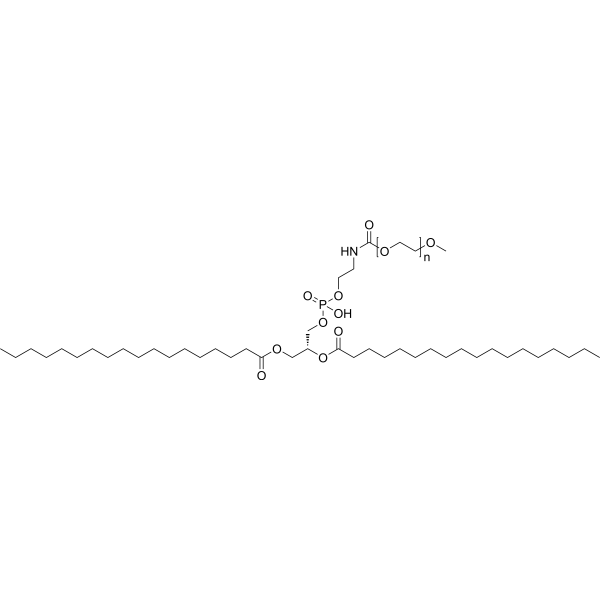
DPPE-PEG1000-COOH is a conjugate composed of DPPE, a PEG chain, and a terminal carboxyl group (-COOH). The carboxyl group in DPPE-PEG1000-COOH can form an amide bond with a primary amine via EDC/NHS activation, enabling targeted modification of liposomes/nanoparticles.
|
-
- HY-W1052117
-
|
|
Biochemical Assay Reagents
|
Others
|
|
DMPE-PEG2000-COOH is a conjugate composed of DMPE, a PEG chain, and a terminal carboxyl group (-COOH). The carboxyl group in DMPE-PEG2000-COOH can form an amide bond with a primary amine via EDC/NHS activation, enabling targeted modification of liposomes/nanoparticles.
|
-
- HY-183173D
-
|
|
Biochemical Assay Reagents
|
Others
|
|
DSG-PEG10000-COOH is a conjugate composed of DSG, a PEG chain, and a terminal carboxyl group (-COOH). The carboxyl group in DSG-PEG10000-COOH can form an amide bond with a primary amine via EDC/NHS activation, enabling targeted modification of liposomes/nanoparticles.
|
-
- HY-200288D
-
|
|
Biochemical Assay Reagents
|
Others
|
|
DMG-PEG10000-COOH is a conjugate composed of DMG, a PEG chain, and a terminal carboxyl group (-COOH). The carboxyl group in DMG-PEG10000-COOH can form an amide bond with a primary amine via EDC/NHS activation, enabling targeted modification of liposomes/nanoparticles.
|
-
- HY-W1052873B
-
|
|
Biochemical Assay Reagents
|
Others
|
|
DPPE-PEG5000-COOH is a conjugate composed of DPPE, a PEG chain, and a terminal carboxyl group (-COOH). The carboxyl group in DPPE-PEG5000-COOH can form an amide bond with a primary amine via EDC/NHS activation, enabling targeted modification of liposomes/nanoparticles.
|
-
- HY-W1052873A
-
|
|
Biochemical Assay Reagents
|
Others
|
|
DPPE-PEG3400-COOH is a conjugate composed of DPPE, a PEG chain, and a terminal carboxyl group (-COOH). The carboxyl group in DPPE-PEG3400-COOH can form an amide bond with a primary amine via EDC/NHS activation, enabling targeted modification of liposomes/nanoparticles.
|
-
- HY-W1052117C
-
|
|
Biochemical Assay Reagents
|
Others
|
|
DMPE-PEG1000-COOH is a conjugate composed of DMPE, a PEG chain, and a terminal carboxyl group (-COOH). The carboxyl group in DMPE-PEG1000-COOH can form an amide bond with a primary amine via EDC/NHS activation, enabling targeted modification of liposomes/nanoparticles.
|
-
- HY-183173C
-
|
|
Biochemical Assay Reagents
|
Others
|
|
DSG-PEG5000-COOH is a conjugate composed of DSG, a PEG chain, and a terminal carboxyl group (-COOH). The carboxyl group in DSG-PEG5000-COOH can form an amide bond with a primary amine via EDC/NHS activation, enabling targeted modification of liposomes/nanoparticles.
|
-
- HY-183173B
-
|
|
Biochemical Assay Reagents
|
Others
|
|
DSG-PEG3400-COOH is a conjugate composed of DSG, a PEG chain, and a terminal carboxyl group (-COOH). The carboxyl group in DSG-PEG3400-COOH can form an amide bond with a primary amine via EDC/NHS activation, enabling targeted modification of liposomes/nanoparticles.
|
-
- HY-183173
-
|
|
Biochemical Assay Reagents
|
Others
|
|
DSG-PEG1000-COOH is a conjugate composed of DSG, a PEG chain, and a terminal carboxyl group (-COOH). The carboxyl group in DSG-PEG1000-COOH can form an amide bond with a primary amine via EDC/NHS activation, enabling targeted modification of liposomes/nanoparticles.
|
-
- HY-W1052873D
-
|
|
Biochemical Assay Reagents
|
Others
|
|
DPPE-PEG10000-COOH is a conjugate composed of DPPE, a PEG chain, and a terminal carboxyl group (-COOH). The carboxyl group in DPPE-PEG10000-COOH can form an amide bond with a primary amine via EDC/NHS activation, enabling targeted modification of liposomes/nanoparticles.
|
-
- HY-200288
-
|
|
Biochemical Assay Reagents
|
Others
|
|
DMG-PEG2000-COOH is a conjugate composed of DMG, a PEG chain, and a terminal carboxyl group (-COOH). The carboxyl group in DMG-PEG2000-COOH can form an amide bond with a primary amine via EDC/NHS activation, enabling targeted modification of liposomes/nanoparticles.
|
-
- HY-183173A
-
|
|
Biochemical Assay Reagents
|
Others
|
|
DSG-PEG2000-COOH is a conjugate composed of DSG, a PEG chain, and a terminal carboxyl group (-COOH). The carboxyl group in DSG-PEG2000-COOH can form an amide bond with a primary amine via EDC/NHS activation, enabling targeted modification of liposomes/nanoparticles.
|
-
- HY-200288A
-
|
|
Biochemical Assay Reagents
|
Others
|
|
DMG-PEG1000-COOH is a conjugate composed of DMG, a PEG chain, and a terminal carboxyl group (-COOH). The carboxyl group in DMG-PEG1000-COOH can form an amide bond with a primary amine via EDC/NHS activation, enabling targeted modification of liposomes/nanoparticles.
|
-
- HY-W1052873
-
|
|
Biochemical Assay Reagents
|
Others
|
|
DPPE-PEG2000-COOH is a conjugate composed of DPPE, a PEG chain, and a terminal carboxyl group (-COOH). The carboxyl group in DPPE-PEG2000-COOH can form an amide bond with a primary amine via EDC/NHS activation, enabling targeted modification of liposomes/nanoparticles.
|
-
- HY-W1052117D
-
|
|
Biochemical Assay Reagents
|
Others
|
|
DMPE-PEG1000-COOH is a conjugate composed of DMPE, a PEG chain, and a terminal carboxyl group (-COOH). The carboxyl group in DMPE-PEG1000-COOH can form an amide bond with a primary amine via EDC/NHS activation, enabling targeted modification of liposomes/nanoparticles.
|
-
- HY-200288C
-
|
|
Biochemical Assay Reagents
|
Others
|
|
DMG-PEG5000-COOH is a conjugate composed of DMG, a PEG chain, and a terminal carboxyl group (-COOH). The carboxyl group in DMG-PEG5000-COOH can form an amide bond with a primary amine via EDC/NHS activation, enabling targeted modification of liposomes/nanoparticles.
|
-
- HY-W1052117B
-
|
|
Biochemical Assay Reagents
|
Others
|
|
DMPE-PEG5000-COOH is a conjugate composed of DMPE, a PEG chain, and a terminal carboxyl group (-COOH). The carboxyl group in DMPE-PEG5000-COOH can form an amide bond with a primary amine via EDC/NHS activation, enabling targeted modification of liposomes/nanoparticles.
|
-
- HY-W888710C
-
|
Folate-PEG1000-COOH
|
Biochemical Assay Reagents
|
Others
|
|
FA-PEG1000-COOH (Folate-PEG1000-COOH) is a Folic acid (HY-16637)-modified PEG derivative containing a carboxyl group (-COOH). The carboxyl group can easily form a stable amide bond with an amino group, or an ester bond with a hydroxyl group. Folic acid (-FA) has a high affinity for the folate receptor and can be used to target cell membrane receptors for drug delivery .
|
-
- HY-W888710A
-
|
Folate-PEG400-COOH
|
Biochemical Assay Reagents
|
Others
|
|
FA-PEG400-COOH (Folate-PEG400-COOH) is a Folic acid (HY-16637)-modified PEG derivative containing a carboxyl group (-COOH). The carboxyl group can easily form a stable amide bond with an amino group, or an ester bond with a hydroxyl group. Folic acid (-FA) has a high affinity for the folate receptor and can be used to target cell membrane receptors for drug delivery .
|
-
- HY-W888710B
-
|
Folate-PEG600-COOH
|
Biochemical Assay Reagents
|
Others
|
|
FA-PEG600-COOH (Folate-PEG600-COOH) is a Folic acid (HY-16637)-modified PEG derivative containing a carboxyl group (-COOH). The carboxyl group can easily form a stable amide bond with an amino group, or an ester bond with a hydroxyl group. Folic acid (-FA) has a high affinity for the folate receptor and can be used to target cell membrane receptors for drug delivery .
|
-
- HY-W888710H
-
|
Folate-PEG5000-COOH
|
Biochemical Assay Reagents
|
Others
|
|
FA-PEG5000-COOH (Folate-PEG5000-COOH) is a Folic acid (HY-16637)-modified PEG derivative containing a carboxyl group (-COOH). The carboxyl group can easily form a stable amide bond with an amino group, or an ester bond with a hydroxyl group. Folic acid (-FA) has a high affinity for the folate receptor and can be used to target cell membrane receptors for drug delivery .
|
-
- HY-W888710I
-
|
Folate-PEG10000-COOH
|
Biochemical Assay Reagents
|
Others
|
|
FA-PEG10000-COOH (Folate-PEG10000-COOH) is a Folic acid (HY-16637)-modified PEG derivative containing a carboxyl group (-COOH). The carboxyl group can easily form a stable amide bond with an amino group, or an ester bond with a hydroxyl group. Folic acid (-FA) has a high affinity for the folate receptor and can be used to target cell membrane receptors for drug delivery .
|
-
- HY-W1048574J
-
|
OHC-PEG40000-carboxyl
|
Biochemical Assay Reagents
|
Others
|
|
OHC-PEG40000-COOH (OHC-PEG40000-carboxyl) is a PEG derivative with a linear heteroterminal bifunctional structure of aldehyde and carboxylic acid groups. OHC-PEG40000-COOH can be used for drug delivery .
|
-
- HY-W1048574H
-
|
OHC-PEG1000-carboxyl
|
Biochemical Assay Reagents
|
Others
|
|
OHC-PEG1000-COOH (OHC-PEG1000-carboxyl) is a PEG derivative with a linear heteroterminal bifunctional structure of aldehyde and carboxylic acid groups. OHC-PEG1000-COOH can be used for drug delivery .
|
-
- HY-W1048574A
-
|
OHC-PEG2000-carboxyl
|
Biochemical Assay Reagents
|
Others
|
|
OHC-PEG2000-COOH (OHC-PEG2000-carboxyl) is a PEG derivative with a linear heteroterminal bifunctional structure of aldehyde and carboxylic acid groups. OHC-PEG2000-COOH can be used for drug delivery .
|
-
- HY-W1048574D
-
|
OHC-PEG10000-carboxyl
|
Biochemical Assay Reagents
|
Others
|
|
OHC-PEG10000-COOH (OHC-PEG10000-carboxyl) is a PEG derivative with a linear heteroterminal bifunctional structure of aldehyde and carboxylic acid groups. OHC-PEG10000-COOH can be used for drug delivery .
|
-
- HY-W1048574C
-
|
OHC-PEG5000-carboxyl
|
Biochemical Assay Reagents
|
Others
|
|
OHC-PEG5000-COOH (OHC-PEG5000-carboxyl) is a PEG derivative with a linear heteroterminal bifunctional structure of aldehyde and carboxylic acid groups. OHC-PEG5000-COOH can be used for drug delivery .
|
-
- HY-P11696
-
|
|
Drug Intermediate
|
Others
|
|
H-Aeg(Fmoc)-OH hydrochloride is an Fmoc-protected aminoethylglycine monomer with a free carboxyl group and can be used for peptide nucleic acid synthesis.
|
-
- HY-183168B
-
|
|
Biochemical Assay Reagents
|
Others
|
|
C18-PEG5000-COOH is a conjugate composed of an octadecyl group (C18 aliphatic chain), a PEG chain, and a carboxyl group (-COOH). C18-PEG5000-COOH combines the membrane compatibility of lipids with the carboxyl group, which can form amide bonds with primary amines via EDC/NHS activation, making it suitable for research in biomaterial construction and drug delivery.
|
-
- HY-183168A
-
|
|
Biochemical Assay Reagents
|
Others
|
|
C18-PEG3400-COOH is a conjugate composed of an octadecyl group (C18 aliphatic chain), a PEG chain, and a carboxyl group (-COOH). C18-PEG3400-COOH combines the membrane compatibility of lipids with the carboxyl group, which can form amide bonds with primary amines via EDC/NHS activation, making it suitable for research in biomaterial construction and drug delivery.
|
-
- HY-183168
-
|
|
Biochemical Assay Reagents
|
Others
|
|
C18-PEG2000-COOH is a conjugate composed of an octadecyl group (C18 aliphatic chain), a PEG chain, and a carboxyl group (-COOH). C18-PEG2000-COOH combines the membrane compatibility of lipids with the carboxyl group, which can form amide bonds with primary amines via EDC/NHS activation, making it suitable for research in biomaterial construction and drug delivery.
|
-
- HY-W399914
-
|
|
Biochemical Assay Reagents
|
Others
|
|
tert-Butyl methyl adipate is a linker with an methyl ester group and a t-butyl ester. The methyl ester groups can be hydrolyzed, reduced, or substituted under different conditions. The t-butyl protected carboxyl group can be deprotected under acidic conditions.
|
-
- HY-174932
-
|
|
Biochemical Assay Reagents
|
Others
|
|
Amino-PEG18-t-butyl ester is a PEG derivative consisting of t-butyl ester, PEG unit and an amino group (Amine). The amino group can react with other chemical groups (such as carboxyl, aldehyde, etc.) to form stable chemical bonds.
|
-
- HY-183133B
-
|
|
Biochemical Assay Reagents
|
Others
|
|
C16-PEG5000-COOH is a conjugate composed of a hexadecyl (C16 aliphatic chain), a PEG chain, and a carboxyl group (-COOH). C16-PEG5000-COOH combines the membrane compatibility of lipids with the carboxyl group, which can form amide bonds with primary amines via EDC/NHS activation, making it suitable for research in biomaterial construction and drug delivery.
|
-
- HY-183133A
-
|
|
Biochemical Assay Reagents
|
Others
|
|
C16-PEG3400-COOH is a conjugate composed of a hexadecyl (C16 aliphatic chain), a PEG chain, and a carboxyl group (-COOH). C16-PEG3400-COOH combines the membrane compatibility of lipids with the carboxyl group, which can form amide bonds with primary amines via EDC/NHS activation, making it suitable for research in biomaterial construction and drug delivery.
|
-
- HY-183133
-
|
|
Biochemical Assay Reagents
|
Others
|
|
C16-PEG2000-COOH is a conjugate composed of a hexadecyl (C16 aliphatic chain), a PEG chain, and a carboxyl group (-COOH). C16-PEG2000-COOH combines the membrane compatibility of lipids with the carboxyl group, which can form amide bonds with primary amines via EDC/NHS activation, making it suitable for research in biomaterial construction and drug delivery.
|
-
- HY-W460261A
-
-
- HY-W460261D
-
-
- HY-174926
-
-
- HY-W460261B
-
-
- HY-174926B
-
-
- HY-W460261C
-
-
- HY-174364B
-
|
|
Biochemical Assay Reagents
|
Others
|
|
Alkyne-PEG3400-COOH is a heterobifunctional PEG crosslinker that can be used to attach functional PEG to biomolecules, particles, and other material surfaces. The carboxyl group can react with the amine group to form a stable amide bond .
|
-
- HY-174364
-
|
|
Biochemical Assay Reagents
|
Others
|
|
Alkyne-PEG1000-COOH is a heterobifunctional PEG crosslinker that can be used to attach functional PEG to biomolecules, particles, and other material surfaces. The carboxyl group can react with the amine group to form a stable amide bond .
|
-
- HY-174364H
-
|
|
Biochemical Assay Reagents
|
Others
|
|
Alkyne-PEG40000-COOH is a heterobifunctional PEG crosslinker that can be used to attach functional PEG to biomolecules, particles, and other material surfaces. The carboxyl group can react with the amine group to form a stable amide bond .
|
-
- HY-174364D
-
|
|
Biochemical Assay Reagents
|
Others
|
|
Alkyne-PEG10000-COOH is a heterobifunctional PEG crosslinker that can be used to attach functional PEG to biomolecules, particles, and other material surfaces. The carboxyl group can react with the amine group to form a stable amide bond .
|
-
- HY-174364A
-
|
|
Biochemical Assay Reagents
|
Others
|
|
Alkyne-PEG2000-COOH is a heterobifunctional PEG crosslinker that can be used to attach functional PEG to biomolecules, particles, and other material surfaces. The carboxyl group can react with the amine group to form a stable amide bond .
|
-
- HY-W005627R
-
|
|
Reference Standards
Others
|
Metabolic Disease
|
|
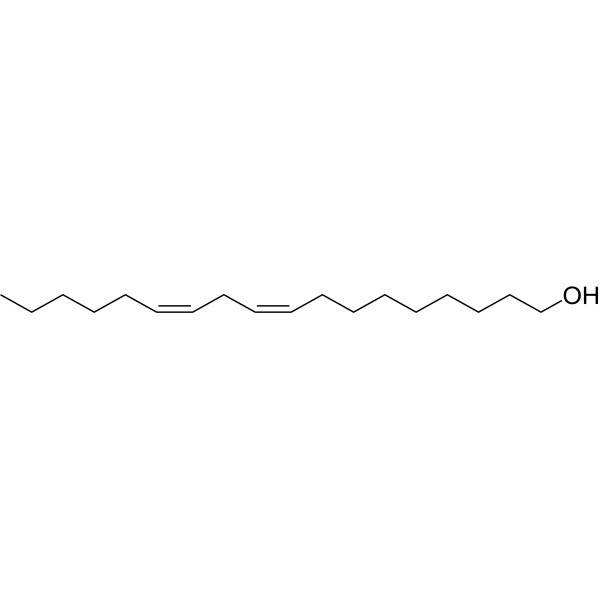
Linoleyl alcohol (Standard) is the analytical standard of Linoleyl alcohol. This product is intended for research and analytical applications. Linoleyl alcohol, a structural analog of Linoleic acid with no a-carboxyl group, is a fatty alcohol .
|
-
- HY-W588728
-
|
|
Biochemical Assay Reagents
|
Others
|
|
DBCO-PEG8-amine is a PEG derivative consisting of DBCO, PEG units and an amino group (Amine). Maleimide forms a stable thioether bond with sulfhydryl (-SH). The amino group can react with other chemical groups (such as carboxyl, aldehyde, etc.) to form stable chemical bonds.
|
-
- HY-W588736
-
|
|
Biochemical Assay Reagents
|
Others
|
|
DBCO-PEG23-amine is a PEG derivative consisting of DBCO, PEG units and an amino group (Amine). Maleimide forms a stable thioether bond with sulfhydryl (-SH). The amino group can react with other chemical groups (such as carboxyl, aldehyde, etc.) to form stable chemical bonds.
|
-
- HY-130159
-
|
|
Biochemical Assay Reagents
|
Others
|
|
Hydroxy-PEG12-t-butyl ester is a PEG linker containing a hydroxyl group with a t-butyl ester. The hydrophilic PEG spacer increases solubility in aqueous media. The hydroxyl group enables further derivatization or replacement with other reactive functional groups. The t-butyl protected carboxyl group can be deprotected under acidic conditions.
|
-
- HY-W190808
-
|
|
Biochemical Assay Reagents
|
Others
|
|
Tos-PEG11-t-butyl ester is a PEG linker containing a t-butyl ester and a tosyl group. The hydrophilic PEG spacer increases solubility in aqueous media. The t-butyl protected carboxyl group can be deprotected under acidic conditions. The tosyl group is a very good leaving group for nucleophilic substitution reactions.
|
-
- HY-149690
-
|
MFA
|
Biochemical Assay Reagents
|
Inflammation/Immunology
|
|
2-(N-Phthalimidoylmethylthio)acetic acid (MFA) is a hapten with a carboxyl group at the end of its spacer arm, suitable for reacting with free amine groups of proteins. 2-(N-Phthalimidoylmethylthio)acetic acid can be combined with carrier proteins and used in antigen design .
|
-
- HY-149691
-
|
MFH
|
Biochemical Assay Reagents
|
Inflammation/Immunology
|
|
6-(N-Phthalimidoylmethylthio)hexanoic acid (MFH) is a hapten with a carboxyl group at the end of its spacer arm, suitable for reacting with free amine groups of proteins. 6-(N-Phthalimidoylmethylthio)hexanoic acid can be combined with carrier proteins and used in antigen design .
|
-
- HY-168940D
-
-
- HY-168940I
-
-
- HY-168940H
-
-
- HY-172505
-
|
|
Biochemical Assay Reagents
|
Others
|
|
Mal-PEG12-t-butyl ester is a PEG linker containing a maleimide group and a t-butyl ester group. The hydrophilic PEG spacer increases solubility in aqueous media. The t-butyl protected carboxyl group can be deprotected under acidic conditions. The maleimide group will react with a thiol group to form a covalent bond, enabling the connection of biomolecule with a thiol.
|
-
- HY-W028210
-
|
|
Biochemical Assay Reagents
|
Inflammation/Immunology
|
|
6-N-Phthalimidoy hexanoic acid (compound FH) is a hapten with a carboxyl group at the end of its spacer arm, suitable for reacting with free amine groups of proteins. 6-N-Phthalimidoy hexanoic acid can be combined with carrier proteins and used in antigen design .
|
-
- HY-W190761
-
|
|
Biochemical Assay Reagents
|
Others
|
|
Amino-PEG11-t-butyl ester is a PEG reagent containing an amino NH2 group with a t-butyl protected carboxyl group (Boc). Amino-PEG11-t-butyl ester can be used in drug delivery research .
|
-
- HY-W1120570
-
|
|
Biochemical Assay Reagents
|
Others
|
|
Amino-PEG16-t-butyl ester is a PEG reagent containing an amino NH2 group with a t-butyl protected carboxyl group (Boc). Amino-PEG16-t-butyl ester can be used in drug delivery research .
|
-
- HY-W046063
-
|
4-Phthalimidobutyric acid
|
Biochemical Assay Reagents
|
Inflammation/Immunology
|
|
4-(N-Phthalimidoyl)butanoic acid (compound FB) is a hapten with a carboxyl group at the end of its spacer arm, suitable for reacting with free amine groups of proteins. 4-(N-Phthalimidoyl)butanoic acid can be combined with carrier proteins and used in antigen design .
|
-
- HY-W037451
-
|
|
Amino Acid Derivatives
|
Others
|
|
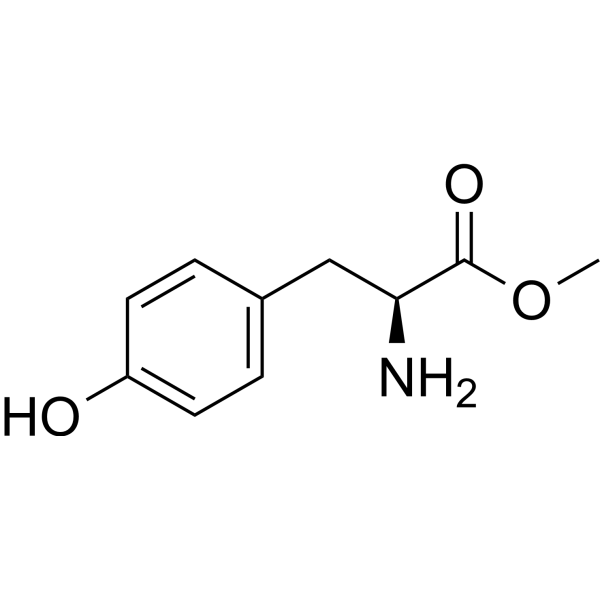
Methyl L-leucinate, methyl ester of L-leucine, is an alpha-amino acid ester. Methyl L-leucinate is a derivative of methyl ester and L-leucine, a class of compounds containing both amino and carboxyl groups in the molecule .
|
-
- HY-W1048918B
-
|
mPEG10000-COOH
|
Biochemical Assay Reagents
|
Others
|
|
mPEG10000-CM (mPEG10000-COOH) has a reactive carboxyl group (-COOH) attached to the terminal site of the structure, which can form a stable amide bond with the amino group or an ester bond with the hydroxyl group. mPEG10000-CM can be used for drug delivery .
|
-
- HY-W1048918C
-
|
mPEG20000-COOH
|
Biochemical Assay Reagents
|
Others
|
|
mPEG20000-CM (mPEG20000-COOH) has a reactive carboxyl group (-COOH) attached to the terminal site of the structure, which can form a stable amide bond with the amino group or an ester bond with the hydroxyl group. mPEG20000-CM can be used for drug delivery .
|
-
- HY-W1048918
-
|
mPEG1000-COOH
|
Biochemical Assay Reagents
|
Others
|
|
mPEG1000-CM (mPEG1000-COOH) has a reactive carboxyl group (-COOH) attached to the terminal site of the structure, which can form a stable amide bond with the amino group or an ester bond with the hydroxyl group. mPEG1000-CM can be used for drug delivery .
|
-
- HY-174916
-
|
|
Biochemical Assay Reagents
|
Others
|
|
Amine-PEG1-Desthiobiotin is a PEG derivative consisting of desthiobiotin, 1 PEG unit, and an amino group (Amine). Desthiobiotin is a biotin analog that has a weak but reversible binding ability to streptavidin or avidin. The amino group is able to react with other chemical groups (such as carboxyl, aldehyde, etc.) to form stable chemical bonds.
|
-
- HY-W1048918A
-
|
mPEG5000-COOH
|
Biochemical Assay Reagents
|
Others
|
|
mPEG5000-CM (mPEG5000-COOH) has a reactive carboxyl group (-COOH) attached to the terminal site of the structure, which can form a stable amide bond with the amino group or an ester bond with the hydroxyl group. mPEG5000-CM can be used for drug delivery .
|
-
- HY-W1048918D
-
|
mPEG40000-COOH
|
Biochemical Assay Reagents
|
Others
|
|
mPEG40000-CM (mPEG40000-COOH) has a reactive carboxyl group (-COOH) attached to the terminal site of the structure, which can form a stable amide bond with the amino group or an ester bond with the hydroxyl group. mPEG40000-CM can be used for drug delivery .
|
-
- HY-W1048918E
-
|
mPEG3400-COOH
|
Biochemical Assay Reagents
|
Others
|
|
mPEG3400-CM (mPEG3400-COOH) has a reactive carboxyl group (-COOH) attached to the terminal site of the structure, which can form a stable amide bond with the amino group or an ester bond with the hydroxyl group. mPEG3400-CM can be used for drug delivery .
|
-
- HY-W1048558A
-
|
mPEG2000-COOH
|
Biochemical Assay Reagents
|
Others
|
|
mPEG2000-CM (mPEG2000-COOH) is a carboxyl-terminated monomethoxy polyethylene glycol. mPEG2000-CM bears a reactive carboxyl group (-COOH) at its structural terminal site, which can form stable amide bonds with amino groups and ester bonds with hydroxyl groups. mPEG2000-CM binds to PCA-g-PCL copolymers via electrostatic interaction to form polyion complex micelles with a hydrophilic PEG surface, which enhances the stability of micelles in aqueous media. mPEG2000-CM can be used for drug delivery .
|
-
- HY-W1123939
-
|
|
Biochemical Assay Reagents
|
Others
|
|
Silane-PEG-COOH (MW 1000) can be used to modify proteins, peptides and other materials with active groups. The carboxyl group (-COOH) can easily form a stable amide bond with the amino group, and can also form an ester bond with the hydroxyl group. Silane-functionalized PEG (Silane-PEG-X) can be used to modify glass, silicon, etc .
|
-
- HY-W1123939C
-
|
|
Biochemical Assay Reagents
|
Others
|
|
Silane-PEG5000-COOH can be used to modify proteins, peptides and other materials with active groups. The carboxyl group (-COOH) can easily form a stable amide bond with the amino group, and can also form an ester bond with the hydroxyl group. Silane-functionalized PEG (Silane-PEG-X) can be used to modify glass, silicon, etc .
|
-
- HY-W1123939B
-
|
|
Biochemical Assay Reagents
|
Others
|
|
Silane-PEG3400-COOH can be used to modify proteins, peptides and other materials with active groups. The carboxyl group (-COOH) can easily form a stable amide bond with the amino group, and can also form an ester bond with the hydroxyl group. Silane-functionalized PEG (Silane-PEG-X) can be used to modify glass, silicon, etc .
|
-
- HY-W598192
-
|
4-Azidobutyl benzoate
|
Biochemical Assay Reagents
|
Others
|
|
1-Butanol, 4-azido-, 1-benzoate (4-Azidobutyl benzoate) is a compound with an ethyl benzoate head and a terminal azide group. The ethyl benzoate protected carboxyl group can be deprotected under acidic conditions. Azide (N3) group can react with alkyne, BCN, DBCO via Click Chemistry.
|
-
- HY-W097018
-
|
|
Biochemical Assay Reagents
|
Others
|
|
Iomeprol intermediate-1 (compound 5) is an iodinated polysaccharide compound used in the synthesis of contrast agents. The amino group of Iomeprol intermediate-1 can be coupled to the carboxyl group of the D-glucuronide subunit of non-animal stable hyaluronic acid (NASHA), providing a water-soluble, radiopaque moiety .
|
-
- HY-174936
-
|
DNP-PEG8-acid
|
Biochemical Assay Reagents
|
Others
|
|
DNP-PEG8-COOH (DNP-PEG8-acid) is a compound composed of 2,4-dinitroaniline (DNP), three PEG units, and a carboxyl group (-COOH) that can be used for drug delivery.
|
-
- HY-D2493
-
|
Cy7 COOH
|
Fluorescent Dye
|
Others
|
|
Cyanine7 carboxylic acid (Cy7 COOH) is a derivative of Cy7 (HY-D0825) dye. Cyanine7 carboxylic acid contains carboxyl groups, which can condense ammonia to form covalent bonds .
|
-
- HY-172717
-
|
|
Fluorescent Dye
|
Others
|
|
TAMRA-PEG4-t-butyl ester is a TAMRA red-fluorescent dye linker, with excitation/emission maximum 553/575 nm, containing a t-butyl protected carboxyl group which can be deprotected under acidic conditions.
|
-
- HY-150352
-
|
|
Biochemical Assay Reagents
|
Others
|
|
Dextran-COOH is a dextran derivative with carboxyl (–COOH) functional groups introduced into the molecular chain. Dextran-COOH can be covalently coupled with a variety of bioactive molecules, drugs, small molecule ligands, fluorescent probes and other functional materials .
|
-
- HY-174358C
-
|
|
Biochemical Assay Reagents
|
Others
|
|
HOOC-PEG5000-COOH has two active carboxyl groups at both ends, which can selectively react with the amino groups in peptide coupling agents. HOOC-PEG5000-COOH is a good cross-linking agent for PEGylation of proteins and peptides, nanoparticles and surface modification .
|
-
- HY-W026082
-
|
|
Biochemical Assay Reagents
|
Inflammation/Immunology
|
|
4-Ketobenztriazine-CH2COOH (compound BA) is a hapten with a carboxyl group at the end of its spacer arm, suitable for reacting with free amine groups of proteins. 4-Ketobenztriazine-CH2COOH can be combined with carrier proteins and used in antigen design .
|
-
- HY-174358
-
|
|
Biochemical Assay Reagents
|
Others
|
|
HOOC-PEG1000-COOH has two active carboxyl groups at both ends, which can selectively react with the amino groups in peptide coupling agents. HOOC-PEG1000-COOH is a good cross-linking agent for PEGylation of proteins and peptides, nanoparticles and surface modification .
|
-
- HY-141540S1
-
|
|
Isotope-Labeled Compounds
Biochemical Assay Reagents
Endogenous Metabolite
|
Others
|
|
Lactyl-CoA-d3 is the deuterium labeled Lactyl-CoA (HY-141540). Lactyl-CoA is an acyl-CoA formally condensed from the sulfhydryl group of CoA and the carboxyl group of lactic acid, also known as lactyl-CoA. Lactyl-CoA is essential for the biosynthesis of biodegradable and biocompatible lactic acid-based copolymers.
|
-
- HY-174358D
-
|
|
Biochemical Assay Reagents
|
Others
|
|
HOOC-PEG10000-COOH has two active carboxyl groups at both ends, which can selectively react with the amino groups in peptide coupling agents. HOOC-PEG10000-COOH is a good cross-linking agent for PEGylation of proteins and peptides, nanoparticles and surface modification .
|
-
- HY-174358E
-
|
|
Biochemical Assay Reagents
|
Others
|
|
HOOC-PEG20000-COOH has two active carboxyl groups at both ends, which can selectively react with the amino groups in peptide coupling agents. HOOC-PEG20000-COOH is a good cross-linking agent for PEGylation of proteins and peptides, nanoparticles and surface modification .
|
-
- HY-174358H
-
|
|
Biochemical Assay Reagents
|
Others
|
|
HOOC-PEG40000-COOH has two active carboxyl groups at both ends, which can selectively react with the amino groups in peptide coupling agents. HOOC-PEG40000-COOH is a good cross-linking agent for PEGylation of proteins and peptides, nanoparticles and surface modification .
|
-
- HY-174358A
-
|
|
Biochemical Assay Reagents
|
Others
|
|
HOOC-PEG2000-COOH has two active carboxyl groups at both ends, which can selectively react with the amino groups in peptide coupling agents. HOOC-PEG2000-COOH is a good cross-linking agent for PEGylation of proteins and peptides, nanoparticles and surface modification .
|
-
- HY-174358B
-
|
|
Biochemical Assay Reagents
|
Others
|
|
HOOC-PEG3400-COOH has two active carboxyl groups at both ends, which can selectively react with the amino groups in peptide coupling agents. HOOC-PEG3400-COOH is a good cross-linking agent for PEGylation of proteins and peptides, nanoparticles and surface modification .
|
-
- HY-D2751
-
|
|
Fluorescent Dye
|
Others
|
|
BP Fluor 488 Cadaverine is a carboxyl/carbonyl reactive building block used widely to modify carboxylic groups in the presence of activators (e.g. EDC or DCC) or activated esters (e.g. NHS esters) through a stable amide bond.
|
-
- HY-164165
-
|
|
Microtubule/Tubulin
Drug Derivative
|
Cancer
|
|
Paclitaxel-2′-succinate NHS ester is a paclitaxel derivative with a succinic acid linker, in which the carboxyl group is activated by the NHS ester. The NHS ester group is highly reactive toward amino or hydroxyl groups and can be used to conjugate with other molecules such as peptides, proteins, antibodies, enzymes or polymers. Paclitaxel-2′-succinate NHS ester can be used in the development of nanomedicines and in the study of cancer therapy .
|
-
- HY-D2162
-
|
|
Fluorescent Dye
|
Others
|
|
AF 594 carboxylic acid is a carboxyl derivative of the red fluorescent dye AF 594, which has high fluorescence quantum yield and high photostability (Ex=594 nm, Em=615 nm). AF 594 carboxylic acid can form stable covalent bonds through the reaction of carboxylic acid groups with molecules with amino groups .
|
-
- HY-D2098
-
|
|
Fluorescent Dye
|
Others
|
|
TAMRA-PEG2-NH2 is a dye derivative of TAMRA (HY-135640) containing 4 PEG units. TAMRA-PEG2-NH2 contains NH2 groups, which can undergo condensation reactions with carboxyl groups to form covalent bonds.
|
-
- HY-D2101
-
|
|
Fluorescent Dye
|
Others
|
|
TAMRA-PEG3-NH2 is a dye derivative of TAMRA (HY-135640) containing 3 PEG units. TAMRA-PEG3-NH2 contains NH2 groups, which can undergo condensation reactions with carboxyl groups to form covalent bonds.
|
-
- HY-D2102
-
|
|
Fluorescent Dye
|
Others
|
|
TAMRA-PEG7-NH2 is a dye derivative of TAMRA (HY-135640) containing 7 PEG units. TAMRA-PEG7-NH2 contains NH2 groups, which can undergo condensation reactions with carboxyl groups to form covalent bonds.
|
-
- HY-136772
-
|
|
E3 Ligase Ligand-Linker Conjugates
|
Others
|
|
Pomalidomide-PEG1-NH2 hydrochloride is a crosslinker-E3 ligase ligand conjugate, consisting of an E3 ligase ligand pomalidomide and a PEGylated crosslinker with terminal amine for reactivity with a carboxyl group on the target ligand .
|
-
- HY-D2487
-
|
|
Fluorescent Dye
|
Others
|
|
Sulfo Cy5 bis COOH is a derivative of Cy5 (HY-D0821) dye containing sulfonate ions. Sulfo Cy5 bis COOH contains carboxyl groups, which can condense ammonia to form covalent bonds.
|
-
- HY-D2492
-
|
|
Fluorescent Dye
|
Others
|
|
Sulfo Cy7 bis-COOH is a derivative of Cy7 (HY-D0825) dye containing sulfonate ions. Sulfo Cy7 bis-COOH contains carboxyl groups, which can condense ammonia to form covalent bonds.
|
-
- HY-D2485
-
|
|
Fluorescent Dye
|
Others
|
|
Sulfo Cy3 bis COOH is a derivative of Cy3 (HY-D0822) dye containing sulfonate ions. Sulfo Cy3 bis COOH contains carboxyl groups, which can condense ammonia to form covalent bonds.
|
-
- HY-W1053112B
-
|
DOPE-PEG10000-NH2
|
Biochemical Assay Reagents
|
Others
|
|
DOPE-PEG10000-Amine (DOPE-PEG1000-NH2) is a conjugate composed of dioleoylphosphatidylethanolamine (DOPE), a PEG chain, and a terminal amino group (-NH2). The amino group in DOPE-PEG10000-Amine can chemically react with carboxyl groups, activated esters, etc., participating in various bioconjugation reactions for targeted modification of liposomes/nanoparticles.
|
-
- HY-W440990
-
|
DOPE-PEG1000-NH2
|
Biochemical Assay Reagents
|
Others
|
|
DOPE-PEG1000-Amine (DOPE-PEG1000-NH2) is a conjugate composed of dioleoylphosphatidylethanolamine (DOPE), a PEG chain, and a terminal amino group (-NH2). The amino group in DOPE-PEG1000-Amine can chemically react with carboxyl groups, activated esters, etc., participating in various bioconjugation reactions for targeted modification of liposomes/nanoparticles.
|
-
- HY-W190865
-
|
Biotin-PEG5-COOH
|
Biochemical Assay Reagents
|
Others
|
|
Biotin-PEG5-acid (Biotin-PEG5-COOH) is a biotin-PEG compound containing a carboxyl group (-COOH) that can be used to react with an amine group (NH2) to form a stable amide bond. Biotin-PEG5-acid can be used for protein labeling and drug delivery research .
|
-
- HY-116027A
-
|
Biotin-PEG10-COOH
|
Biochemical Assay Reagents
|
Others
|
|
Biotin-PEG10-acid (Biotin-PEG10-COOH) is a biotin-PEG compound containing a carboxyl group (-COOH) that can be used to react with an amine group (NH2) to form a stable amide bond. Biotin-PEG10-acid can be used for protein labeling and drug delivery research .
|
-
- HY-116027B
-
|
Biotin-PEG11-COOH
|
Biochemical Assay Reagents
|
Others
|
|
Biotin-PEG11-acid (Biotin-PEG11-COOH) is a biotin-PEG compound containing a carboxyl group (-COOH) that can be used to react with an amine group (NH2) to form a stable amide bond. Biotin-PEG11-acid can be used for protein labeling and drug delivery research .
|
-
- HY-D2163
-
|
|
Fluorescent Dye
|
Others
|
|
AF 430 amine is a derivative of the yellow fluorescent dye AF 430. AF430 has an excitation wavelength of 425 nm and an emission wavelength of 542 nm. AF 430 amine can form covalent bonds through a condensation reaction between amino groups and molecules containing carboxyl groups. To achieve specific coupling of dye labels and biomolecules .
|
-
- HY-W1049061E
-
|
|
Biochemical Assay Reagents
|
Others
|
|
Boc-NH-PEG1000-COOH is a linear hetero-bifunctional PEG product with one Boc-protected amine and one carboxyl group. Boc-NH-PEG1000-COOH is an important cross-linker with PEG chains .
|
-
- HY-150352C
-
|
|
Biochemical Assay Reagents
|
Others
|
|
Dextran-COOH (MW 100 kDa) is a dextran derivative with carboxyl (–COOH) functional groups introduced into the molecular chain. Dextran-COOH can be covalently coupled with a variety of bioactive molecules, drugs, small molecule ligands, fluorescent probes and?other?functional?materials.
|
-
- HY-D2110
-
|
|
Fluorescent Dye
|
Others
|
|
TAMRA-PEG8-COOH is a dye derivative of TAMRA (HY-135640) containing 8 PEG units. TAMRA-PEG8-COOH contains carboxyl groups, which can condense ammonia to form covalent bonds.
|
-
- HY-W1049061D
-
|
|
Biochemical Assay Reagents
|
Others
|
|
Boc-NH-PEG40000-COOH is a linear hetero-bifunctional PEG product with one Boc-protected amine and one carboxyl group. Boc-NH-PEG40000-COOH is an important cross-linker with PEG chains .
|
-
- HY-W1049061B
-
|
|
Biochemical Assay Reagents
|
Others
|
|
Boc-NH-PEG10000-COOH is a linear hetero-bifunctional PEG product with one Boc-protected amine and one carboxyl group. Boc-NH-PEG10000-COOH is an important cross-linker with PEG chains .
|
-
- HY-W1049061
-
|
|
Biochemical Assay Reagents
|
Others
|
|
Boc-NH-PEG2000-COOH is a linear hetero-bifunctional PEG product with one Boc-protected amine and one carboxyl group. Boc-NH-PEG2000-COOH is an important cross-linker with PEG chains .
|
-
- HY-D2109
-
|
|
Fluorescent Dye
|
Others
|
|
TAMRA-PEG4-COOH is a dye derivative of TAMRA (HY-135640) containing 4 PEG units. TAMRA-PEG4-COOH contains carboxyl groups, which can condense ammonia to form covalent bonds.
|
-
- HY-150352A
-
|
|
Biochemical Assay Reagents
|
Others
|
|
Dextran-COOH (MW 10 kDa) is a dextran derivative with carboxyl (–COOH) functional groups introduced into the molecular chain. Dextran-COOH can be covalently coupled with a variety of bioactive molecules, drugs, small molecule ligands, fluorescent probes and?other?functional?materials.
|
-
- HY-D2108
-
|
|
Fluorescent Dye
|
Others
|
|
TAMRA-PEG3-COOH is a dye derivative of TAMRA (HY-135640) containing 3 PEG units. TAMRA-PEG3-COOH contains carboxyl groups, which can condense ammonia to form covalent bonds.
|
-
- HY-W1049061A
-
|
|
Biochemical Assay Reagents
|
Others
|
|
Boc-NH-PEG5000-COOH is a linear hetero-bifunctional PEG product with one Boc-protected amine and one carboxyl group. Boc-NH-PEG5000-COOH is an important cross-linker with PEG chains .
|
-
- HY-W1049061C
-
|
|
Biochemical Assay Reagents
|
Others
|
|
Boc-NH-PEG20000-COOH is a linear hetero-bifunctional PEG product with one Boc-protected amine and one carboxyl group. Boc-NH-PEG20000-COOH is an important cross-linker with PEG chains .
|
-
- HY-150352D
-
|
|
Biochemical Assay Reagents
|
Others
|
|
Dextran-COOH (MW 250 kDa) is a dextran derivative with carboxyl (–COOH) functional groups introduced into the molecular chain. Dextran-COOH can be covalently coupled with a variety of bioactive molecules, drugs, small molecule ligands, fluorescent probes and?other?functional?materials.
|
-
- HY-W1049061H
-
|
|
Biochemical Assay Reagents
|
Others
|
|
Boc-NH-PEG3400-COOH is a linear hetero-bifunctional PEG product with one Boc-protected amine and one carboxyl group. Boc-NH-PEG3400-COOH is an important cross-linker with PEG chains .
|
-
- HY-118924
-
|
|
Fluorescent Dye
|
Cancer
|
|
IR-825 is a near infrared fluorescent dye.the end of IR-825 has carboxyl COOH active group, and can participate in the reaction to connect other molecules. IR-825 can be widely used in tumor photothermal study. .
|
-
- HY-150352E
-
|
|
Biochemical Assay Reagents
|
Others
|
|
Dextran-COOH (MW 500 kDa) is a dextran derivative with carboxyl (–COOH) functional groups introduced into the molecular chain. Dextran-COOH can be covalently coupled with a variety of bioactive molecules, drugs, small molecule ligands, fluorescent probes and?other?functional?materials.
|
-
- HY-150352B
-
|
|
Biochemical Assay Reagents
|
Others
|
|
Dextran-COOH (MW 70 kDa) is a dextran derivative with carboxyl (–COOH) functional groups introduced into the molecular chain. Dextran-COOH can be covalently coupled with a variety of bioactive molecules, drugs, small molecule ligands, fluorescent probes and?other?functional?materials.
|
-
- HY-154659
-
|
|
Biochemical Assay Reagents
|
Others
|
|
Polycarbophil is an orally active hydrophilic polymer. Polycarbophil achieves bioadhesion through hydrogen bonding between carboxyl groups and mucosal surfaces, and prolongs compound retention time and regulates compound release through swelling properties. Polycarbophil relieves constipation and diarrhea .
|
-
- HY-W1048547A
-
|
HOOC-PEG2000-Amine
|
Biochemical Assay Reagents
|
Others
|
|
HOOC-PEG2000-NH2 (HOOC-PEG2000-Amine) is a heterobifunctional PEG crosslinker that can be used to attach functional PEG to biomolecules, particles, and other surface materials. The carboxyl group reacts with the amine group to form a stable amide bond. It can also react with the hydroxyl group to form an unstable ester bond. On the other hand, the amine group can be used to react with many amine-reactive groups, such as succinimidyl NHS esters, aldehydes, etc .
|
-
- HY-W1048547J
-
|
HOOC-PEG40000-Amine
|
PROTAC Linkers
|
Others
|
|
HOOC-PEG40000-NH2 (HOOC-PEG40000-Amine) is a heterobifunctional PEG crosslinker that can be used to attach functional PEG to biomolecules, particles, and other surface materials. The carboxyl group reacts with the amine group to form a stable amide bond. It can also react with the hydroxyl group to form an unstable ester bond. On the other hand, the amine group can be used to react with many amine-reactive groups, such as succinimidyl NHS esters, aldehydes, etc .
|
-
- HY-W1048547H
-
|
HOOC-PEG1000-Amine
|
Biochemical Assay Reagents
|
Others
|
|
HOOC-PEG1000-NH2 (HOOC-PEG1000-Amine) is a heterobifunctional PEG crosslinker that can be used to attach functional PEG to biomolecules, particles, and other surface materials. The carboxyl group reacts with the amine group to form a stable amide bond. It can also react with the hydroxyl group to form an unstable ester bond. On the other hand, the amine group can be used to react with many amine-reactive groups, such as succinimidyl NHS esters, aldehydes, etc .
|
-
- HY-W1048547E
-
|
HOOC-PEG20000-Amine
|
Biochemical Assay Reagents
|
Others
|
|
HOOC-PEG20000-NH2 (HOOC-PEG20000-Amine) is a heterobifunctional PEG crosslinker that can be used to attach functional PEG to biomolecules, particles, and other surface materials. The carboxyl group reacts with the amine group to form a stable amide bond. It can also react with the hydroxyl group to form an unstable ester bond. On the other hand, the amine group can be used to react with many amine-reactive groups, such as succinimidyl NHS esters, aldehydes, etc .
|
-
- HY-W1048547I
-
|
HOOC-PEG3400-Amine
|
Biochemical Assay Reagents
|
Others
|
|
HOOC-PEG3400-NH2 (HOOC-PEG3400-Amine) is a heterobifunctional PEG crosslinker that can be used to attach functional PEG to biomolecules, particles, and other surface materials. The carboxyl group reacts with the amine group to form a stable amide bond. It can also react with the hydroxyl group to form an unstable ester bond. On the other hand, the amine group can be used to react with many amine-reactive groups, such as succinimidyl NHS esters, aldehydes, etc .
|
-
- HY-W1048547C
-
|
HOOC-PEG5000-Amine
|
Biochemical Assay Reagents
|
Others
|
|
HOOC-PEG5000-NH2 (HOOC-PEG5000-Amine) is a heterobifunctional PEG crosslinker that can be used to attach functional PEG to biomolecules, particles, and other surface materials. The carboxyl group reacts with the amine group to form a stable amide bond. It can also react with the hydroxyl group to form an unstable ester bond. On the other hand, the amine group can be used to react with many amine-reactive groups, such as succinimidyl NHS esters, aldehydes, etc .
|
-
- HY-W1048547D
-
|
HOOC-PEG10000-Amine
|
Biochemical Assay Reagents
|
Others
|
|
HOOC-PEG10000-NH2 (HOOC-PEG10000-Amine) is a heterobifunctional PEG crosslinker that can be used to attach functional PEG to biomolecules, particles, and other surface materials. The carboxyl group reacts with the amine group to form a stable amide bond. It can also react with the hydroxyl group to form an unstable ester bond. On the other hand, the amine group can be used to react with many amine-reactive groups, such as succinimidyl NHS esters, aldehydes, etc .
|
-
- HY-W142161
-
|
Fmoc-MeHis(Trt)-OH
|
Amino Acid Derivatives
|
Others
|
|
Fmoc-N-Me-His(Trt)-OH (Fmoc-MeHis(Trt)-OH) is an Amino acid derivative containing a carboxyl group. Fmoc-N-Me-His(Trt)-OH can be used for the synthesis of Fmoc-MeHis (Trt)-Leu-OH and N-methyl peptides .
|
-
- HY-101445B
-
|
|
Drug Isomer
|
Neurological Disease
|
|
(S)-Trolox is an analogue of vitamin E, in which the phytyl chain is replaced with a carboxyl group. (S)-Trolox is frequently used as a model compound for studies of structural features, as well as a standard for evaluation of antioxidant activity. (S)-Trolox has potent and specific neuroprotective and antioxidant effects .
|
-
- HY-W474473
-
|
|
Biochemical Assay Reagents
|
Inflammation/Immunology
|
|
3-(((1,3-Dioxoisoindolin-2-yl)methyl)thio)propanoic acid (MFP) is a hapten with a carboxyl group at the end of its spacer arm, suitable for reacting with free amine groups of proteins. 3-(((1,3-Dioxoisoindolin-2-yl)methyl)thio)propanoic acid can be combined with carrier proteins and used in antigen design .
|
-
- HY-W269700
-
|
L-Isoleucyl-L-leucine
|
Drug Intermediate
|
Neurological Disease
|
|
Ile-Leu-OH (L-Isoleucyl-L-leucine) is a hydrophobic dipeptide fragment and is a component of the neurotensin C-terminal heptapeptide Pro-Arg-Arg-Pro-Tyr-Ile-LeuOH .
|
-
- HY-121011
-
|
|
Cannabinoid Receptor
|
|
|
Cannabigerorcin is a phenolic compound found in cannabis plants, featuring a diphenol backbone and a terpene side chain. By reacting with radiolabeled methylmagnesium carbonate (MMC), its carboxyl group can be 14C-labeled. Radiolabeled Cannabigerorcin is widely used in research on cannabinoid biosynthesis pathways and metabolic processes .
|
-
- HY-B1827
-
|
D-galUA hydrate
|
Endogenous Metabolite
|
Metabolic Disease
|
|
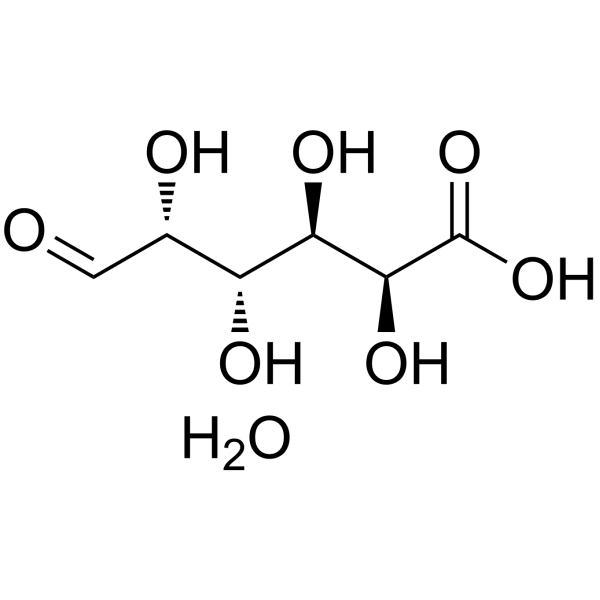
D-Galacturonic acid (D-galUA) hydrate, as the main component of pectin, is abundantly present in plants. The carboxyl group of D-Galacturonic acid hydrate can bind to metal cations. D-Galacturonic acid hydrate plays an important role in the food industry, pharmaceutical field, and heavy metal removal, among other aspects .
|
-
- HY-B1827A
-
|
D-galUA
|
Endogenous Metabolite
|
Metabolic Disease
|
|
D-Galacturonic acid (D-galUA), as the main component of pectin, is abundantly present in plants. The carboxyl group of D-Galacturonic acid can bind to metal cations. D-Galacturonic acid plays an important role in the food industry, pharmaceutical field, and heavy metal removal, among other aspects .
|
-
- HY-168940E
-
|
|
Biochemical Assay Reagents
|
Cancer
|
|
NH2-PEG600-COOH consists of an NH2 group, PEG units and a carboxyl group (-COOH). NH2-PEG600-COOH helps improve the biocompatibility of the resulting nanocomplexes in cancer cells. NH2-PEG600-COOH can be used in cancer-related research .
|
-
- HY-W755033
-
-
- HY-N2436R
-
|
Tartaric acid (Standard)
|
Biochemical Assay Reagents
Reference Standards
|
Others
|
|
2,3-Dihydroxysuccinic acid (Standard) (Tartaric acid (Standard)) is the analytical standard of 2,3-Dihydroxysuccinic acid (HY-N2436). This product is intended for research and analytical applications. 2,3-Dihydroxysuccinic acid (Tartaric acid) is an organic acid containing two hydroxyl groups and two carboxyl groups. 2,3-Dihydroxysuccinic acid exists in various stereoisomers and is widely used in food, pharmaceutical, chemical, and other fields.
|
-
- HY-Y0801R
-
|
|
Reference Standards
Drug Metabolite
|
Others
|
|
2,6-Dihydroxybenzoic acid (Standard) is the analytical standard of 2,6-Dihydroxybenzoic acid (HY-Y0801). This product is used for research and analytical applications. 2,6-Dihydroxybenzoic acid is an aromatic compound containing phenolic hydroxyl groups and carboxyl groups, and it is a secondary metabolite of Salicylic acid (HY-B0167). 2,6-Dihydroxybenzoic acid is also present in olive oil wastewater .
|
-
- HY-132101
-
|
|
Biochemical Assay Reagents
PROTAC Linkers
|
Cancer
|
|
Amino-PEG7-t-butyl ester is a PEG-based PROTAC linker that can be used in the synthesis of PROTACs . Amino-PEG7-t-butyl ester is a PEG reagent containing an amino NH2 group with a t-butyl protected carboxyl group (Boc). Amino-PEG7-t-butyl ester can be used in drug delivery research .
|
-
- HY-W451406C
-
|
|
PROTAC Linkers
|
Others
|
|
NH2-PEG2000-NH2 is a polyethylene glycol derivative containing two primary amine groups. The amino group can react quickly with activated carboxylic acid or carboxyl groups such as NHS esters to form stable amide bonds. The PEGylation of NH2-PEG-NH2 can increase solubility and stability, and reduce the immunogenicity of peptides and proteins, so it is mostly used to modify proteins, peptides and other substances.
|
-
- HY-W451406D
-
|
|
PROTAC Linkers
|
Others
|
|
NH2-PEG10000-NH2 is a polyethylene glycol derivative containing two primary amine groups. The amino group can react quickly with activated carboxylic acid or carboxyl groups such as NHS esters to form stable amide bonds. The PEGylation of NH2-PEG-NH2 can increase solubility and stability, and reduce the immunogenicity of peptides and proteins, so it is mostly used to modify proteins, peptides and other substances.
|
-
- HY-W451406A
-
|
|
PROTAC Linkers
|
Others
|
|
NH2-PEG5000-NH2 is a polyethylene glycol derivative containing two primary amine groups. The amino group can react quickly with activated carboxylic acid or carboxyl groups such as NHS esters to form stable amide bonds. The PEGylation of NH2-PEG-NH2 can increase solubility and stability, and reduce the immunogenicity of peptides and proteins, so it is mostly used to modify proteins, peptides and other substances.
|
-
- HY-158089
-
|
|
Biochemical Assay Reagents
|
Others
|
|
PLGA-COOH (MW 80000) (LA/GA 50:50) is a copolymer composed of lactic acid (LA)-glycolic acid (GA) at a molar ratio of 50:50 and a terminal carboxyl group. PLGA-COOH (MW 80000) (LA/GA 50:50) is used in compound delivery systems due to its biocompatibility and biodegradability .
|
-
- HY-131642
-
|
H-Gla-OH
|
mGluR
|
Neurological Disease
|
|
L-γ-Carboxyglutamic acid (H-Gla-OH) is a mGluR2 antagonist with an IC50 of 102 μM. L-γ-Carboxyglutamic acid binds to the mGluR2 receptor site via the overlapping extended amino acid conformation of its amino and carboxyl groups with glutamic acid, and its additional acidic group locates in a restricted region, thereby blocking the full activation of the receptor. L-γ-Carboxyglutamic acid can be used for the research of neurological disorders .
|
-
- HY-B1142
-
Lipoamide
Maximum Cited Publications
9 Publications Verification
(±)-α-Lipoamide; DL-Lipoamide; DL-6,8-Thioctamide
|
NO Synthase
|
Others
|
|
Lipoamide ((±)-α-Lipoamide) is a monocarboxylic acid derivative of a neutral amide, formed by the condensation of the carboxyl group of lipoic acid and ammonia. Lipoamide protects against oxidative stress-mediated neuronal cell damage and also acts as a coenzyme to transfer acetyl groups and hydrogen during pyruvate deacylation. Lipoamide also stimulates mitochondrial biogenesis in adipocytes through the endothelial NO synthase-cGMP-protein kinase G signaling pathway .
|
-
- HY-D3013
-
|
|
Fluorescent Dye
|
Others
|
|
Cy5.5 bis-COOH bromide is a derivative of Cy5.5 (HY-D0924) dye. Sulfo Cy5.5 bis-COOH bromide contains carboxyl groups, which can condense ammonia to form covalent bonds (Ex/Em = 680/710 nm).
|
-
- HY-W097018R
-
|
|
Biochemical Assay Reagents
Reference Standards
|
Others
|
|
Iomeprol intermediate-1 (Standard) is the analytical standard of Iomeprol intermediate-1. This product is intended for research and analytical applications. Iomeprol intermediate-1 (compound 5) is an iodinated polysaccharide compound used in the synthesis of contrast agents. The amino group of Iomeprol intermediate-1 can be coupled to the carboxyl group of the D-glucuronide subunit of non-animal stable hyaluronic acid (NASHA), providing a water-soluble, radiopaque moiety .
|
-
- HY-W007593
-
|
|
Drug Intermediate
Bacterial
|
Infection
|
|
5-Bromo-1H-indole-2-carboxylic acid is an indole-derived organic compound substituted with bromine and carboxyl groups. 5-Bromo-1H-indole-2-carboxylic serves as an important intermediate for the synthesis of other active compounds .
|
-
- HY-W010221
-
|
Trimethylanilinium hydroxide (ca. 8.5% in Methanol)
|
Biochemical Assay Reagents
|
Others
|
|
Phenyltrimethylammonium hydroxide (Trimethylanilinium hydroxide (ca. 8.5% in Methanol)) is a derivatization reagent. Phenyltrimethylammonium hydroxide converts phenolic compounds including pentachlorophenol herbicides into methyl ethers .
|
-
- HY-Y1134
-
|
D-(-)-Tartaric acid
|
Biochemical Assay Reagents
Bacterial
|
Infection
|
|
D-Tartaric acid (D-(-)-Tartaric acid) serves as an additive in beverages and other food products. When combined with pyrrole, D-Tartaric acid is used to construct a D-TA/polypyrrole-based bacterial imprinted polymer sensor for the detection of Vibrio parahaemolyticus. D-Tartaric acid enhances the sensitivity of polypyrrole-based bacterial imprinted polymer sensors for detecting Vibrio parahaemolyticus. D-Tartaric acid is applicable to research on Vibrio parahaemolyticus infection .
|
-
- HY-133883
-
|
|
Fluorescent Dye
|
Others
|
|
Cyanine7.5 amine is a near-infrared Cy7.5-based dye and also a substrate for amide bond coupling (Ex/Em = 788 nm/808 nm). Cyanine7.5 amine contains a free amino group and can be used for coupling with activated carboxylic acid derivatives .
|
-
- HY-149689
-
|
HBA
|
Biochemical Assay Reagents
|
Inflammation/Immunology
|
|
2-[(4-Oxo-1,2,3-benzotriazin-3-yl)oxy]acetic acid (HBA) is a hapten with a carboxyl group at the end of its spacer arm, suitable for reacting with free amine groups of proteins. 2-[(4-Oxo-1,2,3-benzotriazin-3-yl)oxy]acetic acid can be combined with carrier proteins and used in antigen design .
|
-
- HY-P1883
-
|
|
Fluorescent Dye
|
Infection
|
|
Bacterial Sortase Substrate III, Abz/DNP is a fluorescent peptide substrate. Bacterial Sortase Substrate III, Abz/DNP undergoes cleavage catalyzed by Staphylococcus aureus sortase A (SrtAΔN24) and Streptococcus pyogenes sortase A (SrtAΔN81), and catalyzes the formation of an amide bond between the carboxyl group of threonine and the amino group of the cell wall cross-bridge. Cleavage of this substrate can be detected at Ex/Em=320 nm/420 nm .
|
-
- HY-149687
-
|
MBP
|
Biochemical Assay Reagents
|
Inflammation/Immunology
Cancer
|
|
3-[(4-Oxo-1,2,3-benzotriazin-3-yl)methylthio]propanoic acid (MBP) is a hapten with a carboxyl group at the end of its spacer arm, suitable for reacting with free amine groups of proteins. 3-[(4-Oxo-1,2,3-benzotriazin-3-yl)methylthio]propanoic acid can be combined with carrier proteins and used in antigen design .
|
-
- HY-149688
-
|
MBH
|
Biochemical Assay Reagents
|
Inflammation/Immunology
|
|
6-[(4-Oxo-1,2,3-benzotriazin-3-yl)methylthio]hexanoic acid (MBH) is a hapten with a carboxyl group at the end of its spacer arm, suitable for reacting with free amine groups of proteins. 6-[(4-Oxo-1,2,3-benzotriazin-3-yl)methylthio]hexanoic acid can be combined with carrier proteins and used in antigen design .
|
-
- HY-P2993B
-
|
|
Isocitrate Dehydrogenase (IDH)
|
Others
|
|
Isocitrate dehydrogenase (NAD+) , Bacteria (EC 1.1.1.41) is an enzyme that catalyzes the oxidative decarboxylation of Isocitrate, producing alpha-ketoglutarate (α-ketoglutarate) and CO2. This is a two-step process, which involves oxidation of Isocitrate (a secondary alcohol) to oxalosuccinate (a ketone) , followed by the decarboxylation of the carboxyl group beta to the ketone, forming alpha-ketoglutarate.
|
-
- HY-N11976
-
|
|
Others
|
Others
|
|
Glycyrrhizin-6′′-methylester (compound 22) is a glycyrrhizin that can be isolated from licorice root. Glycyrrhizin-6′′-methylester can participate as an aglycone in the formation of methyl glucuronate, producing a sweet and licorice taste, but no bitterness. This reveals the importance of the free carboxyl group on the glycoside cone-bound glucuronic acid for natural sweetness and licorice taste .
|
-
- HY-P1883A
-
|
|
Fluorescent Dye
|
Infection
|
|
Bacterial Sortase Substrate III, Abz/DNP TFA is a fluorescent peptide substrate. Bacterial Sortase Substrate III, Abz/DNP TFA undergoes cleavage catalyzed by Staphylococcus aureus sortase A (SrtAΔN24) and Streptococcus pyogenes sortase A (SrtAΔN81), and catalyzes the formation of an amide bond between the carboxyl group of threonine and the amino group of the cell wall cross-bridge. Cleavage of this substrate can be detected at Ex/Em=320 nm/420 nm .
|
-
- HY-D1852
-
|
|
Fluorescent Dye
|
Others
|
|
Cy3B amine chloride is a dye derivative of Cyanine 3 (Cy3) (HY-D0822) bearing an amine group. Cy3 is a fluorescent dye with a fluorescence spectrum typically in the green to orange wavelength range. The amine functionality of Sulfo-Cy3 amine can react with carboxyl groups to form covalent bonds. Sulfo-Cy3 amine can bind to biological molecules such as proteins and antibodies to track their location and dynamic changes in biological samples.
|
-
- HY-164732
-
|
|
Amino Acid Derivatives
Biochemical Assay Reagents
|
Others
|
|
Fmoc-Lys (DOTA)-OH is an Fmoc-protected Lysine derivative with metal-chelating properties, containing the macrocyclic chelator DOTA. Fmoc-Lys (DOTA)-OH undergoes metallation with Tb or Lu. Fmoc-Lys (DOTA)-OH utilizes metal coordination to protect the carboxyl groups of DOTA. Fmoc-Lys (DOTA)-OH can be used in solid-phase peptide synthesis research .
|
-
- HY-D1851
-
|
|
Fluorescent Dye
|
Others
|
|
Cy3B amine chloride is a dye derivative of Cyanine 3 (Cy3) (HY-D0822) bearing an amine group in the disodium salt form. Cy3 is a fluorescent dye with a fluorescence spectrum typically in the green to orange wavelength range. The amine functionality of Sulfo-Cy3 amine can react with carboxyl groups to form covalent bonds. Sulfo-Cy3 amine can bind to biological molecules such as proteins and antibodies to track their location and dynamic changes in biological samples.
|
-
- HY-12168
-
|
BAY 12-9566
|
MMP
|
Cancer
|
|
Tanomastat (BAY 12-9566) is an orally bioavailable, non-peptidic biphenyl matrix metalloproteinases (MMPs) inhibitor with a Zn-binding carboxyl group. The Ki values are 11, 143, 301, and 1470 nM for MMP-2, MMP-3, MMP-9, MMP-13 respectively. Tanomastat shows anti-invasive and antimetastatic activity in several experimental tumor models .
|
-
- HY-D0177
-
|
Benzotriazole-1-yl-oxytripyrrolidinophosphonium hexafluorophosphate
|
Biochemical Assay Reagents
|
Others
|
|
(Benzotriazol-1-yloxy)tripyrrolidinophosphonium hexafluorophosphate (Benzotriazole-1-yl-oxytripyrrolidinophosphonium hexafluorophosphate) is a peptide coupling reagent and BOP analog. (Benzotriazol-1-yloxy)tripyrrolidinophosphonium hexafluorophosphate promotes the reaction of amino and carboxyl groups to form peptide bonds. (Benzotriazol-1-yloxy)tripyrrolidinophosphonium hexafluorophosphate can be used in the synthesis of peptide compounds .
|
-
- HY-179477
-
|
|
Amino Acid Derivatives
Drug Intermediate
|
Others
|
|
Fmoc-β-Ala-Asp(OMpe)-OH is a specialized amino acid derivative used in solid-phase peptide synthesis (SPPS). Fmoc-β-Ala-Asp(OMpe)-OH consists of a beta-alanine spacer linked to an aspartic acid residue, where the beta-carboxyl group is protected with a 3-methylpentyl ester (OMpe) to prevent aspartimide formation during synthesis. Fmoc-β-Ala-Asp(OMpe)-OH a useful building block for creating peptides that contain aspartic acid, as the OMpe group is designed to minimize unwanted side reactions .
|
-
- HY-182784
-
|
|
Bacterial
|
Infection
|
|
Antibacterial agent 336 is an antibacterical agent with broad-spectrum inhibitory activity against Gram-negative and Gram-positive bacteria. Antibacterial agent 336 binds tightly via its pyridine group to the carboxyl group, Lys-465 residue, and Leu-480 residue of the MsbA protein, interfering with bacterial outer membrane synthesis, and exerts concentration-dependent bactericidal activity against bacterial. Antibacterial agent 336 has low cytotoxicity to normal human liver cells. Antibacterial agent 336 can be used for the research of bacterial infections .
|
-
- HY-147168
-
|
|
Biochemical Assay Reagents
|
Others
|
|
Biocytin hydrazide is a long-chain biotin-containing hydrazide, serving as a biotin-derived active coupling reagent, selective labeling agent and biotinylating reagent. Biocytin hydrazide targets aldehyde, carboxyl, amino and guanidino groups to biotinylate glycoconjugates, K99 lectin, peptides and proteins through its hydrazide moiety, and achieves nonradioactive detection of sialic acid- and galactose-containing glycoconjugates via the avidin–biotin system .
|
-
- HY-78035
-
|
Methylmaleic anhydride
|
Biochemical Assay Reagents
|
Others
|
|
Citraconic anhydride (Methylmaleic anhydride) is a derivative of maleic anhydride (HY-Z0060) and novel antigen retrieval solution. Citraconic anhydride reversibly blocks protein amino groups, stabilizing specific enzymes and improving their catalytic performance. Citraconic anhydride reacts with free amino groups on proteins (especially lysine residues), converting positively charged NH3 + into carboxyl groups, thereby disrupting methylene bridge crosslinks caused by Formaldehyde during antigen retrieval. Citraconic anhydride functionalizes Isotactic polypropylene. Citraconic anhydride precisely responds to pH changes to achieve reversible modification. Citraconic anhydride is irritating to skin and eyes .
|
-
- HY-B1827R
-
|
D-galUA hydrate (Standard)
|
Reference Standards
Endogenous Metabolite
|
Metabolic Disease
|
|
D-Galacturonic acid hydrate (Standard) (D-galUA hydrate (Standard)) is the analytical standard of D-Galacturonic acid hydrate (HY-B1827). This product is intended for research and analytical applications. D-Galacturonic acid (D-galUA) hydrate, as the main component of pectin, is abundantly present in plants. The carboxyl group of D-Galacturonic acid hydrate can bind to metal cations. D-Galacturonic acid hydrate plays an important role in the food industry, pharmaceutical field, and heavy metal removal, among other aspects.
|
-
- HY-101445BR
-
|
|
Drug Isomer
Reference Standards
|
Neurological Disease
|
|
(S)-Trolox (Standard) is the analytical standard of (S)-Trolox (HY-101445B). This product is intended for research and analytical applications. (S)-Trolox is an analogue of vitamin E, in which the phytyl chain is replaced with a carboxyl group. (S)-Trolox is frequently used as a model compound for studies of structural features, as well as a standard for evaluation of antioxidant activity. (S)-Trolox has potent and specific neuroprotective and antioxidant effects .
|
-
- HY-D1375
-
|
|
Fluorescent Dye
|
Others
|
|
Sulfo-Cy5 amine is a dye derivative of Cyanine 5 (Cy5) (HY-D0821) bearing an amine group. The sulfonate ion increases the water solubility of the compound, making it suitable for use in aqueous solutions. Cy5 is a near-infrared fluorescent dye commonly used in biolabeling and cell imaging. The amine functionality of Sulfo-Cy5 amine can react with carboxyl groups to form covalent bonds. Sulfo-Cy5 amine can bind to biomolecules such as proteins and antibodies to track their location and dynamic changes in biological samples.
|
-
- HY-D1272
-
|
Sulfo-Cyanine3 amine
|
Fluorescent Dye
|
Others
|
|
Sulfo-Cy3 amine is a dye derivative of Cyanine 3 (Cy3) (HY-D0822) bearing an amine group. The sulfonate ion increases the water solubility of the compound, making it suitable for use in aqueous solutions. Cy3 is a fluorescent dye with a fluorescence spectrum typically in the green to orange wavelength range. The amine functionality of Sulfo-Cy3 amine can react with carboxyl groups to form covalent bonds. Sulfo-Cy3 amine can bind to biological molecules such as proteins and antibodies to track their location and dynamic changes in biological samples.
|
-
- HY-NP001
-
|
CBSA
|
Biochemical Assay Reagents
|
Neurological Disease
|
|
Cationic Bovine Serum Albumin is a bovine serum albumin (BSA) modified with excess ethylenediamine, which has enhanced immunogenicity compared to native BSA. Positively charged primary amines block all negatively charged carboxyl groups, making Cationic Bovine Serum Albumin a cationic protein. Cationic Bovine Serum Albumin has remarkable neuroprotective effects on ischemic stroke when in combination with Tanshinone IIA (HY-N0135) .
|
-
- HY-12168B
-
|
(Rac)-BAY 12-9566
|
MMP
|
Cancer
|
|
(Rac)-Tanomastat ((Rac)-BAY 12-9566) is the racemate of Tanomastat. Tanomastat (BAY 12-9566) is an orally bioavailable, non-peptidic biphenyl matrix metalloproteinases (MMPs) inhibitor with a Zn-binding carboxyl group. The Ki values are 11, 143, 301, and 1470 nM for MMP-2, MMP-3, MMP-9, MMP-13 respectively. Tanomastat shows anti-invasive and antimetastatic activity in several experimental tumor models .
|
-
- HY-144013H
-
|
DSPE-mPEG5000 ammonium; 1,2-Distearoyl-sn-glycero-3-phosphoethanolamine-N-[methoxy(polyethylene glycol)-5000] ammonium
|
Liposome
|
Cancer
|
|
18:0 mPEG5000 PE (DSPE-mPEG5000) ammonium is a kind of amphiphilic polymer material. 18:0 mPEG5000 PE ammonium combines hydrophobic lipids (18:0 stearic acid chain) with hydrophilic polyethylene glycol (5 kDa) chains to form amphiphilic molecules, which are used to construct stable liposomes/nanoparticles, thereby enhancing drug delivery, prolonging circulation time, and achieving targeted effects through its functional terminal groups (usually biotin or carboxyl groups). 18:0 mPEG5000 PE ammonium can be used for the research of nanoprobes and drug delivery .
|
-
- HY-N13356
-
|
gamma-Glutamylthreonine; H-γ-Glu-Thr-OH; γ-Glu-Thr
|
Bacterial
Peptide-Drug Conjugates (PDCs)
Drug Metabolite
|
Infection
Inflammation/Immunology
|
|
L-gamma-Glutamyl-L-threonine (gamma-Glutamylthreonine; H-γ-Glu-Thr-OH; γ-Glu-Thr) is a dipeptide obtained through the formal condensation of the L-glutamic acid side chain carboxyl group and the L-threonine amino group. L-gamma-Glutamyl-L-threonine is present in high concentrations in human urine and exhibits antibacterial activity against Gram-negative bacterial. L-gamma-Glutamyl-L-threonine is also a flavor compound. Gamma-Glutamylthreonine is a metabolite catalyzed by γ-glutamyl transpeptidase and is associated with immune regulation. Gamma-Glutamylthreonine can be used in research on inflammation and bacterial infections .
|
-
- HY-D1863
-
|
|
Fluorescent Dye
|
Others
|
|
sulfo-Cy7.5 amine is a dye derivative of Cyanine 7.5 (Cy7.5) (HY-D0926) bearing an amine group. The sulfonate ion increases the water solubility of the compound, making it suitable for use in aqueous solutions. Cy7.5 is a near-infrared fluorescent dye commonly used for biolabeling and cell imaging. The amine functionality of sulfo-Cy7.5 amine can react with carboxyl groups to form covalent bonds. Sulfo-Cy7.5 amine can bind to biomolecules such as proteins and antibodies to track their location and dynamic changes in biological samples.
|
-
- HY-142978
-
|
DSPE-mPEG2000; 1,2-Distearoyl-sn-glycero-3-phosphoethanolamine-N-[methoxy(polyethylene glycol)-2000]
|
Liposome
|
Others
|
|
18:0 mPEG2000 PE (DSPE-mPEG2000) ammonium is a kind of amphiphilic polymer material. 18:0 mPEG2000 PE ammonium combines hydrophobic lipids (18:0 stearic acid chain) with hydrophilic polyethylene glycol (2 kDa) chains to form amphiphilic molecules, which are used to construct stable liposomes/nanoparticles, thereby enhancing drug delivery, prolonging circulation time, and achieving targeted effects through its functional terminal groups (usually biotin or carboxyl groups). 18:0 mPEG2000 PE ammonium can be used for the research of nanoprobes and drug delivery .
|
-
- HY-144012B
-
|
16:0 PEG550 PE; 1,2-Dipalmitoyl-sn-glycero-3-phosphoethanolamine-N-[methoxy(polyethylene glycol)-550] ammonium
|
Biochemical Assay Reagents
Liposome
|
Others
|
|
DPPE-PEG550 is a PEG lipid functional end group used in the synthesis of liposomes (LPs) for the design of conjugated polymer nanoparticles. Through biotin modification and carboxyl terminus, lipid nanoparticles (LNPs) further coupling with other biomolecules can be achieved. Functionalized nanoparticles can be used for targeted labeling of specific cellular proteins. With streptavidin as a linker, biotinylated PEG lipid-conjugated polymer nanoparticles are able to bind to biotinylated antibodies on cell surface receptors, yielding the utility of fluorescence-based imaging and sensing.
|
-
- HY-144013B
-
|
DSPE-mPEG550 ammonium; 1,2-Distearoyl-sn-glycero-3-phosphoethanolamine-N-[methoxy(polyethylene glycol)-550] ammonium
|
Biochemical Assay Reagents
Liposome
|
Others
|
|
18:0 mPEG550 PE (ammonium) is a PEG lipid functional end group used in the synthesis of liposomes (LPs) for the design of conjugated polymeric nanoparticles. Through biotin modification and carboxyl terminus, lipid nanoparticles (LNPs) further coupling with other biomolecules can be achieved. Functionalized nanoparticles can be used for targeted labeling of specific cellular proteins. With streptavidin as a linker, biotinylated PEG lipid-conjugated polymer nanoparticles are able to bind to biotinylated antibodies on cell surface receptors, yielding the utility of fluorescence-based imaging and sensing.
|
-
- HY-144012C
-
|
16:0 PEG750 PE; 1,2-Dipalmitoyl-sn-glycero-3-phosphoethanolamine-N-[methoxy(polyethylene glycol)-750] ammonium
|
Biochemical Assay Reagents
Liposome
|
Others
|
|
DPPE-PEG750 is a PEG lipid functional end group used in the synthesis of liposomes (LPs) for the design of conjugated polymer nanoparticles. Through biotin modification and carboxyl terminus, lipid nanoparticles (LNPs) further coupling with other biomolecules can be achieved. Functionalized nanoparticles can be used for targeted labeling of specific cellular proteins. With streptavidin as a linker, biotinylated PEG lipid-conjugated polymer nanoparticles are able to bind to biotinylated antibodies on cell surface receptors, yielding the utility of fluorescence-based imaging and sensing.
|
-
- HY-144012E
-
|
16:0 PEG3000 PE; 1,2-Dipalmitoyl-sn-glycero-3-phosphoethanolamine-N-[methoxy(polyethylene glycol)-3000] ammonium
|
Liposome
|
Others
|
|
DPPE-PEG3000 is a PEG lipid functional end group used in the synthesis of liposomes (LPs) for the design of conjugated polymer nanoparticles. Through biotin modification and carboxyl terminus, lipid nanoparticles (LNPs) further coupling with other biomolecules can be achieved. Functionalized nanoparticles can be used for targeted labeling of specific cellular proteins. With streptavidin as a linker, biotinylated PEG lipid-conjugated polymer nanoparticles are able to bind to biotinylated antibodies on cell surface receptors, yielding the utility of fluorescence-based imaging and sensing.
|
-
- HY-144013A
-
|
DSPE-mPEG350 ammonium; 1,2-Distearoyl-sn-glycero-3-phosphoethanolamine-N-[methoxy(polyethylene glycol)-350] ammonium
|
Liposome
|
Others
|
|
18:0 mPEG350 PE (ammonium) is a PEG lipid functional end group used in the synthesis of liposomes (LPs) for the design of conjugated polymer nanoparticles. Through biotin modification and carboxyl terminus, lipid nanoparticles (LNPs) further coupling with other biomolecules can be achieved. Functionalized nanoparticles can be used for targeted labeling of specific cellular proteins. With streptavidin as a linker, biotinylated PEG lipid-conjugated polymer nanoparticles are able to bind to biotinylated antibodies on cell surface receptors, yielding the utility of fluorescence-based imaging and sensing.
|
-
- HY-144013D
-
|
DSPE-mPEG1000 ammonium; 1,2-Distearoyl-sn-glycero-3-phosphoethanolamine-N-[methoxy(polyethylene glycol)-1000] ammonium
|
Liposome
|
Others
|
|
18:0 mPEG1000 PE (ammonium) is a PEG lipid functional end group used in the synthesis of liposomes (LPs) for the design of conjugated polymeric nanoparticles. Through biotin modification and carboxyl terminus, lipid nanoparticles (LNPs) further coupling with other biomolecules can be achieved. Functionalized nanoparticles can be used for targeted labeling of specific cellular proteins. With streptavidin as a linker, biotinylated PEG lipid-conjugated polymer nanoparticles are able to bind to biotinylated antibodies on cell surface receptors, yielding the utility of fluorescence-based imaging and sensing.
|
-
- HY-144012D
-
|
16:0 PEG1000 PE; 1,2-Dipalmitoyl-sn-glycero-3-phosphoethanolamine-N-[methoxy(polyethylene glycol)-1000] ammonium
|
Liposome
|
Others
|
|
DPPE-PEG1000 is a PEG lipid functional end group used in the synthesis of liposomes (LPs) for the design of conjugated polymer nanoparticles. Through biotin modification and carboxyl terminus, lipid nanoparticles (LNPs) further coupling with other biomolecules can be achieved. Functionalized nanoparticles can be used for targeted labeling of specific cellular proteins. With streptavidin as a linker, biotinylated PEG lipid-conjugated polymer nanoparticles are able to bind to biotinylated antibodies on cell surface receptors, yielding the utility of fluorescence-based imaging and sensing.
|
-
- HY-144013E
-
|
DSPE-mPEG3000 ammonium; 1,2-Distearoyl-sn-glycero-3-phosphoethanolamine-N-[methoxy(polyethylene glycol)-3000] ammonium
|
Liposome
|
Others
|
|
18:0 mPEG3000 PE (ammonium) is a PEG lipid functional end group used in the synthesis of liposomes (LPs) for the design of conjugated polymeric nanoparticles. Through biotin modification and carboxyl terminus, lipid nanoparticles (LNPs) further coupling with other biomolecules can be achieved. Functionalized nanoparticles can be used for targeted labeling of specific cellular proteins. With streptavidin as a linker, biotinylated PEG lipid-conjugated polymer nanoparticles are able to bind to biotinylated antibodies on cell surface receptors, yielding the utility of fluorescence-based imaging and sensing.
|
-
- HY-Y1168
-
DMTMM
2 Publications Verification
4-(4,6-Dimethoxy-1,3,5-triazin-2-yl)-4-methylmorpholinium chloride
|
Biochemical Assay Reagents
|
Neurological Disease
Cancer
|
|
DMTMM (4-(4,6-dimethoxy-1,3,5-triazine-2-yl)-4-methylmorpholinium chloride) is a coupling agent. DMTMM can activate carboxyl groups and promote the formation of amide bonds. DMTMM plays an important role in promoting the chemical modification of biomacromolecules such as polysaccharides and proteins. DMTMM can be used for research of tissue engineering, breast cancer, corneal regeneration, and biomaterials .
|
-
- HY-W012683
-
|
|
Biochemical Assay Reagents
|
Cancer
|
|
Iminodiacetic acid is a metal ion chelator targeting Cr 6+, Cd 2+, Ni 2+, and Pb 2+. Iminodiacetic acid selectively and irreversibly binds metal ions through the coordination of carboxyl and imino groups, reduces the toxicity of metal ions and promotes their adsorption and separation. Iminodiacetic acid has the functions of heavy metal ion removal and coordination complex stabilization. Iminodiacetic acid is often used in environmental pollution control (such as heavy metal adsorption in water) and coordination chemistry (such as metal ion detection and separation) research .
|
-
- HY-144013C
-
|
DSPE-mPEG750 ammonium; 1,2-Distearoyl-sn-glycero-3-phosphoethanolamine-N-[methoxy(polyethylene glycol)-750] ammonium
|
Biochemical Assay Reagents
Liposome
|
Others
|
|
18:0 mPEG750 PE (ammonium) is a PEG lipid functional end group used in the synthesis of liposomes (LPs) for the design of conjugated polymeric nanoparticles. Through biotin modification and carboxyl terminus, lipid nanoparticles (LNPs) further coupling with other biomolecules can be achieved. Functionalized nanoparticles can be used for targeted labeling of specific cellular proteins. With streptavidin as a linker, biotinylated PEG lipid-conjugated polymer nanoparticles are able to bind to biotinylated antibodies on cell surface receptors, yielding the utility of fluorescence-based imaging and sensing.
|
-
- HY-W012683R
-
|
|
Biochemical Assay Reagents
Reference Standards
|
Cancer
|
|
Iminodiacetic acid is a metal ion chelator targeting Cr6+, Cd2+, Ni2+, and Pb2+. Iminodiacetic acid selectively and irreversibly binds metal ions through the coordination of carboxyl and imino groups, reduces the toxicity of metal ions and promotes their adsorption and separation. Iminodiacetic acid has the functions of heavy metal ion removal and coordination complex stabilization. Iminodiacetic acid is often used in environmental pollution control (such as heavy metal adsorption in water) and coordination chemistry (such as metal ion detection and separation) research .
|
-
- HY-100138
-
|
|
Radionuclide-Drug Conjugates (RDCs)
ADC Linker
|
Cancer
|
|
2-Aminoethyl-mono-amide-DOTA-tris(tBu ester) is a metal chelator precursor containing a DOTA macrocyclic structure. DOTA can form highly stable complexes with metal ions (such as 68Ga, 177Lu) through four nitrogen atoms and four carboxylic acid groups to mediate targeted delivery of radionuclides. The tert-butyl ester group (tBu ester) of 2-Aminoethyl-mono-amide-DOTA-tris(tBu ester) also protects the carboxylic acid group during synthesis, and forms a free carboxyl group after deprotection reaction for coupling with targeting molecules (such as antibodies, peptides). 2-Aminoethyl-mono-amide-DOTA-tris(tBu ester) may be combined with tumor pre-targeting systems through bioorthogonal reactions (such as reverse electron demand Diels-Alder reaction) to study radioactive imaging or therapy of tumor tissues, and is mainly used in tumor pre-targeting research in the field of nuclear medicine .
|
-
- HY-149449
-
|
|
Amino Acid Derivatives
|
Cancer
|
|
Poly-L-γ-glutamic acid sodium is a macromolecular polymer formed by the linkage of glutamic acid residues via peptide bonds between γ-amino and carboxyl groups. Poly-L-γ-glutamic acid sodium plays an important role as a carrier material in compound delivery systems. Poly-L-γ-glutamic acid sodium can deliver Paclitaxel (HY-B0015) to colon cancer cells, reduce cell viability and inhibit the growth of colon cancer spheroids. Poly-L-γ-glutamic acid sodium can be used as a carrier material and in studies related to colon cancer in mice .
|
-
- HY-W243303J
-
|
|
Biochemical Assay Reagents
|
Cancer
|
|
Poly(acrylic acid) (MW 250000) is a synthetic cationic electrolyte containing abundant carboxyl groups (-COOH), which exhibits excellent water absorption and retention properties and is often cross-linked to form hydrogels. Poly(acrylic acid) (with a molecular weight of 250,000). Poly(acrylic acid) (MW 250000) can be used as a non-collagenous analog in the biomimetic mineralization research of type I collagen. Poly(acrylic acid) (MW 250000) has pH responsiveness and biocompatibility and is often used as a drug carrier, surface modifier and functional material .
|
-
- HY-155926
-
|
14:0 PEG750 PE ammonium; 1,2-Dimyristoyl-sn-glycero-3-phosphoethanolamine-N-[methoxy(polyethylene glycol)-750] ammonium
|
Liposome
|
Others
|
|
DMPE-PEG750 ammonium (14:0 PEG750 PE ammonium) is a PEG lipid functional end group used in the synthesis of liposomes (LPs) for the design of conjugated polymeric nanoparticles. Through biotin modification and carboxyl terminus, lipid nanoparticles (LNPs) further coupling with other biomolecules can be achieved. Functionalized nanoparticles can be used for targeted labeling of specific cellular proteins. With streptavidin as a linker, biotinylated PEG lipid-conjugated polymer nanoparticles are able to bind to biotinylated antibodies on cell surface receptors, yielding the utility of fluorescence-based imaging and sensing.
|
-
- HY-155931
-
|
DOPE-PEG550 ammonium; 1,2-Dioleoyl-sn-glycero-3-phosphoethanolamine-N-[methoxy(polyethylene glycol)-550] ammonium
|
Liposome
|
Others
|
|
18:1 PEG550 PE ammonium (DOPE-PEG550 ammonium) is a PEG lipid functional end group used in the synthesis of liposomes (LPs) for the design of conjugated polymer nanoparticles. Through biotin modification and carboxyl terminus, lipid nanoparticles (LNPs) further coupling with other biomolecules can be achieved. Functionalized nanoparticles can be used for targeted labeling of specific cellular proteins. With streptavidin as a linker, biotinylated PEG lipid-conjugated polymer nanoparticles are able to bind to biotinylated antibodies on cell surface receptors, yielding the utility of fluorescence-based imaging and sensing.
|
-
- HY-155924
-
|
14:0 PEG350 PE ammonium; 1,2-Dimyristoyl-sn-glycero-3-phosphoethanolamine-N-[methoxy(polyethylene glycol)-350] ammonium
|
Liposome
|
Others
|
|
DMPE-PEG350 ammonium (14:0 PEG350 PE ammonium) is a PEG lipid functional end group used in the synthesis of liposomes (LPs) for the design of conjugated polymer nanoparticles. Through biotin modification and carboxyl terminus, lipid nanoparticles (LNPs) further coupling with other biomolecules can be achieved. Functionalized nanoparticles can be used for targeted labeling of specific cellular proteins. With streptavidin as a linker, biotinylated PEG lipid-conjugated polymer nanoparticles are able to bind to biotinylated antibodies on cell surface receptors, yielding the utility of fluorescence-based imaging and sensing.
|
-
- HY-155927
-
|
14:0 PEG1000 PE ammonium; 1,2-Dimyristoyl-sn-glycero-3-phosphoethanolamine-N-[methoxy(polyethylene glycol)-1000] ammonium
|
Liposome
|
Others
|
|
DMPE-PEG1000 ammonium (14:0 PEG1000 PE ammonium) is a PEG lipid functional end group used in the synthesis of liposomes (LPs) for the design of conjugated polymer nanoparticles. Through biotin modification and carboxyl terminus, lipid nanoparticles (LNPs) further coupling with other biomolecules can be achieved. Functionalized nanoparticles can be used for targeted labeling of specific cellular proteins. With streptavidin as a linker, biotinylated PEG lipid-conjugated polymer nanoparticles are able to bind to biotinylated antibodies on cell surface receptors, yielding the utility of fluorescence-based imaging and sensing.
|
-
- HY-155934
-
|
DOPE-PEG5000 ammonium; 1,2-Dioleoyl-sn-glycero-3-phosphoethanolamine-N-[methoxy(polyethylene glycol)-5000] ammonium
|
Liposome
|
Others
|
|
18:1 PEG5000 PE ammonium (DOPE-PEG5000 ammonium) is a PEG lipid functional end group used in the synthesis of liposomes (LPs) for the design of conjugated polymer nanoparticles. Through biotin modification and carboxyl terminus, lipid nanoparticles (LNPs) further coupling with other biomolecules can be achieved. Functionalized nanoparticles can be used for targeted labeling of specific cellular proteins. With streptavidin as a linker, biotinylated PEG lipid-conjugated polymer nanoparticles are able to bind to biotinylated antibodies on cell surface receptors, yielding the utility of fluorescence-based imaging and sensing.
|
-
- HY-155933
-
|
DOPE-PEG3000 ammonium; 1,2-Dioleoyl-sn-glycero-3-phosphoethanolamine-N-[methoxy(polyethylene glycol)-3000] ammonium
|
Liposome
|
Others
|
|
18:1 PEG3000 PE ammonium (DOPE-PEG3000 ammonium) is a PEG lipid functional end group used in the synthesis of liposomes (LPs) for the design of conjugated polymer nanoparticles. Through biotin modification and carboxyl terminus, lipid nanoparticles (LNPs) further coupling with other biomolecules can be achieved. Functionalized nanoparticles can be used for targeted labeling of specific cellular proteins. With streptavidin as a linker, biotinylated PEG lipid-conjugated polymer nanoparticles are able to bind to biotinylated antibodies on cell surface receptors, yielding the utility of fluorescence-based imaging and sensing.
|
-
- HY-155932
-
|
DOPE-PEG1000 ammonium; 1,2-Dioleoyl-sn-glycero-3-phosphoethanolamine-N-[methoxy(polyethylene glycol)-1000] ammonium
|
Liposome
|
Others
|
|
18:1 PEG1000 PE ammonium (DOPE-PEG1000 ammonium) is a PEG lipid functional end group used in the synthesis of liposomes (LPs) for the design of conjugated polymer nanoparticles. Through biotin modification and carboxyl terminus, lipid nanoparticles (LNPs) further coupling with other biomolecules can be achieved. Functionalized nanoparticles can be used for targeted labeling of specific cellular proteins. With streptavidin as a linker, biotinylated PEG lipid-conjugated polymer nanoparticles are able to bind to biotinylated antibodies on cell surface receptors, yielding the utility of fluorescence-based imaging and sensing.
|
-
- HY-155925
-
|
14:0 PEG550 PE ammonium; 1,2-Dimyristoyl-sn-glycero-3-phosphoethanolamine-N-[methoxy(polyethylene glycol)-550] ammonium
|
Liposome
|
Others
|
|
DMPE-PEG550 ammonium (14:0 PEG550 PE ammonium) is a PEG lipid functional end group used in the synthesis of liposomes (LPs) for the design of conjugated polymeric nanoparticles. Through biotin modification and carboxyl terminus, lipid nanoparticles (LNPs) further coupling with other biomolecules can be achieved. Functionalized nanoparticles can be used for targeted labeling of specific cellular proteins. With streptavidin as a linker, biotinylated PEG lipid-conjugated polymer nanoparticles are able to bind to biotinylated antibodies on cell surface receptors, yielding the utility of fluorescence-based imaging and sensing.
|
-
- HY-155930
-
|
DOPE-PEG350 ammonium; 1,2-Dioleoyl-sn-glycero-3-phosphoethanolamine-N-[methoxy(polyethylene glycol)-350] ammonium
|
Liposome
|
Others
|
|
18:1 PEG350 PE ammonium (DOPE-PEG350 ammonium) is a PEG lipid functional end group used in the synthesis of liposomes (LPs) for the design of conjugated polymer nanoparticles. Through biotin modification and carboxyl terminus, lipid nanoparticles (LNPs) further coupling with other biomolecules can be achieved. Functionalized nanoparticles can be used for targeted labeling of specific cellular proteins. With streptavidin as a linker, biotinylated PEG lipid-conjugated polymer nanoparticles are able to bind to biotinylated antibodies on cell surface receptors, yielding the utility of fluorescence-based imaging and sensing.
|
-
- HY-155929
-
|
14:0 PEG5000 PE ammonium; 1,2-Dimyristoyl-sn-glycero-3-phosphoethanolamine-N-[methoxy(polyethylene glycol)-5000] ammonium
|
Liposome
|
Others
|
|
DMPE-PEG5000 ammonium (14:0 PEG5000 PE ammonium) is a PEG lipid functional end group used in the synthesis of liposomes (LPs) for the design of conjugated polymer nanoparticles. Through biotin modification and carboxyl terminus, lipid nanoparticles (LNPs) further coupling with other biomolecules can be achieved. Functionalized nanoparticles can be used for targeted labeling of specific cellular proteins. With streptavidin as a linker, biotinylated PEG lipid-conjugated polymer nanoparticles are able to bind to biotinylated antibodies on cell surface receptors, yielding the utility of fluorescence-based imaging and sensing.
|
-
- HY-155928
-
|
14:0 PEG3000 PE ammonium; 1,2-Dimyristoyl-sn-glycero-3-phosphoethanolamine-N-[methoxy(polyethylene glycol)-3000] ammonium
|
Liposome
|
Others
|
|
DMPE-PEG3000 ammonium (14:0 PEG3000 PE ammonium) is a PEG lipid functional end group used in the synthesis of liposomes (LPs) for the design of conjugated polymer nanoparticles. Through biotin modification and carboxyl terminus, lipid nanoparticles (LNPs) further coupling with other biomolecules can be achieved. Functionalized nanoparticles can be used for targeted labeling of specific cellular proteins. With streptavidin as a linker, biotinylated PEG lipid-conjugated polymer nanoparticles are able to bind to biotinylated antibodies on cell surface receptors, yielding the utility of fluorescence-based imaging and sensing.
|
-
- HY-W007695
-
|
4-Imidazolecarboxylic acid
|
Biochemical Assay Reagents
|
Others
|
|
1H-Imidazole-4-carboxylic acid is an organic compound containing an imidazole ring and a carboxyl group. 1H-Imidazole-4-carboxylic acid stabilizes specific forms of metal ions through coordination, thus influencing the progress of chemical reactions. 1H-Imidazole-4-carboxylic acid plays an important role in the hydrolysis of phosphate esters catalyzed by lanthanide metals. 1H-Imidazole-4-carboxylic acid can be used to modify dendrimers, changing the surface properties and catalytic performance of materials .
|
-
- HY-100138R
-
|
|
Radionuclide-Drug Conjugates (RDCs)
ADC Linker
Reference Standards
|
Cancer
|
|
2-Aminoethyl-mono-amide-DOTA-tris(tBu ester) (Standard) is the analytical standard of 2-Aminoethyl-mono-amide-DOTA-tris(tBu ester) (HY-100138). This product is intended for research and analytical applications. 2-Aminoethyl-mono-amide-DOTA-tris(tBu ester) is a metal chelator precursor containing a DOTA macrocyclic structure. DOTA can form highly stable complexes with metal ions (such as 68Ga, 177Lu) through four nitrogen atoms and four carboxylic acid groups to mediate targeted delivery of radionuclides. The tert-butyl ester group (tBu ester) of 2-Aminoethyl-mono-amide-DOTA-tris(tBu ester) also protects the carboxylic acid group during synthesis, and forms a free carboxyl group after deprotection reaction for coupling with targeting molecules (such as antibodies, peptides). 2-Aminoethyl-mono-amide-DOTA-tris(tBu ester) may be combined with tumor pre-targeting systems through bioorthogonal reactions (such as reverse electron demand Diels-Alder reaction) to study radioactive imaging or therapy of tumor tissues, and is mainly used in tumor pre-targeting research in the field of nuclear medicine .
|
-
- HY-129934
-
|
Lat-NEt
|
Prostaglandin Receptor
|
Endocrinology
|
|
Latanoprost ethyl amide (Lat-NEt) is a latanoprost analog in which the C-1 carboxyl group has been modified to an N-ethyl amide. Prostaglandin esters have been shown to have ocular hypotensive activity.1 Prostaglandin N-ethyl amides were recently introduced as alternative prostaglandin ocular hypotensive prodrugs. Although it has been claimed that prostaglandin ethyl amides are not converted to the free acids in vivo, studies in our laboratories have shown that bovine and human corneal tissue converts the N-ethyl amides of various prostaglandins to the free acids with a conversion rate of about 2.5 μg/g corneal tissue/hr. Lat-NEt would be expected to show the typical intraocular effects of Latanoprost free acid, but with the much slower hydrolysis pharmacokinetics of the prostaglandin N-amides.
|
-
- HY-B1306
-
|
p-Aminohippuric acid
|
Others
|
Neurological Disease
Metabolic Disease
|
|
4-Aminohippuric acid (p-Aminohippuric acid) is a coordination ligand for metal ions (such as Cu 2+, Fe 3+, Hg 2+) and a functionalization reagent for nanomaterials. 4-Aminohippuric acid can coordinate with metal ions or modify the surface of materials such as carbon nanotubes and gold nanoparticles through amino and carboxyl groups. 4-Aminohippuric acid can form stable complexes with metal ions or participate in the synthesis of nanomaterials as a reducing agent/stabilizer, enriching metal ions or giving nanoparticles peroxidase-mimicking activity. 4-Aminohippuric acid can be used to construct highly sensitive electrochemical sensors or colorimetric sensors to detect and quantitatively analyze heavy metal ions such as copper, iron, and mercury in environmental water samples and biological samples. 4-Aminohippuric acid may also be a biomarker for attention-deficit/hyperactivity disorder (ADHD) .
|
-
- HY-B1306R
-
|
p-Aminohippuric acid (Standard)
|
Reference Standards
Biochemical Assay Reagents
|
Neurological Disease
Metabolic Disease
|
|
4-Aminohippuric acid (p-Aminohippuric acid) (Standard) is the analytical standard of 4-Aminohippuric acid (HY-B1306). This product is intended for research and analytical applications. 4-Aminohippuric acid (p-Aminohippuric acid) is a coordination ligand for metal ions (such as Cu 2+, Fe 3+, Hg 2+) and a functionalization reagent for nanomaterials. 4-Aminohippuric acid can coordinate with metal ions or modify the surface of materials such as carbon nanotubes and gold nanoparticles through amino and carboxyl groups. 4-Aminohippuric acid can form stable complexes with metal ions or participate in the synthesis of nanomaterials as a reducing agent/stabilizer, enriching metal ions or giving nanoparticles peroxidase-mimicking activity. 4-Aminohippuric acid can be used to construct highly sensitive electrochemical sensors or colorimetric sensors to detect and quantitatively analyze heavy metal ions such as copper, iron, and mercury in environmental water samples and biological samples. 4-Aminohippuric acid may also be a biomarker for attention-deficit/hyperactivity disorder (ADHD) .
|
-
- HY-129934S
-
|
Lat-NEt-d4
|
Isotope-Labeled Compounds
Prostaglandin Receptor
|
Endocrinology
|
|
Latanoprost ethyl amide-d4 (Lat-NEt-d4) is deuterium labeled Latanoprost ethyl amide. Latanoprost ethyl amide (Lat-NEt) is a latanoprost analog in which the C-1 carboxyl group has been modified to an N-ethyl amide. Prostaglandin esters have been shown to have ocular hypotensive activity.1 Prostaglandin N-ethyl amides were recently introduced as alternative prostaglandin ocular hypotensive prodrugs. Although it has been claimed that prostaglandin ethyl amides are not converted to the free acids in vivo, studies in our laboratories have shown that bovine and human corneal tissue converts the N-ethyl amides of various prostaglandins to the free acids with a conversion rate of about 2.5 μg/g corneal tissue/hr. Lat-NEt would be expected to show the typical intraocular effects of Latanoprost free acid, but with the much slower hydrolysis pharmacokinetics of the prostaglandin N-amides .
|
-
- HY-B1306S
-
|
p-Aminohippuric acid-d4
|
Biochemical Assay Reagents
|
Neurological Disease
Metabolic Disease
|
|
4-Aminohippuric acid-d4 (p-Aminohippuric acid-d4) is the deuterium labeled 4-Aminohippuric acid (HY-B1306). 4-Aminohippuric acid (p-Aminohippuric acid) is a coordination ligand for metal ions (such as Cu 2+, Fe 3+, Hg 2+) and a functionalization reagent for nanomaterials. 4-Aminohippuric acid can coordinate with metal ions or modify the surface of materials such as carbon nanotubes and gold nanoparticles through amino and carboxyl groups. 4-Aminohippuric acid can form stable complexes with metal ions or participate in the synthesis of nanomaterials as a reducing agent/stabilizer, enriching metal ions or giving nanoparticles peroxidase-mimicking activity. 4-Aminohippuric acid can be used to construct highly sensitive electrochemical sensors or colorimetric sensors to detect and quantitatively analyze heavy metal ions such as copper, iron, and mercury in environmental water samples and biological samples. 4-Aminohippuric acid may also be a biomarker for attention-deficit/hyperactivity disorder (ADHD) .
|
-
-
-
HY-L0101V
-
|
|
2,244,487 compounds
|
|
FCH Group Screening Library Collection contains about 2,244,487 lead-like compounds for biological screening. This brand new collection comprises polar molecules with pharmacologically important groups such as free carboxylic and amino groups.
|
| Cat. No. |
Product Name |
Type |
-
- HY-D1375
-
|
|
Fluorescent Dyes
|
|
Sulfo-Cy5 amine is a dye derivative of Cyanine 5 (Cy5) (HY-D0821) bearing an amine group. The sulfonate ion increases the water solubility of the compound, making it suitable for use in aqueous solutions. Cy5 is a near-infrared fluorescent dye commonly used in biolabeling and cell imaging. The amine functionality of Sulfo-Cy5 amine can react with carboxyl groups to form covalent bonds. Sulfo-Cy5 amine can bind to biomolecules such as proteins and antibodies to track their location and dynamic changes in biological samples.
|
-
- HY-118924
-
|
|
Fluorescent Dyes
|
|
IR-825 is a near infrared fluorescent dye.the end of IR-825 has carboxyl COOH active group, and can participate in the reaction to connect other molecules. IR-825 can be widely used in tumor photothermal study. .
|
-
- HY-D2493
-
|
Cy7 COOH
|
Fluorescent Dyes
|
|
Cyanine7 carboxylic acid (Cy7 COOH) is a derivative of Cy7 (HY-D0825) dye. Cyanine7 carboxylic acid contains carboxyl groups, which can condense ammonia to form covalent bonds .
|
-
- HY-D2751
-
|
|
Fluorescent Dyes
|
|
BP Fluor 488 Cadaverine is a carboxyl/carbonyl reactive building block used widely to modify carboxylic groups in the presence of activators (e.g. EDC or DCC) or activated esters (e.g. NHS esters) through a stable amide bond.
|
-
- HY-D1272
-
|
Sulfo-Cyanine3 amine
|
Fluorescent Dyes
|
|
Sulfo-Cy3 amine is a dye derivative of Cyanine 3 (Cy3) (HY-D0822) bearing an amine group. The sulfonate ion increases the water solubility of the compound, making it suitable for use in aqueous solutions. Cy3 is a fluorescent dye with a fluorescence spectrum typically in the green to orange wavelength range. The amine functionality of Sulfo-Cy3 amine can react with carboxyl groups to form covalent bonds. Sulfo-Cy3 amine can bind to biological molecules such as proteins and antibodies to track their location and dynamic changes in biological samples.
|
-
- HY-D2101
-
|
|
Fluorescent Dyes
|
|
TAMRA-PEG3-NH2 is a dye derivative of TAMRA (HY-135640) containing 3 PEG units. TAMRA-PEG3-NH2 contains NH2 groups, which can undergo condensation reactions with carboxyl groups to form covalent bonds.
|
-
- HY-D2487
-
|
|
Fluorescent Dyes
|
|
Sulfo Cy5 bis COOH is a derivative of Cy5 (HY-D0821) dye containing sulfonate ions. Sulfo Cy5 bis COOH contains carboxyl groups, which can condense ammonia to form covalent bonds.
|
-
- HY-D2102
-
|
|
Fluorescent Dyes
|
|
TAMRA-PEG7-NH2 is a dye derivative of TAMRA (HY-135640) containing 7 PEG units. TAMRA-PEG7-NH2 contains NH2 groups, which can undergo condensation reactions with carboxyl groups to form covalent bonds.
|
-
- HY-133883
-
|
|
Fluorescent Dyes
|
|
Cyanine7.5 amine is a near-infrared Cy7.5-based dye and also a substrate for amide bond coupling (Ex/Em = 788 nm/808 nm). Cyanine7.5 amine contains a free amino group and can be used for coupling with activated carboxylic acid derivatives .
|
-
- HY-D2162
-
|
|
Fluorescent Dyes
|
|
AF 594 carboxylic acid is a carboxyl derivative of the red fluorescent dye AF 594, which has high fluorescence quantum yield and high photostability (Ex=594 nm, Em=615 nm). AF 594 carboxylic acid can form stable covalent bonds through the reaction of carboxylic acid groups with molecules with amino groups .
|
-
- HY-D2098
-
|
|
Fluorescent Dyes
|
|
TAMRA-PEG2-NH2 is a dye derivative of TAMRA (HY-135640) containing 4 PEG units. TAMRA-PEG2-NH2 contains NH2 groups, which can undergo condensation reactions with carboxyl groups to form covalent bonds.
|
-
- HY-D2163
-
|
|
Fluorescent Dyes
|
|
AF 430 amine is a derivative of the yellow fluorescent dye AF 430. AF430 has an excitation wavelength of 425 nm and an emission wavelength of 542 nm. AF 430 amine can form covalent bonds through a condensation reaction between amino groups and molecules containing carboxyl groups. To achieve specific coupling of dye labels and biomolecules .
|
-
- HY-D2110
-
|
|
Fluorescent Dyes
|
|
TAMRA-PEG8-COOH is a dye derivative of TAMRA (HY-135640) containing 8 PEG units. TAMRA-PEG8-COOH contains carboxyl groups, which can condense ammonia to form covalent bonds.
|
-
- HY-D2109
-
|
|
Fluorescent Dyes
|
|
TAMRA-PEG4-COOH is a dye derivative of TAMRA (HY-135640) containing 4 PEG units. TAMRA-PEG4-COOH contains carboxyl groups, which can condense ammonia to form covalent bonds.
|
-
- HY-D2108
-
|
|
Fluorescent Dyes
|
|
TAMRA-PEG3-COOH is a dye derivative of TAMRA (HY-135640) containing 3 PEG units. TAMRA-PEG3-COOH contains carboxyl groups, which can condense ammonia to form covalent bonds.
|
-
- HY-D1852
-
|
|
Fluorescent Dyes
|
|
Cy3B amine chloride is a dye derivative of Cyanine 3 (Cy3) (HY-D0822) bearing an amine group. Cy3 is a fluorescent dye with a fluorescence spectrum typically in the green to orange wavelength range. The amine functionality of Sulfo-Cy3 amine can react with carboxyl groups to form covalent bonds. Sulfo-Cy3 amine can bind to biological molecules such as proteins and antibodies to track their location and dynamic changes in biological samples.
|
-
- HY-D1851
-
|
|
Fluorescent Dyes
|
|
Cy3B amine chloride is a dye derivative of Cyanine 3 (Cy3) (HY-D0822) bearing an amine group in the disodium salt form. Cy3 is a fluorescent dye with a fluorescence spectrum typically in the green to orange wavelength range. The amine functionality of Sulfo-Cy3 amine can react with carboxyl groups to form covalent bonds. Sulfo-Cy3 amine can bind to biological molecules such as proteins and antibodies to track their location and dynamic changes in biological samples.
|
-
- HY-D1863
-
|
|
Fluorescent Dyes
|
|
sulfo-Cy7.5 amine is a dye derivative of Cyanine 7.5 (Cy7.5) (HY-D0926) bearing an amine group. The sulfonate ion increases the water solubility of the compound, making it suitable for use in aqueous solutions. Cy7.5 is a near-infrared fluorescent dye commonly used for biolabeling and cell imaging. The amine functionality of sulfo-Cy7.5 amine can react with carboxyl groups to form covalent bonds. Sulfo-Cy7.5 amine can bind to biomolecules such as proteins and antibodies to track their location and dynamic changes in biological samples.
|
-
- HY-172717
-
|
|
Fluorescent Dyes
|
|
TAMRA-PEG4-t-butyl ester is a TAMRA red-fluorescent dye linker, with excitation/emission maximum 553/575 nm, containing a t-butyl protected carboxyl group which can be deprotected under acidic conditions.
|
-
- HY-D2492
-
|
|
Fluorescent Dyes
|
|
Sulfo Cy7 bis-COOH is a derivative of Cy7 (HY-D0825) dye containing sulfonate ions. Sulfo Cy7 bis-COOH contains carboxyl groups, which can condense ammonia to form covalent bonds.
|
-
- HY-D2485
-
|
|
Fluorescent Dyes
|
|
Sulfo Cy3 bis COOH is a derivative of Cy3 (HY-D0822) dye containing sulfonate ions. Sulfo Cy3 bis COOH contains carboxyl groups, which can condense ammonia to form covalent bonds.
|
-
- HY-D3013
-
|
|
Fluorescent Dyes
|
|
Cy5.5 bis-COOH bromide is a derivative of Cy5.5 (HY-D0924) dye. Sulfo Cy5.5 bis-COOH bromide contains carboxyl groups, which can condense ammonia to form covalent bonds (Ex/Em = 680/710 nm).
|
| Cat. No. |
Product Name |
Type |
-
- HY-N2436
-
|
Tartaric acid
|
Biochemical Assay Reagents
|
|
2,3-Dihydroxysuccinic acid (Tartaric acid) is an organic acid containing two hydroxyl groups and two carboxyl groups. 2,3-Dihydroxysuccinic acid exists in various stereoisomers and is widely used in food, pharmaceutical, chemical, and other fields .
|
-
- HY-Y0102
-
|
2-Mercaptobenzoic acid
|
Biochemical Assay Reagents
|
|
Thiosalicylic acid (2-Mercaptobenzoic acid) is an organosulfur compound bearing both sulfhydryl and carboxyl functional groups. Thiosalicylic acid acts as a desulfurizing agent. Thiosalicylic acid also serves as a ligand to synthesize azosulfonamide derivatives with antibacterial and antifungal activities, as well as their Fe 3+, Cu 2+ and Hg 2+ chelates .
|
-
- HY-168940B
-
|
|
Biochemical Assay Reagents
|
|
NH2-PEG2000-COOH is a heterofunctional polyethylene glycol with one amino terminal group and one carboxyl terminal group. NH2-PEG2000-COOH reacts with N-succinimidyl-6-maleimidohexanoate to introduce a maleimide terminal group, followed by conjugation with thiolated RGD peptide via a thiol-maleimide coupling reaction to synthesize RGD-PEG-COOH. NH2-PEG2000-COOH can be used in cancer research .
|
-
- HY-W1048558A
-
|
mPEG2000-COOH
|
Biochemical Assay Reagents
|
|
mPEG2000-CM (mPEG2000-COOH) is a carboxyl-terminated monomethoxy polyethylene glycol. mPEG2000-CM bears a reactive carboxyl group (-COOH) at its structural terminal site, which can form stable amide bonds with amino groups and ester bonds with hydroxyl groups. mPEG2000-CM binds to PCA-g-PCL copolymers via electrostatic interaction to form polyion complex micelles with a hydrophilic PEG surface, which enhances the stability of micelles in aqueous media. mPEG2000-CM can be used for drug delivery .
|
-
- HY-174921A
-
|
|
Biochemical Assay Reagents
|
|
Maleimide-PEG2000-COOH is a PEG derivative composed of Maleimide (HY-W007324), PEG units and carboxyl (-COOH). Carboxyl can easily form a stable amide bond with amino groups or an ester bond with hydroxyl groups. Maleimide forms a stable thioether bond with sulfhydryl (-SH) .
|
-
- HY-W1048549A
-
|
HOOC-PEG2000-Thiol
|
Biochemical Assay Reagents
|
|
HOOC-PEG2000-SH (HOOC-PEG2000-Thiol) is a reactive thiol PEG derivative with a terminal carboxyl group. The carboxyl group can react with amine or hydroxyl groups to form a stable amide bond or an unstable ester bond. The PEG linkage between the thiol and carboxyl groups has good water solubility, flexible linker distance and higher stability .
|
-
- HY-W1048918A
-
|
mPEG5000-COOH
|
Biochemical Assay Reagents
|
|
mPEG5000-CM (mPEG5000-COOH) has a reactive carboxyl group (-COOH) attached to the terminal site of the structure, which can form a stable amide bond with the amino group or an ester bond with the hydroxyl group. mPEG5000-CM can be used for drug delivery .
|
-
- HY-W1123939C
-
|
|
Biochemical Assay Reagents
|
|
Silane-PEG5000-COOH can be used to modify proteins, peptides and other materials with active groups. The carboxyl group (-COOH) can easily form a stable amide bond with the amino group, and can also form an ester bond with the hydroxyl group. Silane-functionalized PEG (Silane-PEG-X) can be used to modify glass, silicon, etc .
|
-
- HY-W190877
-
|
SH-PEG1-COOH
|
Biochemical Assay Reagents
|
|
Thiol-PEG1-acid (SH-PEG1-COOH) is a PEG derivative consisting of a thiol (-SH), 1 PEG unit, and a carboxyl (-COOH). The thiol is a highly reactive chemical group that can react specifically with a variety of molecules to form stable covalent bonds. The carboxyl group can easily form stable amide bonds with amino groups, and can also form ester bonds with hydroxyl groups.
|
-
- HY-174926A
-
|
|
Biochemical Assay Reagents
|
|
8-Arm PEG20000-COOH is a compound composed of PEG units and carboxyl (-COOH) groups, which can be used for drug delivery .
|
-
- HY-134428
-
|
|
Biochemical Assay Reagents
|
|
Arachidonoyl coenzyme A lithium is an unsaturated fatty acyl coenzyme A, formed by the condensation of the thiol group of coenzyme A with the carboxyl group of arachidonic acid .
|
-
- HY-168940H
-
|
|
Biochemical Assay Reagents
|
|
NH2-PEG5000-COOH is a compound composed of NH2, PEG units and carboxyl (-COOH) groups, which can be used for drug delivery .
|
-
- HY-W1048549C
-
|
HOOC-PEG5000-Thiol
|
Biochemical Assay Reagents
|
|
HOOC-PEG5000-SH (HOOC-PEG5000-Thiol) is a reactive thiol PEG derivative with a terminal carboxyl group. The carboxyl group can react with amine or hydroxyl groups to form a stable amide bond or an unstable ester bond. The PEG linkage between the thiol and carboxyl groups has good water solubility, flexible linker distance and higher stability .
|
-
- HY-W588728
-
|
|
Biochemical Assay Reagents
|
|
DBCO-PEG8-amine is a PEG derivative consisting of DBCO, PEG units and an amino group (Amine). Maleimide forms a stable thioether bond with sulfhydryl (-SH). The amino group can react with other chemical groups (such as carboxyl, aldehyde, etc.) to form stable chemical bonds.
|
-
- HY-168940D
-
|
|
Biochemical Assay Reagents
|
|
NH2-PEG400-COOH is a compound composed of NH2, PEG units and carboxyl (-COOH) groups, which can be used for drug delivery .
|
-
- HY-W1048549E
-
|
HOOC-PEG20000-Thiol
|
Biochemical Assay Reagents
|
|
HOOC-PEG20000-SH (HOOC-PEG20000-Thiol) is a reactive thiol PEG derivative with a terminal carboxyl group. The carboxyl group can react with amine or hydroxyl groups to form a stable amide bond or an unstable ester bond. The PEG linkage between the thiol and carboxyl groups has good water solubility, flexible linker distance and higher stability .
|
-
- HY-174921B
-
|
|
Biochemical Assay Reagents
|
|
Maleimide-PEG3400-COOH is a PEG derivative composed of Maleimide (HY-W007324), PEG units and carboxyl (-COOH). Carboxyl can easily form a stable amide bond with amino groups or an ester bond with hydroxyl groups. Maleimide forms a stable thioether bond with sulfhydryl (-SH) .
|
-
- HY-174921C
-
|
|
Biochemical Assay Reagents
|
|
Maleimide-PEG5000-COOH is a PEG derivative composed of Maleimide (HY-W007324), PEG units and carboxyl (-COOH). Carboxyl can easily form a stable amide bond with amino groups or an ester bond with hydroxyl groups. Maleimide forms a stable thioether bond with sulfhydryl (-SH) .
|
-
- HY-174921
-
|
|
Biochemical Assay Reagents
|
|
Maleimide-PEG1000-COOH is a PEG derivative composed of Maleimide (HY-W007324), PEG units and carboxyl (-COOH). Carboxyl can easily form a stable amide bond with amino groups or an ester bond with hydroxyl groups. Maleimide forms a stable thioether bond with sulfhydryl (-SH) .
|
-
- HY-W888710D
-
|
Folate-PEG2000-COOH
|
Biochemical Assay Reagents
|
|
FA-PEG2000-COOH (Folate-PEG2000-COOH) is a Folic acid (HY-16637)-modified PEG derivative containing a carboxyl group (-COOH). The carboxyl group can easily form a stable amide bond with an amino group, or an ester bond with a hydroxyl group. Folic acid (-FA) has a high affinity for the folate receptor and can be used to target cell membrane receptors for drug delivery .
|
-
- HY-W888710E
-
|
Folate-PEG3400-COOH
|
Biochemical Assay Reagents
|
|
FA-PEG3400-COOH (Folate-PEG3400-COOH) is a Folic acid (HY-16637)-modified PEG derivative containing a carboxyl group (-COOH). The carboxyl group can easily form a stable amide bond with an amino group, or an ester bond with a hydroxyl group. Folic acid (-FA) has a high affinity for the folate receptor and can be used to target cell membrane receptors for drug delivery .
|
-
- HY-W1048574I
-
|
OHC-PEG3400-carboxyl
|
Biochemical Assay Reagents
|
|
OHC-PEG3400-COOH (OHC-PEG3400-carboxyl) is a PEG derivative with a linear heteroterminal bifunctional structure of aldehyde and carboxylic acid groups. OHC-PEG3400-COOH can be used for drug delivery .
|
-
- HY-W1048574E
-
|
OHC-PEG20000-carboxyl
|
Biochemical Assay Reagents
|
|
OHC-PEG20000-COOH (OHC-PEG20000-carboxyl) is a PEG derivative with a linear heteroterminal bifunctional structure of aldehyde and carboxylic acid groups. OHC-PEG20000-COOH can be used for drug delivery .
|
-
- HY-174930
-
|
|
Biochemical Assay Reagents
|
|
Amino-PEG41-alcohol is a PEG derivative consisting of an alcohol, PEG unit and an amino group. The amino group can react with other chemical groups (such as carboxyl, aldehyde, etc.) to form stable chemical bonds .
|
-
- HY-174364E
-
|
|
Biochemical Assay Reagents
|
|
Alkyne-PEG20000-COOH is a heterobifunctional PEG crosslinker that can be used to attach functional PEG to biomolecules, particles, and other material surfaces. The carboxyl group can react with the amine group to form a stable amide bond .
|
-
- HY-174364C
-
|
|
Biochemical Assay Reagents
|
|
Alkyne-PEG5000-COOH is a heterobifunctional PEG crosslinker that can be used to attach functional PEG to biomolecules, particles, and other material surfaces. The carboxyl group can react with the amine group to form a stable amide bond .
|
-
- HY-W588736
-
|
|
Biochemical Assay Reagents
|
|
DBCO-PEG23-amine is a PEG derivative consisting of DBCO, PEG units and an amino group (Amine). Maleimide forms a stable thioether bond with sulfhydryl (-SH). The amino group can react with other chemical groups (such as carboxyl, aldehyde, etc.) to form stable chemical bonds.
|
-
- HY-168940I
-
|
|
Biochemical Assay Reagents
|
|
NH2-PEG20000-COOH is a compound composed of NH2, PEG units and carboxyl (-COOH) groups, which can be used for drug delivery .
|
-
- HY-W1048918
-
|
mPEG1000-COOH
|
Biochemical Assay Reagents
|
|
mPEG1000-CM (mPEG1000-COOH) has a reactive carboxyl group (-COOH) attached to the terminal site of the structure, which can form a stable amide bond with the amino group or an ester bond with the hydroxyl group. mPEG1000-CM can be used for drug delivery .
|
-
- HY-174916
-
|
|
Biochemical Assay Reagents
|
|
Amine-PEG1-Desthiobiotin is a PEG derivative consisting of desthiobiotin, 1 PEG unit, and an amino group (Amine). Desthiobiotin is a biotin analog that has a weak but reversible binding ability to streptavidin or avidin. The amino group is able to react with other chemical groups (such as carboxyl, aldehyde, etc.) to form stable chemical bonds.
|
-
- HY-W1123939
-
|
|
Biochemical Assay Reagents
|
|
Silane-PEG-COOH (MW 1000) can be used to modify proteins, peptides and other materials with active groups. The carboxyl group (-COOH) can easily form a stable amide bond with the amino group, and can also form an ester bond with the hydroxyl group. Silane-functionalized PEG (Silane-PEG-X) can be used to modify glass, silicon, etc .
|
-
- HY-W1048549H
-
|
HOOC-PEG1000-Thiol
|
Biochemical Assay Reagents
|
|
HOOC-PEG1000-SH (HOOC-PEG1000-Thiol) is a reactive thiol PEG derivative with a terminal carboxyl group. The carboxyl group can react with amine or hydroxyl groups to form a stable amide bond or an unstable ester bond. The reaction of the carboxyl group allows the amine or hydroxyl group to be converted into a free thiol with a linear PEG linkage. The generated thiol group can be used to modify the surface of gold nanoparticles or participate in other PEGylation reactions. The PEG linkage between the thiol and carboxyl groups has good water solubility, flexible linker distance and higher stability .
|
-
- HY-W1048549J
-
|
HOOC-PEG40000-Thiol
|
Biochemical Assay Reagents
|
|
HOOC-PEG40000-SH (HOOC-PEG40000-Thiol) is a reactive thiol PEG derivative with a terminal carboxyl group. The carboxyl group can react with amine or hydroxyl groups to form a stable amide bond or an unstable ester bond. The reaction of the carboxyl group allows the amine or hydroxyl group to be converted into a free thiol with a linear PEG linkage. The generated thiol group can be used to modify the surface of gold nanoparticles or participate in other PEGylation reactions. The PEG linkage between the thiol and carboxyl groups has good water solubility, flexible linker distance and higher stability .
|
-
- HY-W1048549B
-
|
HOOC-PEG3400-Thiol
|
Biochemical Assay Reagents
|
|
HOOC-PEG3400-SH (HOOC-PEG3400-Thiol) is a reactive thiol PEG derivative with a terminal carboxyl group. The carboxyl group can react with amine or hydroxyl groups to form a stable amide bond or an unstable ester bond. The PEG linkage between the thiol and carboxyl groups has good water solubility, flexible linker distance and higher stability .
|
-
- HY-W1048549D
-
|
HOOC-PEG10000-Thiol
|
Biochemical Assay Reagents
|
|
HOOC-PEG10000-SH (HOOC-PEG10000-Thiol) is a reactive thiol PEG derivative with a terminal carboxyl group. The carboxyl group can react with amine or hydroxyl groups to form a stable amide bond or an unstable ester bond. The PEG linkage between the thiol and carboxyl groups has good water solubility, flexible linker distance and higher stability .
|
-
- HY-174904
-
|
|
Biochemical Assay Reagents
|
|
Dde Biotin-PEG4-COOH is a PEG derivative composed of Biotin, 5 PEG units, and a carboxyl group (-COOH). Biotin can form a stable non-covalent bond with streptavidin. The carboxyl group can easily form a stable amide bond with the amino group, and can also form an ester bond with the hydroxyl group.
|
-
- HY-183003C
-
|
|
Biochemical Assay Reagents
|
|
Mannose-PEG5000-COOH is a conjugate composed of mannose, PEG chains, and carboxyl groups (COOH). Mannose-PEG-COOH combines the targeting recognition ability of mannose with the carboxyl group, which can undergo condensation or esterification reactions with amino and hydroxyl groups, for applications such as targeted drug delivery systems and nanoparticle modification.
|
-
- HY-183003D
-
|
|
Biochemical Assay Reagents
|
|
Mannose-PEG10000-COOH is a conjugate composed of mannose, PEG chains, and carboxyl groups (COOH). Mannose-PEG-COOH combines the targeting recognition ability of mannose with the carboxyl group, which can undergo condensation or esterification reactions with amino and hydroxyl groups, for applications such as targeted drug delivery systems and nanoparticle modification.
|
-
- HY-183003A
-
|
|
Biochemical Assay Reagents
|
|
Mannose-PEG2000-COOH is a conjugate composed of mannose, PEG chains, and carboxyl groups (COOH). Mannose-PEG-COOH combines the targeting recognition ability of mannose with the carboxyl group, which can undergo condensation or esterification reactions with amino and hydroxyl groups, for applications such as targeted drug delivery systems and nanoparticle modification.
|
-
- HY-183003
-
|
|
Biochemical Assay Reagents
|
|
Mannose-PEG1000-COOH is a conjugate composed of mannose, PEG chains, and carboxyl groups (COOH). Mannose-PEG-COOH combines the targeting recognition ability of mannose with the carboxyl group, which can undergo condensation or esterification reactions with amino and hydroxyl groups, for applications such as targeted drug delivery systems and nanoparticle modification.
|
-
- HY-183003B
-
|
|
Biochemical Assay Reagents
|
|
Mannose-PEG3400-COOH is a conjugate composed of mannose, PEG chains, and carboxyl groups (COOH). Mannose-PEG-COOH combines the targeting recognition ability of mannose with the carboxyl group, which can undergo condensation or esterification reactions with amino and hydroxyl groups, for applications such as targeted drug delivery systems and nanoparticle modification.
|
-
- HY-183163D
-
|
|
Biochemical Assay Reagents
|
|
Glucose-PEG10000-COOH is a conjugate composed of glucose, PEG chains, and carboxyl groups (COOH). Glucose-PEG10000-COOH combines the targeting recognition ability of glucose with the carboxyl groups capable of condensation or esterification reactions with amino and hydroxyl groups, making it suitable for applications such as targeted drug delivery systems and nanoparticle modification.
|
-
- HY-183163B
-
|
|
Biochemical Assay Reagents
|
|
Glucose-PEG3400-COOH is a conjugate composed of glucose, PEG chains, and carboxyl groups (COOH). Glucose-PEG3400-COOH combines the targeting recognition ability of glucose with the carboxyl groups capable of condensation or esterification reactions with amino and hydroxyl groups, making it suitable for applications such as targeted drug delivery systems and nanoparticle modification.
|
-
- HY-183163
-
|
|
Biochemical Assay Reagents
|
|
Glucose-PEG1000-COOH is a conjugate composed of glucose, PEG chains, and carboxyl groups (COOH). Glucose-PEG1000-COOH combines the targeting recognition ability of glucose with the carboxyl groups capable of condensation or esterification reactions with amino and hydroxyl groups, making it suitable for applications such as targeted drug delivery systems and nanoparticle modification.
|
-
- HY-183163C
-
|
|
Biochemical Assay Reagents
|
|
Glucose-PEG5000-COOH is a conjugate composed of glucose, PEG chains, and carboxyl groups (COOH). Glucose-PEG5000-COOH combines the targeting recognition ability of glucose with the carboxyl groups capable of condensation or esterification reactions with amino and hydroxyl groups, making it suitable for applications such as targeted drug delivery systems and nanoparticle modification.
|
-
- HY-183163A
-
|
|
Biochemical Assay Reagents
|
|
Glucose-PEG2000-COOH is a conjugate composed of glucose, PEG chains, and carboxyl groups (COOH). Glucose-PEG2000-COOH combines the targeting recognition ability of glucose with the carboxyl groups capable of condensation or esterification reactions with amino and hydroxyl groups, making it suitable for applications such as targeted drug delivery systems and nanoparticle modification.
|
-
- HY-200288B
-
|
|
Biochemical Assay Reagents
|
|
DMG-PEG3400-COOH is a conjugate composed of DMG, a PEG chain, and a terminal carboxyl group (-COOH). The carboxyl group in DMG-PEG3400-COOH can form an amide bond with a primary amine via EDC/NHS activation, enabling targeted modification of liposomes/nanoparticles.
|
-
- HY-W1052117A
-
|
|
Biochemical Assay Reagents
|
|
DMPE-PEG3400-COOH is a conjugate composed of DMPE, a PEG chain, and a terminal carboxyl group (-COOH). The carboxyl group in DMPE-PEG3400-COOH can form an amide bond with a primary amine via EDC/NHS activation, enabling targeted modification of liposomes/nanoparticles.
|
-
- HY-W1052873C
-
|
|
Biochemical Assay Reagents
|
|
DPPE-PEG1000-COOH is a conjugate composed of DPPE, a PEG chain, and a terminal carboxyl group (-COOH). The carboxyl group in DPPE-PEG1000-COOH can form an amide bond with a primary amine via EDC/NHS activation, enabling targeted modification of liposomes/nanoparticles.
|
-
- HY-W1052117
-
|
|
Biochemical Assay Reagents
|
|
DMPE-PEG2000-COOH is a conjugate composed of DMPE, a PEG chain, and a terminal carboxyl group (-COOH). The carboxyl group in DMPE-PEG2000-COOH can form an amide bond with a primary amine via EDC/NHS activation, enabling targeted modification of liposomes/nanoparticles.
|
- HY-183173D
-
|
|
Biochemical Assay Reagents
|
|
DSG-PEG10000-COOH is a conjugate composed of DSG, a PEG chain, and a terminal carboxyl group (-COOH). The carboxyl group in DSG-PEG10000-COOH can form an amide bond with a primary amine via EDC/NHS activation, enabling targeted modification of liposomes/nanoparticles.
|
- HY-200288D
-
|
|
Biochemical Assay Reagents
|
|
DMG-PEG10000-COOH is a conjugate composed of DMG, a PEG chain, and a terminal carboxyl group (-COOH). The carboxyl group in DMG-PEG10000-COOH can form an amide bond with a primary amine via EDC/NHS activation, enabling targeted modification of liposomes/nanoparticles.
|
- HY-W1052873B
-
|
|
Biochemical Assay Reagents
|
|
DPPE-PEG5000-COOH is a conjugate composed of DPPE, a PEG chain, and a terminal carboxyl group (-COOH). The carboxyl group in DPPE-PEG5000-COOH can form an amide bond with a primary amine via EDC/NHS activation, enabling targeted modification of liposomes/nanoparticles.
|
- HY-W1052873A
-
|
|
Biochemical Assay Reagents
|
|
DPPE-PEG3400-COOH is a conjugate composed of DPPE, a PEG chain, and a terminal carboxyl group (-COOH). The carboxyl group in DPPE-PEG3400-COOH can form an amide bond with a primary amine via EDC/NHS activation, enabling targeted modification of liposomes/nanoparticles.
|
- HY-W1052117C
-
|
|
Biochemical Assay Reagents
|
|
DMPE-PEG1000-COOH is a conjugate composed of DMPE, a PEG chain, and a terminal carboxyl group (-COOH). The carboxyl group in DMPE-PEG1000-COOH can form an amide bond with a primary amine via EDC/NHS activation, enabling targeted modification of liposomes/nanoparticles.
|
- HY-183173C
-
|
|
Biochemical Assay Reagents
|
|
DSG-PEG5000-COOH is a conjugate composed of DSG, a PEG chain, and a terminal carboxyl group (-COOH). The carboxyl group in DSG-PEG5000-COOH can form an amide bond with a primary amine via EDC/NHS activation, enabling targeted modification of liposomes/nanoparticles.
|
- HY-183173B
-
|
|
Biochemical Assay Reagents
|
|
DSG-PEG3400-COOH is a conjugate composed of DSG, a PEG chain, and a terminal carboxyl group (-COOH). The carboxyl group in DSG-PEG3400-COOH can form an amide bond with a primary amine via EDC/NHS activation, enabling targeted modification of liposomes/nanoparticles.
|
- HY-183173
-
|
|
Biochemical Assay Reagents
|
|
DSG-PEG1000-COOH is a conjugate composed of DSG, a PEG chain, and a terminal carboxyl group (-COOH). The carboxyl group in DSG-PEG1000-COOH can form an amide bond with a primary amine via EDC/NHS activation, enabling targeted modification of liposomes/nanoparticles.
|
- HY-W1052873D
-
|
|
Biochemical Assay Reagents
|
|
DPPE-PEG10000-COOH is a conjugate composed of DPPE, a PEG chain, and a terminal carboxyl group (-COOH). The carboxyl group in DPPE-PEG10000-COOH can form an amide bond with a primary amine via EDC/NHS activation, enabling targeted modification of liposomes/nanoparticles.
|
- HY-200288
-
|
|
Biochemical Assay Reagents
|
|
DMG-PEG2000-COOH is a conjugate composed of DMG, a PEG chain, and a terminal carboxyl group (-COOH). The carboxyl group in DMG-PEG2000-COOH can form an amide bond with a primary amine via EDC/NHS activation, enabling targeted modification of liposomes/nanoparticles.
|
- HY-183173A
-
|
|
Biochemical Assay Reagents
|
|
DSG-PEG2000-COOH is a conjugate composed of DSG, a PEG chain, and a terminal carboxyl group (-COOH). The carboxyl group in DSG-PEG2000-COOH can form an amide bond with a primary amine via EDC/NHS activation, enabling targeted modification of liposomes/nanoparticles.
|
- HY-200288A
-
|
|
Biochemical Assay Reagents
|
|
DMG-PEG1000-COOH is a conjugate composed of DMG, a PEG chain, and a terminal carboxyl group (-COOH). The carboxyl group in DMG-PEG1000-COOH can form an amide bond with a primary amine via EDC/NHS activation, enabling targeted modification of liposomes/nanoparticles.
|
- HY-W1052873
-
|
|
Biochemical Assay Reagents
|
|
DPPE-PEG2000-COOH is a conjugate composed of DPPE, a PEG chain, and a terminal carboxyl group (-COOH). The carboxyl group in DPPE-PEG2000-COOH can form an amide bond with a primary amine via EDC/NHS activation, enabling targeted modification of liposomes/nanoparticles.
|
- HY-W1052117D
-
|
|
Biochemical Assay Reagents
|
|
DMPE-PEG1000-COOH is a conjugate composed of DMPE, a PEG chain, and a terminal carboxyl group (-COOH). The carboxyl group in DMPE-PEG1000-COOH can form an amide bond with a primary amine via EDC/NHS activation, enabling targeted modification of liposomes/nanoparticles.
|
- HY-200288C
-
|
|
Biochemical Assay Reagents
|
|
DMG-PEG5000-COOH is a conjugate composed of DMG, a PEG chain, and a terminal carboxyl group (-COOH). The carboxyl group in DMG-PEG5000-COOH can form an amide bond with a primary amine via EDC/NHS activation, enabling targeted modification of liposomes/nanoparticles.
|
- HY-W1052117B
-
|
|
Biochemical Assay Reagents
|
|
DMPE-PEG5000-COOH is a conjugate composed of DMPE, a PEG chain, and a terminal carboxyl group (-COOH). The carboxyl group in DMPE-PEG5000-COOH can form an amide bond with a primary amine via EDC/NHS activation, enabling targeted modification of liposomes/nanoparticles.
|
- HY-W888710C
-
|
Folate-PEG1000-COOH
|
Biochemical Assay Reagents
|
|
FA-PEG1000-COOH (Folate-PEG1000-COOH) is a Folic acid (HY-16637)-modified PEG derivative containing a carboxyl group (-COOH). The carboxyl group can easily form a stable amide bond with an amino group, or an ester bond with a hydroxyl group. Folic acid (-FA) has a high affinity for the folate receptor and can be used to target cell membrane receptors for drug delivery .
|
- HY-W888710A
-
|
Folate-PEG400-COOH
|
Biochemical Assay Reagents
|
|
FA-PEG400-COOH (Folate-PEG400-COOH) is a Folic acid (HY-16637)-modified PEG derivative containing a carboxyl group (-COOH). The carboxyl group can easily form a stable amide bond with an amino group, or an ester bond with a hydroxyl group. Folic acid (-FA) has a high affinity for the folate receptor and can be used to target cell membrane receptors for drug delivery .
|
- HY-W888710B
-
|
Folate-PEG600-COOH
|
Biochemical Assay Reagents
|
|
FA-PEG600-COOH (Folate-PEG600-COOH) is a Folic acid (HY-16637)-modified PEG derivative containing a carboxyl group (-COOH). The carboxyl group can easily form a stable amide bond with an amino group, or an ester bond with a hydroxyl group. Folic acid (-FA) has a high affinity for the folate receptor and can be used to target cell membrane receptors for drug delivery .
|
- HY-W888710H
-
|
Folate-PEG5000-COOH
|
Biochemical Assay Reagents
|
|
FA-PEG5000-COOH (Folate-PEG5000-COOH) is a Folic acid (HY-16637)-modified PEG derivative containing a carboxyl group (-COOH). The carboxyl group can easily form a stable amide bond with an amino group, or an ester bond with a hydroxyl group. Folic acid (-FA) has a high affinity for the folate receptor and can be used to target cell membrane receptors for drug delivery .
|
- HY-W888710I
-
|
Folate-PEG10000-COOH
|
Biochemical Assay Reagents
|
|
FA-PEG10000-COOH (Folate-PEG10000-COOH) is a Folic acid (HY-16637)-modified PEG derivative containing a carboxyl group (-COOH). The carboxyl group can easily form a stable amide bond with an amino group, or an ester bond with a hydroxyl group. Folic acid (-FA) has a high affinity for the folate receptor and can be used to target cell membrane receptors for drug delivery .
|
- HY-W1048574J
-
|
OHC-PEG40000-carboxyl
|
Biochemical Assay Reagents
|
|
OHC-PEG40000-COOH (OHC-PEG40000-carboxyl) is a PEG derivative with a linear heteroterminal bifunctional structure of aldehyde and carboxylic acid groups. OHC-PEG40000-COOH can be used for drug delivery .
|
- HY-W1048574H
-
|
OHC-PEG1000-carboxyl
|
Biochemical Assay Reagents
|
|
OHC-PEG1000-COOH (OHC-PEG1000-carboxyl) is a PEG derivative with a linear heteroterminal bifunctional structure of aldehyde and carboxylic acid groups. OHC-PEG1000-COOH can be used for drug delivery .
|
- HY-W1048574A
-
|
OHC-PEG2000-carboxyl
|
Biochemical Assay Reagents
|
|
OHC-PEG2000-COOH (OHC-PEG2000-carboxyl) is a PEG derivative with a linear heteroterminal bifunctional structure of aldehyde and carboxylic acid groups. OHC-PEG2000-COOH can be used for drug delivery .
|
- HY-W1048574D
-
|
OHC-PEG10000-carboxyl
|
Biochemical Assay Reagents
|
|
OHC-PEG10000-COOH (OHC-PEG10000-carboxyl) is a PEG derivative with a linear heteroterminal bifunctional structure of aldehyde and carboxylic acid groups. OHC-PEG10000-COOH can be used for drug delivery .
|
- HY-W1048574C
-
|
OHC-PEG5000-carboxyl
|
Biochemical Assay Reagents
|
|
OHC-PEG5000-COOH (OHC-PEG5000-carboxyl) is a PEG derivative with a linear heteroterminal bifunctional structure of aldehyde and carboxylic acid groups. OHC-PEG5000-COOH can be used for drug delivery .
|
- HY-183168B
-
|
|
Biochemical Assay Reagents
|
|
C18-PEG5000-COOH is a conjugate composed of an octadecyl group (C18 aliphatic chain), a PEG chain, and a carboxyl group (-COOH). C18-PEG5000-COOH combines the membrane compatibility of lipids with the carboxyl group, which can form amide bonds with primary amines via EDC/NHS activation, making it suitable for research in biomaterial construction and drug delivery.
|
- HY-183168A
-
|
|
Biochemical Assay Reagents
|
|
C18-PEG3400-COOH is a conjugate composed of an octadecyl group (C18 aliphatic chain), a PEG chain, and a carboxyl group (-COOH). C18-PEG3400-COOH combines the membrane compatibility of lipids with the carboxyl group, which can form amide bonds with primary amines via EDC/NHS activation, making it suitable for research in biomaterial construction and drug delivery.
|
- HY-183168
-
|
|
Biochemical Assay Reagents
|
|
C18-PEG2000-COOH is a conjugate composed of an octadecyl group (C18 aliphatic chain), a PEG chain, and a carboxyl group (-COOH). C18-PEG2000-COOH combines the membrane compatibility of lipids with the carboxyl group, which can form amide bonds with primary amines via EDC/NHS activation, making it suitable for research in biomaterial construction and drug delivery.
|
- HY-174932
-
|
|
Biochemical Assay Reagents
|
|
Amino-PEG18-t-butyl ester is a PEG derivative consisting of t-butyl ester, PEG unit and an amino group (Amine). The amino group can react with other chemical groups (such as carboxyl, aldehyde, etc.) to form stable chemical bonds.
|
- HY-183133B
-
|
|
Biochemical Assay Reagents
|
|
C16-PEG5000-COOH is a conjugate composed of a hexadecyl (C16 aliphatic chain), a PEG chain, and a carboxyl group (-COOH). C16-PEG5000-COOH combines the membrane compatibility of lipids with the carboxyl group, which can form amide bonds with primary amines via EDC/NHS activation, making it suitable for research in biomaterial construction and drug delivery.
|
- HY-183133A
-
|
|
Biochemical Assay Reagents
|
|
C16-PEG3400-COOH is a conjugate composed of a hexadecyl (C16 aliphatic chain), a PEG chain, and a carboxyl group (-COOH). C16-PEG3400-COOH combines the membrane compatibility of lipids with the carboxyl group, which can form amide bonds with primary amines via EDC/NHS activation, making it suitable for research in biomaterial construction and drug delivery.
|
- HY-183133
-
|
|
Biochemical Assay Reagents
|
|
C16-PEG2000-COOH is a conjugate composed of a hexadecyl (C16 aliphatic chain), a PEG chain, and a carboxyl group (-COOH). C16-PEG2000-COOH combines the membrane compatibility of lipids with the carboxyl group, which can form amide bonds with primary amines via EDC/NHS activation, making it suitable for research in biomaterial construction and drug delivery.
|
- HY-W460261A
-
|
|
Biochemical Assay Reagents
|
|
4-Arm-PEG2000-COOH is a compound composed of PEG units and carboxyl (-COOH) groups, which can be used for drug delivery .
|
- HY-W460261D
-
|
|
Biochemical Assay Reagents
|
|
4-Arm-PEG20000-COOH is a compound composed of PEG units and carboxyl (-COOH) groups, which can be used for drug delivery .
|
- HY-174926
-
|
|
Biochemical Assay Reagents
|
|
8-Arm PEG10000-COOH is a compound composed of PEG units and carboxyl (-COOH) groups, which can be used for drug delivery .
|
- HY-W460261B
-
|
|
Biochemical Assay Reagents
|
|
4-Arm-PEG5000-COOH is a compound composed of PEG units and carboxyl (-COOH) groups, which can be used for drug delivery .
|
- HY-174926B
-
|
|
Biochemical Assay Reagents
|
|
8-Arm PEG40000-COOH is a compound composed of PEG units and carboxyl (-COOH) groups, which can be used for drug delivery .
|
- HY-W460261C
-
|
|
Biochemical Assay Reagents
|
|
4-Arm-PEG10000-COOH is a compound composed of PEG units and carboxyl (-COOH) groups, which can be used for drug delivery .
|
- HY-174364B
-
|
|
Biochemical Assay Reagents
|
|
Alkyne-PEG3400-COOH is a heterobifunctional PEG crosslinker that can be used to attach functional PEG to biomolecules, particles, and other material surfaces. The carboxyl group can react with the amine group to form a stable amide bond .
|
- HY-174364
-
|
|
Biochemical Assay Reagents
|
|
Alkyne-PEG1000-COOH is a heterobifunctional PEG crosslinker that can be used to attach functional PEG to biomolecules, particles, and other material surfaces. The carboxyl group can react with the amine group to form a stable amide bond .
|
- HY-174364H
-
|
|
Biochemical Assay Reagents
|
|
Alkyne-PEG40000-COOH is a heterobifunctional PEG crosslinker that can be used to attach functional PEG to biomolecules, particles, and other material surfaces. The carboxyl group can react with the amine group to form a stable amide bond .
|
- HY-174364D
-
|
|
Biochemical Assay Reagents
|
|
Alkyne-PEG10000-COOH is a heterobifunctional PEG crosslinker that can be used to attach functional PEG to biomolecules, particles, and other material surfaces. The carboxyl group can react with the amine group to form a stable amide bond .
|
- HY-174364A
-
|
|
Biochemical Assay Reagents
|
|
Alkyne-PEG2000-COOH is a heterobifunctional PEG crosslinker that can be used to attach functional PEG to biomolecules, particles, and other material surfaces. The carboxyl group can react with the amine group to form a stable amide bond .
|
- HY-W1120570
-
|
|
Biochemical Assay Reagents
|
|
Amino-PEG16-t-butyl ester is a PEG reagent containing an amino NH2 group with a t-butyl protected carboxyl group (Boc). Amino-PEG16-t-butyl ester can be used in drug delivery research .
|
- HY-W1048918B
-
|
mPEG10000-COOH
|
Biochemical Assay Reagents
|
|
mPEG10000-CM (mPEG10000-COOH) has a reactive carboxyl group (-COOH) attached to the terminal site of the structure, which can form a stable amide bond with the amino group or an ester bond with the hydroxyl group. mPEG10000-CM can be used for drug delivery .
|
- HY-W1048918C
-
|
mPEG20000-COOH
|
Biochemical Assay Reagents
|
|
mPEG20000-CM (mPEG20000-COOH) has a reactive carboxyl group (-COOH) attached to the terminal site of the structure, which can form a stable amide bond with the amino group or an ester bond with the hydroxyl group. mPEG20000-CM can be used for drug delivery .
|
- HY-W1048918D
-
|
mPEG40000-COOH
|
Biochemical Assay Reagents
|
|
mPEG40000-CM (mPEG40000-COOH) has a reactive carboxyl group (-COOH) attached to the terminal site of the structure, which can form a stable amide bond with the amino group or an ester bond with the hydroxyl group. mPEG40000-CM can be used for drug delivery .
|
- HY-W1048918E
-
|
mPEG3400-COOH
|
Biochemical Assay Reagents
|
|
mPEG3400-CM (mPEG3400-COOH) has a reactive carboxyl group (-COOH) attached to the terminal site of the structure, which can form a stable amide bond with the amino group or an ester bond with the hydroxyl group. mPEG3400-CM can be used for drug delivery .
|
- HY-W1123939B
-
|
|
Biochemical Assay Reagents
|
|
Silane-PEG3400-COOH can be used to modify proteins, peptides and other materials with active groups. The carboxyl group (-COOH) can easily form a stable amide bond with the amino group, and can also form an ester bond with the hydroxyl group. Silane-functionalized PEG (Silane-PEG-X) can be used to modify glass, silicon, etc .
|
- HY-174936
-
|
DNP-PEG8-acid
|
Biochemical Assay Reagents
|
|
DNP-PEG8-COOH (DNP-PEG8-acid) is a compound composed of 2,4-dinitroaniline (DNP), three PEG units, and a carboxyl group (-COOH) that can be used for drug delivery.
|
- HY-150352
-
|
|
Biochemical Assay Reagents
|
|
Dextran-COOH is a dextran derivative with carboxyl (–COOH) functional groups introduced into the molecular chain. Dextran-COOH can be covalently coupled with a variety of bioactive molecules, drugs, small molecule ligands, fluorescent probes and other functional materials .
|
- HY-174358C
-
|
|
Biochemical Assay Reagents
|
|
HOOC-PEG5000-COOH has two active carboxyl groups at both ends, which can selectively react with the amino groups in peptide coupling agents. HOOC-PEG5000-COOH is a good cross-linking agent for PEGylation of proteins and peptides, nanoparticles and surface modification .
|
- HY-174358
-
|
|
Biochemical Assay Reagents
|
|
HOOC-PEG1000-COOH has two active carboxyl groups at both ends, which can selectively react with the amino groups in peptide coupling agents. HOOC-PEG1000-COOH is a good cross-linking agent for PEGylation of proteins and peptides, nanoparticles and surface modification .
|
- HY-174358D
-
|
|
Biochemical Assay Reagents
|
|
HOOC-PEG10000-COOH has two active carboxyl groups at both ends, which can selectively react with the amino groups in peptide coupling agents. HOOC-PEG10000-COOH is a good cross-linking agent for PEGylation of proteins and peptides, nanoparticles and surface modification .
|
- HY-174358E
-
|
|
Biochemical Assay Reagents
|
|
HOOC-PEG20000-COOH has two active carboxyl groups at both ends, which can selectively react with the amino groups in peptide coupling agents. HOOC-PEG20000-COOH is a good cross-linking agent for PEGylation of proteins and peptides, nanoparticles and surface modification .
|
- HY-174358H
-
|
|
Biochemical Assay Reagents
|
|
HOOC-PEG40000-COOH has two active carboxyl groups at both ends, which can selectively react with the amino groups in peptide coupling agents. HOOC-PEG40000-COOH is a good cross-linking agent for PEGylation of proteins and peptides, nanoparticles and surface modification .
|
- HY-174358A
-
|
|
Biochemical Assay Reagents
|
|
HOOC-PEG2000-COOH has two active carboxyl groups at both ends, which can selectively react with the amino groups in peptide coupling agents. HOOC-PEG2000-COOH is a good cross-linking agent for PEGylation of proteins and peptides, nanoparticles and surface modification .
|
- HY-174358B
-
|
|
Biochemical Assay Reagents
|
|
HOOC-PEG3400-COOH has two active carboxyl groups at both ends, which can selectively react with the amino groups in peptide coupling agents. HOOC-PEG3400-COOH is a good cross-linking agent for PEGylation of proteins and peptides, nanoparticles and surface modification .
|
- HY-W1053112B
-
|
DOPE-PEG10000-NH2
|
Biochemical Assay Reagents
|
|
DOPE-PEG10000-Amine (DOPE-PEG1000-NH2) is a conjugate composed of dioleoylphosphatidylethanolamine (DOPE), a PEG chain, and a terminal amino group (-NH2). The amino group in DOPE-PEG10000-Amine can chemically react with carboxyl groups, activated esters, etc., participating in various bioconjugation reactions for targeted modification of liposomes/nanoparticles.
|
- HY-W440990
-
|
DOPE-PEG1000-NH2
|
Biochemical Assay Reagents
|
|
DOPE-PEG1000-Amine (DOPE-PEG1000-NH2) is a conjugate composed of dioleoylphosphatidylethanolamine (DOPE), a PEG chain, and a terminal amino group (-NH2). The amino group in DOPE-PEG1000-Amine can chemically react with carboxyl groups, activated esters, etc., participating in various bioconjugation reactions for targeted modification of liposomes/nanoparticles.
|
- HY-W190865
-
|
Biotin-PEG5-COOH
|
Biochemical Assay Reagents
|
|
Biotin-PEG5-acid (Biotin-PEG5-COOH) is a biotin-PEG compound containing a carboxyl group (-COOH) that can be used to react with an amine group (NH2) to form a stable amide bond. Biotin-PEG5-acid can be used for protein labeling and drug delivery research .
|
- HY-116027A
-
|
Biotin-PEG10-COOH
|
Biochemical Assay Reagents
|
|
Biotin-PEG10-acid (Biotin-PEG10-COOH) is a biotin-PEG compound containing a carboxyl group (-COOH) that can be used to react with an amine group (NH2) to form a stable amide bond. Biotin-PEG10-acid can be used for protein labeling and drug delivery research .
|
- HY-116027B
-
|
Biotin-PEG11-COOH
|
Biochemical Assay Reagents
|
|
Biotin-PEG11-acid (Biotin-PEG11-COOH) is a biotin-PEG compound containing a carboxyl group (-COOH) that can be used to react with an amine group (NH2) to form a stable amide bond. Biotin-PEG11-acid can be used for protein labeling and drug delivery research .
|
- HY-W1049061E
-
|
|
Biochemical Assay Reagents
|
|
Boc-NH-PEG1000-COOH is a linear hetero-bifunctional PEG product with one Boc-protected amine and one carboxyl group. Boc-NH-PEG1000-COOH is an important cross-linker with PEG chains .
|
- HY-150352C
-
|
|
Biochemical Assay Reagents
|
|
Dextran-COOH (MW 100 kDa) is a dextran derivative with carboxyl (–COOH) functional groups introduced into the molecular chain. Dextran-COOH can be covalently coupled with a variety of bioactive molecules, drugs, small molecule ligands, fluorescent probes and?other?functional?materials.
|
- HY-W1049061D
-
|
|
Biochemical Assay Reagents
|
|
Boc-NH-PEG40000-COOH is a linear hetero-bifunctional PEG product with one Boc-protected amine and one carboxyl group. Boc-NH-PEG40000-COOH is an important cross-linker with PEG chains .
|
- HY-W1049061B
-
|
|
Biochemical Assay Reagents
|
|
Boc-NH-PEG10000-COOH is a linear hetero-bifunctional PEG product with one Boc-protected amine and one carboxyl group. Boc-NH-PEG10000-COOH is an important cross-linker with PEG chains .
|
- HY-W1049061
-
|
|
Biochemical Assay Reagents
|
|
Boc-NH-PEG2000-COOH is a linear hetero-bifunctional PEG product with one Boc-protected amine and one carboxyl group. Boc-NH-PEG2000-COOH is an important cross-linker with PEG chains .
|
- HY-150352A
-
|
|
Biochemical Assay Reagents
|
|
Dextran-COOH (MW 10 kDa) is a dextran derivative with carboxyl (–COOH) functional groups introduced into the molecular chain. Dextran-COOH can be covalently coupled with a variety of bioactive molecules, drugs, small molecule ligands, fluorescent probes and?other?functional?materials.
|
- HY-W1049061A
-
|
|
Biochemical Assay Reagents
|
|
Boc-NH-PEG5000-COOH is a linear hetero-bifunctional PEG product with one Boc-protected amine and one carboxyl group. Boc-NH-PEG5000-COOH is an important cross-linker with PEG chains .
|
- HY-W1049061C
-
|
|
Biochemical Assay Reagents
|
|
Boc-NH-PEG20000-COOH is a linear hetero-bifunctional PEG product with one Boc-protected amine and one carboxyl group. Boc-NH-PEG20000-COOH is an important cross-linker with PEG chains .
|
- HY-150352D
-
|
|
Biochemical Assay Reagents
|
|
Dextran-COOH (MW 250 kDa) is a dextran derivative with carboxyl (–COOH) functional groups introduced into the molecular chain. Dextran-COOH can be covalently coupled with a variety of bioactive molecules, drugs, small molecule ligands, fluorescent probes and?other?functional?materials.
|
- HY-W1049061H
-
|
|
Biochemical Assay Reagents
|
|
Boc-NH-PEG3400-COOH is a linear hetero-bifunctional PEG product with one Boc-protected amine and one carboxyl group. Boc-NH-PEG3400-COOH is an important cross-linker with PEG chains .
|
- HY-150352E
-
|
|
Biochemical Assay Reagents
|
|
Dextran-COOH (MW 500 kDa) is a dextran derivative with carboxyl (–COOH) functional groups introduced into the molecular chain. Dextran-COOH can be covalently coupled with a variety of bioactive molecules, drugs, small molecule ligands, fluorescent probes and?other?functional?materials.
|
- HY-150352B
-
|
|
Biochemical Assay Reagents
|
|
Dextran-COOH (MW 70 kDa) is a dextran derivative with carboxyl (–COOH) functional groups introduced into the molecular chain. Dextran-COOH can be covalently coupled with a variety of bioactive molecules, drugs, small molecule ligands, fluorescent probes and?other?functional?materials.
|
- HY-W1048547A
-
|
HOOC-PEG2000-Amine
|
Biochemical Assay Reagents
|
|
HOOC-PEG2000-NH2 (HOOC-PEG2000-Amine) is a heterobifunctional PEG crosslinker that can be used to attach functional PEG to biomolecules, particles, and other surface materials. The carboxyl group reacts with the amine group to form a stable amide bond. It can also react with the hydroxyl group to form an unstable ester bond. On the other hand, the amine group can be used to react with many amine-reactive groups, such as succinimidyl NHS esters, aldehydes, etc .
|
- HY-W1048547J
-
|
HOOC-PEG40000-Amine
|
Biochemical Assay Reagents
|
|
HOOC-PEG40000-NH2 (HOOC-PEG40000-Amine) is a heterobifunctional PEG crosslinker that can be used to attach functional PEG to biomolecules, particles, and other surface materials. The carboxyl group reacts with the amine group to form a stable amide bond. It can also react with the hydroxyl group to form an unstable ester bond. On the other hand, the amine group can be used to react with many amine-reactive groups, such as succinimidyl NHS esters, aldehydes, etc .
|
- HY-W1048547H
-
|
HOOC-PEG1000-Amine
|
Biochemical Assay Reagents
|
|
HOOC-PEG1000-NH2 (HOOC-PEG1000-Amine) is a heterobifunctional PEG crosslinker that can be used to attach functional PEG to biomolecules, particles, and other surface materials. The carboxyl group reacts with the amine group to form a stable amide bond. It can also react with the hydroxyl group to form an unstable ester bond. On the other hand, the amine group can be used to react with many amine-reactive groups, such as succinimidyl NHS esters, aldehydes, etc .
|
- HY-W1048547E
-
|
HOOC-PEG20000-Amine
|
Biochemical Assay Reagents
|
|
HOOC-PEG20000-NH2 (HOOC-PEG20000-Amine) is a heterobifunctional PEG crosslinker that can be used to attach functional PEG to biomolecules, particles, and other surface materials. The carboxyl group reacts with the amine group to form a stable amide bond. It can also react with the hydroxyl group to form an unstable ester bond. On the other hand, the amine group can be used to react with many amine-reactive groups, such as succinimidyl NHS esters, aldehydes, etc .
|
- HY-W1048547I
-
|
HOOC-PEG3400-Amine
|
Biochemical Assay Reagents
|
|
HOOC-PEG3400-NH2 (HOOC-PEG3400-Amine) is a heterobifunctional PEG crosslinker that can be used to attach functional PEG to biomolecules, particles, and other surface materials. The carboxyl group reacts with the amine group to form a stable amide bond. It can also react with the hydroxyl group to form an unstable ester bond. On the other hand, the amine group can be used to react with many amine-reactive groups, such as succinimidyl NHS esters, aldehydes, etc .
|
- HY-W1048547C
-
|
HOOC-PEG5000-Amine
|
Biochemical Assay Reagents
|
|
HOOC-PEG5000-NH2 (HOOC-PEG5000-Amine) is a heterobifunctional PEG crosslinker that can be used to attach functional PEG to biomolecules, particles, and other surface materials. The carboxyl group reacts with the amine group to form a stable amide bond. It can also react with the hydroxyl group to form an unstable ester bond. On the other hand, the amine group can be used to react with many amine-reactive groups, such as succinimidyl NHS esters, aldehydes, etc .
|
- HY-W1048547D
-
|
HOOC-PEG10000-Amine
|
Biochemical Assay Reagents
|
|
HOOC-PEG10000-NH2 (HOOC-PEG10000-Amine) is a heterobifunctional PEG crosslinker that can be used to attach functional PEG to biomolecules, particles, and other surface materials. The carboxyl group reacts with the amine group to form a stable amide bond. It can also react with the hydroxyl group to form an unstable ester bond. On the other hand, the amine group can be used to react with many amine-reactive groups, such as succinimidyl NHS esters, aldehydes, etc .
|
- HY-168940E
-
|
|
Biochemical Assay Reagents
|
|
NH2-PEG600-COOH consists of an NH2 group, PEG units and a carboxyl group (-COOH). NH2-PEG600-COOH helps improve the biocompatibility of the resulting nanocomplexes in cancer cells. NH2-PEG600-COOH can be used in cancer-related research .
|
- HY-N2436R
-
|
Tartaric acid (Standard)
|
Biochemical Assay Reagents
|
|
2,3-Dihydroxysuccinic acid (Standard) (Tartaric acid (Standard)) is the analytical standard of 2,3-Dihydroxysuccinic acid (HY-N2436). This product is intended for research and analytical applications. 2,3-Dihydroxysuccinic acid (Tartaric acid) is an organic acid containing two hydroxyl groups and two carboxyl groups. 2,3-Dihydroxysuccinic acid exists in various stereoisomers and is widely used in food, pharmaceutical, chemical, and other fields.
|
- HY-W007593
-
|
|
Biochemical Assay Reagents
|
|
5-Bromo-1H-indole-2-carboxylic acid is an indole-derived organic compound substituted with bromine and carboxyl groups. 5-Bromo-1H-indole-2-carboxylic serves as an important intermediate for the synthesis of other active compounds .
|
- HY-W010221
-
|
Trimethylanilinium hydroxide (ca. 8.5% in Methanol)
|
Biochemical Assay Reagents
|
|
Phenyltrimethylammonium hydroxide (Trimethylanilinium hydroxide (ca. 8.5% in Methanol)) is a derivatization reagent. Phenyltrimethylammonium hydroxide converts phenolic compounds including pentachlorophenol herbicides into methyl ethers .
|
- HY-Y1134
-
|
D-(-)-Tartaric acid
|
Biochemical Assay Reagents
|
|
D-Tartaric acid (D-(-)-Tartaric acid) serves as an additive in beverages and other food products. When combined with pyrrole, D-Tartaric acid is used to construct a D-TA/polypyrrole-based bacterial imprinted polymer sensor for the detection of Vibrio parahaemolyticus. D-Tartaric acid enhances the sensitivity of polypyrrole-based bacterial imprinted polymer sensors for detecting Vibrio parahaemolyticus. D-Tartaric acid is applicable to research on Vibrio parahaemolyticus infection .
|
- HY-D0177
-
|
Benzotriazole-1-yl-oxytripyrrolidinophosphonium hexafluorophosphate
|
Biochemical Assay Reagents
|
|
(Benzotriazol-1-yloxy)tripyrrolidinophosphonium hexafluorophosphate (Benzotriazole-1-yl-oxytripyrrolidinophosphonium hexafluorophosphate) is a peptide coupling reagent and BOP analog. (Benzotriazol-1-yloxy)tripyrrolidinophosphonium hexafluorophosphate promotes the reaction of amino and carboxyl groups to form peptide bonds. (Benzotriazol-1-yloxy)tripyrrolidinophosphonium hexafluorophosphate can be used in the synthesis of peptide compounds .
|
- HY-78035
-
|
Methylmaleic anhydride
|
Biochemical Assay Reagents
|
|
Citraconic anhydride (Methylmaleic anhydride) is a derivative of maleic anhydride (HY-Z0060) and novel antigen retrieval solution. Citraconic anhydride reversibly blocks protein amino groups, stabilizing specific enzymes and improving their catalytic performance. Citraconic anhydride reacts with free amino groups on proteins (especially lysine residues), converting positively charged NH3 + into carboxyl groups, thereby disrupting methylene bridge crosslinks caused by Formaldehyde during antigen retrieval. Citraconic anhydride functionalizes Isotactic polypropylene. Citraconic anhydride precisely responds to pH changes to achieve reversible modification. Citraconic anhydride is irritating to skin and eyes .
|
- HY-NP001
-
|
CBSA
|
Biochemical Assay Reagents
|
|
Cationic Bovine Serum Albumin is a bovine serum albumin (BSA) modified with excess ethylenediamine, which has enhanced immunogenicity compared to native BSA. Positively charged primary amines block all negatively charged carboxyl groups, making Cationic Bovine Serum Albumin a cationic protein. Cationic Bovine Serum Albumin has remarkable neuroprotective effects on ischemic stroke when in combination with Tanshinone IIA (HY-N0135) .
|
- HY-144013H
-
|
DSPE-mPEG5000 ammonium; 1,2-Distearoyl-sn-glycero-3-phosphoethanolamine-N-[methoxy(polyethylene glycol)-5000] ammonium
|
Biochemical Assay Reagents
|
|
18:0 mPEG5000 PE (DSPE-mPEG5000) ammonium is a kind of amphiphilic polymer material. 18:0 mPEG5000 PE ammonium combines hydrophobic lipids (18:0 stearic acid chain) with hydrophilic polyethylene glycol (5 kDa) chains to form amphiphilic molecules, which are used to construct stable liposomes/nanoparticles, thereby enhancing drug delivery, prolonging circulation time, and achieving targeted effects through its functional terminal groups (usually biotin or carboxyl groups). 18:0 mPEG5000 PE ammonium can be used for the research of nanoprobes and drug delivery .
|
- HY-142978
-
|
DSPE-mPEG2000; 1,2-Distearoyl-sn-glycero-3-phosphoethanolamine-N-[methoxy(polyethylene glycol)-2000]
|
Biochemical Assay Reagents
|
|
18:0 mPEG2000 PE (DSPE-mPEG2000) ammonium is a kind of amphiphilic polymer material. 18:0 mPEG2000 PE ammonium combines hydrophobic lipids (18:0 stearic acid chain) with hydrophilic polyethylene glycol (2 kDa) chains to form amphiphilic molecules, which are used to construct stable liposomes/nanoparticles, thereby enhancing drug delivery, prolonging circulation time, and achieving targeted effects through its functional terminal groups (usually biotin or carboxyl groups). 18:0 mPEG2000 PE ammonium can be used for the research of nanoprobes and drug delivery .
|
- HY-144012B
-
|
16:0 PEG550 PE; 1,2-Dipalmitoyl-sn-glycero-3-phosphoethanolamine-N-[methoxy(polyethylene glycol)-550] ammonium
|
Biochemical Assay Reagents
|
|
DPPE-PEG550 is a PEG lipid functional end group used in the synthesis of liposomes (LPs) for the design of conjugated polymer nanoparticles. Through biotin modification and carboxyl terminus, lipid nanoparticles (LNPs) further coupling with other biomolecules can be achieved. Functionalized nanoparticles can be used for targeted labeling of specific cellular proteins. With streptavidin as a linker, biotinylated PEG lipid-conjugated polymer nanoparticles are able to bind to biotinylated antibodies on cell surface receptors, yielding the utility of fluorescence-based imaging and sensing.
|
- HY-144013B
-
|
DSPE-mPEG550 ammonium; 1,2-Distearoyl-sn-glycero-3-phosphoethanolamine-N-[methoxy(polyethylene glycol)-550] ammonium
|
Biochemical Assay Reagents
|
|
18:0 mPEG550 PE (ammonium) is a PEG lipid functional end group used in the synthesis of liposomes (LPs) for the design of conjugated polymeric nanoparticles. Through biotin modification and carboxyl terminus, lipid nanoparticles (LNPs) further coupling with other biomolecules can be achieved. Functionalized nanoparticles can be used for targeted labeling of specific cellular proteins. With streptavidin as a linker, biotinylated PEG lipid-conjugated polymer nanoparticles are able to bind to biotinylated antibodies on cell surface receptors, yielding the utility of fluorescence-based imaging and sensing.
|
- HY-144012C
-
|
16:0 PEG750 PE; 1,2-Dipalmitoyl-sn-glycero-3-phosphoethanolamine-N-[methoxy(polyethylene glycol)-750] ammonium
|
Biochemical Assay Reagents
|
|
DPPE-PEG750 is a PEG lipid functional end group used in the synthesis of liposomes (LPs) for the design of conjugated polymer nanoparticles. Through biotin modification and carboxyl terminus, lipid nanoparticles (LNPs) further coupling with other biomolecules can be achieved. Functionalized nanoparticles can be used for targeted labeling of specific cellular proteins. With streptavidin as a linker, biotinylated PEG lipid-conjugated polymer nanoparticles are able to bind to biotinylated antibodies on cell surface receptors, yielding the utility of fluorescence-based imaging and sensing.
|
- HY-144012E
-
|
16:0 PEG3000 PE; 1,2-Dipalmitoyl-sn-glycero-3-phosphoethanolamine-N-[methoxy(polyethylene glycol)-3000] ammonium
|
Biochemical Assay Reagents
|
|
DPPE-PEG3000 is a PEG lipid functional end group used in the synthesis of liposomes (LPs) for the design of conjugated polymer nanoparticles. Through biotin modification and carboxyl terminus, lipid nanoparticles (LNPs) further coupling with other biomolecules can be achieved. Functionalized nanoparticles can be used for targeted labeling of specific cellular proteins. With streptavidin as a linker, biotinylated PEG lipid-conjugated polymer nanoparticles are able to bind to biotinylated antibodies on cell surface receptors, yielding the utility of fluorescence-based imaging and sensing.
|
- HY-144013A
-
|
DSPE-mPEG350 ammonium; 1,2-Distearoyl-sn-glycero-3-phosphoethanolamine-N-[methoxy(polyethylene glycol)-350] ammonium
|
Biochemical Assay Reagents
|
|
18:0 mPEG350 PE (ammonium) is a PEG lipid functional end group used in the synthesis of liposomes (LPs) for the design of conjugated polymer nanoparticles. Through biotin modification and carboxyl terminus, lipid nanoparticles (LNPs) further coupling with other biomolecules can be achieved. Functionalized nanoparticles can be used for targeted labeling of specific cellular proteins. With streptavidin as a linker, biotinylated PEG lipid-conjugated polymer nanoparticles are able to bind to biotinylated antibodies on cell surface receptors, yielding the utility of fluorescence-based imaging and sensing.
|
- HY-144013D
-
|
DSPE-mPEG1000 ammonium; 1,2-Distearoyl-sn-glycero-3-phosphoethanolamine-N-[methoxy(polyethylene glycol)-1000] ammonium
|
Biochemical Assay Reagents
|
|
18:0 mPEG1000 PE (ammonium) is a PEG lipid functional end group used in the synthesis of liposomes (LPs) for the design of conjugated polymeric nanoparticles. Through biotin modification and carboxyl terminus, lipid nanoparticles (LNPs) further coupling with other biomolecules can be achieved. Functionalized nanoparticles can be used for targeted labeling of specific cellular proteins. With streptavidin as a linker, biotinylated PEG lipid-conjugated polymer nanoparticles are able to bind to biotinylated antibodies on cell surface receptors, yielding the utility of fluorescence-based imaging and sensing.
|
- HY-144012D
-
|
16:0 PEG1000 PE; 1,2-Dipalmitoyl-sn-glycero-3-phosphoethanolamine-N-[methoxy(polyethylene glycol)-1000] ammonium
|
Biochemical Assay Reagents
|
|
DPPE-PEG1000 is a PEG lipid functional end group used in the synthesis of liposomes (LPs) for the design of conjugated polymer nanoparticles. Through biotin modification and carboxyl terminus, lipid nanoparticles (LNPs) further coupling with other biomolecules can be achieved. Functionalized nanoparticles can be used for targeted labeling of specific cellular proteins. With streptavidin as a linker, biotinylated PEG lipid-conjugated polymer nanoparticles are able to bind to biotinylated antibodies on cell surface receptors, yielding the utility of fluorescence-based imaging and sensing.
|
- HY-144013E
-
|
DSPE-mPEG3000 ammonium; 1,2-Distearoyl-sn-glycero-3-phosphoethanolamine-N-[methoxy(polyethylene glycol)-3000] ammonium
|
Biochemical Assay Reagents
|
|
18:0 mPEG3000 PE (ammonium) is a PEG lipid functional end group used in the synthesis of liposomes (LPs) for the design of conjugated polymeric nanoparticles. Through biotin modification and carboxyl terminus, lipid nanoparticles (LNPs) further coupling with other biomolecules can be achieved. Functionalized nanoparticles can be used for targeted labeling of specific cellular proteins. With streptavidin as a linker, biotinylated PEG lipid-conjugated polymer nanoparticles are able to bind to biotinylated antibodies on cell surface receptors, yielding the utility of fluorescence-based imaging and sensing.
|
- HY-Y1168
-
DMTMM
2 Publications Verification
4-(4,6-Dimethoxy-1,3,5-triazin-2-yl)-4-methylmorpholinium chloride
|
Biochemical Assay Reagents
|
|
DMTMM (4-(4,6-dimethoxy-1,3,5-triazine-2-yl)-4-methylmorpholinium chloride) is a coupling agent. DMTMM can activate carboxyl groups and promote the formation of amide bonds. DMTMM plays an important role in promoting the chemical modification of biomacromolecules such as polysaccharides and proteins. DMTMM can be used for research of tissue engineering, breast cancer, corneal regeneration, and biomaterials .
|
- HY-144013C
-
|
DSPE-mPEG750 ammonium; 1,2-Distearoyl-sn-glycero-3-phosphoethanolamine-N-[methoxy(polyethylene glycol)-750] ammonium
|
Biochemical Assay Reagents
|
|
18:0 mPEG750 PE (ammonium) is a PEG lipid functional end group used in the synthesis of liposomes (LPs) for the design of conjugated polymeric nanoparticles. Through biotin modification and carboxyl terminus, lipid nanoparticles (LNPs) further coupling with other biomolecules can be achieved. Functionalized nanoparticles can be used for targeted labeling of specific cellular proteins. With streptavidin as a linker, biotinylated PEG lipid-conjugated polymer nanoparticles are able to bind to biotinylated antibodies on cell surface receptors, yielding the utility of fluorescence-based imaging and sensing.
|
- HY-149449
-
|
|
Biochemical Assay Reagents
|
|
Poly-L-γ-glutamic acid sodium is a macromolecular polymer formed by the linkage of glutamic acid residues via peptide bonds between γ-amino and carboxyl groups. Poly-L-γ-glutamic acid sodium plays an important role as a carrier material in compound delivery systems. Poly-L-γ-glutamic acid sodium can deliver Paclitaxel (HY-B0015) to colon cancer cells, reduce cell viability and inhibit the growth of colon cancer spheroids. Poly-L-γ-glutamic acid sodium can be used as a carrier material and in studies related to colon cancer in mice .
|
- HY-W243303J
-
|
|
Biochemical Assay Reagents
|
|
Poly(acrylic acid) (MW 250000) is a synthetic cationic electrolyte containing abundant carboxyl groups (-COOH), which exhibits excellent water absorption and retention properties and is often cross-linked to form hydrogels. Poly(acrylic acid) (with a molecular weight of 250,000). Poly(acrylic acid) (MW 250000) can be used as a non-collagenous analog in the biomimetic mineralization research of type I collagen. Poly(acrylic acid) (MW 250000) has pH responsiveness and biocompatibility and is often used as a drug carrier, surface modifier and functional material .
|
- HY-155926
-
|
14:0 PEG750 PE ammonium; 1,2-Dimyristoyl-sn-glycero-3-phosphoethanolamine-N-[methoxy(polyethylene glycol)-750] ammonium
|
Biochemical Assay Reagents
|
|
DMPE-PEG750 ammonium (14:0 PEG750 PE ammonium) is a PEG lipid functional end group used in the synthesis of liposomes (LPs) for the design of conjugated polymeric nanoparticles. Through biotin modification and carboxyl terminus, lipid nanoparticles (LNPs) further coupling with other biomolecules can be achieved. Functionalized nanoparticles can be used for targeted labeling of specific cellular proteins. With streptavidin as a linker, biotinylated PEG lipid-conjugated polymer nanoparticles are able to bind to biotinylated antibodies on cell surface receptors, yielding the utility of fluorescence-based imaging and sensing.
|
- HY-155931
-
|
DOPE-PEG550 ammonium; 1,2-Dioleoyl-sn-glycero-3-phosphoethanolamine-N-[methoxy(polyethylene glycol)-550] ammonium
|
Biochemical Assay Reagents
|
|
18:1 PEG550 PE ammonium (DOPE-PEG550 ammonium) is a PEG lipid functional end group used in the synthesis of liposomes (LPs) for the design of conjugated polymer nanoparticles. Through biotin modification and carboxyl terminus, lipid nanoparticles (LNPs) further coupling with other biomolecules can be achieved. Functionalized nanoparticles can be used for targeted labeling of specific cellular proteins. With streptavidin as a linker, biotinylated PEG lipid-conjugated polymer nanoparticles are able to bind to biotinylated antibodies on cell surface receptors, yielding the utility of fluorescence-based imaging and sensing.
|
- HY-155924
-
|
14:0 PEG350 PE ammonium; 1,2-Dimyristoyl-sn-glycero-3-phosphoethanolamine-N-[methoxy(polyethylene glycol)-350] ammonium
|
Biochemical Assay Reagents
|
|
DMPE-PEG350 ammonium (14:0 PEG350 PE ammonium) is a PEG lipid functional end group used in the synthesis of liposomes (LPs) for the design of conjugated polymer nanoparticles. Through biotin modification and carboxyl terminus, lipid nanoparticles (LNPs) further coupling with other biomolecules can be achieved. Functionalized nanoparticles can be used for targeted labeling of specific cellular proteins. With streptavidin as a linker, biotinylated PEG lipid-conjugated polymer nanoparticles are able to bind to biotinylated antibodies on cell surface receptors, yielding the utility of fluorescence-based imaging and sensing.
|
- HY-155927
-
|
14:0 PEG1000 PE ammonium; 1,2-Dimyristoyl-sn-glycero-3-phosphoethanolamine-N-[methoxy(polyethylene glycol)-1000] ammonium
|
Biochemical Assay Reagents
|
|
DMPE-PEG1000 ammonium (14:0 PEG1000 PE ammonium) is a PEG lipid functional end group used in the synthesis of liposomes (LPs) for the design of conjugated polymer nanoparticles. Through biotin modification and carboxyl terminus, lipid nanoparticles (LNPs) further coupling with other biomolecules can be achieved. Functionalized nanoparticles can be used for targeted labeling of specific cellular proteins. With streptavidin as a linker, biotinylated PEG lipid-conjugated polymer nanoparticles are able to bind to biotinylated antibodies on cell surface receptors, yielding the utility of fluorescence-based imaging and sensing.
|
- HY-155934
-
|
DOPE-PEG5000 ammonium; 1,2-Dioleoyl-sn-glycero-3-phosphoethanolamine-N-[methoxy(polyethylene glycol)-5000] ammonium
|
Biochemical Assay Reagents
|
|
18:1 PEG5000 PE ammonium (DOPE-PEG5000 ammonium) is a PEG lipid functional end group used in the synthesis of liposomes (LPs) for the design of conjugated polymer nanoparticles. Through biotin modification and carboxyl terminus, lipid nanoparticles (LNPs) further coupling with other biomolecules can be achieved. Functionalized nanoparticles can be used for targeted labeling of specific cellular proteins. With streptavidin as a linker, biotinylated PEG lipid-conjugated polymer nanoparticles are able to bind to biotinylated antibodies on cell surface receptors, yielding the utility of fluorescence-based imaging and sensing.
|
- HY-155933
-
|
DOPE-PEG3000 ammonium; 1,2-Dioleoyl-sn-glycero-3-phosphoethanolamine-N-[methoxy(polyethylene glycol)-3000] ammonium
|
Biochemical Assay Reagents
|
|
18:1 PEG3000 PE ammonium (DOPE-PEG3000 ammonium) is a PEG lipid functional end group used in the synthesis of liposomes (LPs) for the design of conjugated polymer nanoparticles. Through biotin modification and carboxyl terminus, lipid nanoparticles (LNPs) further coupling with other biomolecules can be achieved. Functionalized nanoparticles can be used for targeted labeling of specific cellular proteins. With streptavidin as a linker, biotinylated PEG lipid-conjugated polymer nanoparticles are able to bind to biotinylated antibodies on cell surface receptors, yielding the utility of fluorescence-based imaging and sensing.
|
- HY-155932
-
|
DOPE-PEG1000 ammonium; 1,2-Dioleoyl-sn-glycero-3-phosphoethanolamine-N-[methoxy(polyethylene glycol)-1000] ammonium
|
Biochemical Assay Reagents
|
|
18:1 PEG1000 PE ammonium (DOPE-PEG1000 ammonium) is a PEG lipid functional end group used in the synthesis of liposomes (LPs) for the design of conjugated polymer nanoparticles. Through biotin modification and carboxyl terminus, lipid nanoparticles (LNPs) further coupling with other biomolecules can be achieved. Functionalized nanoparticles can be used for targeted labeling of specific cellular proteins. With streptavidin as a linker, biotinylated PEG lipid-conjugated polymer nanoparticles are able to bind to biotinylated antibodies on cell surface receptors, yielding the utility of fluorescence-based imaging and sensing.
|
- HY-155925
-
|
14:0 PEG550 PE ammonium; 1,2-Dimyristoyl-sn-glycero-3-phosphoethanolamine-N-[methoxy(polyethylene glycol)-550] ammonium
|
Biochemical Assay Reagents
|
|
DMPE-PEG550 ammonium (14:0 PEG550 PE ammonium) is a PEG lipid functional end group used in the synthesis of liposomes (LPs) for the design of conjugated polymeric nanoparticles. Through biotin modification and carboxyl terminus, lipid nanoparticles (LNPs) further coupling with other biomolecules can be achieved. Functionalized nanoparticles can be used for targeted labeling of specific cellular proteins. With streptavidin as a linker, biotinylated PEG lipid-conjugated polymer nanoparticles are able to bind to biotinylated antibodies on cell surface receptors, yielding the utility of fluorescence-based imaging and sensing.
|
- HY-155930
-
|
DOPE-PEG350 ammonium; 1,2-Dioleoyl-sn-glycero-3-phosphoethanolamine-N-[methoxy(polyethylene glycol)-350] ammonium
|
Biochemical Assay Reagents
|
|
18:1 PEG350 PE ammonium (DOPE-PEG350 ammonium) is a PEG lipid functional end group used in the synthesis of liposomes (LPs) for the design of conjugated polymer nanoparticles. Through biotin modification and carboxyl terminus, lipid nanoparticles (LNPs) further coupling with other biomolecules can be achieved. Functionalized nanoparticles can be used for targeted labeling of specific cellular proteins. With streptavidin as a linker, biotinylated PEG lipid-conjugated polymer nanoparticles are able to bind to biotinylated antibodies on cell surface receptors, yielding the utility of fluorescence-based imaging and sensing.
|
- HY-155929
-
|
14:0 PEG5000 PE ammonium; 1,2-Dimyristoyl-sn-glycero-3-phosphoethanolamine-N-[methoxy(polyethylene glycol)-5000] ammonium
|
Biochemical Assay Reagents
|
|
DMPE-PEG5000 ammonium (14:0 PEG5000 PE ammonium) is a PEG lipid functional end group used in the synthesis of liposomes (LPs) for the design of conjugated polymer nanoparticles. Through biotin modification and carboxyl terminus, lipid nanoparticles (LNPs) further coupling with other biomolecules can be achieved. Functionalized nanoparticles can be used for targeted labeling of specific cellular proteins. With streptavidin as a linker, biotinylated PEG lipid-conjugated polymer nanoparticles are able to bind to biotinylated antibodies on cell surface receptors, yielding the utility of fluorescence-based imaging and sensing.
|
- HY-155928
-
|
14:0 PEG3000 PE ammonium; 1,2-Dimyristoyl-sn-glycero-3-phosphoethanolamine-N-[methoxy(polyethylene glycol)-3000] ammonium
|
Biochemical Assay Reagents
|
|
DMPE-PEG3000 ammonium (14:0 PEG3000 PE ammonium) is a PEG lipid functional end group used in the synthesis of liposomes (LPs) for the design of conjugated polymer nanoparticles. Through biotin modification and carboxyl terminus, lipid nanoparticles (LNPs) further coupling with other biomolecules can be achieved. Functionalized nanoparticles can be used for targeted labeling of specific cellular proteins. With streptavidin as a linker, biotinylated PEG lipid-conjugated polymer nanoparticles are able to bind to biotinylated antibodies on cell surface receptors, yielding the utility of fluorescence-based imaging and sensing.
|
- HY-W007695
-
|
4-Imidazolecarboxylic acid
|
Biochemical Assay Reagents
|
|
1H-Imidazole-4-carboxylic acid is an organic compound containing an imidazole ring and a carboxyl group. 1H-Imidazole-4-carboxylic acid stabilizes specific forms of metal ions through coordination, thus influencing the progress of chemical reactions. 1H-Imidazole-4-carboxylic acid plays an important role in the hydrolysis of phosphate esters catalyzed by lanthanide metals. 1H-Imidazole-4-carboxylic acid can be used to modify dendrimers, changing the surface properties and catalytic performance of materials .
|
| Cat. No. |
Product Name |
Target |
Research Area |
-
- HY-P1883A
-
|
|
Fluorescent Dye
|
Infection
|
|
Bacterial Sortase Substrate III, Abz/DNP TFA is a fluorescent peptide substrate. Bacterial Sortase Substrate III, Abz/DNP TFA undergoes cleavage catalyzed by Staphylococcus aureus sortase A (SrtAΔN24) and Streptococcus pyogenes sortase A (SrtAΔN81), and catalyzes the formation of an amide bond between the carboxyl group of threonine and the amino group of the cell wall cross-bridge. Cleavage of this substrate can be detected at Ex/Em=320 nm/420 nm .
|
-
- HY-N13356
-
|
gamma-Glutamylthreonine; H-γ-Glu-Thr-OH; γ-Glu-Thr
|
Bacterial
Peptide-Drug Conjugates (PDCs)
Drug Metabolite
|
Infection
Inflammation/Immunology
|
|
L-gamma-Glutamyl-L-threonine (gamma-Glutamylthreonine; H-γ-Glu-Thr-OH; γ-Glu-Thr) is a dipeptide obtained through the formal condensation of the L-glutamic acid side chain carboxyl group and the L-threonine amino group. L-gamma-Glutamyl-L-threonine is present in high concentrations in human urine and exhibits antibacterial activity against Gram-negative bacterial. L-gamma-Glutamyl-L-threonine is also a flavor compound. Gamma-Glutamylthreonine is a metabolite catalyzed by γ-glutamyl transpeptidase and is associated with immune regulation. Gamma-Glutamylthreonine can be used in research on inflammation and bacterial infections .
|
-
- HY-W016012
-
|
H-Glu-Glu-OH; Glutamyl-glutamic acid
|
Amino Acid Derivatives
|
Others
|
|
Glu-Glu is a glutamic acid derivative containing amino and carboxyl groups. Glu-Glu is an analogs of acidic tripeptide and can contribute to calcium absorption .
|
-
- HY-P5481
-
|
|
Peptides
|
Others
|
|
DABCYL-LPETG-EDANS is a biological active peptide. (This 5-amino acid peptide is a sortase substrate, C-terminal sorting signal. Sortase cleaves surface proteins at the LPXTG motif and catalyzes the formation of an amide bond between the carboxyl group of threonine and the amino group of cell-wall crossbridges. Sortases are a family of Gram-positive transpeptidases responsible for anchoring surface protein virulence factors to the peptidoglycan cell wall layer. Cleavage of this FRET substrate by sortase reveals the fluorescent signal, Abs/Em = 340/490 nm.)
|
-
- HY-21983
-
|
|
Amino Acid Derivatives
|
Others
|
|
O-Acetyl-N-[(1,1-dimethylethoxy)carbonyl]-L-threonine is a compound containing both an amino group and a carboxyl group.
|
-
- HY-W142161
-
|
Fmoc-MeHis(Trt)-OH
|
Amino Acid Derivatives
|
Others
|
|
Fmoc-N-Me-His(Trt)-OH (Fmoc-MeHis(Trt)-OH) is an Amino acid derivative containing a carboxyl group. Fmoc-N-Me-His(Trt)-OH can be used for the synthesis of Fmoc-MeHis (Trt)-Leu-OH and N-methyl peptides .
|
-
- HY-W041983
-
-
- HY-P1883
-
|
|
Fluorescent Dye
|
Infection
|
|
Bacterial Sortase Substrate III, Abz/DNP is a fluorescent peptide substrate. Bacterial Sortase Substrate III, Abz/DNP undergoes cleavage catalyzed by Staphylococcus aureus sortase A (SrtAΔN24) and Streptococcus pyogenes sortase A (SrtAΔN81), and catalyzes the formation of an amide bond between the carboxyl group of threonine and the amino group of the cell wall cross-bridge. Cleavage of this substrate can be detected at Ex/Em=320 nm/420 nm .
|
-
- HY-W037451
-
|
|
Amino Acid Derivatives
|
Others
|
|
Methyl L-leucinate, methyl ester of L-leucine, is an alpha-amino acid ester. Methyl L-leucinate is a derivative of methyl ester and L-leucine, a class of compounds containing both amino and carboxyl groups in the molecule .
|
-
- HY-W269700
-
|
L-Isoleucyl-L-leucine
|
Drug Intermediate
|
Neurological Disease
|
|
Ile-Leu-OH (L-Isoleucyl-L-leucine) is a hydrophobic dipeptide fragment and is a component of the neurotensin C-terminal heptapeptide Pro-Arg-Arg-Pro-Tyr-Ile-LeuOH .
|
-
- HY-P0181
-
|
|
Tau Protein
|
Neurological Disease
|
|
Microtubule-associated protein tau (26-44) is a synthetic peptide chain with an amine group attached to glutamine and an carboxyl group attached to lysine.
|
-
- HY-P0182
-
|
|
Peptides
|
Others
|
|
NH2-QGGYTMHQDQEGDTDAGLK-COOH is a synthetic peptide chain with an amine group attached to lysine and an carboxyl group attached to glutamine.
|
-
- HY-P11696
-
|
|
Drug Intermediate
|
Others
|
|
H-Aeg(Fmoc)-OH hydrochloride is an Fmoc-protected aminoethylglycine monomer with a free carboxyl group and can be used for peptide nucleic acid synthesis.
|
-
- HY-K0225
-
2 Publications Verification
|
|
MCE Carboxyl Magnetic beads (200 nm, 10 mg/mL) are characterized by superparamagnetism, fast magnetic response, abundant carboxyl functional groups, monodispersity, and submicron scale particle size. Biological ligands (proteins, peptides, oligonucleotides, drug molecules, etc.) can be covalently coupled to the surface of microspheres under the action of special chemical reagents (such as EDC).
|
| Cat. No. |
Product Name |
Category |
Target |
Chemical Structure |
-
- HY-B1142
-
-
-
- HY-B1306
-
|
p-Aminohippuric acid
|
Classification of Application Fields
Ketones, Aldehydes, Acids
Other Diseases
Endogenous metabolite
Disease Research Fields
Source Classification
|
Others
|
|
4-Aminohippuric acid (p-Aminohippuric acid) is a coordination ligand for metal ions (such as Cu 2+, Fe 3+, Hg 2+) and a functionalization reagent for nanomaterials. 4-Aminohippuric acid can coordinate with metal ions or modify the surface of materials such as carbon nanotubes and gold nanoparticles through amino and carboxyl groups. 4-Aminohippuric acid can form stable complexes with metal ions or participate in the synthesis of nanomaterials as a reducing agent/stabilizer, enriching metal ions or giving nanoparticles peroxidase-mimicking activity. 4-Aminohippuric acid can be used to construct highly sensitive electrochemical sensors or colorimetric sensors to detect and quantitatively analyze heavy metal ions such as copper, iron, and mercury in environmental water samples and biological samples. 4-Aminohippuric acid may also be a biomarker for attention-deficit/hyperactivity disorder (ADHD) .
|
-
-
- HY-W005627
-
-
-
- HY-B1827
-
-
-
- HY-N2436
-
-
-
- HY-Y0801
-
-
-
- HY-W004289
-
-
-
- HY-B1827A
-
-
-
- HY-W012683
-
-
-
- HY-B1827R
-
|
D-galUA hydrate (Standard)
|
Structural Classification
Endogenous metabolite
Saccharides
Source Classification
|
Reference Standards
Endogenous Metabolite
|
|
D-Galacturonic acid hydrate (Standard) (D-galUA hydrate (Standard)) is the analytical standard of D-Galacturonic acid hydrate (HY-B1827). This product is intended for research and analytical applications. D-Galacturonic acid (D-galUA) hydrate, as the main component of pectin, is abundantly present in plants. The carboxyl group of D-Galacturonic acid hydrate can bind to metal cations. D-Galacturonic acid hydrate plays an important role in the food industry, pharmaceutical field, and heavy metal removal, among other aspects.
|
-
-
- HY-B1306R
-
|
p-Aminohippuric acid (Standard)
|
Structural Classification
Ketones, Aldehydes, Acids
Endogenous metabolite
Source Classification
|
Reference Standards
Biochemical Assay Reagents
|
|
4-Aminohippuric acid (p-Aminohippuric acid) (Standard) is the analytical standard of 4-Aminohippuric acid (HY-B1306). This product is intended for research and analytical applications. 4-Aminohippuric acid (p-Aminohippuric acid) is a coordination ligand for metal ions (such as Cu 2+, Fe 3+, Hg 2+) and a functionalization reagent for nanomaterials. 4-Aminohippuric acid can coordinate with metal ions or modify the surface of materials such as carbon nanotubes and gold nanoparticles through amino and carboxyl groups. 4-Aminohippuric acid can form stable complexes with metal ions or participate in the synthesis of nanomaterials as a reducing agent/stabilizer, enriching metal ions or giving nanoparticles peroxidase-mimicking activity. 4-Aminohippuric acid can be used to construct highly sensitive electrochemical sensors or colorimetric sensors to detect and quantitatively analyze heavy metal ions such as copper, iron, and mercury in environmental water samples and biological samples. 4-Aminohippuric acid may also be a biomarker for attention-deficit/hyperactivity disorder (ADHD) .
|
-
-
- HY-N2436R
-
-
-
- HY-W012683R
-
|
|
Alkaloids
Other Alkaloids
Endogenous metabolite
Source Classification
|
Biochemical Assay Reagents
Reference Standards
|
|
Iminodiacetic acid is a metal ion chelator targeting Cr6+, Cd2+, Ni2+, and Pb2+. Iminodiacetic acid selectively and irreversibly binds metal ions through the coordination of carboxyl and imino groups, reduces the toxicity of metal ions and promotes their adsorption and separation. Iminodiacetic acid has the functions of heavy metal ion removal and coordination complex stabilization. Iminodiacetic acid is often used in environmental pollution control (such as heavy metal adsorption in water) and coordination chemistry (such as metal ion detection and separation) research .
|
-
-
- HY-W005627R
-
-
-
- HY-Y0801R
-
-
-
- HY-N11976
-
|
|
Glycyrrhiza glabra Linn.
Leguminosae
Ketones, Aldehydes, Acids
Plants
Source Classification
|
Others
|
|
Glycyrrhizin-6′′-methylester (compound 22) is a glycyrrhizin that can be isolated from licorice root. Glycyrrhizin-6′′-methylester can participate as an aglycone in the formation of methyl glucuronate, producing a sweet and licorice taste, but no bitterness. This reveals the importance of the free carboxyl group on the glycoside cone-bound glucuronic acid for natural sweetness and licorice taste .
|
-
| Cat. No. |
Product Name |
Chemical Structure |
-
- HY-B1306S
-
|
|
|
4-Aminohippuric acid-d4 (p-Aminohippuric acid-d4) is the deuterium labeled 4-Aminohippuric acid (HY-B1306). 4-Aminohippuric acid (p-Aminohippuric acid) is a coordination ligand for metal ions (such as Cu 2+, Fe 3+, Hg 2+) and a functionalization reagent for nanomaterials. 4-Aminohippuric acid can coordinate with metal ions or modify the surface of materials such as carbon nanotubes and gold nanoparticles through amino and carboxyl groups. 4-Aminohippuric acid can form stable complexes with metal ions or participate in the synthesis of nanomaterials as a reducing agent/stabilizer, enriching metal ions or giving nanoparticles peroxidase-mimicking activity. 4-Aminohippuric acid can be used to construct highly sensitive electrochemical sensors or colorimetric sensors to detect and quantitatively analyze heavy metal ions such as copper, iron, and mercury in environmental water samples and biological samples. 4-Aminohippuric acid may also be a biomarker for attention-deficit/hyperactivity disorder (ADHD) .
|
-
-
- HY-129934S
-
|
|
|
Latanoprost ethyl amide-d4 (Lat-NEt-d4) is deuterium labeled Latanoprost ethyl amide. Latanoprost ethyl amide (Lat-NEt) is a latanoprost analog in which the C-1 carboxyl group has been modified to an N-ethyl amide. Prostaglandin esters have been shown to have ocular hypotensive activity.1 Prostaglandin N-ethyl amides were recently introduced as alternative prostaglandin ocular hypotensive prodrugs. Although it has been claimed that prostaglandin ethyl amides are not converted to the free acids in vivo, studies in our laboratories have shown that bovine and human corneal tissue converts the N-ethyl amides of various prostaglandins to the free acids with a conversion rate of about 2.5 μg/g corneal tissue/hr. Lat-NEt would be expected to show the typical intraocular effects of Latanoprost free acid, but with the much slower hydrolysis pharmacokinetics of the prostaglandin N-amides .
|
-
-
- HY-141540S1
-
|
|
|
Lactyl-CoA-d3 is the deuterium labeled Lactyl-CoA (HY-141540). Lactyl-CoA is an acyl-CoA formally condensed from the sulfhydryl group of CoA and the carboxyl group of lactic acid, also known as lactyl-CoA. Lactyl-CoA is essential for the biosynthesis of biodegradable and biocompatible lactic acid-based copolymers.
|
-
| Cat. No. |
Product Name |
|
Classification |
-
- HY-W588728
-
|
|
|
DBCO
|
|
DBCO-PEG8-amine is a PEG derivative consisting of DBCO, PEG units and an amino group (Amine). Maleimide forms a stable thioether bond with sulfhydryl (-SH). The amino group can react with other chemical groups (such as carboxyl, aldehyde, etc.) to form stable chemical bonds.
|
-
- HY-W588736
-
|
|
|
DBCO
|
|
DBCO-PEG23-amine is a PEG derivative consisting of DBCO, PEG units and an amino group (Amine). Maleimide forms a stable thioether bond with sulfhydryl (-SH). The amino group can react with other chemical groups (such as carboxyl, aldehyde, etc.) to form stable chemical bonds.
|
| Cat. No. |
Product Name |
|
Classification |
-
- HY-142978
-
|
DSPE-mPEG2000; 1,2-Distearoyl-sn-glycero-3-phosphoethanolamine-N-[methoxy(polyethylene glycol)-2000]
|
|
Pegylated Lipids
|
|
18:0 mPEG2000 PE (DSPE-mPEG2000) ammonium is a kind of amphiphilic polymer material. 18:0 mPEG2000 PE ammonium combines hydrophobic lipids (18:0 stearic acid chain) with hydrophilic polyethylene glycol (2 kDa) chains to form amphiphilic molecules, which are used to construct stable liposomes/nanoparticles, thereby enhancing drug delivery, prolonging circulation time, and achieving targeted effects through its functional terminal groups (usually biotin or carboxyl groups). 18:0 mPEG2000 PE ammonium can be used for the research of nanoprobes and drug delivery .
|
-
- HY-154659
-
|
|
|
Emulsifiers
Thickeners
Release-retarding Agents
|
|
Polycarbophil is an orally active hydrophilic polymer. Polycarbophil achieves bioadhesion through hydrogen bonding between carboxyl groups and mucosal surfaces, and prolongs compound retention time and regulates compound release through swelling properties. Polycarbophil relieves constipation and diarrhea .
|
-
- HY-158089
-
|
|
|
Polymers
|
|
PLGA-COOH (MW 80000) (LA/GA 50:50) is a copolymer composed of lactic acid (LA)-glycolic acid (GA) at a molar ratio of 50:50 and a terminal carboxyl group. PLGA-COOH (MW 80000) (LA/GA 50:50) is used in compound delivery systems due to its biocompatibility and biodegradability .
|
-
- HY-144013H
-
|
DSPE-mPEG5000 ammonium; 1,2-Distearoyl-sn-glycero-3-phosphoethanolamine-N-[methoxy(polyethylene glycol)-5000] ammonium
|
|
Pegylated Lipids
|
|
18:0 mPEG5000 PE (DSPE-mPEG5000) ammonium is a kind of amphiphilic polymer material. 18:0 mPEG5000 PE ammonium combines hydrophobic lipids (18:0 stearic acid chain) with hydrophilic polyethylene glycol (5 kDa) chains to form amphiphilic molecules, which are used to construct stable liposomes/nanoparticles, thereby enhancing drug delivery, prolonging circulation time, and achieving targeted effects through its functional terminal groups (usually biotin or carboxyl groups). 18:0 mPEG5000 PE ammonium can be used for the research of nanoprobes and drug delivery .
|
-
- HY-144013B
-
|
DSPE-mPEG550 ammonium; 1,2-Distearoyl-sn-glycero-3-phosphoethanolamine-N-[methoxy(polyethylene glycol)-550] ammonium
|
|
Pegylated Lipids
|
|
18:0 mPEG550 PE (ammonium) is a PEG lipid functional end group used in the synthesis of liposomes (LPs) for the design of conjugated polymeric nanoparticles. Through biotin modification and carboxyl terminus, lipid nanoparticles (LNPs) further coupling with other biomolecules can be achieved. Functionalized nanoparticles can be used for targeted labeling of specific cellular proteins. With streptavidin as a linker, biotinylated PEG lipid-conjugated polymer nanoparticles are able to bind to biotinylated antibodies on cell surface receptors, yielding the utility of fluorescence-based imaging and sensing.
|
-
- HY-144013A
-
|
DSPE-mPEG350 ammonium; 1,2-Distearoyl-sn-glycero-3-phosphoethanolamine-N-[methoxy(polyethylene glycol)-350] ammonium
|
|
Pegylated Lipids
|
|
18:0 mPEG350 PE (ammonium) is a PEG lipid functional end group used in the synthesis of liposomes (LPs) for the design of conjugated polymer nanoparticles. Through biotin modification and carboxyl terminus, lipid nanoparticles (LNPs) further coupling with other biomolecules can be achieved. Functionalized nanoparticles can be used for targeted labeling of specific cellular proteins. With streptavidin as a linker, biotinylated PEG lipid-conjugated polymer nanoparticles are able to bind to biotinylated antibodies on cell surface receptors, yielding the utility of fluorescence-based imaging and sensing.
|
-
- HY-144013D
-
|
DSPE-mPEG1000 ammonium; 1,2-Distearoyl-sn-glycero-3-phosphoethanolamine-N-[methoxy(polyethylene glycol)-1000] ammonium
|
|
Pegylated Lipids
|
|
18:0 mPEG1000 PE (ammonium) is a PEG lipid functional end group used in the synthesis of liposomes (LPs) for the design of conjugated polymeric nanoparticles. Through biotin modification and carboxyl terminus, lipid nanoparticles (LNPs) further coupling with other biomolecules can be achieved. Functionalized nanoparticles can be used for targeted labeling of specific cellular proteins. With streptavidin as a linker, biotinylated PEG lipid-conjugated polymer nanoparticles are able to bind to biotinylated antibodies on cell surface receptors, yielding the utility of fluorescence-based imaging and sensing.
|
-
- HY-144013E
-
|
DSPE-mPEG3000 ammonium; 1,2-Distearoyl-sn-glycero-3-phosphoethanolamine-N-[methoxy(polyethylene glycol)-3000] ammonium
|
|
Pegylated Lipids
|
|
18:0 mPEG3000 PE (ammonium) is a PEG lipid functional end group used in the synthesis of liposomes (LPs) for the design of conjugated polymeric nanoparticles. Through biotin modification and carboxyl terminus, lipid nanoparticles (LNPs) further coupling with other biomolecules can be achieved. Functionalized nanoparticles can be used for targeted labeling of specific cellular proteins. With streptavidin as a linker, biotinylated PEG lipid-conjugated polymer nanoparticles are able to bind to biotinylated antibodies on cell surface receptors, yielding the utility of fluorescence-based imaging and sensing.
|
-
- HY-144013C
-
|
DSPE-mPEG750 ammonium; 1,2-Distearoyl-sn-glycero-3-phosphoethanolamine-N-[methoxy(polyethylene glycol)-750] ammonium
|
|
Pegylated Lipids
|
|
18:0 mPEG750 PE (ammonium) is a PEG lipid functional end group used in the synthesis of liposomes (LPs) for the design of conjugated polymeric nanoparticles. Through biotin modification and carboxyl terminus, lipid nanoparticles (LNPs) further coupling with other biomolecules can be achieved. Functionalized nanoparticles can be used for targeted labeling of specific cellular proteins. With streptavidin as a linker, biotinylated PEG lipid-conjugated polymer nanoparticles are able to bind to biotinylated antibodies on cell surface receptors, yielding the utility of fluorescence-based imaging and sensing.
|
-
- HY-155934
-
|
DOPE-PEG5000 ammonium; 1,2-Dioleoyl-sn-glycero-3-phosphoethanolamine-N-[methoxy(polyethylene glycol)-5000] ammonium
|
|
Pegylated Lipids
|
|
18:1 PEG5000 PE ammonium (DOPE-PEG5000 ammonium) is a PEG lipid functional end group used in the synthesis of liposomes (LPs) for the design of conjugated polymer nanoparticles. Through biotin modification and carboxyl terminus, lipid nanoparticles (LNPs) further coupling with other biomolecules can be achieved. Functionalized nanoparticles can be used for targeted labeling of specific cellular proteins. With streptavidin as a linker, biotinylated PEG lipid-conjugated polymer nanoparticles are able to bind to biotinylated antibodies on cell surface receptors, yielding the utility of fluorescence-based imaging and sensing.
|
-
- HY-155926
-
|
14:0 PEG750 PE ammonium; 1,2-Dimyristoyl-sn-glycero-3-phosphoethanolamine-N-[methoxy(polyethylene glycol)-750] ammonium
|
|
Pegylated Lipids
|
|
DMPE-PEG750 ammonium (14:0 PEG750 PE ammonium) is a PEG lipid functional end group used in the synthesis of liposomes (LPs) for the design of conjugated polymeric nanoparticles. Through biotin modification and carboxyl terminus, lipid nanoparticles (LNPs) further coupling with other biomolecules can be achieved. Functionalized nanoparticles can be used for targeted labeling of specific cellular proteins. With streptavidin as a linker, biotinylated PEG lipid-conjugated polymer nanoparticles are able to bind to biotinylated antibodies on cell surface receptors, yielding the utility of fluorescence-based imaging and sensing.
|
-
- HY-155924
-
|
14:0 PEG350 PE ammonium; 1,2-Dimyristoyl-sn-glycero-3-phosphoethanolamine-N-[methoxy(polyethylene glycol)-350] ammonium
|
|
Pegylated Lipids
|
|
DMPE-PEG350 ammonium (14:0 PEG350 PE ammonium) is a PEG lipid functional end group used in the synthesis of liposomes (LPs) for the design of conjugated polymer nanoparticles. Through biotin modification and carboxyl terminus, lipid nanoparticles (LNPs) further coupling with other biomolecules can be achieved. Functionalized nanoparticles can be used for targeted labeling of specific cellular proteins. With streptavidin as a linker, biotinylated PEG lipid-conjugated polymer nanoparticles are able to bind to biotinylated antibodies on cell surface receptors, yielding the utility of fluorescence-based imaging and sensing.
|
-
- HY-155927
-
|
14:0 PEG1000 PE ammonium; 1,2-Dimyristoyl-sn-glycero-3-phosphoethanolamine-N-[methoxy(polyethylene glycol)-1000] ammonium
|
|
Pegylated Lipids
|
|
DMPE-PEG1000 ammonium (14:0 PEG1000 PE ammonium) is a PEG lipid functional end group used in the synthesis of liposomes (LPs) for the design of conjugated polymer nanoparticles. Through biotin modification and carboxyl terminus, lipid nanoparticles (LNPs) further coupling with other biomolecules can be achieved. Functionalized nanoparticles can be used for targeted labeling of specific cellular proteins. With streptavidin as a linker, biotinylated PEG lipid-conjugated polymer nanoparticles are able to bind to biotinylated antibodies on cell surface receptors, yielding the utility of fluorescence-based imaging and sensing.
|
-
- HY-155925
-
|
14:0 PEG550 PE ammonium; 1,2-Dimyristoyl-sn-glycero-3-phosphoethanolamine-N-[methoxy(polyethylene glycol)-550] ammonium
|
|
Pegylated Lipids
|
|
DMPE-PEG550 ammonium (14:0 PEG550 PE ammonium) is a PEG lipid functional end group used in the synthesis of liposomes (LPs) for the design of conjugated polymeric nanoparticles. Through biotin modification and carboxyl terminus, lipid nanoparticles (LNPs) further coupling with other biomolecules can be achieved. Functionalized nanoparticles can be used for targeted labeling of specific cellular proteins. With streptavidin as a linker, biotinylated PEG lipid-conjugated polymer nanoparticles are able to bind to biotinylated antibodies on cell surface receptors, yielding the utility of fluorescence-based imaging and sensing.
|
-
- HY-155929
-
|
14:0 PEG5000 PE ammonium; 1,2-Dimyristoyl-sn-glycero-3-phosphoethanolamine-N-[methoxy(polyethylene glycol)-5000] ammonium
|
|
Pegylated Lipids
|
|
DMPE-PEG5000 ammonium (14:0 PEG5000 PE ammonium) is a PEG lipid functional end group used in the synthesis of liposomes (LPs) for the design of conjugated polymer nanoparticles. Through biotin modification and carboxyl terminus, lipid nanoparticles (LNPs) further coupling with other biomolecules can be achieved. Functionalized nanoparticles can be used for targeted labeling of specific cellular proteins. With streptavidin as a linker, biotinylated PEG lipid-conjugated polymer nanoparticles are able to bind to biotinylated antibodies on cell surface receptors, yielding the utility of fluorescence-based imaging and sensing.
|
-
- HY-155928
-
|
14:0 PEG3000 PE ammonium; 1,2-Dimyristoyl-sn-glycero-3-phosphoethanolamine-N-[methoxy(polyethylene glycol)-3000] ammonium
|
|
Pegylated Lipids
|
|
DMPE-PEG3000 ammonium (14:0 PEG3000 PE ammonium) is a PEG lipid functional end group used in the synthesis of liposomes (LPs) for the design of conjugated polymer nanoparticles. Through biotin modification and carboxyl terminus, lipid nanoparticles (LNPs) further coupling with other biomolecules can be achieved. Functionalized nanoparticles can be used for targeted labeling of specific cellular proteins. With streptavidin as a linker, biotinylated PEG lipid-conjugated polymer nanoparticles are able to bind to biotinylated antibodies on cell surface receptors, yielding the utility of fluorescence-based imaging and sensing.
|
-
- HY-144012B
-
|
16:0 PEG550 PE; 1,2-Dipalmitoyl-sn-glycero-3-phosphoethanolamine-N-[methoxy(polyethylene glycol)-550] ammonium
|
|
Pegylated Lipids
|
|
DPPE-PEG550 is a PEG lipid functional end group used in the synthesis of liposomes (LPs) for the design of conjugated polymer nanoparticles. Through biotin modification and carboxyl terminus, lipid nanoparticles (LNPs) further coupling with other biomolecules can be achieved. Functionalized nanoparticles can be used for targeted labeling of specific cellular proteins. With streptavidin as a linker, biotinylated PEG lipid-conjugated polymer nanoparticles are able to bind to biotinylated antibodies on cell surface receptors, yielding the utility of fluorescence-based imaging and sensing.
|
-
- HY-144012C
-
|
16:0 PEG750 PE; 1,2-Dipalmitoyl-sn-glycero-3-phosphoethanolamine-N-[methoxy(polyethylene glycol)-750] ammonium
|
|
Pegylated Lipids
|
|
DPPE-PEG750 is a PEG lipid functional end group used in the synthesis of liposomes (LPs) for the design of conjugated polymer nanoparticles. Through biotin modification and carboxyl terminus, lipid nanoparticles (LNPs) further coupling with other biomolecules can be achieved. Functionalized nanoparticles can be used for targeted labeling of specific cellular proteins. With streptavidin as a linker, biotinylated PEG lipid-conjugated polymer nanoparticles are able to bind to biotinylated antibodies on cell surface receptors, yielding the utility of fluorescence-based imaging and sensing.
|
-
- HY-144012E
-
|
16:0 PEG3000 PE; 1,2-Dipalmitoyl-sn-glycero-3-phosphoethanolamine-N-[methoxy(polyethylene glycol)-3000] ammonium
|
|
Pegylated Lipids
|
|
DPPE-PEG3000 is a PEG lipid functional end group used in the synthesis of liposomes (LPs) for the design of conjugated polymer nanoparticles. Through biotin modification and carboxyl terminus, lipid nanoparticles (LNPs) further coupling with other biomolecules can be achieved. Functionalized nanoparticles can be used for targeted labeling of specific cellular proteins. With streptavidin as a linker, biotinylated PEG lipid-conjugated polymer nanoparticles are able to bind to biotinylated antibodies on cell surface receptors, yielding the utility of fluorescence-based imaging and sensing.
|
-
- HY-144012D
-
|
16:0 PEG1000 PE; 1,2-Dipalmitoyl-sn-glycero-3-phosphoethanolamine-N-[methoxy(polyethylene glycol)-1000] ammonium
|
|
Pegylated Lipids
|
|
DPPE-PEG1000 is a PEG lipid functional end group used in the synthesis of liposomes (LPs) for the design of conjugated polymer nanoparticles. Through biotin modification and carboxyl terminus, lipid nanoparticles (LNPs) further coupling with other biomolecules can be achieved. Functionalized nanoparticles can be used for targeted labeling of specific cellular proteins. With streptavidin as a linker, biotinylated PEG lipid-conjugated polymer nanoparticles are able to bind to biotinylated antibodies on cell surface receptors, yielding the utility of fluorescence-based imaging and sensing.
|
-
- HY-155931
-
|
DOPE-PEG550 ammonium; 1,2-Dioleoyl-sn-glycero-3-phosphoethanolamine-N-[methoxy(polyethylene glycol)-550] ammonium
|
|
Pegylated Lipids
|
|
18:1 PEG550 PE ammonium (DOPE-PEG550 ammonium) is a PEG lipid functional end group used in the synthesis of liposomes (LPs) for the design of conjugated polymer nanoparticles. Through biotin modification and carboxyl terminus, lipid nanoparticles (LNPs) further coupling with other biomolecules can be achieved. Functionalized nanoparticles can be used for targeted labeling of specific cellular proteins. With streptavidin as a linker, biotinylated PEG lipid-conjugated polymer nanoparticles are able to bind to biotinylated antibodies on cell surface receptors, yielding the utility of fluorescence-based imaging and sensing.
|
-
- HY-155933
-
|
DOPE-PEG3000 ammonium; 1,2-Dioleoyl-sn-glycero-3-phosphoethanolamine-N-[methoxy(polyethylene glycol)-3000] ammonium
|
|
Pegylated Lipids
|
|
18:1 PEG3000 PE ammonium (DOPE-PEG3000 ammonium) is a PEG lipid functional end group used in the synthesis of liposomes (LPs) for the design of conjugated polymer nanoparticles. Through biotin modification and carboxyl terminus, lipid nanoparticles (LNPs) further coupling with other biomolecules can be achieved. Functionalized nanoparticles can be used for targeted labeling of specific cellular proteins. With streptavidin as a linker, biotinylated PEG lipid-conjugated polymer nanoparticles are able to bind to biotinylated antibodies on cell surface receptors, yielding the utility of fluorescence-based imaging and sensing.
|
-
- HY-155932
-
|
DOPE-PEG1000 ammonium; 1,2-Dioleoyl-sn-glycero-3-phosphoethanolamine-N-[methoxy(polyethylene glycol)-1000] ammonium
|
|
Pegylated Lipids
|
|
18:1 PEG1000 PE ammonium (DOPE-PEG1000 ammonium) is a PEG lipid functional end group used in the synthesis of liposomes (LPs) for the design of conjugated polymer nanoparticles. Through biotin modification and carboxyl terminus, lipid nanoparticles (LNPs) further coupling with other biomolecules can be achieved. Functionalized nanoparticles can be used for targeted labeling of specific cellular proteins. With streptavidin as a linker, biotinylated PEG lipid-conjugated polymer nanoparticles are able to bind to biotinylated antibodies on cell surface receptors, yielding the utility of fluorescence-based imaging and sensing.
|
-
- HY-155930
-
|
DOPE-PEG350 ammonium; 1,2-Dioleoyl-sn-glycero-3-phosphoethanolamine-N-[methoxy(polyethylene glycol)-350] ammonium
|
|
Pegylated Lipids
|
|
18:1 PEG350 PE ammonium (DOPE-PEG350 ammonium) is a PEG lipid functional end group used in the synthesis of liposomes (LPs) for the design of conjugated polymer nanoparticles. Through biotin modification and carboxyl terminus, lipid nanoparticles (LNPs) further coupling with other biomolecules can be achieved. Functionalized nanoparticles can be used for targeted labeling of specific cellular proteins. With streptavidin as a linker, biotinylated PEG lipid-conjugated polymer nanoparticles are able to bind to biotinylated antibodies on cell surface receptors, yielding the utility of fluorescence-based imaging and sensing.
|
Your information is safe with us. * Required Fields.
Inquiry Information
- Product Name:
- Cat. No.:
- Quantity:
- MCE Japan Authorized Agent:

