Search Result
Results for "
chloride leaving group
" in MedChemExpress (MCE) Product Catalog:
1
Biochemical Assay Reagents
| Cat. No. |
Product Name |
Target |
Research Areas |
Chemical Structure |
-
- HY-W052066
-
|
|
Biochemical Assay Reagents
|
Others
|
|
tert-Butyl (3-chloropropyl)carbamate is a compound with a t-butyl and a terminal choloride. The cholorine (Cl) is a good leaving group for nucleophilic substitution reactions. The Boc group can be deprotected under mild acidic conditions to form the free amine.
|
-
-
- HY-W591374
-
|
|
ADC Linker
|
Cancer
|
|
DBCO-PEG4-Val-Ala-PAB-PNP is a cleavable ADC linker. The Val-Ala linkers can be cleaved by Cathepsin B. The DBCO groups is commonly used for Click Chemistry reactions. PEG spacer improves the compound's aqueous solubility. PNP is a good leaving group.
|
-
-
- HY-W250928D
-
|
|
Fluorescent Dye
|
Others
|
|
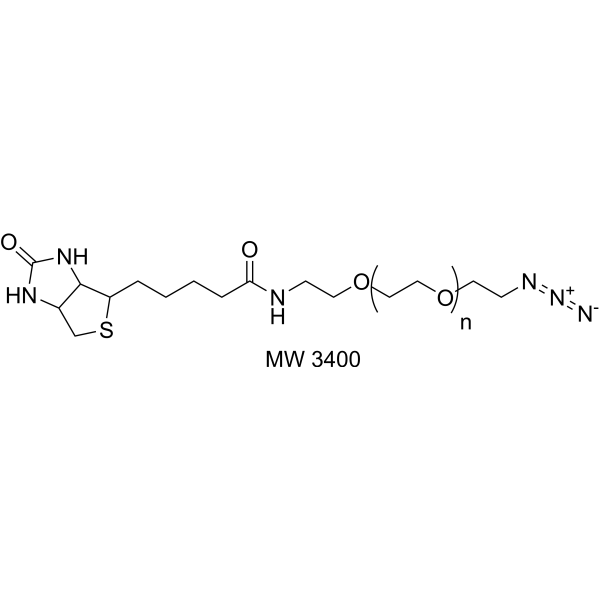
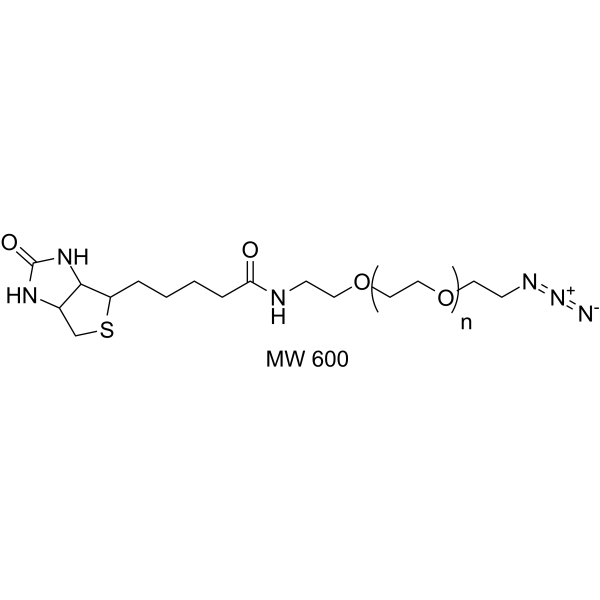
Biotin-PEG3400-azide is a biotin labeled PEG derivative. Biotin is an enzyme co-factor, can be used for labeling protein; PEG is a hydrophilic and water-soluble polymer with low toxicity; azide, is a moderately good leaving group, can react with alkyne by Cu-catalyzation, which improve the efficiency of biotin binding targets. It contains an azide group and can undergo copper-catalyzed azide-alkyne cycloaddition (CuAAc) with molecules containing alkyne groups. It can also undergo ring strain-promoted alkyne-azide cycloaddition (SPAAC) with molecules containing DBCO or BCN groups.
|
-
-
- HY-W250928C
-
|
|
Fluorescent Dye
|
Others
|
|
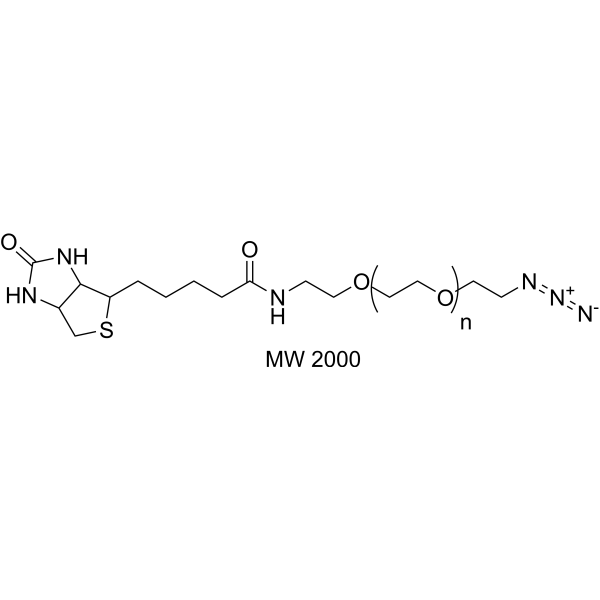
Biotin-PEG2000-azide is a biotin labeled PEG derivative. Biotin is an enzyme co-factor, can be used for labeling protein; PEG is a hydrophilic and water-soluble polymer with low toxicity; azide, is a moderately good leaving group, can react with alkyne by Cu-catalyzation, which improve the efficiency of biotin binding targets. It contains an azide group and can undergo copper-catalyzed azide-alkyne cycloaddition (CuAAc) with molecules containing alkyne groups. It can also undergo ring strain-promoted alkyne-azide cycloaddition (SPAAC) with molecules containing DBCO or BCN groups.
|
-
-
- HY-W032015
-
|
n-Octyl Bromide
|
Biochemical Assay Reagents
|
Others
|
|
1-Bromooctane (n-Octyl Bromide) posesses a terminal bromine. The bromine is a very good leaving group for nucleophilic substitution reactions.
|
-
-
- HY-W016455
-
|
|
Biochemical Assay Reagents
|
Others
|
|
6-Bromo-1-hexanol posesses a terminal bromine and hydroxylic group. The bromine is a very good leaving group for nucleophilic substitution reactions. The hydroxyl group enables further derivatization or replacement with other reactive functional groups.
|
-
-
- HY-W014159
-
|
|
Biochemical Assay Reagents
|
Others
|
|
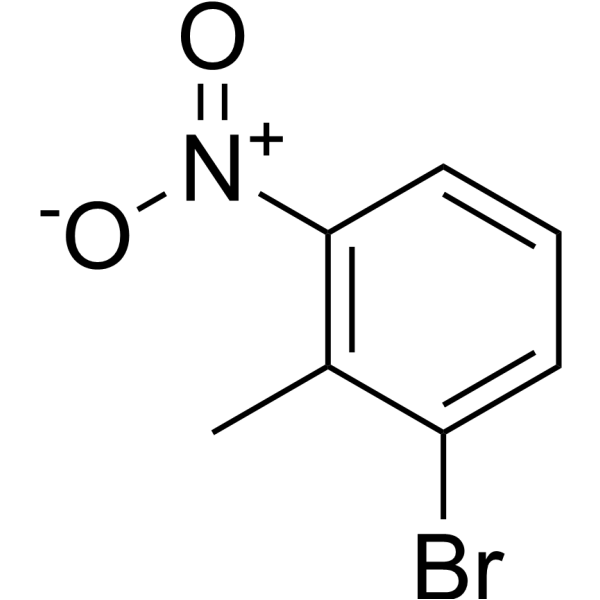
1-Bromo-2-methyl-3-nitrobenzene is an organic synthesis intermediate. 1-Bromo-2-methyl-3-nitrobenzene participates in chemical reactions such as electrophilic substitution and coupling through the bromine atom and nitro group in the molecule, and acts as a synthetic precursor. 1-Bromo-2-methyl-3-nitrobenzene can construct complex molecular structures by relying on the leaving property of bromine and the electron-withdrawing property of nitro group, and can be used in the synthesis of benzimidazole VISTA inhibitors in medicinal chemistry .
|
-
-
- HY-W053842
-
|
|
Biochemical Assay Reagents
|
Others
|
|
tert-Butyl 3-iodopropylcarbamate is a compound with a t-butyl and a terminal iodine. The iodine (I) is a very good leaving group for nucleophilic substitution reactions. The Boc group can be deprotected under mild acidic conditions to form the free amine.
|
-
-
- HY-W190881
-
|
|
Biochemical Assay Reagents
|
Others
|
|
N3-PEG11-CH2CH2Br is a PEG linker containing a bromine and an azide group. The hydrophilic PEG spacer increases solubility in aqueous media. The azide group can react with alkyne, BCN, DBCO via Click Chemistry to yield a stable triazole linkage. The bromine (Br) is a very good leaving group for nucleophilic substitution reactions.
|
-
-
- HY-172291
-
|
|
ADC Linker
|
Cancer
|
|
Mal-amide-PEG8-Val-Cit-PAB-PNP is a cleavable ADC linker featuring a maleimide, a PEG spacer, a Val-Cit dipeptide, a PAB. and a PNP carbonate. Maleimide is a thiol-specific covalent linker which is used to label cysteine residues in proteins while the PNP group acts as a highly activated leaving group. Val-Cit linkers are cleaved by cytoplasmic peptidases.
|
-
-
- HY-W395122
-
|
|
Biochemical Assay Reagents
|
Others
|
|
Mal-PEG1-PNP-carbonate is a amine-reactive compound. PNP is a good leaving group. The maleimide group will react with a thiol group to form a covalent bond, enabling the connection of biomolecule with a thiol.
|
-
-
- HY-W878813
-
|
|
Biochemical Assay Reagents
|
Others
|
|
Tos-PEG22-Tos is a PEG linker containing two tosyl groups. The hydrophilic PEG spacer increases solubility in aqueous media. The tosyl group is a very good leaving group for nucleophilic substitution reactions.
|
-
-
- HY-W096068
-
|
|
Biochemical Assay Reagents
|
Others
|
|
Propargyl-PEG5-Ms represents a bifunctional linker possessing a proparygyl group reactive towards azides in copper (I) click chemistry to form stable triazoles with the target compound as well as a mesyl group which is a good leaving group for nucleophilic reactions.
|
-
-
- HY-W451433
-
|
|
Biochemical Assay Reagents
|
Others
|
|
OTs-PEG1-NHCbz is a PEG linker containing a tosyl group and benzyl (Cbz) protecting group. The hydrophilic PEG spacer increases the water solubility of the compound in aqueous media. The tosyl group is a very good leaving group for nucleophilic substitution reactions. The benzyl protecting group can be removed via hydrogenolysis to form a free amine.
|
-
-
- HY-W777866
-
|
|
Biochemical Assay Reagents
|
Others
|
|
(Rac)-1-Linoleoyl-2-stearoyl-3-chloropropanediol is a diacylglycerol that contains Linoleic acid at the sn-1 position and stearic acid group at the sn-2 position. The chlorine is a good leaving group and can undergo substitution reactions.
|
-
-
- HY-W572763
-
|
|
Biochemical Assay Reagents
|
Others
|
|
Tos-PEG6-acid is a PEG linker containing a tosyl group and a terminal carboxylic acid. The hydrophilic PEG spacer increases solubility in aqueous media. The tosyl group is a very good leaving group for nucleophilic substitution reactions. The terminal carboxylic acid can react with primary amine groups in the presence of activators (e.g. HATU) to form a stable amide bond.
|
-
-
- HY-W393115
-
|
|
Biochemical Assay Reagents
|
Others
|
|
Diethyl 6-bromohexylphosphonate is a short linker featuring a bromide and a diethyl phosphonate. The bromide is a good leaving group which can be easily displaced by nucleophiles like alcohols, amines or thiols, while the diethyl phosphonate may be hydrolyzed to allow for esterification.
|
-
-
- HY-W800760
-
|
|
E3 Ligase Ligand-Linker Conjugates
|
Cancer
|
|
(S, R, S)-AHPC-PEG6-Tos is a combination of a von Hippel-Lindau (VHL)-recruiting ligand and PEGylated crosslinker with a tosyl group. The tosyl group is a good leaving group for nucleophilic substitution reactions. (S, R, S)-AHPC-PEG2-Tos is useful for synthesis of PROTAC compounds and molecules for targeted protein degradation.
|
-
-
- HY-W190836
-
|
|
Biochemical Assay Reagents
|
Others
|
|
Azide-PEG2-Tos is a small PEG linker featuring an azide and a tosylate. Tosylates are good leaving groups which are easily displaced by nucleophiles while azide is a click chemistry handle which is used to react with terminal alkynes or strained cyclooctynes.
|
-
-
- HY-W460133
-
|
|
Biochemical Assay Reagents
|
Others
|
|
tert-Butyl (2-(2-(2-iodoethoxy)ethoxy)ethyl)carbamate is a PEG linker containing a Boc protected amine and an iodine group. The protected amine can be deprotected under mild acidic conditions. Iodine (I) is a very good leaving group for nucleophilic substitution reactions. The hydrophilic PEG spacer increases solubility in aqueous media.
|
-
-
- HY-W394551
-
|
|
Biochemical Assay Reagents
|
Others
|
|
Methyl 3,4-dibromo-2,5-dioxo-2,5-dihydro-1H-pyrrole-1-carboxylate is a small pyrrolidone molecule which features two bromine atoms and a methyl ester. The unsaturated dibromo motif is a covalent ligand for thiol groups, and may be used to label cysteine residues in proteins. The presence of two leaving groups on this molecule allows this linker to bind two thiols at a time. The methyl ester can be saponified to link this molecule to amines to form larger structures.
|
-
-
- HY-402737
-
|
|
Drug Intermediate
|
Others
|
|
FTC-146 precursor (Compound s6) is a drug intermediate that can be used to prepare σ-1 receptor positron emission tomography tracers ([¹⁸F]FTC-146) .
|
-
-
- HY-W591972
-
|
|
Biochemical Assay Reagents
|
Others
|
|
6-Hydroxyhexyl 4-methylbenzenesulfonate is a six carbon linker containing a hydroxyl group and a tosyl group. The hydroxyl group enables further derivatization or replacement with other reactive functional groups. The tosyl group is a very good leaving group for nucleophilic substitution reactions.
|
-
-
- HY-W800678
-
|
|
Biochemical Assay Reagents
|
Others
|
|
Bromoacetamido-PEG2-AZD is a PEG linker containing an AZD group and a bromide group which is a very good leaving group for nucleophilic substitution reactions. The hydrophilic PEG spacer increases solubility in aqueous media.
|
-
-
- HY-W591314
-
|
|
Biochemical Assay Reagents
|
Others
|
|
m-PEG11-Ms is a PEG linker featuring a methoxy cap and a mesylate group. The methoxy cap is inert while the mesylate is a good leaving group which is easily displaced by nucleophiles such as alcohols and amines.
|
-
-
- HY-W348170
-
|
|
Biochemical Assay Reagents
|
Others
|
|
tert-Butyl((5-iodopentyl)oxy)dimethylsilane is a silane compound with a terminal iodine group. The trimethylsilane is commonly used for surface modifications. The iodine (I) is a very good leaving group for nucleophilic substitution reactions.
|
-
-
- HY-W248726
-
|
|
Biochemical Assay Reagents
|
Others
|
|
tert-Butyl (6-iodohexyl)carbamate is a six carbon linker containing an iodine group and a t-butyl ester. The iodine (I) acts as a good leaving group for nucleophilic substitution reactions. The t-butyl ester groups can be deprotected under acidic conditions.
|
-
-
- HY-W591973
-
|
|
Biochemical Assay Reagents
|
Others
|
|
OTs-C6-NHBoc is a six carbon linker containing a tosyl group and Boc-protected amine group. The tosyl group is a very good leaving group for nucleophilic substitution reactions. The Boc group can be deprotected under mild acidic conditions to form a free amine.
|
-
-
- HY-W396413
-
|
|
Biochemical Assay Reagents
|
Others
|
|
4-Chlorobutoxy(trimethyl)silane is a silane compound with a terminal cholorine. The cholorine (Cl) is a good leaving group for nucleophilic substitution reactions. The trimethylsilane is commonly used for surface modifications.
|
-
-
- HY-W591963
-
|
Tos-pentane-azide
|
Biochemical Assay Reagents
|
Others
|
|
5-Azidopentyl 4-methylbenzenesulfonate (Tos-pentane-azide) is a linker containing an azide group and a tosyl group. The azide group can react with alkyne, BCN, DBCO via Click Chemistry to yield a stable triazole linkage. The tosyl group is a good leaving group for nucleophilic substitution reactions.
|
-
-
- HY-W092078
-
|
|
Biochemical Assay Reagents
|
Others
|
|
tert-Butyl (4-iodobutyl)carbamate is a four carbon linker containing a Boc-protected amino group and an iodine group. The Boc group can be deprotected under mild acidic conditions to form the free amine. Iodine (I) is a very good leaving group for nucleophilic substitution reactions.
|
-
-
- HY-W591971
-
|
|
Biochemical Assay Reagents
|
Others
|
|
5-((tert-Butoxycarbonyl)amino)pentyl 4-methylbenzenesulfonate is a PEG linker containing a Boc protected amine and a tosyl group. The protected amine can be deprotected under mild acidic conditions. The tosyl group is a very good leaving group for nucleophilic substitution reactions.
|
-
-
- HY-W702728
-
|
|
Biochemical Assay Reagents
|
Others
|
|
rac 1-Palmitoyl-2-chloropropanediol is a monoacylglycerol of palmitic acid at the sn-1 position and a chloride group at the sn-2 position. The hydroxyl group enables further derivatization or replacement with other reactive functional groups. The chlorine is a good leaving group and can undergo substitution reactions.
|
-
-
- HY-172720
-
|
|
Biochemical Assay Reagents
|
Others
|
|
Azide-PEG5-Ms serves as a PEG linker containing an azide that reacts with BCN, DBCO, alkyne via Click Chemistry and mesyl group that is a good leaving group for nucleophilic substitution reactions. The PEG spacer imparts water solubility.
|
-
-
- HY-W591440
-
|
|
Biochemical Assay Reagents
|
Others
|
|
Fmoc-Cit-PAB-PNP is a Citrulline linked to 4-aminobenzoiate (PAB) with terminal Fmoc and PNP groups. The Fmoc group can be deprotected under basic conditions to release the free amine which can be used for further conjugations. PNP group is a good leaving group when reacting with an amine-bearing payload.
|
-
-
- HY-W403732
-
|
|
Biochemical Assay Reagents
|
Others
|
|
8-Iodooct-7-yn-1-ol comprises an iodo-propargyl group attached to a 6-carbon tail with a terminal hydroxyl group. The iodine (I) acts as a good leaving group for nucleophilic substitution reactions. The hydroxyl group enables further derivatization or replacement with other reactive functional groups.
|
-
-
- HY-W190808
-
|
|
Biochemical Assay Reagents
|
Others
|
|
Tos-PEG11-t-butyl ester is a PEG linker containing a t-butyl ester and a tosyl group. The hydrophilic PEG spacer increases solubility in aqueous media. The t-butyl protected carboxyl group can be deprotected under acidic conditions. The tosyl group is a very good leaving group for nucleophilic substitution reactions.
|
-
-
- HY-W591441
-
|
|
Biochemical Assay Reagents
|
Others
|
|
Fmoc-Ala-PAB-PNP is an Alanine linked to 4-aminobenzoiate (PAB) with terminal Fmoc and PNP groups. The Fmoc group can be deprotected under basic conditions to release the free amine which can be used for further conjugations. PNP is a good leaving group when reacting with an amine-bearing payload.
|
-
-
- HY-W800661
-
|
|
Biochemical Assay Reagents
|
Others
|
|
Tos-PEG3-methyl ester is a PEG linker with tosyl and methyl ester moieties. The tosyl group is a very good leaving group for nucleophilic substitution reactions. The hydrophilic PEG linker increases the water solubility of the compound. Methyl ester can be hydrolyzed under strong basic condition.
|
-
-
- HY-W400574
-
|
6-Iodo-1-Hexanol
|
Biochemical Assay Reagents
|
Others
|
|
6-Iodohexan-1-ol (6-Iodo-1-Hexanol) comprises an Iodo group attached to a 6-carbon tail with a terminal hydroxyl group. The hydroxyl group enables further derivatization or replacement with other reactive functional groups. The iodine (I) acts as a good leaving group for nucleophilic substitution reactions.
|
-
-
- HY-W800806
-
|
|
Biochemical Assay Reagents
|
Others
|
|
Heptyl 8-bromooctanoate is an ester compound that has a terminal bromine. Heptyl 8-bromooctanoate is formed by coupling 8-Bromooctanoic acid to Heptanol. The bromine (Br) is a very good leaving group for nucleophilic substitution reactions.
|
-
-
- HY-W460275
-
|
|
Biochemical Assay Reagents
|
Others
|
|
t-Boc-N-Amido-PEG5-Tos is a PEG linker containing a tosyl group and Boc-protected amine group. The hydrophilic PEG spacer increases the water solubility of a compound in aqueous media. The tosyl group is a very good leaving group for nucleophilic substitution reactions. The Boc group can be deprotected under mild acidic conditions to form a free amine.
|
-
-
- HY-W454989
-
|
|
Biochemical Assay Reagents
|
Others
|
|
Hept-6-yn-1-yl 4-methylbenzenesulfonate is a linker containing a tosyl group and a propargyl group. The tosyl group is a very good leaving group for nucleophilic substitution reactions. The propargyl group can react with azide-bearing compounds or biomolecules via copper catalyzed azide-alkyne Click Chemistry to yield a stable triazole linkage.
|
-
-
- HY-W800712
-
|
|
Biochemical Assay Reagents
|
Others
|
|
t-Boc-N-Amido-PEG11-Tos is a PEG linker containing a tosyl group and Boc-protected amine group. The hydrophilic PEG spacer increases the water solubility of a compound in aqueous media. The tosyl group is a very good leaving group for nucleophilic substitution reactions. The Boc group can be deprotected under mild acidic conditions to form a free amine.
|
-
-
- HY-W800842
-
|
|
Biochemical Assay Reagents
|
Others
|
|
1-Ethylnonyl 8-bromooctanoate is a lipid featuring a bromide along an octanoate chain linking to a C11 chain. 1-Ethylnonyl 8-bromooctanoate can be derivatized via substitution at the bromide leaving group.
|
-
-
- HY-W190738
-
|
|
Biochemical Assay Reagents
|
Others
|
|
Azide-PEG8-Tos is a small PEG linker featuring an azide and a tosylate. Tosylates are good leaving groups which are easily displaced by nucleophiles while azide is a click chemistry motif which is used to react with terminal alkynes or strained cyclooctynes.
|
-
-
- HY-W251756
-
|
|
Biochemical Assay Reagents
|
Others
|
|
3-(2-Iodoethoxy)prop-1-yne is a crosslinker that can be used in copper catalyzed azide-alkyne Click Chemistry to form a stable triazole linkage with azides. The iodine (I) acts as a good leaving group for nucleophilic substitution reactions.
|
-
-
- HY-172294
-
|
|
Biochemical Assay Reagents
|
Others
|
|
Mes-PEG2-CH2-t-butyl ester is a PEG linker consisting of a PEG2 linker for improved water-solubility of the compound and a t-butyl ester group which can be deprotected under acidic conditions. The mesylate serves as an excellent leaving group, offering all the advantages without the limitation of having an acidic proton that could react with nucleophiles.
|
-
-
- HY-W800662
-
|
|
Biochemical Assay Reagents
|
Others
|
|
Bromo-PEG2-methyl ester is a PEG linker containing a bromide moiety and a methyl ester. The bromide (Br) is a very good leaving group for nucleophilic substitution reactions. The hydrophilic PEG spacer increases solubility in aqueous media. Methyl ester can be hydrolyzed under strong basic condition.
|
-
-
- HY-E71219
-
|
|
Biochemical Assay Reagents
|
Others
|
|
α-Bisabolene synthase (EC 4.2.3.38) requires a divalent cationic cofactor (Mg2+) to neutralize the negative charge of the bisphosphate leaving group. α-Bisabolene synthase (EC 4.2.3.38) can generate (+)-(4R)-limonene in vitro using GDP as a substrate.
|
-
- HY-W800753
-
|
|
Biochemical Assay Reagents
|
Others
|
|
2,5-Dioxopyrrolidin-1-yl 6-bromohexanoate is an alkane linker with a terminal bromide and an NHS ester. The bromide is a very good leaving group for nucleophilic substitution reactions. The NHS ester can be used to label the primary amines (-NH2) of proteins, amine-modified oligonucleotides, and other amine-containing molecules.
|
-
- HY-W800754
-
|
|
Biochemical Assay Reagents
|
Others
|
|
8-Bromo-octanoic acid 2,5-dioxo-pyrrolidin-1-yl ester is an alkane linker with a terminal bromide and an NHS ester. The bromide is a very good leaving group for nucleophilic substitution reactions. The NHS ester can be used to label the primary amines (-NH2) of proteins, amine-modified oligonucleotides, and other amine-containing molecules.
|
-
- HY-E70958
-
|
|
Carboxypeptidase
|
Metabolic Disease
|
|
Carboxypeptidase G, Pseudomonas sp. (EC 3.4.17.11) is a lysosomal thiol-dependent protease that stepwise cleaves γ-glutamylpteroyl polyγ-glutamic acid to generate pteroyl-α-glutamic acid (folic acid) and free glutamic acid. Carboxypeptidase G is highly specific for the γ-glutamyl bond but not for the C-terminal amino acid of the leaving group. Carboxypeptidase G can be activated by Zn 2+ ions.
|
-
| Cat. No. |
Product Name |
Type |
-
- HY-W014159
-
|
|
Biochemical Assay Reagents
|
|
1-Bromo-2-methyl-3-nitrobenzene is an organic synthesis intermediate. 1-Bromo-2-methyl-3-nitrobenzene participates in chemical reactions such as electrophilic substitution and coupling through the bromine atom and nitro group in the molecule, and acts as a synthetic precursor. 1-Bromo-2-methyl-3-nitrobenzene can construct complex molecular structures by relying on the leaving property of bromine and the electron-withdrawing property of nitro group, and can be used in the synthesis of benzimidazole VISTA inhibitors in medicinal chemistry .
|
| Cat. No. |
Product Name |
|
Classification |
-
- HY-W591374
-
|
|
|
DBCO
|
|
DBCO-PEG4-Val-Ala-PAB-PNP is a cleavable ADC linker. The Val-Ala linkers can be cleaved by Cathepsin B. The DBCO groups is commonly used for Click Chemistry reactions. PEG spacer improves the compound's aqueous solubility. PNP is a good leaving group.
|
-
- HY-W250928D
-
|
|
|
Azide
|
|
Biotin-PEG3400-azide is a biotin labeled PEG derivative. Biotin is an enzyme co-factor, can be used for labeling protein; PEG is a hydrophilic and water-soluble polymer with low toxicity; azide, is a moderately good leaving group, can react with alkyne by Cu-catalyzation, which improve the efficiency of biotin binding targets. It contains an azide group and can undergo copper-catalyzed azide-alkyne cycloaddition (CuAAc) with molecules containing alkyne groups. It can also undergo ring strain-promoted alkyne-azide cycloaddition (SPAAC) with molecules containing DBCO or BCN groups.
|
-
- HY-W250928C
-
|
|
|
Azide
|
|
Biotin-PEG2000-azide is a biotin labeled PEG derivative. Biotin is an enzyme co-factor, can be used for labeling protein; PEG is a hydrophilic and water-soluble polymer with low toxicity; azide, is a moderately good leaving group, can react with alkyne by Cu-catalyzation, which improve the efficiency of biotin binding targets. It contains an azide group and can undergo copper-catalyzed azide-alkyne cycloaddition (CuAAc) with molecules containing alkyne groups. It can also undergo ring strain-promoted alkyne-azide cycloaddition (SPAAC) with molecules containing DBCO or BCN groups.
|
-
- HY-W190881
-
|
|
|
Azide
|
|
N3-PEG11-CH2CH2Br is a PEG linker containing a bromine and an azide group. The hydrophilic PEG spacer increases solubility in aqueous media. The azide group can react with alkyne, BCN, DBCO via Click Chemistry to yield a stable triazole linkage. The bromine (Br) is a very good leaving group for nucleophilic substitution reactions.
|
-
- HY-W096068
-
|
|
|
Alkynes
|
|
Propargyl-PEG5-Ms represents a bifunctional linker possessing a proparygyl group reactive towards azides in copper (I) click chemistry to form stable triazoles with the target compound as well as a mesyl group which is a good leaving group for nucleophilic reactions.
|
-
- HY-W190836
-
|
|
|
Azide
|
|
Azide-PEG2-Tos is a small PEG linker featuring an azide and a tosylate. Tosylates are good leaving groups which are easily displaced by nucleophiles while azide is a click chemistry handle which is used to react with terminal alkynes or strained cyclooctynes.
|
Your information is safe with us. * Required Fields.
Inquiry Information
- Product Name:
- Cat. No.:
- Quantity:
- MCE Japan Authorized Agent:

