10 Results for "

copper(II) ion

" in MedChemExpress (MCE) Product Catalog:
Products (10)

10 Results for "copper(II) ion" in MCE Product Catalog:

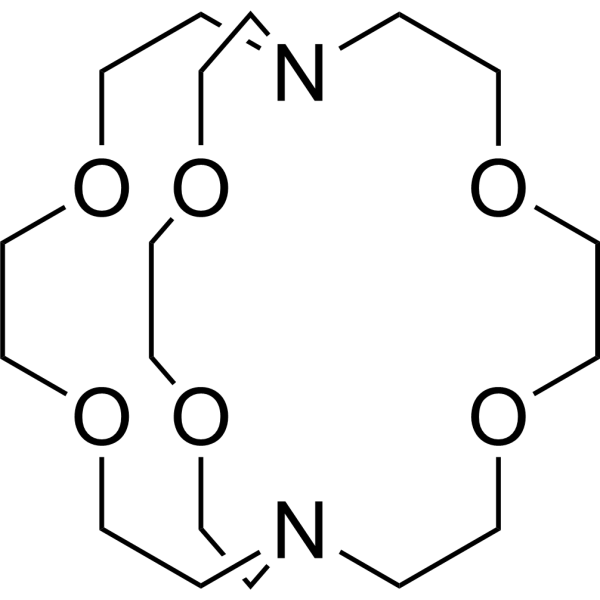
Cat. No.: HY-W011060
CAS No.: 23978-09-8
Synonyms: 4,7,13,16,21,24-Hexaoxa-1,10-diazabicyclo[8.8.8]hexacosane
Cryptand 2.2.2 (4,7,13,16,21,24-Hexaoxa-1,10-diazabicyclo[8.8.8]hexacosane) is a metal ion chelator. Cryptand 2.2.2 forms stable mononuclear, protonated and dinuclear complexes with copper (II) ions; forms protonated complexes with hydrogen ions; and also forms stable complexes with Zn 2+, Co 2+, Ni 2+, Cd 2+, Hg 2+ and Pb 2+ ions. Cryptand 2.2.2 can be used for the preparation of nanoparticles, transition metal compounds, etc.
loading...
    loading...
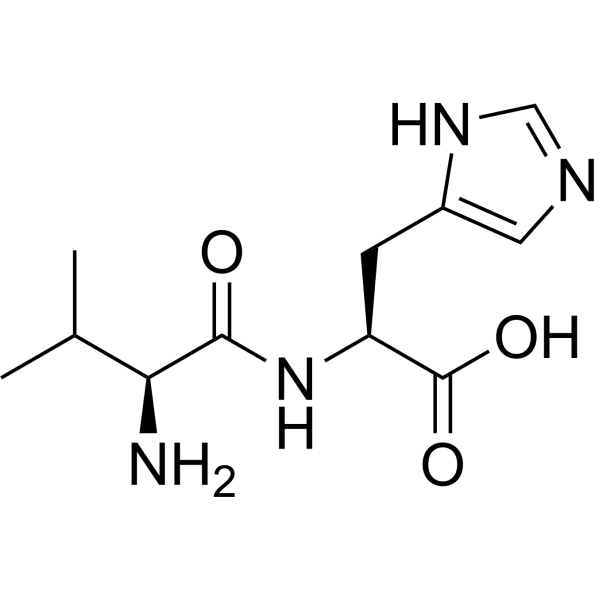
Cat. No.: HY-P4666
CAS No.: 13589-07-6
Research Areas:  

Others

Valylhistidine is a dipeptide composed of valine and histidine (Val-His). Valylhistidine can form a dipeptide complex with Cu (II) that mimics superoxide dismutase but lacks activity .
loading...
    loading...
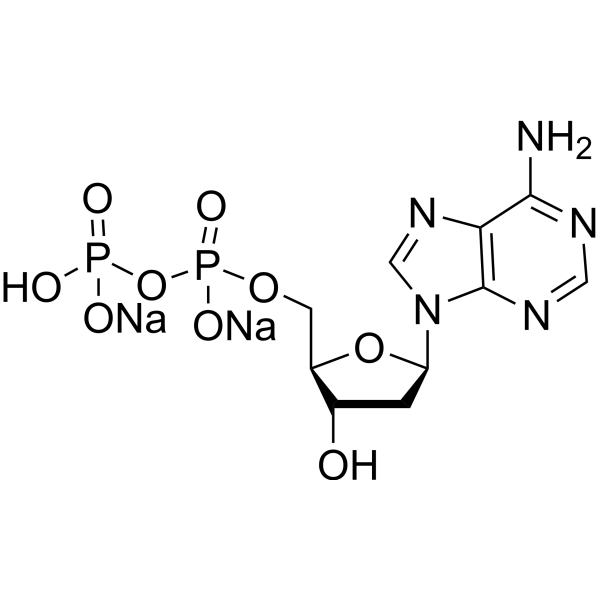
Cat. No.: HY-W010854
CAS No.: 72003-83-9
Synonyms: dADP disodium
2'-Deoxyadenosine 5'-diphosphate disodium (dADP disodium) is an inhibitor of Polynucleotide phosphorylase and Polyadenylate polymerase. 2'-Deoxyadenosine 5'-diphosphate disodium inhibits polyadenylate synthesis in permeabilized bacterial cells. As a chelating agent, 2'-Deoxyadenosine 5'-diphosphate disodium forms 1:1 complexes with trivalent lanthanides, Manganese (II) and Copper (II) ions, with unique coordination modes and structural conformations for each ion type .
loading...
    loading...
Cat. No.: HY-120420
CAS No.: 167695-87-6
N4Py is a bleomycin-mimetic pentadentate ligand that targets intracellular FeII and reversibly chelates a variety of transition metals. N4Py chelates induce apoptosis through two pathways: DNA cleavage via ROS generation and XIAP downregulation via ZnII chelation, with only FeII/FeIII-N4Py exhibiting potent DNA cleavage activity. The folate conjugate of N4Py targets folate receptors, can be intracellularly cleaved, and selectively kills FR-positive cancer cells. N4Py can be used in research on various cancers including nasopharyngeal epidermoid carcinoma, ovarian cancer, and mammary adenocarcinoma .
loading...
    loading...
Cat. No.: HY-P11642A
Sialorphin TFA is a neutral endopeptidase (NEP) and aminopeptidase N (APN) inhibitor that responds to androgen signals. Sialorphin TFA blocks the degradation of endogenous opioid peptides and interacts with μ-, δ-, κ-opioid receptors. Sialorphin TFA regulates the ERK/mTOR signaling pathway by inducing cell cycle arrest, enhancing ERK1/2 activity, and reducing the phosphorylation levels of mTOR, 4E-BP1, p70S6K; accordingly, Sialorphin TFA exhibits antiproliferative activity against colorectal cancer, glioma and prostate cancer cells without cytotoxicity. In addition, Sialorphin TFA also produces antinociceptive responses, regulates sexual behavior, relaxes corpus cavernosum smooth muscle, and alleviates experimental colitis. Sialorphin TFA is also a copper (II) ion-binding ligand. Sialorphin TFA has been used in mechanistic studies related to cancer, pain management and inflammatory bowel disease .
loading...
    loading...
Cat. No.: HY-164055
CAS No.: 202828-10-2
Target:  

Fluorescent Dye

Research Areas:  

Cancer

HL1 is a Schiff base ligand. HL1 exhibits chelation-enhanced fluorescence effect when forming complexes and can be used as a fluorescent probe for metal ions. HL1 can be used for the research of cancer .
loading...
    loading...
Cat. No.: HY-W027881
CAS No.: 5519-42-6
Research Areas:  

Others

3,4,5-Trimethyl-1H-pyrazole is a ligand that can coordinate to nickel(II) or copper(II) ions to form distinct complexes .
loading...
    loading...
Cat. No.: HY-D3205
CAS No.: 869343-71-5
Bis (picolinoyl) fluorescein is a Cu 2+ esterase activity probe with both fluorogenic and chromogenic properties. Bis (picolinoyl) fluorescein enables quantitative analysis of free Cu 2+, as well as detection of esterolytic activity of Cu bound to organic ligands or biomolecules .
loading...
    loading...
Cat. No.: HY-P11933
Research Areas:  

Others

FAHF is a polypeptide-based dual-signal fluorescent colorimetric probe synthesized by conjugating the 5-carboxyfluorescein (5-FAM) (HY-66022) fluorophore to the Ala-His-Phe-NH2 tripeptide backbone. FAHF achieves highly selective recognition of Cu 2+ via fluorescence quenching and colorimetric change. The FAHF-Cu 2+ complex responds to Glyphosate (HY-B0863) based on the displacement effect, resulting in fluorescence enhancement and a visually distinguishable color change. FAHF can penetrate cell membranes to enable cascade detection of copper (II) and glyphosate in living cells, and it can also be combined with smartphone RGB analysis for semi-quantitative identification .
loading...
    loading...
Cat. No.: HY-P11642
CAS No.: 131748-26-0
Sialorphin is a neutral endopeptidase (NEP) and aminopeptidase N (APN) inhibitor that responds to androgen signals. Sialorphin blocks the degradation of endogenous opioid peptides and interacts with μ-, δ-, κ-opioid receptors. Sialorphin regulates the ERK/mTOR signaling pathway by inducing cell cycle arrest, enhancing ERK1/2 activity, and reducing the phosphorylation levels of mTOR, 4E-BP1, p70S6K; accordingly, Sialorphin exhibits antiproliferative activity against colorectal cancer, glioma and prostate cancer cells without cytotoxicity. In addition, Sialorphin also produces antinociceptive responses, regulates sexual behavior, relaxes corpus cavernosum smooth muscle, and alleviates experimental colitis. Sialorphin is also a copper (II) ion-binding ligand. Sialorphin has been used in mechanistic studies related to cancer, pain management and inflammatory bowel disease .
loading...
    loading...

