6 Results for "

coronary plaques

" in MedChemExpress (MCE) Product Catalog:
Products (6)

6 Results for "coronary plaques" in MCE Product Catalog:

1
1 Cited Publications
Cat. No.: HY-P2799D
CAS No.: 9001-15-4
Synonyms: CK-MB
Creatine Kinase MB (rCK-MB), Recombinant Human (CK-MB) is a cytoplasmic creatine kinase isoenzyme composed of M and B subunits, belonging to the phosphotransferase family. Creatine Kinase MB (rCK-MB), Recombinant Human catalyzes the transfer of phosphate groups between creatine and phosphocreatine, and consumes phosphocreatine immobilized on the surface of the biosensor, resulting in a decrease in the electrochemical peak current that is proportional to its concentration. Creatine Kinase MB (rCK-MB), Recombinant Human can be used in studies of acute myocardial infarction, coronary artery disease with atherosclerotic plaques, autoimmune myocarditis, and malignant tumors .
loading...
    loading...
Cat. No.: HY-154831
CAS No.: 27888-44-4
Purity:  ≥98.0%
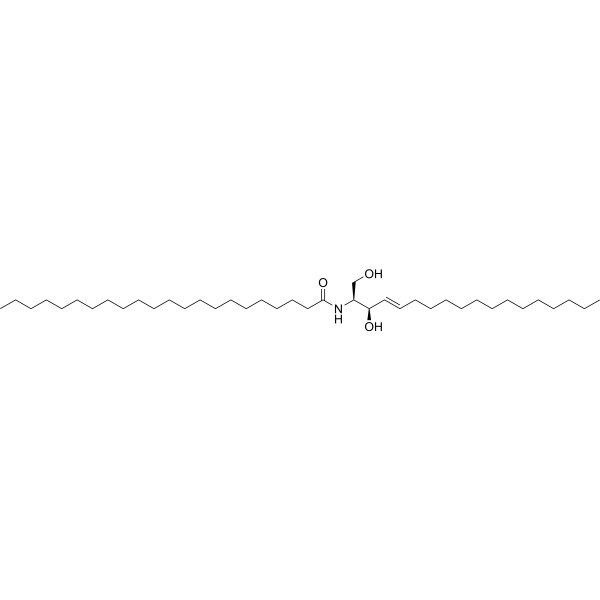
Synonyms: N-Behenoyl-D-erythro-sphingosine; C22-Ceramide; Cer d18:1/22:0
Target:  

Liposome

C22-Ceramide (d18:1/22:0) (N-Behenoyl-D-erythro-sphingosine) is an ultra-long-chain ceramide containing a C22:0 behenoyl acyl chain. C22-Ceramide can be glycosylated via CGT-3 to form C22 glucosylceramide (C22 GlcCer), which in turn maintains clathrin membrane localization and lysosomal homeostasis, inhibits TOR signaling and promotes SKN-1 activation, thereby enhancing oxidative stress resistance and extending the lifespan of C. elegans. C22-Ceramide can be used in research on cardiometabolic diseases such as type 2 diabetes, obesity, dyslipidemia, coronary artery disease and thin-cap fibroatheroma (TCFA), as well as oxidative stress and aging-related studies .
loading...
    loading...
Cat. No.: HY-E70559
CAS No.: 65802-85-9
Target:  

PGE synthase

Research Areas:  

Cardiovascular Disease Cancer

Prostaglandin D synthase is a biomarker for meningioma cells and coronary artery disease. Lipocalin-type Prostaglandin D synthase (L-PGDS) is present in the atherosclerotic plaque of the human coronary artery and can be detectable in human serum .
loading...
    loading...
Cat. No.: HY-135876
CAS No.: 29873-99-2
Synonyms: (-)-γ-Elemene
γ-Elemene ((-)-γ-Elemene) is a lipid-lowering agent. γ-Elemene increases superoxide dismutase (SOD). γ-Elemene reduces the expression of adhesion molecules (VCAM-1, ICAM-1) in cells damaged by H2O2. γ-Elemene regulates lipid peroxidation. γ-Elemene protects cells from peroxidative damage induced by high fat and H2O2. γ-Elemene decreases lipid content. γ-Elemene can be used in the research of atherosclerosis .
loading...
    loading...
Cat. No.: HY-184265
CAS No.: 1993461-76-9
Synonyms: Mito-Esc
Mito-Esculetin (Mito-Esc) is an orally active mitochondria-targeted derivative of Esculetin (HY-N0284). Mito-Esculetin inhibits LPS-induced phosphorylation of STAT3 Tyr-705, partially reverses LPS-mediated depletion of SIRT3, and enhances the AMPK-SIRT1 signaling axis. Mito-Esculetin inhibits PAI-1 activity, regulates miRNA, and induces phosphorylation of IRS and AKT. Mito-Esculetin suppresses oxidant-induced endothelial dysfunction, Ang-II (HY-13948)- and high glucose-induced atherosclerotic plaque formation, Palmitate (HY-N0830)-induced insulin resistance, as well as high glucose-mediated endothelial cell senescence and inflammatory responses. Mito-Esculetin reduces body weight and non-esterified fatty acid (NEFA) levels. Mito-Esculetin can be used in research related to acute coronary syndrome, type 2 diabetes, and hyperglycemia-induced atherosclerosis .
loading...
    loading...
Cat. No.: HY-W1143867
CAS No.: 2226-71-3
4’-Phosphopantetheine is an orally active coenzyme A (CoA) precursor. 4’-Phosphopantetheine is membrane-permeable and acts as a CoA precursor, a prosthetic group, and a reactive oxygen species (ROS) inhibitor. 4’-Phosphopantetheine binds covalently to rat liver fatty acid synthase, modifies the conserved serine residue in the PKS/NRPS carrier protein domain, and serves as a substrate for CoA synthase and PPAT. 4’-Phosphopantetheine undergoes non-catalytic exchange on rat liver fatty acid synthase, with a faster turnover rate than that of the enzyme complex, and restores intracellular CoA levels in cells with impaired de novo biosynthesis. 4’-Phosphopantetheine rescues phenotypes induced by CoA deficiency, normalizes PKAN-related biomarkers, restores mitochondrial enzyme activity, and alleviates vascular endothelial damage. 4’-Phosphopantetheine shows biological stability in serum, acts as a prosthetic group and degradation product of ACP, and inhibits the formation of atherosclerotic plaques. 4’-Phosphopantetheine can be used in the research of brain iron accumulation neurodegenerative diseases, pantothenate kinase-associated neurodegeneration, CoASY protein-associated neurodegenerative diseases, coronary heart disease, and atherosclerosis .
loading...
    loading...

