
9 Results for "

ethylene signalling

" in MedChemExpress (MCE) Product Catalog:
Products (9)

9 Results for "ethylene signalling" in MCE Product Catalog:

1
1 Cited Publications
Cat. No.: HY-N9929
CAS No.: 629-97-0
Docosane is a plant resistance inducer found in Frullania probosciphora. Docosane induces activation of the salicylic acid signaling pathway. Docosane induces activation of the jasmonic acid signaling pathway. Docosane induces activation of the ethylene signaling pathway. Docosane can be used in research on tomato bacterial wilt and apple fire blight .
loading...
    loading...
Cat. No.: HY-W923189
CAS No.: 106-26-3
Neral is a plant-derived anti-inflammatory, antioxidant and anticancer agent. Neral inhibits the phosphorylation of ERK1/2, p38 MAPK and IκB in macrophages induced by LPS (HY-D1056), suppresses the secretion of TNF-α and IL-6, as well as the expression of pro-IL-1β, iNOS and COX-2 in cells, and reduces the production of ROS in cells. Neral inhibits the activation of the NLRP3 inflammasome, and decreases the activation of caspase-1 and the secretion of IL-1β in mouse macrophages. Neral induces autophagy, and exhibits antiproliferative activity both in in vitro breast cancer cell models and mouse xenograft models. Neral regulates brassinosteroid, jasmonic acid and ethylene signaling pathways, and induces the expression of AP2/ERF-ERF and bHLH family genes in rice roots. Neral acts as a herbicide safener, alleviates the damage induced by Fenoxaprop-P-ethyl (HY-B2013), and promotes the elongation of rice roots. Neral can be used in research related to breast cancer, inflammatory and immune system diseases, and herbicide safeners .
loading...
    loading...
Cat. No.: HY-151931
CAS No.: 371778-55-1
Synonyms: Jasmonyl-ACC
Target:  

Phytohormone

Research Areas:  

Metabolic Disease

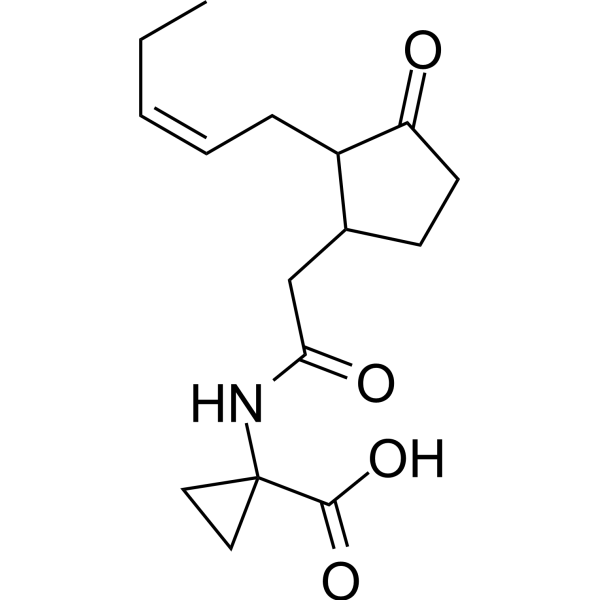
JA-ACC (Jasmonyl-ACC) is a derivative of 1-aminocyclopropane-1-carboxylic acid (ACC). ACC is the direct precursor of the plant hormone ethylene. JA-ACC inhibits root growth in Arabidopsis and the inhibition is independent of jasmonic acid (JA) signaling .
loading...
    loading...
Cat. No.: HY-120743
CAS No.: 1421584-86-2
Research Areas:  

Metabolic Disease

Triplin is a copper chelator, Triplin perturbs copper ion transport involved in the interaction of RAN1 and ATX1. Triplin suppresses the toxic effects of excess copper ions on plant root growth. Triplin increases the RNA expression of ERF1. Triplin acts through the ethylene signal transduction pathway. Triplin also is a bacterial pore-former .
loading...
    loading...
Cat. No.: HY-N9929S
CAS No.: 260411-88-9
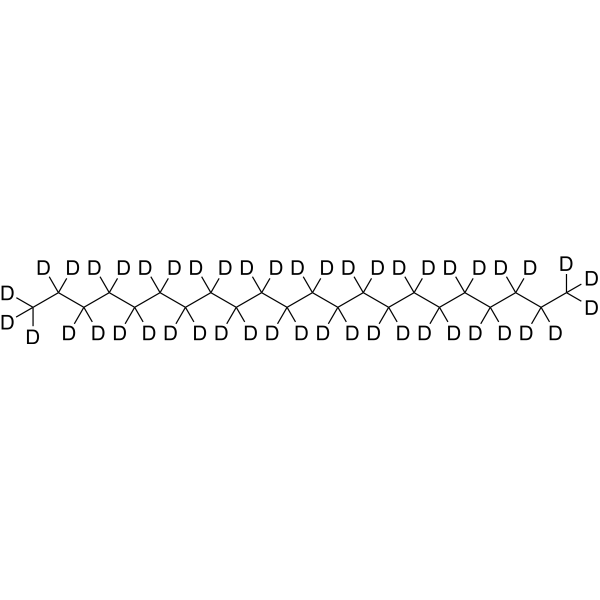
Docosane-d46 is the deuterated-labeled Docosane (HY-N9929). Docosane is a plant resistance inducer found in Frullania probosciphora. Docosane induces activation of the salicylic acid signaling pathway. Docosane induces activation of the jasmonic acid signaling pathway. Docosane induces activation of the ethylene signaling pathway. Docosane can be used in research on tomato bacterial wilt and apple fire blight .
loading...
    loading...
Cat. No.: HY-N9929R
CAS No.: 629-97-0
Docosane (Standard) is the analytical standard of Docosane (HY-N9929). This product is intended for research and analytical applications. Docosane is a plant resistance inducer found in Frullania probosciphora. Docosane induces activation of the salicylic acid signaling pathway. Docosane induces activation of the jasmonic acid signaling pathway. Docosane induces activation of the ethylene signaling pathway. Docosane can be used in research on tomato bacterial wilt and apple fire blight .
loading...
    loading...
Cat. No.: HY-W751266
CAS No.: 113565-32-5
DIMBOA-Glc is a benzoxazinoid glucoside insecticide that exists in two epimeric forms. DIMBOA-Glc helps enhance the resistance of maize to lepidopteran larvae. When plant cells rupture, plant-derived (2R)-DIMBOA-Glc interacts with glucosidases and undergoes hydrolysis to produce toxic DIMBOA for defense against infestation. The accumulation process of DIMBOA-Glc is negatively regulated by ZmMPK6 and the ethylene signaling pathway. DIMBOA-Glc does not react with plant glucosidases and can act as a detoxification metabolite to help insects counter plant defenses .
loading...
    loading...
Cat. No.: HY-L240
44 compounds

Plant hormones are natural signaling molecules synthesized by plants themselves, serving as crucial chemical messengers that exert physiological effects on plants at extremely low concentrations. They coordinate cellular growth, division, differentiation, and organ formation, helping plants adapt to environmental changes. Major categories include abscisic acid, auxins, gibberellins, cytokinins, ethylene, and brassinosteroids, among others.

MCE has included 44 plant hormones, which can be used for identification in plant metabolomics and related botanical research.

Cat. No.: HY-N12990
CAS No.: 34328-57-9
Synonyms: MyA
Myrigalone A (MyA) is a plant ethylene biosynthesis inhibitor and natural herbicide . Myrigalone A possesses antioxidant, antifungal, and antimicrobial activities. Myrigalone A interferes with auxin homeostasis during seed germination. Myrigalone A delays seed germination, inhibits the formation of roots, hypocotyls, and root hairs, and causes developmental delay in specific organisms. Myrigalone A triggers the induction of detoxification programs, alters the metabolism of gibberellins, cis-(+)-12-oxophytodienoic acid, and jasmonic acid, disrupts the antioxidant system and oxidative signaling, and impairs the function of aquaporins and water uptake in imbibed seeds. Myrigalone A can be used in studies related to herbicides and plant growth regulators .
loading...
    loading...

