



Search Result
Results for "
excipient
" in MedChemExpress (MCE) Product Catalog:
80
Biochemical Assay Reagents
27
Isotope-Labeled Compounds
| Cat. No. |
Product Name |
Target |
Research Areas |
Chemical Structure |
-
- HY-138300
-
-
-
- HY-Y0873I
-
PEG6000
3 Publications Verification
Polyethylene glycol 6000
|
Environmental Pollutants
Biochemical Assay Reagents
|
Others
|
|
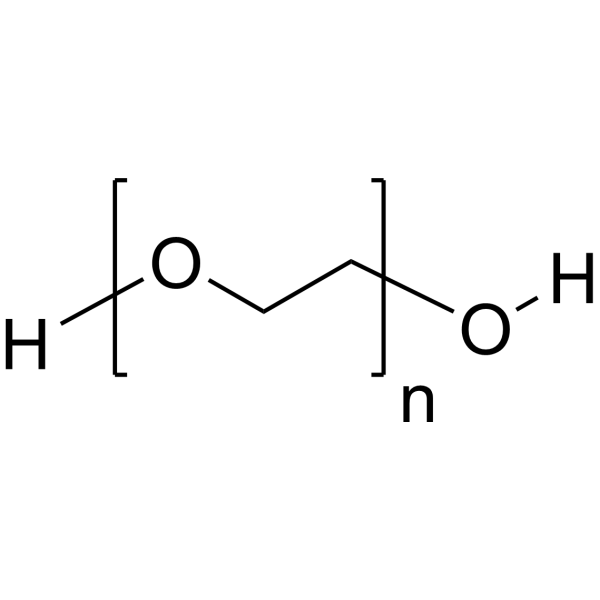
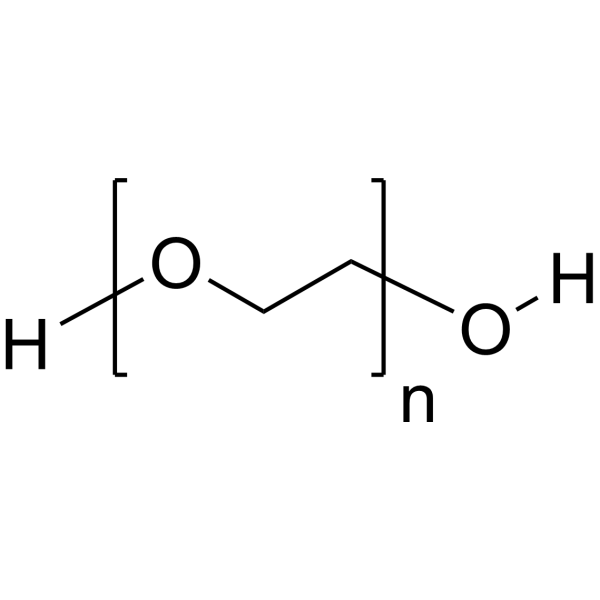
PEG6000 can be used as an excipient, such as Ointment base, lubricant, etc. Pharmaceutical excipients, or pharmaceutical auxiliaries, refer to other chemical substances used in the pharmaceutical process other than pharmaceutical ingredients. Pharmaceutical excipients generally refer to inactive ingredients in pharmaceutical preparations, which can improve the stability, solubility and processability of pharmaceutical preparations. Pharmaceutical excipients also affect the absorption, distribution, metabolism, and elimination (ADME) processes of co-administered drugs .
|
-
-
- HY-N1132A
-
|
D-Trehalose dihydrate; α,α-Trehalose dihydrate
|
Endogenous Metabolite
|
Others
|
|
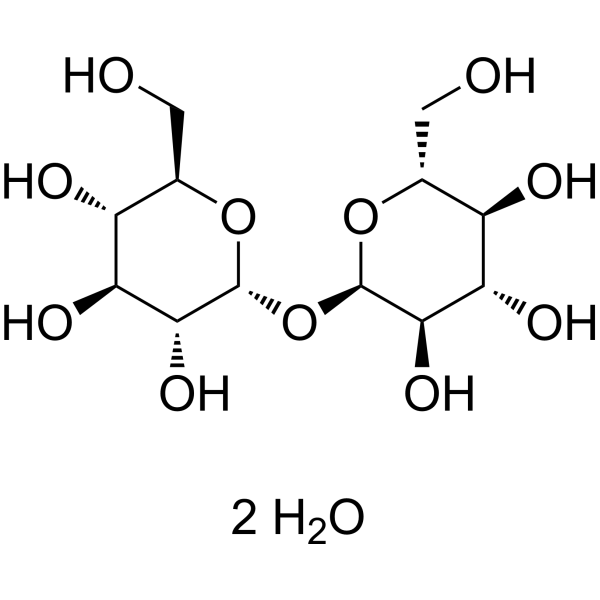
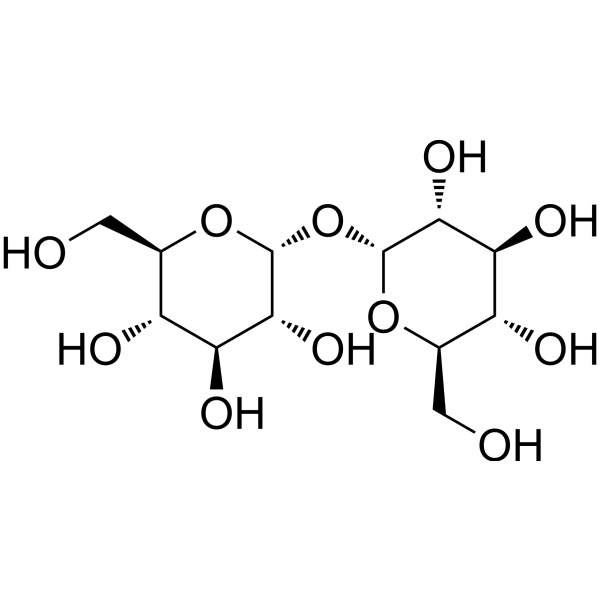
D-(+)-Trehalose dihydrate, isolated from Saccharomyces cerevisiae, can be used as a food ingredient and pharmaceutical excipient.
|
-
-
- HY-Y1316
-
|
|
Environmental Pollutants
Biochemical Assay Reagents
Apoptosis
NF-κB
|
Inflammation/Immunology
Cancer
|
|
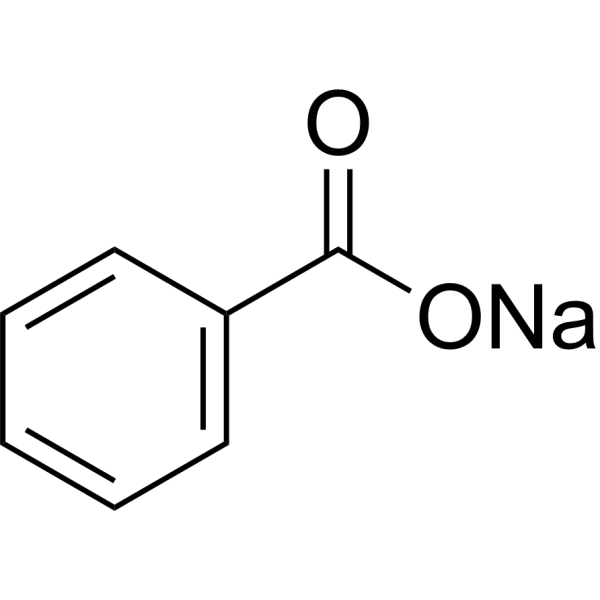
Sodium benzoate is an orally active pharmaceutical excipient, such as an antibacterial agent, preservative, lubricant, etc. Pharmaceutical excipients, or pharmaceutical auxiliaries, refer to other chemical substances used in the pharmaceutical process other than pharmaceutical ingredients. Pharmaceutical excipients generally refer to inactive ingredients in pharmaceutical preparations, which can improve the stability, solubility and processability of pharmaceutical preparations. Pharmaceutical excipients also affect the absorption, distribution, metabolism, and elimination (ADME) processes of co-administered drugs.Sodium benzoate activates NF-κB and induces Apoptosis. Sodium benzoate induces immune suppression and produces reproductively toxic. Sodium benzoate can be used for colon cancer and immune disease research .
|
-
-
- HY-Y0873H
-
PEG4000
3 Publications Verification
Polyethylene glycol 4000
|
Environmental Pollutants
Biochemical Assay Reagents
|
Others
|
|
PEG4000 can be used as an excipient, such as Ointment base, lubricant, etc. Pharmaceutical excipients, or pharmaceutical auxiliaries, refer to other chemical substances used in the pharmaceutical process other than pharmaceutical ingredients. Pharmaceutical excipients generally refer to inactive ingredients in pharmaceutical preparations, which can improve the stability, solubility and processability of pharmaceutical preparations. Pharmaceutical excipients also affect the absorption, distribution, metabolism, and elimination (ADME) processes of co-administered drugs .
|
-
-
- HY-Y0873G
-
|
Polyethylene glycol 1000
|
Environmental Pollutants
Biochemical Assay Reagents
|
Others
|
|
PEG1000 can be used as an excipient, such as Ointment base, lubricant, etc. Pharmaceutical excipients, or pharmaceutical auxiliaries, refer to other chemical substances used in the pharmaceutical process other than pharmaceutical ingredients. Pharmaceutical excipients generally refer to inactive ingredients in pharmaceutical preparations, which can improve the stability, solubility and processability of pharmaceutical preparations. Pharmaceutical excipients also affect the absorption, distribution, metabolism, and elimination (ADME) processes of co-administered drugs .
|
-
-
- HY-N1446C
-
-
-
- HY-Y0850J
-
|
PVA (Mw 13000-23000, 87-89% hydrolyzed); Poly(Ethenol) (Mw 13000-23000, 87-89% hydrolyzed)
|
Environmental Pollutants
Biochemical Assay Reagents
|
Cancer
|
|
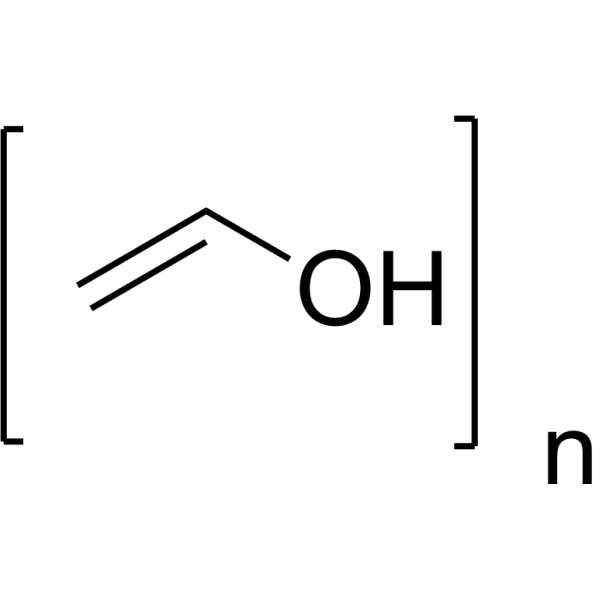
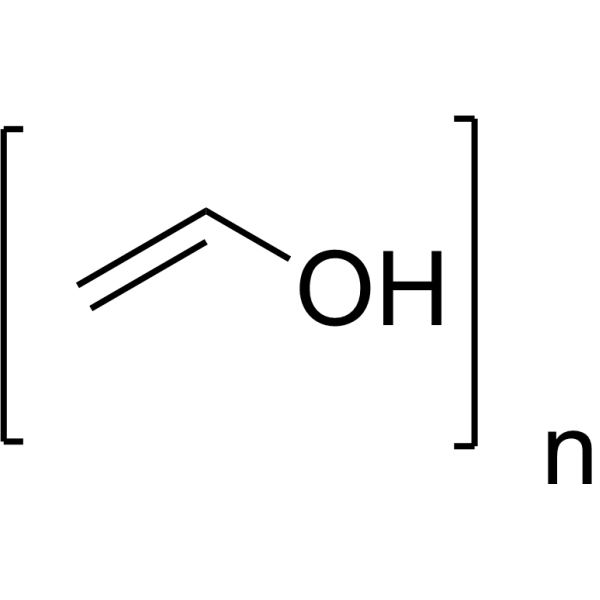
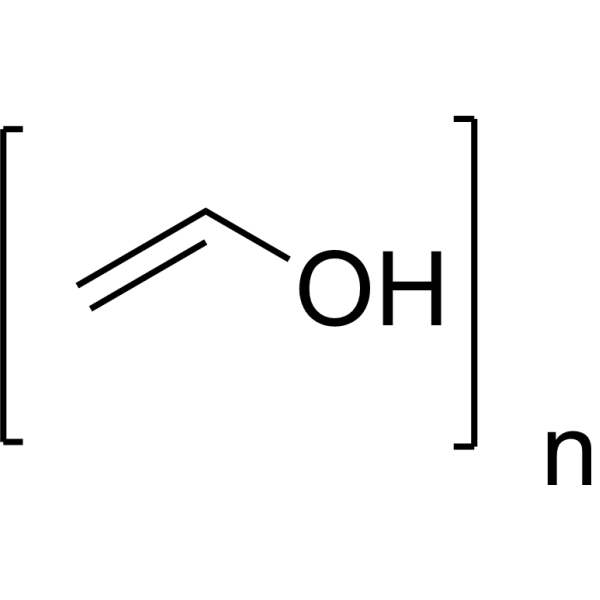
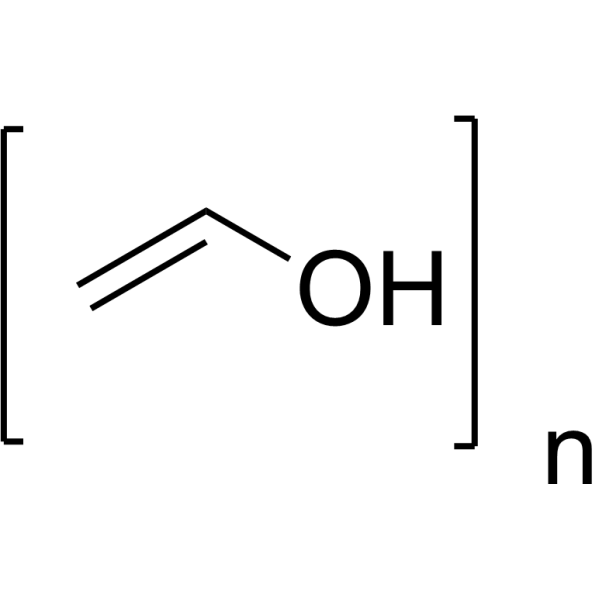
Polyvinyl alcohol (Mw 13000-23000, 87-89% hydrolyzed) is a polyvinyl alcohol with a molecular weight of 130000-23000 and hydrolytic properties. Polyvinyl alcohol (Mw 13000-23000, 87-89% hydrolyzed) is the hydrolysis and removal of acetate groups after the polymerization of ethylene acetate and polyvinyl alcohol is obtained. A degree of hydrolysis of 87-89% indicates that a large part of the acetate groups have been removed, resulting in a large number of hydroxyl groups in the PVA structure. Polyvinyl alcohol with different degrees of hydrolysis can be used to self-crosslink to form cryogel, which can be used as biological excipient. Polyvinyl alcohol can be used in tissue engineering by electrospinning. Polyvinyl alcohol can achieve high cellular density, infiltration, and uniform distribution, facilitating functional connections between cells. Polyvinyl alcohol can improve cell vitality through in vitro cultivation. Polyvinyl alcohol demonstrates promising inhibition of ostersarcoma cancer cells with Doxorubicin (HY-15142A) .
|
-
-
- HY-Y0873F
-
|
Polyethylene glycol 600
|
Environmental Pollutants
Biochemical Assay Reagents
|
Others
|
|
PEG600 can be used as an excipient, such as ointment base, lubricant. Pharmaceutical excipients, or pharmaceutical auxiliaries, refer to other chemical substances used in the pharmaceutical process other than pharmaceutical ingredients. Pharmaceutical excipients generally refer to inactive ingredients in pharmaceutical preparations, which can improve the stability, solubility and processability of pharmaceutical preparations. Pharmaceutical excipients also affect the absorption, distribution, metabolism, and elimination (ADME) processes of co-administered drugs .
|
-
-
- HY-W250795
-
|
Maltodextrin; Dextrin maize starch
|
Environmental Pollutants
Biochemical Assay Reagents
|
Others
|
|
Maltodextrin, dextrose equivalent 16.5-19.5 can be used as an excipient. Pharmaceutical excipients, or pharmaceutical auxiliaries, refer to other chemical substances used in the pharmaceutical process other than pharmaceutical ingredients. Pharmaceutical excipients generally refer to inactive ingredients in pharmaceutical preparations, which can improve the stability, solubility and processability of pharmaceutical preparations. Pharmaceutical excipients also affect the absorption, distribution, metabolism, and elimination (ADME) processes of co-administered drugs .
|
-
-
- HY-W051271
-
|
Titanium dioxide
|
Environmental Pollutants
Reactive Oxygen Species (ROS)
Photosensitizer
|
Others
|
|
Titanium(IV) oxide is a photosensitizer and photocatalyst. Titanium(IV) oxide can be used as a pharmaceutical excipient such as a flow aid, coating agent, sunscreen, colorant, etc. Pharmaceutical excipients or pharmaceutical excipients refer to other chemical substances used in the pharmaceutical process other than the drug ingredients. Pharmaceutical excipients generally refer to inactive ingredients in pharmaceutical preparations that can improve the stability, solubility and processability of pharmaceutical preparations. Pharmaceutical excipients also affect the absorption, distribution, metabolism and elimination (ADME) process of co-administered drugs. Titanium(IV) oxide can use light energy to generate electron-hole pairs to degrade pollutants. Photons excite electrons in TiO2 to generate active oxygen species (such as ·OH and ·O2 -), thereby oxidizing and mineralizing pollutants such as organic compounds and heavy metals. TiO2 can be used in the research of environmental remediation fields such as water treatment, air purification and self-cleaning materials .
|
-
-
- HY-W115786
-
-
-
- HY-Y0873E
-
|
Polyethylene glycol 1500
|
Environmental Pollutants
Biochemical Assay Reagents
|
Others
|
|
PEG1500 can be used as an excipient, such as ointment base, lubricant. Pharmaceutical excipients, or pharmaceutical auxiliaries, refer to other chemical substances used in the pharmaceutical process other than pharmaceutical ingredients. Pharmaceutical excipients generally refer to inactive ingredients in pharmaceutical preparations, which can improve the stability, solubility and processability of pharmaceutical preparations. Pharmaceutical excipients also affect the absorption, distribution, metabolism, and elimination (ADME) processes of co-administered drugs .
|
-
-
- HY-Y1054
-
|
Stearic Acid Magnesium(II) Salt
|
Environmental Pollutants
Biochemical Assay Reagents
|
Others
|
|
Magnesium stearate is a commonly used pharmaceutical lubricant. But Magnesium stearate leads to an adverse effect on bonding between particles. Magnesium stearate can be used as an excipient, such as lubricant. Pharmaceutical excipients, or pharmaceutical auxiliaries, refer to other chemical substances used in the pharmaceutical process other than pharmaceutical ingredients. Pharmaceutical excipients generally refer to inactive ingredients in pharmaceutical preparations, which can improve the stability, solubility and processability of pharmaceutical preparations. Pharmaceutical excipients also affect the absorption, distribution, metabolism, and elimination (ADME) processes of co-administered drugs .
|
-
-
- HY-Y0850L
-
|
PVA (Mw 85000-124000, 99+% hydrolyzed); Poly(Ethenol) (Mw 85000-124000, 99+% hydrolyzed)
|
Environmental Pollutants
Biochemical Assay Reagents
|
Cancer
|
|
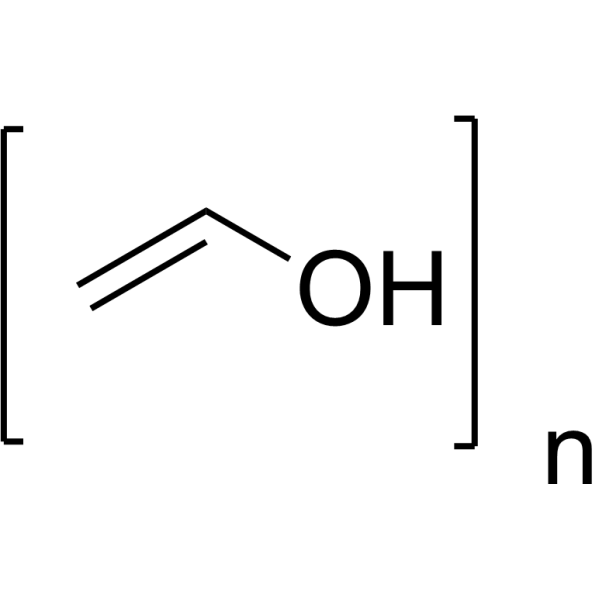
Polyvinyl alcohol (Mw 85000-124000, 99+% hydrolyzed) is a polyvinyl alcohol with a molecular weight of 85000-124000 and hydrolytic properties. Polyvinyl alcohol (Mw 85000-124000, 99+% hydrolyzed) forms hydrogels that can be used to simulate digestive organs and lesion models for the training of endoscopic ultrasound (EUS) and endoscopic ultrasound elastography (EUS-E). Polyvinyl alcohol with different degrees of hydrolysis can be used to self-crosslink to form cryogel, which can be used as biological excipients .
|
-
-
- HY-W129988
-
-
-
- HY-W019883
-
-
-
- HY-Y1213
-
|
|
Biochemical Assay Reagents
Drug Intermediate
|
Others
|
|
Carbon possesses unique physicochemical properties such as electrical and structural characteristics, making it a core material in the field of fuel cells. Carbon also serves as a pharmaceutical excipient and can be used in the synthesis of other compounds .
|
-
-
- HY-Y0850P
-
|
PVA (Mw 146000-186000, 87-89% hydrolyzed); Poly(Ethenol) (Mw 146000-186000, 87-89% hydrolyzed)
|
Environmental Pollutants
Biochemical Assay Reagents
|
Cancer
|
|
Polyvinyl alcohol (Mw 146000-186000, 87-89% hydrolyzed) is a polyvinyl alcohol with a molecular weight of 146000-186000 and hydrolytic properties. Polyvinyl alcohol (Mw 146000-186000, 87-89% hydrolyzed) is the hydrolysis and removal of acetate groups after the polymerization of ethylene acetate. And polyvinyl alcohol is obtained. Polyvinyl alcohol with different degrees of hydrolysis can be used to self-crosslink to form cryogel, which can be used as biological excipient. Polyvinyl alcohol can be used in tissue engineering by electrospinning. Polyvinyl alcohol can achieve high cellular density, infiltration, and uniform distribution, facilitating functional connections between cells. Polyvinyl alcohol can improve cell vitality through in vitro cultivation. Polyvinyl alcohol demonstrates promising inhibition of ostersarcoma cancer cells with Doxorubicin (HY-15142A) .
|
-
-
- HY-100557
-
|
|
Environmental Pollutants
Biochemical Assay Reagents
Interleukin Related
|
Metabolic Disease
Inflammation/Immunology
|
|
Hydroxypropyl Cellulose is an orally active cellulose ether and surfactant. Hydroxypropyl cellulose is divided into high-substituted HPC (HHPC) and low-substituted HPC (LHPC). Hydroxypropyl Cellulose reduces inflammatory mediators (IL-6, IL-1β). Hydroxypropyl Cellulose improves colitis and obesity. Hydroxypropyl Cellulose can be used as a pharmaceutical excipient, such as coating agent, emulsifier, suspension, tablet, thickener, viscosifier .
|
-
-
- HY-N11684
-
|
|
Biochemical Assay Reagents
|
Others
|
|
Cocoa butter can be used as an excipient, such as lubricants, suppository bases. Pharmaceutical excipients, or pharmaceutical auxiliaries, refer to other chemical substances used in the pharmaceutical process other than pharmaceutical ingredients. Pharmaceutical excipients generally refer to inactive ingredients in pharmaceutical preparations, which can improve the stability, solubility and processability of pharmaceutical preparations. Pharmaceutical excipients also affect the absorption, distribution, metabolism, and elimination (ADME) processes of co-administered drugs .
|
-
-
- HY-W011426
-
|
Propan-2-yl hexadecanoate
|
Environmental Pollutants
Biochemical Assay Reagents
Liposome
|
Others
|
|
Isopropyl palmitate is an fatty acid ester. Isopropyl palmitate can be used for design and characterization of bioactive bilayer films. The bilayer membrane not only has the ability to scavenge free radicals and inhibit lipid peroxidation, but also can inhibit the growth of known foodborne pathogens. Isopropyl palmitate can be used as an excipient, such as lubricant, oily carrier, solvent, controlled-release transdermal film. Pharmaceutical excipients, or pharmaceutical auxiliaries, refer to other chemical substances used in the pharmaceutical process other than pharmaceutical ingredients. Pharmaceutical excipients generally refer to inactive ingredients in pharmaceutical preparations, which can improve the stability, solubility and processability of pharmaceutical preparations. Pharmaceutical excipients also affect the absorption, distribution, metabolism, and elimination (ADME) processes of co-administered drugs .
|
-
-
- HY-45072
-
|
|
Environmental Pollutants
Biochemical Assay Reagents
|
Others
|
|
Croscarmellose sodium is a commonly used pharmaceutical additive approved by the US Food and Drug Administration (FDA). Croscarmellose sodium is used as excipients, such as the suspending agent, binder, glidant, antiadherent, and disintegrants .
|
-
-
- HY-W115746
-
|
Ethyl cellulose N-200
|
Environmental Pollutants
Biochemical Assay Reagents
|
Infection
Cancer
|
|
Ethyl cellulose is a derivative of cellulose. Ethyl cellulose is a non-toxic, biodegradable polymer. Ethyl cellulose has unique properties such as oil gel formation, active ingredient delivery and film formation. Ethyl cellulose can be used as a pharmaceutical excipient, such as a coating agent, flavoring agent, tablet filler, etc. Ethyl cellulose can be used to prepare nanoparticles for active compound delivery .
|
-
-
- HY-N7393
-
|
Palatinitol
|
Environmental Pollutants
Lactate Dehydrogenase
|
Metabolic Disease
|
|
Isomalt (Palatinitol), a well-tolerated, non-toxic polyol and a protein-stabilizing excipient, stabilizes lactate dehydrogenase (LDH) moderately during freeze-drying, and performs better during storage. Isomalt is traditionally used as a sweetening agent in the food industry and as a tabletting excipient for pharmaceutical purposes .
|
-
-
- HY-W422419
-
|
Cetostearyl alcohol
|
Biochemical Assay Reagents
|
Others
|
|
Cetearyl alcohol can be used as an excipient. Pharmaceutical excipients, or pharmaceutical auxiliaries, refer to other chemical substances used in the pharmaceutical process other than pharmaceutical ingredients. Pharmaceutical excipients generally refer to inactive ingredients in pharmaceutical preparations, which can improve the stability, solubility and processability of pharmaceutical preparations. Pharmaceutical excipients also affect the absorption, distribution, metabolism, and elimination (ADME) processes of co-administered drugs .
|
-
-
- HY-154631
-
|
|
Biochemical Assay Reagents
|
Others
|
|
Peanut Oil can be used as an excipient. Pharmaceutical excipients, or pharmaceutical auxiliaries, refer to other chemical substances used in the pharmaceutical process other than pharmaceutical ingredients. Pharmaceutical excipients generally refer to inactive ingredients in pharmaceutical preparations, which can improve the stability, solubility and processability of pharmaceutical preparations. Pharmaceutical excipients also affect the absorption, distribution, metabolism, and elimination (ADME) processes of co-administered drugs .
|
-
-
- HY-W392209A
-
|
|
Environmental Pollutants
Biochemical Assay Reagents
|
Others
|
|
Copovidone can be used as an excipient, such as Film formers, adhesives, etc. Pharmaceutical excipients, or pharmaceutical auxiliaries, refer to other chemical substances used in the pharmaceutical process other than pharmaceutical ingredients. Pharmaceutical excipients generally refer to inactive ingredients in pharmaceutical preparations, which can improve the stability, solubility and processability of pharmaceutical preparations. Pharmaceutical excipients also affect the absorption, distribution, metabolism, and elimination (ADME) processes of co-administered drugs .
|
-
-
- HY-154696
-
|
|
Biochemical Assay Reagents
|
Others
|
|
Ferric oxide, yellow can be used as an excipient, such as colorant. Pharmaceutical excipients, or pharmaceutical auxiliaries, refer to other chemical substances used in the pharmaceutical process other than pharmaceutical ingredients. Pharmaceutical excipients generally refer to inactive ingredients in pharmaceutical preparations, which can improve the stability, solubility and processability of pharmaceutical preparations. Pharmaceutical excipients also affect the absorption, distribution, metabolism, and elimination (ADME) processes of co-administered drugs .
|
-
-
- HY-112754AGL
-
|
1,2-Dioleoyl-3-trimethylammonium-propane chloride (GMP Like)
|
Liposome
|
Others
|
|
DOTAP chloride (GMP Like) is the GMP Like class DOTAP chloride (HY-112754A). GMP small molecules works appropriately as an auxiliary reagent for cell therapy manufacture. DOTAP chloride is a cationic lipid with good membrane fusion ability and biocompatibility. DOTAP chloride (GMP Like) can be used as an excipient for transient and stable transfection DNA (plasmids, bacmids) and modified nucleic acids (antisense oligonucleotides) without the use of helper lipid .
|
-
-
- HY-Y0708
-
|
Calcium phosphate dihydrate
|
Biochemical Assay Reagents
|
Others
|
|
Calcium hydrogen phosphate dihydrate (Calcium phosphate dihydrate) can be found quite frequently in urinary calculi stones. Calcium hydrogen phosphate dihydrate can be used as an excipient, such as diluent, adsorbent. Pharmaceutical excipients, or pharmaceutical auxiliaries, refer to other chemical substances used in the pharmaceutical process other than pharmaceutical ingredients. Pharmaceutical excipients generally refer to inactive ingredients in pharmaceutical preparations, which can improve the stability, solubility and processability of pharmaceutical preparations. Pharmaceutical excipients also affect the absorption, distribution, metabolism, and elimination (ADME) processes of co-administered drugs .
|
-
-
- HY-W250795B
-
|
|
Biochemical Assay Reagents
|
Others
|
|
Maltodextrin, dextrose equivalent 5.0-8.0 can be used as an excipient. Pharmaceutical excipients, or pharmaceutical auxiliaries, refer to other chemical substances used in the pharmaceutical process other than pharmaceutical ingredients. Pharmaceutical excipients generally refer to inactive ingredients in pharmaceutical preparations, which can improve the stability, solubility and processability of pharmaceutical preparations. Pharmaceutical excipients also affect the absorption, distribution, metabolism, and elimination (ADME) processes of co-administered drugs .
|
-
-
- HY-D1005F
-
|
PEG-PPG-PEG, 2500(Average Mn)
|
Environmental Pollutants
Biochemical Assay Reagents
|
Others
|
|
Poloxamer 182 (L62) can be used as an excipient, such as Emulsifier, solubilizer, lubricant, etc. Pharmaceutical excipients, or pharmaceutical auxiliaries, refer to other chemical substances used in the pharmaceutical process other than pharmaceutical ingredients. Pharmaceutical excipients generally refer to inactive ingredients in pharmaceutical preparations, which can improve the stability, solubility and processability of pharmaceutical preparations. Pharmaceutical excipients also affect the absorption, distribution, metabolism, and elimination (ADME) processes of co-administered drugs .
|
-
-
- HY-154696A
-
|
|
Biochemical Assay Reagents
|
Others
|
|
Ferric oxide, red can be used as an excipient, such as colorant. Pharmaceutical excipients, or pharmaceutical auxiliaries, refer to other chemical substances used in the pharmaceutical process other than pharmaceutical ingredients. Pharmaceutical excipients generally refer to inactive ingredients in pharmaceutical preparations, which can improve the stability, solubility and processability of pharmaceutical preparations. Pharmaceutical excipients also affect the absorption, distribution, metabolism, and elimination (ADME) processes of co-administered drugs .
|
-
-
- HY-154630
-
|
|
Biochemical Assay Reagents
|
Others
|
|
Polyoxypropylene stearyl ether can be used as an excipient, such as surfactant, softener, lubricating, wetting, plasticizing, solubilizing and dispersing properties. Pharmaceutical excipients, or pharmaceutical auxiliaries, refer to other chemical substances used in the pharmaceutical process other than pharmaceutical ingredients. Pharmaceutical excipients generally refer to inactive ingredients in pharmaceutical preparations, which can improve the stability, solubility and processability of pharmaceutical preparations. Pharmaceutical excipients also affect the absorption, distribution, metabolism, and elimination (ADME) processes of co-administered drugs .
|
-
-
- HY-W115716
-
|
Span 85
|
Environmental Pollutants
Biochemical Assay Reagents
|
Others
|
|
Sorbitan trioleate is an orally active nonionic surfactant with low toxicity (LD≥200 mg/kg). Sorbitan trioleate can be used as an excipient, such as surfactant, emulsifier, lubricant, wetting agent, dispersant, thickener, defoamer. Pharmaceutical excipients, or pharmaceutical auxiliaries, refer to other chemical substances used in the pharmaceutical process other than pharmaceutical ingredients. Pharmaceutical excipients generally refer to inactive ingredients in pharmaceutical preparations, which can improve the stability, solubility and processability of pharmaceutical preparations. Pharmaceutical excipients also affect the absorption, distribution, metabolism, and elimination (ADME) processes of co-administered drugs .
|
-
-
- HY-134098
-
|
Adipic acid diisopropyl ester
|
Environmental Pollutants
TRP Channel
|
Others
|
|
Diisopropyl adipate is an alternative plasticizer and a TRPA1 activator. Diisopropyl adipate activates TRPA1 and enhances FITC-induced contact hypersensitivity (CHS).Diisopropyl adipate also serves as an ingredient in cosmetics and drug formulations topically applied to the skin. Diisopropyl adipate can be used as an excipient, such as emollients, plasticizers. Pharmaceutical excipients, or pharmaceutical auxiliaries, refer to other chemical substances used in the pharmaceutical process other than pharmaceutical ingredients. Pharmaceutical excipients generally refer to inactive ingredients in pharmaceutical preparations, which can improve the stability, solubility and processability of pharmaceutical preparations. Pharmaceutical excipients also affect the absorption, distribution, metabolism, and elimination (ADME) processes of co-administered drugs .
|
-
-
- HY-W099536
-
|
Tetraoxyethylene glycol monododecyl ether
|
Biochemical Assay Reagents
|
Others
|
|
PEG-4 lauryl ether is a non-ionic detergent that can be used as an excipient or for the isolation of functional membrane complexes .
|
-
-
- HY-134783
-
|
|
Liposome
|
Others
|
|
1,19-Bis(2-butyloctyl) 10-[[3-(dimethylamino)propyl](1-oxononyl)amino]nonadecanedioate is an excipient for vaccines. 1,19-Bis(2-butyloctyl) 10-[[3-(dimethylamino)propyl](1-oxononyl)amino]nonadecanedioate can be used for the research of the development of COVID-19 vaccines and drug delivery for gene therapy .
|
-
-
- HY-154639
-
|
|
Environmental Pollutants
Biochemical Assay Reagents
|
Others
|
|
Polyoxyl 20 Cetostearyl Ether can be used as an excipient, such as Emulsifier and solubilizer for emulsions and creams, etc. Pharmaceutical excipients, or pharmaceutical auxiliaries, refer to other chemical substances used in the pharmaceutical process other than pharmaceutical ingredients. Pharmaceutical excipients generally refer to inactive ingredients in pharmaceutical preparations, which can improve the stability, solubility and processability of pharmaceutical preparations. Pharmaceutical excipients also affect the absorption, distribution, metabolism, and elimination (ADME) processes of co-administered drugs .
|
-
-
- HY-W013482
-
|
Benzyl Paraben
|
Biochemical Assay Reagents
|
Others
|
|
Benzyl 4-hydroxybenzoate is a prominent material. Benzyl 4-hydroxybenzoate can be used as an excipient, such as bacteriostatic agent, preservative. Pharmaceutical excipients, or pharmaceutical auxiliaries, refer to other chemical substances used in the pharmaceutical process other than pharmaceutical ingredients. Pharmaceutical excipients generally refer to inactive ingredients in pharmaceutical preparations, which can improve the stability, solubility and processability of pharmaceutical preparations. Pharmaceutical excipients also affect the absorption, distribution, metabolism, and elimination (ADME) processes of co-administered drugs .
|
-
-
- HY-154739A
-
|
|
Biochemical Assay Reagents
|
Others
|
|
Amorphous silica can be used as an excipient, such as viscosifier, suspending agent, tablet disintegrating agent, adsorbent dispersing agent as liquid in powders. Pharmaceutical excipients, or pharmaceutical auxiliaries, refer to other chemical substances used in the pharmaceutical process other than pharmaceutical ingredients. Pharmaceutical excipients generally refer to inactive ingredients in pharmaceutical preparations, which can improve the stability, solubility and processability of pharmaceutical preparations. Pharmaceutical excipients also affect the absorption, distribution, metabolism, and elimination (ADME) processes of co-administered drugs .
|
-
-
- HY-154636A
-
|
|
Biochemical Assay Reagents
|
Others
|
|
Light Liquid Paraffin can be used as an excipient, such as excipient, lubricant. Pharmaceutical excipients, or pharmaceutical auxiliaries, refer to other chemical substances used in the pharmaceutical process other than pharmaceutical ingredients. Pharmaceutical excipients generally refer to inactive ingredients in pharmaceutical preparations, which can improve the stability, solubility and processability of pharmaceutical preparations. Pharmaceutical excipients also affect the absorption, distribution, metabolism, and elimination (ADME) processes of co-administered drugs .
|
-
-
- HY-W020027
-
|
2-Methylacrylamide
|
Environmental Pollutants
Biochemical Assay Reagents
|
Others
|
|
Methacrylamide can be used as an excipient. Pharmaceutical excipients, or pharmaceutical auxiliaries, refer to other chemical substances used in the pharmaceutical process other than pharmaceutical ingredients. Pharmaceutical excipients generally refer to inactive ingredients in pharmaceutical preparations, which can improve the stability, solubility and processability of pharmaceutical preparations. Pharmaceutical excipients also affect the absorption, distribution, metabolism, and elimination (ADME) processes of co-administered drugs .
|
-
-
- HY-138300GL
-
|
|
Liposome
|
Inflammation/Immunology
|
|
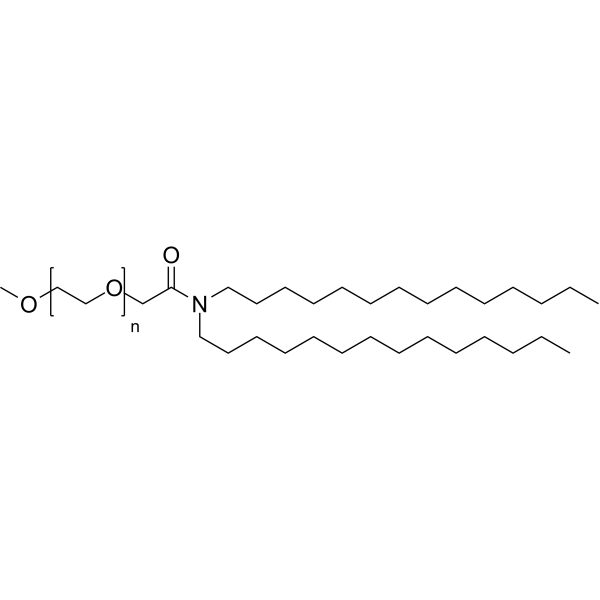
ALC-0159 (GMP Like) is the GMP Like class ALC-0159 (HY-138300). GMP small molecules works appropriately as an auxiliary reagent for cell therapy manufacture. ALC-0159, a polyethylene glycol (PEG) lipid conjugate, could be used as vaccine excipient .
|
-
-
- HY-Y0850U8
-
|
Polyvinyl alcohol (Mw 47000, 98-99% hydrolyzed, ~1000 polymerization); Poly(Ethenol) (Mw 47000, 98-99% hydrolyzed, ~1000 polymerization)
|
Biochemical Assay Reagents
|
Others
|
|
PVA (Mw 47000, 98-99% hydrolyzed, ~1000 polymerization) is a polyvinyl alcohol with molecular weight of 47000 with hydrolysis properties. Hydrolysis degree refers to the conversion rate of acetic acid group hydrolysis to hydroxyl group in the original polyvinyl acetate, PVA (Mw 47000, 98-99% hydrolyzed, ~1000 polymerization). In addition, polyvinyl alcohol is obtained from polymerization of vinyl acetate to remove acetic acid group by hydrolysis. Polyvinyl alcohol with different degrees of hydrolysis can be self-crosslinked to form frozen gels and used as biological excipients .
|
-
-
- HY-Y0302
-
-
-
- HY-100557A
-
|
|
Biochemical Assay Reagents
|
Others
|
|
Low-Substituted Hydroxypropyl Cellulose can be used as an excipient, such as Coating agents, emulsifiers, suspensions, tablets, thickeners, thickeners, etc. Pharmaceutical excipients, or pharmaceutical auxiliaries, refer to other chemical substances used in the pharmaceutical process other than pharmaceutical ingredients. Pharmaceutical excipients generally refer to inactive ingredients in pharmaceutical preparations, which can improve the stability, solubility and processability of pharmaceutical preparations. Pharmaceutical excipients also affect the absorption, distribution, metabolism, and elimination (ADME) processes of co-administered drugs .
|
-
-
- HY-157049
-
|
|
Biochemical Assay Reagents
|
Others
|
|
Caprylocaproyl Macrogolglycerides is a lipoidic excipient/vehicle in an oral capsule formulation. Caprylocaproyl Macrogolglycerides can enhance the absorption of small molecule compounds .
|
-
-
- HY-101530A
-
|
PEG 8 stearate
|
Biochemical Assay Reagents
|
Others
|
|
Polyoxyl 8 stearate can be used as an excipient. Pharmaceutical excipients, or pharmaceutical auxiliaries, refer to other chemical substances used in the pharmaceutical process other than pharmaceutical ingredients. Pharmaceutical excipients generally refer to inactive ingredients in pharmaceutical preparations, which can improve the stability, solubility and processability of pharmaceutical preparations. Pharmaceutical excipients also affect the absorption, distribution, metabolism, and elimination (ADME) processes of co-administered drugs .
|
-
- HY-W127624A
-
|
|
Biochemical Assay Reagents
|
Others
|
|
PEG 18 cetostearyl ether can be used as an excipient. Pharmaceutical excipients, or pharmaceutical auxiliaries, refer to other chemical substances used in the pharmaceutical process other than pharmaceutical ingredients. Pharmaceutical excipients generally refer to inactive ingredients in pharmaceutical preparations, which can improve the stability, solubility and processability of pharmaceutical preparations. Pharmaceutical excipients also affect the absorption, distribution, metabolism, and elimination (ADME) processes of co-administered drugs .
|
-
- HY-154634
-
|
|
Biochemical Assay Reagents
|
Others
|
|
Cyclomethicone can be used as an excipient, such as emollients, humectants, thickeners. Pharmaceutical excipients, or pharmaceutical auxiliaries, refer to other chemical substances used in the pharmaceutical process other than pharmaceutical ingredients. Pharmaceutical excipients generally refer to inactive ingredients in pharmaceutical preparations, which can improve the stability, solubility and processability of pharmaceutical preparations. Pharmaceutical excipients also affect the absorption, distribution, metabolism, and elimination (ADME) processes of co-administered drugs .
|
-
- HY-154635
-
|
|
Biochemical Assay Reagents
|
Others
|
|
Oxidized paraffin (calcium) can be used as an excipient, such as ointment base, hardening agent. Pharmaceutical excipients, or pharmaceutical auxiliaries, refer to other chemical substances used in the pharmaceutical process other than pharmaceutical ingredients. Pharmaceutical excipients generally refer to inactive ingredients in pharmaceutical preparations, which can improve the stability, solubility and processability of pharmaceutical preparations. Pharmaceutical excipients also affect the absorption, distribution, metabolism, and elimination (ADME) processes of co-administered drugs .
|
-
- HY-154739
-
|
|
Biochemical Assay Reagents
|
Others
|
|
Cristobalite can be used as an excipient, such as disintegrants, anti-adhesives, glidants, suspending agents, thickeners, defoamers. Pharmaceutical excipients, or pharmaceutical auxiliaries, refer to other chemical substances used in the pharmaceutical process other than pharmaceutical ingredients. Pharmaceutical excipients generally refer to inactive ingredients in pharmaceutical preparations, which can improve the stability, solubility and processability of pharmaceutical preparations. Pharmaceutical excipients also affect the absorption, distribution, metabolism, and elimination (ADME) processes of co-administered drugs .
|
-
- HY-Y1316R
-
|
|
Biochemical Assay Reagents
Reference Standards
|
Others
|
|
Sodium benzoate (Standard) is the analytical standard of Sodium benzoate. This product is intended for research and analytical applications. Sodium benzoate can be used as an excipient, such as antimicrobial agent, preservative, lubricant. Pharmaceutical excipients, or pharmaceutical auxiliaries, refer to other chemical substances used in the pharmaceutical process other than pharmaceutical ingredients. Pharmaceutical excipients generally refer to inactive ingredients in pharmaceutical preparations, which can improve the stability, solubility and processability of pharmaceutical preparations. Pharmaceutical excipients also affect the absorption, distribution, metabolism, and elimination (ADME) processes of co-administered drugs .
|
-
- HY-W115818
-
|
|
Environmental Pollutants
Biochemical Assay Reagents
|
Others
|
|
Polyoxyethylene Sorbitan Monostearate is an ester of the saturated fatty acid stearic acid (C18:0). Polyoxyethylene Sorbitan Monostearate can be used as an excipient, such as surfactant, emulsifier, solubilizer, wetting agent. Pharmaceutical excipients, or pharmaceutical auxiliaries, refer to other chemical substances used in the pharmaceutical process other than pharmaceutical ingredients. Pharmaceutical excipients generally refer to inactive ingredients in pharmaceutical preparations, which can improve the stability, solubility and processability of pharmaceutical preparations. Pharmaceutical excipients also affect the absorption, distribution, metabolism, and elimination (ADME) processes of co-administered drugs .
|
-
- HY-Y1054R
-
|
Stearic Acid Magnesium(II) Salt (Standard)
|
Biochemical Assay Reagents
Reference Standards
|
Others
|
|
Magnesium stearate (Standard) is the analytical standard of Magnesium stearate. This product is intended for research and analytical applications. Magnesium stearate is a commonly used pharmaceutical lubricant. But Magnesium stearate leads to an adverse effect on bonding between particles. Magnesium stearate can be used as an excipient, such as lubricant. Pharmaceutical excipients, or pharmaceutical auxiliaries, refer to other chemical substances used in the pharmaceutical process other than pharmaceutical ingredients. Pharmaceutical excipients generally refer to inactive ingredients in pharmaceutical preparations, which can improve the stability, solubility and processability of pharmaceutical preparations. Pharmaceutical excipients also affect the absorption, distribution, metabolism, and elimination (ADME) processes of co-administered drugs .
|
-
- HY-112005GL
-
|
Dioleoylphosphatidylethanolamine (GMP Like); 1,2-Dioleoyl-sn-glycero-3-phosphoethanolamine (GMP Like)
|
Liposome
Endogenous Metabolite
|
Inflammation/Immunology
|
|
DOPE (GMP Like) is the GMP Like class DOPE (HY-112005), and can be used as pharmaceutical excipients. GMP small molecules works appropriately as an auxiliary reagent for cell therapy manufacture. DOPE is a neutral helper lipid for cationic liposome and combines with cationic phospholipids to improve transfection efficiency of naked siRNA .
|
-
- HY-154637
-
|
|
Biochemical Assay Reagents
|
Others
|
|
Sucrose Stearate can be used as an excipient, such as Surfactants, emulsifiers, solubilizers, etc. Pharmaceutical excipients, or pharmaceutical auxiliaries, refer to other chemical substances used in the pharmaceutical process other than pharmaceutical ingredients. Pharmaceutical excipients generally refer to inactive ingredients in pharmaceutical preparations, which can improve the stability, solubility and processability of pharmaceutical preparations. Pharmaceutical excipients also affect the absorption, distribution, metabolism, and elimination (ADME) processes of co-administered drugs .
|
-
- HY-W250795A
-
|
|
Biochemical Assay Reagents
|
Others
|
|
Maltodextrin, dextrose equivalent 13.0-17.0 can be used as an excipient. Pharmaceutical excipients, or pharmaceutical auxiliaries, refer to other chemical substances used in the pharmaceutical process other than pharmaceutical ingredients. Pharmaceutical excipients generally refer to inactive ingredients in pharmaceutical preparations, which can improve the stability, solubility and processability of pharmaceutical preparations. Pharmaceutical excipients also affect the absorption, distribution, metabolism, and elimination (ADME) processes of co-administered drugs .
|
-
- HY-W250721E
-
|
Carboxy polymethylene (copolymer)
|
Biochemical Assay Reagents
|
Others
|
|
Carbomer copolymer can be used as an excipient, such as Bioadhesives, emulsifiers, release modifiers, suspending agents, tablet binders, viscosity enhancers, etc. Pharmaceutical excipients, or pharmaceutical auxiliaries, refer to other chemical substances used in the pharmaceutical process other than pharmaceutical ingredients. Pharmaceutical excipients generally refer to inactive ingredients in pharmaceutical preparations, which can improve the stability, solubility and processability of pharmaceutical preparations. Pharmaceutical excipients also affect the absorption, distribution, metabolism, and elimination (ADME) processes of co-administered drugs .
|
-
- HY-W127624C
-
|
|
Biochemical Assay Reagents
|
Others
|
|
PEG 20 cetostearyl ether can be used as an excipient. Pharmaceutical excipients, or pharmaceutical auxiliaries, refer to other chemical substances used in the pharmaceutical process other than pharmaceutical ingredients. Pharmaceutical excipients generally refer to inactive ingredients in pharmaceutical preparations, which can improve the stability, solubility and processability of pharmaceutical preparations. Pharmaceutical excipients also affect the absorption, distribution, metabolism, and elimination (ADME) processes of co-administered drugs .
|
-
- HY-154632
-
|
|
Biochemical Assay Reagents
|
Others
|
|
Omega 3 fatty acid triglycerides can be used as an excipient. Pharmaceutical excipients, or pharmaceutical auxiliaries, refer to other chemical substances used in the pharmaceutical process other than pharmaceutical ingredients. Pharmaceutical excipients generally refer to inactive ingredients in pharmaceutical preparations, which can improve the stability, solubility and processability of pharmaceutical preparations. Pharmaceutical excipients also affect the absorption, distribution, metabolism, and elimination (ADME) processes of co-administered drugs .
|
-
- HY-W127624B
-
|
|
Biochemical Assay Reagents
|
Others
|
|
PEG 25 cetostearyl ether can be used as an excipient. Pharmaceutical excipients, or pharmaceutical auxiliaries, refer to other chemical substances used in the pharmaceutical process other than pharmaceutical ingredients. Pharmaceutical excipients generally refer to inactive ingredients in pharmaceutical preparations, which can improve the stability, solubility and processability of pharmaceutical preparations. Pharmaceutical excipients also affect the absorption, distribution, metabolism, and elimination (ADME) processes of co-administered drugs .
|
-
- HY-W142428
-
|
Diethylene glycol monododecyl ether
|
Biochemical Assay Reagents
|
Others
|
|
PEG 2 lauryl ether can be used as an excipient. Pharmaceutical excipients, or pharmaceutical auxiliaries, refer to other chemical substances used in the pharmaceutical process other than pharmaceutical ingredients. Pharmaceutical excipients generally refer to inactive ingredients in pharmaceutical preparations, which can improve the stability, solubility and processability of pharmaceutical preparations. Pharmaceutical excipients also affect the absorption, distribution, metabolism, and elimination (ADME) processes of co-administered drugs .
|
-
- HY-W131101
-
|
|
Environmental Pollutants
Liposome
|
Others
|
|
Sorbitan tristearate is a non-ionic surfactant, with a synergistic effect on skin permeability. Sorbitan tristearate can be used as an excipient, such as emulsifier. Pharmaceutical excipients, or pharmaceutical auxiliaries, refer to other chemical substances used in the pharmaceutical process other than pharmaceutical ingredients. Pharmaceutical excipients generally refer to inactive ingredients in pharmaceutical preparations, which can improve the stability, solubility and processability of pharmaceutical preparations. Pharmaceutical excipients also affect the absorption, distribution, metabolism, and elimination (ADME) processes of co-administered drugs .
|
-
- HY-27979
-
|
|
Biochemical Assay Reagents
|
Others
|
|
Ethyl acrylate-methyl methacrylate copolymer can be used as an excipient, such as sustained-release coating materials, matrix sustained-release tablet binders and retarders. Pharmaceutical excipients, or pharmaceutical auxiliaries, refer to other chemical substances used in the pharmaceutical process other than pharmaceutical ingredients. Pharmaceutical excipients generally refer to inactive ingredients in pharmaceutical preparations, which can improve the stability, solubility and processability of pharmaceutical preparations. Pharmaceutical excipients also affect the absorption, distribution, metabolism, and elimination (ADME) processes of co-administered drugs .
|
-
- HY-154703
-
|
|
Biochemical Assay Reagents
|
Others
|
|
Aluminum magnesium silicate can be used as an excipient, such as adsorbent, stabilizer, suspending agent, disintegrant for tablet and capsule, binder for tablet, thickener. Pharmaceutical excipients, or pharmaceutical auxiliaries, refer to other chemical substances used in the pharmaceutical process other than pharmaceutical ingredients. Pharmaceutical excipients generally refer to inactive ingredients in pharmaceutical preparations, which can improve the stability, solubility and processability of pharmaceutical preparations. Pharmaceutical excipients also affect the absorption, distribution, metabolism, and elimination (ADME) processes of co-administered drugs .
|
-
- HY-154704
-
|
|
Biochemical Assay Reagents
|
Others
|
|
Calcium carboxymethyl cellulose can be used as an excipient. Pharmaceutical excipients, or pharmaceutical auxiliaries, refer to other chemical substances used in the pharmaceutical process other than pharmaceutical ingredients. Pharmaceutical excipients generally refer to inactive ingredients in pharmaceutical preparations, which can improve the stability, solubility and processability of pharmaceutical preparations. Pharmaceutical excipients also affect the absorption, distribution, metabolism, and elimination (ADME) processes of co-administered drugs .
|
-
- HY-N7393R
-
|
Palatinitol (Standard)
|
Reference Standards
Lactate Dehydrogenase
|
Metabolic Disease
|
|
Isomalt (Standard) is the analytical standard of Isomalt. This product is intended for research and analytical applications. Isomalt (Palatinitol), a well-tolerated, non-toxic polyol and a protein-stabilizing excipient, stabilizes lactate dehydrogenase (LDH) moderately during freeze-drying, and performs better during storage. Isomalt is traditionally used as a sweetening agent in the food industry and as a tabletting excipient for pharmaceutical purposes .
|
-
- HY-B2106C
-
|
|
Biochemical Assay Reagents
|
Others
|
|
PEG 23 lauryl ether can be used as an excipient. Pharmaceutical excipients, or pharmaceutical auxiliaries, refer to other chemical substances used in the pharmaceutical process other than pharmaceutical ingredients. Pharmaceutical excipients generally refer to inactive ingredients in pharmaceutical preparations, which can improve the stability, solubility and processability of pharmaceutical preparations. Pharmaceutical excipients also affect the absorption, distribution, metabolism, and elimination (ADME) processes of co-administered drugs .
|
-
- HY-W127624D
-
|
|
Biochemical Assay Reagents
|
Others
|
|
PEG 12 cetostearyl ether can be used as an excipient. Pharmaceutical excipients, or pharmaceutical auxiliaries, refer to other chemical substances used in the pharmaceutical process other than pharmaceutical ingredients. Pharmaceutical excipients generally refer to inactive ingredients in pharmaceutical preparations, which can improve the stability, solubility and processability of pharmaceutical preparations. Pharmaceutical excipients also affect the absorption, distribution, metabolism, and elimination (ADME) processes of co-administered drugs .
|
-
- HY-W099536R
-
|
Tetraoxyethylene glycol monododecyl ether (Standard)
|
Biochemical Assay Reagents
Reference Standards
|
Others
|
|
PEG 4 lauryl ether (Standard) is the analytical standard of PEG 4 lauryl ether. This product is intended for research and analytical applications. PEG 4 lauryl ether can be used as an excipient. Pharmaceutical excipients, or pharmaceutical auxiliaries, refer to other chemical substances used in the pharmaceutical process other than pharmaceutical ingredients. Pharmaceutical excipients generally refer to inactive ingredients in pharmaceutical preparations, which can improve the stability, solubility and processability of pharmaceutical preparations. Pharmaceutical excipients also affect the absorption, distribution, metabolism, and elimination (ADME) processes of co-administered drugs .
|
-
- HY-Y0302S
-
|
|
Biochemical Assay Reagents
|
Others
|
|
Diammonium phosphate- 15N2 is 15N2 labeled Diammonium phosphate (HY-Y0302). Diammonium phosphate is a neutral and efficient catalyst in 1,8-Dioxo-octahydroxanthene derivatives synthesis, which can be used as an excipient, such as diuretic, buffer, effervescent .
|
-
- HY-W013482R
-
|
Benzyl Paraben (Standard)
|
Biochemical Assay Reagents
Reference Standards
|
Others
|
|
Benzyl 4-hydroxybenzoate (Standard) is the analytical standard of Benzyl 4-hydroxybenzoate. This product is intended for research and analytical applications. Benzyl 4-hydroxybenzoate is a prominent material. Benzyl 4-hydroxybenzoate can be used as an excipient, such as bacteriostatic agent, preservative. Pharmaceutical excipients, or pharmaceutical auxiliaries, refer to other chemical substances used in the pharmaceutical process other than pharmaceutical ingredients. Pharmaceutical excipients generally refer to inactive ingredients in pharmaceutical preparations, which can improve the stability, solubility and processability of pharmaceutical preparations. Pharmaceutical excipients also affect the absorption, distribution, metabolism, and elimination (ADME) processes of co-administered drugs .
|
-
- HY-W011426R
-
|
Propan-2-yl hexadecanoate (Standard)
|
Biochemical Assay Reagents
Liposome
Reference Standards
|
Others
|
|
Isopropyl palmitate (Standard) is the analytical standard of Isopropyl palmitate. This product is intended for research and analytical applications. Isopropyl palmitate is an fatty acid ester. Isopropyl palmitate can be used for design and characterization of bioactive bilayer films. The bilayer membrane not only has the ability to scavenge free radicals and inhibit lipid peroxidation, but also can inhibit the growth of known foodborne pathogens. Isopropyl palmitate can be used as an excipient, such as lubricant, oily carrier, solvent, controlled-release transdermal film. Pharmaceutical excipients, or pharmaceutical auxiliaries, refer to other chemical substances used in the pharmaceutical process other than pharmaceutical ingredients. Pharmaceutical excipients generally refer to inactive ingredients in pharmaceutical preparations, which can improve the stability, solubility and processability of pharmaceutical preparations. Pharmaceutical excipients also affect the absorption, distribution, metabolism, and elimination (ADME) processes of co-administered drugs .
|
-
- HY-138694R
-
|
|
Antibiotic
Reference Standards
|
Infection
|
|
Cholesterol (Excipient) (Standard) is the analytical standard of Cholesterol (Excipient). This product is intended for research and analytical applications. Cholesterol Excipient is a component of cell membranes, and precursors certain hormones, vitamin D and bile acids. Cholesterol Excipient can be used as an excipient in pharmaceutical preparations for its amphiphilicity, good biocompatibility and biodegradability .
|
-
- HY-Y0683B
-
|
|
Biochemical Assay Reagents
|
Infection
Inflammation/Immunology
|
|
Petrolatum (yellow) is mainly composed of hydrocarbons, possesses strong water resistance and moisturizing properties, and is commonly used as a pharmaceutical excipient. Petrolatum (yellow) penetrates into stratum corneum cells, improves skin barrier function, repairs epidermal structure, and reduces transepidermal water loss and the risk of skin damage. Petrolatum (yellow) induces the expression of antimicrobial peptides, innate immune genes, filaggrin and loricrin. Petrolatum (yellow) is used in research on atopic dermatitis and post-operative skin infections .
|
-
- HY-W013482S1
-
|
|
Isotope-Labeled Compounds
Biochemical Assay Reagents
|
Others
|
|
Benzyl Paraben-d7 is deuterium labeled Benzyl 4-hydroxybenzoate. Benzyl 4-hydroxybenzoate is a prominent material. Benzyl 4-hydroxybenzoate can be used as an excipient, such as bacteriostatic agent, preservative. Pharmaceutical excipients, or pharmaceutical auxiliaries, refer to other chemical substances used in the pharmaceutical process other than pharmaceutical ingredients. Pharmaceutical excipients generally refer to inactive ingredients in pharmaceutical preparations, which can improve the stability, solubility and processability of pharmaceutical preparations. Pharmaceutical excipients also affect the absorption, distribution, metabolism, and elimination (ADME) processes of co-administered drugs .
|
-
- HY-W747060
-
|
Benzyl Paraben-13C6
|
Isotope-Labeled Compounds
Biochemical Assay Reagents
|
Others
|
|
Benzyl 4-hydroxybenzoate- 13C6 (Benzyl Paraben- 13C6) is the 13C-labeled Benzyl 4-hydroxybenzoate (HY-W013482). Benzyl 4-hydroxybenzoate is a prominent material. Benzyl 4-hydroxybenzoate can be used as an excipient, such as bacteriostatic agent, preservative. Pharmaceutical excipients, or pharmaceutical auxiliaries, refer to other chemical substances used in the pharmaceutical process other than pharmaceutical ingredients. Pharmaceutical excipients generally refer to inactive ingredients in pharmaceutical preparations, which can improve the stability, solubility and processability of pharmaceutical preparations. Pharmaceutical excipients also affect the absorption, distribution, metabolism, and elimination (ADME) processes of co-administered drugs .
|
-
- HY-W012618R
-
|
|
Drug Intermediate
Reference Standards
|
Others
|
|
Isopropyl palmitate (Standard) is the analytical standard of Isopropyl palmitate. This product is intended for research and analytical applications. Isopropyl palmitate is an fatty acid ester. Isopropyl palmitate can be used for design and characterization of bioactive bilayer films. The bilayer membrane not only has the ability to scavenge free radicals and inhibit lipid peroxidation, but also can inhibit the growth of known foodborne pathogens. Isopropyl palmitate can be used as an excipient, such as lubricant, oily carrier, solvent, controlled-release transdermal film. Pharmaceutical excipients, or pharmaceutical auxiliaries, refer to other chemical substances used in the pharmaceutical process other than pharmaceutical ingredients. Pharmaceutical excipients generally refer to inactive ingredients in pharmaceutical preparations, which can improve the stability, solubility and processability of pharmaceutical preparations. Pharmaceutical excipients also affect the absorption, distribution, metabolism, and elimination (ADME) processes of co-administered drugs .
|
-
- HY-B0400EGL
-
|
|
Endogenous Metabolite
|
Others
|
|
D-Sorbitol, M400 (GMP Like) is the GMP Like class D-Sorbitol, M400 that can be used as pharmaceutical excipients. D-Sorbitol (Sorbitol) is a six-carbon sugar alcohol and can used as a sugar substitute. D-Sorbitol can be used as a stabilizing excipient and/or isotonicity agent, sweetener, humectant, thickener and dietary supplement .
|
-
- HY-B0400CGL
-
|
Sorbitol, M150 (GMP Like); D-Glucitol, M150 (GMP Like)
|
Endogenous Metabolite
|
Others
|
|
D-Sorbitol, M150 (GMP Like) is the GMP Like class D-Sorbitol, M150 that can be used as pharmaceutical excipients. D-Sorbitol (Sorbitol) is a six-carbon sugar alcohol and can used as a sugar substitute. D-Sorbitol can be used as a stabilizing excipient and/or isotonicity agent, sweetener, humectant, thickener and dietary supplement .
|
-
- HY-B0400DGL
-
|
|
Endogenous Metabolite
|
Others
|
|
D-Sorbitol, M200 (GMP Like) is the GMP Like class D-Sorbitol, M200 that can be used as pharmaceutical excipients. D-Sorbitol (Sorbitol) is a six-carbon sugar alcohol and can used as a sugar substitute. D-Sorbitol can be used as a stabilizing excipient and/or isotonicity agent, sweetener, humectant, thickener and dietary supplement .
|
-
- HY-W133968
-
-
- HY-179360
-
-
- HY-27819
-
-
- HY-W1115078
-
-
- HY-W106711
-
-
- HY-W717626
-
-
- HY-W584219
-
-
- HY-78451
-
-
- HY-Y2025
-
-
- HY-179357
-
-
- HY-179362
-
-
- HY-179361
-
-
- HY-179358
-
-
- HY-34498
-
-
- HY-W020027R
-
|
2-Methylacrylamide (Standard)
|
Biochemical Assay Reagents
Reference Standards
|
Others
|
|
Methacrylamide (Standard) is the analytical standard of Methacrylamide. This product is intended for research and analytical applications. Methacrylamide can be used as an excipient. Pharmaceutical excipients, or pharmaceutical auxiliaries, refer to other chemical substances used in the pharmaceutical process other than pharmaceutical ingredients. Pharmaceutical excipients generally refer to inactive ingredients in pharmaceutical preparations, which can improve the stability, solubility and processability of pharmaceutical preparations. Pharmaceutical excipients also affect the absorption, distribution, metabolism, and elimination (ADME) processes of co-administered drugs .
|
-
- HY-101530BR
-
|
PEG 40 stearate (Standard)
|
Biochemical Assay Reagents
Reference Standards
|
Others
|
|
Polyoxyl 40 stearate (Standard) is the analytical standard of Polyoxyl 40 stearate (HY-101530B). This product is intended for research and analytical applications. Polyoxyl 40 stearate can be used as an excipient. Pharmaceutical excipients, or pharmaceutical auxiliaries, refer to other chemical substances used in the pharmaceutical process other than pharmaceutical ingredients. Pharmaceutical excipients generally refer to inactive ingredients in pharmaceutical preparations, which can improve the stability, solubility and processability of pharmaceutical preparations. Pharmaceutical excipients also affect the absorption, distribution, metabolism, and elimination (ADME) processes of co-administered drugs .
|
-
- HY-W440715
-
|
|
Liposome
|
Others
|
|
Cholesterol-PEG2000-Folate is an excipient and can be used for the preparation of folate-conjugated PEG-liposomes .
|
-
- HY-155935
-
-
- HY-B0342GL
-
|
Methylglucamine (GMP Like); Meglumin (GMP Like); Methylglucamin (GMP Like)
|
Biochemical Assay Reagents
|
Cancer
|
|
Meglumine (GMP Like) (Methylglucamine (GMP Like)) is the GMP Like class Meglumine (HY-B0342) that can be used as pharmaceutical excipients. Meglumine (Methylglucamine) is an orally active amino sugar derived from sorbitol. Meglumine has anti-inflammatory and antitumor activity. Meglumine is often used as an excipient in active molecules and with iodinated compounds in contrast agents such as meglumine and meglumine iodide .
|
-
- HY-17031
-
SBE-β-CD
Maximum Cited Publications
147 Publications Verification
Sulfobutylether-β-Cyclodextrin
|
Biochemical Assay Reagents
|
Others
|
|
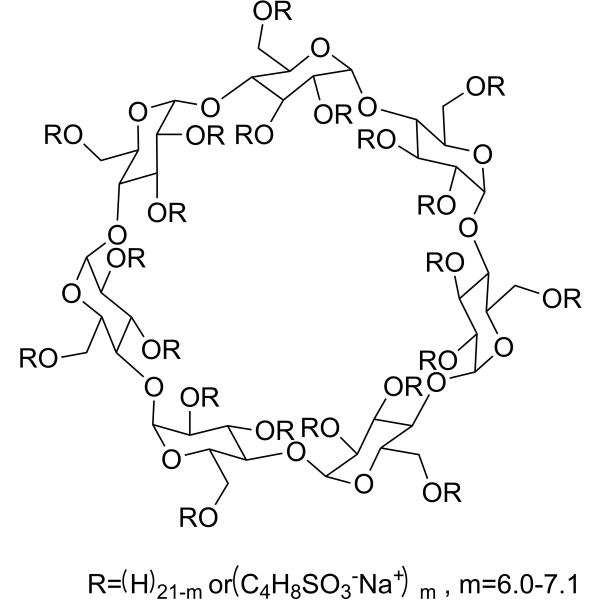
SBE-β-CD is a sulfobutylether β-cyclodextrin derivative used as an excipient or a formulating agent to increase the solubility of poorly soluble agents .
|
-
- HY-Y0850U7
-
|
Polyvinyl alcohol (Mw 195000, 98-99% hydrolyzed, ~4300 polymerization); Poly(Ethenol) (Mw 195000, 98-99% hydrolyzed, ~4300 polymerization)
|
Biochemical Assay Reagents
|
Others
|
|
PVA (Mw 195000, 98-99% hydrolyzed, ~4300 polymerization) is polyvinyl alcohol with a molecular weight of 195,000 and hydrolytic properties. PVA (Mw 195000, 98-99% hydrolyzed, ~4300 polymerization) is obtained by polymerizing vinyl acetate followed by hydrolysis to remove acetate groups, yielding polyvinyl alcohol .
|
-
- HY-Y0850U4
-
|
Polyvinyl alcohol (Mw 145000, 99+% hydrolyzed, ~3300 polymerization); Poly(Ethenol) (Mw 145000, 99+% hydrolyzed, ~3300 polymerization)
|
Biochemical Assay Reagents
|
Others
|
|
PVA (Mw 145000, 99+% hydrolyzed, ~3300 polymerization) is a polyvinyl alcohol with molecular weight of 145000 with hydrolysis properties. PVA (Mw 145000, 99+% hydrolyzed, ~3300 polymerization) is obtained by polymerizing vinyl acetate followed by hydrolysis to remove acetate groups, yielding polyvinyl alcohol .
|
-
- HY-N2269
-
|
4-Hydroxyphenethyl anisate
|
Others
|
Metabolic Disease
|
|
p-Hydroxyphenethyl anisate is a main constituent of Notopterygium Radix . p-Hydroxyphenethyl anisate can be used as a new type of natural sustained-release excipients .
|
-
- HY-W373206
-
|
|
Biochemical Assay Reagents
|
Metabolic Disease
|
|
Triampizine is a potent gastric antisecretory agent without the side effects of anticholinergic drugs. Triampizine may react with the excipient magnesium stearate and is used in studies of hyperacidity .
|
-
- HY-Y0850AGL2
-
|
PVA, MW 64000 (GMP Like)
|
Biochemical Assay Reagents
|
Others
|
|
Polyvinyl alcohol, MW 64000 (GMP Like) (PVA, MW 64000 (GMP Like)) is the GMP Like class Polyvinyl alcohol, MW 64000 that can be used as pharmaceutical excipients.
|
-
- HY-P99108A
-
|
|
PD-1/PD-L1
Drug Derivative
|
Cancer
|
|
Penpulimab (Anti-PD-1) is an analogue of Penpulimab (HY-P99108). Penpulimab (Anti-PD-1) exists in liquid form without the influence of excipients.
|
-
- HY-W129593
-
|
Sorbitan monostearate
|
Environmental Pollutants
Biochemical Assay Reagents
|
Others
|
|
Sorbitan monooctadecanoate (Sorbitan monostearate) is a hydrophobic nonionic surfactant. Sorbitan monooctadecanoate can serve as a pharmaceutical excipient, such as an emulsifier, nonionic surfactant, solubilizer, wetting agent, and dispersing/suspending agent .
|
-
- HY-W010981
-
|
Tributyl O-acetylcitrate; ATBC
|
Environmental Pollutants
Biochemical Assay Reagents
|
Others
|
|
Acetyl tributyl citrate (Tributyl O-acetylcitrate) is a pharmaceutical excipient and biodegradable hydrophobic plasticizer. Acetyl tributyl citrate can be used in cosmetics, food packaging, and as a flavoring substance for food .
|
-
- HY-B0400
-
|
Sorbitol; D-Glucitol
|
Environmental Pollutants
Endogenous Metabolite
Bacterial
|
Others
|
|
D-Sorbitol (Sorbitol) is a six-carbon sugar alcohol and can used as a sugar substitute. D-Sorbitol can be used as a stabilizing excipient and/or isotonicity agent, sweetener, humectant, thickener and dietary supplement .
|
-
- HY-N1132AR
-
|
D-Trehalose dihydrate (Standard); α,α-Trehalose dihydrate (Standard)
|
Reference Standards
Endogenous Metabolite
|
Others
|
|
D-(+)-Trehalose dihydrate (Standard) is the analytical standard of D-(+)-Trehalose dihydrate. This product is intended for research and analytical applications. D-(+)-Trehalose dihydrate, isolated from Saccharomyces cerevisiae, can be used as a food ingredient and pharmaceutical excipient.
|
-
- HY-B1620D
-
|
PVP K25; Polyvidone K25; Povidone K25
|
Biochemical Assay Reagents
|
Others
|
|
Polyvinylpyrrolidone K25 is a multifunctional synthetic polymer. Polyvinylpyrrolidone K25 is a versatile excipient for both conventional formulations and novel controlled or targeted delivery systems. Polyvinylpyrrolidone K25 is a preferable binder for granules and tablets .
|
-
- HY-W768345
-
|
D-Trehalose-13C12; α,α-Trehalose-13C12
|
Endogenous Metabolite
Isotope-Labeled Compounds
|
Others
|
|
D-(+)-Trehalose-13C12 is a 13C isotope labeled version of D-(+)-Trehalose (HY-N1132). D-(+)-Trehalose,which is widespread, can be used as a food ingredient and pharmaceutical excipient .
|
-
- HY-112251GL
-
|
|
Liposome
|
Cancer
|
|
D-Lin-MC3-DMA (GMP Like) is the GMP Like class D-Lin-MC3-DMA (HY-112251). GMP small molecules works appropriately as an auxiliary reagent for cell therapy manufacture. D-Lin-MC3-DMA, an ionizable cationic lipid, is a potent siRNA delivery vehicle.
|
-
- HY-N1132AS2
-
|
|
Isotope-Labeled Compounds
Endogenous Metabolite
|
Others
|
|
Alpha,Beta-Trehalose- 13C12 is the 13C-labeled D-(+)-Trehalose dihydrate (HY-N1132A). D-(+)-Trehalose dihydrate, isolated from Saccharomyces cerevisiae, can be used as a food ingredient and pharmaceutical excipient.
|
-
- HY-B0342
-
|
Methylglucamine; Meglumin; Methylglucamin
|
Biochemical Assay Reagents
|
Cancer
|
|
Meglumine (Methylglucamine) is an orally active amino sugar derived from sorbitol. Meglumine has anti-inflammatory and antitumor activity. Meglumine is often used as an excipient in active molecules and with iodinated compounds in contrast agents such as meglumine and meglumine iodide .
|
-
- HY-W441001
-
|
|
Biochemical Assay Reagents
|
Others
|
|
DSPE-Fluorescein is a phospholipid. Phospholipids have good biocompatibility and significant amphiphilic characteristics, making them the main and suitable dosage form or excipient in drug formulations, thereby achieving better therapeutic effects. DSPE-Fluoresceincan be used in drug delivery research .
|
-
- HY-B2242GL
-
|
Secondary calcium (GMP Like)
|
Biochemical Assay Reagents
|
Others
|
|
Calcium phosphate (GMP Like) (Secondary calcium (GMP Like)) is the GMP Like class Calcium phosphate (HY-B2242) that can be used as pharmaceutical excipients. Calcium phosphate is a biochemical reagent that can be used as a biological material or organic compound for life science related research.
|
-
- HY-W016445
-
|
1-Amino-1-deoxy-D-glucitol, 98%
|
Biochemical Assay Reagents
|
Others
|
|
D-Glucamine, 98% (1-Amino-1-deoxy-D-glucitol, 98%) is an amino sugar derivative that serves as an excipient in pharmaceutical formulations. D-Glucamine, 98% also acts as a substrate for studies investigating sugar transporter pathways
|
-
- HY-B1620C
-
|
PVP K17; Polyvidone K17; Povidone K17
|
Biochemical Assay Reagents
|
Others
|
|
Polyvinylpyrrolidone K17 is one of the polymers in pharmaceutical preparations. Polyvinylpyrrolidone K17 is a versatile excipient for both conventional formulations and novel controlled or targeted delivery systems, serving as a binder, coating agent, suspending agent, pore-former, solubilizer, stabilizer, etc .
|
-
- HY-B0400S7
-
|
Sorbitol-d1-2; D-Glucitol-d1-2
|
Endogenous Metabolite
|
Others
|
|
D-Sorbitol-d-2 is the deuterium labeled D-Sorbitol. D-Sorbitol (Sorbitol) is a six-carbon sugar alcohol and can used as a sugar substitute. D-Sorbitol can be used as a stabilizing excipient and/or isotonicity agent, sweetener, humectant, thickener and di
|
-
- HY-W768295
-
-
- HY-B0400S10
-
|
Sorbitol-d4; D-Glucitol-d4
|
Endogenous Metabolite
|
Others
|
|
D-Sorbitol-d4 is the deuterium labeled D-Sorbitol. D-Sorbitol (Sorbitol) is a six-carbon sugar alcohol and can used as a sugar substitute. D-Sorbitol can be used as a stabilizing excipient and/or isotonicity agent, sweetener, humectant, thickener and diet
|
-
- HY-B0400S4
-
|
Sorbitol-d2; D-Glucitol-d2
|
Isotope-Labeled Compounds
Endogenous Metabolite
|
Others
|
|
D-Sorbitol-d2 is the deuterium labeled D-Sorbitol. D-Sorbitol (Sorbitol) is a six-carbon sugar alcohol and can used as a sugar substitute. D-Sorbitol can be used as a stabilizing excipient and/or isotonicity agent, sweetener, humectant, thickener and diet
|
-
- HY-Y0921
-
|
1,2-(RS)-Propanediol; 1,2-Propylene glycol; Propylene glycol
|
Environmental Pollutants
Endogenous Metabolite
|
Neurological Disease
|
|
(±)-1, 2-propanediol (1,2-(RS)-Propanediol) is an aliphatic alcohol that is often used as an excipient in many active molecular preparations to increase the solubility and stability of the active molecule. (±)-1, 2-propanediol can affect the neurobehavior of zebrafish .
|
-
- HY-W768296
-
-
- HY-B0400S9
-
|
Sorbitol-d2-2; D-Glucitol-d2-2
|
Endogenous Metabolite
|
Others
|
|
D-Sorbitol-d2-2 is the deuterium labeled D-Sorbitol. D-Sorbitol (Sorbitol) is a six-carbon sugar alcohol and can used as a sugar substitute. D-Sorbitol can be used as a stabilizing excipient and/or isotonicity agent, sweetener, humectant, thickener and di
|
-
- HY-B0400S8
-
|
Sorbitol-d2-1; D-Glucitol-d2-1
|
Endogenous Metabolite
|
Others
|
|
D-Sorbitol-d2-1 is the deuterium labeled D-Sorbitol. D-Sorbitol (Sorbitol) is a six-carbon sugar alcohol and can used as a sugar substitute. D-Sorbitol can be used as a stabilizing excipient and/or isotonicity agent, sweetener, humectant, thickener and di
|
-
- HY-B0400S1
-
|
Sorbitol-13C; D-Glucitol-13C
|
Endogenous Metabolite
|
Others
|
|
D-Sorbitol- 13C is the 13C labeled D-Sorbitol. D-Sorbitol (Sorbitol) is a six-carbon sugar alcohol and can used as a sugar substitute. D-Sorbitol can be used as a stabilizing excipient and/or isotonicity agent, sweetener, humectant, thickener and dietary s
|
-
- HY-B0400S
-
|
Sorbitol-d8; D-Glucitol-d8
|
Endogenous Metabolite
|
Others
|
|
D-Sorbitol-d8 is the deuterium labeled D-Sorbitol. D-Sorbitol (Sorbitol) is a six-carbon sugar alcohol and can used as a sugar substitute. D-Sorbitol can be used as a stabilizing excipient and/or isotonicity agent, sweetener, humectant, thickener and dietary supplement .
|
-
- HY-W440987
-
|
|
Biochemical Assay Reagents
|
Others
|
|
DOPE-mPEG1000 is a phospholipid. Phospholipids have good biocompatibility and significant amphiphilic characteristics, making them the main and suitable dosage form or excipient in drug formulations to achieve better therapeutic effects. DOPE-mPEG1000 can be used in drug delivery research .
|
-
- HY-W800741
-
|
|
Biochemical Assay Reagents
|
Others
|
|
Undecyl 8-bromooctanoate is a phospholipid. Phospholipids have good biocompatibility and significant amphiphilic characteristics, making them the main and suitable dosage form or excipient in drug formulations to achieve better therapeutic effects. Undecyl 8-bromooctanoate can be used in drug delivery research .
|
-
- HY-B1620I
-
|
PVP K120; Polyvidone K120; Povidone K120
|
Environmental Pollutants
Biochemical Assay Reagents
|
Others
|
|
Polyvinylpyrrolidone K120 is a multifunctional synthetic polymer with excellent adhesiveness and thickening properties. Polyvinylpyrrolidone K120 is a versatile excipient for both conventional formulations and novel controlled or targeted delivery systems. Polyvinylpyrrolidone K120 can be used to prepare drug-loaded hydrogel patches .
|
-
- HY-B0400S2
-
|
Sorbitol-13C-1; D-Glucitol-13C-1
|
Isotope-Labeled Compounds
Endogenous Metabolite
|
Others
|
|
D-Sorbitol- 13C-1 is the 13C labeled D-Sorbitol. D-Sorbitol (Sorbitol) is a six-carbon sugar alcohol and can used as a sugar substitute. D-Sorbitol can be used as a stabilizing excipient and/or isotonicity agent, sweetener, humectant, thickener and dietary
|
-
- HY-Y0921S1
-
|
1,2-(RS)-Propanediol-d2; 1,2-Propylene glycol-d2; Propylene glycol-d2
|
Endogenous Metabolite
Isotope-Labeled Compounds
|
Neurological Disease
|
|
(±)-1,2-Propanediol-d2 is the deuterium labeled (±)-1,2-Propanediol. (±)-1,2-Propanediol (1,2-(RS)-Propanediol) is an aliphatic alcohol and frequently used as an excipient in many agent formulations to increase the solubility and stability of agents .
|
-
- HY-B0400S15
-
|
Sorbitol-18O-1; D-Glucitol-18O-1
|
Endogenous Metabolite
|
Others
|
|
D-Sorbitol- 18O-1 is the 18O labeled D-Sorbitol. D-Sorbitol (Sorbitol) is a six-carbon sugar alcohol and can used as a sugar substitute. D-Sorbitol can be used as a stabilizing excipient and/or isotonicity agent, sweetener, humectant, thickener and dietary
|
-
- HY-Y0921S
-
|
1,2-(RS)-Propanediol-d8; 1,2-Propylene glycol-d8; Propylene glycol-d8
|
Endogenous Metabolite
Isotope-Labeled Compounds
|
Neurological Disease
|
|
(±)-1,2-Propanediol-d8 is the deuterium labeled (±)-1,2-Propanediol. (±)-1,2-Propanediol (1,2-(RS)-Propanediol) is an aliphatic alcohol and frequently used as an excipient in many agent formulations to increase the solubility and stability of agents .
|
-
- HY-Y1213S
-
|
|
Isotope-Labeled Compounds
Biochemical Assay Reagents
Drug Intermediate
|
Others
|
|
Carbon- 13C is the 13C labeled Carbon (HY-Y1213). Carbon possesses unique physicochemical properties such as electrical and structural characteristics, making it a core material in the field of fuel cells. Carbon also serves as a pharmaceutical excipient and can be used in the synthesis of other compounds .
|
-
- HY-N1132
-
|
D-Trehalose; α,α-Trehalose
|
Endogenous Metabolite
|
Metabolic Disease
|
|
D-(+)-Trehalose (α,α-Trehalose) is an orally active disaccharide, showing anti-desiccant and cryopreservative activities. D-(+)-Trehalose acts as an osmolyte, and stress protectant and helps in the storage and transport of carbon. D-(+)-Trehalose can be used as a food ingredient and pharmaceutical excipient .
|
-
- HY-B0400S3
-
|
Sorbitol-13C-2; D-Glucitol-13C-2
|
Isotope-Labeled Compounds
Endogenous Metabolite
|
Others
|
|
D-Sorbitol- 13C-2 is the 13C labeled D-Sorbitol. D-Sorbitol (Sorbitol) is a six-carbon sugar alcohol and can used as a sugar substitute. D-Sorbitol can be used as a stabilizing excipient and/or isotonicity agent, sweetener, humectant, thickener and dietary
|
-
- HY-Y0921S2
-
|
1,2-(RS)-Propanediol-d6; 1,2-Propylene glycol-d6; Propylene glycol-d6
|
Isotope-Labeled Compounds
Endogenous Metabolite
|
Neurological Disease
|
|
(±)-1,2-Propanediol-d6 is the deuterium labeled (±)-1,2-Propanediol. (±)-1,2-Propanediol (1,2-(RS)-Propanediol) is an aliphatic alcohol and frequently used as an excipient in many agent formulations to increase the solubility and stability of agents .
|
-
- HY-W440989
-
|
|
Biochemical Assay Reagents
|
Others
|
|
DOPE-mPEG5000 is a phospholipid. Phospholipids have good biocompatibility and significant amphiphilic characteristics, making them the main and suitable dosage form or excipient in drug formulations, thereby achieving better therapeutic effects. DOPE-mPEG5000can be used in drug delivery research .
|
-
- HY-B0400S16
-
|
Sorbitol-13C6; D-Glucitol-13C6
|
Bacterial
Endogenous Metabolite
|
Others
|
|
D-Sorbitol- 13C6 is the 13C labeled D-Sorbitol . D-Sorbitol (Sorbitol) is a six-carbon sugar alcohol and can used as a sugar substitute. D-Sorbitol can be used as a stabilizing excipient and/or isotonicity agent, sweetener, humectant, thickener and dietary supplement .
|
-
- HY-166606
-
|
|
Biochemical Assay Reagents
|
Others
|
|
DSPE-polysarcosine66 is a phospholipid. Phospholipids have good biocompatibility and significant amphiphilic characteristics, making them the main and suitable dosage form or excipient in drug formulations, thereby achieving better therapeutic effects. DSPE-polysarcosine66can be used in drug delivery research .
|
-
- HY-W115746B
-
|
|
Biochemical Assay Reagents
|
Others
|
|
Ethyl cellulose (viscosity 300 cP) serves as a non-toxic and biodegradable polymer, with unique properties such as oleogel formation, delivery of active component, and film-forming ability in the food and pharmaceutical sectors. Ethyl cellulose (viscosity 300 cP) can be used as an excipient, such as coating agent, flavoring agent, tablet filler .
|
-
- HY-B0400R
-
|
Sorbitol (Standard); D-Glucitol (Standard)
|
Reference Standards
Endogenous Metabolite
Bacterial
|
Others
|
|
D-Sorbitol (Standard) is the analytical standard of D-Sorbitol. This product is intended for research and analytical applications. D-Sorbitol (Sorbitol) is a six-carbon sugar alcohol and can used as a sugar substitute. D-Sorbitol can be used as a stabilizing excipient and/or isotonicity agent, sweetener, humectant, thickener and dietary supplement .
|
-
- HY-W115746A
-
|
|
Biochemical Assay Reagents
|
Others
|
|
Ethyl cellulose (viscosity 10 cP) serves as a non-toxic and biodegradable polymer, with unique properties such as oleogel formation, delivery of active component, and film-forming ability in the food and pharmaceutical sectors. Ethyl cellulose (viscosity 10 cP) can be used as an excipient, such as coating agent, flavoring agent, tablet filler .
|
-
- HY-W099569
-
|
Zinc octadecanoate
|
Biochemical Assay Reagents
Fungal
Bacterial
Parasite
|
Infection
|
|
Zinc stearate is a metal stearate that acts as a preservative, bactericide, fungicide, and larvicide. Zinc stearate inhibits larval reproduction in animal feces. Zinc stearate exhibits extremely low systemic toxicity. Zinc stearate is a common component of pharmaceutical excipients, lubricants, mold release agents, polymer stabilizers, and coating matting agents .
|
-
- HY-W440828
-
|
|
Biochemical Assay Reagents
|
Others
|
|
DOPE-PEG3400-COOH is a phospholipid. Phospholipids have good biocompatibility and significant amphiphilic characteristics, making them the main and suitable dosage form or excipient in drug formulations, thereby achieving better therapeutic effects. DOPE-PEG3400-COOHcan be used in drug delivery research .
|
-
- HY-W440997
-
|
|
Biochemical Assay Reagents
|
Others
|
|
DOPE-PEG5000-Mal is a phospholipid. Phospholipids have good biocompatibility and significant amphiphilic characteristics, making them the main and suitable dosage form or excipient in drug formulations, thereby achieving better therapeutic effects. DOPE-PEG5000-Malcan be used in drug delivery research .
|
-
- HY-106546
-
|
KC 9147
|
Fungal
|
Infection
|
|
Tolciclate (KC 9147) is an antifungal agent with in vitro inhibitory activity against dermatophytes, effective at concentrations of 0.01-0.1 μg/mL. Tolciclate is colorless and soluble in well-tolerated excipients, and it is more lipophilic than Tolnaftate (HY-B0370). Tolciclate can be used in research related to antifungal infections .
|
-
- HY-W591450
-
|
|
Biochemical Assay Reagents
|
Others
|
|
DOPE-PEG3400-Azide is a phospholipid. Phospholipids have good biocompatibility and significant amphiphilic characteristics, making them the main and suitable dosage form or excipient in drug formulations, thereby achieving better therapeutic effects. DOPE-PEG3400-Azidecan be used in drug delivery research .
|
-
- HY-W440993
-
|
DOPE-PEG5000-NH2
|
Biochemical Assay Reagents
|
Others
|
|
DOPE-PEG-Amine (MW 5000) is a phospholipid. Phospholipids have good biocompatibility and significant amphiphilic characteristics, making them the main and suitable dosage form or excipient in drug formulations, thereby achieving better therapeutic effects. DOPE-PEG-Amine (MW 5000)can be used in drug delivery research .
|
-
- HY-166857
-
|
|
Biochemical Assay Reagents
|
Others
|
|
DMPE-PEG2000-amineTFA is a phospholipid. Phospholipids have good biocompatibility and significant amphiphilic characteristics, making them the main and suitable dosage form or excipient in drug formulations, thereby achieving better therapeutic effects. DMPE-PEG2000-amineTFAcan be used in drug delivery research .
|
-
- HY-W440996
-
|
|
Biochemical Assay Reagents
|
Others
|
|
DOPE-PEG3400-Mal is a phospholipid. Phospholipids have good biocompatibility and significant amphiphilic characteristics, making them the main and suitable dosage form or excipient in drug formulations, thereby achieving better therapeutic effects. DOPE-PEG3400-Malcan be used in drug delivery research .
|
-
- HY-W591448
-
|
|
Biochemical Assay Reagents
|
Others
|
|
DOPE-PEG1000-Azide is a phospholipid. Phospholipids have good biocompatibility and significant amphiphilic characteristics, making them the main and suitable dosage form or excipient in drug formulations, thereby achieving better therapeutic effects. DOPE-PEG1000-Azidecan be used in drug delivery research .
|
-
- HY-166846
-
|
|
Biochemical Assay Reagents
|
Others
|
|
DOPE-PEG2000-FITC is a phospholipid. Phospholipids have good biocompatibility and significant amphiphilic characteristics, making them the main and suitable dosage form or excipient in drug formulations, thereby achieving better therapeutic effects. DOPE-PEG2000-FITCcan be used in drug delivery research .
|
-
- HY-166644
-
|
|
Biochemical Assay Reagents
|
Others
|
|
DPPE-PEG2000-amine is a phospholipid. Phospholipids have good biocompatibility and significant amphiphilic characteristics, making them the main and suitable dosage form or excipient in drug formulations, thereby achieving better therapeutic effects. DPPE-PEG2000-aminecan be used in drug delivery research .
|
-
- HY-W591451
-
|
|
Biochemical Assay Reagents
|
Others
|
|
DOPE-PEG5000-Azide is a phospholipid. Phospholipids have good biocompatibility and significant amphiphilic characteristics, making them the main and suitable dosage form or excipient in drug formulations, thereby achieving better therapeutic effects. DOPE-PEG5000-Azidecan be used in drug delivery research .
|
-
- HY-W440992
-
|
DOPE-PEG3400-NH2
|
Biochemical Assay Reagents
|
Others
|
|
DOPE-PEG-Amine (MW 3400) is a phospholipid. Phospholipids have good biocompatibility and significant amphiphilic characteristics, making them the main and suitable dosage form or excipient in drug formulations, thereby achieving better therapeutic effects. DOPE-PEG-Amine (MW 3400)can be used in drug delivery research .
|
-
- HY-W440826
-
|
|
Biochemical Assay Reagents
|
Others
|
|
DOPE-PEG1000-COOH is a phospholipid. Phospholipids have good biocompatibility and significant amphiphilic characteristics, making them the main and suitable dosage form or excipient in drug formulations, thereby achieving better therapeutic effects. DOPE-PEG1000-COOHcan be used in drug delivery research .
|
-
- HY-W440829
-
|
|
Biochemical Assay Reagents
|
Others
|
|
DOPE-PEG5000-COOH is a phospholipid. Phospholipids have good biocompatibility and significant amphiphilic characteristics, making them the main and suitable dosage form or excipient in drug formulations, thereby achieving better therapeutic effects. DOPE-PEG5000-COOHcan be used in drug delivery research .
|
-
- HY-166680
-
|
|
Biochemical Assay Reagents
|
Others
|
|
DOPE-PEG5000-FITC is a phospholipid. Phospholipids have good biocompatibility and significant amphiphilic characteristics, making them the main and suitable dosage form or excipient in drug formulations, thereby achieving better therapeutic effects. DOPE-PEG5000-FITCcan be used in drug delivery research .
|
-
- HY-CP001
-
|
|
Biochemical Assay Reagents
|
Metabolic Disease
|
|
D-Trehalose is a disaccharide formed by a 1,1-glycosidic bond between two α-glucose units and is widely used as a food ingredient and pharmaceutical excipient. D-Trehalose is known to protect and stabilise proteins. For long-term storage, recombinant protein solution should be diluted further with 5% D-Trehalose, Carrier Protein.
|
-
- HY-B1620K
-
|
PVP, average Mw~29000; Polyvidone, average Mw~29000; Povidone, average Mw~29000
|
Environmental Pollutants
Biochemical Assay Reagents
|
Others
|
|
Polyvinylpyrrolidone, average Mw~29000 is a multifunctional synthetic polymer with an average molecular weight of 29,000 Da. Polyvinylpyrrolidone, average Mw~29000 is a versatile excipient for both conventional formulations and novel controlled or targeted delivery systems, serving as a binder, coating agent, suspending agent, pore-former, solubilizer, stabilizer, etc .
|
-
- HY-166654
-
|
|
Biochemical Assay Reagents
|
Others
|
|
DSPE-Amide-PEG2000-Rhodamine is a phospholipid. Phospholipids have good biocompatibility and significant amphiphilic characteristics, making them the main and suitable dosage form or excipient in drug formulations, thereby achieving better therapeutic effects. DSPE-Amide-PEG2000-Rhodaminecan be used in drug delivery research .
|
-
- HY-B0342R
-
|
Methylglucamine (Standard); Meglumin (Standard); Methylglucamin (Standard)
|
Biochemical Assay Reagents
Reference Standards
|
Cancer
|
|
Meglumine (Standard) is the analytical standard of Meglumine. This product is intended for research and analytical applications. Meglumine (Methylglucamine) is an orally active amino sugar derived from sorbitol. Meglumine has anti-inflammatory and antitumor activity. Meglumine is often used as an excipient in active molecules and with iodinated compounds in contrast agents such as meglumine and meglumine iodide .
|
-
- HY-W590667
-
|
|
Biochemical Assay Reagents
|
Others
|
|
C2 Ceramide-1-phosphate is a phospholipid. Phospholipids have good biocompatibility and significant amphiphilic characteristics, making them the main and suitable dosage form or excipient in drug formulations, thereby achieving better therapeutic effects. C2 Ceramide-1-phosphatecan be used in drug delivery research .
|
-
- HY-166833
-
|
|
Biochemical Assay Reagents
|
Others
|
|
DOPE-PEG5000-Rhodamine B is a phospholipid. Phospholipids have good biocompatibility and significant amphiphilic characteristics, making them the main and suitable dosage form or excipient in drug formulations, thereby achieving better therapeutic effects. DOPE-PEG5000-Rhodamine Bcan be used in drug delivery research .
|
-
- HY-166651
-
|
|
Biochemical Assay Reagents
|
Others
|
|
DSPE-Hyd-PEG2000-Mal is a phospholipid. Phospholipids have good biocompatibility and significant amphiphilic characteristics, making them the main and suitable dosage form or excipient in drug formulations, thereby achieving better therapeutic effects. DSPE-Hyd-PEG2000-Malcan be used in drug delivery research .
|
-
- HY-N15858
-
|
|
Fluorescent Dye
|
Others
|
|
DSPE PEG(2000)-N-Cyanine 7 is a phospholipid. Phospholipids have good biocompatibility and significant amphiphilic characteristics, making them the main and suitable dosage form or excipient in drug formulations, thereby achieving better therapeutic effects. DSPE PEG(2000)-N-Cyanine 7 can be used in drug delivery research.
|
-
- HY-P9970
-
|
Avakine; CT-P13; SB2; TA-650
|
TNF Receptor
|
Neurological Disease
Metabolic Disease
Inflammation/Immunology
Cancer
|
Infliximab (Avakine) is a chimeric monoclonal IgG1 antibody that specifically binds to TNF-α. Infliximab prevents the interaction of TNF-α with TNF-α receptor (TNFR1 and TNFR2). Infliximab has the potential for autoimmune, chronic inflammatory diseases and diabetic neuropathy research . The component ratio of this product is Active ingredient : Excipients = 9 : 47.
|
-
- HY-P9950
-
|
Olizumab; rhuMab-E25; IGE25; RG-3648
|
Interleukin Related
|
Inflammation/Immunology
Cancer
|
|
Omalizumab is a recombinant, humanized, monoclonal antibody against human immunoglobulin E (IgE) with a KD of 0.393 nM. Omalizumab binds to the human FcγRIIb receptors with a KD of 6.37 uM. Omalizumab has the potential for persistent allergic asthma research . The component ratio of this product is Active ingredient : Excipients = 1:1.3-1:1.5.
|
-
- HY-Y1809
-
|
Stearyl alcohol
|
Environmental Pollutants
Biochemical Assay Reagents
|
Inflammation/Immunology
|
|
1-Hydroxyoctadecane (Stearyl alcohol) is a long-chain fatty alcohol and excipient. 1-Hydroxyoctadecane forms a closed oil film, thereby reducing transepidermal water loss (TEWL) and promoting skin moisturization. 1-Hydroxyoctadecane improves Imiquimod (HY-B0180)-induced psoriatic skin inflammation in mice .
|
-
- HY-W042416
-
|
DMAc
|
NF-κB
|
Neurological Disease
Metabolic Disease
Inflammation/Immunology
|
|
N,N-Dimethylacetamide (DMAc) is an organic solvent with blood-brain transmissibility and an FDA-approved drug excipient. N, N-dimethylacetamide exerts anti-inflammatory activity by inhibiting the NF-κB signaling pathway. N, N-dimethylacetamide can be used in studies of weight gain caused by a high-fat diet and neuroinflammation in Alzheimer's disease .
|
-
- HY-N15907
-
|
|
Liposome
|
Others
|
|
DOPE PEG(2000)-N-Cyanine 5 is a phospholipid. Phospholipids have good biocompatibility and significant amphiphilic characteristics, making them the main and suitable dosage form or excipient in drug formulations, thereby achieving better therapeutic effects. DOPE PEG(2000)-N-Cyanine 5 can be used in drug delivery research.
|
-
- HY-166852
-
|
|
Biochemical Assay Reagents
|
Others
|
|
DOPE-PEG2000-Cy5 is a phospholipid. Phospholipids have good biocompatibility and significant amphiphilic characteristics, making them the main and suitable dosage form or excipient in drug formulations, thereby achieving better therapeutic effects. DOPE-PEG2000-Cy5can be used in drug delivery research .
|
-
- HY-N15909
-
|
|
Fluorescent Dye
|
Others
|
|
DSPE PEG(2000)-N-Cyanine 5.5 is a phospholipid. Phospholipids have good biocompatibility and significant amphiphilic characteristics, making them the main and suitable dosage form or excipient in drug formulations, thereby achieving better therapeutic effects. DSPE PEG(2000)-N-Cyanine 5.5 can be used in drug delivery research.
|
-
- HY-166849
-
|
|
Biochemical Assay Reagents
|
Others
|
|
DOPE-PEG5000-Cy5 is a phospholipid. Phospholipids have good biocompatibility and significant amphiphilic characteristics, making them the main and suitable dosage form or excipient in drug formulations, thereby achieving better therapeutic effects. DOPE-PEG5000-Cy5can be used in drug delivery research .
|
-
- HY-N0614GL
-
|
E955 (GMP Like); Trichlorosucrose (GMP Like)
|
Endogenous Metabolite
|
Cancer
|
|
Sucralose (GMP Like) (E955 (GMP Like)) is the GMP Like class Sucralose (HY-N0614) that can be used as pharmaceutical excipients. Sucralose (E955; Trichlorosucrose) is a non-nutritive artificial sweetener and sugar substitute. Sucralose can activate a conserved neural fasting response and thereby exerts an appetite-stimulating effect in rodents .
|
-
- HY-W010981R
-
|
Tributyl O-acetylcitrate (Standard); ATBC (Standard)
|
Biochemical Assay Reagents
Reference Standards
|
Others
|
|
Acetyl tributyl citrate (Tributyl O-acetylcitrate) Standard is the analytical standard of Acetyl tributyl citrate (HY-W010981). This product is intended for research and analytical applications. Acetyl tributyl citrate (Tributyl O-acetylcitrate) is a pharmaceutical excipient and biodegradable hydrophobic plasticizer. Acetyl tributyl citrate can be used in cosmetics, food packaging, and as a flavoring substance for food .
|
-
- HY-166848
-
|
|
Biochemical Assay Reagents
|
Others
|
|
DOPE-PEG2000-Cy5.5 is a phospholipid. Phospholipids have good biocompatibility and significant amphiphilic characteristics, making them the main and suitable dosage form or excipient in drug formulations, thereby achieving better therapeutic effects. DOPE-PEG2000-Cy5.5can be used in drug delivery research .
|
-
- HY-P99568
-
|
RC18
|
TNF Receptor
|
Inflammation/Immunology
|
|
Telitacicept (RC18) is a fully human TACI-Fc fusion protein. Telitacicept is a dual B lymphocyte stimulator (BLyS)/APRIL (a proliferation-inducing ligand) inhibitor that effectively blocks proliferation of B lymphocytes. Telitacicept can be used in research of B-cell autoimmune disease . The component ratio of this product is Active ingredient : Excipients = 1: 0.5-1: 0.8.
|
-
- HY-166850
-
|
|
Biochemical Assay Reagents
|
Others
|
|
DOPE-PEG5000-Cy5.5 is a phospholipid. Phospholipids have good biocompatibility and significant amphiphilic characteristics, making them the main and suitable dosage form or excipient in drug formulations, thereby achieving better therapeutic effects. DOPE-PEG5000-Cy5.5can be used in drug delivery research .
|
-
- HY-W145516
-
|
|
Environmental Pollutants
Biochemical Assay Reagents
|
Metabolic Disease
|
|
Guar gum is an orally active nonionic galactomannan polysaccharide. It is present in the endosperm of Cyamopsis tetragonolobus seeds. Guar gum reduces cholesterol levels, regulates body weight, and acts as a thickener and viscosity modifier by forming hydrogen-bonded aqueous solutions. It serves as a rate-controlling excipient in compound delivery systems, and finds applications in the food, tissue engineering, nanosensing and industrial fields .
|
-
- HY-P9952
-
|
LymphoStat B
|
TNF Receptor
CD20
|
Inflammation/Immunology
Cancer
|
|
Belimumab (LymphoStat B) is a humanized IgG1λ monoclonal antibody against B-lymphocyte stimulator (BLyS) protein. Belimumab antagonizes BLyS activity in autoimmune diseases and B-lymphocyte malignancies. Belimumab can be used for systemic lupus erythematosus (SLE) research . The component ratio of this product is Active ingredient: Excipients = 1:1.0-1:1.2.
|
-
- HY-B1620M
-
|
PVP, average Mw~55000; Polyvidone, average Mw~55000; Povidone, average Mw~55000
|
Biochemical Assay Reagents
|
Others
|
|
Polyvinylpyrrolidone, average Mw~55000 is a multifunctional synthetic polymer with an average molecular weight of 55000 Da. Polyvinylpyrrolidone, average Mw~55000 is widely used to synthesize nanoparticlesPolyvinylpyrrolidone, average Mw~55000 is a versatile excipient for both conventional formulations and novel controlled or targeted delivery systems, serving as a binder, coating agent, suspending agent, pore-former, solubilizer, stabilizer, etc .
|
-
- HY-P9907
-
Trastuzumab
Maximum Cited Publications
55 Publications Verification
Anti-Human HER2, Humanized Antibody
|
Radionuclide-Drug Conjugates (RDCs)
EGFR
ADC Antibody
|
Cancer
|
|
Trastuzumab is a humanized IgG1 monoclonal antibody that selectively binds to HER2 with high affinity. Trastuzumab can be used for the research of HER2-positive metastatic breast cancer and gastric cancer . (Note: The product specifications below only indicate the effective content of Trastuzumab. The component ratio of this product is Trastuzumab : excipients = 1:0.6-1:0.9.)
|
-
- HY-Y0921R
-
|
1,2-(RS)-Propanediol (Standard); 1,2-Propylene glycol (Standard); Propylene glycol (Standard)
|
Endogenous Metabolite
Reference Standards
|
Neurological Disease
|
|
(±)-1,2-Propanediol (Standard) is the analytical standard of (±)-1,2-Propanediol. This product is intended for research and analytical applications. (±)-1, 2-propanediol (1,2-(RS)-Propanediol) is an aliphatic alcohol that is often used as an excipient in many active molecular preparations to increase the solubility and stability of the active molecule. (±)-1, 2-propanediol can affect the neurobehavior of zebrafish .
|
-
- HY-B1620J
-
|
PVP, average Mw~10000; Polyvidone, average Mw~10000; Povidone, average Mw~10000
|
Environmental Pollutants
Biochemical Assay Reagents
|
Others
|
|
Polyvinylpyrrolidone, average Mw~10000 is a multifunctional synthetic polymer with an average molecular weight of 10000 Da. Polyvinylpyrrolidone, average Mw~10000 is widely used to synthesize nanoparticlesPolyvinylpyrrolidone, average Mw~10000 is a versatile excipient for both conventional formulations and novel controlled or targeted delivery systems, serving as a binder, coating agent, suspending agent, pore-former, solubilizer, stabilizer, etc .
|
-
- HY-B1620N
-
|
PVP, average Mw~360000; Polyvidone, average Mw~360000; Povidone, average Mw~360000
|
Environmental Pollutants
Biochemical Assay Reagents
|
Others
|
|
Polyvinylpyrrolidone, average Mw~360000 is a multifunctional synthetic polymer with an average molecular weight of 360000 Da. Polyvinylpyrrolidone, average Mw~360000 is widely used to synthesize nanoparticlesPolyvinylpyrrolidone, average Mw~360000 is a versatile excipient for both conventional formulations and novel controlled or targeted delivery systems, serving as a binder, coating agent, suspending agent, pore-former, solubilizer, stabilizer, etc .
|
-
- HY-Y0921S3
-
|
1,2-(RS)-Propanediol-13C3; 1,2-Propylene glycol-13C3; Propylene glycol-13C3
|
Isotope-Labeled Compounds
Endogenous Metabolite
|
Neurological Disease
|
|
(±)-1,2-Propanediol- 13C3 is 13C labeled (±)-1,2-Propanediol (HY-Y0921). (±)-1, 2-propanediol (1,2-(RS)-Propanediol) is an aliphatic alcohol that is often used as an excipient in many active molecular preparations to increase the solubility and stability of the active molecule. (±)-1, 2-propanediol can affect the neurobehavior of zebrafish .
|
-
- HY-B1620L
-
|
PVP, average Mw~40000; Polyvidone, average Mw~40000; Povidone, average Mw~40000
|
Environmental Pollutants
Biochemical Assay Reagents
|
Others
|
|
Polyvinylpyrrolidone, average Mw~40000 is a multifunctional synthetic polymer with an average molecular weight of 40,000 Da. Polyvinylpyrrolidone, average Mw~40000 is widely used to synthesize nanoparticles. Polyvinylpyrrolidone, average Mw~40000 is a versatile excipient for both conventional formulations and novel controlled or targeted delivery systems, serving as a binder, coating agent, suspending agent, pore-former, solubilizer, stabilizer, etc .
|
-
- HY-166992
-
|
|
Biochemical Assay Reagents
|
Others
|
|
1,2-Dioleoyl-sn-glycero-3-PA (ammonium) is a phospholipid. Phospholipids have good biocompatibility and significant amphiphilic characteristics, making them the main and suitable dosage form or excipient in drug formulations, thereby achieving better therapeutic effects. 1,2-Dioleoyl-sn-glycero-3-PA (ammonium)can be used in drug delivery research .
|
-
- HY-W007174A
-
|
|
Biochemical Assay Reagents
|
Others
|
|
1,4-Anhydro-D-xylitol is a compound belonging to the class of sugar alcohols. It is derived from xylitol, a natural sweetener found in many fruits and vegetables. 1,4-Anhydro-D-xylitol is commonly used as a low-calorie sweetener and excipient in the food and pharmaceutical industries, and as a filler or binder in pharmaceutical formulations. It has also been investigated for its potential use in the development of biodegradable plastics and other sustainable materials.
|
-
- HY-Y0683A
-
|
|
Biochemical Assay Reagents
|
Infection
Inflammation/Immunology
|
|
Petrolatum (white) is mainly composed of hydrocarbons, possesses strong water resistance and moisturizing properties, and is commonly used as a pharmaceutical excipient. Petrolatum (white) penetrates into stratum corneum cells, improves skin barrier function, repairs epidermal structure, and reduces transepidermal water loss and the risk of skin damage. Petrolatum (white) induces the expression of antimicrobial peptides, innate immune genes, filaggrin and loricrin. Petrolatum (white) is used in research on atopic dermatitis and post-operative skin infections .
|
-
- HY-W011053GL
-
|
|
Taste Receptor
Apoptosis
Drug Derivative
|
Metabolic Disease
|
|
Neotame (GMP Like) is the GMP Like class Neotame (HY-W011053) that can be used as pharmaceutical excipients. Neotame is a derivative of Aspartame (HY-B0361) and is a flavor enhancer and low-caloric, non-nutritive, high-intensity artificial sweetener that is 7000-13,000 times sweeter than sugar. Neotame causes intestinal epithelial cell death at high concentrations. Neotame induces Apoptosis of Caco-2 cells .
|
-
- HY-W042416R
-
|
DMAc (Standard)
|
Reference Standards
NF-κB
|
Neurological Disease
Metabolic Disease
Inflammation/Immunology
|
|
N,N-Dimethylacetamide (Standard) is the analytical standard of N,N-Dimethylacetamide. This product is intended for research and analytical applications. N,N-Dimethylacetamide (DMAc) is an organic solvent with blood-brain transmissibility and an FDA-approved drug excipient. N, N-dimethylacetamide exerts anti-inflammatory activity by inhibiting the NF-κB signaling pathway. N, N-dimethylacetamide can be used in studies of weight gain caused by a high-fat diet and neuroinflammation in Alzheimer's disease .
|
-
- HY-W719128
-
|
|
Isotope-Labeled Compounds
Endogenous Metabolite
|
Neurological Disease
|
|
Propane-1,1,2-d3-1,2-diol is the deuterium labeled (±)-1,2-Propanediol (HY-Y0921). (±)-1, 2-propanediol (1,2-(RS)-Propanediol) is an aliphatic alcohol that is often used as an excipient in many active molecular preparations to increase the solubility and stability of the active molecule. (±)-1, 2-propanediol can affect the neurobehavior of zebrafish .
|
-
- HY-154644
-
|
|
Environmental Pollutants
Biochemical Assay Reagents
|
Cancer
|
|
Soya Lecithin is a phospholipid mixture that can be used as a drug delivery vehicle and is a pharmaceutical excipient. Soya Lecithin can form a lipid bilayer structure through self-assembly, and its binding properties are amphiphilic (hydrophilic head and hydrophobic tail), encapsulating hydrophobic drugs. Soya Lecithin forms stable nanoliposomes or microemulsions, improves the solubility and cellular uptake efficiency of poorly soluble drugs (such as Curcumin (HY-N0005)), and exerts activities such as enhancing drug delivery and regulating cell proliferation .
|
-
- HY-137273A
-
|
|
MMP
Somatostatin Receptor
|
Inflammation/Immunology
|
|
Sucrose octasulfate, a derivative of sulfated oligosaccharides, is a matrix metalloproteinase (MMP) inhibitor. Sucrose octasulfate stimulates the release of somatostatin-like immunoreactivity (SLI) from the stomach by acting directly on D cells in the gastric mucosa. Sucrose octasulfate exerts its ulcer-healing effect by releasing endogenous gastric somatostatin. Sucrose octasulfate can be used as a pharmaceutical excipient and significantly improves wound closure in diabetic foot ulcers caused by nerve ischemia and venous leg ulcers. Sucrose octasulfate can be used in the study of chronic wound healing .
|
-
- HY-137273
-
|
|
Somatostatin Receptor
MMP
|
Inflammation/Immunology
|
|
Sucrose octasulfate sodium, a derivative of sulfated oligosaccharides, is a matrix metalloproteinase (MMP) inhibitor. Sucrose octasulfate sodium stimulates the release of somatostatin-like immunoreactivity (SLI) from the stomach by acting directly on D cells in the gastric mucosa. Sucrose octasulfate sodium exerts its ulcer-healing effect by releasing endogenous gastric somatostatin. Sucrose octasulfate sodium can be used as a pharmaceutical excipient and significantly improves wound closure in diabetic foot ulcers caused by nerve ischemia and venous leg ulcers. Sucrose octasulfate sodium can be used in the study of chronic wound healing .
|
-
- HY-132604A
-
|
ARO-AAT sodium
|
Small Interfering RNA (siRNA)
|
Metabolic Disease
|
|
Fazirsiran sodium is a second-generation RNAi agent. Fazirsiran sodium consistes of a cholesterol-conjugated RNAi trigger (chol-RNAi) to selectively degrade Alpha1-antitrypsin (AAT) mRNA by RNAi and a melittin-derived peptide conjugated to N-acetylgalactosamine (NAG) formulated as the excipient EX1 to promote endosomal escape of the chol-RNAi in hepatocytes . Fazirsiran sodium can be used in the study of Alpha-1 Antitrypsin Deficiency (AATD) liver disease. AATD is caused by mutations in the alpha-1 antitrypsin (SERPINA1) gene.
|
-
- HY-167680
-
|
GSK823093
|
Endogenous Metabolite
|
Metabolic Disease
|
|
Denagliptin (GSK823093) is a small molecule dipeptidyl peptidase IV (DPP-4) inhibitor with activity for the suppression of endocrine and metabolic diseases. Denagliptin can be used to study type 2 diabetes. Denagliptin is stable in the solid state but degrades in solution and in mixtures with various excipients. Denagliptin also exhibits degradation in capsules, mainly through cyclization reactions to form (3S,7S,8aS) aminoamines to provide further synthetic materials. The degradation pathway of Denagliptin was elucidated, providing data to support its formulation development and regulatory filings .
|
-
- HY-107202GL
-
|
Poly(I:C) (GMP Like)
|
Toll-like Receptor (TLR)
PKD
HSP
Bcl-2 Family
Interleukin Related
Apoptosis
|
Infection
Inflammation/Immunology
Cancer
|
|
Polyinosinic-polycytidylic acid (Poly(I:C)) (GMP Like) is the GMP Like class Polyinosinic-polycytidylic acid (HY-107202), and can be used as pharmaceutical excipients. Polyinosinic-polycytidylic acid (Poly(I:C)) is a synthetic analog of double-stranded RNA and an agonist of toll-like receptor 3 (TLR3) and retinoic acid inducible gene I (RIG-I)-like receptors (RIG-I and MDA5). Polyinosinic-polycytidylic acid can be used as a vaccine adjuvant to enhance innate and adaptive immune responses, and to alter the tumor microenvironment. Polyinosinic-polycytidylic acid can directly trigger cancer cells to undergo apoptosis .
|
-
- HY-132604
-
|
ARO-AAT
|
Small Interfering RNA (siRNA)
|
Metabolic Disease
|
|
Fazirsiran (ARO-AAT) is a second-generation RNAi agent. Fazirsiran consistes of a cholesterol-conjugated RNAi trigger (chol-RNAi) to selectively reduce Alpha1-antitrypsin (AAT) synthesis and a melittin-derived peptide conjugated to N-acetylgalactosamine (NAG) formulated as the excipient EX1 to promote endosomal escape of the chol-RNAi in hepatocytes . Fazirsiran can be used in the study of Alpha-1 Antitrypsin Deficiency (AATD) liver disease. Alpha-1 antitrypsin deficiency (AATD) is caused by mutations in the alpha-1 antitrypsin (SERPINA1) gene.
|
-
- HY-16387
-
|
|
VEGFR
|
Others
|
|
PF-00337210 is a potent and selective inhibitor of VEGFRs, designed for treating age-related macular degeneration via intravitreal injection. The formulation strategy focused on developing an ophthalmic solution that would precipitate upon injection into the vitreous, ensuring sustained drug delivery. Challenges included maintaining low dosing volumes, selecting safe excipients for intravitreal use, and addressing the drug's unique physicochemical properties. The final formulation, an isotonic solution in a citrate-buffered vehicle with NaCl, demonstrated stability, potency, and recovery through intravitreal dosing syringes. It formed a depot upon injection into vitreous humor, representing a novel nonpolymeric in situ-forming depot formulation for intravitreal drug delivery .
|
-
- HY-Y0850M
-
|
PVA (Mw 85000-124000, 87-89% hydrolyzed); Poly(Ethenol) (Mw 85000-124000, 87-89% hydrolyzed)
|
Environmental Pollutants
Biochemical Assay Reagents
|
Others
|
|
Polyvinyl alcohol (Mw 85000-124000, 87-89% hydrolyzed) is a polyvinyl alcohol with a molecular weight of 85000-124000 and hydrolytic properties. The degree of hydrolysis refers to the degree to which the acetate groups in the original polyvinyl acetate are converted into hydroxyl groups during the hydrolysis process. Polyvinyl alcohol (Mw 85000-124000, 87-89% hydrolyzed) is the hydrolysis and removal of acetate groups after the polymerization of ethylene acetate. And polyvinyl alcohol is obtained. A degree of hydrolysis of 87-89% indicates that a large part of the acetate groups have been removed, resulting in a large number of hydroxyl groups in the PVA structure. Polyvinyl alcohol with different degrees of hydrolysis can be used to self-crosslink to form cryogel, which can be used as biological excipient .
|
-
- HY-Y0850E
-
|
PVA (Mw 30000-70000, 87-90% hydrolyzed); Poly(Ethenol) (Mw 30000-70000, 87-90% hydrolyzed)
|
Environmental Pollutants
Biochemical Assay Reagents
|
Cardiovascular Disease
Cancer
|
|
Polyvinyl alcohol (Mw 30000-70000, 87-90% hydrolyzed) is a polyvinyl alcohol with a molecular weight of 30000-70000 and hydrolytic properties. The degree of hydrolysis refers to the degree to which the acetate groups in the original polyvinyl acetate are converted into hydroxyl groups during the hydrolysis process. Polyvinyl alcohol (Mw 30000-70000, 87-90% hydrolyzed) is the hydrolysis and removal of acetate groups after the polymerization of ethylene acetate. And polyvinyl alcohol is obtained. A degree of hydrolysis of 87-90% indicates that a large part of the acetate groups have been removed, resulting in a large number of hydroxyl groups in the PVA structure. Polyvinyl alcohol with different degrees of hydrolysis can be used to self-crosslink to form cryogel, which can be used as biological excipients .
|
-
- HY-Y1883
-
|
|
Environmental Pollutants
Biochemical Assay Reagents
Apoptosis
|
Infection
Cancer
|
|
Polyethylene glycol mono(4-tert-octylphenyl) ether surfactant is a non-denaturing detergent that solubilizes lipid membranes. Polyethylene glycol mono(4-tert-octylphenyl) ether surfactant is commonly used in laboratories and is applied to vaccines at different stages of the manufacturing process. Polyethylene glycol mono(4-tert-octylphenyl) ether surfactant is listed as an excipient in certain vaccines including split virus influenza vaccines. Polyethylene glycol mono(4-tert-octylphenyl) ether surfactant is a nonionic surfactant. Polyethylene glycol mono(4-tert-octylphenyl) ether surfactant induces Apoptosis in prostate and colon cancer cell lines and reduces the infectivity of classic enveloped viruses such as WNV .
|
-
- HY-Y1883A
-
|
|
Environmental Pollutants
Biochemical Assay Reagents
|
Infection
Cancer
|
|
Polyethylene glycol mono(4-tert-octylphenyl) ether is a non-denaturing detergent that solubilizes lipid membranes. Polyethylene glycol mono(4-tert-octylphenyl) ether is commonly used in laboratories and is applied to vaccines at different stages of the manufacturing process. Polyethylene glycol mono(4-tert-octylphenyl) ether is listed as an excipient in certain vaccines including split virus influenza vaccines. Polyethylene glycol mono(4-tert-octylphenyl) ether is a nonionic surfactant. Polyethylene glycol mono(4-tert-octylphenyl) ether induces Apoptosis in prostate and colon cancer cell lines and reduces the infectivity of classic enveloped viruses such as WNV .
|
-
- HY-W094497B
-
|
Sodium phosphate monobasic monohydrate, for molecular biology
|
Biochemical Assay Reagents
|
Others
|
|
Sodium dihydrogen phosphate monohydrate, for molecular biology is an inorganic salt compound commonly used in industry and laboratories. It can be used as a buffer, and plays a role in certain metal processing, pharmaceutical and chemical industries.
|
-
- HY-N0378AGL
-
|
Mannitol, M200 (GMP Like); Mannite, M200 (GMP Like)
|
Endogenous Metabolite
Apoptosis
Adrenergic Receptor
PGC-1α
PKA
|
Cardiovascular Disease
Metabolic Disease
Cancer
|
|
D-Mannitol, M200 (GMP Like) (Mannitol, M200 (GMP Like)) is the GMP Like class D-Mannitol that can be used as pharmaceutical excipients. D-Mannitol (Mannitol) is an oral, resistant sugar widely used in the food and pharmaceutical industries to promote the absorption and retention of calcium and magnesium through cecal fermentation, while acting as a osmotic diuretic to reduce tissue edema. D-Mannitol can enhance brown fat formation, improve insulin effect, reduce blood sugar levels, And through the start the β3-adrenergic receptor (β3-AR), PGC1α and PKA induced by means of white fat cells into brown fat cells .
|
-
- HY-N0378BGL
-
|
Mannitol, M100 (GMP Like); Mannite, M100 (GMP Like)
|
Endogenous Metabolite
Apoptosis
Adrenergic Receptor
PGC-1α
PKA
|
Cardiovascular Disease
Metabolic Disease
Cancer
|
|
D-Mannitol, M100 (GMP Like) (Mannitol, M100 (GMP Like)) is the GMP Like class D-Mannitol that can be used as pharmaceutical excipients. D-Mannitol (Mannitol) is an oral, resistant sugar widely used in the food and pharmaceutical industries to promote the absorption and retention of calcium and magnesium through cecal fermentation, while acting as a osmotic diuretic to reduce tissue edema. D-Mannitol can enhance brown fat formation, improve insulin effect, reduce blood sugar levels, And through the start the β3-adrenergic receptor (β3-AR), PGC1α and PKA induced by means of white fat cells into brown fat cells .
|
-
- HY-Y1326
-
-
- HY-Y1326R
-
|
|
Biochemical Assay Reagents
Reference Standards
Bacterial
|
Infection
|
|
Sodium metabisulfite (Standard) is the analytical standard of Sodium metabisulfite. This product is intended for research and analytical applications.Sodium metabisulfite, a sulfite salt, is used as an antioxidant and antimicrobial agent in a variety of drugs and functions as a preservative in many food preparations.
|
-
- HY-B2221S1
-
|
|
Isotope-Labeled Compounds
Endogenous Metabolite
|
Others
|
|
U- 13C Cellulose from chicory is the 13C labeled Cellulose (HY-B2221). Cellulose (Pectin glycosidase) is a natural high molecular weight polysaccharide found in many plants and organisms. It is widely used in manufacturing industries, such as in paper making, textiles, food and medicine, etc. As a renewable resource, Cellulose is biodegradable and sustainable, and can also be used to manufacture chemicals such as Cellulose Esters, Cellulose Acetate and Cellulose Nitrate. In addition, Cellulose is often used as a food additive to increase the stability and quality of food .
|
-
- HY-134524
-
-
- HY-B2221
-
|
Pectin glycosidase
|
Environmental Pollutants
Endogenous Metabolite
|
Others
Cancer
|
|
Cellulose (Pectin glycosidase) is a natural high molecular weight polysaccharide found in many plants and organisms. It is widely used in manufacturing industries, such as in paper making, textiles, food and medicine, etc. As a renewable resource, Cellulose is biodegradable and sustainable, and can also be used to manufacture chemicals such as Cellulose Esters, Cellulose Acetate and Cellulose Nitrate. In addition, Cellulose is often used as a food additive to increase the stability and quality of food.
|
-
- HY-Y0316
-
|
Sodium lauryl sulfate; Laurylsulfuric acid sodium salt
|
Environmental Pollutants
Biochemical Assay Reagents
|
Others
|
|
Sodium dodecyl sulfate is an anionic surfactant commonly used as a detergent, emulsifier, and protein denaturant in various industrial processes, especially in the production of personal care products, cleaners, and laboratory reagents. Sodium dodecyl sulfate has unique chemical properties that make it an effective ingredient in many applications, helping to reduce surface tension and enhance cleaning power.
|
-
- HY-B2243
-
|
Sodium phosphate monobasic; Monosodium dihydrogen orthophosphate; Monosodium phosphate
|
Environmental Pollutants
Biochemical Assay Reagents
|
Others
|
|
Dihydrogen monosodium phosphate (Monosodium phosphate) is an inorganic salt compound commonly used in industry and laboratories. It can be used as a buffer, nutritional supplement, cleaning agent, etc., and plays a role in certain metal processing, pharmaceutical and chemical industries. In addition, Dihydrogen monosodium phosphate can also be used in the field of water treatment and environmental protection, for example as a purifying agent or precipitating agent for solutions.
|
-
- HY-B2221S
-
|
|
Isotope-Labeled Compounds
Endogenous Metabolite
|
Others
|
|
U- 13C Cellulose high DP from potato is the 13C labeled Cellulose (HY-B2221). Cellulose (Pectin glycosidase) is a natural high molecular weight polysaccharide found in many plants and organisms. It is widely used in manufacturing industries, such as in paper making, textiles, food and medicine, etc. As a renewable resource, Cellulose is biodegradable and sustainable, and can also be used to manufacture chemicals such as Cellulose Esters, Cellulose Acetate and Cellulose Nitrate. In addition, Cellulose is often used as a food additive to increase the stability and quality of food .
|
-
- HY-B2221S3
-
|
|
Isotope-Labeled Compounds
Endogenous Metabolite
|
Others
|
|
U- 13C Cellulose high DP from maize is the 13C labeled Cellulose (HY-B2221). Cellulose (Pectin glycosidase) is a natural high molecular weight polysaccharide found in many plants and organisms. It is widely used in manufacturing industries, such as in paper making, textiles, food and medicine, etc. As a renewable resource, Cellulose is biodegradable and sustainable, and can also be used to manufacture chemicals such as Cellulose Esters, Cellulose Acetate and Cellulose Nitrate. In addition, Cellulose is often used as a food additive to increase the stability and quality of food .
|
-
- HY-134098R
-
|
Adipic acid diisopropyl ester (Standard)
|
TRP Channel
Reference Standards
|
Others
|
|
Oxaloacetic acid (Standard) is the analytical standard of Oxaloacetic acid. This product is intended for research and analytical applications. Oxaloacetic acid (2-Oxosuccinic acid) is a metabolic intermediate involved in several ways, such as citric acid cycle, gluconeogenesis, the urea cycle, the glyoxylate cycle, amino acid synthesis, and fatty acid synthesis, whereby Oxaloacetic acid facilitates the clearance of reactive oxygen species (ROS) and improves mitochondrial function .
|
-
- HY-W013762R
-
|
|
Reference Standards
Biochemical Assay Reagents
|
Others
|
|
Tributyl citrate (Standard) is the analytical standard of Tributyl citrate. This product is intended for research and analytical applications. Tributyl citrate is a low-toxicity and orally active citrate ester with no genotoxicity or skin sensitizing activity. Tributyl citrate also acts as a plasticizer, solvent, FDA-approved indirect food additive, and topical anesthetic, among other uses. Tributyl citrate induces a needle-prick insensitivity response that lasts for more than 2 hours, and a 5% suspension of it temporarily eliminates the corneal reflex in rabbits. Tributyl citrate causes no significant systemic toxicity in rats and cats at most tested doses, and only may cause growth retardation and gastrointestinal reactions such as diarrhea and nausea at high doses or with repeated oral administration .
|
-
- HY-W099558R
-
|
Sodium 2-octadecylfumarate (Standard)
|
Biochemical Assay Reagents
Reference Standards
|
Others
|
|
Sodium stearyl fumarate (Standard) is the analytical standard of Sodium stearyl fumarate (HY-W099558). This product is intended for research and analytical applications. Sodium stearyl fumarate is a tablet lubricant. Sodium stearyl fumarate improves tablet compressibility .
|
-
- HY-W088069
-
|
|
Biochemical Assay Reagents
|
Others
|
|
Dipotassium hydrogen phosphate trihydrate, which is commonly used as a buffer and source of phosphorus and potassium in various applications, such as fertilizers, food processing, and pharmaceuticals, in biochemistry and molecular biology, Dipotassium hydrogen phosphate trihydrate is used in the preparation of cell culture media And reagent buffer system, in addition, it has been used in analytical chemistry as a reagent for the determination of calcium and magnesium ions in water samples.
|
-
- HY-Y0308
-
|
|
Environmental Pollutants
Biochemical Assay Reagents
|
Others
|
|
Disodium phosphate is commonly used as a food additive, buffer and laboratory reagent. Disodium phosphate has unique chemical properties that make it an important ingredient in the manufacture of fertilizers, detergents and water treatment products. Additionally, it is used in various medical applications such as osmotic laxatives and electrolyte replacement solutions.
|
-
- HY-P99974
-
|
Nanoparticle albumin-bound Paclitaxel; Nanoparticle albumin-bound ABI-007
|
Microtubule/Tubulin
Apoptosis
Autophagy
|
Cancer
|
|
Nab-Paclitaxel (Nanoparticle albumin-bound Paclitaxel) is an albumin-bound nanoparticle formulation of Paclitaxel (HY-B0015). Nab-Paclitaxel is composed of albumin and the active pharmaceutical ingredient Paclitaxel, in which human albumin is used as an excipient to disperse and stabilize particles and carry the main drug. Nab-Paclitaxel is a solvent-free taxane with higher response rates and improved tolerability. Nab-Paclitaxel displays less toxicity and greater antitumor activity. Nab-Paclitaxel is more readily available for tumor cell uptake in three rhabdomyosarcoma, seven neuroblastoma cell lines, and one ostersarcoma cell line Nab-Paclitaxel can be studied in cancer research for example breast cancer and solid tumors. (The product specifications below only indicate the effective content of Paditaxel, the actual albumin quality depends on the batch; the ratio of each ingredient in this product is Paditaxel: albumin -1:7~1:11) .
|
-
- HY-Y0308E
-
|
Disodium hydrogen phosphate, for cell culture
|
Environmental Pollutants
Biochemical Assay Reagents
|
Others
|
|
Sodium phosphate dibasic (Disodium hydrogen phosphate), for cell culture is a buffer and chelating agent. Sodium phosphate dibasic is used to adjust the pH of liquids. Sodium phosphate dibasic can be used in cell culture .
|
-
- HY-A0104K
-
|
Hypromellose (Type II,Viscosity:3mPa.s); (Hydroxypropyl)methyl cellulose (Type II,Viscosity:3mPa.s); Celacol HPM 5000 (Type II,Viscosity:3mPa.s)
|
Environmental Pollutants
Biochemical Assay Reagents
|
Others
|
|
HPMC (Type II, Viscosity: 3 mPa.s) is a nonionic polymer prepared via synthetic modification of cellulose. As a hydrophilic matrix material, HPMC prolongs drug release through non-Fickian diffusion, which includes the diffusion of drugs in the hydrated matrix and the polymer relaxation process .
|
-
- HY-W087904
-
|
α-D-Lactose hydrate
|
Endogenous Metabolite
Biochemical Assay Reagents
|
Others
|
|
α-Lactose hydrate (α-D-Lactose (hydrate)) is the primary carbohydrate in the milk of most mammals. α-Lactose hydrate consists of glucose and galactose and exists in two isomeric forms, α and β. α-Lactose hydrate has numerous applications in the food and pharmaceutical industries, such as serving as a bulking or agglomerating agent, and a diluent for pigments, flavors or enzymes .
|
-
- HY-D1005I
-
|
|
Biochemical Assay Reagents
|
Others
|
|
Poloxamer L61 is a non-ionic triblock copolymer surfactant. Poloxamer L61 effectively achieves intracellular molecular delivery to cancer cells during photoacoustic molecular delivery, and maintains cell viability by promoting cell membrane resealing, thus avoiding irreversible damage caused by laser-induced membrane permeabilization. Poloxamer L61 is a key component of SP1017, a compound related to gene therapy, which regulates the interaction between DNA and extracellular matrix as well as cellular uptake, and significantly enhances the distribution and bioavailability of plasmid DNA in skeletal muscle. Poloxamer L61 can be used in studies on local or systemic therapeutic protein production .
|
-
| Cat. No. |
Product Name |
Type |
-
- HY-112754AGL
-
|
1,2-Dioleoyl-3-trimethylammonium-propane chloride (GMP Like)
|
Fluorescent Dye
|
|
DOTAP chloride (GMP Like) is the GMP Like class DOTAP chloride (HY-112754A). GMP small molecules works appropriately as an auxiliary reagent for cell therapy manufacture. DOTAP chloride is a cationic lipid with good membrane fusion ability and biocompatibility. DOTAP chloride (GMP Like) can be used as an excipient for transient and stable transfection DNA (plasmids, bacmids) and modified nucleic acids (antisense oligonucleotides) without the use of helper lipid .
|
-
- HY-107202GL
-
|
Poly(I:C) (GMP Like)
|
Fluorescent Dye
|
|
Polyinosinic-polycytidylic acid (Poly(I:C)) (GMP Like) is the GMP Like class Polyinosinic-polycytidylic acid (HY-107202), and can be used as pharmaceutical excipients. Polyinosinic-polycytidylic acid (Poly(I:C)) is a synthetic analog of double-stranded RNA and an agonist of toll-like receptor 3 (TLR3) and retinoic acid inducible gene I (RIG-I)-like receptors (RIG-I and MDA5). Polyinosinic-polycytidylic acid can be used as a vaccine adjuvant to enhance innate and adaptive immune responses, and to alter the tumor microenvironment. Polyinosinic-polycytidylic acid can directly trigger cancer cells to undergo apoptosis .
|
-
- HY-112251GL
-
|
|
Fluorescent Dye
|
|
D-Lin-MC3-DMA (GMP Like) is the GMP Like class D-Lin-MC3-DMA (HY-112251). GMP small molecules works appropriately as an auxiliary reagent for cell therapy manufacture. D-Lin-MC3-DMA, an ionizable cationic lipid, is a potent siRNA delivery vehicle.
|
-
- HY-138300GL
-
|
|
Fluorescent Dye
|
|
ALC-0159 (GMP Like) is the GMP Like class ALC-0159 (HY-138300). GMP small molecules works appropriately as an auxiliary reagent for cell therapy manufacture. ALC-0159, a polyethylene glycol (PEG) lipid conjugate, could be used as vaccine excipient .
|
-
- HY-112005GL
-
|
Dioleoylphosphatidylethanolamine (GMP Like); 1,2-Dioleoyl-sn-glycero-3-phosphoethanolamine (GMP Like)
|
Fluorescent Dye
|
|
DOPE (GMP Like) is the GMP Like class DOPE (HY-112005), and can be used as pharmaceutical excipients. GMP small molecules works appropriately as an auxiliary reagent for cell therapy manufacture. DOPE is a neutral helper lipid for cationic liposome and combines with cationic phospholipids to improve transfection efficiency of naked siRNA .
|
-
- HY-W011053GL
-
|
|
Fluorescent Dye
|
|
Neotame (GMP Like) is the GMP Like class Neotame (HY-W011053) that can be used as pharmaceutical excipients. Neotame is a derivative of Aspartame (HY-B0361) and is a flavor enhancer and low-caloric, non-nutritive, high-intensity artificial sweetener that is 7000-13,000 times sweeter than sugar. Neotame causes intestinal epithelial cell death at high concentrations. Neotame induces Apoptosis of Caco-2 cells .
|
-
- HY-N0378AGL
-
|
Mannitol, M200 (GMP Like); Mannite, M200 (GMP Like)
|
Fluorescent Dye
|
|
D-Mannitol, M200 (GMP Like) (Mannitol, M200 (GMP Like)) is the GMP Like class D-Mannitol that can be used as pharmaceutical excipients. D-Mannitol (Mannitol) is an oral, resistant sugar widely used in the food and pharmaceutical industries to promote the absorption and retention of calcium and magnesium through cecal fermentation, while acting as a osmotic diuretic to reduce tissue edema. D-Mannitol can enhance brown fat formation, improve insulin effect, reduce blood sugar levels, And through the start the β3-adrenergic receptor (β3-AR), PGC1α and PKA induced by means of white fat cells into brown fat cells .
|
-
- HY-B0400EGL
-
|
|
Fluorescent Dye
|
|
D-Sorbitol, M400 (GMP Like) is the GMP Like class D-Sorbitol, M400 that can be used as pharmaceutical excipients. D-Sorbitol (Sorbitol) is a six-carbon sugar alcohol and can used as a sugar substitute. D-Sorbitol can be used as a stabilizing excipient and/or isotonicity agent, sweetener, humectant, thickener and dietary supplement .
|
-
- HY-B0400CGL
-
|
Sorbitol, M150 (GMP Like); D-Glucitol, M150 (GMP Like)
|
Fluorescent Dye
|
|
D-Sorbitol, M150 (GMP Like) is the GMP Like class D-Sorbitol, M150 that can be used as pharmaceutical excipients. D-Sorbitol (Sorbitol) is a six-carbon sugar alcohol and can used as a sugar substitute. D-Sorbitol can be used as a stabilizing excipient and/or isotonicity agent, sweetener, humectant, thickener and dietary supplement .
|
-
- HY-B0400DGL
-
|
|
Fluorescent Dye
|
|
D-Sorbitol, M200 (GMP Like) is the GMP Like class D-Sorbitol, M200 that can be used as pharmaceutical excipients. D-Sorbitol (Sorbitol) is a six-carbon sugar alcohol and can used as a sugar substitute. D-Sorbitol can be used as a stabilizing excipient and/or isotonicity agent, sweetener, humectant, thickener and dietary supplement .
|
-
- HY-B0342GL
-
|
Methylglucamine (GMP Like); Meglumin (GMP Like); Methylglucamin (GMP Like)
|
Fluorescent Dye
|
|
Meglumine (GMP Like) (Methylglucamine (GMP Like)) is the GMP Like class Meglumine (HY-B0342) that can be used as pharmaceutical excipients. Meglumine (Methylglucamine) is an orally active amino sugar derived from sorbitol. Meglumine has anti-inflammatory and antitumor activity. Meglumine is often used as an excipient in active molecules and with iodinated compounds in contrast agents such as meglumine and meglumine iodide .
|
-
- HY-Y0850AGL2
-
|
PVA, MW 64000 (GMP Like)
|
Fluorescent Dye
|
|
Polyvinyl alcohol, MW 64000 (GMP Like) (PVA, MW 64000 (GMP Like)) is the GMP Like class Polyvinyl alcohol, MW 64000 that can be used as pharmaceutical excipients.
|
-
- HY-B2242GL
-
|
Secondary calcium (GMP Like)
|
Fluorescent Dye
|
|
Calcium phosphate (GMP Like) (Secondary calcium (GMP Like)) is the GMP Like class Calcium phosphate (HY-B2242) that can be used as pharmaceutical excipients. Calcium phosphate is a biochemical reagent that can be used as a biological material or organic compound for life science related research.
|
-
- HY-N0614GL
-
|
E955 (GMP Like); Trichlorosucrose (GMP Like)
|
Fluorescent Dye
|
|
Sucralose (GMP Like) (E955 (GMP Like)) is the GMP Like class Sucralose (HY-N0614) that can be used as pharmaceutical excipients. Sucralose (E955; Trichlorosucrose) is a non-nutritive artificial sweetener and sugar substitute. Sucralose can activate a conserved neural fasting response and thereby exerts an appetite-stimulating effect in rodents .
|
-
- HY-N0378BGL
-
|
Mannitol, M100 (GMP Like); Mannite, M100 (GMP Like)
|
Fluorescent Dye
|
|
D-Mannitol, M100 (GMP Like) (Mannitol, M100 (GMP Like)) is the GMP Like class D-Mannitol that can be used as pharmaceutical excipients. D-Mannitol (Mannitol) is an oral, resistant sugar widely used in the food and pharmaceutical industries to promote the absorption and retention of calcium and magnesium through cecal fermentation, while acting as a osmotic diuretic to reduce tissue edema. D-Mannitol can enhance brown fat formation, improve insulin effect, reduce blood sugar levels, And through the start the β3-adrenergic receptor (β3-AR), PGC1α and PKA induced by means of white fat cells into brown fat cells .
|
| Cat. No. |
Product Name |
Type |
-
- HY-17031
-
SBE-β-CD
Maximum Cited Publications
147 Publications Verification
Sulfobutylether-β-Cyclodextrin
|
Biochemical Assay Reagents
|
|
SBE-β-CD is a sulfobutylether β-cyclodextrin derivative used as an excipient or a formulating agent to increase the solubility of poorly soluble agents .
|
-
- HY-138300
-
ALC-0159
Maximum Cited Publications
15 Publications Verification
|
Biochemical Assay Reagents
|
|
ALC-0159, a polyethylene glycol (PEG) lipid conjugate, could be used as vaccine excipient .
|
-
- HY-Y0921
-
|
1,2-(RS)-Propanediol; 1,2-Propylene glycol; Propylene glycol
|
Biochemical Assay Reagents
|
|
(±)-1, 2-propanediol (1,2-(RS)-Propanediol) is an aliphatic alcohol that is often used as an excipient in many active molecular preparations to increase the solubility and stability of the active molecule. (±)-1, 2-propanediol can affect the neurobehavior of zebrafish .
|
-
- HY-W042416
-
|
DMAc
|
Biochemical Assay Reagents
|
|
N,N-Dimethylacetamide (DMAc) is an organic solvent with blood-brain transmissibility and an FDA-approved drug excipient. N, N-dimethylacetamide exerts anti-inflammatory activity by inhibiting the NF-κB signaling pathway. N, N-dimethylacetamide can be used in studies of weight gain caused by a high-fat diet and neuroinflammation in Alzheimer's disease .
|
-
- HY-B1620L
-
|
PVP, average Mw~40000; Polyvidone, average Mw~40000; Povidone, average Mw~40000
|
Biochemical Assay Reagents
|
|
Polyvinylpyrrolidone, average Mw~40000 is a multifunctional synthetic polymer with an average molecular weight of 40,000 Da. Polyvinylpyrrolidone, average Mw~40000 is widely used to synthesize nanoparticles. Polyvinylpyrrolidone, average Mw~40000 is a versatile excipient for both conventional formulations and novel controlled or targeted delivery systems, serving as a binder, coating agent, suspending agent, pore-former, solubilizer, stabilizer, etc .
|
-
- HY-Y0850E
-
|
PVA (Mw 30000-70000, 87-90% hydrolyzed); Poly(Ethenol) (Mw 30000-70000, 87-90% hydrolyzed)
|
Biochemical Assay Reagents
|
|
Polyvinyl alcohol (Mw 30000-70000, 87-90% hydrolyzed) is a polyvinyl alcohol with a molecular weight of 30000-70000 and hydrolytic properties. The degree of hydrolysis refers to the degree to which the acetate groups in the original polyvinyl acetate are converted into hydroxyl groups during the hydrolysis process. Polyvinyl alcohol (Mw 30000-70000, 87-90% hydrolyzed) is the hydrolysis and removal of acetate groups after the polymerization of ethylene acetate. And polyvinyl alcohol is obtained. A degree of hydrolysis of 87-90% indicates that a large part of the acetate groups have been removed, resulting in a large number of hydroxyl groups in the PVA structure. Polyvinyl alcohol with different degrees of hydrolysis can be used to self-crosslink to form cryogel, which can be used as biological excipients .
|
-
- HY-Y1883
-
|
|
Biochemical Assay Reagents
|
|
Polyethylene glycol mono(4-tert-octylphenyl) ether surfactant is a non-denaturing detergent that solubilizes lipid membranes. Polyethylene glycol mono(4-tert-octylphenyl) ether surfactant is commonly used in laboratories and is applied to vaccines at different stages of the manufacturing process. Polyethylene glycol mono(4-tert-octylphenyl) ether surfactant is listed as an excipient in certain vaccines including split virus influenza vaccines. Polyethylene glycol mono(4-tert-octylphenyl) ether surfactant is a nonionic surfactant. Polyethylene glycol mono(4-tert-octylphenyl) ether surfactant induces Apoptosis in prostate and colon cancer cell lines and reduces the infectivity of classic enveloped viruses such as WNV .
|
-
- HY-Y0850J
-
|
PVA (Mw 13000-23000, 87-89% hydrolyzed); Poly(Ethenol) (Mw 13000-23000, 87-89% hydrolyzed)
|
Biochemical Assay Reagents
|
|
Polyvinyl alcohol (Mw 13000-23000, 87-89% hydrolyzed) is a polyvinyl alcohol with a molecular weight of 130000-23000 and hydrolytic properties. Polyvinyl alcohol (Mw 13000-23000, 87-89% hydrolyzed) is the hydrolysis and removal of acetate groups after the polymerization of ethylene acetate and polyvinyl alcohol is obtained. A degree of hydrolysis of 87-89% indicates that a large part of the acetate groups have been removed, resulting in a large number of hydroxyl groups in the PVA structure. Polyvinyl alcohol with different degrees of hydrolysis can be used to self-crosslink to form cryogel, which can be used as biological excipient. Polyvinyl alcohol can be used in tissue engineering by electrospinning. Polyvinyl alcohol can achieve high cellular density, infiltration, and uniform distribution, facilitating functional connections between cells. Polyvinyl alcohol can improve cell vitality through in vitro cultivation. Polyvinyl alcohol demonstrates promising inhibition of ostersarcoma cancer cells with Doxorubicin (HY-15142A) .
|
-
- HY-Y0850L
-
|
PVA (Mw 85000-124000, 99+% hydrolyzed); Poly(Ethenol) (Mw 85000-124000, 99+% hydrolyzed)
|
Biochemical Assay Reagents
|
|
Polyvinyl alcohol (Mw 85000-124000, 99+% hydrolyzed) is a polyvinyl alcohol with a molecular weight of 85000-124000 and hydrolytic properties. Polyvinyl alcohol (Mw 85000-124000, 99+% hydrolyzed) forms hydrogels that can be used to simulate digestive organs and lesion models for the training of endoscopic ultrasound (EUS) and endoscopic ultrasound elastography (EUS-E). Polyvinyl alcohol with different degrees of hydrolysis can be used to self-crosslink to form cryogel, which can be used as biological excipients .
|
-
- HY-Y0850P
-
|
PVA (Mw 146000-186000, 87-89% hydrolyzed); Poly(Ethenol) (Mw 146000-186000, 87-89% hydrolyzed)
|
Biochemical Assay Reagents
|
|
Polyvinyl alcohol (Mw 146000-186000, 87-89% hydrolyzed) is a polyvinyl alcohol with a molecular weight of 146000-186000 and hydrolytic properties. Polyvinyl alcohol (Mw 146000-186000, 87-89% hydrolyzed) is the hydrolysis and removal of acetate groups after the polymerization of ethylene acetate. And polyvinyl alcohol is obtained. Polyvinyl alcohol with different degrees of hydrolysis can be used to self-crosslink to form cryogel, which can be used as biological excipient. Polyvinyl alcohol can be used in tissue engineering by electrospinning. Polyvinyl alcohol can achieve high cellular density, infiltration, and uniform distribution, facilitating functional connections between cells. Polyvinyl alcohol can improve cell vitality through in vitro cultivation. Polyvinyl alcohol demonstrates promising inhibition of ostersarcoma cancer cells with Doxorubicin (HY-15142A) .
|
-
- HY-B1620D
-
|
PVP K25; Polyvidone K25; Povidone K25
|
Biochemical Assay Reagents
|
|
Polyvinylpyrrolidone K25 is a multifunctional synthetic polymer. Polyvinylpyrrolidone K25 is a versatile excipient for both conventional formulations and novel controlled or targeted delivery systems. Polyvinylpyrrolidone K25 is a preferable binder for granules and tablets .
|
-
- HY-B1620C
-
|
PVP K17; Polyvidone K17; Povidone K17
|
Biochemical Assay Reagents
|
|
Polyvinylpyrrolidone K17 is one of the polymers in pharmaceutical preparations. Polyvinylpyrrolidone K17 is a versatile excipient for both conventional formulations and novel controlled or targeted delivery systems, serving as a binder, coating agent, suspending agent, pore-former, solubilizer, stabilizer, etc .
|
-
- HY-Y0850M
-
|
PVA (Mw 85000-124000, 87-89% hydrolyzed); Poly(Ethenol) (Mw 85000-124000, 87-89% hydrolyzed)
|
Biochemical Assay Reagents
|
|
Polyvinyl alcohol (Mw 85000-124000, 87-89% hydrolyzed) is a polyvinyl alcohol with a molecular weight of 85000-124000 and hydrolytic properties. The degree of hydrolysis refers to the degree to which the acetate groups in the original polyvinyl acetate are converted into hydroxyl groups during the hydrolysis process. Polyvinyl alcohol (Mw 85000-124000, 87-89% hydrolyzed) is the hydrolysis and removal of acetate groups after the polymerization of ethylene acetate. And polyvinyl alcohol is obtained. A degree of hydrolysis of 87-89% indicates that a large part of the acetate groups have been removed, resulting in a large number of hydroxyl groups in the PVA structure. Polyvinyl alcohol with different degrees of hydrolysis can be used to self-crosslink to form cryogel, which can be used as biological excipient .
|
-
- HY-Y0308E
-
|
Disodium hydrogen phosphate, for cell culture
|
Biochemical Assay Reagents
|
|
Sodium phosphate dibasic (Disodium hydrogen phosphate), for cell culture is a buffer and chelating agent. Sodium phosphate dibasic is used to adjust the pH of liquids. Sodium phosphate dibasic can be used in cell culture .
|
-
- HY-W011426
-
|
Propan-2-yl hexadecanoate
|
Biochemical Assay Reagents
|
|
Isopropyl palmitate is an fatty acid ester. Isopropyl palmitate can be used for design and characterization of bioactive bilayer films. The bilayer membrane not only has the ability to scavenge free radicals and inhibit lipid peroxidation, but also can inhibit the growth of known foodborne pathogens. Isopropyl palmitate can be used as an excipient, such as lubricant, oily carrier, solvent, controlled-release transdermal film. Pharmaceutical excipients, or pharmaceutical auxiliaries, refer to other chemical substances used in the pharmaceutical process other than pharmaceutical ingredients. Pharmaceutical excipients generally refer to inactive ingredients in pharmaceutical preparations, which can improve the stability, solubility and processability of pharmaceutical preparations. Pharmaceutical excipients also affect the absorption, distribution, metabolism, and elimination (ADME) processes of co-administered drugs .
|
-
- HY-W016445
-
|
1-Amino-1-deoxy-D-glucitol, 98%
|
Biochemical Assay Reagents
|
|
D-Glucamine, 98% (1-Amino-1-deoxy-D-glucitol, 98%) is an amino sugar derivative that serves as an excipient in pharmaceutical formulations. D-Glucamine, 98% also acts as a substrate for studies investigating sugar transporter pathways
|
-
- HY-Y0850U4
-
|
Polyvinyl alcohol (Mw 145000, 99+% hydrolyzed, ~3300 polymerization); Poly(Ethenol) (Mw 145000, 99+% hydrolyzed, ~3300 polymerization)
|
Biochemical Assay Reagents
|
|
PVA (Mw 145000, 99+% hydrolyzed, ~3300 polymerization) is a polyvinyl alcohol with molecular weight of 145000 with hydrolysis properties. PVA (Mw 145000, 99+% hydrolyzed, ~3300 polymerization) is obtained by polymerizing vinyl acetate followed by hydrolysis to remove acetate groups, yielding polyvinyl alcohol .
|
-
- HY-B1620J
-
|
PVP, average Mw~10000; Polyvidone, average Mw~10000; Povidone, average Mw~10000
|
Biochemical Assay Reagents
|
|
Polyvinylpyrrolidone, average Mw~10000 is a multifunctional synthetic polymer with an average molecular weight of 10000 Da. Polyvinylpyrrolidone, average Mw~10000 is widely used to synthesize nanoparticlesPolyvinylpyrrolidone, average Mw~10000 is a versatile excipient for both conventional formulations and novel controlled or targeted delivery systems, serving as a binder, coating agent, suspending agent, pore-former, solubilizer, stabilizer, etc .
|
-
- HY-B1620N
-
|
PVP, average Mw~360000; Polyvidone, average Mw~360000; Povidone, average Mw~360000
|
Biochemical Assay Reagents
|
|
Polyvinylpyrrolidone, average Mw~360000 is a multifunctional synthetic polymer with an average molecular weight of 360000 Da. Polyvinylpyrrolidone, average Mw~360000 is widely used to synthesize nanoparticlesPolyvinylpyrrolidone, average Mw~360000 is a versatile excipient for both conventional formulations and novel controlled or targeted delivery systems, serving as a binder, coating agent, suspending agent, pore-former, solubilizer, stabilizer, etc .
|
-
- HY-112754AGL
-
|
1,2-Dioleoyl-3-trimethylammonium-propane chloride (GMP Like)
|
Biochemical Assay Reagents
|
|
DOTAP chloride (GMP Like) is the GMP Like class DOTAP chloride (HY-112754A). GMP small molecules works appropriately as an auxiliary reagent for cell therapy manufacture. DOTAP chloride is a cationic lipid with good membrane fusion ability and biocompatibility. DOTAP chloride (GMP Like) can be used as an excipient for transient and stable transfection DNA (plasmids, bacmids) and modified nucleic acids (antisense oligonucleotides) without the use of helper lipid .
|
-
- HY-W250795B
-
|
|
Biochemical Assay Reagents
|
|
Maltodextrin, dextrose equivalent 5.0-8.0 can be used as an excipient. Pharmaceutical excipients, or pharmaceutical auxiliaries, refer to other chemical substances used in the pharmaceutical process other than pharmaceutical ingredients. Pharmaceutical excipients generally refer to inactive ingredients in pharmaceutical preparations, which can improve the stability, solubility and processability of pharmaceutical preparations. Pharmaceutical excipients also affect the absorption, distribution, metabolism, and elimination (ADME) processes of co-administered drugs .
|
-
- HY-D1005F
-
|
PEG-PPG-PEG, 2500(Average Mn)
|
Biochemical Assay Reagents
|
|
Poloxamer 182 (L62) can be used as an excipient, such as Emulsifier, solubilizer, lubricant, etc. Pharmaceutical excipients, or pharmaceutical auxiliaries, refer to other chemical substances used in the pharmaceutical process other than pharmaceutical ingredients. Pharmaceutical excipients generally refer to inactive ingredients in pharmaceutical preparations, which can improve the stability, solubility and processability of pharmaceutical preparations. Pharmaceutical excipients also affect the absorption, distribution, metabolism, and elimination (ADME) processes of co-administered drugs .
|
-
- HY-B1620I
-
|
PVP K120; Polyvidone K120; Povidone K120
|
Biochemical Assay Reagents
|
|
Polyvinylpyrrolidone K120 is a multifunctional synthetic polymer with excellent adhesiveness and thickening properties. Polyvinylpyrrolidone K120 is a versatile excipient for both conventional formulations and novel controlled or targeted delivery systems. Polyvinylpyrrolidone K120 can be used to prepare drug-loaded hydrogel patches .
|
-
- HY-B1620K
-
|
PVP, average Mw~29000; Polyvidone, average Mw~29000; Povidone, average Mw~29000
|
Biochemical Assay Reagents
|
|
Polyvinylpyrrolidone, average Mw~29000 is a multifunctional synthetic polymer with an average molecular weight of 29,000 Da. Polyvinylpyrrolidone, average Mw~29000 is a versatile excipient for both conventional formulations and novel controlled or targeted delivery systems, serving as a binder, coating agent, suspending agent, pore-former, solubilizer, stabilizer, etc .
|
-
- HY-107202GL
-
|
Poly(I:C) (GMP Like)
|
Biochemical Assay Reagents
|
|
Polyinosinic-polycytidylic acid (Poly(I:C)) (GMP Like) is the GMP Like class Polyinosinic-polycytidylic acid (HY-107202), and can be used as pharmaceutical excipients. Polyinosinic-polycytidylic acid (Poly(I:C)) is a synthetic analog of double-stranded RNA and an agonist of toll-like receptor 3 (TLR3) and retinoic acid inducible gene I (RIG-I)-like receptors (RIG-I and MDA5). Polyinosinic-polycytidylic acid can be used as a vaccine adjuvant to enhance innate and adaptive immune responses, and to alter the tumor microenvironment. Polyinosinic-polycytidylic acid can directly trigger cancer cells to undergo apoptosis .
|
-
- HY-112251GL
-
|
|
Biochemical Assay Reagents
|
|
D-Lin-MC3-DMA (GMP Like) is the GMP Like class D-Lin-MC3-DMA (HY-112251). GMP small molecules works appropriately as an auxiliary reagent for cell therapy manufacture. D-Lin-MC3-DMA, an ionizable cationic lipid, is a potent siRNA delivery vehicle.
|
-
- HY-B1620M
-
|
PVP, average Mw~55000; Polyvidone, average Mw~55000; Povidone, average Mw~55000
|
Biochemical Assay Reagents
|
|
Polyvinylpyrrolidone, average Mw~55000 is a multifunctional synthetic polymer with an average molecular weight of 55000 Da. Polyvinylpyrrolidone, average Mw~55000 is widely used to synthesize nanoparticlesPolyvinylpyrrolidone, average Mw~55000 is a versatile excipient for both conventional formulations and novel controlled or targeted delivery systems, serving as a binder, coating agent, suspending agent, pore-former, solubilizer, stabilizer, etc .
|
-
- HY-W094497B
-
|
Sodium phosphate monobasic monohydrate, for molecular biology
|
Biochemical Assay Reagents
|
|
Sodium dihydrogen phosphate monohydrate, for molecular biology is an inorganic salt compound commonly used in industry and laboratories. It can be used as a buffer, and plays a role in certain metal processing, pharmaceutical and chemical industries.
|
-
- HY-D1005I
-
|
|
Biochemical Assay Reagents
|
|
Poloxamer L61 is a non-ionic triblock copolymer surfactant. Poloxamer L61 effectively achieves intracellular molecular delivery to cancer cells during photoacoustic molecular delivery, and maintains cell viability by promoting cell membrane resealing, thus avoiding irreversible damage caused by laser-induced membrane permeabilization. Poloxamer L61 is a key component of SP1017, a compound related to gene therapy, which regulates the interaction between DNA and extracellular matrix as well as cellular uptake, and significantly enhances the distribution and bioavailability of plasmid DNA in skeletal muscle. Poloxamer L61 can be used in studies on local or systemic therapeutic protein production .
|
-
- HY-138300GL
-
|
|
Biochemical Assay Reagents
|
|
ALC-0159 (GMP Like) is the GMP Like class ALC-0159 (HY-138300). GMP small molecules works appropriately as an auxiliary reagent for cell therapy manufacture. ALC-0159, a polyethylene glycol (PEG) lipid conjugate, could be used as vaccine excipient .
|
-
- HY-Y0850U8
-
|
Polyvinyl alcohol (Mw 47000, 98-99% hydrolyzed, ~1000 polymerization); Poly(Ethenol) (Mw 47000, 98-99% hydrolyzed, ~1000 polymerization)
|
Biochemical Assay Reagents
|
|
PVA (Mw 47000, 98-99% hydrolyzed, ~1000 polymerization) is a polyvinyl alcohol with molecular weight of 47000 with hydrolysis properties. Hydrolysis degree refers to the conversion rate of acetic acid group hydrolysis to hydroxyl group in the original polyvinyl acetate, PVA (Mw 47000, 98-99% hydrolyzed, ~1000 polymerization). In addition, polyvinyl alcohol is obtained from polymerization of vinyl acetate to remove acetic acid group by hydrolysis. Polyvinyl alcohol with different degrees of hydrolysis can be self-crosslinked to form frozen gels and used as biological excipients .
|
-
- HY-Y0850U7
-
|
Polyvinyl alcohol (Mw 195000, 98-99% hydrolyzed, ~4300 polymerization); Poly(Ethenol) (Mw 195000, 98-99% hydrolyzed, ~4300 polymerization)
|
Biochemical Assay Reagents
|
|
PVA (Mw 195000, 98-99% hydrolyzed, ~4300 polymerization) is polyvinyl alcohol with a molecular weight of 195,000 and hydrolytic properties. PVA (Mw 195000, 98-99% hydrolyzed, ~4300 polymerization) is obtained by polymerizing vinyl acetate followed by hydrolysis to remove acetate groups, yielding polyvinyl alcohol .
|
-
- HY-W440987
-
|
|
Biochemical Assay Reagents
|
|
DOPE-mPEG1000 is a phospholipid. Phospholipids have good biocompatibility and significant amphiphilic characteristics, making them the main and suitable dosage form or excipient in drug formulations to achieve better therapeutic effects. DOPE-mPEG1000 can be used in drug delivery research .
|
-
- HY-112005GL
-
|
Dioleoylphosphatidylethanolamine (GMP Like); 1,2-Dioleoyl-sn-glycero-3-phosphoethanolamine (GMP Like)
|
Biochemical Assay Reagents
|
|
DOPE (GMP Like) is the GMP Like class DOPE (HY-112005), and can be used as pharmaceutical excipients. GMP small molecules works appropriately as an auxiliary reagent for cell therapy manufacture. DOPE is a neutral helper lipid for cationic liposome and combines with cationic phospholipids to improve transfection efficiency of naked siRNA .
|
-
- HY-W250795A
-
|
|
Biochemical Assay Reagents
|
|
Maltodextrin, dextrose equivalent 13.0-17.0 can be used as an excipient. Pharmaceutical excipients, or pharmaceutical auxiliaries, refer to other chemical substances used in the pharmaceutical process other than pharmaceutical ingredients. Pharmaceutical excipients generally refer to inactive ingredients in pharmaceutical preparations, which can improve the stability, solubility and processability of pharmaceutical preparations. Pharmaceutical excipients also affect the absorption, distribution, metabolism, and elimination (ADME) processes of co-administered drugs .
|
-
- HY-W115746B
-
|
|
Biochemical Assay Reagents
|
|
Ethyl cellulose (viscosity 300 cP) serves as a non-toxic and biodegradable polymer, with unique properties such as oleogel formation, delivery of active component, and film-forming ability in the food and pharmaceutical sectors. Ethyl cellulose (viscosity 300 cP) can be used as an excipient, such as coating agent, flavoring agent, tablet filler .
|
-
- HY-W115746A
-
|
|
Biochemical Assay Reagents
|
|
Ethyl cellulose (viscosity 10 cP) serves as a non-toxic and biodegradable polymer, with unique properties such as oleogel formation, delivery of active component, and film-forming ability in the food and pharmaceutical sectors. Ethyl cellulose (viscosity 10 cP) can be used as an excipient, such as coating agent, flavoring agent, tablet filler .
|
-
- HY-W591450
-
|
|
Biochemical Assay Reagents
|
|
DOPE-PEG3400-Azide is a phospholipid. Phospholipids have good biocompatibility and significant amphiphilic characteristics, making them the main and suitable dosage form or excipient in drug formulations, thereby achieving better therapeutic effects. DOPE-PEG3400-Azidecan be used in drug delivery research .
|
-
- HY-W591448
-
|
|
Biochemical Assay Reagents
|
|
DOPE-PEG1000-Azide is a phospholipid. Phospholipids have good biocompatibility and significant amphiphilic characteristics, making them the main and suitable dosage form or excipient in drug formulations, thereby achieving better therapeutic effects. DOPE-PEG1000-Azidecan be used in drug delivery research .
|
-
- HY-W131101
-
|
|
Biochemical Assay Reagents
|
|
Sorbitan tristearate is a non-ionic surfactant, with a synergistic effect on skin permeability. Sorbitan tristearate can be used as an excipient, such as emulsifier. Pharmaceutical excipients, or pharmaceutical auxiliaries, refer to other chemical substances used in the pharmaceutical process other than pharmaceutical ingredients. Pharmaceutical excipients generally refer to inactive ingredients in pharmaceutical preparations, which can improve the stability, solubility and processability of pharmaceutical preparations. Pharmaceutical excipients also affect the absorption, distribution, metabolism, and elimination (ADME) processes of co-administered drugs .
|
-
- HY-W440996
-
|
|
Biochemical Assay Reagents
|
|
DOPE-PEG3400-Mal is a phospholipid. Phospholipids have good biocompatibility and significant amphiphilic characteristics, making them the main and suitable dosage form or excipient in drug formulations, thereby achieving better therapeutic effects. DOPE-PEG3400-Malcan be used in drug delivery research .
|
-
- HY-166852
-
|
|
Biochemical Assay Reagents
|
|
DOPE-PEG2000-Cy5 is a phospholipid. Phospholipids have good biocompatibility and significant amphiphilic characteristics, making them the main and suitable dosage form or excipient in drug formulations, thereby achieving better therapeutic effects. DOPE-PEG2000-Cy5can be used in drug delivery research .
|
-
- HY-Y0921R
-
|
1,2-(RS)-Propanediol (Standard); 1,2-Propylene glycol (Standard); Propylene glycol (Standard)
|
Biochemical Assay Reagents
|
|
(±)-1,2-Propanediol (Standard) is the analytical standard of (±)-1,2-Propanediol. This product is intended for research and analytical applications. (±)-1, 2-propanediol (1,2-(RS)-Propanediol) is an aliphatic alcohol that is often used as an excipient in many active molecular preparations to increase the solubility and stability of the active molecule. (±)-1, 2-propanediol can affect the neurobehavior of zebrafish .
|
-
- HY-W011053GL
-
|
|
Biochemical Assay Reagents
|
|
Neotame (GMP Like) is the GMP Like class Neotame (HY-W011053) that can be used as pharmaceutical excipients. Neotame is a derivative of Aspartame (HY-B0361) and is a flavor enhancer and low-caloric, non-nutritive, high-intensity artificial sweetener that is 7000-13,000 times sweeter than sugar. Neotame causes intestinal epithelial cell death at high concentrations. Neotame induces Apoptosis of Caco-2 cells .
|
-
- HY-N0378AGL
-
|
Mannitol, M200 (GMP Like); Mannite, M200 (GMP Like)
|
Biochemical Assay Reagents
|
|
D-Mannitol, M200 (GMP Like) (Mannitol, M200 (GMP Like)) is the GMP Like class D-Mannitol that can be used as pharmaceutical excipients. D-Mannitol (Mannitol) is an oral, resistant sugar widely used in the food and pharmaceutical industries to promote the absorption and retention of calcium and magnesium through cecal fermentation, while acting as a osmotic diuretic to reduce tissue edema. D-Mannitol can enhance brown fat formation, improve insulin effect, reduce blood sugar levels, And through the start the β3-adrenergic receptor (β3-AR), PGC1α and PKA induced by means of white fat cells into brown fat cells .
|
-
- HY-W011426R
-
|
Propan-2-yl hexadecanoate (Standard)
|
Biochemical Assay Reagents
|
|
Isopropyl palmitate (Standard) is the analytical standard of Isopropyl palmitate. This product is intended for research and analytical applications. Isopropyl palmitate is an fatty acid ester. Isopropyl palmitate can be used for design and characterization of bioactive bilayer films. The bilayer membrane not only has the ability to scavenge free radicals and inhibit lipid peroxidation, but also can inhibit the growth of known foodborne pathogens. Isopropyl palmitate can be used as an excipient, such as lubricant, oily carrier, solvent, controlled-release transdermal film. Pharmaceutical excipients, or pharmaceutical auxiliaries, refer to other chemical substances used in the pharmaceutical process other than pharmaceutical ingredients. Pharmaceutical excipients generally refer to inactive ingredients in pharmaceutical preparations, which can improve the stability, solubility and processability of pharmaceutical preparations. Pharmaceutical excipients also affect the absorption, distribution, metabolism, and elimination (ADME) processes of co-administered drugs .
|
-
- HY-B0400EGL
-
|
|
Biochemical Assay Reagents
|
|
D-Sorbitol, M400 (GMP Like) is the GMP Like class D-Sorbitol, M400 that can be used as pharmaceutical excipients. D-Sorbitol (Sorbitol) is a six-carbon sugar alcohol and can used as a sugar substitute. D-Sorbitol can be used as a stabilizing excipient and/or isotonicity agent, sweetener, humectant, thickener and dietary supplement .
|
-
- HY-B0400CGL
-
|
Sorbitol, M150 (GMP Like); D-Glucitol, M150 (GMP Like)
|
Biochemical Assay Reagents
|
|
D-Sorbitol, M150 (GMP Like) is the GMP Like class D-Sorbitol, M150 that can be used as pharmaceutical excipients. D-Sorbitol (Sorbitol) is a six-carbon sugar alcohol and can used as a sugar substitute. D-Sorbitol can be used as a stabilizing excipient and/or isotonicity agent, sweetener, humectant, thickener and dietary supplement .
|
-
- HY-B0400DGL
-
|
|
Biochemical Assay Reagents
|
|
D-Sorbitol, M200 (GMP Like) is the GMP Like class D-Sorbitol, M200 that can be used as pharmaceutical excipients. D-Sorbitol (Sorbitol) is a six-carbon sugar alcohol and can used as a sugar substitute. D-Sorbitol can be used as a stabilizing excipient and/or isotonicity agent, sweetener, humectant, thickener and dietary supplement .
|
-
- HY-W440715
-
|
|
Biochemical Assay Reagents
|
|
Cholesterol-PEG2000-Folate is an excipient and can be used for the preparation of folate-conjugated PEG-liposomes .
|
- HY-B0342GL
-
|
Methylglucamine (GMP Like); Meglumin (GMP Like); Methylglucamin (GMP Like)
|
Biochemical Assay Reagents
|
|
Meglumine (GMP Like) (Methylglucamine (GMP Like)) is the GMP Like class Meglumine (HY-B0342) that can be used as pharmaceutical excipients. Meglumine (Methylglucamine) is an orally active amino sugar derived from sorbitol. Meglumine has anti-inflammatory and antitumor activity. Meglumine is often used as an excipient in active molecules and with iodinated compounds in contrast agents such as meglumine and meglumine iodide .
|
- HY-Y0850AGL2
-
|
PVA, MW 64000 (GMP Like)
|
Biochemical Assay Reagents
|
|
Polyvinyl alcohol, MW 64000 (GMP Like) (PVA, MW 64000 (GMP Like)) is the GMP Like class Polyvinyl alcohol, MW 64000 that can be used as pharmaceutical excipients.
|
- HY-W441001
-
|
|
Biochemical Assay Reagents
|
|
DSPE-Fluorescein is a phospholipid. Phospholipids have good biocompatibility and significant amphiphilic characteristics, making them the main and suitable dosage form or excipient in drug formulations, thereby achieving better therapeutic effects. DSPE-Fluoresceincan be used in drug delivery research .
|
- HY-B2242GL
-
|
Secondary calcium (GMP Like)
|
Biochemical Assay Reagents
|
|
Calcium phosphate (GMP Like) (Secondary calcium (GMP Like)) is the GMP Like class Calcium phosphate (HY-B2242) that can be used as pharmaceutical excipients. Calcium phosphate is a biochemical reagent that can be used as a biological material or organic compound for life science related research.
|
- HY-166606
-
|
|
Biochemical Assay Reagents
|
|
DSPE-polysarcosine66 is a phospholipid. Phospholipids have good biocompatibility and significant amphiphilic characteristics, making them the main and suitable dosage form or excipient in drug formulations, thereby achieving better therapeutic effects. DSPE-polysarcosine66can be used in drug delivery research .
|
- HY-W440997
-
|
|
Biochemical Assay Reagents
|
|
DOPE-PEG5000-Mal is a phospholipid. Phospholipids have good biocompatibility and significant amphiphilic characteristics, making them the main and suitable dosage form or excipient in drug formulations, thereby achieving better therapeutic effects. DOPE-PEG5000-Malcan be used in drug delivery research .
|
- HY-166857
-
|
|
Biochemical Assay Reagents
|
|
DMPE-PEG2000-amineTFA is a phospholipid. Phospholipids have good biocompatibility and significant amphiphilic characteristics, making them the main and suitable dosage form or excipient in drug formulations, thereby achieving better therapeutic effects. DMPE-PEG2000-amineTFAcan be used in drug delivery research .
|
- HY-166846
-
|
|
Biochemical Assay Reagents
|
|
DOPE-PEG2000-FITC is a phospholipid. Phospholipids have good biocompatibility and significant amphiphilic characteristics, making them the main and suitable dosage form or excipient in drug formulations, thereby achieving better therapeutic effects. DOPE-PEG2000-FITCcan be used in drug delivery research .
|
- HY-166644
-
|
|
Biochemical Assay Reagents
|
|
DPPE-PEG2000-amine is a phospholipid. Phospholipids have good biocompatibility and significant amphiphilic characteristics, making them the main and suitable dosage form or excipient in drug formulations, thereby achieving better therapeutic effects. DPPE-PEG2000-aminecan be used in drug delivery research .
|
- HY-W590667
-
|
|
Biochemical Assay Reagents
|
|
C2 Ceramide-1-phosphate is a phospholipid. Phospholipids have good biocompatibility and significant amphiphilic characteristics, making them the main and suitable dosage form or excipient in drug formulations, thereby achieving better therapeutic effects. C2 Ceramide-1-phosphatecan be used in drug delivery research .
|
- HY-166833
-
|
|
Biochemical Assay Reagents
|
|
DOPE-PEG5000-Rhodamine B is a phospholipid. Phospholipids have good biocompatibility and significant amphiphilic characteristics, making them the main and suitable dosage form or excipient in drug formulations, thereby achieving better therapeutic effects. DOPE-PEG5000-Rhodamine Bcan be used in drug delivery research .
|
- HY-166651
-
|
|
Biochemical Assay Reagents
|
|
DSPE-Hyd-PEG2000-Mal is a phospholipid. Phospholipids have good biocompatibility and significant amphiphilic characteristics, making them the main and suitable dosage form or excipient in drug formulations, thereby achieving better therapeutic effects. DSPE-Hyd-PEG2000-Malcan be used in drug delivery research .
|
- HY-166849
-
|
|
Biochemical Assay Reagents
|
|
DOPE-PEG5000-Cy5 is a phospholipid. Phospholipids have good biocompatibility and significant amphiphilic characteristics, making them the main and suitable dosage form or excipient in drug formulations, thereby achieving better therapeutic effects. DOPE-PEG5000-Cy5can be used in drug delivery research .
|
- HY-N0614GL
-
|
E955 (GMP Like); Trichlorosucrose (GMP Like)
|
Biochemical Assay Reagents
|
|
Sucralose (GMP Like) (E955 (GMP Like)) is the GMP Like class Sucralose (HY-N0614) that can be used as pharmaceutical excipients. Sucralose (E955; Trichlorosucrose) is a non-nutritive artificial sweetener and sugar substitute. Sucralose can activate a conserved neural fasting response and thereby exerts an appetite-stimulating effect in rodents .
|
- HY-166848
-
|
|
Biochemical Assay Reagents
|
|
DOPE-PEG2000-Cy5.5 is a phospholipid. Phospholipids have good biocompatibility and significant amphiphilic characteristics, making them the main and suitable dosage form or excipient in drug formulations, thereby achieving better therapeutic effects. DOPE-PEG2000-Cy5.5can be used in drug delivery research .
|
- HY-166850
-
|
|
Biochemical Assay Reagents
|
|
DOPE-PEG5000-Cy5.5 is a phospholipid. Phospholipids have good biocompatibility and significant amphiphilic characteristics, making them the main and suitable dosage form or excipient in drug formulations, thereby achieving better therapeutic effects. DOPE-PEG5000-Cy5.5can be used in drug delivery research .
|
- HY-W007174A
-
|
|
Biochemical Assay Reagents
|
|
1,4-Anhydro-D-xylitol is a compound belonging to the class of sugar alcohols. It is derived from xylitol, a natural sweetener found in many fruits and vegetables. 1,4-Anhydro-D-xylitol is commonly used as a low-calorie sweetener and excipient in the food and pharmaceutical industries, and as a filler or binder in pharmaceutical formulations. It has also been investigated for its potential use in the development of biodegradable plastics and other sustainable materials.
|
- HY-W042416R
-
|
DMAc (Standard)
|
Biochemical Assay Reagents
|
|
N,N-Dimethylacetamide (Standard) is the analytical standard of N,N-Dimethylacetamide. This product is intended for research and analytical applications. N,N-Dimethylacetamide (DMAc) is an organic solvent with blood-brain transmissibility and an FDA-approved drug excipient. N, N-dimethylacetamide exerts anti-inflammatory activity by inhibiting the NF-κB signaling pathway. N, N-dimethylacetamide can be used in studies of weight gain caused by a high-fat diet and neuroinflammation in Alzheimer's disease .
|
- HY-N0378BGL
-
|
Mannitol, M100 (GMP Like); Mannite, M100 (GMP Like)
|
Biochemical Assay Reagents
|
|
D-Mannitol, M100 (GMP Like) (Mannitol, M100 (GMP Like)) is the GMP Like class D-Mannitol that can be used as pharmaceutical excipients. D-Mannitol (Mannitol) is an oral, resistant sugar widely used in the food and pharmaceutical industries to promote the absorption and retention of calcium and magnesium through cecal fermentation, while acting as a osmotic diuretic to reduce tissue edema. D-Mannitol can enhance brown fat formation, improve insulin effect, reduce blood sugar levels, And through the start the β3-adrenergic receptor (β3-AR), PGC1α and PKA induced by means of white fat cells into brown fat cells .
|
- HY-W800741
-
|
|
Biochemical Assay Reagents
|
|
Undecyl 8-bromooctanoate is a phospholipid. Phospholipids have good biocompatibility and significant amphiphilic characteristics, making them the main and suitable dosage form or excipient in drug formulations to achieve better therapeutic effects. Undecyl 8-bromooctanoate can be used in drug delivery research .
|
- HY-W440989
-
|
|
Biochemical Assay Reagents
|
|
DOPE-mPEG5000 is a phospholipid. Phospholipids have good biocompatibility and significant amphiphilic characteristics, making them the main and suitable dosage form or excipient in drug formulations, thereby achieving better therapeutic effects. DOPE-mPEG5000can be used in drug delivery research .
|
- HY-W440828
-
|
|
Biochemical Assay Reagents
|
|
DOPE-PEG3400-COOH is a phospholipid. Phospholipids have good biocompatibility and significant amphiphilic characteristics, making them the main and suitable dosage form or excipient in drug formulations, thereby achieving better therapeutic effects. DOPE-PEG3400-COOHcan be used in drug delivery research .
|
- HY-W440993
-
|
DOPE-PEG5000-NH2
|
Biochemical Assay Reagents
|
|
DOPE-PEG-Amine (MW 5000) is a phospholipid. Phospholipids have good biocompatibility and significant amphiphilic characteristics, making them the main and suitable dosage form or excipient in drug formulations, thereby achieving better therapeutic effects. DOPE-PEG-Amine (MW 5000)can be used in drug delivery research .
|
- HY-W591451
-
|
|
Biochemical Assay Reagents
|
|
DOPE-PEG5000-Azide is a phospholipid. Phospholipids have good biocompatibility and significant amphiphilic characteristics, making them the main and suitable dosage form or excipient in drug formulations, thereby achieving better therapeutic effects. DOPE-PEG5000-Azidecan be used in drug delivery research .
|
- HY-W440992
-
|
DOPE-PEG3400-NH2
|
Biochemical Assay Reagents
|
|
DOPE-PEG-Amine (MW 3400) is a phospholipid. Phospholipids have good biocompatibility and significant amphiphilic characteristics, making them the main and suitable dosage form or excipient in drug formulations, thereby achieving better therapeutic effects. DOPE-PEG-Amine (MW 3400)can be used in drug delivery research .
|
- HY-W440826
-
|
|
Biochemical Assay Reagents
|
|
DOPE-PEG1000-COOH is a phospholipid. Phospholipids have good biocompatibility and significant amphiphilic characteristics, making them the main and suitable dosage form or excipient in drug formulations, thereby achieving better therapeutic effects. DOPE-PEG1000-COOHcan be used in drug delivery research .
|
- HY-W440829
-
|
|
Biochemical Assay Reagents
|
|
DOPE-PEG5000-COOH is a phospholipid. Phospholipids have good biocompatibility and significant amphiphilic characteristics, making them the main and suitable dosage form or excipient in drug formulations, thereby achieving better therapeutic effects. DOPE-PEG5000-COOHcan be used in drug delivery research .
|
- HY-166680
-
|
|
Biochemical Assay Reagents
|
|
DOPE-PEG5000-FITC is a phospholipid. Phospholipids have good biocompatibility and significant amphiphilic characteristics, making them the main and suitable dosage form or excipient in drug formulations, thereby achieving better therapeutic effects. DOPE-PEG5000-FITCcan be used in drug delivery research .
|
- HY-166654
-
|
|
Biochemical Assay Reagents
|
|
DSPE-Amide-PEG2000-Rhodamine is a phospholipid. Phospholipids have good biocompatibility and significant amphiphilic characteristics, making them the main and suitable dosage form or excipient in drug formulations, thereby achieving better therapeutic effects. DSPE-Amide-PEG2000-Rhodaminecan be used in drug delivery research .
|
- HY-166992
-
|
|
Biochemical Assay Reagents
|
|
1,2-Dioleoyl-sn-glycero-3-PA (ammonium) is a phospholipid. Phospholipids have good biocompatibility and significant amphiphilic characteristics, making them the main and suitable dosage form or excipient in drug formulations, thereby achieving better therapeutic effects. 1,2-Dioleoyl-sn-glycero-3-PA (ammonium)can be used in drug delivery research .
|
| Cat. No. |
Product Name |
Target |
Research Area |
Image |
-
- HY-P9907
-
Trastuzumab
Maximum Cited Publications
55 Publications Verification
Anti-Human HER2, Humanized Antibody
|
Radionuclide-Drug Conjugates (RDCs)
EGFR
ADC Antibody
|
Cancer
|
|
Trastuzumab is a humanized IgG1 monoclonal antibody that selectively binds to HER2 with high affinity. Trastuzumab can be used for the research of HER2-positive metastatic breast cancer and gastric cancer . (Note: The product specifications below only indicate the effective content of Trastuzumab. The component ratio of this product is Trastuzumab : excipients = 1:0.6-1:0.9.)
|
-
(5)
-
- HY-P9970
-
|
Avakine; CT-P13; SB2; TA-650
|
TNF Receptor
|
Neurological Disease
Metabolic Disease
Inflammation/Immunology
Cancer
|
Infliximab (Avakine) is a chimeric monoclonal IgG1 antibody that specifically binds to TNF-α. Infliximab prevents the interaction of TNF-α with TNF-α receptor (TNFR1 and TNFR2). Infliximab has the potential for autoimmune, chronic inflammatory diseases and diabetic neuropathy research . The component ratio of this product is Active ingredient : Excipients = 9 : 47.
|
-
(5)
-
- HY-P99974
-
|
Nanoparticle albumin-bound Paclitaxel; Nanoparticle albumin-bound ABI-007
|
Microtubule/Tubulin
Apoptosis
Autophagy
|
Cancer
|
|
Nab-Paclitaxel (Nanoparticle albumin-bound Paclitaxel) is an albumin-bound nanoparticle formulation of Paclitaxel (HY-B0015). Nab-Paclitaxel is composed of albumin and the active pharmaceutical ingredient Paclitaxel, in which human albumin is used as an excipient to disperse and stabilize particles and carry the main drug. Nab-Paclitaxel is a solvent-free taxane with higher response rates and improved tolerability. Nab-Paclitaxel displays less toxicity and greater antitumor activity. Nab-Paclitaxel is more readily available for tumor cell uptake in three rhabdomyosarcoma, seven neuroblastoma cell lines, and one ostersarcoma cell line Nab-Paclitaxel can be studied in cancer research for example breast cancer and solid tumors. (The product specifications below only indicate the effective content of Paditaxel, the actual albumin quality depends on the batch; the ratio of each ingredient in this product is Paditaxel: albumin -1:7~1:11) .
|
-
(5)
-
- HY-P9950
-
|
Olizumab; rhuMab-E25; IGE25; RG-3648
|
Interleukin Related
|
Inflammation/Immunology
Cancer
|
|
Omalizumab is a recombinant, humanized, monoclonal antibody against human immunoglobulin E (IgE) with a KD of 0.393 nM. Omalizumab binds to the human FcγRIIb receptors with a KD of 6.37 uM. Omalizumab has the potential for persistent allergic asthma research . The component ratio of this product is Active ingredient : Excipients = 1:1.3-1:1.5.
|
-
(5)
-
- HY-P99568
-
|
RC18
|
TNF Receptor
|
Inflammation/Immunology
|
|
Telitacicept (RC18) is a fully human TACI-Fc fusion protein. Telitacicept is a dual B lymphocyte stimulator (BLyS)/APRIL (a proliferation-inducing ligand) inhibitor that effectively blocks proliferation of B lymphocytes. Telitacicept can be used in research of B-cell autoimmune disease . The component ratio of this product is Active ingredient : Excipients = 1: 0.5-1: 0.8.
|
-
(5)
-
- HY-P9952
-
|
LymphoStat B
|
TNF Receptor
CD20
|
Inflammation/Immunology
Cancer
|
|
Belimumab (LymphoStat B) is a humanized IgG1λ monoclonal antibody against B-lymphocyte stimulator (BLyS) protein. Belimumab antagonizes BLyS activity in autoimmune diseases and B-lymphocyte malignancies. Belimumab can be used for systemic lupus erythematosus (SLE) research . The component ratio of this product is Active ingredient: Excipients = 1:1.0-1:1.2.
|
-
(5)
-
- HY-108813
-
|
BMS 224818; LEA 29Y
|
Inhibitory Antibodies
|
Inflammation/Immunology
|
|
Belatacept (BMS 224818) is a selective T-cell costimulation blocker and a costimulator of the CD28-CD80/86 pathway. Belatacept binds to the CD 80/86 ligand and inhibits CD-28-mediated T cell costimulation and IFN-γ production. Belatacept can be used in studies of immunosuppression in organ transplantation . The component ratio of this product is Active ingredient : Excipients = 1:2.4.
|
-
(5)
-
- HY-P99108A
-
|
|
PD-1/PD-L1
Drug Derivative
|
Cancer
|
|
Penpulimab (Anti-PD-1) is an analogue of Penpulimab (HY-P99108). Penpulimab (Anti-PD-1) exists in liquid form without the influence of excipients.
|
-
(5)
| Cat. No. |
Product Name |
Category |
Target |
Chemical Structure |
-
- HY-N1132
-
-
-
- HY-B0400
-
-
-
- HY-N1132A
-
-
-
- HY-W250795
-
|
Maltodextrin; Dextrin maize starch
|
Structural Classification
Natural Products
Endogenous metabolite
Source Classification
|
Environmental Pollutants
Biochemical Assay Reagents
|
|
Maltodextrin, dextrose equivalent 16.5-19.5 can be used as an excipient. Pharmaceutical excipients, or pharmaceutical auxiliaries, refer to other chemical substances used in the pharmaceutical process other than pharmaceutical ingredients. Pharmaceutical excipients generally refer to inactive ingredients in pharmaceutical preparations, which can improve the stability, solubility and processability of pharmaceutical preparations. Pharmaceutical excipients also affect the absorption, distribution, metabolism, and elimination (ADME) processes of co-administered drugs .
|
-
-
- HY-B2221
-
-
-
- HY-W087904
-
-
-
- HY-N7393
-
-
-
- HY-N1132AR
-
-
-
- HY-Y1809
-
-
-
- HY-N2269
-
-
-
- HY-B0400R
-
-
-
- HY-N15907
-
|
|
Structural Classification
Lipid
|
Liposome
|
|
DOPE PEG(2000)-N-Cyanine 5 is a phospholipid. Phospholipids have good biocompatibility and significant amphiphilic characteristics, making them the main and suitable dosage form or excipient in drug formulations, thereby achieving better therapeutic effects. DOPE PEG(2000)-N-Cyanine 5 can be used in drug delivery research.
|
-
-
- HY-N15858
-
|
|
Structural Classification
Lipid
|
Fluorescent Dye
|
|
DSPE PEG(2000)-N-Cyanine 7 is a phospholipid. Phospholipids have good biocompatibility and significant amphiphilic characteristics, making them the main and suitable dosage form or excipient in drug formulations, thereby achieving better therapeutic effects. DSPE PEG(2000)-N-Cyanine 7 can be used in drug delivery research.
|
-
-
- HY-N15909
-
|
|
Structural Classification
Lipid
|
Fluorescent Dye
|
|
DSPE PEG(2000)-N-Cyanine 5.5 is a phospholipid. Phospholipids have good biocompatibility and significant amphiphilic characteristics, making them the main and suitable dosage form or excipient in drug formulations, thereby achieving better therapeutic effects. DSPE PEG(2000)-N-Cyanine 5.5 can be used in drug delivery research.
|
-
-
- HY-N7393R
-
|
Palatinitol (Standard)
|
other families
Plants
Saccharides
Source Classification
|
Reference Standards
Lactate Dehydrogenase
|
|
Isomalt (Standard) is the analytical standard of Isomalt. This product is intended for research and analytical applications. Isomalt (Palatinitol), a well-tolerated, non-toxic polyol and a protein-stabilizing excipient, stabilizes lactate dehydrogenase (LDH) moderately during freeze-drying, and performs better during storage. Isomalt is traditionally used as a sweetening agent in the food industry and as a tabletting excipient for pharmaceutical purposes .
|
-
| Cat. No. |
Product Name |
Chemical Structure |
-
- HY-Y1213S
-
2 Publications Verification
|
|
Carbon- 13C is the 13C labeled Carbon (HY-Y1213). Carbon possesses unique physicochemical properties such as electrical and structural characteristics, making it a core material in the field of fuel cells. Carbon also serves as a pharmaceutical excipient and can be used in the synthesis of other compounds .
|
-
-
- HY-B0400S1
-
|
|
|
D-Sorbitol- 13C is the 13C labeled D-Sorbitol. D-Sorbitol (Sorbitol) is a six-carbon sugar alcohol and can used as a sugar substitute. D-Sorbitol can be used as a stabilizing excipient and/or isotonicity agent, sweetener, humectant, thickener and dietary s
|
-
-
- HY-B0400S16
-
|
|
|
D-Sorbitol- 13C6 is the 13C labeled D-Sorbitol . D-Sorbitol (Sorbitol) is a six-carbon sugar alcohol and can used as a sugar substitute. D-Sorbitol can be used as a stabilizing excipient and/or isotonicity agent, sweetener, humectant, thickener and dietary supplement .
|
-
-
- HY-W768345
-
|
|
|
D-(+)-Trehalose-13C12 is a 13C isotope labeled version of D-(+)-Trehalose (HY-N1132). D-(+)-Trehalose,which is widespread, can be used as a food ingredient and pharmaceutical excipient .
|
-
-
- HY-B0400S
-
|
|
|
D-Sorbitol-d8 is the deuterium labeled D-Sorbitol. D-Sorbitol (Sorbitol) is a six-carbon sugar alcohol and can used as a sugar substitute. D-Sorbitol can be used as a stabilizing excipient and/or isotonicity agent, sweetener, humectant, thickener and dietary supplement .
|
-
-
- HY-Y0921S
-
|
|
|
(±)-1,2-Propanediol-d8 is the deuterium labeled (±)-1,2-Propanediol. (±)-1,2-Propanediol (1,2-(RS)-Propanediol) is an aliphatic alcohol and frequently used as an excipient in many agent formulations to increase the solubility and stability of agents .
|
-
-
- HY-Y0921S2
-
|
|
|
(±)-1,2-Propanediol-d6 is the deuterium labeled (±)-1,2-Propanediol. (±)-1,2-Propanediol (1,2-(RS)-Propanediol) is an aliphatic alcohol and frequently used as an excipient in many agent formulations to increase the solubility and stability of agents .
|
-
-
- HY-B2221S1
-
|
|
|
U- 13C Cellulose from chicory is the 13C labeled Cellulose (HY-B2221). Cellulose (Pectin glycosidase) is a natural high molecular weight polysaccharide found in many plants and organisms. It is widely used in manufacturing industries, such as in paper making, textiles, food and medicine, etc. As a renewable resource, Cellulose is biodegradable and sustainable, and can also be used to manufacture chemicals such as Cellulose Esters, Cellulose Acetate and Cellulose Nitrate. In addition, Cellulose is often used as a food additive to increase the stability and quality of food .
|
-
-
- HY-B2221S
-
|
|
|
U- 13C Cellulose high DP from potato is the 13C labeled Cellulose (HY-B2221). Cellulose (Pectin glycosidase) is a natural high molecular weight polysaccharide found in many plants and organisms. It is widely used in manufacturing industries, such as in paper making, textiles, food and medicine, etc. As a renewable resource, Cellulose is biodegradable and sustainable, and can also be used to manufacture chemicals such as Cellulose Esters, Cellulose Acetate and Cellulose Nitrate. In addition, Cellulose is often used as a food additive to increase the stability and quality of food .
|
-
-
- HY-Y0302S
-
|
|
|
Diammonium phosphate- 15N2 is 15N2 labeled Diammonium phosphate (HY-Y0302). Diammonium phosphate is a neutral and efficient catalyst in 1,8-Dioxo-octahydroxanthene derivatives synthesis, which can be used as an excipient, such as diuretic, buffer, effervescent .
|
-
-
- HY-W013482S1
-
|
|
|
Benzyl Paraben-d7 is deuterium labeled Benzyl 4-hydroxybenzoate. Benzyl 4-hydroxybenzoate is a prominent material. Benzyl 4-hydroxybenzoate can be used as an excipient, such as bacteriostatic agent, preservative. Pharmaceutical excipients, or pharmaceutical auxiliaries, refer to other chemical substances used in the pharmaceutical process other than pharmaceutical ingredients. Pharmaceutical excipients generally refer to inactive ingredients in pharmaceutical preparations, which can improve the stability, solubility and processability of pharmaceutical preparations. Pharmaceutical excipients also affect the absorption, distribution, metabolism, and elimination (ADME) processes of co-administered drugs .
|
-
-
- HY-W747060
-
|
|
|
Benzyl 4-hydroxybenzoate- 13C6 (Benzyl Paraben- 13C6) is the 13C-labeled Benzyl 4-hydroxybenzoate (HY-W013482). Benzyl 4-hydroxybenzoate is a prominent material. Benzyl 4-hydroxybenzoate can be used as an excipient, such as bacteriostatic agent, preservative. Pharmaceutical excipients, or pharmaceutical auxiliaries, refer to other chemical substances used in the pharmaceutical process other than pharmaceutical ingredients. Pharmaceutical excipients generally refer to inactive ingredients in pharmaceutical preparations, which can improve the stability, solubility and processability of pharmaceutical preparations. Pharmaceutical excipients also affect the absorption, distribution, metabolism, and elimination (ADME) processes of co-administered drugs .
|
-
-
- HY-N1132AS2
-
|
|
|
Alpha,Beta-Trehalose- 13C12 is the 13C-labeled D-(+)-Trehalose dihydrate (HY-N1132A). D-(+)-Trehalose dihydrate, isolated from Saccharomyces cerevisiae, can be used as a food ingredient and pharmaceutical excipient.
|
-
-
- HY-W768296
-
|
|
|
D-Lactose monohydrate- 13C12 is the 13C-labeled D-Lactose (hydrate) (HY-W115740). D-Lactose monohydrate is a type of lactose. D-Lactose is composed of D-galactose and D-glucose. D-Lactose monohydrate can be used as sweetener or excipient .
|
-
-
- HY-B0400S7
-
|
|
|
D-Sorbitol-d-2 is the deuterium labeled D-Sorbitol. D-Sorbitol (Sorbitol) is a six-carbon sugar alcohol and can used as a sugar substitute. D-Sorbitol can be used as a stabilizing excipient and/or isotonicity agent, sweetener, humectant, thickener and di
|
-
-
- HY-W768295
-
|
|
|
D-Lactose monohydrate- 13C6 is the 13C-labeled D-Lactose (hydrate) (HY-W115740). D-Lactose monohydrate is a type of lactose. D-Lactose is composed of D-galactose and D-glucose. D-Lactose monohydrate can be used as sweetener or excipient .
|
-
-
- HY-B0400S10
-
|
|
|
D-Sorbitol-d4 is the deuterium labeled D-Sorbitol. D-Sorbitol (Sorbitol) is a six-carbon sugar alcohol and can used as a sugar substitute. D-Sorbitol can be used as a stabilizing excipient and/or isotonicity agent, sweetener, humectant, thickener and diet
|
-
-
- HY-B0400S4
-
|
|
|
D-Sorbitol-d2 is the deuterium labeled D-Sorbitol. D-Sorbitol (Sorbitol) is a six-carbon sugar alcohol and can used as a sugar substitute. D-Sorbitol can be used as a stabilizing excipient and/or isotonicity agent, sweetener, humectant, thickener and diet
|
-
-
- HY-B0400S9
-
|
|
|
D-Sorbitol-d2-2 is the deuterium labeled D-Sorbitol. D-Sorbitol (Sorbitol) is a six-carbon sugar alcohol and can used as a sugar substitute. D-Sorbitol can be used as a stabilizing excipient and/or isotonicity agent, sweetener, humectant, thickener and di
|
-
-
- HY-B0400S8
-
|
|
|
D-Sorbitol-d2-1 is the deuterium labeled D-Sorbitol. D-Sorbitol (Sorbitol) is a six-carbon sugar alcohol and can used as a sugar substitute. D-Sorbitol can be used as a stabilizing excipient and/or isotonicity agent, sweetener, humectant, thickener and di
|
-
-
- HY-B0400S2
-
|
|
|
D-Sorbitol- 13C-1 is the 13C labeled D-Sorbitol. D-Sorbitol (Sorbitol) is a six-carbon sugar alcohol and can used as a sugar substitute. D-Sorbitol can be used as a stabilizing excipient and/or isotonicity agent, sweetener, humectant, thickener and dietary
|
-
-
- HY-Y0921S1
-
|
|
|
(±)-1,2-Propanediol-d2 is the deuterium labeled (±)-1,2-Propanediol. (±)-1,2-Propanediol (1,2-(RS)-Propanediol) is an aliphatic alcohol and frequently used as an excipient in many agent formulations to increase the solubility and stability of agents .
|
-
-
- HY-B0400S15
-
|
|
|
D-Sorbitol- 18O-1 is the 18O labeled D-Sorbitol. D-Sorbitol (Sorbitol) is a six-carbon sugar alcohol and can used as a sugar substitute. D-Sorbitol can be used as a stabilizing excipient and/or isotonicity agent, sweetener, humectant, thickener and dietary
|
-
-
- HY-B0400S3
-
|
|
|
D-Sorbitol- 13C-2 is the 13C labeled D-Sorbitol. D-Sorbitol (Sorbitol) is a six-carbon sugar alcohol and can used as a sugar substitute. D-Sorbitol can be used as a stabilizing excipient and/or isotonicity agent, sweetener, humectant, thickener and dietary
|
-
-
- HY-Y0921S3
-
|
|
|
(±)-1,2-Propanediol- 13C3 is 13C labeled (±)-1,2-Propanediol (HY-Y0921). (±)-1, 2-propanediol (1,2-(RS)-Propanediol) is an aliphatic alcohol that is often used as an excipient in many active molecular preparations to increase the solubility and stability of the active molecule. (±)-1, 2-propanediol can affect the neurobehavior of zebrafish .
|
-
-
- HY-W719128
-
|
|
|
Propane-1,1,2-d3-1,2-diol is the deuterium labeled (±)-1,2-Propanediol (HY-Y0921). (±)-1, 2-propanediol (1,2-(RS)-Propanediol) is an aliphatic alcohol that is often used as an excipient in many active molecular preparations to increase the solubility and stability of the active molecule. (±)-1, 2-propanediol can affect the neurobehavior of zebrafish .
|
-
-
- HY-B2221S3
-
|
|
|
U- 13C Cellulose high DP from maize is the 13C labeled Cellulose (HY-B2221). Cellulose (Pectin glycosidase) is a natural high molecular weight polysaccharide found in many plants and organisms. It is widely used in manufacturing industries, such as in paper making, textiles, food and medicine, etc. As a renewable resource, Cellulose is biodegradable and sustainable, and can also be used to manufacture chemicals such as Cellulose Esters, Cellulose Acetate and Cellulose Nitrate. In addition, Cellulose is often used as a food additive to increase the stability and quality of food .
|
-
| Cat. No. |
Product Name |
|
Classification |
-
- HY-138300
-
ALC-0159
Maximum Cited Publications
15 Publications Verification
|
|
Pegylated Lipids
|
|
ALC-0159, a polyethylene glycol (PEG) lipid conjugate, could be used as vaccine excipient .
|
-
- HY-Y0873I
-
PEG6000
3 Publications Verification
Polyethylene glycol 6000
|
|
Bases
|
|
PEG6000 can be used as an excipient, such as Ointment base, lubricant, etc. Pharmaceutical excipients, or pharmaceutical auxiliaries, refer to other chemical substances used in the pharmaceutical process other than pharmaceutical ingredients. Pharmaceutical excipients generally refer to inactive ingredients in pharmaceutical preparations, which can improve the stability, solubility and processability of pharmaceutical preparations. Pharmaceutical excipients also affect the absorption, distribution, metabolism, and elimination (ADME) processes of co-administered drugs .
|
-
- HY-N1132
-
|
D-Trehalose; α,α-Trehalose
|
|
Sweetening Agents
Thickeners
Flavoring Agents
Freeze-drying Protective Agents
|
|
D-(+)-Trehalose (α,α-Trehalose) is an orally active disaccharide, showing anti-desiccant and cryopreservative activities. D-(+)-Trehalose acts as an osmolyte, and stress protectant and helps in the storage and transport of carbon. D-(+)-Trehalose can be used as a food ingredient and pharmaceutical excipient .
|
-
- HY-Y0921
-
|
1,2-(RS)-Propanediol; 1,2-Propylene glycol; Propylene glycol
|
|
Emulsifiers
Preservatives
|
|
(±)-1, 2-propanediol (1,2-(RS)-Propanediol) is an aliphatic alcohol that is often used as an excipient in many active molecular preparations to increase the solubility and stability of the active molecule. (±)-1, 2-propanediol can affect the neurobehavior of zebrafish .
|
-
- HY-Y0850E
-
|
PVA (Mw 30000-70000, 87-90% hydrolyzed); Poly(Ethenol) (Mw 30000-70000, 87-90% hydrolyzed)
|
|
Polymers
|
|
Polyvinyl alcohol (Mw 30000-70000, 87-90% hydrolyzed) is a polyvinyl alcohol with a molecular weight of 30000-70000 and hydrolytic properties. The degree of hydrolysis refers to the degree to which the acetate groups in the original polyvinyl acetate are converted into hydroxyl groups during the hydrolysis process. Polyvinyl alcohol (Mw 30000-70000, 87-90% hydrolyzed) is the hydrolysis and removal of acetate groups after the polymerization of ethylene acetate. And polyvinyl alcohol is obtained. A degree of hydrolysis of 87-90% indicates that a large part of the acetate groups have been removed, resulting in a large number of hydroxyl groups in the PVA structure. Polyvinyl alcohol with different degrees of hydrolysis can be used to self-crosslink to form cryogel, which can be used as biological excipients .
|
-
- HY-Y0316
-
|
Sodium lauryl sulfate; Laurylsulfuric acid sodium salt
|
|
Emulsifiers
Surfactants
|
|
Sodium dodecyl sulfate is an anionic surfactant commonly used as a detergent, emulsifier, and protein denaturant in various industrial processes, especially in the production of personal care products, cleaners, and laboratory reagents. Sodium dodecyl sulfate has unique chemical properties that make it an effective ingredient in many applications, helping to reduce surface tension and enhance cleaning power.
|
-
- HY-B2243
-
|
Sodium phosphate monobasic; Monosodium dihydrogen orthophosphate; Monosodium phosphate
|
|
Chelating Agents
pH Modifiers
|
|
Dihydrogen monosodium phosphate (Monosodium phosphate) is an inorganic salt compound commonly used in industry and laboratories. It can be used as a buffer, nutritional supplement, cleaning agent, etc., and plays a role in certain metal processing, pharmaceutical and chemical industries. In addition, Dihydrogen monosodium phosphate can also be used in the field of water treatment and environmental protection, for example as a purifying agent or precipitating agent for solutions.
|
-
- HY-Y1326
-
|
|
|
Antioxidants
Preservatives
|
|
Sodium metabisulfite, a sulfite salt, is used as an antioxidant and antimicrobial agent in a variety of drugs and functions as a preservative in many food preparations .
|
-
- HY-Y1316
-
|
|
|
Preservatives
|
|
Sodium benzoate is an orally active pharmaceutical excipient, such as an antibacterial agent, preservative, lubricant, etc. Pharmaceutical excipients, or pharmaceutical auxiliaries, refer to other chemical substances used in the pharmaceutical process other than pharmaceutical ingredients. Pharmaceutical excipients generally refer to inactive ingredients in pharmaceutical preparations, which can improve the stability, solubility and processability of pharmaceutical preparations. Pharmaceutical excipients also affect the absorption, distribution, metabolism, and elimination (ADME) processes of co-administered drugs.Sodium benzoate activates NF-κB and induces Apoptosis. Sodium benzoate induces immune suppression and produces reproductively toxic. Sodium benzoate can be used for colon cancer and immune disease research .
|
-
- HY-Y0873H
-
PEG4000
3 Publications Verification
Polyethylene glycol 4000
|
|
Bases
|
|
PEG4000 can be used as an excipient, such as Ointment base, lubricant, etc. Pharmaceutical excipients, or pharmaceutical auxiliaries, refer to other chemical substances used in the pharmaceutical process other than pharmaceutical ingredients. Pharmaceutical excipients generally refer to inactive ingredients in pharmaceutical preparations, which can improve the stability, solubility and processability of pharmaceutical preparations. Pharmaceutical excipients also affect the absorption, distribution, metabolism, and elimination (ADME) processes of co-administered drugs .
|
-
- HY-Y0873G
-
|
Polyethylene glycol 1000
|
|
Bases
|
|
PEG1000 can be used as an excipient, such as Ointment base, lubricant, etc. Pharmaceutical excipients, or pharmaceutical auxiliaries, refer to other chemical substances used in the pharmaceutical process other than pharmaceutical ingredients. Pharmaceutical excipients generally refer to inactive ingredients in pharmaceutical preparations, which can improve the stability, solubility and processability of pharmaceutical preparations. Pharmaceutical excipients also affect the absorption, distribution, metabolism, and elimination (ADME) processes of co-administered drugs .
|
-
- HY-N1446C
-
|
|
|
Emulsifiers
Surfactants
|
|
Sorbitan monooleate is a food emulsifier and can also be used as a pharmaceutical excipient. Sorbitan monooleate has good safety .
|
-
- HY-Y0850J
-
|
PVA (Mw 13000-23000, 87-89% hydrolyzed); Poly(Ethenol) (Mw 13000-23000, 87-89% hydrolyzed)
|
|
Polymers
|
|
Polyvinyl alcohol (Mw 13000-23000, 87-89% hydrolyzed) is a polyvinyl alcohol with a molecular weight of 130000-23000 and hydrolytic properties. Polyvinyl alcohol (Mw 13000-23000, 87-89% hydrolyzed) is the hydrolysis and removal of acetate groups after the polymerization of ethylene acetate and polyvinyl alcohol is obtained. A degree of hydrolysis of 87-89% indicates that a large part of the acetate groups have been removed, resulting in a large number of hydroxyl groups in the PVA structure. Polyvinyl alcohol with different degrees of hydrolysis can be used to self-crosslink to form cryogel, which can be used as biological excipient. Polyvinyl alcohol can be used in tissue engineering by electrospinning. Polyvinyl alcohol can achieve high cellular density, infiltration, and uniform distribution, facilitating functional connections between cells. Polyvinyl alcohol can improve cell vitality through in vitro cultivation. Polyvinyl alcohol demonstrates promising inhibition of ostersarcoma cancer cells with Doxorubicin (HY-15142A) .
|
-
- HY-Y0308
-
|
|
|
Chelating Agents
pH Modifiers
|
|
Disodium phosphate is commonly used as a food additive, buffer and laboratory reagent. Disodium phosphate has unique chemical properties that make it an important ingredient in the manufacture of fertilizers, detergents and water treatment products. Additionally, it is used in various medical applications such as osmotic laxatives and electrolyte replacement solutions.
|
-
- HY-Y0873F
-
|
Polyethylene glycol 600
|
|
Solvents
|
|
PEG600 can be used as an excipient, such as ointment base, lubricant. Pharmaceutical excipients, or pharmaceutical auxiliaries, refer to other chemical substances used in the pharmaceutical process other than pharmaceutical ingredients. Pharmaceutical excipients generally refer to inactive ingredients in pharmaceutical preparations, which can improve the stability, solubility and processability of pharmaceutical preparations. Pharmaceutical excipients also affect the absorption, distribution, metabolism, and elimination (ADME) processes of co-administered drugs .
|
-
- HY-W250795
-
|
Maltodextrin; Dextrin maize starch
|
|
Binders
|
|
Maltodextrin, dextrose equivalent 16.5-19.5 can be used as an excipient. Pharmaceutical excipients, or pharmaceutical auxiliaries, refer to other chemical substances used in the pharmaceutical process other than pharmaceutical ingredients. Pharmaceutical excipients generally refer to inactive ingredients in pharmaceutical preparations, which can improve the stability, solubility and processability of pharmaceutical preparations. Pharmaceutical excipients also affect the absorption, distribution, metabolism, and elimination (ADME) processes of co-administered drugs .
|
-
- HY-W115786
-
|
|
|
Fillers
|
|
Kaolin is a family of kaolinitic clays, which is found in the earth's crust. Kaolin alleviates the toxicity of graphene oxide for mammalian cells. Kaolin can be utilized in industrial, cosmetic and medical fields, excipient .
|
-
- HY-Y0873E
-
|
Polyethylene glycol 1500
|
|
Bases
|
|
PEG1500 can be used as an excipient, such as ointment base, lubricant. Pharmaceutical excipients, or pharmaceutical auxiliaries, refer to other chemical substances used in the pharmaceutical process other than pharmaceutical ingredients. Pharmaceutical excipients generally refer to inactive ingredients in pharmaceutical preparations, which can improve the stability, solubility and processability of pharmaceutical preparations. Pharmaceutical excipients also affect the absorption, distribution, metabolism, and elimination (ADME) processes of co-administered drugs .
|
-
- HY-Y1054
-
|
Stearic Acid Magnesium(II) Salt
|
|
Others
|
|
Magnesium stearate is a commonly used pharmaceutical lubricant. But Magnesium stearate leads to an adverse effect on bonding between particles. Magnesium stearate can be used as an excipient, such as lubricant. Pharmaceutical excipients, or pharmaceutical auxiliaries, refer to other chemical substances used in the pharmaceutical process other than pharmaceutical ingredients. Pharmaceutical excipients generally refer to inactive ingredients in pharmaceutical preparations, which can improve the stability, solubility and processability of pharmaceutical preparations. Pharmaceutical excipients also affect the absorption, distribution, metabolism, and elimination (ADME) processes of co-administered drugs .
|
-
- HY-Y0850L
-
|
PVA (Mw 85000-124000, 99+% hydrolyzed); Poly(Ethenol) (Mw 85000-124000, 99+% hydrolyzed)
|
|
Polymers
|
|
Polyvinyl alcohol (Mw 85000-124000, 99+% hydrolyzed) is a polyvinyl alcohol with a molecular weight of 85000-124000 and hydrolytic properties. Polyvinyl alcohol (Mw 85000-124000, 99+% hydrolyzed) forms hydrogels that can be used to simulate digestive organs and lesion models for the training of endoscopic ultrasound (EUS) and endoscopic ultrasound elastography (EUS-E). Polyvinyl alcohol with different degrees of hydrolysis can be used to self-crosslink to form cryogel, which can be used as biological excipients .
|
-
- HY-W129988
-
|
|
|
Emulsifiers
Surfactants
|
|
Sorbitan monododecanoate is a non-ionic surfactant, often used as an emulsifier in food, feed and topical preparations. Sorbitan monododecanoate can also be employed as a pharmaceutical excipient .
|
-
- HY-W019883
-
|
|
|
pH Modifiers
|
|
Dipotassium hydrogen phosphate is a salt. Dipotassium hydrogen phosphate can enhance the lipase production of Rhizopous oligosporous in neutral pH phosphate buffer. Dipotassium hydrogen phosphate can be used as a pharmaceutical excipient, such as a pH adjuster, a buffer .
|
-
- HY-Y1213
-
|
|
|
Others
|
|
Carbon possesses unique physicochemical properties such as electrical and structural characteristics, making it a core material in the field of fuel cells. Carbon also serves as a pharmaceutical excipient and can be used in the synthesis of other compounds .
|
-
- HY-Y0850P
-
|
PVA (Mw 146000-186000, 87-89% hydrolyzed); Poly(Ethenol) (Mw 146000-186000, 87-89% hydrolyzed)
|
|
Polymers
|
|
Polyvinyl alcohol (Mw 146000-186000, 87-89% hydrolyzed) is a polyvinyl alcohol with a molecular weight of 146000-186000 and hydrolytic properties. Polyvinyl alcohol (Mw 146000-186000, 87-89% hydrolyzed) is the hydrolysis and removal of acetate groups after the polymerization of ethylene acetate. And polyvinyl alcohol is obtained. Polyvinyl alcohol with different degrees of hydrolysis can be used to self-crosslink to form cryogel, which can be used as biological excipient. Polyvinyl alcohol can be used in tissue engineering by electrospinning. Polyvinyl alcohol can achieve high cellular density, infiltration, and uniform distribution, facilitating functional connections between cells. Polyvinyl alcohol can improve cell vitality through in vitro cultivation. Polyvinyl alcohol demonstrates promising inhibition of ostersarcoma cancer cells with Doxorubicin (HY-15142A) .
|
-
- HY-100557
-
|
|
|
Emulsifiers
Thickeners
|
|
Hydroxypropyl Cellulose is an orally active cellulose ether and surfactant. Hydroxypropyl cellulose is divided into high-substituted HPC (HHPC) and low-substituted HPC (LHPC). Hydroxypropyl Cellulose reduces inflammatory mediators (IL-6, IL-1β). Hydroxypropyl Cellulose improves colitis and obesity. Hydroxypropyl Cellulose can be used as a pharmaceutical excipient, such as coating agent, emulsifier, suspension, tablet, thickener, viscosifier .
|
-
- HY-B2221
-
|
Pectin glycosidase
|
|
Fillers
|
|
Cellulose (Pectin glycosidase) is a natural high molecular weight polysaccharide found in many plants and organisms. It is widely used in manufacturing industries, such as in paper making, textiles, food and medicine, etc. As a renewable resource, Cellulose is biodegradable and sustainable, and can also be used to manufacture chemicals such as Cellulose Esters, Cellulose Acetate and Cellulose Nitrate. In addition, Cellulose is often used as a food additive to increase the stability and quality of food.
|
-
- HY-N11684
-
|
|
|
Bases
|
|
Cocoa butter can be used as an excipient, such as lubricants, suppository bases. Pharmaceutical excipients, or pharmaceutical auxiliaries, refer to other chemical substances used in the pharmaceutical process other than pharmaceutical ingredients. Pharmaceutical excipients generally refer to inactive ingredients in pharmaceutical preparations, which can improve the stability, solubility and processability of pharmaceutical preparations. Pharmaceutical excipients also affect the absorption, distribution, metabolism, and elimination (ADME) processes of co-administered drugs .
|
-
- HY-W011426
-
|
Propan-2-yl hexadecanoate
|
|
Solvents
|
|
Isopropyl palmitate is an fatty acid ester. Isopropyl palmitate can be used for design and characterization of bioactive bilayer films. The bilayer membrane not only has the ability to scavenge free radicals and inhibit lipid peroxidation, but also can inhibit the growth of known foodborne pathogens. Isopropyl palmitate can be used as an excipient, such as lubricant, oily carrier, solvent, controlled-release transdermal film. Pharmaceutical excipients, or pharmaceutical auxiliaries, refer to other chemical substances used in the pharmaceutical process other than pharmaceutical ingredients. Pharmaceutical excipients generally refer to inactive ingredients in pharmaceutical preparations, which can improve the stability, solubility and processability of pharmaceutical preparations. Pharmaceutical excipients also affect the absorption, distribution, metabolism, and elimination (ADME) processes of co-administered drugs .
|
-
- HY-45072
-
|
|
|
Disintegrants
|
|
Croscarmellose sodium is a commonly used pharmaceutical additive approved by the US Food and Drug Administration (FDA). Croscarmellose sodium is used as excipients, such as the suspending agent, binder, glidant, antiadherent, and disintegrants .
|
-
- HY-W115746
-
|
Ethyl cellulose N-200
|
|
Fillers
|
|
Ethyl cellulose is a derivative of cellulose. Ethyl cellulose is a non-toxic, biodegradable polymer. Ethyl cellulose has unique properties such as oil gel formation, active ingredient delivery and film formation. Ethyl cellulose can be used as a pharmaceutical excipient, such as a coating agent, flavoring agent, tablet filler, etc. Ethyl cellulose can be used to prepare nanoparticles for active compound delivery .
|
-
- HY-W145516
-
|
|
|
Thickeners
Suspending Agents
|
|
Guar gum is an orally active nonionic galactomannan polysaccharide. It is present in the endosperm of Cyamopsis tetragonolobus seeds. Guar gum reduces cholesterol levels, regulates body weight, and acts as a thickener and viscosity modifier by forming hydrogen-bonded aqueous solutions. It serves as a rate-controlling excipient in compound delivery systems, and finds applications in the food, tissue engineering, nanosensing and industrial fields .
|
-
- HY-154644
-
|
|
|
Emulsifiers
Solubilizing Agents
|
|
Soya Lecithin is a phospholipid mixture that can be used as a drug delivery vehicle and is a pharmaceutical excipient. Soya Lecithin can form a lipid bilayer structure through self-assembly, and its binding properties are amphiphilic (hydrophilic head and hydrophobic tail), encapsulating hydrophobic drugs. Soya Lecithin forms stable nanoliposomes or microemulsions, improves the solubility and cellular uptake efficiency of poorly soluble drugs (such as Curcumin (HY-N0005)), and exerts activities such as enhancing drug delivery and regulating cell proliferation .
|
-
- HY-W422419
-
|
Cetostearyl alcohol
|
|
Emulsifiers
|
|
Cetearyl alcohol can be used as an excipient. Pharmaceutical excipients, or pharmaceutical auxiliaries, refer to other chemical substances used in the pharmaceutical process other than pharmaceutical ingredients. Pharmaceutical excipients generally refer to inactive ingredients in pharmaceutical preparations, which can improve the stability, solubility and processability of pharmaceutical preparations. Pharmaceutical excipients also affect the absorption, distribution, metabolism, and elimination (ADME) processes of co-administered drugs .
|
-
- HY-154631
-
|
|
|
Solvents
|
|
Peanut Oil can be used as an excipient. Pharmaceutical excipients, or pharmaceutical auxiliaries, refer to other chemical substances used in the pharmaceutical process other than pharmaceutical ingredients. Pharmaceutical excipients generally refer to inactive ingredients in pharmaceutical preparations, which can improve the stability, solubility and processability of pharmaceutical preparations. Pharmaceutical excipients also affect the absorption, distribution, metabolism, and elimination (ADME) processes of co-administered drugs .
|
-
- HY-W392209A
-
|
|
|
Binders
|
|
Copovidone can be used as an excipient, such as Film formers, adhesives, etc. Pharmaceutical excipients, or pharmaceutical auxiliaries, refer to other chemical substances used in the pharmaceutical process other than pharmaceutical ingredients. Pharmaceutical excipients generally refer to inactive ingredients in pharmaceutical preparations, which can improve the stability, solubility and processability of pharmaceutical preparations. Pharmaceutical excipients also affect the absorption, distribution, metabolism, and elimination (ADME) processes of co-administered drugs .
|
-
- HY-W129593
-
|
Sorbitan monostearate
|
|
Emulsifiers
Solubilizing Agents
Surfactants
Suspending Agents
|
|
Sorbitan monooctadecanoate (Sorbitan monostearate) is a hydrophobic nonionic surfactant. Sorbitan monooctadecanoate can serve as a pharmaceutical excipient, such as an emulsifier, nonionic surfactant, solubilizer, wetting agent, and dispersing/suspending agent .
|
-
- HY-154696
-
|
|
|
Others
|
|
Ferric oxide, yellow can be used as an excipient, such as colorant. Pharmaceutical excipients, or pharmaceutical auxiliaries, refer to other chemical substances used in the pharmaceutical process other than pharmaceutical ingredients. Pharmaceutical excipients generally refer to inactive ingredients in pharmaceutical preparations, which can improve the stability, solubility and processability of pharmaceutical preparations. Pharmaceutical excipients also affect the absorption, distribution, metabolism, and elimination (ADME) processes of co-administered drugs .
|
-
- HY-Y0708
-
|
Calcium phosphate dihydrate
|
|
Others
|
|
Calcium hydrogen phosphate dihydrate (Calcium phosphate dihydrate) can be found quite frequently in urinary calculi stones. Calcium hydrogen phosphate dihydrate can be used as an excipient, such as diluent, adsorbent. Pharmaceutical excipients, or pharmaceutical auxiliaries, refer to other chemical substances used in the pharmaceutical process other than pharmaceutical ingredients. Pharmaceutical excipients generally refer to inactive ingredients in pharmaceutical preparations, which can improve the stability, solubility and processability of pharmaceutical preparations. Pharmaceutical excipients also affect the absorption, distribution, metabolism, and elimination (ADME) processes of co-administered drugs .
|
-
- HY-D1005F
-
|
PEG-PPG-PEG, 2500(Average Mn)
|
|
Emulsifiers
Surfactants
|
|
Poloxamer 182 (L62) can be used as an excipient, such as Emulsifier, solubilizer, lubricant, etc. Pharmaceutical excipients, or pharmaceutical auxiliaries, refer to other chemical substances used in the pharmaceutical process other than pharmaceutical ingredients. Pharmaceutical excipients generally refer to inactive ingredients in pharmaceutical preparations, which can improve the stability, solubility and processability of pharmaceutical preparations. Pharmaceutical excipients also affect the absorption, distribution, metabolism, and elimination (ADME) processes of co-administered drugs .
|
-
- HY-134524
-
|
Dimethyl isosorbide; O,O-Dimethylisosorbide
|
|
Solvents
|
|
Isosorbide dimethyl ether is a green solvent. Isosorbide dimethyl ether can be used to prepare sustainable ultrafiltration and microfiltration membranes .
|
-
- HY-W088069
-
|
|
|
pH Modifiers
|
|
Dipotassium hydrogen phosphate trihydrate, which is commonly used as a buffer and source of phosphorus and potassium in various applications, such as fertilizers, food processing, and pharmaceuticals, in biochemistry and molecular biology, Dipotassium hydrogen phosphate trihydrate is used in the preparation of cell culture media And reagent buffer system, in addition, it has been used in analytical chemistry as a reagent for the determination of calcium and magnesium ions in water samples.
|
-
- HY-154696A
-
|
|
|
Others
|
|
Ferric oxide, red can be used as an excipient, such as colorant. Pharmaceutical excipients, or pharmaceutical auxiliaries, refer to other chemical substances used in the pharmaceutical process other than pharmaceutical ingredients. Pharmaceutical excipients generally refer to inactive ingredients in pharmaceutical preparations, which can improve the stability, solubility and processability of pharmaceutical preparations. Pharmaceutical excipients also affect the absorption, distribution, metabolism, and elimination (ADME) processes of co-administered drugs .
|
-
- HY-154630
-
|
|
|
Solubilizing Agents
Surfactants
|
|
Polyoxypropylene stearyl ether can be used as an excipient, such as surfactant, softener, lubricating, wetting, plasticizing, solubilizing and dispersing properties. Pharmaceutical excipients, or pharmaceutical auxiliaries, refer to other chemical substances used in the pharmaceutical process other than pharmaceutical ingredients. Pharmaceutical excipients generally refer to inactive ingredients in pharmaceutical preparations, which can improve the stability, solubility and processability of pharmaceutical preparations. Pharmaceutical excipients also affect the absorption, distribution, metabolism, and elimination (ADME) processes of co-administered drugs .
|
-
- HY-W115716
-
|
Span 85
|
|
Emulsifiers
Thickeners
Surfactants
|
|
Sorbitan trioleate is an orally active nonionic surfactant with low toxicity (LD≥200 mg/kg). Sorbitan trioleate can be used as an excipient, such as surfactant, emulsifier, lubricant, wetting agent, dispersant, thickener, defoamer. Pharmaceutical excipients, or pharmaceutical auxiliaries, refer to other chemical substances used in the pharmaceutical process other than pharmaceutical ingredients. Pharmaceutical excipients generally refer to inactive ingredients in pharmaceutical preparations, which can improve the stability, solubility and processability of pharmaceutical preparations. Pharmaceutical excipients also affect the absorption, distribution, metabolism, and elimination (ADME) processes of co-administered drugs .
|
-
- HY-W099536
-
|
Tetraoxyethylene glycol monododecyl ether
|
|
Solvents
|
|
PEG-4 lauryl ether is a non-ionic detergent that can be used as an excipient or for the isolation of functional membrane complexes .
|
-
- HY-134783
-
|
|
|
Pegylated Lipids
|
|
1,19-Bis(2-butyloctyl) 10-[[3-(dimethylamino)propyl](1-oxononyl)amino]nonadecanedioate is an excipient for vaccines. 1,19-Bis(2-butyloctyl) 10-[[3-(dimethylamino)propyl](1-oxononyl)amino]nonadecanedioate can be used for the research of the development of COVID-19 vaccines and drug delivery for gene therapy .
|
-
- HY-154639
-
|
|
|
Emulsifiers
Solubilizing Agents
|
|
Polyoxyl 20 Cetostearyl Ether can be used as an excipient, such as Emulsifier and solubilizer for emulsions and creams, etc. Pharmaceutical excipients, or pharmaceutical auxiliaries, refer to other chemical substances used in the pharmaceutical process other than pharmaceutical ingredients. Pharmaceutical excipients generally refer to inactive ingredients in pharmaceutical preparations, which can improve the stability, solubility and processability of pharmaceutical preparations. Pharmaceutical excipients also affect the absorption, distribution, metabolism, and elimination (ADME) processes of co-administered drugs .
|
-
- HY-Y1809
-
|
Stearyl alcohol
|
|
Others
|
|
1-Hydroxyoctadecane (Stearyl alcohol) is a long-chain fatty alcohol and excipient. 1-Hydroxyoctadecane forms a closed oil film, thereby reducing transepidermal water loss (TEWL) and promoting skin moisturization. 1-Hydroxyoctadecane improves Imiquimod (HY-B0180)-induced psoriatic skin inflammation in mice .
|
-
- HY-Y0683A
-
|
|
|
Bases
|
|
Petrolatum (white) is mainly composed of hydrocarbons, possesses strong water resistance and moisturizing properties, and is commonly used as a pharmaceutical excipient. Petrolatum (white) penetrates into stratum corneum cells, improves skin barrier function, repairs epidermal structure, and reduces transepidermal water loss and the risk of skin damage. Petrolatum (white) induces the expression of antimicrobial peptides, innate immune genes, filaggrin and loricrin. Petrolatum (white) is used in research on atopic dermatitis and post-operative skin infections .
|
-
- HY-W013482
-
|
Benzyl Paraben
|
|
Preservatives
|
|
Benzyl 4-hydroxybenzoate is a prominent material. Benzyl 4-hydroxybenzoate can be used as an excipient, such as bacteriostatic agent, preservative. Pharmaceutical excipients, or pharmaceutical auxiliaries, refer to other chemical substances used in the pharmaceutical process other than pharmaceutical ingredients. Pharmaceutical excipients generally refer to inactive ingredients in pharmaceutical preparations, which can improve the stability, solubility and processability of pharmaceutical preparations. Pharmaceutical excipients also affect the absorption, distribution, metabolism, and elimination (ADME) processes of co-administered drugs .
|
- HY-154739A
-
|
|
|
Disintegrants
Suspending Agents
|
|
Amorphous silica can be used as an excipient, such as viscosifier, suspending agent, tablet disintegrating agent, adsorbent dispersing agent as liquid in powders. Pharmaceutical excipients, or pharmaceutical auxiliaries, refer to other chemical substances used in the pharmaceutical process other than pharmaceutical ingredients. Pharmaceutical excipients generally refer to inactive ingredients in pharmaceutical preparations, which can improve the stability, solubility and processability of pharmaceutical preparations. Pharmaceutical excipients also affect the absorption, distribution, metabolism, and elimination (ADME) processes of co-administered drugs .
|
- HY-132604A
-
|
ARO-AAT sodium
|
|
siRNAs
siRNA drugs
|
|
Fazirsiran sodium is a second-generation RNAi agent. Fazirsiran sodium consistes of a cholesterol-conjugated RNAi trigger (chol-RNAi) to selectively degrade Alpha1-antitrypsin (AAT) mRNA by RNAi and a melittin-derived peptide conjugated to N-acetylgalactosamine (NAG) formulated as the excipient EX1 to promote endosomal escape of the chol-RNAi in hepatocytes . Fazirsiran sodium can be used in the study of Alpha-1 Antitrypsin Deficiency (AATD) liver disease. AATD is caused by mutations in the alpha-1 antitrypsin (SERPINA1) gene.
|
- HY-154636A
-
|
|
|
Others
|
|
Light Liquid Paraffin can be used as an excipient, such as excipient, lubricant. Pharmaceutical excipients, or pharmaceutical auxiliaries, refer to other chemical substances used in the pharmaceutical process other than pharmaceutical ingredients. Pharmaceutical excipients generally refer to inactive ingredients in pharmaceutical preparations, which can improve the stability, solubility and processability of pharmaceutical preparations. Pharmaceutical excipients also affect the absorption, distribution, metabolism, and elimination (ADME) processes of co-administered drugs .
|
- HY-W020027
-
|
2-Methylacrylamide
|
|
Others
|
|
Methacrylamide can be used as an excipient. Pharmaceutical excipients, or pharmaceutical auxiliaries, refer to other chemical substances used in the pharmaceutical process other than pharmaceutical ingredients. Pharmaceutical excipients generally refer to inactive ingredients in pharmaceutical preparations, which can improve the stability, solubility and processability of pharmaceutical preparations. Pharmaceutical excipients also affect the absorption, distribution, metabolism, and elimination (ADME) processes of co-administered drugs .
|
- HY-Y0302
-
|
|
|
pH Modifiers
|
|
Diammonium phosphate is a neutral and efficient catalyst in 1,8‐Dioxo‐octahydroxanthene derivatives synthesis. Diammonium phosphate can be used as an excipient, such as diuretic, buffer, effervescent .
|
- HY-100557A
-
|
|
|
Disintegrants
|
|
Low-Substituted Hydroxypropyl Cellulose can be used as an excipient, such as Coating agents, emulsifiers, suspensions, tablets, thickeners, thickeners, etc. Pharmaceutical excipients, or pharmaceutical auxiliaries, refer to other chemical substances used in the pharmaceutical process other than pharmaceutical ingredients. Pharmaceutical excipients generally refer to inactive ingredients in pharmaceutical preparations, which can improve the stability, solubility and processability of pharmaceutical preparations. Pharmaceutical excipients also affect the absorption, distribution, metabolism, and elimination (ADME) processes of co-administered drugs .
|
- HY-132604
-
|
ARO-AAT
|
|
siRNAs
siRNA drugs
|
|
Fazirsiran (ARO-AAT) is a second-generation RNAi agent. Fazirsiran consistes of a cholesterol-conjugated RNAi trigger (chol-RNAi) to selectively reduce Alpha1-antitrypsin (AAT) synthesis and a melittin-derived peptide conjugated to N-acetylgalactosamine (NAG) formulated as the excipient EX1 to promote endosomal escape of the chol-RNAi in hepatocytes . Fazirsiran can be used in the study of Alpha-1 Antitrypsin Deficiency (AATD) liver disease. Alpha-1 antitrypsin deficiency (AATD) is caused by mutations in the alpha-1 antitrypsin (SERPINA1) gene.
|
- HY-101530A
-
|
PEG 8 stearate
|
|
Emulsifiers
Bases
Solubilizing Agents
|
|
Polyoxyl 8 stearate can be used as an excipient. Pharmaceutical excipients, or pharmaceutical auxiliaries, refer to other chemical substances used in the pharmaceutical process other than pharmaceutical ingredients. Pharmaceutical excipients generally refer to inactive ingredients in pharmaceutical preparations, which can improve the stability, solubility and processability of pharmaceutical preparations. Pharmaceutical excipients also affect the absorption, distribution, metabolism, and elimination (ADME) processes of co-administered drugs .
|
- HY-W127624A
-
|
|
|
Emulsifiers
Solubilizing Agents
|
|
PEG 18 cetostearyl ether can be used as an excipient. Pharmaceutical excipients, or pharmaceutical auxiliaries, refer to other chemical substances used in the pharmaceutical process other than pharmaceutical ingredients. Pharmaceutical excipients generally refer to inactive ingredients in pharmaceutical preparations, which can improve the stability, solubility and processability of pharmaceutical preparations. Pharmaceutical excipients also affect the absorption, distribution, metabolism, and elimination (ADME) processes of co-administered drugs .
|
- HY-154634
-
|
|
|
Others
|
|
Cyclomethicone can be used as an excipient, such as emollients, humectants, thickeners. Pharmaceutical excipients, or pharmaceutical auxiliaries, refer to other chemical substances used in the pharmaceutical process other than pharmaceutical ingredients. Pharmaceutical excipients generally refer to inactive ingredients in pharmaceutical preparations, which can improve the stability, solubility and processability of pharmaceutical preparations. Pharmaceutical excipients also affect the absorption, distribution, metabolism, and elimination (ADME) processes of co-administered drugs .
|
- HY-154635
-
|
|
|
Bases
|
|
Oxidized paraffin (calcium) can be used as an excipient, such as ointment base, hardening agent. Pharmaceutical excipients, or pharmaceutical auxiliaries, refer to other chemical substances used in the pharmaceutical process other than pharmaceutical ingredients. Pharmaceutical excipients generally refer to inactive ingredients in pharmaceutical preparations, which can improve the stability, solubility and processability of pharmaceutical preparations. Pharmaceutical excipients also affect the absorption, distribution, metabolism, and elimination (ADME) processes of co-administered drugs .
|
- HY-154739
-
|
|
|
Thickeners
Disintegrants
Suspending Agents
|
|
Cristobalite can be used as an excipient, such as disintegrants, anti-adhesives, glidants, suspending agents, thickeners, defoamers. Pharmaceutical excipients, or pharmaceutical auxiliaries, refer to other chemical substances used in the pharmaceutical process other than pharmaceutical ingredients. Pharmaceutical excipients generally refer to inactive ingredients in pharmaceutical preparations, which can improve the stability, solubility and processability of pharmaceutical preparations. Pharmaceutical excipients also affect the absorption, distribution, metabolism, and elimination (ADME) processes of co-administered drugs .
|
- HY-W115818
-
|
|
|
Emulsifiers
Solubilizing Agents
Surfactants
|
|
Polyoxyethylene Sorbitan Monostearate is an ester of the saturated fatty acid stearic acid (C18:0). Polyoxyethylene Sorbitan Monostearate can be used as an excipient, such as surfactant, emulsifier, solubilizer, wetting agent. Pharmaceutical excipients, or pharmaceutical auxiliaries, refer to other chemical substances used in the pharmaceutical process other than pharmaceutical ingredients. Pharmaceutical excipients generally refer to inactive ingredients in pharmaceutical preparations, which can improve the stability, solubility and processability of pharmaceutical preparations. Pharmaceutical excipients also affect the absorption, distribution, metabolism, and elimination (ADME) processes of co-administered drugs .
|
- HY-154637
-
|
|
|
Emulsifiers
Solubilizing Agents
Surfactants
|
|
Sucrose Stearate can be used as an excipient, such as Surfactants, emulsifiers, solubilizers, etc. Pharmaceutical excipients, or pharmaceutical auxiliaries, refer to other chemical substances used in the pharmaceutical process other than pharmaceutical ingredients. Pharmaceutical excipients generally refer to inactive ingredients in pharmaceutical preparations, which can improve the stability, solubility and processability of pharmaceutical preparations. Pharmaceutical excipients also affect the absorption, distribution, metabolism, and elimination (ADME) processes of co-administered drugs .
|
- HY-W250721E
-
|
Carboxy polymethylene (copolymer)
|
|
Release-retarding Agents
|
|
Carbomer copolymer can be used as an excipient, such as Bioadhesives, emulsifiers, release modifiers, suspending agents, tablet binders, viscosity enhancers, etc. Pharmaceutical excipients, or pharmaceutical auxiliaries, refer to other chemical substances used in the pharmaceutical process other than pharmaceutical ingredients. Pharmaceutical excipients generally refer to inactive ingredients in pharmaceutical preparations, which can improve the stability, solubility and processability of pharmaceutical preparations. Pharmaceutical excipients also affect the absorption, distribution, metabolism, and elimination (ADME) processes of co-administered drugs .
|
- HY-W099569
-
|
Zinc octadecanoate
|
|
Others
|
|
Zinc stearate is a metal stearate that acts as a preservative, bactericide, fungicide, and larvicide. Zinc stearate inhibits larval reproduction in animal feces. Zinc stearate exhibits extremely low systemic toxicity. Zinc stearate is a common component of pharmaceutical excipients, lubricants, mold release agents, polymer stabilizers, and coating matting agents .
|
- HY-W591450
-
|
|
|
Pegylated Lipids
|
|
DOPE-PEG3400-Azide is a phospholipid. Phospholipids have good biocompatibility and significant amphiphilic characteristics, making them the main and suitable dosage form or excipient in drug formulations, thereby achieving better therapeutic effects. DOPE-PEG3400-Azidecan be used in drug delivery research .
|
- HY-W591448
-
|
|
|
Pegylated Lipids
|
|
DOPE-PEG1000-Azide is a phospholipid. Phospholipids have good biocompatibility and significant amphiphilic characteristics, making them the main and suitable dosage form or excipient in drug formulations, thereby achieving better therapeutic effects. DOPE-PEG1000-Azidecan be used in drug delivery research .
|
- HY-W127624C
-
|
|
|
Emulsifiers
|
|
PEG 20 cetostearyl ether can be used as an excipient. Pharmaceutical excipients, or pharmaceutical auxiliaries, refer to other chemical substances used in the pharmaceutical process other than pharmaceutical ingredients. Pharmaceutical excipients generally refer to inactive ingredients in pharmaceutical preparations, which can improve the stability, solubility and processability of pharmaceutical preparations. Pharmaceutical excipients also affect the absorption, distribution, metabolism, and elimination (ADME) processes of co-administered drugs .
|
- HY-154632
-
|
|
|
Others
|
|
Omega 3 fatty acid triglycerides can be used as an excipient. Pharmaceutical excipients, or pharmaceutical auxiliaries, refer to other chemical substances used in the pharmaceutical process other than pharmaceutical ingredients. Pharmaceutical excipients generally refer to inactive ingredients in pharmaceutical preparations, which can improve the stability, solubility and processability of pharmaceutical preparations. Pharmaceutical excipients also affect the absorption, distribution, metabolism, and elimination (ADME) processes of co-administered drugs .
|
- HY-W127624B
-
|
|
|
Emulsifiers
|
|
PEG 25 cetostearyl ether can be used as an excipient. Pharmaceutical excipients, or pharmaceutical auxiliaries, refer to other chemical substances used in the pharmaceutical process other than pharmaceutical ingredients. Pharmaceutical excipients generally refer to inactive ingredients in pharmaceutical preparations, which can improve the stability, solubility and processability of pharmaceutical preparations. Pharmaceutical excipients also affect the absorption, distribution, metabolism, and elimination (ADME) processes of co-administered drugs .
|
- HY-W142428
-
|
Diethylene glycol monododecyl ether
|
|
Emulsifiers
|
|
PEG 2 lauryl ether can be used as an excipient. Pharmaceutical excipients, or pharmaceutical auxiliaries, refer to other chemical substances used in the pharmaceutical process other than pharmaceutical ingredients. Pharmaceutical excipients generally refer to inactive ingredients in pharmaceutical preparations, which can improve the stability, solubility and processability of pharmaceutical preparations. Pharmaceutical excipients also affect the absorption, distribution, metabolism, and elimination (ADME) processes of co-administered drugs .
|
- HY-W131101
-
|
|
|
Emulsifiers
|
|
Sorbitan tristearate is a non-ionic surfactant, with a synergistic effect on skin permeability. Sorbitan tristearate can be used as an excipient, such as emulsifier. Pharmaceutical excipients, or pharmaceutical auxiliaries, refer to other chemical substances used in the pharmaceutical process other than pharmaceutical ingredients. Pharmaceutical excipients generally refer to inactive ingredients in pharmaceutical preparations, which can improve the stability, solubility and processability of pharmaceutical preparations. Pharmaceutical excipients also affect the absorption, distribution, metabolism, and elimination (ADME) processes of co-administered drugs .
|
- HY-154703
-
|
|
|
Thickeners
Binders
Disintegrants
|
|
Aluminum magnesium silicate can be used as an excipient, such as adsorbent, stabilizer, suspending agent, disintegrant for tablet and capsule, binder for tablet, thickener. Pharmaceutical excipients, or pharmaceutical auxiliaries, refer to other chemical substances used in the pharmaceutical process other than pharmaceutical ingredients. Pharmaceutical excipients generally refer to inactive ingredients in pharmaceutical preparations, which can improve the stability, solubility and processability of pharmaceutical preparations. Pharmaceutical excipients also affect the absorption, distribution, metabolism, and elimination (ADME) processes of co-administered drugs .
|
- HY-154704
-
|
|
|
Disintegrants
|
|
Calcium carboxymethyl cellulose can be used as an excipient. Pharmaceutical excipients, or pharmaceutical auxiliaries, refer to other chemical substances used in the pharmaceutical process other than pharmaceutical ingredients. Pharmaceutical excipients generally refer to inactive ingredients in pharmaceutical preparations, which can improve the stability, solubility and processability of pharmaceutical preparations. Pharmaceutical excipients also affect the absorption, distribution, metabolism, and elimination (ADME) processes of co-administered drugs .
|
- HY-W440996
-
|
|
|
Pegylated Lipids
|
|
DOPE-PEG3400-Mal is a phospholipid. Phospholipids have good biocompatibility and significant amphiphilic characteristics, making them the main and suitable dosage form or excipient in drug formulations, thereby achieving better therapeutic effects. DOPE-PEG3400-Malcan be used in drug delivery research .
|
- HY-166852
-
|
|
|
Pegylated Lipids
Fluorescent Lipids
|
|
DOPE-PEG2000-Cy5 is a phospholipid. Phospholipids have good biocompatibility and significant amphiphilic characteristics, making them the main and suitable dosage form or excipient in drug formulations, thereby achieving better therapeutic effects. DOPE-PEG2000-Cy5can be used in drug delivery research .
|
- HY-B2106C
-
|
|
|
Surfactants
|
|
PEG 23 lauryl ether can be used as an excipient. Pharmaceutical excipients, or pharmaceutical auxiliaries, refer to other chemical substances used in the pharmaceutical process other than pharmaceutical ingredients. Pharmaceutical excipients generally refer to inactive ingredients in pharmaceutical preparations, which can improve the stability, solubility and processability of pharmaceutical preparations. Pharmaceutical excipients also affect the absorption, distribution, metabolism, and elimination (ADME) processes of co-administered drugs .
|
- HY-W127624D
-
|
|
|
Emulsifiers
|
|
PEG 12 cetostearyl ether can be used as an excipient. Pharmaceutical excipients, or pharmaceutical auxiliaries, refer to other chemical substances used in the pharmaceutical process other than pharmaceutical ingredients. Pharmaceutical excipients generally refer to inactive ingredients in pharmaceutical preparations, which can improve the stability, solubility and processability of pharmaceutical preparations. Pharmaceutical excipients also affect the absorption, distribution, metabolism, and elimination (ADME) processes of co-administered drugs .
|
- HY-Y0683B
-
|
|
|
Bases
|
|
Petrolatum (yellow) is mainly composed of hydrocarbons, possesses strong water resistance and moisturizing properties, and is commonly used as a pharmaceutical excipient. Petrolatum (yellow) penetrates into stratum corneum cells, improves skin barrier function, repairs epidermal structure, and reduces transepidermal water loss and the risk of skin damage. Petrolatum (yellow) induces the expression of antimicrobial peptides, innate immune genes, filaggrin and loricrin. Petrolatum (yellow) is used in research on atopic dermatitis and post-operative skin infections .
|
- HY-W440715
-
|
|
|
Pegylated Lipids
Cholesterol
|
|
Cholesterol-PEG2000-Folate is an excipient and can be used for the preparation of folate-conjugated PEG-liposomes .
|
- HY-W441001
-
|
|
|
Phospholipids
|
|
DSPE-Fluorescein is a phospholipid. Phospholipids have good biocompatibility and significant amphiphilic characteristics, making them the main and suitable dosage form or excipient in drug formulations, thereby achieving better therapeutic effects. DSPE-Fluoresceincan be used in drug delivery research .
|
- HY-166606
-
|
|
|
Phospholipids
|
|
DSPE-polysarcosine66 is a phospholipid. Phospholipids have good biocompatibility and significant amphiphilic characteristics, making them the main and suitable dosage form or excipient in drug formulations, thereby achieving better therapeutic effects. DSPE-polysarcosine66can be used in drug delivery research .
|
- HY-W440997
-
|
|
|
Pegylated Lipids
|
|
DOPE-PEG5000-Mal is a phospholipid. Phospholipids have good biocompatibility and significant amphiphilic characteristics, making them the main and suitable dosage form or excipient in drug formulations, thereby achieving better therapeutic effects. DOPE-PEG5000-Malcan be used in drug delivery research .
|
- HY-166857
-
|
|
|
Pegylated Lipids
|
|
DMPE-PEG2000-amineTFA is a phospholipid. Phospholipids have good biocompatibility and significant amphiphilic characteristics, making them the main and suitable dosage form or excipient in drug formulations, thereby achieving better therapeutic effects. DMPE-PEG2000-amineTFAcan be used in drug delivery research .
|
- HY-166846
-
|
|
|
Pegylated Lipids
Fluorescent Lipids
|
|
DOPE-PEG2000-FITC is a phospholipid. Phospholipids have good biocompatibility and significant amphiphilic characteristics, making them the main and suitable dosage form or excipient in drug formulations, thereby achieving better therapeutic effects. DOPE-PEG2000-FITCcan be used in drug delivery research .
|
- HY-166644
-
|
|
|
Pegylated Lipids
|
|
DPPE-PEG2000-amine is a phospholipid. Phospholipids have good biocompatibility and significant amphiphilic characteristics, making them the main and suitable dosage form or excipient in drug formulations, thereby achieving better therapeutic effects. DPPE-PEG2000-aminecan be used in drug delivery research .
|
- HY-166833
-
|
|
|
Pegylated Lipids
|
|
DOPE-PEG5000-Rhodamine B is a phospholipid. Phospholipids have good biocompatibility and significant amphiphilic characteristics, making them the main and suitable dosage form or excipient in drug formulations, thereby achieving better therapeutic effects. DOPE-PEG5000-Rhodamine Bcan be used in drug delivery research .
|
- HY-166849
-
|
|
|
Pegylated Lipids
Fluorescent Lipids
|
|
DOPE-PEG5000-Cy5 is a phospholipid. Phospholipids have good biocompatibility and significant amphiphilic characteristics, making them the main and suitable dosage form or excipient in drug formulations, thereby achieving better therapeutic effects. DOPE-PEG5000-Cy5can be used in drug delivery research .
|
- HY-166848
-
|
|
|
Pegylated Lipids
Fluorescent Lipids
|
|
DOPE-PEG2000-Cy5.5 is a phospholipid. Phospholipids have good biocompatibility and significant amphiphilic characteristics, making them the main and suitable dosage form or excipient in drug formulations, thereby achieving better therapeutic effects. DOPE-PEG2000-Cy5.5can be used in drug delivery research .
|
- HY-166850
-
|
|
|
Pegylated Lipids
Fluorescent Lipids
|
|
DOPE-PEG5000-Cy5.5 is a phospholipid. Phospholipids have good biocompatibility and significant amphiphilic characteristics, making them the main and suitable dosage form or excipient in drug formulations, thereby achieving better therapeutic effects. DOPE-PEG5000-Cy5.5can be used in drug delivery research .
|
- HY-W440828
-
|
|
|
Pegylated Lipids
|
|
DOPE-PEG3400-COOH is a phospholipid. Phospholipids have good biocompatibility and significant amphiphilic characteristics, making them the main and suitable dosage form or excipient in drug formulations, thereby achieving better therapeutic effects. DOPE-PEG3400-COOHcan be used in drug delivery research .
|
- HY-W440993
-
|
DOPE-PEG5000-NH2
|
|
Pegylated Lipids
|
|
DOPE-PEG-Amine (MW 5000) is a phospholipid. Phospholipids have good biocompatibility and significant amphiphilic characteristics, making them the main and suitable dosage form or excipient in drug formulations, thereby achieving better therapeutic effects. DOPE-PEG-Amine (MW 5000)can be used in drug delivery research .
|
- HY-W591451
-
|
|
|
Pegylated Lipids
|
|
DOPE-PEG5000-Azide is a phospholipid. Phospholipids have good biocompatibility and significant amphiphilic characteristics, making them the main and suitable dosage form or excipient in drug formulations, thereby achieving better therapeutic effects. DOPE-PEG5000-Azidecan be used in drug delivery research .
|
- HY-W440992
-
|
DOPE-PEG3400-NH2
|
|
Pegylated Lipids
|
|
DOPE-PEG-Amine (MW 3400) is a phospholipid. Phospholipids have good biocompatibility and significant amphiphilic characteristics, making them the main and suitable dosage form or excipient in drug formulations, thereby achieving better therapeutic effects. DOPE-PEG-Amine (MW 3400)can be used in drug delivery research .
|
- HY-W440826
-
|
|
|
Pegylated Lipids
|
|
DOPE-PEG1000-COOH is a phospholipid. Phospholipids have good biocompatibility and significant amphiphilic characteristics, making them the main and suitable dosage form or excipient in drug formulations, thereby achieving better therapeutic effects. DOPE-PEG1000-COOHcan be used in drug delivery research .
|
- HY-W440829
-
|
|
|
Pegylated Lipids
|
|
DOPE-PEG5000-COOH is a phospholipid. Phospholipids have good biocompatibility and significant amphiphilic characteristics, making them the main and suitable dosage form or excipient in drug formulations, thereby achieving better therapeutic effects. DOPE-PEG5000-COOHcan be used in drug delivery research .
|
- HY-166680
-
|
|
|
Pegylated Lipids
Fluorescent Lipids
|
|
DOPE-PEG5000-FITC is a phospholipid. Phospholipids have good biocompatibility and significant amphiphilic characteristics, making them the main and suitable dosage form or excipient in drug formulations, thereby achieving better therapeutic effects. DOPE-PEG5000-FITCcan be used in drug delivery research .
|
| Cat. No. |
Product Name |
Target |
Research Areas |
Chemical Structure |
-
- HY-138300GL
-
|
|
Liposome
|
Inflammation/Immunology
|
|
ALC-0159 (GMP Like) is the GMP Like class ALC-0159 (HY-138300). GMP small molecules works appropriately as an auxiliary reagent for cell therapy manufacture. ALC-0159, a polyethylene glycol (PEG) lipid conjugate, could be used as vaccine excipient .
|
-
-
- HY-112754AGL
-
|
1,2-Dioleoyl-3-trimethylammonium-propane chloride (GMP Like)
|
Liposome
|
Others
|
|
DOTAP chloride (GMP Like) is the GMP Like class DOTAP chloride (HY-112754A). GMP small molecules works appropriately as an auxiliary reagent for cell therapy manufacture. DOTAP chloride is a cationic lipid with good membrane fusion ability and biocompatibility. DOTAP chloride (GMP Like) can be used as an excipient for transient and stable transfection DNA (plasmids, bacmids) and modified nucleic acids (antisense oligonucleotides) without the use of helper lipid .
|
-
-
- HY-112005GL
-
|
Dioleoylphosphatidylethanolamine (GMP Like); 1,2-Dioleoyl-sn-glycero-3-phosphoethanolamine (GMP Like)
|
Liposome
Endogenous Metabolite
|
Inflammation/Immunology
|
|
DOPE (GMP Like) is the GMP Like class DOPE (HY-112005), and can be used as pharmaceutical excipients. GMP small molecules works appropriately as an auxiliary reagent for cell therapy manufacture. DOPE is a neutral helper lipid for cationic liposome and combines with cationic phospholipids to improve transfection efficiency of naked siRNA .
|
-
-
- HY-B0400EGL
-
|
|
Endogenous Metabolite
|
Others
|
|
D-Sorbitol, M400 (GMP Like) is the GMP Like class D-Sorbitol, M400 that can be used as pharmaceutical excipients. D-Sorbitol (Sorbitol) is a six-carbon sugar alcohol and can used as a sugar substitute. D-Sorbitol can be used as a stabilizing excipient and/or isotonicity agent, sweetener, humectant, thickener and dietary supplement .
|
-
-
- HY-B0400CGL
-
|
Sorbitol, M150 (GMP Like); D-Glucitol, M150 (GMP Like)
|
Endogenous Metabolite
|
Others
|
|
D-Sorbitol, M150 (GMP Like) is the GMP Like class D-Sorbitol, M150 that can be used as pharmaceutical excipients. D-Sorbitol (Sorbitol) is a six-carbon sugar alcohol and can used as a sugar substitute. D-Sorbitol can be used as a stabilizing excipient and/or isotonicity agent, sweetener, humectant, thickener and dietary supplement .
|
-
-
- HY-B0400DGL
-
|
|
Endogenous Metabolite
|
Others
|
|
D-Sorbitol, M200 (GMP Like) is the GMP Like class D-Sorbitol, M200 that can be used as pharmaceutical excipients. D-Sorbitol (Sorbitol) is a six-carbon sugar alcohol and can used as a sugar substitute. D-Sorbitol can be used as a stabilizing excipient and/or isotonicity agent, sweetener, humectant, thickener and dietary supplement .
|
-
-
- HY-B0342GL
-
|
Methylglucamine (GMP Like); Meglumin (GMP Like); Methylglucamin (GMP Like)
|
Biochemical Assay Reagents
|
Cancer
|
|
Meglumine (GMP Like) (Methylglucamine (GMP Like)) is the GMP Like class Meglumine (HY-B0342) that can be used as pharmaceutical excipients. Meglumine (Methylglucamine) is an orally active amino sugar derived from sorbitol. Meglumine has anti-inflammatory and antitumor activity. Meglumine is often used as an excipient in active molecules and with iodinated compounds in contrast agents such as meglumine and meglumine iodide .
|
-
-
- HY-Y0850AGL2
-
|
PVA, MW 64000 (GMP Like)
|
Biochemical Assay Reagents
|
Others
|
|
Polyvinyl alcohol, MW 64000 (GMP Like) (PVA, MW 64000 (GMP Like)) is the GMP Like class Polyvinyl alcohol, MW 64000 that can be used as pharmaceutical excipients.
|
-
-
- HY-112251GL
-
|
|
Liposome
|
Cancer
|
|
D-Lin-MC3-DMA (GMP Like) is the GMP Like class D-Lin-MC3-DMA (HY-112251). GMP small molecules works appropriately as an auxiliary reagent for cell therapy manufacture. D-Lin-MC3-DMA, an ionizable cationic lipid, is a potent siRNA delivery vehicle.
|
-
-
- HY-B2242GL
-
|
Secondary calcium (GMP Like)
|
Biochemical Assay Reagents
|
Others
|
|
Calcium phosphate (GMP Like) (Secondary calcium (GMP Like)) is the GMP Like class Calcium phosphate (HY-B2242) that can be used as pharmaceutical excipients. Calcium phosphate is a biochemical reagent that can be used as a biological material or organic compound for life science related research.
|
-
-
- HY-N0614GL
-
|
E955 (GMP Like); Trichlorosucrose (GMP Like)
|
Endogenous Metabolite
|
Cancer
|
|
Sucralose (GMP Like) (E955 (GMP Like)) is the GMP Like class Sucralose (HY-N0614) that can be used as pharmaceutical excipients. Sucralose (E955; Trichlorosucrose) is a non-nutritive artificial sweetener and sugar substitute. Sucralose can activate a conserved neural fasting response and thereby exerts an appetite-stimulating effect in rodents .
|
-
-
- HY-W011053GL
-
|
|
Taste Receptor
Apoptosis
Drug Derivative
|
Metabolic Disease
|
|
Neotame (GMP Like) is the GMP Like class Neotame (HY-W011053) that can be used as pharmaceutical excipients. Neotame is a derivative of Aspartame (HY-B0361) and is a flavor enhancer and low-caloric, non-nutritive, high-intensity artificial sweetener that is 7000-13,000 times sweeter than sugar. Neotame causes intestinal epithelial cell death at high concentrations. Neotame induces Apoptosis of Caco-2 cells .
|
-
-
- HY-107202GL
-
|
Poly(I:C) (GMP Like)
|
Toll-like Receptor (TLR)
PKD
HSP
Bcl-2 Family
Interleukin Related
Apoptosis
|
Infection
Inflammation/Immunology
Cancer
|
|
Polyinosinic-polycytidylic acid (Poly(I:C)) (GMP Like) is the GMP Like class Polyinosinic-polycytidylic acid (HY-107202), and can be used as pharmaceutical excipients. Polyinosinic-polycytidylic acid (Poly(I:C)) is a synthetic analog of double-stranded RNA and an agonist of toll-like receptor 3 (TLR3) and retinoic acid inducible gene I (RIG-I)-like receptors (RIG-I and MDA5). Polyinosinic-polycytidylic acid can be used as a vaccine adjuvant to enhance innate and adaptive immune responses, and to alter the tumor microenvironment. Polyinosinic-polycytidylic acid can directly trigger cancer cells to undergo apoptosis .
|
-
-
- HY-N0378AGL
-
|
Mannitol, M200 (GMP Like); Mannite, M200 (GMP Like)
|
Endogenous Metabolite
Apoptosis
Adrenergic Receptor
PGC-1α
PKA
|
Cardiovascular Disease
Metabolic Disease
Cancer
|
|
D-Mannitol, M200 (GMP Like) (Mannitol, M200 (GMP Like)) is the GMP Like class D-Mannitol that can be used as pharmaceutical excipients. D-Mannitol (Mannitol) is an oral, resistant sugar widely used in the food and pharmaceutical industries to promote the absorption and retention of calcium and magnesium through cecal fermentation, while acting as a osmotic diuretic to reduce tissue edema. D-Mannitol can enhance brown fat formation, improve insulin effect, reduce blood sugar levels, And through the start the β3-adrenergic receptor (β3-AR), PGC1α and PKA induced by means of white fat cells into brown fat cells .
|
-
-
- HY-N0378BGL
-
|
Mannitol, M100 (GMP Like); Mannite, M100 (GMP Like)
|
Endogenous Metabolite
Apoptosis
Adrenergic Receptor
PGC-1α
PKA
|
Cardiovascular Disease
Metabolic Disease
Cancer
|
|
D-Mannitol, M100 (GMP Like) (Mannitol, M100 (GMP Like)) is the GMP Like class D-Mannitol that can be used as pharmaceutical excipients. D-Mannitol (Mannitol) is an oral, resistant sugar widely used in the food and pharmaceutical industries to promote the absorption and retention of calcium and magnesium through cecal fermentation, while acting as a osmotic diuretic to reduce tissue edema. D-Mannitol can enhance brown fat formation, improve insulin effect, reduce blood sugar levels, And through the start the β3-adrenergic receptor (β3-AR), PGC1α and PKA induced by means of white fat cells into brown fat cells .
|
-
Your information is safe with us. * Required Fields.
Inquiry Information
- Product Name:
- Cat. No.:
- Quantity:
- MCE Japan Authorized Agent:

