10 Results for "

fungal membrane structure

" in MedChemExpress (MCE) Product Catalog:
Products (10)

10 Results for "fungal membrane structure" in MCE Product Catalog:

5
5 Cited Publications
Cat. No.: HY-14273
CAS No.: 241479-67-4
Purity:  99.97%
Synonyms: BAL-4815; RO-0094815
Research Areas:  

Infection Cancer

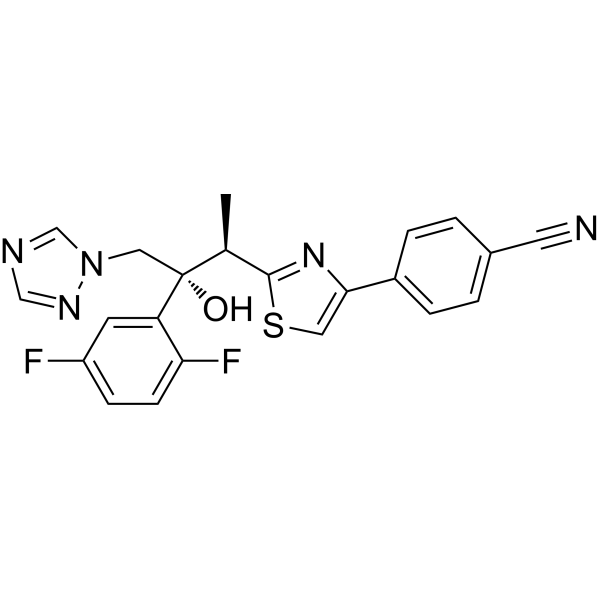
Isavuconazole (BAL-4815) is a triazole proagent with antifungal activity against yeasts, molds, and dimorphic fungi. Isavuconazole inhibits ergosterol biosynthesis and results in the disruption of fungal membrane structure and function. Isavuconazole is a moderate inhibitor of CYP3A4.
loading...
    loading...
Cat. No.: HY-14273R
CAS No.: 241479-67-4
Synonyms: BAL-4815 (Standard); RO-0094815 (Standard)
Isavuconazole (Standard) is the analytical standard of Isavuconazole. This product is intended for research and analytical applications. Isavuconazole (BAL-4815) is a triazole proagent with antifungal activity against yeasts, molds, and dimorphic fungi. Isavuconazole inhibits ergosterol biosynthesis and results in the disruption of fungal membrane structure and function. Isavuconazole is a moderate inhibitor of CYP3A4.
loading...
    loading...
Cat. No.: HY-176746
Target:  

Fungal

Research Areas:  

Infection

CMLD009688 is a cationic amphiphilic antifungal agent. CMLD009688 selectively inhibits plant pathogenic fungi such as Fusarium graminearum. CMLD009688 interacts with biological membranes, perturbing vacuolar and mitochondrial membrane structures to induce fungal cell death. CMLD009688 is promising for research of plant fungal diseases (e.g., wheat head blight, gray mold) .
loading...
    loading...
Cat. No.: HY-172804
Research Areas:  

Infection

SDH-IN-26 (Compound C3) is a succinate dehydrogenase (SDH) inhibitor. SDH-IN-26 exhibits significant inhibitory activity against multiple phytopathogenic fungi, such as Rhizoctonia solani and Botrytis cinerea, with an EC50 value of 0.270 μg/mL against Rhizoctonia solani. SDH-IN-26 damages the integrity of the fungal cell membrane, increases membrane permeability, disrupts cell structure, and reduces the number of mitochondria, thus affecting the normal growth of mycelia. SDH-IN-26 leads to a decrease in mitochondrial membrane potential, and induces cell apoptosis. SDH-IN-26 is promising for research of plant diseases caused by fungi .
loading...
    loading...
Cat. No.: HY-182586
CAS No.: 19198-75-5
Target:  

Fungal Bcl-2 Family

Research Areas:  

Infection

Decyl gallate is an antifungal (fungal) agent. Decyl gallate downregulates the expression of the pro-apoptotic (apoptosis) protein Bak, upregulates the expression of the anti-apoptotic protein Bcl-2, and inhibits DNA damage. Decyl gallate disrupts ALG12-mediated N-glycosylation, overactivates the UPR pathway, and simultaneously reduces fungal cell wall enzyme activity, chitin levels, mitochondrial activity, budding ability, cell viability, and host cell adhesion capacity. Decyl gallate reduces inflammatory responses induced by fungal infection and disrupts fungal membrane structure. Decyl gallate can be used in studies related to paracoccidioidomycosis and invasive fungal infections .
loading...
    loading...
Cat. No.: HY-184980
CAS No.: 2180967-88-6
Target:  

Urease Fungal

Research Areas:  

Infection

Urease-IN-23 is a cryptococcal urease inhibitor with antifungal activity. AF55 exhibits mixed-type inhibition against cryptococcal urease, binds to both the nickel ion site at the enzyme's catalytic center and the allosteric site, impairs urease catalytic efficiency, simultaneously disrupts fungal virulence structures and damages cell membrane integrity. The IC50 and Ki values of Urease-IN-23 against cryptococcal urease are 54.92 nM and 149.1 nM, respectively. Urease-IN-23 significantly reduces the capsule thickness of Cryptococcus neoformans and Cryptococcus gattii, increases fungal cell membrane permeability, and completely blocks melanin synthesis. Urease-IN-23 shows no toxicity in the Galleria mellonella larval model. Urease-IN-23 can be used in studies related to fungal infections .
loading...
    loading...
Cat. No.: HY-D3383
Target:  

Fluorescent Dye

Research Areas:  

Neurological Disease

AM4-64 is a fixable cationic styryl fluorescent dye for nerve terminals, which can be used for vesicle cycle evaluation, endocytic pathway tracing and endocytosis detection. AM4-64 inserts into the plasma membrane, is internalized via activity- or energy-dependent endocytosis, and accumulates in vesicles, endosomal compartments, vacuolar membranes, mitochondria and endolysosomal structures. The fluorescence of AM4-64 is enhanced in the membrane-bound state. AM4-64 is applicable to relevant studies on neurons, plant and fungal cells and tissues (Ex/Em = 510/750 nm) .
loading...
    loading...
Cat. No.: HY-P11783
CAS No.: 86711-55-9
Target:  

Fungal

Research Areas:  

Infection

Surfactin C2 is a lipopeptide produced by Bacillus subtilis A18 with antifungal activity. Surfactin C2 acts against Heterobasidion annosum and Heterobasidion parviporum. Surfactin C2 exerts its activity mainly through membrane‑active effects to disrupt fungal cell structures and inhibit mycelial growth. Surfactin C2 can be used for the research of butt rot and root rot of conifers .
loading...
    loading...
Cat. No.: HY-167081
CAS No.: 70161-09-0
Target:  

Fungal Cytochrome P450

Research Areas:  

Infection

Democonazole is an imidazole antifungal agent that blocks ergosterol synthesis by inhibiting CYP450 14α-lanosterol demethylase (CYP51), thereby disrupting the integrity and fluidity of fungal cell membranes. Democonazole is lipophilic, which enhances its ability to penetrate fungal cell membranes and inhibit ergosterol synthesis. Democonazole can be used in studies related to fungal infections .
loading...
    loading...
Cat. No.: HY-L048
585 compounds

The high rates of morbidity and mortality caused by fungal infections are associated with the current limited antifungal arsenal and the high toxicity of the compounds. Additionally, identifying novel drug targets is challenging because there are many similarities between fungal and human cells. The most common antifungal targets include fungal RNA synthesis and cell wall and membrane components, though new antifungal targets are being investigated. Nonetheless, fungi have developed resistance mechanisms, such as overexpression of efflux pump proteins, overexpression and changes in drug targets and biofilm formation, emphasizing the importance of discovering new antifungal drugs and therapies. Due to the limited antifungal arsenal, researchers have sought to improve treatment via different approaches, such as the combination of antifungal drugs, development of new formulations for antifungal agents and modifications to the chemical structures of traditional antifungals, etc.

MCE offers a unique collection of 585 compounds with validated antifungal activities. MCE antifungal compound library is an effective tool for drug repurposing screening, combination screening and biological investigation.

