
1. Search Result
Search Result
Results for "

human intestinal bacteria

" in MedChemExpress (MCE) Product Catalog:

10

Inhibitors & Agonists

6

Natural
Products

2

Isotope-Labeled Compounds

Cat. No. Product Name Target Research Areas Chemical Structure
  • HY-108695

    Apoptosis Endogenous Metabolite Cancer
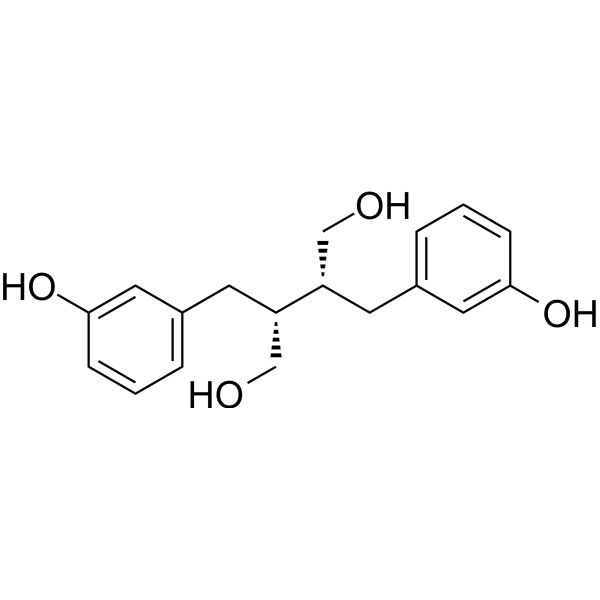
    Enterodiol is transformed by human intestinal bacteria from lignans contained in various whole-grain cereals, nuts, legumes, flaxseed, and vegetables. Enterodiol has an apoptotic effect in colorectal cancer (CRC) cells. Anti-cancer activities .
    Enterodiol
  • HY-W008030

    Bacterial Infection
    3-Aminobiphenyl is a chemical isomer of 4-ABP. 3-Aminobiphenyl can inhibit the growth of human intestinal bacteria Bifidobacterium infantis ATCC 15697, B. bifidium ATCC 11863, Clostridium perfringens ATCC 13124, Escherichia coli ATCC 25922, E. coli ATCC 35218, Enterobacter cloacae ATCC 13047 and Salmonella typhimurium TA98, TA100, YG1041. 3-Aminobiphenyl can be used as a biomarker of exposure to aromatic amines from cigarette smoke .
    3-Aminobiphenyl
  • HY-108695B

    Apoptosis Endogenous Metabolite Cancer
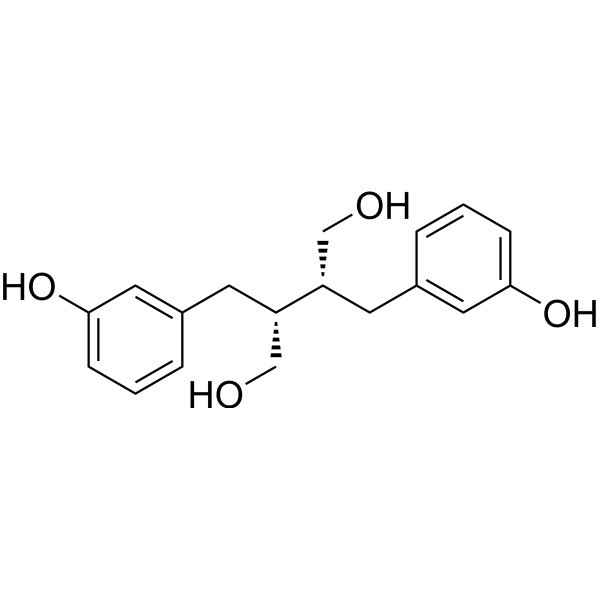
    (±)-Enterodiol is the racemate of Enterodiol (HY-108695). Enterodiol is transformed by human intestinal bacteria from lignans contained in various whole-grain cereals, nuts, legumes, flaxseed, and vegetables. Enterodiol has an apoptotic effect in colorectal cancer (CRC) cells. Enterodiol has anti-cancer activities .
    (±)-Enterodiol
  • HY-W705820

    Isotope-Labeled Compounds Apoptosis Endogenous Metabolite Cancer
    (±)-Enterodiol-d6 is the deuterium labeled (±)-Enterodiol (HY-108695B). (±)-Enterodiol is the racemate of Enterodiol (HY-108695). Enterodiol is transformed by human intestinal bacteria from lignans contained in various whole-grain cereals, nuts, legumes, flaxseed, and vegetables. Enterodiol has an apoptotic effect in colorectal cancer (CRC) cells. Enterodiol has anti-cancer activities .
    (±)-Enterodiol-d6
  • HY-N0882

    Deacetylcinobufotalin

    Apoptosis Bcl-2 Family Inflammation/Immunology Cancer
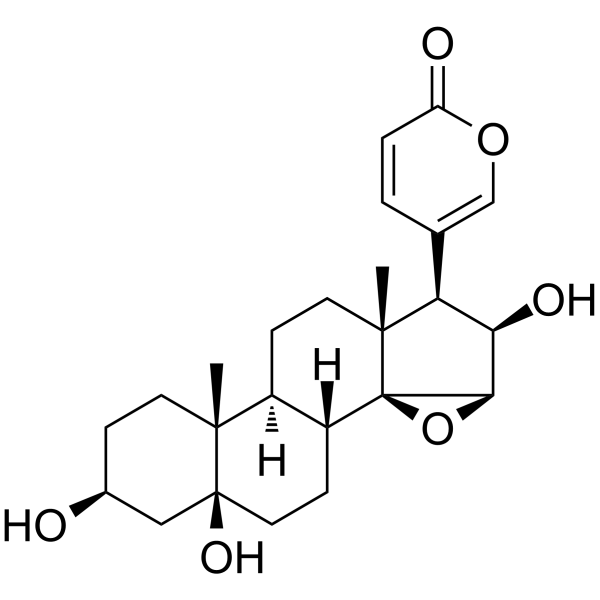
    Desacetylcinobufotalin is an active component isolated from Venenum Bufonis, which exhibits significant cytotoxicity against human hepatocellular carcinoma HepG2 cells (IC50 = 0.0279 µmol/mL). Desacetylcinobufotalin upregulates Bax protein expression, downregulates Bcl-2 protein expression, and induces apoptosis via the mitochondrial pathway. Desacetylcinobufotalin inhibits cancer cell survival, and shows lower cytotoxicity compared to its parent compound Cinobufagin (HY-N0421). Desacetylcinobufotalin can be used in hepatocellular carcinoma-related research .
    Desacetylcinobufotalin
  • HY-N8911

    Endogenous Metabolite Infection
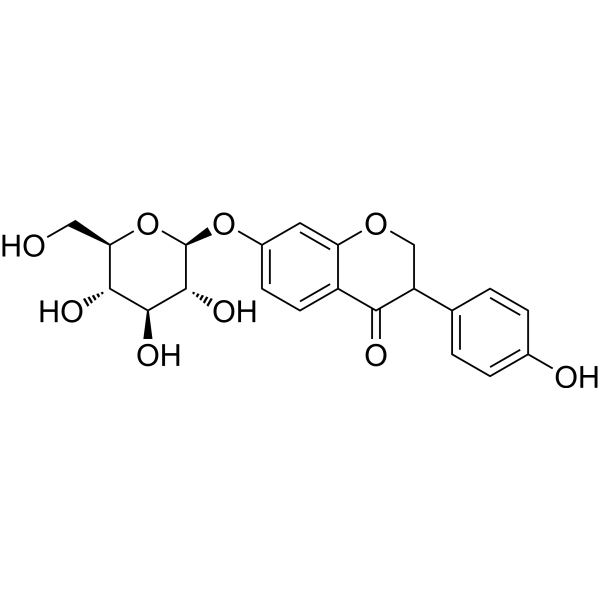
    Dihydrodaidzin is an isoflavanone that can be isolated from Soybeans. Dihydrodaidzin is also a product of biotransformation by human intestinal bacteria .
    Dihydrodaidzin
  • HY-108695BR

    Reference Standards Apoptosis Endogenous Metabolite Cancer
    (±)-Enterodiol (Standard) is the analytical standard of (±)-Enterodiol. This product is intended for research and analytical applications. (±)-Enterodiol is the racemate of Enterodiol (HY-108695). Enterodiol is transformed by human intestinal bacteria from lignans contained in various whole-grain cereals, nuts, legumes, flaxseed, and vegetables. Enterodiol has an apoptotic effect in colorectal cancer (CRC) cells. Enterodiol has anti-cancer activities .
    (±)-Enterodiol (Standard)
  • HY-W778288

    Isotope-Labeled Compounds Apoptosis Endogenous Metabolite Cancer
    (±)-Enterodiol- 13C3 is the 13C-labeled (±)-Enterodiol (HY-108695B). (±)-Enterodiol is the racemate of Enterodiol (HY-108695). Enterodiol is transformed by human intestinal bacteria from lignans contained in various whole-grain cereals, nuts, legumes, flaxseed, and vegetables. Enterodiol has an apoptotic effect in colorectal cancer (CRC) cells. Enterodiol has anti-cancer activities .
    (±)-Enterodiol-13C3
  • HY-N17985

    Others Metabolic Disease Inflammation/Immunology
    Kalopanaxsaponin H is an hederagenin glycoside (saponin) with no hypoglycemic activity upon intraperitoneal injection. Kalopanaxsaponin H can be metabolized by human intestinal bacteria into Kalopanaxsaponin I, Kalopanaxsaponin A, hederagenin 3-O-α-L-arabinopyranoside and hederagenin, among which Kalopanaxsaponin I and hederagenin are the main metabolites. Kalopanaxsaponin H is isolated from the stem bark of Kalopanax pictus and is used in diabetes-related research .
    Kalopanaxsaponin H
  • HY-167754

    GPR84 Inflammation/Immunology
    Resolvin D5 n-3 DPA is a Docosapentaenoic acid (DPA) derived specialized proresolving lipid mediator (SPM). Resolvin D5 n-3 DPA is a GPR101, GPR12, and GPR84 agonist with EC50s of 4.6 pM, 14 pM, and 1.5 pM, respectively. Resolvin D5 n-3 DPA possesses potent pro-resolution and anti-inflammatory actions. Resolvin D5 n-3 DPA reduces cell adhesion onto TNF-α-activated human endothelial monolayers. Resolvin D5 n-3 DPA displays potent leukocyte-directed activities, upregulating the ability of neutrophils and macrophages to phagocytose bacteria. Resolvin D5 n-3 DPA can be used for the study of intestinal inflammation .
    Resolvin D5 n-3 DPA

Inquiry Online

Your information is safe with us. * Required Fields.

Salutation


Country or Region *

Applicant Name *


Organization Name *

Department *


Email Address *


Product Name *

Cat. No.


Requested quantity *

Phone Number *


Remarks

Inquiry Online

Inquiry Information

Product Name:
Cat. No.:
Quantity:
MCE Japan Authorized Agent:

