



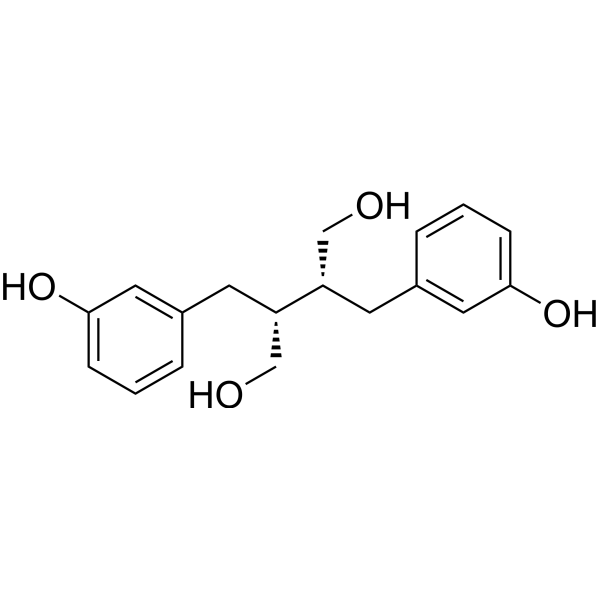
(±)-Enterodiol

Based on 1 Customer Validation
(±)-Enterodiol is the racemate of Enterodiol (HY-108695). Enterodiol is transformed by human intestinal bacteria from lignans contained in various whole-grain cereals, nuts, legumes, flaxseed, and vegetables. Enterodiol has an apoptotic effect in colorectal cancer (CRC) cells. Enterodiol has anti-cancer activities.
For research use only. We do not sell to patients.
- CAS No.: 77756-22-0
- Formula: C18H22O4
- Molecular Weight:302.36
-
Storage:
4°C, sealed storage, away from moisture
* In solvent : -80°C, 6 months; -20°C, 1 month (sealed storage, away from moisture)

To place orders, for customer services and technical support, please contact: MedChemExpress USA
Tel: 609-228-6898 E-mail: [email protected] [email protected]


-
 Biological Activity
-
Chemical Information
- Protocols
- Purity & Documentation
- References
-
 Help & FAQs


All Endogenous Metabolite Isoforms
More

Biological Activity
Description


Chemical Information
-
CAS No. 77756-22-0
-
Appearance Solid
-
Molecular Weight 302.36
-
Formula C18H22O4
-
Color White to off-white
-
SMILES
OC1=CC=CC(C[C@@H](CO)[C@H](CO)CC2=CC(O)=CC=C2)=C1
-
Structure Classification
-
Initial Source
-
Shipping
Room temperature in continental US; may vary elsewhere.
-
Storage
4°C, sealed storage, away from moisture
* In solvent : -80°C, 6 months; -20°C, 1 month (sealed storage, away from moisture)


Purity & Documentation
-
Data Sheet (272 KB)
-
SDS (252 KB)
- English - EN (252 KB)
- Français - FR (252 KB)
- Deutsch - DE (252 KB)
- Norwegian - NO (252 KB)
- Español - ES (252 KB)
- Swedish - SV (252 KB)
- Italian - IT (252 KB)
- Korean - KR (252 KB)
- Portuguese - PT (252 KB)
-
Handling Instructions (2659 KB)
References
[1]. Shin MK, et al. Apoptotic effect of enterodiol, the final metabolite of edible lignans, in colorectal cancer cells. J Sci Food Agric. 2019 Mar 30;99(5):2411-2419. [Content Brief]
[2]. Liu H, et al. Enterolactone has stronger effects than enterodiol on ovarian cancer. J Ovarian Res. 2017 Jul 24;10(1):49. [Content Brief]

Calculators
Concentration (start) × Volume (start) = Concentration (final) × Volume (final)


(±)-Enterodiol Related Classifications
HY-108695B Related Classifications
 Powered by Bioz