Search Result
Results for "
inverse
" in MedChemExpress (MCE) Product Catalog:
3
Biochemical Assay Reagents
15
Isotope-Labeled Compounds
| Cat. No. |
Product Name |
Target |
Research Areas |
Chemical Structure |
-
- HY-108529
-
|
|
RAR/RXR
|
Metabolic Disease
|
|
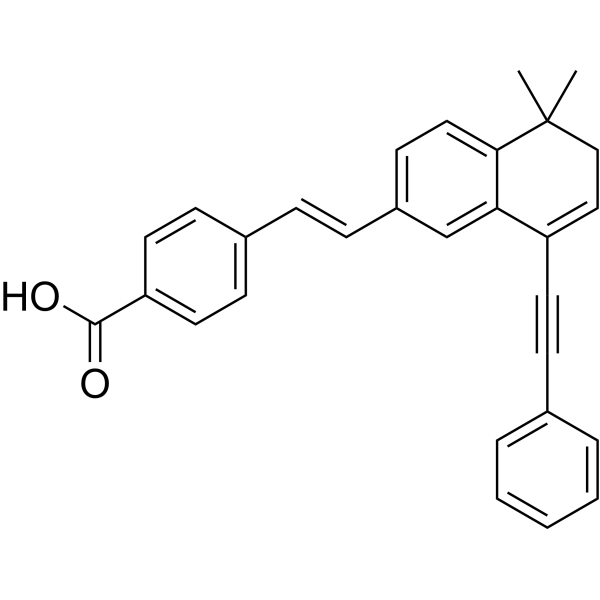
BMS493 is an inverse pan-retinoic acid receptor (RAR) agonist. BMS493 increases nuclear corepressor interaction with RARs. BMS493 also could prevent retinoic acid-induced differentiation . BMS493 is a click chemistry reagent, it contains an Alkyne group and can undergo copper-catalyzed azide-alkyne cycloaddition (CuAAc) with molecules containing Azide groups.
|
-
-
- HY-14289
-
-
-
- HY-13421
-
-
-
- HY-14413
-
|
ML 176
|
ROR
|
Metabolic Disease
|
|
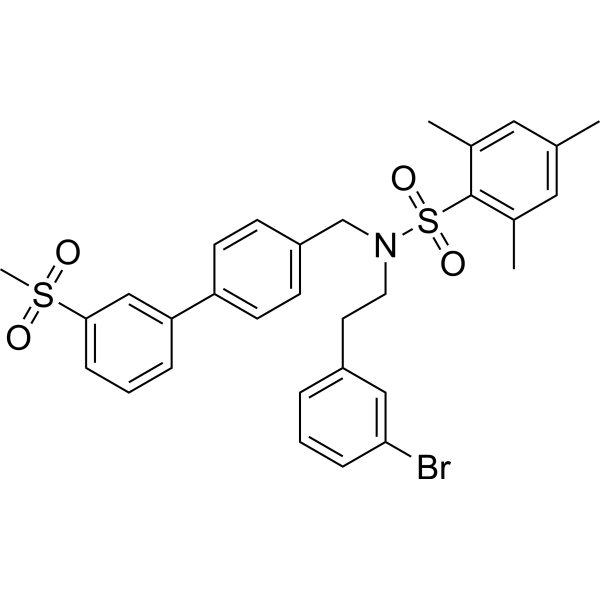
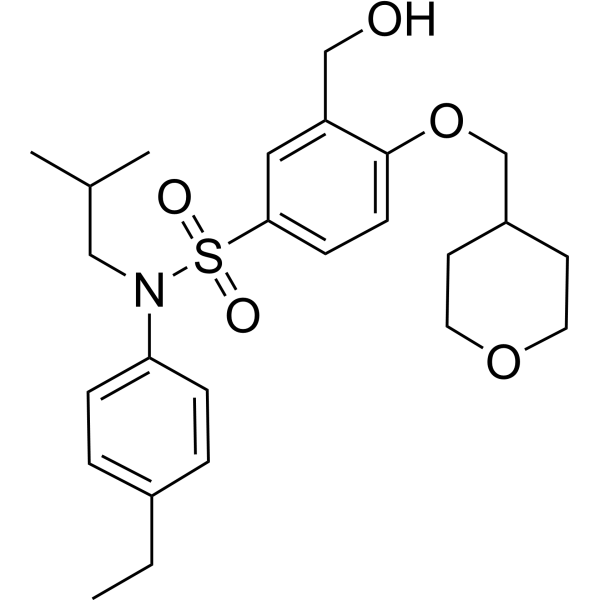
SR3335 (ML 176) is a selective RORα inverse agonist that directly binds to RORα with a Ki of 220 nM .
|
-
-
- HY-12584
-
-
-
- HY-12199
-
-
-
- HY-12199B
-
-
-
- HY-16972
-
|
|
LXR
|
Cancer
|
|
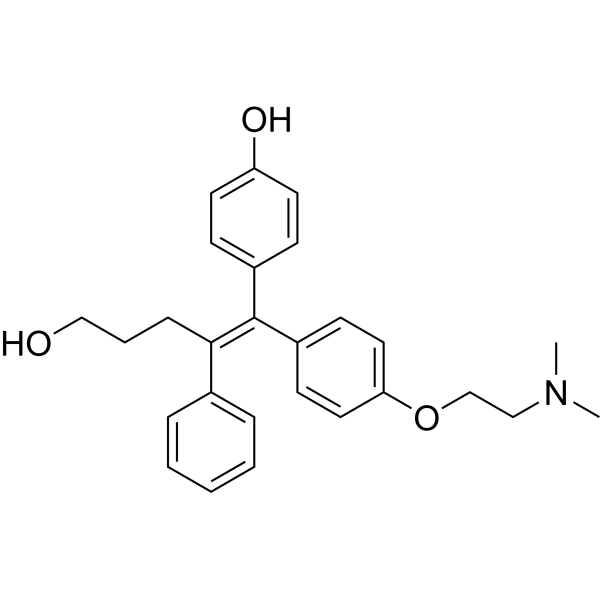
SR9243 is a liver-X-receptor (LXR) inverse agonist that induces LXR-corepressor interaction.
|
-
-
- HY-16998
-
SR2211
1 Publications Verification
|
ROR
|
Inflammation/Immunology
|
|
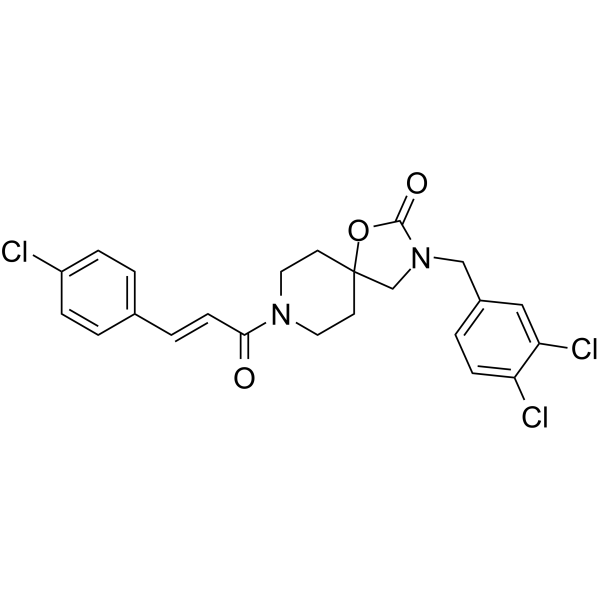
SR2211 is a potent, selective synthetic RORγ modulator and functions as an inverse agonist, with a Ki of 105 nM and an IC50 of ~320 nM.
|
-
-
- HY-134599
-
|
|
Biochemical Assay Reagents
|
Cancer
|
|
(2E)-TCO-PNB ester is an active reaction substrate with the properties of trans-cyclooctene derivatives. The core chemical property of (2E)-TCO-PNB ester is its ability to undergo efficient inverse electron-demand Diels-Alder (IEDDA) cycloaddition with tetrazine groups. (2E)-TCO-PNB ester can be used in ligation reactions to verify the integrity of tetrazine groups, and also serves as a key synthetic raw material for the preparation of the prodrug TCO-DOX. (2E)-TCO-PNB ester is applied in research related to drug synthesis and bioorthogonal chemistry .
|
-
-
- HY-10559
-
|
APD125
|
5-HT Receptor
|
Neurological Disease
Cancer
|
|
Nelotanserin is a potent 5-HT2A inverse agonist, a moderately potent 5-HT2C partial inverse agonist and a weak 5-HT2B inverse agonist, with IC50s of 1.7, 79, 791 nM in IP accumulation assays, respectively.
|
-
-
- HY-12664
-
-
-
- HY-137434
-
|
ABBV-157
|
ROR
|
Inflammation/Immunology
|
|
Cedirogant (ABBV-157) is an orally active RORγt inverse agonist. Cedirogant can be used for psoriasis research .
|
-
-
- HY-19770
-
|
|
ROR
|
Inflammation/Immunology
|
|
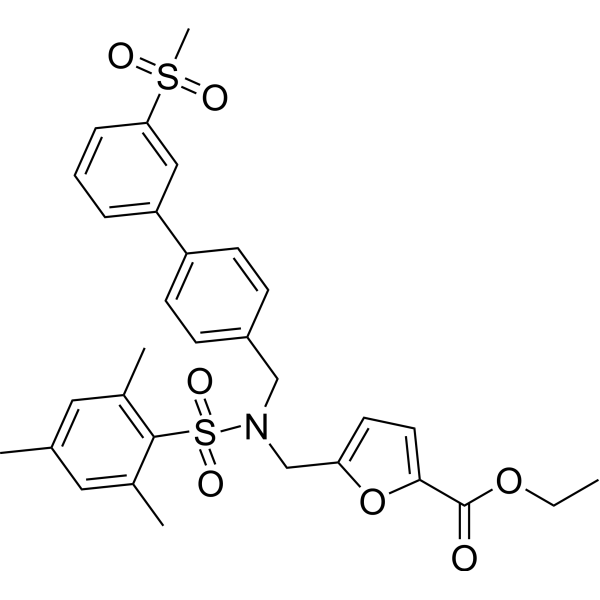
GSK2981278 is a potent and selective RORγ inverse agonist. GSK2981278 inhibits activation of the il17 promoter and interferes RORγ-DNA binding .
|
-
-
- HY-100369A
-
|
|
GABA Receptor
|
Neurological Disease
|
|
DMCM hydrochloride is a nonselective full inverse agonist of benzodiazepine. DMCM shows bnding afinity at human recombinant GABAA αxβ3γ2 receptor subtypes with Kis of 10 nM, 13 nM, 7.5 nM, 2.2 nM for α1, α2, α3, and α5 receptors, respectively .
|
-
-
- HY-101198
-
|
|
Histamine Receptor
Apoptosis
|
Neurological Disease
Cancer
|
|
Clobenpropit dihydrobromide is a potent histamine H3R antagonist/inverse agonist with a pEC50 of 8.07 for histamine H3LR . Clobenpropit dihydrobromide acts as partial agonist at histamine H4 receptors (Ki 13 nM). Clobenpropit dihydrobromide also binds to serotonin 5-HT3 receptors (Ki 7.4 nM) and α2A/α2C adrenoceptors (Ki 17.4/7.8 nM) . Clobenpropit dihydrobromide increases apoptosis .
|
-
-
- HY-100991
-
|
ZK 39106; LSU-65
|
GABA Receptor
|
Neurological Disease
|
|
FG 7142 (ZK 39106; LSU-65), a non-selectively benzodiazepine inverse agonist, has high affinity for the α1 subunit-containing GABAA receptor (Ki=91 nM). FG 7142 (ZK 39106; LSU-65) also modulates GABA-induced chloride flux at GABAA receptors expressing the α1 subunit (EC50= 137 nM). FG 7142 (ZK 39106; LSU-65) can increase tyrosine hydroxylation and cause upregulation of β-adrenoceptors in mouse cerebral cortex .
|
-
-
- HY-156354
-
|
|
Orphan GPCR
|
Metabolic Disease
|
|
GPR61 Inverse agonist 1 (Compound 1) is a GPR61 inverse agonist (IC50: 11 nM). GPR61 Inverse agonist 1 can be used for research of disorders of metabolism and body weight, such as obesity and cachexia .
|
-
-
- HY-103476
-
|
|
GABA Receptor
|
Neurological Disease
|
|
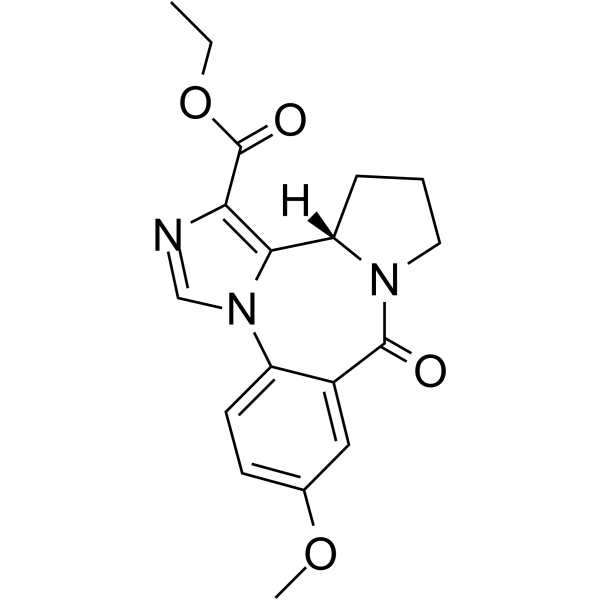
Ro15-4513, imidazobenzodiazepinone derivative, is a partial inverse agonist of benzodiazepine receptor (BZR) . Ro15-4513 is a potent ethanol antagonist . Ro15-4513 has anti-anxiety effect . Ro15-4513 is a click chemistry reagent, it contains an Azide group and can undergo copper-catalyzed azide-alkyne cycloaddition reaction (CuAAc) with molecules containing Alkyne groups. It can also undergo strain-promoted alkyne-azide cycloaddition (SPAAC) reactions with molecules containing DBCO or BCN groups.
|
-
-
- HY-102075A
-
-
-
- HY-148352
-
|
|
PPAR
|
Cancer
|
|
BAY-4931 is a potent, covalent and selective PPARγ inverse-agonist with an IC50 of 0.17 nM .
|
-
-
- HY-132909
-
-
-
- HY-114411
-
|
|
Estrogen Receptor/ERR
|
Cancer
|
|
ERRγ inverse agonist 1 (Compound 12) is a selective ERRγ inverse agonist with an IC50 value of 0.040 μM against ERRγ. ERRγ inverse agonist 1 inhibits the activity of ERRγ at the functional level. ERRγ inverse agonist 1 can be used in the research of anaplastic thyroid cancer .
|
-
-
- HY-12095
-
|
|
Cannabinoid Receptor
|
Neurological Disease
|
|
CB1 inverse agonist 2 is an orally active inverse agonist of Cannabinoid Receptor CB1. CB1 inverse agonist 2 effectively inhibits CP55940-induced hypothermia and anorexia in mice model .
|
-
-
- HY-160039
-
|
|
LXR
|
Cancer
|
|
GAC0001E5 is an LXR inverse agonist. GAC0001E5 has antiproliferative activity and can be used in cancer research .
|
-
-
- HY-14289R
-
|
SKF-92334 (Standard)
|
Reference Standards
Histamine Receptor
Bacterial
|
Endocrinology
Cancer
|
|
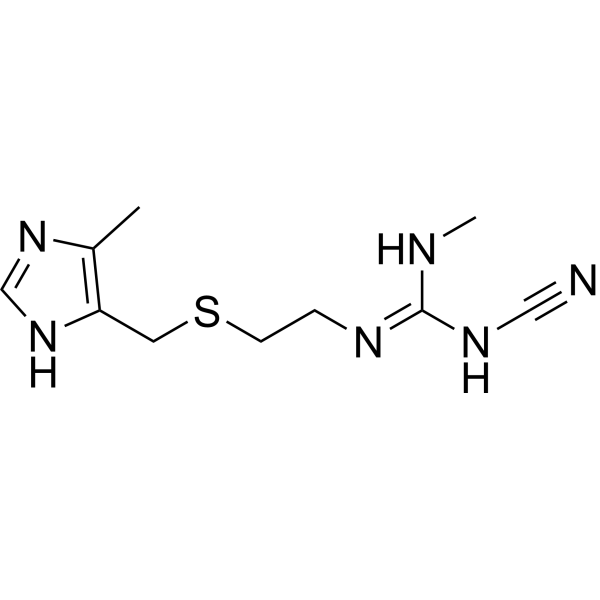
Cimetidine (Standard) is the analytical standard of Cimetidine. This product is intended for research and analytical applications. Cimetidine (SKF-92334) is an orally active and inverse histamine H2 receptor antagonist with a Ki of 0.6 μM. Cimetidine is a gastric acid reducer, and can be used for duodenal and gastric ulcers research. Cimetidine has anti-cancer and anti-inflammatory activity .
|
-
-
- HY-119464
-
MRL-871
1 Publications Verification
|
ROR
|
Cancer
|
|
MRL-871 (compound 3) is a potent and allosteric retinoic acid receptor-related orphan receptor γt (RORγt) inverse agonists with an IC50 of 12.7 nM. MRL-871 has a distinct isoxazole chemotype and effectively reduces IL-17a mRNA production in EL4 cells .
|
-
-
- HY-116247
-
|
|
PPAR
|
Metabolic Disease
Inflammation/Immunology
|
|
ST247 a potent PPARβ/δ inverse agonist. ST247 has a higher affinity to PPARβ/δ. ST247 modulates expression of the activation marker CCL2 in the opposite direction. ST247 efficiently induces the interaction with corepressors. ST247 inhibits the agonist-induced transcriptional activity of PPARβ/δ .
|
-
-
- HY-121852
-
|
SCH-225336
|
Cannabinoid Receptor
|
Inflammation/Immunology
|
|
SCH 336 is a potent, selective, inverse and orally active CB2 agonist. SCH 336 inhibits BaF3/CB2 migration. SCH 336 significantly inhibits the migration of leukocytes in vivo. SCH 336 blocks ovalbumin-induced lung eosinophilia in mice .
|
-
-
- HY-110329
-
|
|
Nuclear Hormone Receptor 4A/NR4A
|
Cancer
|
|
ML179 (SR-1309) is a inverse LRH1/NR5A2 (Liver receptor homologue-1) agonist with IC50 of 320 nM. ML179 shows anti-proliferation activity in MDA-MB-231 cells. ML179 has the potential for the research of ER-negative breast cancer .
|
-
-
- HY-151759
-
|
|
Fluorescent Dye
|
Cancer
|
|
Sulfo-Cy5-TCO is a water-soluble sulfonated Cy5 fluorescent reagent containing trans-cyclooctene (TCO). Sulfo-Cy5-TCO undergoes an inverse electron demand Diels‑Alder reaction with tetrazine-labeled fixed breast cancer cells to achieve cell labeling. Sulfo-Cy5-TCO is used for fluorescent labeling and imaging of biological samples such as proteins and cells .
|
-
-
- HY-131338
-
|
|
ROR
|
Inflammation/Immunology
|
|
RORγt inverse agonist 13 (Compound 3i) is a potent, orally active and selective RORγt inverse agonist, with improved agent-like properties, with an IC50 of 63.8 nM .
|
-
-
- HY-144699
-
|
|
Estrogen Receptor/ERR
|
Cancer
|
|
ERRα antagonist-2 (Compound 11) is a potential ERRα (estrogen related receptor α) inverse agonist with an IC50 of 0.80 μM. ERRα antagonist-2 suppresses the migration and invasion of the ER-negative MDA-MB-231 cell line. ERRα antagonist-2 inhibits breast cancer growth in vivo .
|
-
-
- HY-160258
-
|
GDP-Fucose-Am-Tz
|
Biochemical Assay Reagents
|
Others
|
|
GDP-Fucose-Tz (GDP-Fucose-Am-Tz) is a non-natural GDP-fucose analog bearing a Tetrazine group. As a precursor, GDP-Fucose-Tz enables the synthesis of GDP-fucose-ssDNA probes via inverse electron demand Diels-Alder reaction. GDP-Fucose-Tz participates in chemoenzymatic reactions to prepare GDP-fucose-Herceptin derivatives through conjugation with TCO-Herceptin .
|
-
-
- HY-175306
-
|
|
EBI2/GPR183
Arrestin
|
Inflammation/Immunology
Cancer
|
|
GPR183 inverse agonist-1 (Compound 78) is a GPR183 inverse agonist. GPR183 inverse agonist-1 inhibits the GPR183-mediated Gi activation and β-arrestin2 recruitment, and blocks PBMC migration. GPR183 inverse agonist-1 can be used for inflammatory, autoimmune and neoplastic disorders research .
|
-
-
- HY-175822
-
|
|
5-HT Receptor
|
Neurological Disease
|
|
5-HT2A inverse agonist-1 is a 5-HT2A receptor inverse agonist with a IC50 of 5.5 nM. 5-HT2A inverse agonist-1 shows minimal hERG inhibition. 5-HT2A inverse agonist-1 can be used for the research of neurological disease, such as Parkinson’s disease .
|
-
-
- HY-136100
-
|
|
ADC Linker
|
Cancer
|
|
TCO-PEG1-Val-Cit-PABC-PNP is a cleavable 1 unit PEG ADC linker used in the synthesis of antibody-drug conjugates (ADCs). TCO-PEG1-Val-Cit-PABC-PNP is a click chemistry reagent, which contains a TCO group that can undergo an inverse electron demand Diels-Alder reaction (iEDDA) with molecules containing Tetrazine groups .
|
-
-
- HY-136100A
-
|
|
ADC Linker
|
Cancer
|
|
TCO-PEG1-Val-Cit-PABC-PNP TFA is a cleavable 1 unit PEG ADC linker used in the synthesis of antibody-drug conjugates (ADCs). TCO-PEG1-Val-Cit-PABC-PNP TFA is a click chemistry reagent, which contains a TCO group that can undergo an inverse electron demand Diels-Alder reaction (iEDDA) with molecules containing Tetrazine groups .
|
-
-
- HY-133128
-
|
|
ROR
|
Cancer
|
|
FM26 (compound 25) is a potent and allosteric retinoic acid receptor-related orphan receptor γt (RORγt) inverse agonists with an IC50 of 264 nM. FM26 has a distinct isoxazole chemotype and effectively reduces IL-17a mRNA production in EL4 cells .
|
-
-
- HY-157006A
-
|
|
Biochemical Assay Reagents
|
Others
|
|
TCO-PEG3-NH2 is a click chemistry reagent that contains a TCO group and undergoes the inverse electron-demand Diels-Alder (iEDDA) reaction with tetrazine-containing molecules .
|
-
-
- HY-W012472
-
|
|
Environmental Pollutants
Biochemical Assay Reagents
|
Others
|
|
1,3,5-Triisopropylbenzene is a symmetric aromatic hydrocarbon compound. 1,3,5-Triisopropylbenzene serves as a saturated crosslinker to participate in the "inverse vulcanization" reaction of elemental sulfur. 1,3,5-Triisopropylbenzene acts as a probe molecule to evaluate the external surface acidity and accessibility of zeolite materials. 1,3,5-Triisopropylbenzene is also used as fuel and fuel additive, lubricant and lubricant additive, as well as micelle swelling agent .
|
-
-
- HY-128604
-
|
|
ROR
|
Cancer
|
|
XY101 is a potent, selective, metabolically stable and orally available RORγ inverse agonist with an IC50 of 30 nM and a Kd of 380 nM .
|
-
-
- HY-175490
-
|
|
ROR
|
Inflammation/Immunology
|
|
RORγ inverse agonist 2 (Compound 15) is a potent inverse agonist of the retinoic acid receptor-related orphan receptor RORγ, with IC50 values of 0.4 and 0.9 μM for Gal4-RORγ and full-length RORγ, respectively. RORγ inverse agonist 2 is useful in the study of autoimmune diseases .
|
-
-
- HY-177712
-
|
|
ROR
|
Inflammation/Immunology
|
|
RORγt inverse agonist 36 (S configuration of Compound 16) is a RORγt inverse agonist. RORγt inverse agonist 36 can be used for the research of inflammation and immunology .
|
-
-
- HY-128573
-
|
|
ROR
|
Neurological Disease
|
|
RORγt Inverse agonist 3 is a potent, selective and orally active RORγ inverse agonist, with EC50s of 0.22 μM and 0.15 μM for hRORγ and RORγt (human IL-17 cells), respectively .
|
-
-
- HY-169001
-
|
|
5-HT Receptor
|
Neurological Disease
|
|
5-HT2A/5-HT2C inverse agonist 1 is a potent and dual 5-HT2A and 5-HT2C receptor inverse agonist with a hERG inhibitions, thus avoiding cardiovascular risks. 5-HT2A/5-HT2C inverse agonist 1 shows significant antipsychotic efficacy in the MK-801 (HY-15084B)-induced mouse model. 5-HT2A/5-HT2C inverse agonist 1 is promising for research of psychosis .
|
-
-
- HY-137061
-
-
-
- HY-116603
-
|
|
5-HT Receptor
|
Others
|
|
SB-236057 is an inverse agonist of the 5-HT1B receptor that exhibits strong skeletal teratogenicity in rodents and rabbits. SB-236057 affects gene expression during embryonic development through interference with the Notch signaling pathway and interaction with r-esp1. SB-236057 induces somatic patterning and tail extension defects in rat embryos during early organogenesis .
|
-
-
- HY-116521
-
-
-
- HY-119208
-
|
|
CXCR
|
Others
|
|
VUF11211 is an allosteric inverse CXCR3 agonist with a Kd of 0.65 nM .
|
-
- HY-170456
-
-
- HY-122737
-
|
|
ROR
|
Inflammation/Immunology
|
|
RORγt Inverse agonist 8 is a potent, selective, orally bioavailable RORγt inverse agonist, with an IC50 of 19 nM for human RORγt-LBD .
|
-
- HY-114025
-
-
- HY-168179
-
|
|
ROR
|
Inflammation/Immunology
|
|
RORγt inverse agonist 32 (compound b14) is orally active. RORγt inverse agonist 32 can be used in inflammation research .
|
-
- HY-143271
-
|
|
ROR
|
Inflammation/Immunology
|
|
RORγt inverse agonist 29 is a potent, orally active and selective RORγt inverse agonist (IC50: 21 nM). RORγt inverse agonist 29 can be used in the research of skin inflammation and autoimmune diseases like psoriasis .
|
-
- HY-135280
-
|
CB1 inverse agonist 1
|
Cannabinoid Receptor
|
Metabolic Disease
|
|
MRL-650 (CB1 inverse agonist 1), a chemical probe, is a highly potent, orally active, and specific inverse agonist of CB1 receptor with IC50s of 7.5 nM and 4100 nM for CB1 and CB2 receptors, respectively. Anorexigenic effects .
|
-
- HY-176273
-
|
|
ROR
Interleukin Related
|
Inflammation/Immunology
|
|
RORγt inverse agonist 35 (Compound 22) is a RORγt inverse agonist with an IC50 of 1.51 μM. RORγt inverse agonist 35 significantly inhibits Th17 differentiation and proinflammatory properties in human CD4 + T cells. RORγt inverse agonist 35 can be used for research of Th17-driven autoimmune diseases, such as psoriasis, multiple sclerosis, and inflammatory bowel disease (IBD) .
|
-
- HY-147533
-
|
|
ROR
|
Inflammation/Immunology
|
|
RORγt inverse agonist 30 (Compound 1) is a potent RORγt inverse agonist with the IC50 of 46 nM. Targeting the nuclear receptor RORγt is effective in autoimmune disorders .
|
-
- HY-49076
-
|
|
ROR
|
Cancer
|
|
RORγ inverse agonist 1 is the inverse agonist of RORγ .
|
-
- HY-149833
-
|
|
Estrogen Receptor/ERR
|
Infection
Metabolic Disease
|
|
ERRγ inverse agonist 2 (compound 19) is a potent and selective ERRγ inverse agonist with a Kd value of 6.5 μM. ERRγ inverse agonist 2 inhibits the expression of hepcidin, fibrinogen and gluconeogenic genes. ERRγ inverse agonist 2 has antimicrobial, anti-coagulant and antidiabetic activities .
|
-
- HY-170370
-
|
|
ROR
|
Inflammation/Immunology
|
|
RORγt inverse agonist 34 (compound 5a) is a RORγt inverse agonist with an IC50 of 0.094 μM for RORγt-LBD. RORγt inverse agonist 34 is used for psoriasis research .
|
-
- HY-111748
-
-
- HY-169952
-
|
|
ROR
|
Inflammation/Immunology
|
|
RORγt inverse agonist 33 (compound (R)-D4) is an orally bioavailable and inverse agonists of RORγt, with the IC50 of 21 nM. RORγt inverse agonist 33 plays an important role in rheumatoid arthritis research .
|
-
- HY-132195
-
|
|
ROR
|
Inflammation/Immunology
|
|
RORγt inverse agonist 14 (8e) is a potent, orally active and selective RORγt inverse agonist (EC50 of 2.5 nM) with anti-inflammatory activity. RORγt inverse agonist 14 is used in the study for rheumatoid arthritis and psoriasis .
|
-
- HY-139847
-
|
|
ROR
|
Inflammation/Immunology
|
|
RORγt inverse agonist 23 is a potent, selective, and orally available novel retinoic acid receptor-related orphan receptor γt inverse agonist.
|
-
- HY-130243
-
|
|
ROR
|
Inflammation/Immunology
|
|
RORγt Inverse agonist 6 (compound 43) is a RORγt inverse agonist for the study of Th17-driven autoimmune diseases. RORγt Inverse agonist 6 (compound 43) suppresses IL-17A gene expression by IL-23 stimulation in vivo .
|
-
- HY-155548
-
|
|
ROR
|
Inflammation/Immunology
|
|
RORγt inverse agonist 31 (14g) is a potent retinoic acid receptor-related orphan receptor γt (RORγt) inverse agonist, with an IC50 of 0.428 μM. RORγt inverse agonist 31 can alleviate the severity of Imiquimod (HY-B0180)-induced psoriasis in mice .
|
-
- HY-142703
-
|
|
ROR
|
Inflammation/Immunology
|
|
RORγt inverse agonist 28 is a potent reverse agonist of RORγt. RORγt inverse agonist 28 regulates the differentiation of Th17 cells and inhibits the production of IL-17. RORγt inverse agonist 28 has the potential for the research of inflammation and autoimmune diseases (extracted from patent WO2021228215A1, compound 6) .
|
-
- HY-142806
-
|
|
ROR
|
Inflammation/Immunology
|
|
RORγt inverse agonist 26 is a potent reverse agonist of RORγt. RORγt inverse agonist 26 regulates the differentiation of Th17 cells and inhibits the production of IL-17. RORγt inverse agonist 26 has the potential for the research of inflammation and autoimmune diseases (extracted from patent WO2021228215A1, compound 1) .
|
-
- HY-133552
-
|
|
ROR
|
Inflammation/Immunology
|
|
RORγt Inverse agonist 10 is a potent and orally bioavailable RORγt (retinoic acid receptor-related orphan nuclear receptor gamma t) inverse agonist, with an IC50 of 51 nM. RORγt is a major transcription factor of genes related to psoriasis pathogenesis such as IL-17A, IL-22, and IL-23R
|
-
- HY-168333
-
|
|
5-HT Receptor
mTOR
CDK
|
Neurological Disease
|
|
5-HT6 inverse agonist 1 (Compound 33) is an antagonist for 5-HT6 receptor with a Ki of 23 nM and a Kb of 6.62 nM. 5-HT6 inverse agonist 1 inhibits the 5-HT6R mediated Cdk5 and mTOR signaling pathway. 5-HT6 inverse agonist 1 reduces tactile hypersensitivity in spinal nerve ligation (SNL)-induced rat model .
|
-
- HY-118336
-
-
- HY-124225
-
-
- HY-155481A
-
|
|
Cannabinoid Receptor
|
Others
|
|
CB2 receptor antagonist 4 (compound (R)-1) is a CB2R-selective inverse agonist with a Kd value of 39 nM .
|
-
- HY-160161
-
|
|
PPAR
|
Cancer
|
|
BAY-5094 is a PPAR gamma (PPARG) inverse agonist. BAY-5094 has oral activity. BAY-5094 can be used in the research of luminal bladder cancer .
|
-
- HY-119010
-
-
- HY-171235
-
|
|
5-HT Receptor
|
Neurological Disease
|
|
5-HT2A antagonist 3 (Formula (III)) is a 5-HT2A receptor antagonist and inverse agonist with a pIC50 of 8.7 and a pKi of 9. 5-HT2A antagonist 3 can be utilized in neurological reesearch .
|
-
- HY-170908
-
|
|
5-HT Receptor
|
Neurological Disease
|
|
Pellotine is an alkaloid that can be isolated from Lophophora. Pellotine is the inverse agonist for 5-HT7 receptor with an EC50 of 291 nM. Pellotine exhibits good affinity to 5-HT1DR and 5-HT6R with Ki of 117 nM and 170 nM. Pellotine reduces intracellular cAMP levels, thereby reducing neuronal excitability and neurotransmitter release .
|
-
- HY-P1432
-
|
|
GHSR
|
Metabolic Disease
|
|
K-(D-1-Nal)-FwLL-NH2 is a high affinity, potent and inverse ghrelin receptor agonist (EC50=3.4 nM, Ki=4.9 nM). K-(D-1-Nal)-FwLL-NH2 can be used for the research of obesity .
|
-
- HY-111273
-
-
- HY-123836
-
|
|
Histamine Receptor
|
Neurological Disease
|
|
MK-7288 is a histamine H3 receptor inverse agonist. MK-7288 can prolong sleep latency in the Maintain Wake Test (MWT). MK-7288 can be used in research on obstructive sleep apnea (OSA) and excessive daytime sleepiness (EDS) .
|
-
- HY-100369AR
-
|
|
Reference Standards
GABA Receptor
|
Neurological Disease
|
|
DMCM (hydrochloride) (Standard) is the analytical standard of DMCM (hydrochloride). This product is intended for research and analytical applications. DMCM hydrochloride is a nonselective full inverse agonist of benzodiazepine. DMCM shows bnding afinity at human recombinant GABAA αxβ3γ2 receptor subtypes with Kis of 10 nM, 13 nM, 7.5 nM, 2.2 nM for α1, α2, α3, and α5 ?receptors, respectively .
|
-
- HY-110186
-
|
|
Adenosine Receptor
|
Metabolic Disease
|
|
PQ-69 is a potent and selective adenosine A1 receptor antagonist with inverse agonist activity. PQ-69 binds to hA1 receptor with a Ki value of 0.96 nM, is 217-fold more selective compared with hA2A receptors (Ki=208 nM) and >1,000-fold selectivity over hA3 receptor (Ki >100 μM). PQ-69 can be used for the research of renal dysfunction .
|
-
- HY-100991R
-
|
ZK 39106 (Standard); LSU-65 (Standard)
|
Reference Standards
GABA Receptor
|
Neurological Disease
|
|
FG 7142 (Standard) is the analytical standard of FG 7142. This product is intended for research and analytical applications. FG 7142 (ZK 39106; LSU-65), a non-selectively benzodiazepine inverse agonist, has high affinity for the α1 subunit-containing GABAA receptor (Ki=91 nM). FG 7142 (ZK 39106; LSU-65) also modulates GABA-induced chloride flux at GABAA receptors expressing the α1 subunit (EC50= 137 nM). FG 7142 (ZK 39106; LSU-65) can increase tyrosine hydroxylation and cause upregulation of?β-adrenoceptors in mouse cerebral cortex .
|
-
- HY-103476R
-
|
|
Reference Standards
GABA Receptor
|
Neurological Disease
|
|
Ro15-4513 (Standard) is the analytical standard of Ro15-4513. This product is intended for research and analytical applications. Ro15-4513, imidazobenzodiazepinone derivative, is a partial inverse agonist of benzodiazepine receptor (BZR) . Ro15-4513 is a potent ethanol antagonist . Ro15-4513 has anti-anxiety effect . Ro15-4513 is a click chemistry reagent, it contains an Azide group and can undergo copper-catalyzed azide-alkyne cycloaddition reaction (CuAAc) with molecules containing Alkyne groups. It can also undergo strain-promoted alkyne-azide cycloaddition (SPAAC) reactions with molecules containing DBCO or BCN groups.
|
-
- HY-14289S
-
|
SKF-92334-d3
|
Histamine Receptor
|
Endocrinology
Cancer
|
|
Cimetidine-d3 is the deuterium labeled Cimetidine. Cimetidine (SKF-92334) is an orally active and inverse histamine H2 receptor antagonist with a Ki of 0.6 μM. Cimetidine is an inverse agonist. Cimetidine has anti-cancer and anti-inflammatory activity .
|
-
- HY-115777
-
|
|
ROR
|
Neurological Disease
|
|
ARN-6039 is an orally available inverse agonist of RORγ for autoimmune demyelinating disease.
|
-
- HY-103225
-
|
SB-737552 phosphate
|
GABA Receptor
|
Neurological Disease
|
|
S-8510 (phosphate) is an inverse Benzodiazepine (BDZ) receptor agonist, with Kis of 34.6 nM, 36.2 nM for –GABA and +GABA respectively.
|
-
- HY-100328
-
-
- HY-148237
-
-
- HY-183763
-
|
|
ROR
Interleukin Related
|
Inflammation/Immunology
|
|
RORγt inverse agonist 37 is an orally active RORγt inverse agonist with an IC50 of 10.8 nM against human targets. RORγt inverse agonist 37 destabilizes helix 12 of RORγt in the agonist-bound conformation, thereby inhibiting transcriptional activity. RORγt inverse agonist 37 inhibits the secretion of IL-17 in cells and in LPS-induced systemic inflammation mouse models. RORγt inverse agonist 37 improves disease-related symptoms in mouse models of psoriasiform dermatitis. RORγt inverse agonist 37 can be used in research related to psoriasiform dermatitis and systemic inflammation .
|
-
- HY-183657A
-
|
|
|
Neurological Disease
|
|
GPR3 inverse agonist-1 TFA is a selective and competitive GPR3 inverse agonist with an EC50 of 5 μM. GPR3 inverse agonist-1 TFA inhibits GPR3-dependent Gs activity, stabilizes a specific receptor conformation, and reduces cAMP levels. GPR3 inverse agonist-1 TFA can be used for the research of Alzheimer's disease .
|
-
- HY-181349
-
|
|
GPR6
|
Neurological Disease
|
|
GPR6 inverse agonist 1 (Compound 101) is a selective GPR6 inverse agonist with an IC50 < 100 nM. GPR6 inverse agonist 1 is applicable to research related to Parkinson's disease and Huntington's disease .
|
-
- HY-182270
-
|
|
Orphan GPCR
|
Metabolic Disease
|
|
GPR61 Inverse agonist 2 is a selective GPR61 inverse agonist with human IC50 of 6.2 nM and mouse IC50 of 20 nM, human Ki of 0.21 nM, and mouse Ki of 0.72 nM. GPR61 Inverse agonist 2 binds to an induced intracellular allosteric pocket of GPR61, disrupts receptor-Gαs interactions, and abolishes GPR61 constitutive activity. GPR61 Inverse agonist 2 does not alter food intake or body weight in healthy mice. GPR61 Inverse agonist 2 can be used for the research of cachexia/sarcopenia .
|
-
- HY-182011
-
|
|
GPR6
|
Neurological Disease
|
|
GPR6 inverse agonist 2 (Compound 575) is a selective GPR6 inverse agonist, with IC50 values of < 0.1 μM and 1~30 μM against GPR6 and GPR3, respectively. GPR6 inverse agonist 2 exhibits preliminary cardiac safety, with an IC50 of 21.71 μM for hERG. GPR6 inverse agonist 2 can be used in the research of movement disorders such as Parkinson's disease .
|
-
- HY-182271
-
|
|
Orphan GPCR
GABA Receptor
Phosphodiesterase (PDE)
|
Metabolic Disease
|
|
GPR61 Inverse agonist 3 is a selective and brain-penetrant GPR61 inverse agonist with human IC50 of 4.0 nM, mouse IC50 of 8.8 nM, human Ki of 0.34 nM, mouse Ki of 1.1 nM. GPR61 Inverse agonist 3 disrupts GPR61-Gαs protein interactions to abolish GPR61 constitutive activity. GPR61 Inverse agonist 3 moderately inhibits GABAA chloride channel and PDE3A1 with IC50 values of 4.6 and 8.9 μM. GPR61 Inverse agonist 3 shows no functional effect on food intake in adult mice co-administered with a pan-CYP inhibitor. GPR61 Inverse agonist 3 can be used for the research of cachexia/sarcopenia .
|
-
- HY-108529R
-
|
|
Reference Standards
RAR/RXR
|
Metabolic Disease
|
|
BMS493 (Standard) is the analytical standard of BMS493 (HY-108529). This product is intended for research and analytical applications. BMS493 is an inverse pan-retinoic acid receptor (RAR) agonist. BMS493 increases nuclear corepressor interaction with RARs. BMS493 also could prevent retinoic acid-induced differentiation . BMS493 is a click chemistry reagent, it contains an Alkyne group and can undergo copper-catalyzed azide-alkyne cycloaddition (CuAAc) with molecules containing Azide groups.
|
-
- HY-186171
-
|
|
Biochemical Assay Reagents
|
Others
|
|
Mal-(1R,2S,3R,4S)-himic acid-alkyne is a trifunctional click chemistry scaffold containing complementary functionalities for copper catalyzed azide-alkyne (CuAAC), thiol-Michael addition, and inverse electron demand Diels-Alder (iEDDA) click reactions .
|
-
- HY-10559R
-
|
APD125 (Standard)
|
Reference Standards
5-HT Receptor
|
Neurological Disease
Cancer
|
|
Nelotanserin (Standard) is the analytical standard of Nelotanserin (HY-10559). This product is intended for research and analytical applications. Nelotanserin is a potent 5-HT2A inverse agonist, a moderately potent 5-HT2C partial inverse agonist and a weak 5-HT2B inverse agonist, with IC50s of 1.7, 79, 791 nM in IP accumulation assays, respectively.
|
-
- HY-124912
-
|
|
Histamine Receptor
|
Others
|
|
VUF-6884 (Compound 7j) is a histamine receptor (Histamine Receptor) ligand with activity toward human H4R and H1R. Its pEC50 and pKi values against human H4R are 7.70 and 7.55, respectively, while those against human H1R are 8.17 and 8.11, respectively. VUF-6884 competitively binds to the orthosteric binding site of human H4R to displace histamine, and exhibits inverse agonist activity at human H1R .
|
-
- HY-12199A
-
-
- HY-155215
-
|
|
5-HT Receptor
|
Others
|
|
Tenilapine displays potent inverse agonist activity at rat and human 5-HT(2C) receptors .
|
-
- HY-14426
-
-
- HY-113730
-
|
|
CXCR
|
Others
|
|
VUF5834 is a non-peptide chemokine receptor CXCR3 antagonist with non-competitive antagonistic and inverse agonistic activities. VUF5834 blocks the effects of CXCL10 and CXCL11 on human CXCR3, exhibits non-competitive antagonistic and inverse agonistic properties to CXCR3, and, except for TAK-779, has a slightly lower affinity for rodent CXCR3 than for primate CXCR3.
|
-
- HY-116622
-
-
- HY-160160
-
|
|
PPAR
|
Cancer
|
|
BAY-5516 is a inverse-agonist o PPARG, with the IC50 value of 6.1±3.6 nM that has anti-tumor effect .
|
-
- HY-113885
-
-
- HY-102075B
-
|
|
ROR
|
Inflammation/Immunology
|
|
TMP780 is an inverse agonist of RORγt with an IC50 of 13 nM. RORγt is a tractable agent target for the treatment of cutaneous inflammatory disorders .
|
-
- HY-114685
-
|
SB-737552 free base
|
GABA Receptor
|
Neurological Disease
|
|
S-8510 free base is an inverse Benzodiazepine (BDZ) receptor agonist, with Kis of 34.6 nM, 36.2 nM for –GABA and +GABA respectively.
|
-
- HY-101192
-
|
|
EBI2/GPR183
|
Inflammation/Immunology
|
|
GSK682753A is a selective and highly potent inverse agonist of the epstein-barr virus-induced receptor 2 (EBI2) with an IC50 of 53.6 nM.
|
-
- HY-103500
-
-
- HY-101442
-
SR9238
2 Publications Verification
|
LXR
|
Metabolic Disease
|
|
SR9238 is a synthetic liver X receptor (LXR) inverse agonist with IC50s of 214 nM and 43 nM for LXRα and LXRβ, respectively.
|
-
- HY-143259
-
|
|
LXR
|
Cancer
|
|
BE1218 is a liver X receptor (LXR) inverse agonist with IC50 values of 9 nM and 7 nM against LXRα and LXRβ, respectively .
|
-
- HY-147400
-
|
KW-6356
|
Adenosine Receptor
|
Neurological Disease
|
|
Sipagladenant (Compound I) is an orally active adenosine receptor A2A inverse agonist . Sipagladenant can be used in frontal lobe dysfunction research .
|
-
- HY-135717
-
|
|
Biochemical Assay Reagents
|
Cancer
|
|
Norbiotinamine is an alternative to biotin. Norbiotinamine can be coupled with a carboxylic group of amino acids to give inverse peptides, having the amide linkage oriented in the opposite direction .
|
-
- HY-135717A
-
|
|
Biochemical Assay Reagents
|
Cancer
|
|
Norbiotinamine hydrochloride is an alternative to biotin. Norbiotinamine can be coupled with a carboxylic group of amino acids to give inverse peptides, having the amide linkage oriented in the opposite direction .
|
-
- HY-153344
-
FX-909
1 Publications Verification
|
PPAR
|
Cancer
|
|
FX-909 is a covalent peroxisome proliferator-activated receptor gamma (PPARG) inverse agonist. FX-909 can be used for the research of cancer .
|
-
- HY-14557
-
|
ACP-103
|
5-HT Receptor
|
Neurological Disease
|
|
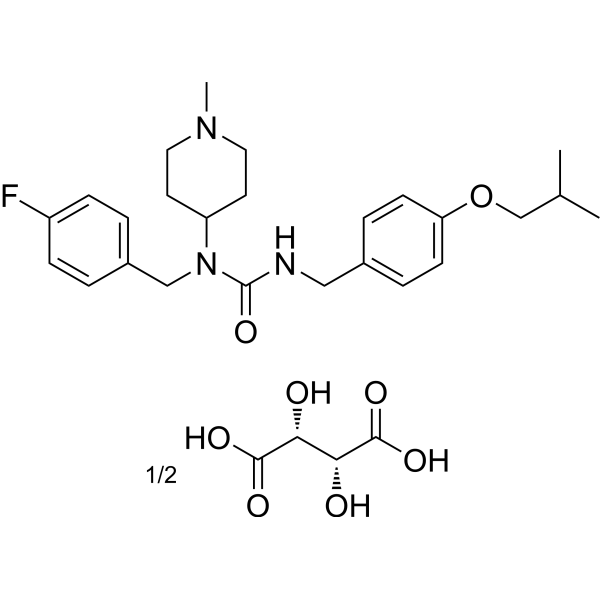
Pimavanserin is a selective, brain-penetrant, inverse agonist of the 5-HT2A receptor with pIC50 and pKd of 8.73 and 9.3, respectively.
|
-
- HY-150308
-
|
|
PPAR
|
Cancer
|
|
SR10221, a noncovalent inverse agonist of PPARγ, represses downstream PPARγ target genes leading to growth inhibition in bladder cancer cell lines .
|
-
- HY-10013B
-
|
MK0364 (1R,2R)stereoisomer
|
Cannabinoid Receptor
|
Others
|
|
Taranabant (1R,2R)stereoisomer is the R-enantiomer of Taranabant. Taranabant is a highly potent and selective cannabinoid 1 (CB1) receptor inverse agonist.
|
-
- HY-10013A
-
|
MK-0364 racemate
|
Cannabinoid Receptor
|
Neurological Disease
|
|
Taranabant racemate (MK-0364 racemate) is an antagonist and/or inverse agonist of the Cannabinoid-1 (CB1) receptor extracted from patent WO 2004048317 A1 .
|
-
- HY-160188
-
|
|
PPAR
|
Cancer
|
|
BAY-9683 is an orally active covalent PPARG inverse agonist. BAY-9683 can be used in the study of diseases with overactive PPARG, such as luminal bladder cancer .
|
-
- HY-105518
-
|
SR-25776
|
GABA Receptor
|
Neurological Disease
|
|
Terbequinil (SR-25776) is a potent orally active Gamma-aminobutyric acid A (GABAA) receptor inverse agonist. Terbequinil can be used for research on nervous system diseases .
|
-
- HY-159831
-
|
ACP-204
|
5-HT Receptor
|
Neurological Disease
|
|
Remlifanserin (ACP-204) is a highly selective 5-HT2A inverse agonist. Remlifanserin is applicable to research related to Alzheimer's disease psychosis .
|
-
- HY-18286
-
|
|
TSH Receptor
|
Endocrinology
|
|
NCGC00229600 is an allosteric inverse agonist of thyrotropin receptor (TSHR). NCGC00229600 inhibits both TSH and stimulating antibody activation of TSHRs endogenously expressed in Graves' disease .
|
-
- HY-W140282
-
|
|
Angiotensin Receptor
|
Cardiovascular Disease
|
|
Angiotensin II antipeptide, a peptide, is an inverse agonist of AR1 receptor. Angiotensin II antipeptide is encoded by mRNA, complementary to that encoding Angiotensin II (HY-13948) itself .
|
-
- HY-163612
-
|
|
ROR
Apoptosis
|
Cancer
|
|
XY077 (compound 14a) is a RORγ inverse agonist with the IC50 of 0.004 μM. XY077 induces cell apoptosis and shows antiproliferative activity in vivoand in vitro .
|
-
- HY-119242
-
-
- HY-120384
-
|
|
ROR
|
Inflammation/Immunology
|
|
AZD-0284 is a selective inverse agonist of the nuclear receptor RORγ. AZD-0284 has the potential for plaque psoriasis vulgaris and respiratory tract disorders treatment .
|
-
- HY-14557A
-
|
ACP-103 hemitartrate
|
5-HT Receptor
|
Neurological Disease
|
|
Pimavanserin (ACP-103) hemitartrate is a potent and brain-penetrant5-HT 2A receptor inverse agonist with pIC50 and pKi of 8.73 and 9.3, respectively.
|
-
- HY-178319
-
-
- HY-U00443
-
|
|
5-HT Receptor
|
Neurological Disease
Cancer
|
|
SB 258719 is a selective 5-HT7 receptor antagonist with high affinity (pKi=7.5) for the receptor. SB 258719 can be used for the research of cancer and neurological disease .
|
-
- HY-101232R
-
|
ICI 125211 (Standard)
|
Reference Standards
Histamine Receptor
|
Cardiovascular Disease
|
|
Tiotidine (Standard) is the analytical standard of Tiotidine. This product is intended for research and analytical applications. Tiotidine (ICI 125211) is a potent and selective antagonist of histamine H2-receptor (pA2=7.3-7.8 for guinea-pig right atrium). Tiotidine has low affinity for both the H1 and the H3 receptors .
|
-
- HY-101232
-
|
ICI 125211
|
Histamine Receptor
|
Cardiovascular Disease
|
|
Tiotidine (ICI 125211) is a potent and selective antagonist of histamine H2-receptor (pA2=7.3-7.8 for guinea-pig right atrium). Tiotidine has low affinity for both the H1 and the H3 receptors .
|
-
- HY-103123
-
|
|
5-HT Receptor
|
Neurological Disease
Cancer
|
|
SB 258719 hydrochloride is a selective 5-HT7 receptor antagonist displayed high affnity (pKi=7.5) for the receptor. SB-258719 hydrochloride can be used for the research of cancer and neurological diseases .
|
-
- HY-114706
-
|
MDL-26479
|
GABA Receptor
|
Neurological Disease
|
|
Suritozole (MGL-26479) is a cognitive enhancer that acts as a partial inverse agonist of benzodiazepine receptor sites on GABAA ion channel complexes. Suritozole can be used in the study of neurodegenerative diseases .
|
-
- HY-106025
-
|
AC-3933
|
GABA Receptor
|
Neurological Disease
|
|
Radequinil (AC-3933) is a benzodiazepine receptor (BzR) partial inverse agonist. AC-3933 binds to GABA(-) and GABA(+) ligand with Kis of 5.15 and 6.11 nM, respectively .
|
-
- HY-134661A
-
|
CVN424
|
GPR6
|
Neurological Disease
|
|
CVN424 is an orally active and selective GPR6 inverse agonist with a Ki of 9.4 nM and an EC50 of 38 nM. CVN424 is brain-penetrant and has the potential for Parkinson disease research .
|
-
- HY-163611
-
|
|
ROR
|
Cancer
|
|
XY039 (compound 13e) is a RORγ inverse agonist with the IC50 of 0.55 μM. XY039 induces cell apoptosis and shows antiproliferative activity in vivoand in vitro .
|
-
- HY-103330
-
-
- HY-13421R
-
|
|
REV-ERB
ROR
|
Inflammation/Immunology
|
|
SR1001 (Standard) is the analytical standard of SR1001. This product is intended for research and analytical applications. SR1001 is a selective RORα and RORγt inverse agonist with Kis 172 and 111 nM, respectively.
|
-
- HY-100778
-
|
|
Cannabinoid Receptor
|
Neurological Disease
|
|
SMM-189 is a potent and selective cannabinoid receptor 2 (CB2) inverse agonist. SMM-189 plays an important role in neurodegenerative disorders and traumatic brain injury research .
|
-
- HY-135392
-
|
AC-279
|
Drug Metabolite
|
Neurological Disease
|
|
N-Desmethyl Pimavanserin is the active metabolite of Pimavanserin. Pimavanserin is a selective inverse agonist of the 5-HT2A receptor with pIC50 and pKd of 8.73 and 9.3, respectively.
|
-
- HY-10013
-
|
MK-0364
|
Cannabinoid Receptor
|
Metabolic Disease
|
|
Taranabant is a highly potent and selective cannabinoid 1 (CB1) receptor inverse agonist that inhibits the binding and functional activity of various agonists, with a binding Ki of 0.13 nM for the human CB1R in vitro.
|
-
- HY-140015
-
|
|
Biochemical Assay Reagents
|
Others
|
|
TCO-PEG3-acid is a click chemistry reagent that contains a TCO group that can undergo an inverse electron demand Diels-Alder reaction (iEDDA) with molecules containing Tetrazine groups .
|
-
- HY-13974
-
|
|
Adrenergic Receptor
|
Neurological Disease
|
|
S32212 is a serotonin type 2C receptor inverse agonist and an 2 adrenoceptor antagonist. S32212 exhibits antidepressant activity and can reduce immobility time in forced-swim test in rats .
|
-
- HY-12199R
-
|
Tiprolisant (Standard)
|
Histamine Receptor
Reference Standards
|
Neurological Disease
Endocrinology
|
|
Pitolisant (Standard) is the analytical standard of Pitolisant. This product is intended for research and analytical applications. Pitolisant is a potent and selective nonimidazole inverse agonist at the recombinant human histamine H3 receptor (Ki=0.16 nM).
|
-
- HY-12199BR
-
|
Ciproxidine (Standard); BF 2649 (Standard)
|
Histamine Receptor
Reference Standards
|
Neurological Disease
Endocrinology
|
|
Pitolisant (hydrochloride) (Standard) is the analytical standard of Pitolisant (hydrochloride). This product is intended for research and analytical applications. Pitolisant hydrochloride is a potent and selective nonimidazole inverse agonist at the recombinant human histamine H3 receptor (Ki=0.16 nM).
|
-
- HY-109968A
-
|
CEP-26401 hydrochloride
|
Histamine Receptor
|
Neurological Disease
|
|
Irdabisant (CEP-26401) hydrochloride is a selective, orally active and blood-brain barrier (BBB) penetrant histamine H3 receptor (H3R) inverse agonist/inverse agonist with Ki values of 7.2 nM and 2.0 nM for rat H3R and human H3R, respectively. Irdabisant hydrochloride has relatively low inhibitory activity against hERG current with an IC50 of 13.8 μM. Irdabisant hydrochloride has cognition-enhancing and wake-promoting activities in the rat social recognition model. Irdabisant hydrochloride can be used to research schizophrenia or cognitive impairment .
|
-
- HY-109968
-
|
CEP-26401
|
Histamine Receptor
|
Neurological Disease
Metabolic Disease
|
|
Irdabisant (CEP-26401) is a selective, orally active and blood-brain barrier (BBB) penetrant histamine H3 receptor (H3R) inverse agonist/inverse agonist with Ki values of 7.2 nM and 2.0 nM for rat H3R and human H3R, respectively. Irdabisant has relatively low inhibitory activity against hERG current with an IC50 of 13.8 μM. Irdabisant has cognition-enhancing and wake-promoting activities in the rat social recognition model. Irdabisant can be used to research schizophrenia or cognitive impairment .
|
-
- HY-117118A
-
-
- HY-124147
-
|
|
Histamine Receptor
|
Neurological Disease
|
|
FUB 465 is an orally active inverse agonist at the constitutively active histamine H3 receptor with a pKi of 6.2 for H3 receptor. FUB 465 can be used in the research of central nervous system diseases .
|
-
- HY-102075AR
-
|
|
Reference Standards
ROR
|
Inflammation/Immunology
|
|
TMP778 (Standard) is the analytical standard of TMP778 (HY-102075A). This product is intended for research and analytical applications. TMP778 is a potent and selevtive RORγt inverse agonist, with an IC50 of 7 nM in FRET assay.
|
-
- HY-12199S1
-
-
- HY-101630A
-
|
EGIS-3886 fumarate
|
5-HT Receptor
|
Others
|
|
Deramciclane fumarate is an antagonist of 5-HT Receptor. Deramciclane fumarate is an inverse agonist of 5-HT2C Receptor with an IC50 of 168 nM. Deramciclane fumarate also decreases basal phosphoinositide hydrolysis .
|
-
- HY-P10673
-
|
|
GHSR
|
Metabolic Disease
|
|
KwFwLL-NH2, a hexapeptide, is a ghrelin receptor ligand. KwFwLL-NH2 can act as a specific inverse agonist at the ghrelin receptor but with moderate potency (EC50=45.6 nM) .
|
-
- HY-157070
-
|
|
Biochemical Assay Reagents
|
Others
|
|
SCO-L-Lysine contains a SCO group that can undergo an inverse electron demand Diels-Alder reaction (iEDDA) with molecules containing Tetrazine groups. SCO-L-Lysine can be incorporated into the protein of interest by the tRNAPyl/PylRSAF synthetase .
|
-
- HY-139748
-
|
|
Antibiotic
Bacterial
|
Infection
|
|
S32212 is a serotonin type 2C receptor inverse agonist and an α2 adrenoceptor antagonist. S32212 exhibits antidepressant activity and can reduce immobility time in forced-swim test in rats .
|
-
- HY-148351
-
|
|
PPAR
|
Cancer
|
|
BAY-0069 is a potent and selective PPARγ inverse agonist with an IC50 value of 6.3 nM and 24 nM for human PPARγ and mouse PPARγ. BAY-0069 can be used to research cancer .
|
-
- HY-110060
-
|
|
Complement System
|
Inflammation/Immunology
|
|
NDT 9513727 is a potent, selective, orally active and competitive inverse agonist of the human C5aR (C5a receptor), with an IC50 of 11.6 nM. NDT 9513727 can be used for the research of human inflammatory diseases .
|
-
- HY-12199S
-
-
- HY-176851
-
|
|
REV-ERB
|
Inflammation/Immunology
|
|
GSK1362 is a selective inverse agonist of REV-ERB. GSK1362disrupts the interaction of REV-ERBα with repressive co-modulators (NCoR1, SMRT2, RIP140). GSK1362 exerts an inverse agonist effect by increasing the transcription of BMAL1 to relieve BMAL1 repression by endogenous REV-ERB ligands. GSK1362 suppresses LPS (HY-D1056)-induced inflammatory cytokine expression, inhibits IL-1β-induced Cxcl5 transcription in cells. GSK1362 can be used for the study of inflammatory diseases .
|
-
- HY-112706
-
|
|
ROR
|
Inflammation/Immunology
|
|
PF-06747711 is a potent, selective, and orally active retinoic acid receptor-related orphan C2 (RORC2, also known as RORγt) inverse agonist, with an IC50 of 4.1 nM. Anti-skin inflammatory activity .
|
-
- HY-19775
-
|
|
ROR
|
Inflammation/Immunology
|
|
GNE-6468 is a highly potent and selective RORγ (RORc) inverse agonist with an EC50 value of 13 nM for HEK-293 cell. GNE-6468 exhibits an EC50 of 30 nM for IL-17 PBMC .
|
-
- HY-12584A
-
|
(S)-PF-05190457
|
GHSR
|
Metabolic Disease
|
|
(S)-PF-5190457 ((S)-PF-05190457) is the S-enantiomer of PF-5190457 (HY-12584). PF-5190457 (PF-05190457) is a potent and selective ghrelin receptor inverse agonist with a pKi of 8.36 .
|
-
- HY-141175
-
|
|
Biochemical Assay Reagents
|
Others
|
|
TCO-PNB ester is an amine-reactive building block used for modification of amine-containing molecule. TCO-PNB ester contains a TCO group that can undergo an inverse electron demand Diels-Alder reaction (iEDDA) with molecules containing a Tetrazine group .
|
-
- HY-103365
-
|
VUF2274 hydrochloride
|
CMV
|
Infection
|
|
BX-513 hydrochloride (VUF 2274 hydrochloride)is a novel inverse agonists acting on human cytomegalovirus (HCMV)-encoded receptor US28 with the IC50 of 4.9 μM. BX-513 hydrochloride can be used for study of viral infection .
|
-
- HY-151698A
-
|
|
Biochemical Assay Reagents
|
Others
|
|
(S,E)-TCO-NHS Ester is a Click Amino Acid that can be used to label amine-containing compounds or biomolecules. TCO-NHS ester contains a TCO group that can undergo an inverse electron demand Diels-Alder reaction (iEDDA) with molecules containing a Tetrazine group.
|
-
- HY-151698B
-
|
|
Biochemical Assay Reagents
|
Others
|
|
(R,E)-TCO-NHS Ester is a Click Amino Acid that can be used to label amine-containing compounds or biomolecules. TCO-NHS ester contains a TCO group that can undergo an inverse electron demand Diels-Alder reaction (iEDDA) with molecules containing a Tetrazine group.
|
-
- HY-17043
-
-
- HY-101442R
-
|
|
Reference Standards
LXR
|
Metabolic Disease
|
|
SR9238 (Standard) is the analytical standard of SR9238. This product is intended for research and analytical applications. SR9238 is a synthetic liver X receptor (LXR) inverse agonist with IC50s of 214 nM and 43 nM for LXRα and LXRβ, respectively.
|
-
- HY-14557R
-
|
ACP-103 (Standard)
|
Reference Standards
5-HT Receptor
|
Neurological Disease
|
|
Pimavanserin (Standard) is the analytical standard of Pimavanserin. This product is intended for research and analytical applications. Pimavanserin is a selective and brain-penetrant inverse agonist of the 5-HT2A receptor with pIC50 and pKd of 8.73 and 9.3, respectively.
|
-
- HY-153895
-
|
|
Estrogen Receptor/ERR
|
Endocrinology
|
|
SLU-PP-1072 is a dual ERRα/γ inverse agonist, used in Prostate cancer (PCa) research. SLU-PP-1072 disrupts PCa cell metabolism, and induces apoptosis via dysregulating cell cycle .
|
-
- HY-106586
-
|
P-286
|
Biochemical Assay Reagents
|
Others
|
|
Ioxaglic acid (P-286) is negatively charged contrast agent, is useful as an inverse indicator for glycosaminoglycan (GAG) used in computed tomography (CT). Ioxaglic acid can be used for imaging of human osteoarthritic cartilage via quantitative assessment of glycosaminoglycan content .
|
-
- HY-100775
-
|
Setogepram sodium; PBI-4050 sodium
|
Free Fatty Acid Receptor
GPR84
|
Metabolic Disease
Inflammation/Immunology
|
|
Fezagepras (Setogepram) sodium acts as an orally active agonist for GPR40 and as an antagonist or inverse agonist for GPR84 . Fezagepras sodium decreases renal, liver and pancreatic fibrosis . Fezagepras sodium exerts anti-fibrotic, anti-inflammatory and anti-proliferative actions .
|
-
- HY-160038
-
|
|
LXR
|
Cancer
|
|
GAC0003A4 is an LXR inverse agonist that inhibits LXR transcriptional activity. GAC0003A4 also efficiently degrades LXRβ protein. GAC0003A4 has the potential to be used in advanced pancreatic cancer and other refractory malignancies .
|
-
- HY-100775A
-
|
Setogepram; PBI-4050
|
Free Fatty Acid Receptor
GPR84
|
Metabolic Disease
Inflammation/Immunology
|
|
Fezagepras (Setogepram) acts as an orally active agonist for GPR40 and as an antagonist or inverse agonist for GPR84 . Fezagepras decreases renal, liver and pancreatic fibrosis . Fezagepras exerts anti-fibrotic, anti-inflammatory and anti-proliferative actions .
|
-
- HY-151698
-
|
|
ADC Linker
|
Others
|
|
TCO-NHS Ester axial is a click chemistry reagent that can be used as a building block in amine reactions. TCO-NHS Ester axial contains TCO groups, which can undergo inverse electron demand Diels-Alder reaction (iEDDA) with molecules containing Tetrazine groups.
|
-
- HY-101192R
-
|
|
EBI2/GPR183
Reference Standards
|
Inflammation/Immunology
|
|
GSK682753A (Standard) is the analytical standard of GSK682753A (HY-101192). This product is intended for research and analytical applications. GSK682753A is a selective and highly potent inverse agonist of the epstein-barr virus-induced receptor 2 (EBI2) with an IC50 of 53.6 nM.
|
-
- HY-136095
-
|
|
ADC Linker
|
Cancer
|
|
Tetrazine-biotin is a cleavable ADC linker used in the synthesis of antibody-drug conjugates (ADCs) . Tetrazine-biotin is a click chemistry reagent, it contains a Tetrazine group that can undergo an inverse electron demand Diels-Alder reaction (iEDDA) with molecules containing TCO groups.
|
-
- HY-124480
-
|
|
PROTAC Linkers
|
Cancer
|
|
Tetrazine-Ph-acid is an alkyl chain-based PROTAC linker that can be used in the synthesis of PROTACs . Tetrazine-Ph-acid is a click chemistry reagent, it contains a Tetrazine group that can undergo an inverse electron demand Diels-Alder reaction (iEDDA) with molecules containing TCO groups.
|
-
- HY-12199BS
-
|
Ciproxidine-d5 hydrochloride; BF 2649-d5 hydrochloride
|
Histamine Receptor
Isotope-Labeled Compounds
|
Neurological Disease
Endocrinology
|
|
Pitolisant-d5 hydrochloride (Ciproxidine-d5 hydrochloride) is the deuterium labeled Pitolisant hydrochloride (HY-12199B). Pitolisant hydrochloride is a potent and selective nonimidazole inverse agonist at the recombinant human histamine H3 receptor (Ki=0.16 nM) .
|
-
- HY-17610A
-
|
TS-091 hydrochloride
|
Histamine Receptor
|
Neurological Disease
|
|
Enerisant (TS-091) hydrochloride is a potent, highly selective, competitive and orally active histamine H3 receptor antagonist/inverse agonist with IC50s of 2.89 nM and 14.5 nM against human and rat histamine H3 receptors, respectively .
|
-
- HY-24592
-
|
|
PROTAC Linkers
|
Cancer
|
|
(S,E)-Cyclooct-2-enol is a Click Amino Acid that can be used as a linker in the synthesis of PROTAC molecules. TCO-NHS ester contains a TCO group that can undergo an inverse electron demand Diels-Alder reaction (iEDDA) with molecules containing a Tetrazine group.
|
-
- HY-141165
-
|
|
PROTAC Linkers
|
Cancer
|
|
TCO-NHS ester is an alkyl/ether-based PROTAC linker that can be used in the synthesis of PROTACs . TCO-NHS ester is a click chemistry reagent, it contains a TCO group that can undergo an inverse electron demand Diels-Alder reaction (iEDDA) with molecules containing Tetrazine groups.
|
-
- HY-136104
-
|
|
ADC Linker
|
Cancer
|
|
Methyltetrazine-Maleimide is a cleavable ADC linker used in the synthesis of antibody-drug conjugates (ADCs) . Methyltetrazine-Maleimide is a click chemistry reagent, it contains a Tetrazine group that can undergo an inverse electron demand Diels-Alder reaction (iEDDA) with molecules containing TCO groups.
|
-
- HY-141176
-
|
|
PROTAC Linkers
|
Cancer
|
|
TCO-amine is an alkyl chain-based PROTAC linker that can be used in the synthesis of PROTACs . TCO-amine is a click chemistry reagent, it contains a TCO group that can undergo an inverse electron demand Diels-Alder reaction (iEDDA) with molecules containing Tetrazine groups.
|
-
- HY-17610
-
|
TS-091
|
Histamine Receptor
|
Neurological Disease
|
|
Enerisant (TS-091) is a potent, highly selective, competitive and orally active histamine H3 receptor antagonist/inverse agonist with IC50s of 2.89 nM and 14.5 nM against human and rat histamine H3 receptors, respectively .
|
-
- HY-155481
-
|
|
Cannabinoid Receptor
|
Neurological Disease
|
|
CB2 receptor antagonist 3 (compound (S)-1) is an inverse agonist of the cannabinoid receptor CB2R with Kd=39 nM. CB2 receptor antagonist 3 can be used as a tool to synthesize a variety of CB2R probes .
|
-
- HY-B0349S
-
-
- HY-W714234
-
|
|
Biochemical Assay Reagents
|
Others
|
|
Endo-BCN CE-phosphoramidite is a stable and one of the most reactive cyclooctynes for copper-free click chemistry. Unlike dibenzocyclooctyne (DBCO), BCN is reactive both to azides (strain-promoted azyde-alkyne cycloaddition, SPAAC) and tetrazines (inverse electron demand Diels-Alder reaction, IEDDA).
|
-
- HY-103331
-
-
- HY-14557AR
-
|
ACP-103 hemitartrate (Standard)
|
5-HT Receptor
Reference Standards
|
Neurological Disease
|
|
Pimavanserin hemitartrate (Standard) is the analytical standard of Pimavanserin hemitartrate. This product is intended for research and analytical applications. Pimavanserin (ACP-103) hemitartrate is a potent and brain-penetrant 5-HT 2A receptor inverse agonist with pIC50 and pKi of 8.73 and 9.3, respectively.
|
-
- HY-128174
-
|
Beta-CCM; Ro 22-7497
|
GABA Receptor
|
Neurological Disease
|
|
β-CCM is a benzodiazepine receptor inverse agonist with anxiogenic and proconvulsant effects. β-CCM enhances emotional reactivity and reduces vulnerability to interference in spatial working memory tasks. β-CCM can be used for research on anxiety-related disorders .
|
-
- HY-136033
-
|
|
ADC Linker
|
Cancer
|
|
Methyltetrazine-SS-NHS is a cleavable ADC linker used in the synthesis of antibody-drug conjugates (ADCs) . Methyltetrazine-SS-NHS is a click chemistry reagent, it contains a Tetrazine group that can undergo an inverse electron demand Diels-Alder reaction (iEDDA) with molecules containing TCO groups.
|
-
- HY-126908
-
|
|
PROTAC Linkers
|
Cancer
|
|
Tetrazine-Ph-NHS ester is an alkyl/ether-based PROTAC linker that can be used in the synthesis of PROTACs . Tetrazine-Ph-NHS ester is a click chemistry reagent, it contains a Tetrazine group that can undergo an inverse electron demand Diels-Alder reaction (iEDDA) with molecules containing TCO groups.
|
-
- HY-141186A
-
|
|
PROTAC Linkers
|
Cancer
|
|
(R)-TCO-OH is an alkyl chain-based PROTAC linker that can be used in the synthesis of PROTACs . (R)-TCO-OH is a click chemistry reagent, it contains a TCO group that can undergo an inverse electron demand Diels-Alder reaction (iEDDA) with molecules containing Tetrazine groups.
|
-
- HY-130283
-
|
|
PROTAC Linkers
|
Cancer
|
|
Methyltetrazine-Ph-NHS ester is an alkyl/ether-based PROTAC linker that can be used in the synthesis of PROTACs . Methyltetrazine-Ph-NHS ester is a click chemistry reagent, it contains a Tetrazine group that can undergo an inverse electron demand Diels-Alder reaction (iEDDA) with molecules containing TCO groups.
|
-
- HY-136031
-
|
|
ADC Linker
|
Cancer
|
|
Tetrazine-SS-Biotin is a cleavable ADC linker used in the synthesis of antibody-drug conjugates (ADCs) . Tetrazine-SS-Biotin is a click chemistry reagent, it contains a Tetrazine group that can undergo an inverse electron demand Diels-Alder reaction (iEDDA) with molecules containing TCO groups.
|
-
- HY-102075BR
-
|
|
Reference Standards
ROR
|
Inflammation/Immunology
|
|
TMP780 (Standard) is the analytical standard of TMP780 (HY-102075B). This product is intended for research and analytical applications. TMP780 is an inverse agonist of RORγt with an IC50 of 13 nM. RORγt is a tractable agent target for the treatment of cutaneous inflammatory disorders .
|
-
- HY-D2243
-
|
|
Fluorescent Dye
|
Others
|
|
Cy3.5 tetrazineis a Tetrazine modified Cy3.5 fluorescent dye. SiR-tetrazine is a click chemistry reagent, it contains a Tetrazine group that can undergo an inverse electron demand Diels-Alder reaction (iEDDA) with molecules containing TCO groups .
|
-
- HY-141161B
-
|
|
ADC Linker
|
Cancer
|
|
(R)-TCO-PEG8-acid is an ADC linker containing 8 PEG units. (R)-TCO-PEG8-acid can use its own TCO group to perform an inverse electron demand Diels-Alder reaction (iEDDA) with molecules with Tetrazine groups.
|
-
- HY-136032
-
|
|
ADC Linker
|
Cancer
|
|
Tetrazine-SS-NHS is a cleavable ADC linker used in the synthesis of antibody-drug conjugates (ADCs) . Tetrazine-SS-NHS is a click chemistry reagent, it contains a Tetrazine group that can undergo an inverse electron demand Diels-Alder reaction (iEDDA) with molecules containing TCO groups.
|
-
- HY-130928
-
|
|
ADC Linker
|
Cancer
|
|
Tetrazine-Ph-OPSS is a cleavable ADC linker used in the synthesis of antibody-drug conjugates (ADCs) . Tetrazine-Ph-OPSS is a click chemistry reagent, it contains a Tetrazine group that can undergo an inverse electron demand Diels-Alder reaction (iEDDA) with molecules containing TCO groups.
|
-
- HY-156304
-
|
|
Fluorescent Dye
|
Others
|
|
Coumarin-C2-TCO is a dye derivative of Coumarin (HY-N0709). Coumarin-C2-TCO utilizes its TCO group to undergo an inverse electron demand Diels-Alder reaction (iEDDA) with molecules bearing Tetrazine groups.
|
-
- HY-128353
-
|
|
ROR
|
Inflammation/Immunology
|
|
ROR agonist-1 is a potent and orally bioavailable inverse agonist of the retinoic acid receptor-related orphan receptor C2 (RORC2), inhibition of IL-17A production from human primary TH 17 cells with a pIC50 of 7.5 .
|
-
- HY-136039
-
|
|
ADC Linker
|
Cancer
|
|
TCO-SS-amine is a cleavable ADC linker used in the synthesis of antibody-drug conjugates (ADCs) . TCO-SS-amine is a click chemistry reagent, it contains a TCO group that can undergo an inverse electron demand Diels-Alder reaction (iEDDA) with molecules containing Tetrazine groups.
|
-
- HY-W595136
-
|
|
Endogenous Metabolite
|
Cardiovascular Disease
Cancer
|
|
(rac)-α-Carotene is the racemate of α-Carotene. α-Carotene is a carotenoid and potent antioxidant. Serum α-Carotene concentrations are inversely associated with the risk of all-cause mortality, cardiovascular disease, cancer, and mortality from all causes other than cardiovascular disease and cancer .
|
-
- HY-116625
-
|
|
GHSR
|
Neurological Disease
|
|
PF-04628935 (compound 10n) is a potent ghrelin receptor inverse agonist, with an IC50 of 4.6 nM. PF-04628935 exhibits oral bioavailability of 43% in rats and shows reasonable penetration into the brain. PF-04628935 can be used for stress and anxiety research .
|
-
- HY-14289A
-
|
SKF-92334 hydrochloride
|
Histamine Receptor
Bacterial
|
Metabolic Disease
Cancer
|
|
Cimetidine (SKF-92334) hydrochloride is an orally active, inverse and BBB-permeable histamine H2 receptor antagonist with a Ki of 0.6 μM. Cimetidine hydrochloride is a gastric acid reducer, and can be used for duodenal and gastric ulcers research. Cimetidine hydrochloride has anti-cancer and anti-inflammatory activity .
|
-
- HY-14517
-
|
|
Histamine Receptor
|
Neurological Disease
|
|
H3R antagonist 5 (Compound 1b) is a selective histamine H3 receptor inverse agonist with a IC50 of 0.54 nM and the ability to cross the blood-brain barrier. H3R antagonist 5 can be used in central nervous system-related research .
|
-
- HY-157008
-
|
|
ADC Linker
|
Cancer
|
|
(S)-TCO-PEG2-Maleimide is an ADC linker containing 2 PEG units. (S)-TCO-PEG2-Maleimide can use its own TCO group to perform an inverse electron demand Diels-Alder reaction (iEDDA) with molecules with Tetrazine groups.
|
-
- HY-P1091
-
|
|
Cannabinoid Receptor
|
Neurological Disease
|
|
Hemopressin is a nonapeptide derived from the α1-chain of hemoglobin, is originally isolated from rat brain homogenates. Hemopressin is orally active, selective and inverse agonist of CB1 cannabinoid receptors. Hemopressin exerts antinociceptive action in inflammatory pain models .
|
-
- HY-106025R
-
|
AC-3933 (Standard)
|
Reference Standards
GABA Receptor
|
Neurological Disease
|
|
Radequinil (Standard) is the analytical standard of Radequinil (HY-106025). This product is intended for research and analytical applications. Radequinil (AC-3933) is a benzodiazepine receptor (BzR) partial inverse agonist. AC-3933 binds to GABA(-) and GABA(+) ligand with Kis of 5.15 and 6.11 nM, respectively .
|
-
- HY-P3561
-
|
|
Melanocortin Receptor
|
Neurological Disease
|
|
Agouti-related Protein (AGRP) (83-132) Amide (human) is a fragment of agouti-related protein (AGRP) which is a protein found in abundance in the arcuate nucleus of the hypothalamus. AgRP primarily acts as an inverse agonist for the melanocortin-4 receptor (MC4R) to increase food intake .
|
-
- HY-138007
-
|
|
ROR
PPAR
LXR
|
Metabolic Disease
Inflammation/Immunology
|
|
SR-1903 is an inverse agonist of RORγ and PPARγ (IC50 of ∼100 nM and 209 nM for RORγ and PPARγ, respectively) and a LXR agonist. SR-1903 exhibits anti-inflammatory and anti-diabetic efficacy in collagen-induced arthritis and diet-induced obesity mouse models .
|
-
- HY-141167B
-
|
|
ADC Linker
|
Cancer
|
|
(S)-TCO-PEG4-NHS ester is an ADC linker containing 4 PEG units. (S)-TCO-PEG4-NHS ester can use its own TCO group to perform an inverse electron demand Diels-Alder reaction (iEDDA) with molecules with Tetrazine groups.
|
-
- HY-150067
-
|
|
Cannabinoid Receptor
|
Metabolic Disease
|
|
CB1R Allosteric modulator 5, a selective cannabinoid-1 receptor (CB1R) inverse agonist with an IC50 value of 4.2 μM and EC50 value of >10 μM. CB1R Allosteric modulator 5 can be used for the research of metabolic and obesity .
|
-
- HY-141169B
-
|
|
ADC Linker
|
Cancer
|
|
(R)-TCO-PEG8-NHS ester is an ADC linker containing 8 PEG units. (R)-TCO-PEG8-NHS ester can use its own TCO group to perform an inverse electron demand Diels-Alder reaction (iEDDA) with molecules with Tetrazine groups.
|
-
- HY-175784
-
|
|
Cannabinoid Receptor
|
Neurological Disease
|
|
CB2R antagonist 4 is a selective CB2R antagonist/inverse agonist with a pKi of 6.54. CB2R antagonist 4 shows a ≥11-fold selectivity towards CB2R over CB1R and can be utilized in neurological research .
|
-
- HY-141169A
-
|
|
ADC Linker
|
Cancer
|
|
(S)-TCO-PEG8-NHS ester is an ADC linker containing 8 PEG units. (S)-TCO-PEG8-NHS ester can use its own TCO group to perform an inverse electron demand Diels-Alder reaction (iEDDA) with molecules with Tetrazine groups.
|
-
- HY-133504
-
|
|
ADC Linker
|
Cancer
|
|
Tetrazine-Ph-SS-amine is a cleavable ADC linker used in the synthesis of antibody-drug conjugates (ADCs) . Tetrazine-Ph-SS-amine is a click chemistry reagent, it contains a Tetrazine group that can undergo an inverse electron demand Diels-Alder reaction (iEDDA) with molecules containing TCO groups.
|
-
- HY-P3561A
-
|
|
Melanocortin Receptor
|
Neurological Disease
|
|
Agouti-related Protein (AGRP) (83-132) Amide (human) TFA is a fragment of agouti-related protein (AGRP) which is a protein found in abundance in the arcuate nucleus of the hypothalamus. AgRP primarily acts as an inverse agonist for the melanocortin-4 receptor (MC4R) to increase food intake .
|
-
- HY-141267
-
|
|
PROTAC Linkers
|
Cancer
|
|
Methyltetrazine-PEG25-acid is a PEG-based PROTAC linker that can be used in the synthesis of PROTACs . Methyltetrazine-PEG25-acid is a click chemistry reagent, it contains a Tetrazine group that can undergo an inverse electron demand Diels-Alder reaction (iEDDA) with molecules containing TCO groups.
|
-
- HY-156494
-
|
|
ADC Linker
|
Cancer
|
|
Me-Tet-PEG9-COOH is an ADC Linker containing 9 PEG units. Me-Tet-PEG9-COOH can utilize its own Tetrazine group to undergo a specific inverse electron demand Diels-Alder reaction (iEDDA) with compounds with TCO groups.
|
-
- HY-17043S
-
-
- HY-D2142
-
|
|
Fluorescent Dye
|
Others
|
|
Cy5-PEG2-TCO is a fluorescent dye that reacts with tetrazines. Cy5-PEG2-TCO contains a TCO group that can undergo an inverse electron demand Diels-Alder reaction (iEDDA) with molecules containing a Tetrazine group.
|
-
- HY-141161
-
|
|
PROTAC Linkers
|
Cancer
|
|
TCO-PEG8-acid is a PEG-based PROTAC linker can be used in the synthesis of PROTACs . TCO-PEG8-acid is a click chemistry reagent, it contains a TCO group that can undergo an inverse electron demand Diels-Alder reaction (iEDDA) with molecules containing Tetrazine groups.
|
-
- HY-156491
-
|
|
ADC Linker
|
Cancer
|
|
Me-Tet-PEG9-NHS is an ADC Linker containing 9 PEG units. Me-Tet-PEG9-NHS can utilize its own Tetrazine group to undergo a specific inverse electron demand Diels-Alder reaction (iEDDA) with compounds with TCO groups.
|
-
- HY-156475
-
|
|
ADC Linker
|
Cancer
|
|
Me-Tet-PEG2-COOH is an ADC Linker containing 2 PEG units. Me-Tet-PEG2-COOH can use its own Tetrazine group to undergo a specific inverse electron demand Diels-Alder reaction (iEDDA) with compounds with TCO groups.
|
-
- HY-156495
-
|
|
ADC Linker
|
Cancer
|
|
Biotin-PEG3-Me-Tet is an ADC Linker containing 3 PEG units. Biotin-PEG3-Me-Tet can utilize its own Tetrazine group to undergo a specific inverse electron demand Diels-Alder reaction (iEDDA) with compounds with TCO groups.
|
-
- HY-156479
-
|
|
ADC Linker
|
Cancer
|
|
Me-Tet-PEG3-NHBoc is an ADC Linker containing 3 PEG units. Me-Tet-PEG3-NHBoc can utilize its own Tetrazine group to undergo a specific inverse electron demand Diels-Alder reaction (iEDDA) with compounds with TCO groups.
|
-
- HY-156476
-
|
|
ADC Linker
|
Cancer
|
|
Me-Tet-PEG2-NHS is an ADC Linker containing 2 PEG units. Me-Tet-PEG2-NHS can utilize its own Tetrazine group to undergo a specific inverse electron demand Diels-Alder reaction (iEDDA) with compounds with TCO groups.
|
-
- HY-156478
-
|
|
ADC Linker
|
Cancer
|
|
Me-Tet-PEG4-NHBoc is an ADC Linker containing 4 PEG units. Me-Tet-PEG4-NHBoc can utilize its own Tetrazine group to undergo a specific inverse electron demand Diels-Alder reaction (iEDDA) with compounds with TCO groups.
|
-
- HY-156313
-
|
|
ADC Linker
|
Cancer
|
|
Me-Tet-PEG4-NHS is an ADC Linker containing 4 PEG units. Me-Tet-PEG4-NHS can utilize its own Tetrazine group to undergo a specific inverse electron demand Diels-Alder reaction (iEDDA) with compounds with TCO groups.
|
-
- HY-W013854
-
|
3β-Hydroxy-5α-androstane
|
Endogenous Metabolite
|
Others
|
|
5α-Androstan-3β-ol (Androstan), a saturated sterol, is a CAR (constitutive androstane receptor) inverse agonist ligand. 5α-Androstan-3β-ol (Androstan) increases the AmB-channel conductance in a concentration dependent manner .
|
-
- HY-141286
-
|
|
Fluorescent Dye
|
Others
|
|
TAMRA-PEG4-methyltetrazine is a dye derivative of TAMRA (HY-135640) containing 4 PEG units. TAMRA-PEG4-methyltetrazine contains a Tetrazine group that can undergo an inverse electron demand Diels-Alder reaction (iEDDA) with molecules containing TCO groups.
|
-
- HY-141285
-
|
|
Fluorescent Dye
|
Others
|
|
TAMRA-PEG4-tetrazine is a dye derivative of TAMRA (HY-135640) containing 4 PEG units. TAMRA-PEG4-tetrazine contains a Tetrazine group that can undergo an inverse electron demand Diels-Alder reaction (iEDDA) with molecules containing TCO groups.
|
-
- HY-156477
-
|
|
ADC Linker
|
Cancer
|
|
Me-Tet-PEG8-NHBoc is an ADC Linker containing 8 PEG units. Me-Tet-PEG8-NHBoc can utilize its own Tetrazine group to undergo a specific inverse electron demand Diels-Alder reaction (iEDDA) with compounds with TCO groups.
|
-
- HY-156490
-
|
|
ADC Linker
|
Cancer
|
|
Me-Tet-PEG5-NHS is an ADC Linker containing 5 PEG units. Me-Tet-PEG5-NHS can utilize its own Tetrazine group to undergo a specific inverse electron demand Diels-Alder reaction (iEDDA) with compounds with TCO groups.
|
-
- HY-17043S1
-
-
- HY-156492
-
|
|
ADC Linker
|
Cancer
|
|
Me-Tet-PEG4-COOH is an ADC Linker containing 4 PEG units. Me-Tet-PEG4-COOH can utilize its own Tetrazine group to undergo a specific inverse electron demand Diels-Alder reaction (iEDDA) with compounds with TCO groups.
|
-
- HY-156493
-
|
|
ADC Linker
|
Cancer
|
|
Me-Tet-PEG5-COOH is an ADC Linker containing 5 PEG units. Me-Tet-PEG5-COOH can utilize its own Tetrazine group to undergo a specific inverse electron demand Diels-Alder reaction (iEDDA) with compounds with TCO groups.
|
-
- HY-141261A
-
|
|
Biochemical Assay Reagents
|
Others
|
|
Methyltetrazine-PEG4-amine hydrochloride is a PEG derivative containing a free amine and a methyltetrazine group. Methyltetrazine-PEG4-amine hydrochloride is a click chemistry reagent, it contains a Tetrazine group that can undergo an inverse electron demand Diels-Alder reaction (iEDDA) with molecules containing TCO groups .
|
-
- HY-151691
-
|
|
ADC Linker
|
Others
|
|
Trisulfo-Cy3 Methyltetrazine is a click chemistry reagent containing an methyltetrazine group. Methyltetrazine-activated Cy3 probe reacts with TCO-containing compounds via an Inverse-Electron-Demand Diels-Alder reaction to form a stable covalent bond and does not require Cu-catalyst or elevated temperatures .
|
-
- HY-124717
-
|
|
Endogenous Metabolite
|
Others
|
|
YC-001 is an inverse agonist and antagonist of rod opsin. YC-001 reversibly binds rod opsin and stabilizes the rod opsin structure. YC-001 protects mice from bright light-induced retinal degeneration. YC-001 has the potential for the research of retinal degeneration .
|
-
- HY-151755
-
|
|
Fluorescent Dye
|
Others
|
|
Sulfo-Cy3-Tetrazine is a click chemistry reagent containing an tetrazine group. Sulfo-Cy3-Tetrazine is water soluble cyanine fluorescence dye, which is an inverse electron demand [4+2] cycloaddition that takes place between tetrazine and trans-cyclooctene or other strained olefin.
|
-
- HY-156303
-
|
|
Fluorescent Dye
|
Others
|
|
Coumarin-PEG2-TCO is a dye derivative of Coumarin (HY-N0709) containing 2 PEG units. Coumarin-PEG2-TCO utilizes its TCO group to undergo an inverse electron demand Diels-Alder reaction (iEDDA) with molecules bearing Tetrazine groups.
|
-
- HY-141261
-
|
|
Biochemical Assay Reagents
|
Others
|
|
Methyltetrazine-PEG4-amine is a PEG derivative containing a free amine and a methyltetrazine group. Methyltetrazine-PEG4-amine is a click chemistry reagent, it contains a Tetrazine group that can undergo an inverse electron demand Diels-Alder reaction (iEDDA) with molecules containing TCO groups .
|
-
- HY-156309
-
|
|
Fluorescent Dye
|
Others
|
|
Coumarin-PEG8-tetrazine is a dye derivative of Coumarin (HY-N0709) containing 8 PEG units. Coumarin-PEG8-tetrazine contains a Tetrazine group that can undergo an inverse electron demand Diels-Alder reaction (iEDDA) with molecules containing TCO groups.
|
-
- HY-157312
-
|
|
Cannabinoid Receptor
|
Metabolic Disease
|
|
TM38837 is an orally active and selective inverse agonist of cannabinoid receptor 1 (CB1) with an IC50 of 24 nM. TM38837 has higher selectivity for CB1 than for CB2 (IC50: 4500 nM). TM38837 can reduce body weight, improve plasma inflammatory markers and glucose homeostasis .
|
-
- HY-101630
-
|
EGIS-3886
|
5-HT Receptor
|
Neurological Disease
|
|
Deramciclane has a high affinity for 5-HT2A and 5-HT2C receptors; it acts as an antagonist at both receptor subtypes and has inverse agonist properties at the 5-HT2C receptors without direct stimulatory agonist.
|
-
- HY-156306
-
|
|
Fluorescent Dye
|
Others
|
|
Coumarin-PEG3-TCO is a dye derivative of Coumarin (HY-N0709) containing 3 PEG units. Coumarin-PEG3-TCO utilizes its TCO group to undergo an inverse electron demand Diels-Alder reaction (iEDDA) with molecules bearing Tetrazine groups.
|
-
- HY-D2040
-
|
|
Fluorescent Dye
|
Others
|
|
ROX tetrazine is a derivative of ROX (Rhodamine X, Rhodamine 101) dye, a red-emitting fluorophore possessing high brightness and fluorescence quantum yield. This compound contains tetrazine moiety that reacts with trans-cycloalkenes and other strained olefins in inverse electron demand Diels-Alder reaction (IEDDA). The reaction is very quick and specific.
|
-
- HY-126351
-
-
- HY-D2116
-
|
|
Fluorescent Dye
|
Others
|
|
TAMRA-PEG8-Me-Tet is a dye derivative of TAMRA (HY-135640) containing 8 PEG units. TAMRA-PEG8-Me-Tet contains a Tetrazine group that can undergo an inverse electron demand Diels-Alder reaction (iEDDA) with molecules containing TCO groups.
|
-
- HY-17043R
-
-
- HY-140731
-
|
|
PROTAC Linkers
|
Cancer
|
|
TCO-PEG5000-TCO is a PEG-based PROTAC linker that can be used in the synthesis of PROTACs . TCO-PEG5000-TCO is a click chemistry reagent, it contains a TCO group that can undergo an inverse electron demand Diels-Alder reaction (iEDDA) with molecules containing Tetrazine groups.
|
-
- HY-10426
-
|
|
Estrogen Receptor/ERR
Autophagy
|
Cancer
|
|
XCT-790 is a potent and selective inverse agonist for ERRα with an IC50 value of 0.37 μM. XCT-790 induces cell death in chemotherapeutic resistant cancer cells. XCT-790 (Compound 12) is inactive against ERRγ and the estrogen receptors ERα and ERβ .
|
-
- HY-133475
-
|
|
PROTAC Linkers
|
Cancer
|
|
TCO-PEG5-maleimide is a PEG-based PROTAC linker that can be used in the synthesis of PROTACs . TCO-PEG5-maleimide is a click chemistry reagent, it contains a TCO group that can undergo an inverse electron demand Diels-Alder reaction (iEDDA) with molecules containing Tetrazine groups.
|
-
- HY-141171
-
|
|
PROTAC Linkers
|
Cancer
|
|
TCO-PEG24-NHS ester is a PEG-based PROTAC linker that can be used in the synthesis of PROTACs . TCO-PEG24-NHS ester is a click chemistry reagent, it contains a TCO group that can undergo an inverse electron demand Diels-Alder reaction (iEDDA) with molecules containing Tetrazine groups.
|
-
- HY-P1090
-
|
|
Cannabinoid Receptor
|
Neurological Disease
|
|
Hemopressin(rat) is a nonapeptide derived from the α1-chain of hemoglobin, is originally isolated from rat brain homogenates. Hemopressin(rat) is orally active, selective and inverse agonist of CB1 cannabinoid receptors. Hemopressin(rat) exerts antinociceptive action in inflammatory pain models .
|
-
- HY-139780
-
|
|
ROR
|
Inflammation/Immunology
|
|
JNJ-61803534 is a potent and orally active RORγt inverse agonist with an IC50 of 9.6 nM. JNJ-61803534 has anti-inflammatory activity. JNJ-61803534 inhibits IL-17A production in human CD4+ T cells under Th17 differentiation conditions .
|
-
- HY-141167A
-
|
|
PROTAC Linkers
|
Cancer
|
|
TCO-PEG4-NHS ester is a PEG-based PROTAC linker that can be used in the synthesis of PROTACs . TCO-PEG4-NHS ester is a click chemistry reagent, it contains a TCO group that can undergo an inverse electron demand Diels-Alder reaction (iEDDA) with molecules containing Tetrazine groups.
|
-
- HY-133467
-
|
|
PROTAC Linkers
|
Cancer
|
|
Methyltetrazine-PEG5-methyltetrazine is a PEG-based PROTAC linker that can be used in the synthesis of PROTACs . Methyltetrazine-PEG5-methyltetrazine is a click chemistry reagent, it contains a Tetrazine group that can undergo an inverse electron demand Diels-Alder reaction (iEDDA) with molecules containing TCO groups.
|
-
- HY-D2117
-
|
|
Fluorescent Dye
|
Others
|
|
TAMRA-PEG4-Me-Tet is a dye derivative of TAMRA (HY-135640) containing 4 PEG units. TAMRA-PEG8-Me-Tet contains a Tetrazine group that can undergo an inverse electron demand Diels-Alder reaction (iEDDA) with molecules containing TCO groups.
|
-
- HY-133478
-
|
|
PROTAC Linkers
|
Cancer
|
|
TCO-PEG11-TCO is a PEG-based PROTAC linker that can be used in the synthesis of PROTACs . TCO-PEG11-TCO is a click chemistry reagent, it contains a TCO group that can undergo an inverse electron demand Diels-Alder reaction (iEDDA) with molecules containing Tetrazine groups.
|
-
- HY-133474
-
|
|
PROTAC Linkers
|
Cancer
|
|
TCO-PEG3-oxyamine is a PEG-based PROTAC linker that can be used in the synthesis of PROTACs . TCO-PEG3-oxyamine is a click chemistry reagent, it contains a TCO group that can undergo an inverse electron demand Diels-Alder reaction (iEDDA) with molecules containing Tetrazine groups.
|
-
- HY-133497
-
|
|
PROTAC Linkers
|
Cancer
|
|
HyNic-PEG2-TCO is a PEG-based PROTAC linker that can be used in the synthesis of PROTACs . HyNic-PEG2-TCO is a click chemistry reagent, it contains a TCO group that can undergo an inverse electron demand Diels-Alder reaction (iEDDA) with molecules containing Tetrazine groups.
|
-
- HY-D2118
-
|
|
Fluorescent Dye
|
Others
|
|
TAMRA-PEG3-Me-Tet is a dye derivative of TAMRA (HY-135640) containing 3 PEG units. TAMRA-PEG3-Me-Tet contains a Tetrazine group that can undergo an inverse electron demand Diels-Alder reaction (iEDDA) with molecules containing TCO groups.
|
-
- HY-P1091A
-
|
|
Cannabinoid Receptor
|
Neurological Disease
|
|
Hemopressin TFA is a nonapeptide derived from the α1-chain of hemoglobin, is originally isolated from rat brain homogenates. Hemopressin TFA is orally active, selective and inverse agonist of CB1 cannabinoid receptors. Hemopressin TFA exerts antinociceptive action in inflammatory pain models .
|
-
- HY-133508
-
|
|
PROTAC Linkers
|
Cancer
|
|
Methyltetrazine-PEG4-SSPy is a PEG-based PROTAC linker that can be used in the synthesis of PROTACs . Methyltetrazine-PEG4-SSPy is a click chemistry reagent, it contains a Tetrazine group that can undergo an inverse electron demand Diels-Alder reaction (iEDDA) with molecules containing TCO groups.
|
-
- HY-157003
-
|
|
ADC Linker
|
Cancer
|
|
(S)-TCO-PEG2-NH2 is an ADC Linker containing 2 PEG units. (S)-TCO-PEG2-NH2 can use its own TCO group to perform an inverse electron demand Diels-Alder reaction (iEDDA) with molecules with Tetrazine groups.
|
-
- HY-133476
-
|
|
PROTAC Linkers
|
Cancer
|
|
TCO-PEG3-alcohol is a PEG-based PROTAC linker that can be used in the synthesis of PROTACs . TCO-PEG3-alcohol is a click chemistry reagent, it contains a TCO group that can undergo an inverse electron demand Diels-Alder reaction (iEDDA) with molecules containing Tetrazine groups.
|
-
- HY-141278
-
|
|
PROTAC Linkers
|
Cancer
|
|
Methyltetrazine-PEG4-maleimide is a PEG-based PROTAC linker that can be used in the synthesis of PROTACs . Methyltetrazine-PEG4-maleimide is a click chemistry reagent, it contains a Tetrazine group that can undergo an inverse electron demand Diels-Alder reaction (iEDDA) with molecules containing TCO groups.
|
-
- HY-157007
-
|
|
ADC Linker
|
Cancer
|
|
(S)-TCO-PEG7-NH2 is an ADC linker containing 7 PEG units. (S)-TCO-PEG7-NH2 can use its own TCO group to perform the inverse electron demand Diels-Alder reaction (iEDDA) with molecules with Tetrazine groups.
|
-
- HY-157006
-
|
|
ADC Linker
|
Cancer
|
|
(S)-TCO-PEG3-NH2 is an ADC linker containing 3 PEG units. (S)-TCO-PEG3-NH2 can use its own TCO group to perform the inverse electron demand Diels-Alder reaction (iEDDA) with molecules with Tetrazine groups.
|
-
- HY-140940
-
|
|
PROTAC Linkers
|
Cancer
|
|
Biotin-PEG4-methyltetrazine is a PEG-based PROTAC linker that can be used in the synthesis of PROTACs . Biotin-PEG4-methyltetrazine is a click chemistry reagent, it contains a Tetrazine group that can undergo an inverse electron demand Diels-Alder reaction (iEDDA) with molecules containing TCO groups.
|
-
- HY-133468
-
|
|
PROTAC Linkers
|
Cancer
|
|
Methyltetrazine-PEG6-maleimide is a PEG-based PROTAC linker that can be used in the synthesis of PROTACs . Methyltetrazine-PEG6-maleimide is a click chemistry reagent, it contains a Tetrazine group that can undergo an inverse electron demand Diels-Alder reaction (iEDDA) with molecules containing TCO groups.
|
-
- HY-141273
-
|
|
PROTAC Linkers
|
Cancer
|
|
Methyltetrazine-PEG8-PFP ester is a PEG-based PROTAC linker that can be used in the synthesis of PROTACs . Methyltetrazine-PEG8-PFP ester is a click chemistry reagent, it contains a Tetrazine group that can undergo an inverse electron demand Diels-Alder reaction (iEDDA) with molecules containing TCO groups.
|
-
- HY-103510
-
|
|
GABA Receptor
|
Neurological Disease
|
|
TB-21007 is a selective and brain penetrant α5 subunit-containing GABAA receptor inverse agonist with Kis of 1.6 nM, 20 nM, 16 nM, and 20 nM for α5, α1, α2 and α3 subtypes, respectively. TB-21007 enhances cognition in rats .
|
-
- HY-112219
-
|
|
Histamine Receptor
|
Inflammation/Immunology
Endocrinology
|
|
H3R antagonist 1 is a histamine receptor 3 (H3R) inverse agonist. H3R antagonist 1 increases the expression levels of myelin-associated glycoprotein (MAG) and myeline basic protein (MBP) in differentiating oligodendrocytes. H3R antagonist 1 can be used for the study of multiple sclerosis .
|
-
- HY-W012974S
-
|
|
Endogenous Metabolite
|
Metabolic Disease
|
|
3-Amino-2-methylpropanoic acid-d3 is the deuterium labeled 3-Amino-2-methylpropanoic acid . 3-Amino-2-methylpropanoic acid could induce browning of white fat and hepatic β-oxidation and is inversely correlated with cardiometabolic risk factors .
|
-
- HY-156301A
-
|
|
ADC Linker
|
Cancer
|
|
Me-Tet-PEG8-NH2 (hydrochloride) is an ADC Linker containing 2 PEG units. Me-Tet-PEG8-NH2 (hydrochloride) can utilize its own Tetrazine group to undergo a specific inverse electron demand Diels-Alder reaction (iEDDA) with compounds with TCO groups.
|
-
- HY-112219A
-
|
|
Histamine Receptor
|
Inflammation/Immunology
Endocrinology
|
|
H3R antagonist 1 hydrochloride is a histamine receptor 3 (H3R) inverse agonist. H3R antagonist 1 hydrochloride increases the expression levels of myelin-associated glycoprotein (MAG) and myeline basic protein (MBP) in differentiating oligodendrocytes. H3R antagonist 1 hydrochloride can be used for the study of multiple sclerosis .
|
-
- HY-111226
-
-
- HY-W716774
-
|
|
Fluorescent Dye
|
Others
|
|
5-TAMRA-Terazine is a fluorescent dye that combines 5-TAMRA (HY-15942) with a Terazine group. 5-TAMRA-Terazine is a click chemistry reagent, it contains a Tetrazine group that can undergo an inverse electron demand Diels-Alder reaction (iEDDA) with molecules containing TCO groups (Ex/Em = 541/567 nm) .
|
-
- HY-130551
-
|
|
PROTAC Linkers
|
Cancer
|
|
Tetrazine-Ph-PEG5-NHS ester is a PEG-based PROTAC linker that can be used in the synthesis of PROTACs . Tetrazine-Ph-PEG5-NHS ester is a click chemistry reagent, it contains a Tetrazine group that can undergo an inverse electron demand Diels-Alder reaction (iEDDA) with molecules containing TCO groups.
|
-
- HY-W591272
-
|
|
ADC Linker
|
Cancer
|
|
Me-Tet-PEG3-NH2 is an ADC Linker containing 3 PEG units. Me-Tet-PEG3-NH2 can use its own Tetrazine group to undergo a specific inverse electron demand Diels-Alder reaction (iEDDA) with compounds with TCO groups .
|
-
- HY-100449A
-
|
|
Prostaglandin Receptor
|
Endocrinology
|
|
(S)-AL 8810 is an 11β-fluoro analog of PGF2α that acts as a potent and selective antagonist at the FP receptor. (S)-AL 8810 is the C-15 epimer of AL 8810, having the
inverse, (S), or "natural" configuration at C-15 relative to AL 8810, which is 15-(R) .
|
-
- HY-202399
-
|
|
PROTAC Linkers
|
Others
|
|
TCO-PEG2-NHS ester is a PEG/Alkyl/ether-based PROTAC linker can be used in the synthesis of PROTACs. TCO-PEG2-NHS ester is a click chemistry reagent, it contains a TCO group that can undergo an inverse electron demand Diels-Alder reaction (iEDDA) with molecules containing Tetrazine groups .
|
-
- HY-141176B
-
|
|
Drug Isomer
|
Others
|
|
cis-Cyclooctene-amine is the cis isomer of TCO-amine (HY-141176). TCO-amine is an alkyl chain-based PROTAC linker that can be used in the synthesis of PROTACs. TCO-amine is a click chemistry reagent, it contains a TCO group that can undergo an inverse electron demand Diels-Alder reaction (iEDDA) with molecules containing Tetrazine groups.
|
-
- HY-141176C
-
|
|
Drug Isomer
|
Others
|
|
cis-Cyclooctene-amine hydrochloride is the cis isomer of TCO-amine hydrochloride (HY-141176A). TCO-amine hydrochloride is an alkyl chain-based PROTAC linker that can be used in the synthesis of PROTACs. TCO-amine hydrochloride is a click chemistry reagent, it contains a TCO group that can undergo an inverse electron demand Diels-Alder reaction (iEDDA) with molecules containing Tetrazine groups.
|
-
- HY-100775R
-
|
Setogepram sodium (Standard); PBI-4050 sodium (Standard)
|
Reference Standards
Free Fatty Acid Receptor
GPR84
|
Metabolic Disease
Inflammation/Immunology
|
|
Fezagepras (sodium) (Standard) is the analytical standard of Fezagepras (sodium). This product is intended for research and analytical applications. Fezagepras (Setogepram) sodium acts as an orally active agonist for GPR40 and as an antagonist or inverse agonist for GPR84 . Fezagepras sodium decreases renal, liver and pancreatic fibrosis . Fezagepras sodium exerts anti-fibrotic, anti-inflammatory and anti-proliferative actions .
|
-
- HY-120531
-
|
|
Histamine Receptor
|
Neurological Disease
|
|
UR-PI376 is a potent and selective histamine H4 receptor (H4R) agonist with a pEC50 value of 7.47. UR-PI376 shows negligible hH1R and hH2R activities and moderate inverse agonistic activity at the hH3R .
|
-
- HY-133477
-
|
|
PROTAC Linkers
|
Cancer
|
|
(S)-TCO-PEG3-maleimide is a PEG-based PROTAC linker that can be used in the synthesis of PROTACs . (S)-TCO-PEG3-maleimide is a click chemistry reagent, it contains a TCO group that can undergo an inverse electron demand Diels-Alder reaction (iEDDA) with molecules containing Tetrazine groups.
|
-
- HY-171559
-
|
|
PROTAC Linkers
|
Others
|
|
TCO-PEG5-NHS ester is a PEG/Alkyl/ether-based PROTAC linker can be used in the synthesis of PROTACs. TCO-PEG5-NHS ester is a click chemistry reagent, it contains a TCO group that can undergo an inverse electron demand Diels-Alder reaction (iEDDA) with molecules containing Tetrazine groups .
|
-
- HY-111366
-
|
|
ROR
|
Inflammation/Immunology
|
|
CD12681 (compound 14) is a potent and selective RORγ inverse agonist with IC50 of 19 nM and 10 nM for RORγ GAL4 and CD4-IL-17 cells, respectively. CD12681 decreases the IL-17 inflammatory cell recruitment. CD12681 has the potential for the research of psoriasis .
|
-
- HY-23188
-
|
Loratidine-d5-1; SCH 29851-d5-1
|
Isotope-Labeled Compounds
|
Others
|
|
Loratadine-d5-1 is a deuterated labeled Loratadine (HY-17043). Loratadine (SCH-29851) is a selective inverse peripheral histamine H1-receptor agonist with an IC50 of >32 μM. Loratadine has anti-dengue-virus (DENV) activity. Loratadine can inhibit immunologic release of inflammatory mediators.
|
-
- HY-W591272A
-
|
|
ADC Linker
|
Cancer
|
|
Me-Tet-PEG3-NH2 hydrochloride is an ADC Linker containing 3 PEG units. Me-Tet-PEG3-NH2 hydrochloride can use its own Tetrazine group to undergo a specific inverse electron demand Diels-Alder reaction (iEDDA) with compounds with TCO groups .
|
-
- HY-156300
-
|
|
ADC Linker
|
Cancer
|
|
Me-Tet-PEG4-NH2 is an ADC Linker containing 4 PEG units. Me-Tet-PEG4-NH2 can use its own Tetrazine group to undergo a specific inverse electron demand Diels-Alder reaction (iEDDA) with compounds with TCO groups.
|
-
- HY-100775AR
-
|
Setogepram (Standard); PBI-4050 (Standard)
|
Reference Standards
Free Fatty Acid Receptor
GPR84
|
Metabolic Disease
Inflammation/Immunology
|
|
Fezagepras (Standard) is the analytical standard of Fezagepras. This product is intended for research and analytical applications. Fezagepras (Setogepram) acts as an orally active agonist for GPR40 and as an antagonist or inverse agonist for GPR84 . Fezagepras decreases renal, liver and pancreatic fibrosis . Fezagepras exerts anti-fibrotic, anti-inflammatory and anti-proliferative actions .
|
-
- HY-P1090A
-
|
|
Cannabinoid Receptor
|
Neurological Disease
|
|
Hemopressin(rat) TFA is a nonapeptide derived from the α1-chain of hemoglobin, is originally isolated from rat brain homogenates. Hemopressin(rat) TFA is orally active, selective and inverse agonist of CB1 cannabinoid receptors. Hemopressin(rat) TFA exerts antinociceptive action in inflammatory pain models .
|
-
- HY-103186
-
|
|
Adenosine Receptor
|
Inflammation/Immunology
|
|
MRS-1706 is a potent and selective adenosine A2B receptor inverse agonist. MRS-1706 has Ki values of 1.39, 112, 157, and 230 nM for human A2B, A2A, A1 and A3 receptors respectively. MRS-1706 blocks adenosine-mediated cAMP induction .
|
-
- HY-136052
-
|
|
ADC Linker
|
Cancer
|
|
Tetrazine-PEG4-oxyamine (hydrochloride) is a cleavable 4 unit PEG ADC linker used in the synthesis of antibody-drug conjugates (ADCs) . Tetrazine-PEG4-oxyamine (hydrochloride) is a click chemistry reagent, it contains a Tetrazine group that can undergo an inverse electron demand Diels-Alder reaction (iEDDA) with molecules containing TCO groups.
|
-
- HY-136086
-
|
|
ADC Linker
|
Cancer
|
|
Tetrazine-PEG6-amine (hydrochloride) is a cleavable 6 unit PEG ADC linker used in the synthesis of antibody-drug conjugates (ADCs) . Tetrazine-PEG6-amine (hydrochloride) is a click chemistry reagent, it contains a Tetrazine group that can undergo an inverse electron demand Diels-Alder reaction (iEDDA) with molecules containing TCO groups.
|
-
- HY-148211
-
|
|
ADC Linker
|
Cancer
|
|
Tetrazine-PEG7-amine hydrochloride is a cleavable 7 unit PEG ADC linker used in the synthesis of antibody-drug conjugates (ADCs) . Tetrazine-PEG7-amine (hydrochloride) is a click chemistry reagent, it contains a Tetrazine group that can undergo an inverse electron demand Diels-Alder reaction (iEDDA) with molecules containing TCO groups.
|
-
- HY-D2148
-
|
|
Fluorescent Dye
|
Others
|
|
AF 430 tetrazine is a derivative of the yellow fluorescent dye AF 430. AF430 has an excitation wavelength of 425 nm and an emission wavelength of 542 nm. AF 430 tetrazine contains a Tetrazine group that can undergo an inverse electron demand Diels-Alder reaction (iEDDA) with molecules containing TCO groups. To achieve specific coupling of dye labels and biomolecules .
|
-
- HY-14289AR
-
|
SKF-92334 hydrochloride (Standard)
|
Reference Standards
Histamine Receptor
Bacterial
|
Endocrinology
Cancer
|
|
Cimetidine (hydrochloride) (Standard) is the analytical standard of Cimetidine (hydrochloride). This product is intended for research and analytical applications. Cimetidine (SKF-92334) hydrochloride is an orally active and inverse histamine H2 receptor antagonist with a Ki of 0.6 μM. Cimetidine hydrochloride is a gastric acid reducer, and can be used for duodenal and gastric ulcers research. Cimetidine hydrochloride has anti-cancer and anti-inflammatory activity .
|
-
- HY-B1109R
-
|
Acecainide (Standard); NAPA (Standard)
|
Reference Standards
Potassium Channel
Drug Metabolite
|
Cardiovascular Disease
|
|
Cimetidine (hydrochloride) (Standard) is the analytical standard of Cimetidine (hydrochloride). This product is intended for research and analytical applications. Cimetidine (SKF-92334) hydrochloride is an orally active and inverse histamine H2 receptor antagonist with a Ki of 0.6 μM. Cimetidine hydrochloride is a gastric acid reducer, and can be used for duodenal and gastric ulcers research. Cimetidine hydrochloride has anti-cancer and anti-inflammatory activity .
|
-
- HY-133460
-
|
|
PROTAC Linkers
|
Cancer
|
|
Tetrazine-Ph-NHCO-PEG3-alcohol is a PEG-based PROTAC linker that can be used in the synthesis of PROTACs . Tetrazine-Ph-NHCO-PEG3-alcohol is a click chemistry reagent, it contains a Tetrazine group that can undergo an inverse electron demand Diels-Alder reaction (iEDDA) with molecules containing TCO groups.
|
-
- HY-17043S2
-
-
- HY-136045
-
|
|
ADC Linker
|
Cancer
|
|
APN-PEG4-tetrazine is a cleavable 4 unit PEG ADC linker used in the synthesis of antibody-drug conjugates (ADCs) . APN-PEG4-tetrazine is a click chemistry reagent, it contains a Tetrazine group that can undergo an inverse electron demand Diels-Alder reaction (iEDDA) with molecules containing TCO groups.
|
-
- HY-133465
-
|
|
PROTAC Linkers
|
Cancer
|
|
Tetrazine-Ph-PEG4-Ph-aldehyde is a PEG-based PROTAC linker that can be used in the synthesis of PROTACs . Tetrazine-Ph-PEG4-Ph-aldehyde is a click chemistry reagent, it contains a Tetrazine group that can undergo an inverse electron demand Diels-Alder reaction (iEDDA) with molecules containing TCO groups.
|
-
- HY-136050
-
|
|
ADC Linker
|
Cancer
|
|
TCO-PEG3-Biotin is a cleavable 3 unit PEG ADC linker used in the synthesis of antibody-drug conjugates (ADCs) . TCO-PEG3-Biotin is a click chemistry reagent, it contains a TCO group that can undergo an inverse electron demand Diels-Alder reaction (iEDDA) with molecules containing Tetrazine groups.
|
-
- HY-140141
-
|
|
PROTAC Linkers
|
Cancer
|
|
PC Methyltetrazine-PEG4-NHS carbonate ester is a PEG-based PROTAC linker that can be used in the synthesis of PROTACs . PC Methyltetrazine-PEG4-NHS carbonate ester is a click chemistry reagent, it contains a Tetrazine group that can undergo an inverse electron demand Diels-Alder reaction (iEDDA) with molecules containing TCO groups.
|
-
- HY-136074
-
|
|
ADC Linker
|
Cancer
|
|
Methyltetrazine-PEG4-aldehyde is a cleavable 4 unit PEG ADC linker used in the synthesis of antibody-drug conjugates (ADCs) . Methyltetrazine-PEG4-aldehyde is a click chemistry reagent, it contains a Tetrazine group that can undergo an inverse electron demand Diels-Alder reaction (iEDDA) with molecules containing TCO groups.
|
-
- HY-118037
-
|
|
CXCR
|
Inflammation/Immunology
|
|
VUF10132 is a non-peptide CXCR3 receptor antagonist with anti-inflammatory activity, inhibiting diseases such as rheumatoid arthritis, multiple sclerosis, and psoriasis. VUF10132 has high affinity for the human CXCR3 receptor but slightly lower affinity for the murine CXCR3 receptor. Additionally, VUF10132 exhibits inverse agonist properties at the CXCR3 receptor .
|
-
- HY-133479
-
|
|
PROTAC Linkers
|
Cancer
|
|
Tetrazine-Ph-NHCO-C3-NHS ester is a PEG-based PROTAC linker that can be used in the synthesis of PROTACs . Tetrazine-Ph-NHCO-C3-NHS ester is a click chemistry reagent, it contains a Tetrazine group that can undergo an inverse electron demand Diels-Alder reaction (iEDDA) with molecules containing TCO groups.
|
-
- HY-136053
-
|
|
ADC Linker
|
Cancer
|
|
Tetrazine-PEG4-biotin is a cleavable 4 unit PEG ADC linker used in the synthesis of antibody-drug conjugates (ADCs) . Tetrazine-PEG4-biotin is a click chemistry reagent, it contains a Tetrazine group that can undergo an inverse electron demand Diels-Alder reaction (iEDDA) with molecules containing TCO groups.
|
-
- HY-130977
-
|
|
ADC Linker
|
Cancer
|
|
Tetrazine-PEG4-amine (hydrochloride) is a cleavable 4 unit PEG ADC linker used in the synthesis of antibody-drug conjugates (ADCs) . Tetrazine-PEG4-amine (hydrochloride) is a click chemistry reagent, it contains a Tetrazine group that can undergo an inverse electron demand Diels-Alder reaction (iEDDA) with molecules containing TCO groups.
|
-
- HY-17043S3
-
-
- HY-133463
-
|
|
PROTAC Linkers
|
Cancer
|
|
Tetrazine-Ph-PEG5-Ph-tetrazine is a PEG-based PROTAC linker that can be used in the synthesis of PROTACs . Tetrazine-Ph-PEG5-Ph-tetrazine is a click chemistry reagent, it contains a Tetrazine group that can undergo an inverse electron demand Diels-Alder reaction (iEDDA) with molecules containing TCO groups.
|
-
- HY-136056
-
|
|
ADC Linker
|
Cancer
|
|
Methyltetrazine-PEG4-oxyamine is a cleavable 4 unit PEG ADC linker used in the synthesis of antibody-drug conjugates (ADCs) . Methyltetrazine-PEG4-oxyamine is a click chemistry reagent, it contains a Tetrazine group that can undergo an inverse electron demand Diels-Alder reaction (iEDDA) with molecules containing TCO groups.
|
-
- HY-176995
-
|
|
GHSR
|
Metabolic Disease
|
|
AZ-GHS-38 (compound 38) is an orally active CNS-penetrant inverse agonist of growth hormone secretagogue receptor (GHS-R1a) with an IC50 of 6.7 nM. AZ-GHS-38 results in acute reduction of food intake in wild-type mice. AZ-GHS-38 can be used for anti-obesity research .
|
-
- HY-111226A
-
-
- HY-141190
-
|
|
ADC Linker
|
Cancer
|
|
Gly-Gly-Gly-PEG3-TCO is a 3 unit PEG ADC linker used in the synthesis of antibody-drug conjugates (ADCs) . Gly-Gly-Gly-PEG3-TCO is a click chemistry reagent, it contains a TCO group that can undergo an inverse electron demand Diels-Alder reaction (iEDDA) with molecules containing Tetrazine groups.
|
-
- HY-120785
-
|
|
ROR
|
Inflammation/Immunology
|
|
SR1555 is a specific retinoic acid receptor-related orphan nuclear receptor γ (RORγ) inverse agonist with an IC50 value of 1 μM. SR1555 not only inhibits TH17 cell development and function but also increases the frequency of T regulatory cells, as well as inhibits the expression of IL-17. SR1555 can be used for researching autoimmune diseases .
|
-
- HY-133466
-
|
|
ADC Linker
|
Cancer
|
|
Methyltetrazine-PEG4-SS-NHS ester is a cleavable 4 unit PEG ADC linker used in the synthesis of antibody-drug conjugates (ADCs) . Methyltetrazine-PEG4-SS-NHS ester is a click chemistry reagent, it contains a Tetrazine group that can undergo an inverse electron demand Diels-Alder reaction (iEDDA) with molecules containing TCO groups.
|
-
- HY-W800750
-
|
|
Biochemical Assay Reagents
|
Others
|
|
TCO-PEG2-acid is a click chemistry linker containing a TCO (trans-cycloctene) and a terminal carboxylic acid. The terminal carboxylic acid can react with primary amine groups in the presence of activators such as EDC. TCO reagent is highly reactive with tetrazine in an inverse electron demand Diels Alder (IEDDA) reaction followed by a retro-DA reaction. The hydrophilic PEG spacer increases solubility in aqueous media.
|
-
- HY-136035
-
|
|
ADC Linker
|
Cancer
|
|
Methyltetrazine-SS-PEG4-Biotin is a cleavable 4 unit PEG ADC linker used in the synthesis of antibody-drug conjugates (ADCs) . Methyltetrazine-SS-PEG4-Biotin is a click chemistry reagent, it contains a Tetrazine group that can undergo an inverse electron demand Diels-Alder reaction (iEDDA) with molecules containing TCO groups.
|
-
- HY-133461
-
|
|
PROTAC Linkers
|
Cancer
|
|
Tetrazine-Ph-NHCO-PEG6-NH-Boc is a PEG-based PROTAC linker that can be used in the synthesis of PROTACs . Tetrazine-Ph-NHCO-PEG6-NH-Boc is a click chemistry reagent, it contains a Tetrazine group that can undergo an inverse electron demand Diels-Alder reaction (iEDDA) with molecules containing TCO groups.
|
-
- HY-136077
-
|
|
ADC Linker
|
Cancer
|
|
(S)-TCO-PEG3-aldehyde is a cleavable 3 unit PEG ADC linker used in the synthesis of antibody-drug conjugates (ADCs) . (S)-TCO-PEG3-aldehyde is a click chemistry reagent, it contains a TCO group that can undergo an inverse electron demand Diels-Alder reaction (iEDDA) with molecules containing Tetrazine groups.
|
-
- HY-W053709A
-
|
(4-(1,2,4,5-Tetrazin-3-yl)phenyl)methanamine (monohydrochloride); Tetrazine-NH2 monohydrochloride
|
Biochemical Assay Reagents
|
Cancer
|
|
Tetrazine-Amine monohydrochloride is the monohydrochloride form of Tetrazine-Amine (HY-W053709). Tetrazine-amine is a Tetrazine linker that can be used to covalently label living cells by cycloaddition . Tetrazine-Amine (monohydrochloride) is a click chemistry reagent, it contains a Tetrazine group that can undergo an inverse electron demand Diels-Alder reaction (iEDDA) with molecules containing TCO groups.
|
-
- HY-130955
-
|
|
ADC Linker
|
Cancer
|
|
Amino-bis-PEG3-TCO is a cleavable 3 unit PEG ADC linker used in the synthesis of antibody-drug conjugates (ADCs) . Amino-bis-PEG3-TCO is a click chemistry reagent, it contains a TCO group that can undergo an inverse electron demand Diels-Alder reaction (iEDDA) with molecules containing Tetrazine groups.
|
-
- HY-136078
-
|
|
ADC Linker
|
Cancer
|
|
Tetrazine-diazo-PEG4-biotin is a cleavable 4 unit PEG ADC linker used in the synthesis of antibody-drug conjugates (ADCs) . Tetrazine-diazo-PEG4-biotin is a click chemistry reagent, it contains a Tetrazine group that can undergo an inverse electron demand Diels-Alder reaction (iEDDA) with molecules containing TCO groups.
|
-
- HY-133432
-
|
|
ADC Linker
|
Cancer
|
|
DBCO-PEG4-SS-TCO is a cleavable 4 unit PEG ADC linker used in the synthesis of antibody-drug conjugates (ADCs) . DBCO-PEG4-SS-TCO is a click chemistry reagent, it contains a TCO group that can undergo an inverse electron demand Diels-Alder reaction (iEDDA) with molecules containing Tetrazine groups.
|
-
- HY-130945
-
|
|
ADC Linker
|
Cancer
|
|
Tetrazine-PEG5-SS-amine is a cleavable 5 unit PEG ADC linker used in the synthesis of antibody-drug conjugates (ADCs) . Tetrazine-PEG5-SS-amine is a click chemistry reagent, it contains a Tetrazine group that can undergo an inverse electron demand Diels-Alder reaction (iEDDA) with molecules containing TCO groups.
|
-
- HY-136040
-
|
|
ADC Linker
|
Cancer
|
|
Tetrazine-PEG4-SS-NHS is a cleavable 4 unit PEG ADC linker used in the synthesis of antibody-drug conjugates (ADCs) . Tetrazine-PEG4-SS-NHS is a click chemistry reagent, it contains a Tetrazine group that can undergo an inverse electron demand Diels-Alder reaction (iEDDA) with molecules containing TCO groups.
|
-
- HY-150028
-
|
|
Cannabinoid Receptor
|
Inflammation/Immunology
|
|
CB1/2 agonist 2 (compound 23) is a potent non-selective cannabinoid ligand, with Ki values of 3.5 and 1.2 nM, respectively. CB1/2 agonist 2 can behave as a full CB1 agonist and CB2 competitive inverse agonist. CB1/2 agonist 2 shows antinociceptive activity .
|
-
- HY-136036
-
|
|
ADC Linker
|
Cancer
|
|
Tetrazine-SS-PEG4-Biotin is a cleavable 4 unit PEG ADC linker used in the synthesis of antibody-drug conjugates (ADCs) . Tetrazine-SS-PEG4-Biotin is a click chemistry reagent, it contains a Tetrazine group that can undergo an inverse electron demand Diels-Alder reaction (iEDDA) with molecules containing TCO groups.
|
-
- HY-133505
-
|
|
PROTAC Linkers
|
Cancer
|
|
Me-Tet-PEG4-NH2 (hydrochloride) is a PEG-based PROTAC linker that can be used in the synthesis of PROTACs . Me-Tet-PEG4-NH2 (hydrochloride) is a click chemistry reagent, it contains a Tetrazine group that can undergo an inverse electron demand Diels-Alder reaction (iEDDA) with molecules containing TCO groups.
|
-
- HY-135392S
-
|
AC-279-d9 hydrochloride
|
Isotope-Labeled Compounds
|
Neurological Disease
|
|
N-Desmethyl Pimavanserin-d9 hydrochloride (AC-279-d9 hydrochloride) is the deuterium labeled N-Desmethyl Pimavanserin (HY-135392). N-Desmethyl Pimavanserin is the active metabolite of Pimavanserin. Pimavanserin is a selective inverse agonist of the 5-HT2A receptor with pIC50 and pKd of 8.73 and 9.3, respectively .
|
-
- HY-130947
-
|
|
ADC Linker
|
Cancer
|
|
Tetrazine-PEG4-SS-Py is a cleavable 4 unit PEG ADC linker used in the synthesis of antibody-drug conjugates (ADCs) . Tetrazine-PEG4-SS-Py is a click chemistry reagent, it contains a Tetrazine group that can undergo an inverse electron demand Diels-Alder reaction (iEDDA) with molecules containing TCO groups.
|
-
- HY-133462
-
|
|
PROTAC Linkers
|
Cancer
|
|
Tetrazine-Ph-NHCO-PEG4-NH-Boc is a PEG-based PROTAC linker that can be used in the synthesis of PROTACs . Tetrazine-Ph-NHCO-PEG4-NH-Boc is a click chemistry reagent, it contains a Tetrazine group that can undergo an inverse electron demand Diels-Alder reaction (iEDDA) with molecules containing TCO groups.
|
-
- HY-W422109
-
|
|
Drug Derivative
|
Others
|
|
4-(6-Methyl-1,2,4,5-tetrazin-3-yl) benzoic acid is an asymmetric tetrazine derivative and a bioorthogonal reaction partner. 4-(6-Methyl-1,2,4,5-tetrazin-3-yl) benzoic acid can be conjugated with Bevacizumab (HY-P9906) via EDC/NHS activation while retaining the VEGF-binding affinity of the antibody, thus constructing a targeting agent for pretargeted immuno-PET/NIRF imaging .
|
-
- HY-155324
-
|
|
Fluorescent Dye
|
Others
|
|
Cy3-PEG7-TCO is a dye derivative of Cyanine 3 (Cy3) (HY-D0822) containing 7 PEG units. Cy3-PEG7-TCO can use its own TCO group to perform an inverse electron demand Diels-Alder reaction (iEDDA) with molecules with Tetrazine groups.
|
-
- HY-136527
-
|
|
ROR
Interleukin Related
|
Inflammation/Immunology
|
|
BMS-986251 is an orally active and selective RORγt inverse agonist with an EC50 of 12 nM for RORγt GAL4. BMS-986251 inhibits IL-17 with an EC50 of 24 nM in human whole blood assay. BMS-986251 demonstrates robust efficacy in mouse acanthosis and Imiquimod-induced (HY-B0180) models (preclinical models of psoriasis) .
|
-
- HY-130934
-
|
|
ADC Linker
|
Cancer
|
|
TCO-PEG1-Val-Cit-OH is a cleavable 1 unit PEG ADC linker used in the synthesis of antibody-drug conjugates (ADCs) . TCO-PEG1-Val-Cit-OH is a click chemistry reagent, it contains a TCO group that can undergo an inverse electron demand Diels-Alder reaction (iEDDA) with molecules containing Tetrazine groups.
|
-
- HY-182581
-
|
|
Histamine Receptor
|
Neurological Disease
|
|
MK-3134 is an orally active, brain-penetrant and selective histamine H3 receptor inverse agonist. MK-3134 modulates histaminergic neurotransmission, decreases constitutive H3 receptor signaling, releases tonic inhibition of neurotransmitter release, potentiates neurotransmission, and may enhance cholinergic neurotransmission. MK-3134 can be used for the research of Alzheimer's disease .
|
-
- HY-101630R
-
|
EGIS-3886 (Standard)
|
Reference Standards
5-HT Receptor
|
Neurological Disease
|
|
Deramciclane (Standard) is the analytical standard of Deramciclane. This product is intended for research and analytical applications. Deramciclane has a high affinity for 5-HT2A and 5-HT2C receptors; it acts as an antagonist at both receptor subtypes and has inverse agonist properties at the 5-HT2C receptors without direct stimulatory agonist.
|
-
- HY-D2134
-
|
|
Fluorescent Dye
|
Others
|
|
Cy5-PEG3-Tetrazin is a dye derivative of Cyanine 5 (Cy5) (HY-D0821) containing 3 PEG units. Cy5-PEG3-Tetrazin contains a Tetrazine group that can undergo an inverse electron demand Diels-Alder reaction (iEDDA) with molecules containing TCO groups.
|
-
- HY-155323
-
|
|
Fluorescent Dye
|
Others
|
|
Cy3-PEG3-TCO is a dye derivative of Cyanine 3 (Cy3) (HY-D0822) containing 3 PEG units. Cy3-PEG3-TCO can use its own TCO group to perform an inverse electron demand Diels-Alder reaction (iEDDA) with molecules with Tetrazine groups.
|
-
- HY-155322
-
|
|
Fluorescent Dye
|
Others
|
|
Cy3-PEG2-TCO is a dye derivative of Cyanine 3 (Cy3) (HY-D0822) containing 2 PEG units. Cy3-PEG2-TCO can use its own TCO group to perform an inverse electron demand Diels-Alder reaction (iEDDA) with molecules with Tetrazine groups.
|
-
- HY-141284
-
|
|
ADC Linker
|
Cancer
|
|
Gly-Gly-Gly-PEG4-methyltetrazine is a cleavable 4 unit PEG ADC linker used in the synthesis of antibody-drug conjugates (ADCs) . Gly-Gly-Gly-PEG4-methyltetrazine is a click chemistry reagent, it contains a Tetrazine group that can undergo an inverse electron demand Diels-Alder reaction (iEDDA) with molecules containing TCO groups.
|
-
- HY-W053709
-
|
(4-(1,2,4,5-Tetrazin-3-yl)phenyl)methanamine; Tetrazine-NH2
|
MOFs
|
Cancer
|
|
Tetrazine-Amine ((4-(1,2,4,5-Tetrazin-3-yl)phenyl)methanamine) is a tetrazine linker that can be used to covalently label live cells through a cycloaddition . Tetrazine-Amine is a click chemistry reagent, it contains a Tetrazine group that can undergo an inverse electron demand Diels-Alder reaction (iEDDA) with molecules containing TCO groups.
|
-
- HY-D2144
-
|
|
Fluorescent Dye
|
Others
|
|
Cy5-PEG7-TCO is a dye derivative of Cyanine 5 (Cy5) (HY-D0821) containing 7 PEG units. Cy5-PEG7-TCO utilizes its own TCO group to undergo an inverse electron demand Diels-Alder reaction (iEDDA) with molecules bearing Tetrazine groups.
|
-
- HY-151730
-
|
|
ADC Linker
|
Others
|
|
(Me)Tz-butanoic acid is a click chemistry reagent containing an azide. (Me)Tz-butanoic acid is tetrazine linker for conjugation via Diels-Alder-reaction, i.e. copper-free Click reaction with dienophiles . (Me)Tz-butanoic acid is a click chemistry reagent, it contains a Tetrazine group that can undergo an inverse electron demand Diels-Alder reaction (iEDDA) with molecules containing TCO groups.
|
-
- HY-D2159
-
|
|
Fluorescent Dye
|
Others
|
|
Cy5-PEG8-Tetrazin is a dye derivative of Cyanine 5 (Cy5) (HY-D0821) containing 7 PEG units. Cy5-PEG8-Tetrazin contains a Tetrazine group that can undergo an inverse electron demand Diels-Alder reaction (iEDDA) with molecules containing TCO groups.
|
-
- HY-D2143
-
|
|
Fluorescent Dye
|
Others
|
|
Cy5-PEG3-TCO is a dye derivative of Cyanine 5 (Cy5) (HY-D0821) containing 3 PEG units. Cy5-PEG3-TCO utilizes its own TCO group to undergo an inverse electron demand Diels-Alder reaction (iEDDA) with molecules bearing Tetrazine groups.
|
-
- HY-151833
-
|
|
ADC Linker
|
Others
|
|
Methyltetrazine-amido-N-bis(PEG4-acid) is a click chemistry reagent containing an azide group. Methyltetrazine-amido-N-bis(PEG4-acid) is a PEG derivative that contains a methyltetrazine group and two acid groups. This reagent can react with TCO-containing compounds to form a stable covalent bond without the catalysis of Cu or elevated temperatures. The inverse-electron demand Diels-Alder cycloaddition reaction of TCO with tetrazines is the fastest bioorthogonal reaction with exceptional selectivity. The terminal carboxylic acid can react with primary amine groups in the presence of activators (e.g. EDC, or HATU) to form a stable amide bond. PEG linker increases the water solubility of the compound. Reagent grade, for research use only . Methyltetrazine-amido-N-bis(PEG4-acid) is a click chemistry reagent, it contains a Tetrazine group that can undergo an inverse electron demand Diels-Alder reaction (iEDDA) with molecules containing TCO groups.
|
-
- HY-156307
-
|
|
ADC Linker
|
Cancer
|
|
Me-Tet-PEG3-Maleimide is an ADC Linker containing 3 PEG units. Me-Tet-PEG3-Maleimide can utilize its own Tetrazine group to undergo a specific inverse electron demand Diels-Alder reaction (iEDDA) with compounds with TCO groups. Its maleimide group (-Maleimide) degrades in aqueous media and has been used in drug delivery studies.
|
-
- HY-153095
-
|
|
GHSR
|
Metabolic Disease
|
|
PF-6870961 is an inverse agonist of GHSR1a with Ki values of 73.6 nM (human GHSR), 239 nM (rat GHSR), and 217 nM (dog GHSR), respectively. PF-6870961 inhibits the constitutive GHSR1a-induced IP accumulation with an IC50 value of 300 nM. PF-6870961 also inhibits constitutive GHSR1a β-arrestin mobilization with an IC50 value of 1.10 nM .
|
-
- HY-130966
-
|
|
ADC Linker
|
Cancer
|
|
TCO-PEG1-Val-Cit-PABC-OH is a cleavable 1 unit PEG ADC linker used in the synthesis of antibody-drug conjugates (ADCs) . TCO-PEG1-Val-Cit-PABC-OH is a click chemistry reagent, it contains a TCO group that can undergo an inverse electron demand Diels-Alder reaction (iEDDA) with molecules containing Tetrazine groups.
|
-
- HY-10626
-
T0901317
Maximum Cited Publications
44 Publications Verification
|
LXR
FXR
ROR
Apoptosis
|
Cardiovascular Disease
Metabolic Disease
Cancer
|
|
T0901317 is an orally active and highly selective LXR agonist with an EC50 of 20 nM for LXRα . T0901317 activates FXR with an EC50 of 5 μM . T0901317 is RORα and RORγ dual inverse agonist with Ki values of 132 nM and 51 nM, respectively . T0901317 induces apoptosis and inhibits the development of atherosclerosis in low-density lipoprotein (LDL) receptor-deficient mice .
|
-
- HY-156312
-
|
|
ADC Linker
|
Cancer
|
|
Me-Tet-PEG8-Maleimide is an ADC Linker containing 8 PEG units. Me-Tet-PEG8-Maleimide can utilize its own Tetrazine group to undergo a specific inverse electron demand Diels-Alder reaction (iEDDA) with compounds with TCO groups. Its maleimide group (-Maleimide) degrades in aqueous media and has been used in drug delivery studies.
|
-
- HY-D2744
-
|
|
Fluorescent Dye
|
Others
|
|
BP Fluor 488 TCO reacts with tetrazines to produce a stable, covalent linkage, also referred to as the inverse-electron demand Diels-Alder cycloaddition reaction. This reaction is extremely fast (k > 800 M-1 s-1), selective, biocompatible, and does not require Cu-catalyst or elevated temperatures. Such excellent reaction rate constants are unparalleled by any other bioorthogonal reaction pair described to date.
|
-
- HY-P1432A
-
|
|
GHSR
|
Cancer
|
|
K-(D-1-Nal)-FwLL-NH2 TFA is a high affinity and potent ghrelin receptor inverse agonist (Ki values are 4.9 and 31 nM in COS7 and HEK293T cells, respectively). K-(D-1-Nal)-FwLL-NH2 blocks ghrelin receptor-mediated Gq- and G13-dependent signaling pathways.
|
-
- HY-153095A
-
|
|
GHSR
|
Metabolic Disease
|
|
PF-6870961 hydrochloride is an inverse agonist of GHSR1a with Ki values of 73.6 nM (human GHSR), 239 nM (rat GHSR), and 217 nM (dog GHSR), respectively. PF-6870961 hydrochloride inhibits the constitutive GHSR1a-induced IP accumulation with an IC50 value of 300 nM. PF-6870961 hydrochloride also inhibits constitutive GHSR1a β-arrestin mobilization with an IC50 value of 1.10 nM .
|
-
- HY-156308
-
|
|
ADC Linker
|
Cancer
|
|
Me-Tet-PEG4-Maleimide is an ADC Linker containing 4 PEG units. Me-Tet-PEG4-Maleimide can utilize its own Tetrazine group to undergo a specific inverse electron demand Diels-Alder reaction (iEDDA) with compounds with TCO groups. Its maleimide group (-Maleimide) degrades in aqueous media and has been used in drug delivery studies.
|
-
- HY-120785A
-
|
|
ROR
|
Inflammation/Immunology
|
|
SR1555 hydrochloride is the hydrochloride salt form of SR1555 (HY-120785). SR1555 hydrochloride is an inverse agonist for retinoic acid receptor-related orphan nuclear receptor γ (RORγ) with an IC50 of 1 μM. SR1555 hydrochloride inhibits the development and function of pro-inflammatory TH17 cell, increases the frequency of anti-inflammatory T regulatory (Treg) cells. SR1555 hydrochloride can be used for research about autoimmune diseases .
|
-
- HY-140313
-
|
|
ADC Linker
|
Cancer
|
|
Methyltetrazine-DBCO is a non-cleavable ADC linker used in the synthesis of antibody-drug conjugates (ADCs) . Methyltetrazine-DBCO is a click chemistry reagent, it contains a DBCO group that can undergo strain-promoted alkyne-azide cycloaddition (SPAAC) with molecules containing Azide groups. Methyltetrazine-DBCO also contains a Tetrazine group that can undergo an inverse electron demand Diels-Alder reaction (iEDDA) with molecules containing TCO groups.
|
-
- HY-10013BR
-
|
MK0364 (1R,2R)stereoisomer (Standard)
|
Cannabinoid Receptor
Reference Standards
|
Others
|
|
Taranabant ((1R,2R)stereoisomer) (Standard) is the analytical standard of Taranabant ((1R,2R)stereoisomer) (HY-10013B). This product is intended for research and analytical applications. Taranabant (1R,2R)stereoisomer is the R-enantiomer of Taranabant. Taranabant is a highly potent and selective cannabinoid 1 (CB1) receptor inverse agonist.
|
-
- HY-D1482A
-
|
|
Fluorescent Dye
|
Others
|
|
Sulfo Cy5-tetrazine sodium is a tetrazine-coupled Cy5 (HY-D0821) derivative dye with fluorescence properties similar to CY5 (Ex/Em=633/647 nm). Sulfo-Cy5-tetrazine sodium is a click chemistry reagent, it contains a Tetrazine group that can undergo an inverse electron demand Diels-Alder reaction (iEDDA) with molecules containing TCO groups .
|
-
- HY-B0349B
-
|
Meclozine dihydrochloride monohydrate
|
Histamine Receptor
Apoptosis
|
Neurological Disease
Inflammation/Immunology
|
|
Meclizine (Meclozine) dihydrochloride monohydrate, an antihistamine, reversibly inhibits the interaction of histamine at the H1 receptors. Meclizine dihydrochloride is a member of the piperazine class of H1 antagonists. Meclizine dihydrochloride monohydrate is an effective anti-motion sickness agent. Meclizine dihydrochloride monohydrate crosses the blood-brain barrier. Meclizine dihydrochloride monohydrate is an agonist ligand for mouse constitutive androstane receptor (CAR) and an inverse agonist for Human CAR. Meclizine dihydrochloride monohydrate can be used for the research of polyQ toxicity disorders, such as Huntington's disease .
|
-
- HY-112340
-
|
|
Cannabinoid Receptor
|
Neurological Disease
Metabolic Disease
|
|
CB1 antagonist 4 (compound 8) is a selective cannabinoid receptor 1 (CB1) inverse agonist with an IC50 of 8.5 nM for human CB1. CB1 antagonist 4 shows selective for CB1 over CB2 receptors (IC50 of 604.9 nM). CB1 antagonist 4 inhibits GTP binding to CB1-overexpressing cell membranes with an EC50 of 18.5 nM .
|
-
- HY-B0349
-
|
Meclozine dihydrochloride
|
Histamine Receptor
Apoptosis
|
Neurological Disease
Endocrinology
Cancer
|
|
Meclizine (Meclozine) dihydrochloride, an antihistamine, reversibly inhibits the interaction of histamine at the H1 receptors. Meclizine dihydrochloride is a member of the piperazine class of H1 antagonists. Meclizine dihydrochloride is an effective anti-motion sickness agent. Meclizine dihydrochloride crosses the blood-brain barrier. Meclizine dihydrochloride can be used for the research of polyQ toxicity disorders, such as Huntington's disease. Meclizine dihydrochloride is an agonist ligand for mouse constitutive androstane receptor (CAR) and an inverse agonist for Human CAR .
|
-
- HY-D2147
-
|
|
Fluorescent Dye
|
Others
|
|
Cy5-PEG7-TCO4 is a dye derivative of Cyanine 5 (Cy5) (HY-D0821) containing 7 PEG units. Cy5-PEG7-TCO4 utilizes its own TCO group to undergo an inverse electron demand Diels-Alder reaction (iEDDA) with molecules bearing Tetrazine groups.
|
-
- HY-155325
-
|
|
Fluorescent Dye
|
Others
|
|
Cy3-PEG2-TCO4 is a dye derivative of Cyanine 3 (Cy3) (HY-D0822) containing 2 PEG units. Cy3-PEG2-TCO4 can use its own TCO group to perform the inverse electron demand Diels-Alder reaction (iEDDA) with molecules with Tetrazine groups.
|
-
- HY-B0349A
-
|
Meclozine
|
Histamine Receptor
Apoptosis
|
Neurological Disease
Inflammation/Immunology
|
|
Meclizine (Meclozine), an antihistamine, reversibly inhibits the interaction of histamine at the H1 receptors. Meclizine is a member of the piperazine class of H1 antagonists. Meclizine is an effective anti-motion sickness agent. Meclizine crosses the blood–brain barrier. Meclizine is an agonist ligand for mouse constitutive androstane receptor (CAR) and an inverse agonist for Human CAR. Meclizine can be used for the research of polyQ toxicity disorders, such as Huntington's disease .
|
-
- HY-D2146
-
|
|
Fluorescent Dye
|
Others
|
|
Cy5-PEG3-TCO4 is a dye derivative of Cyanine 5 (Cy5) (HY-D0821) containing 3 PEG units. Cy5-PEG3-TCO4 utilizes its own TCO group to undergo an inverse electron demand Diels-Alder reaction (iEDDA) with molecules bearing Tetrazine groups.
|
-
- HY-155326
-
|
|
Fluorescent Dye
|
Others
|
|
Cy3-PEG3-TCO4 is a dye derivative of Cyanine 3 (Cy3) (HY-D0822) containing 3 PEG units. Cy3-PEG3-TCO4 can use its own TCO group to perform the inverse electron demand Diels-Alder reaction (iEDDA) with molecules with Tetrazine groups.
|
-
- HY-D2145
-
|
|
Fluorescent Dye
|
Others
|
|
Cy5-PEG2-TCO4 is a dye derivative of Cyanine 5 (Cy5) (HY-D0821) containing 2 PEG units. Cy5-PEG2-TCO4 utilizes its own TCO group to undergo an inverse electron demand Diels-Alder reaction (iEDDA) with molecules bearing Tetrazine groups.
|
-
- HY-175264
-
|
|
Pregnane X Receptor (PXR)
Cytochrome P450
|
Metabolic Disease
|
|
MI891 is a highly selective PXR antagonist (IC50 = 3.76 μM, Kd = 1.7 μM) and inverse agonist (IC50 = 6.1 μM). MI891 selectively disrupts the interaction between PXR and its coactivator SRC1. MI891 effectively inhibits Rifampicin (HY-B0272)-induced PXR activation. MI891 is useful for the study of metabolic diseases and other diseases .
|
-
- HY-D1482
-
|
|
Fluorescent Dye
|
Others
|
|
Sulfo Cy5-tetrazine is a tetrazine-coupled Cy5 (HY-D0821) derivative dye with fluorescence properties similar to CY5 (Ex/Em=633/647 nm). Sulfo-Cy5-tetrazine is a click chemistry reagent, it contains a Tetrazine group that can undergo an inverse electron demand Diels-Alder reaction (iEDDA) with molecules containing TCO groups .
|
-
- HY-136076
-
|
|
ADC Linker
|
Cancer
|
|
TCO-PEG3-CH2-aldehyde is a cleavable 3 unit PEG ADC linker used in the synthesis of antibody-drug conjugates (ADCs) . TCO-PEG3-CH2-aldehyde is a click chemistry reagent, it contains a TCO group that can undergo an inverse electron demand Diels-Alder reaction (iEDDA) with molecules containing Tetrazine groups.
|
-
- HY-140313A
-
|
|
ADC Linker
|
Cancer
|
|
Methyltetrazine-DBCO TEA is a non-cleavable ADC linker used in the synthesis of antibody-drug conjugates (ADCs). Methyltetrazine-DBCO TEA is a click chemistry reagent, it contains a DBCO group that can undergo strain-promoted alkyne-azide cycloaddition (SPAAC) with molecules containing Azide groups. Methyltetrazine-DBCO TEA also contains a Tetrazine group that can undergo an inverse electron demand Diels-Alder reaction (iEDDA) with molecules containing TCO groups .
|
-
- HY-130943
-
|
|
ADC Linker
|
Cancer
|
|
Methyltetrazine-PEG4-SS-PEG4-methyltetrazine is a cleavable 8 unit PEG ADC linker used in the synthesis of antibody-drug conjugates (ADCs) . Methyltetrazine-PEG4-SS-PEG4-methyltetrazine is a click chemistry reagent, it contains a Tetrazine group that can undergo an inverse electron demand Diels-Alder reaction (iEDDA) with molecules containing TCO groups.
|
-
- HY-128656
-
|
|
Histamine Receptor
|
Neurological Disease
Endocrinology
|
|
LML134 (compound 18b) is an orally active and high selective Histamine 3 receptor (H3R) inverse agonist with Kis of 0.3 nM and 12 nM for hH3R cAMP and hH3R bdg. LML134 penetrates the brain rapidly, leading to high H3R occupancy, and disengages its target with a fast kinetic profile. LML134 has the potential for excessive sleep disorders .
|
-
- HY-130970
-
|
|
ADC Linker
|
Cancer
|
|
Amino-PEG4-bis-PEG3-methyltetrazine is a cleavable 7 unit PEG ADC linker used in the synthesis of antibody-drug conjugates (ADCs) . Amino-PEG4-bis-PEG3-methyltetrazine is a click chemistry reagent, it contains a Tetrazine group that can undergo an inverse electron demand Diels-Alder reaction (iEDDA) with molecules containing TCO groups.
|
-
- HY-111509
-
|
|
ROR
|
Inflammation/Immunology
|
|
TAK-828F is a potent, selective, and orally available retinoic acid receptor-related orphan receptor γt (RORγt) inverse agonist (binding IC50=1.9 nM, reporter gene IC50=6.1 nM). TAK-828F shows excellent RORγt isoforms selectivity (>5000-fold selectivity against human RORα and RORβ) .
|
-
- HY-126252
-
|
|
ROR
Interleukin Related
|
Inflammation/Immunology
|
|
A-9758 is a RORγ ligand and a potent, selective RORγt inverse agonist (IC50=5 nM), and exhibits robust potency against IL-17A release. A-9758 is effective in suppressing both Th17 differentiation and Th17 effector function. A-9758 significantly attenuates IL-23 driven psoriasiform dermatitis and is effective in blocking skin and joint inflammation .
|
-
- HY-107489
-
|
|
GABA Receptor
|
Neurological Disease
|
|
RO 4938581 is a potent and selective GABAA α5 inverse agonist, with a Ki of 4.6 nM for GABAA α5β3γ2a, and shows a lower affinity at α1β3γ2a, α2β3γ2a, α3β3γ2a (Ki, 174, 185, 80 nM, respectively); RO 4938581 is used in the research of cognitive dysfunction.
|
-
- HY-130953
-
|
|
ADC Linker
|
Cancer
|
|
Mal-PEG4-bis-PEG3-methyltetrazine is a cleavable 7 unit PEG ADC linker used in the synthesis of antibody-drug conjugates (ADCs) . Mal-PEG4-bis-PEG3-methyltetrazine is a click chemistry reagent, it contains a Tetrazine group that can undergo an inverse electron demand Diels-Alder reaction (iEDDA) with molecules containing TCO groups.
|
-
- HY-U00033
-
|
|
Endogenous Metabolite
|
Neurological Disease
|
|
Iomazenil is a benzodiazepine receptor antagonist with partial inverse agonist activity. Iomazenil can assess the binding potential of central benzodiazepine receptors in the cerebral cortex and may reflect neuronal function in viable tissue. Iomazenil use is associated with improved cognitive function in adult patients with ischemic cerebral pathology after indirect revascularization surgery. Iomazenil demonstrated restoration of benzodiazepine receptor binding potential in the affected hemisphere after surgery on brain SPECT imaging .
|
-
- HY-117560
-
|
|
GABA Receptor
|
Neurological Disease
|
|
PWZ-029 is a selective inverse agonist for 5 GABAA receptors. PWZ-029 is a benzodiazepine site ligand. PWZ-029 shows a weak but significant partial agonistic effect at 1- and 3-containing receptors. PWZ-029 significantly increases retention session latency in mouse fibroblast cells. PWZ-029 can improve object recognition in normal and scopolamine-treated rat model .
|
-
- HY-141009
-
|
|
PROTAC Linkers
|
Cancer
|
|
N-(Mal-PEG6)-N-bis(PEG7-TCO) is a PEG-based PROTAC linker that can be used in the synthesis of PROTACs . N-(Mal-PEG6)-N-bis(PEG7-TCO) is a click chemistry reagent, it contains a TCO group that can undergo an inverse electron demand Diels-Alder reaction (iEDDA) with molecules containing Tetrazine groups.
|
-
- HY-10426R
-
|
|
Reference Standards
Estrogen Receptor/ERR
Autophagy
|
Cancer
|
|
XCT790 (Standard) is the analytical standard of XCT790 (HY-10426). This product is intended for research and analytical applications. XCT-790 is a potent and selective inverse agonist for ERRα with an IC50 value of 0.37 μM. XCT-790 induces cell death in chemotherapeutic resistant cancer cells. XCT-790 (Compound 12) is inactive against ERRγ and the estrogen receptors ERα and ERβ .
|
-
- HY-145545
-
|
PE(18:0/22:4); 1-Stearoyl-2-Docosatraenoyl-sn-glycero-3-PE
|
Endogenous Metabolite
|
Metabolic Disease
|
|
1-Stearoyl-2-adrenoyl-sn-glycero-3-PE is a phospholipid that contains stearic acid (HY-B2219) and adrenic acid (HY-W013215) at the sn-1 and sn-2 positions, respectively. 1-Stearoyl-2-adrenoyl-sn-glycero-3-PE levels are inversely correlated with subject age in mitochondria isolated from human post-mortem hippocampus.
|
-
- HY-W800708
-
|
|
Biochemical Assay Reagents
|
Others
|
|
N-(TCO)-N-bis(PEG4-acid) is a branched click chemistry reagent with a terminal TCO group and two terminal carboxylic acids. This reagent can react with tetrazine-containing molecule to form a stable covalent bond . The inverse-electron demand Diels-Alder cycloaddition reaction of TCO with tetrazines is the fastest bioorthogonal reaction with exceptional selectivity. The terminal carboxylic acids can react with primary amino groups in the presence of activators (e.g. EDC, HATU ).
|
-
- HY-139859
-
|
|
ADC Linker
|
Cancer
|
|
APN-PEG36-tetrazine is an analogue of APN-PEG4-tetrazine. APN-PEG4-tetrazine is a cleavable 4 unit PEG ADC linker used in the synthesis of antibody-drug conjugates (ADCs) . APN-PEG36-tetrazine is a click chemistry reagent, it contains a Tetrazine group that can undergo an inverse electron demand Diels-Alder reaction (iEDDA) with molecules containing TCO groups.
|
-
- HY-130974
-
|
|
ADC Linker
|
Cancer
|
|
Ald-Ph-PEG4-bis-PEG3-methyltetrazine is a cleavable 7 unit PEG ADC linker used in the synthesis of antibody-drug conjugates (ADCs) . Ald-Ph-PEG4-bis-PEG3-methyltetrazine is a click chemistry reagent, it contains a Tetrazine group that can undergo an inverse electron demand Diels-Alder reaction (iEDDA) with molecules containing TCO groups.
|
-
- HY-D1598
-
|
|
Fluorescent Dye
|
Others
|
|
Sulfo-CY3 tetrazine potassium is a sulfo-Cyanine3 derivative that contains methyltetrazine moiety (Ex=548 nm, Em=563 nm). Sulfo-CY3 tetrazine potassium can be used for the labeling of metabolically engineered cell-surface glycoconjugates . Sulfo-CY3 tetrazine (potassium) is a click chemistry reagent, it contains a Tetrazine group that can undergo an inverse electron demand Diels-Alder reaction (iEDDA) with molecules containing TCO groups.
|
-
- HY-D2489
-
|
|
Fluorescent Dye
|
Others
|
|
Cy5-tetrazine is a fluorescent dye. Cy5-tetrazine is a CY5 (HY-D0821) derivative contains a tetrazine moiety. Cyanine5.5 tetrazine can be used for in vivo imaging and low background applications. Cy5-tetrazine is a click chemistry reagent, it contains a Tetrazine group that can undergo an inverse electron demand Diels-Alder reaction (iEDDA) with molecules containing TCO groups .
|
-
- HY-103186R
-
|
|
Reference Standards
Adenosine Receptor
|
Inflammation/Immunology
|
|
MRS-1706 (Standard) is the analytical standard of MRS-1706. This product is intended for research and analytical applications. MRS-1706 is a potent and selective adenosine A2B receptor inverse agonist. MRS-1706 has Ki values of 1.39, 112, 157, and 230 nM for human A2B, A2A, A1 and A3 receptors respectively. MRS-1706 blocks adenosine-mediated cAMP induction .
|
-
- HY-115613
-
ML-180
5 Publications Verification
SR1848
|
Orphan Nuclear Receptor
|
Cancer
|
|
ML-180 (SR1848) is a potent orphan nuclear receptor liver receptor homolog 1 (LRH-1; NR5A2) inverse agonist with an IC50 of 3.7 μM. ML-180 is inactive for steroidogenic factor-1 (SF-1; NR5A1; IC50>10 μM). ML-180 has the potential for LRH-1-dependent cancers .
|
-
- HY-116649
-
|
AM4113
|
Cannabinoid Receptor
|
Neurological Disease
Metabolic Disease
|
|
CB1 antagonist 2 (AM4113) is an orally active cannabinoid receptor type 1 (CB1R) antagonist. CB1 antagonist 2 suppresses appetite, reduces body weight, and blocks addictive behaviors such as heroin addiction, without causing adverse effects like nausea and depression that are associated with traditional CB1 inverse agonists. CB1 antagonist 2 can be used in studies related to obesity and opioid addiction .
|
-
- HY-120124
-
|
SUVN-G3031
|
Histamine Receptor
|
Neurological Disease
|
|
Samelisant (SUVN-G3031) is a potent and selective histamine H3 receptor (H3R) inverse agonist with good brain penetration and oral bioavailability. Samelisant has a similar binding affinity towards human (hH3R; Ki=8.7 nM) and rat (rH3R;Ki=9.8 nM) H3R indicating no inter-species differences. Samelisant can be used for the research of sleep-related disorders .
|
-
- HY-D1071
-
|
|
Fluorescent Dye
|
Others
|
|
DBCO-PEG12-TCO cantains a TCO and a DBCO moiety. TCO group can specifically react with terrahydrazine. DBCO-PEG12-TCO is a click chemistry reagent, it contains a DBCO group that can undergo strain-promoted alkyne-azide cycloaddition (SPAAC) with molecules containing Azide groups. DBCO-PEG12-TCO also contains a TCO group that can undergo an inverse electron demand Diels-Alder reaction (iEDDA) with molecules containing Tetrazine groups.
|
-
- HY-32329
-
|
Org-8282
|
5-HT Receptor
Adrenergic Receptor
|
Neurological Disease
|
|
Setiptiline (Org-8282) is a serotonin receptor antagonist. Setiptiline is a tetracyclic antidepressant (TeCA) which acts as a noradrenergic and specific serotonergic antidepressant (NaSSA). Setiptiline acts as a norepinephrine reuptake inhibitor, α2-adrenergic receptor antagonist, and serotonin receptor antagonist, likely at the 5-HT2A, 5-HT2C, and/or 5-HT3 subtypes, as well as an H1 receptor inverse agonist/antihistamine.
|
-
- HY-136084
-
|
|
ADC Linker
|
Cancer
|
|
Mal-PEG4-(PEG3-DBCO)-(PEG3-TCO) is a cleavable 10 unit PEG ADC linker used in the synthesis of antibody-drug conjugates (ADCs) . Mal-PEG4-(PEG3-DBCO)-(PEG3-TCO) is a click chemistry reagent, it contains a TCO group that can undergo an inverse electron demand Diels-Alder reaction (iEDDA) with molecules containing Tetrazine groups.
|
-
- HY-10626R
-
|
|
Reference Standards
LXR
FXR
ROR
Apoptosis
|
Cardiovascular Disease
Metabolic Disease
Cancer
|
|
T0901317 (Standard) is the analytical standard of T0901317. This product is intended for research and analytical applications. T0901317 is an orally active and highly selective LXR agonist with an EC50 of 20 nM for LXRα . T0901317 activates FXR with an EC50 of 5 μM . T0901317 is RORα and RORγ dual inverse agonist with Ki values of 132 nM and 51 nM, respectively . T0901317 induces apoptosis and inhibits the development of atherosclerosis in low-density lipoprotein (LDL) receptor-deficient mice .
|
-
- HY-W800721
-
|
|
Biochemical Assay Reagents
|
Others
|
|
Methyltetrazine-amido-bis-(carboxyethoxymethyl)-methane is a click chemistry PEG reagent which contains three carboxylic acid groups and a methyltetrazine group. This reagent can react with TCO-containing compounds to form a stable covalent bond without the catalysis of Cu or elevated temperatures. The inverse-electron demand Diels-Alder cycloaddition reaction of TCO with tetrazines is the fastest bioorthogonal reaction with exceptional selectivity. The terminal carboxylic acid can react with primary amine groups in the presence of activators (e.g. EDC, or HATU) to form a stable amide bond.
|
-
- HY-14845
-
|
(S)-Mequitazine
|
Drug Isomer
Histamine Receptor
|
Inflammation/Immunology
|
|
Levomequitazine (Compound V0114) ((S)-Mequitazine), the levorotatory enantiomer of Mequitazine (HY-B2168), is an orally active, inverse H4 receptor agonist (IC50s: 94 nM (hM2), 17 nM (hM3)). Levomequitazine strongly binds to human histamine H4 receptor. Levomequitazine antagonizes the activating action induced by histamine on H4 receptor. Levomequitazine induces a powerful and statistically significant anti-inflammatory effect. Levomequitazine can be used for research on inflammatory diseases .
|
-
- HY-B0349R
-
|
Meclozine dihydrochloride (Standard)
|
Reference Standards
Histamine Receptor
Apoptosis
|
Neurological Disease
Endocrinology
Cancer
|
|
Meclizine (dihydrochloride) (Standard) is the analytical standard of Meclizine (dihydrochloride). This product is intended for research and analytical applications. Meclizine (Meclozine) dihydrochloride, an antihistamine, reversibly inhibits the interaction of histamine at the H1 receptors. Meclizine dihydrochloride is a member of the piperazine class of H1 antagonists. Meclizine dihydrochloride is an effective anti-motion sickness agent. Meclizine dihydrochloride crosses the blood-brain barrier. Meclizine dihydrochloride can be used for the research of polyQ toxicity disorders, such as Huntington's disease. Meclizine dihydrochloride is an agonist ligand for mouse constitutive androstane receptor (CAR) and an inverse agonist for Human CAR .
|
-
- HY-140312
-
|
|
PROTAC Linkers
|
Cancer
|
|
Methyltetrazine-PEG12-DBCO is a PEG-based PROTAC linker that can be used in the synthesis of PROTACs . Methyltetrazine-PEG12-DBCO is a click chemistry reagent, it contains a DBCO group that can undergo strain-promoted alkyne-azide cycloaddition (SPAAC) with molecules containing Azide groups. Methyltetrazine-PEG12-DBCO also contains a Tetrazine group that can undergo an inverse electron demand Diels-Alder reaction (iEDDA) with molecules containing TCO groups.
|
-
- HY-D1557
-
|
|
Fluorescent Dye
|
Others
|
|
Cyanine5.5 tetrazine is a far-infrared luminescent dye. Cyanine5.5 tetrazine is a Cyanine5.5 (HY-D0925A) derivative contains a tetrazine moiety. Cyanine5.5 tetrazine can be used for in vivo imaging and low background applications. Cyanine5.5 tetrazine is a click chemistry reagent, it contains a Tetrazine group that can undergo an inverse electron demand Diels-Alder reaction (iEDDA) with molecules containing TCO groups.
|
-
- HY-179528
-
|
|
Nuclear Hormone Receptor 4A/NR4A
Ferroptosis
Glutathione Peroxidase
Reactive Oxygen Species (ROS)
Transferrin Receptor
Apoptosis
Bcl-2 Family
Caspase
|
Endocrinology
Cancer
|
|
DIM-3,5-Cl2 is an inverse NR4A1/NR4A2 agonist with KD values of 7.7 μM and 12.0 μM for NR4A1 and NR4A2, respectively. DIM-3,5-Cl2 acts as an inverse agonist to downregulate pro-oncogenic and proendometriotic gene products, and as an agonist to enhance NR4A1/2/Sp1/Sp4-mediated CD71 transactivation. DIM-3,5-Cl2 induces ferroptosis via ROS formation, lipoperoxidation, MDA production, and reduced GPX4, SLC7A11 expression. DIM-3,5-Cl2 induces apoptosis via PARP and caspase-3 cleavage, reduced BCL-2 expression, and inhibits cancer cell viability. DIM-3,5-Cl2 can be used for the research of triple negative breast cancer, endometriosis, and colorectal cancer .
|
-
- HY-14546
-
|
OPC-14597
|
5-HT Receptor
Dopamine Receptor
|
Infection
Neurological Disease
Inflammation/Immunology
|
|
Aripiprazole (OPC-14597), an atypical antipsychotic, is a potent and high-affinity dopamine D2 receptor partial agonist. Aripiprazole is an inverse agonist at 5-HT2B and 5-HT2A receptors and displays partial agonist actions at 5-HT1A, 5-HT2C, D3, and D4 receptors. Aripiprazole can be used for the research of schizophrenia and COVID19 .
|
-
- HY-14546A
-
|
OPC-14597 monohydrate
|
5-HT Receptor
Dopamine Receptor
|
Infection
Neurological Disease
Inflammation/Immunology
|
|
Aripiprazole (OPC-14597) monohydrate, an atypical antipsychotic, is a potent and high-affinity dopamine D2 receptor partial agonist. Aripiprazole monohydrate is an inverse agonist at 5-HT2B and 5-HT2A receptors and displays partial agonist actions at 5-HT1A, 5-HT2C, D3, and D4 receptors. Aripiprazole monohydrate can be used for the research of schizophrenia and COVID19 .
|
-
- HY-122608
-
|
SUVN-G3031 free base
|
Histamine Receptor
|
Neurological Disease
|
|
Samelisant (SUVN-G3031) free base is a potent and selective histamine H3 receptor (H3R) inverse agonist with good brain penetration and oral bioavailability. Samelisant free base has a similar binding affinity towards human (hH3R; Ki=8.7 nM) and rat (rH3R;Ki=9.8 nM) H3R indicating no inter-species differences. Samelisant free base can be used for the research of sleep-related disorders .
|
-
- HY-W800718
-
|
|
Biochemical Assay Reagents
|
Others
|
|
Methyltetrazine-amido-Tri-(acid-PEG1-ethoxymethyl)-methane is a click chemistry PEG reagent which contains three carboxylic acid groups and a methyltetrazine group. This reagent can react with TCO-containing compounds to form a stable covalent bond without the catalysis of Cu or elevated temperatures. The inverse-electron demand Diels-Alder cycloaddition reaction of TCO with tetrazines is the fastest bioorthogonal reaction with exceptional selectivity. The terminal carboxylic acid can react with primary amine groups in the presence of activators (e.g. EDC, or HATU) to form a stable amide bond.
|
-
- HY-133428
-
|
|
ADC Linker
|
Cancer
|
|
DBCO-PEG3-TCO is a non-cleavable 3 unit PEG ADC linker used in the synthesis of antibody-drug conjugates (ADCs) . DBCO-PEG3-TCO is a click chemistry reagent, it contains a DBCO group that can undergo strain-promoted alkyne-azide cycloaddition (SPAAC) with molecules containing Azide groups. DBCO-PEG3-TCO also contains a TCO group that can undergo an inverse electron demand Diels-Alder reaction (iEDDA) with molecules containing Tetrazine groups.
|
-
- HY-148057
-
|
|
Drug-Linker Conjugates for ADC
|
Cancer
|
|
TCO-PEG4-VC-PAB-MMAE is a agent-linker conjugate for ADC. TCO-PEG4-VC-PAB-MMAE contains a cleavable ADC linker (TCO-PEG4-VC-PA) and a potent tubulin inhibitor MMAE (HY-15162) . TCO-PEG4-VC-PAB-MMAE is a click chemistry reagent, it contains a TCO group that can undergo an inverse electron demand Diels-Alder reaction (iEDDA) with molecules containing Tetrazine groups.
|
-
- HY-12192
-
|
|
Histamine Receptor
|
Metabolic Disease
|
|
A-423579 is an orally active non-imidazole histamine H3 receptor antagonist. A-423579 exhibits high affinity and good selectivity for human and rat H3 receptors, and possesses both antagonistic and inverse agonistic activities. A-423579 can effectively reduce body weight in obese rodents, with concomitant decreases in fat content, plasma leptin levels, and triglycerides. A-423579 possesses anti-obesity activity and can be used in the research of obesity and related metabolic disorders .
|
-
- HY-32329A
-
|
MO-8282
|
5-HT Receptor
|
Neurological Disease
|
|
Setiptiline maleate (MO-8282 maleate) is a serotonin receptor antagonist. Setiptiline maleate is a tetracyclic antidepressant (TeCA) which acts as a noradrenergic and specific serotonergic antidepressant (NaSSA). Setiptiline maleate acts as a norepinephrine reuptake inhibitor, α2-adrenergic receptor antagonist, and serotonin receptor antagonist, likely at the 5-HT2A, 5-HT2C, and/or 5-HT3 subtypes, as well as an H1 receptor inverse agonist/antihistamine .
|
-
- HY-138659
-
|
JF646, Tetrazine
|
Fluorescent Dye
|
Others
|
|
Janelia Fluor 646, Tetrazine (JF646, Tetrazine) a red fluorescent dye that contains a tetrazine group. JF646, Tetrazine can be used in cellular imaging . Janelia Fluor products are licensed under U.S. Pat. Nos. 9,933,417, 10,018,624 and 10,161,932 and other patents from Howard Hughes Medical Institute. Janelia Fluor? 646, Tetrazine is a click chemistry reagent, it contains a Tetrazine group that can undergo an inverse electron demand Diels-Alder reaction (iEDDA) with molecules containing TCO groups.
|
-
- HY-100370
-
MRK-016
2 Publications Verification
|
GABA Receptor
|
Cancer
|
|
MRK-016 is a selective, orally bioavailable inverse agonist of GABAA α5 receptor, with an EC50 of 3 nM for GABAA α5, and Kis of 0.83, 0.85, 0.77 and 1.4 nM for human GABAA α1β3γ2, GABAA α2β3γ2, GABAA α3β3γ2, and GABAA α5β3γ2, respectively; MRK-016 also readily penetrates the CNS.
|
-
- HY-107489R
-
|
|
Reference Standards
GABA Receptor
|
Neurological Disease
|
|
RO 4938581 (Standard) is the analytical standard of RO 4938581 (HY-107489). This product is intended for research and analytical applications. RO 4938581 is a potent and selective GABAA α5 inverse agonist, with a Ki of 4.6 nM for GABAA α5β3γ2a, and shows a lower affinity at α1β3γ2a, α2β3γ2a, α3β3γ2a (Ki, 174, 185, 80 nM, respectively); RO 4938581 is used in the research of cognitive dysfunction.
|
-
- HY-107513
-
|
|
mGluR
|
Neurological Disease
Cancer
|
|
BAY 36-7620 is a potent and noncompetitive antagonist of mGlu1 Receptor (IC50=0.16 μM) with inverse agonist activity. BAY 36-7620 inhibits tumor growth and prolongs the survival of mice with tumors by inhibiting mGlu1 receptor. BAY 36-7620 suppresses AKT phosphorylation in A549 tumors. BAY 36-762 has neuroprotective effect in acute subdural hematoma rat model.BAY 36-7620 is used in non-small cell lung cancer and breast cancer research .
|
-
- HY-136079
-
|
|
ADC Linker
|
Cancer
|
|
Methyltetrazine-PEG4-hydrazone-DBCO is a cleavable 4 unit PEG ADC linker used in the synthesis of antibody-drug conjugates (ADCs) . Methyltetrazine-PEG4-hydrazone-DBCO is a click chemistry reagent, it contains a DBCO group that can undergo strain-promoted alkyne-azide cycloaddition (SPAAC) with molecules containing Azide groups. Methyltetrazine-PEG4-hydrazone-DBCO also contains a Tetrazine group that can undergo an inverse electron demand Diels-Alder reaction (iEDDA) with molecules containing TCO groups.
|
-
- HY-179278
-
|
|
LXR
|
Cardiovascular Disease
Metabolic Disease
Endocrinology
|
|
LXR agonist 4 is a selective LXR inverse agonist with IC50 values of 7.6 (LXRα) and 2.9 μM (LXRβ), respectively. LXR agonist 4 exhibits selectivity over RORα and FXR. LXR agonist 4 robustly suppresses SREBP1c expression without altering ABCA1 or APOE. LXR agonist 4 displays antilipogenic properties and resolves fatty acid-induced steatosis. LXR agonist 4 can be used for the research of atherosclerosis and metabolic dysfunction-associated steatotic liver disease (MASLD) .
|
-
- HY-101460R
-
|
|
PROTACs
Reference Standards
Molecular Glues
Epigenetic Reader Domain
|
Cancer
|
|
Tz-Thalidomide (Standard) is the analytical standard of Tz-Thalidomide (HY-101460). This product is intended for research and analytical applications. Tz-Thalidomide is a tetrazine tagged Thalidomide (HY-14658) (Ligands for E3 Ligase). Tz-Thalidomide has binding affinity for BRD4, with IC50s of 46.25 μM (BRD4-1) and 62.55 μM (BRD4-2). Tz-Thalidomide is a click chemistry reagent, it contains a Tetrazine group that can undergo an inverse electron demand Diels-Alder reaction (iEDDA) with molecules containing TCO groups .
|
-
- HY-14546R
-
|
OPC-14597 (Standard)
|
Reference Standards
5-HT Receptor
Dopamine Receptor
|
Infection
Neurological Disease
Inflammation/Immunology
|
|
Aripiprazole (Standard) is the analytical standard of Aripiprazole. This product is intended for research and analytical applications. Aripiprazole (OPC-14597), an atypical antipsychotic, is a potent and high-affinity dopamine D2 receptor partial agonist. Aripiprazole is an inverse agonist at 5-HT2B and 5-HT2A receptors and displays partial agonist actions at 5-HT1A, 5-HT2C, D3, and D4 receptors. Aripiprazole can be used for the research of schizophrenia and COVID19 .
|
-
- HY-130508
-
|
|
PROTAC Linkers
|
Cancer
|
|
Methyltetrazine-Ph-PEG4-azide is a PEG-based PROTAC linker that can be used in the synthesis of PROTACs . Methyltetrazine-Ph-PEG4-azide is a click chemistry reagent, it contains a Tetrazine group that can undergo an inverse electron demand Diels-Alder reaction (iEDDA) with molecules containing TCO groups. It contains an azide group and can undergo copper-catalyzed azide-alkyne cycloaddition (CuAAc) with molecules containing alkyne groups. It can also undergo ring strain-promoted alkyne-azide cycloaddition (SPAAC) with molecules containing DBCO or BCN groups.
|
-
- HY-32329S
-
|
|
Isotope-Labeled Compounds
5-HT Receptor
Adrenergic Receptor
|
Neurological Disease
|
|
Setiptiline-d3 is the deuterium labeled Setiptiline. Setiptiline (Org-8282) is a serotonin receptor antagonist. Setiptiline is a tetracyclic antidepressant (TeCA) which acts as a noradrenergic and specific serotonergic antidepressant (NaSSA). Setiptiline acts as a norepinephrine reuptake inhibitor, α2-adrenergic receptor antagonist, and serotonin receptor antagonist, likely at the 5-HT2A, 5-HT2C, and/or 5-HT3 subtypes, as well as an H1 receptor inverse agonist/antihistamine .
|
-
- HY-32329R
-
|
Org-8282 (Standard)
|
5-HT Receptor
Adrenergic Receptor
Reference Standards
|
Neurological Disease
|
|
Setiptiline (Standard) is the analytical standard of Setiptiline. This product is intended for research and analytical applications. Setiptiline (Org-8282) is a serotonin receptor antagonist. Setiptiline is a tetracyclic antidepressant (TeCA) which acts as a noradrenergic and specific serotonergic antidepressant (NaSSA). Setiptiline acts as a norepinephrine reuptake inhibitor, α2-adrenergic receptor antagonist, and serotonin receptor antagonist, likely at the 5-HT2A, 5-HT2C, and/or 5-HT3 subtypes, as well as an H1 receptor inverse agonist/antihistamine.
|
-
- HY-181960
-
|
|
Histamine Receptor
|
Neurological Disease
|
|
BP1.3656B is a selective, orally active, blood-brain barrier-permeable histamine H3 receptor (histamine H3 receptor) inverse agonist/antagonist, with a KB value of 0.08 nM for antagonizing agonist-induced activity and an IC50 value of 0.38 nM for directly inhibiting the basal activity of the receptor. BP1.3656B reduces alcohol consumption, alcohol-seeking behavior, alcohol self-administration, motivation to drink, alcohol relapse, alcohol-induced hyperlocomotion, and binge alcohol intake. BP1.3656B is applicable for the research of alcohol use disorder .
|
-
- HY-32329AR
-
|
MO-8282 (Standard)
|
5-HT Receptor
Reference Standards
|
Neurological Disease
|
|
Setiptiline (maleate) (Standard) is the analytical standard of Setiptiline (maleate). This product is intended for research and analytical applications. Setiptiline maleate (MO-8282 maleate) is a serotonin receptor antagonist. Setiptiline maleate is a tetracyclic antidepressant (TeCA) which acts as a noradrenergic and specific serotonergic antidepressant (NaSSA). Setiptiline maleate acts as a norepinephrine reuptake inhibitor, α2-adrenergic receptor antagonist, and serotonin receptor antagonist, likely at the 5-HT2A, 5-HT2C, and/or 5-HT3 subtypes, as well as an H1 receptor inverse agonist/antihistamine .
|
-
- HY-129636
-
|
(E)-GABAB receptor antagonist 1
|
GABA Receptor
ERK
|
Neurological Disease
|
|
CLH304a (compound 14) is a specific and noncompetitive GABAB receptor negative allosteric modulator (NAM). CLH304a decreases GABA-induced IP3 production with an IC50 of 37.9 μM. CLH304a has no effect on other GPCR Class C members such as mGluR1, mGluR2, and mGluR5. CLH304a acts on the heptahelical domain of GB2 subunits and non-competitively inhibits the effect of agonists with inverse agonist properties. CLH304a inhibits Baclofen (HY-B0007)-induced ERK1/2 phosphorylation in HEK293 cells overexpressing GABAB receptor .
|
-
- HY-154802
-
|
|
ADC Linker
Radionuclide-Drug Conjugates (RDCs)
|
Cancer
|
|
TCO-GK-PEG4-NHS ester is an ADC Linker, and can be used for synthesis of [18F]AlF-NOTA-Tz-TCO-GK-2Rs15d. [18F]AlF-NOTA-Tz-TCO-GK-2Rs15d binds with high affinity and immunoreactivity to HER2 . TCO-GK-PEG4-NHS ester is a click chemistry reagent, it contains a TCO group that can undergo an inverse electron demand Diels-Alder reaction (iEDDA) with molecules containing Tetrazine groups.
|
-
- HY-140310
-
|
|
ADC Linker
PROTAC Linkers
|
Cancer
|
|
TCO-PEG4-DBCO is a PEG-based PROTAC linker can be used in the synthesis of PROTACs. TCO-PEG4-DBCO is a cleavable ADC linker used in the synthesis of antibody-drug conjugates (ADCs) . TCO-PEG4-DBCO is a click chemistry reagent, it contains a DBCO group that can undergo strain-promoted alkyne-azide cycloaddition (SPAAC) with molecules containing Azide groups. TCO-PEG4-DBCO also contains a TCO group that can undergo an inverse electron demand Diels-Alder reaction (iEDDA) with molecules containing Tetrazine groups.
|
-
- HY-14546S
-
|
OPC-14597-d8
|
5-HT Receptor
|
Neurological Disease
|
|
Aripiprazole-d8 (OPC-14597-d8) is the deuterium labeled Aripiprazole (HY-14546). Aripiprazole (OPC-14597), an atypical antipsychotic, is a potent and high-affinity dopamine D2 receptor partial agonist. Aripiprazole is an inverse agonist at 5-HT2B and 5-HT2A receptors and displays partial agonist actions at 5-HT1A, 5-HT2C, D3, and D4 receptors. Aripiprazole can be used for the research of schizophrenia and COVID19.
|
-
- HY-10575
-
|
|
Cannabinoid Receptor
Cytochrome P450
|
Metabolic Disease
|
|
MK-5596 is an efficient, selective and orally active CB1R (IC50 = 1.0 nM, EC50 = 5.8 nM) inverse agonist. MK-5596 has weak hERG inhibitory activity. MK-5596 has strong weight loss and appetite suppression effects. MK-5596 has a certain inhibitory effect on CYP enzymes (CYP3A4: IC50 = 3.3 μM, CYP2C8: IC50 = 11 μM, CYP2C9: IC50 = 18 μM, CYP2D6: IC50 = 6 μM). MK-5596 can be used for research on conditions such as obesity .
|
-
- HY-116711
-
|
11-cis Retinaldehyde; 11-cis Vitamin A aldehyde
|
Drug Derivative
Endogenous Metabolite
|
Neurological Disease
|
|
11-cis-Retinal (11-cis Retinaldehyde; 11-cis Vitamin A aldehyde), oxidized form of 11-cis-Retinol (HY-W587807), is a naturally occurring visual component. 11-cis-Retinal binds to opsin in the mammalian visual system as an inverse agonist forming the inactive conformation of rhodopsin. 11-cis-Retinal plays a crucial role in vision, growth and development. 11-cis-Retinal can restore visual function in moths with visual impairments. 11-cis-Retinal can restore retinal function in an early-age LCA2 retinal degeneration 12 mouse model .
|
-
- HY-U00425
-
|
|
Ligands for Target Protein for PROTAC
Estrogen Receptor/ERR
|
Metabolic Disease
Cancer
|
|
PROTAC ERRα ligand 1 is a PROTAC target protein ligand. PROTAC ERRα ligand 1 is an orally active ERRα inverse agonist with IC50 values of 0.6 μM for ERRα. PROTAC ERRα ligand 1 shows no significant activity against a panel of other nuclear receptors, including ERα c, ERRγ, ERβ, PPARα, PPARγ, PPARδ, and RXRα. PROTAC ERRα ligand 1 can provide enhanced insulin sensitivity in vivo. PROTAC ERRα ligand 1 can be used for metabolic diseases research, such as type 2 diabetes and obesity .
|
-
- HY-132225
-
|
|
5-HT Receptor
|
Inflammation/Immunology
|
|
SB 206553 is a 5-HT2C inverse agonist. SB 206553 can attenuate methamphetamine-seeking in rats. SB 206553 has activity for 5-HT2 receptor ligands in HEK-293 or CHO-K1 cells expressing human recombinant 5-HT2 receptors with pKi values of 5.6 nM (5-HT2A), 7.7 nM (5-HT2B) and 7.8 nM (5-HT2C), respectively. SB 206553 can be used for the research of psychostimulant abuse disorders .
|
-
- HY-151769
-
|
|
ADC Linker
|
Others
|
|
TCO-PEG2-Sulfo-NHS ester-EDC Urea is a click chemistry reagent containing an azide group. TCO-PEG2-Sulfo-NHS ester is a PEG linker containing a TCO moiety and a sulfo-NHS ester moiety. The sulfo group makes this molecule soluble in waqueous buffer. This reagent can be used to label antibodies, proteins and other primary amine-containing macromolecules with TCO moiety. Reagent grade, for research use only . TCO-PEG2-Sulfo-NHS ester-EDC Urea is a click chemistry reagent, it contains a TCO group that can undergo an inverse electron demand Diels-Alder reaction (iEDDA) with molecules containing Tetrazine groups.
|
-
- HY-143712
-
|
|
Drug Metabolite
G protein-coupled Bile Acid Receptor 1
ROR
|
Metabolic Disease
Inflammation/Immunology
Cancer
|
|
Allolithocholic acid is an orally active metabolite of Lithocholic acid (HY-B0172). Allolithocholic acid is a dual GPBAR1 agonist (EC50 = 2.7 μM) and RORγt inverse agonist (IC50 = 3.4 μM). Allolithocholic acid modulates immune and metabolic pathways, regulates immune cell polarization, prevents M1 macrophage and Th17 CD4 cell polarization. Allolithocholic acid improves insulin sensitivity, reduces liver lipid accumulation, reverses liver immunological, inflammatory and metabolic signaling dysregulation, restores bile acid homeostasis, adipose tissue histopathology/function, and intestinal microbiota composition, modulates intestinal immunity. Allolithocholic acid can be used for the researches of cancer, inflammayion, immunology and metabolic disease .
|
-
- HY-113440
-
|
|
Melatonin Receptor
ERK
TNF Receptor
Interleukin Related
MMP
Endogenous Metabolite
|
Neurological Disease
Metabolic Disease
Inflammation/Immunology
|
|
5-Methoxytryptophol is a 5-methoxyindole alcohol structurally homologous to Melatonin (HY-B0075). It is secreted by the mammalian pineal gland and exhibits an inverse circadian rhythm. 5-Methoxytryptophol regulates bone metabolism by activating the ERK1/2 pathway. It reduces the levels of pro-inflammatory cytokines TNF-α and IL-1β, as well as proteolytic enzymes MMP-1 and MMP-2, in serum and dental pulp tissues, thereby ameliorating acute pulpitis. 5-Methoxytryptophol induces rapid sleep in mice, while high doses cause respiratory depression and death. 5-Methoxytryptophol. 5-Methoxytryptophol can be used in studies related to acute pulpitis, hypnosis, and bone metabolism .
|
-
- HY-179724
-
|
|
5-HT Receptor
Dopamine Receptor
MMP
Cytochrome P450
|
Neurological Disease
|
|
PZ-1657 (Compound 57) is an orally active, blood-brain barrier permeable, highly selective, and metabolically stable 5-HT7 receptor inverse agonist with a Ki value of 5 nM. PZ-1657 inhibits constitutive cyclic adenosine monophosphate (cAMP) production mediated by the Gs signaling pathway (EC50 value of 2.93 nM). PZ-1657 inhibits CYP3A4 P450 (IC50 = 12.2 μM) and hERG channels. PZ-1657 reduces 5-HT7 receptor-mediated MMP-9 activity. PZ-1657 reverses Phencyclidine-induced cognitive impairment. PZ-1657 possesses antidepressant properties .
|
-
- HY-179724A
-
|
|
5-HT Receptor
Dopamine Receptor
MMP
Potassium Channel
|
Neurological Disease
|
|
PZ-1657 hydrochloride (Compound 57) is a potent, selective and orally active 5-HT7 receptor inverse agonist with a Ki of 5 nM. PZ-1657 hydrochloride can inhibit the constitutive cAMP production mediated by the Gs signaling pathway (EC50 = 2.93 nM). PZ-1657 hydrochloride can significantly reduce the MMP-9 activity mediated by 5-HT7 receptors in the hippocampus of mice, and the effect is comparable to that of SB-269970 (HY-15370). PZ-1657 hydrochloride can reverse the cognitive deficits observed in the rat novel object recognition test induced by Phencyclidine without affecting the animals' spontaneous activities. PZ-1657 hydrochloride can be used for the research of emotional disorders, such as depression and bipolar disorder .
|
-
- HY-103325
-
|
|
Cannabinoid Receptor
TRP Channel
Interleukin Related
ANGPTL
VEGFR
|
Metabolic Disease
Inflammation/Immunology
|
|
JTE-907 is a selective and orally active cannabinoid CB2 receptor inverse agonist and exerts anti-inflammatory effects. JTE-907 upregulates IL-6, MCP-1, IL-1β, VEGF, ANGPTL4, and TRPV1 in mature adipocytes. JTE-907 downregulates CB1, MCP-1, and IL-1β in preadipocytes. JTE-907 inhibits ear swelling in mice. JTE-907 reverses the protective effects of CB2 agonists and Anandamide (HY-10863) against cytokine-evoked colonic mucosal damage. JTE-907 can be used for the research of allergic dermatitis, obesity, and colitis .
|
-
- HY-N0049
-
Nuciferine
Maximum Cited Publications
8 Publications Verification
|
Parasite
5-HT Receptor
Dopamine Receptor
|
Neurological Disease
|
|
Nuciferine is an antagonist at 5-HT2A (IC50=478 nM), 5-HT2C (IC50=131 nM), and 5-HT2B (IC50=1 μM), an inverse agonist at 5-HT7 (IC50=150 nM), a partial agonist at D2 (EC50=64 nM), D5 (EC50=2.6 μM) and 5-HT6 (EC50=700 nM), an agonist at 5-HT1A (EC50=3.2 μM) and D4 (EC50=2 μM) receptor.
|
-
- HY-120006A
-
|
|
ERK
|
Cardiovascular Disease
|
|
(rel)-AR234960 is a selective and competitive agonist of the G protein-coupled receptor MAS. (rel)-AR234960 binds to the MAS receptor to activate the downstream ERK1/2 signaling pathway, inducing the expression of connective tissue growth factor (CTGF) and its downstream collagen subtype genes (such as COL1A1, COL3A1). (rel)-AR234960 promotes collagen synthesis in cardiac fibroblasts through the MAS-ERK1/2-CTGF pathway and aggravates extracellular matrix remodeling. (rel)-AR234960's in vitro effect can be blocked by the MAS inverse agonist AR244555 and MEK1 inhibitor. (rel)-AR234960 regulates the expression of cardiac fibrosis-related genes and can be used in the study of heart failure .
|
-
- HY-143712R
-
|
|
Reference Standards
Drug Metabolite
G protein-coupled Bile Acid Receptor 1
ROR
|
Metabolic Disease
Inflammation/Immunology
Cancer
|
|
Allolithocholic acid (Standard) is the analytical standard of Allolithocholic acid (HY-143712). This product is intended for research and analytical applications. Allolithocholic acid is an orally active metabolite of Lithocholic acid (HY-B0172). Allolithocholic acid is a dual GPBAR1 agonist (EC50 = 2.7 μM) and RORγt inverse agonist (IC50 = 3.4 μM). Allolithocholic acid modulates immune and metabolic pathways, regulates immune cell polarization, prevents M1 macrophage and Th17 CD4 cell polarization. Allolithocholic acid improves insulin sensitivity, reduces liver lipid accumulation, reverses liver immunological, inflammatory and metabolic signaling dysregulation, restores bile acid homeostasis, adipose tissue histopathology/function, and intestinal microbiota composition, modulates intestinal immunity. Allolithocholic acid can be used for the researches of cancer, inflammayion, immunology and metabolic disease .
|
-
- HY-N0049R
-
|
|
Reference Standards
5-HT Receptor
Dopamine Receptor
|
Neurological Disease
|
|
Nuciferine (Standard) is the analytical standard of Nuciferine. This product is intended for research and analytical applications. Nuciferine is an antagonist at 5-HT2A (IC50=478 nM), 5-HT2C (IC50=131 nM), and 5-HT2B (IC50=1 μM), an inverse agonist at 5-HT7 (IC50=150 nM), a partial agonist at D2 (EC50=64 nM), D5 (EC50=2.6 μM) and 5-HT6 (EC50=700 nM), an agonist at 5-HT1A (EC50=3.2 μM) and D4 (EC50=2 μM) receptor.
|
-
- HY-W008820R
-
|
|
Reference Standards
Endogenous Metabolite
|
Metabolic Disease
|
|
Glutaric acid (Standard) is the analytical standard of Glutaric acid. This product is intended for research and analytical applications. Glutaric acid, C5 dicarboxylic acid, is an intermediate during the catabolic pathways of lysine and tryptophan. Glutaric acid affects pericyte contractility and migration. Glutaric acid is an indicator of glutaric aciduria type I .
In Vitro: Glutaric acid (GA) at concentrations of 1 and 2 mM is able to reduce TRAP measurement by up to 28% in a dose-dependent manner (β=0.77; P<0.001). Furthermore, a significantly inverse correlation is also verified between chemiluminescence and TRAP (β=0.81; P<0.001). Glutaric acid does not alter the activities of Cat and SOD, but strongly inhibits (up to 46%) the activity of GPx even at the lower concentration used (0.5 mM). It is observed that the metabolite inhibits this activity in a dose-dependent manner at concentrations as low as 0.05 mM .
|
-
- HY-113440R
-
|
|
Reference Standards
Interleukin Related
Endogenous Metabolite
Melatonin Receptor
TNF Receptor
ERK
MMP
|
Neurological Disease
Metabolic Disease
Inflammation/Immunology
|
|
5-Methoxytryptophol (Standard) is the analytical standard of 5-Methoxytryptophol. This product is intended for research and analytical applications. 5-Methoxytryptophol is a 5-methoxyindole alcohol structurally homologous to Melatonin (HY-B0075). It is secreted by the mammalian pineal gland and exhibits an inverse circadian rhythm. 5-Methoxytryptophol regulates bone metabolism by activating the ERK1/2 pathway. It reduces the levels of pro-inflammatory cytokines TNF-α and IL-1β, as well as proteolytic enzymes MMP-1 and MMP-2, in serum and dental pulp tissues, thereby ameliorating acute pulpitis. 5-Methoxytryptophol induces rapid sleep in mice, while high doses cause respiratory depression and death. 5-Methoxytryptophol. 5-Methoxytryptophol can be used in studies related to acute pulpitis, hypnosis, and bone metabolism.
|
-
- HY-121837
-
|
|
Adrenergic Receptor
Arrestin
|
Cardiovascular Disease
Inflammation/Immunology
|
|
β2AR-IN-15 is a selective β2-adrenergic receptor (β2AR) antagonist with a Kd of 1.7 μM. β2AR-IN-15 binds to an intracellular β2AR region overlapping the G-protein binding site, enhancing orthosteric inverse agonist binding while negatively modulating binding of orthosteric agonists with EC50 values of 1.9 and 0.48 μM. β2AR-IN-15 shows inhibitory effect on cAMP production and β-arrestin recruitment to activated β2AR. β2AR-IN-15 can be used for the research of cardiovascular and pulmonary diseases .
|
-
- HY-W048513
-
|
|
DNA/RNA Synthesis
|
Cancer
|
|
7-Deaza-2'-deoxyadenosine is an isosteric dATP analog of 2'-deoxyadenosine. 7-Deaza-2'-deoxyadenosine is recognized by various DNA polymerases and incorporated into DNA strands as a substrate. 7-Deaza-2'-deoxyadenosine undergoes a bioorthogonal inverse electron demand Diels-Alder reaction with tetrazine-modified molecules, enabling site-specific labeling of DNA, surface antibody immobilization and intracellular fluorescent labeling. 7-Deaza-2'-deoxyadenosine reduces the DNA curvature of d(A6)·d(T6) fragments and the stability of DNA/RNA double helices, and leads to decreased antisense activity against SV40 T Antigen. 7-Deaza-2'-deoxyadenosine finds application in the research field of SV40 T Antigen-related cancers .
|
-
- HY-143712S1
-
|
3α-hydoxy-5α-Cholaoic Acid-d4, allo-LCA-d4
|
Isotope-Labeled Compounds
Drug Metabolite
G protein-coupled Bile Acid Receptor 1
ROR
|
Metabolic Disease
Inflammation/Immunology
Cancer
|
|
Allolithocholic Acid-d4 (3α-hydoxy-5α-Cholaoic Acid-d4, allo-LCA-d4) is deuterium labeled Allolithocholic acid (HY-143712). Allolithocholic acid is an orally active metabolite of Lithocholic acid (HY-B0172). Allolithocholic acid is a dual GPBAR1 agonist (EC50 = 2.7 μM) and RORγt inverse agonist (IC50 = 3.4 μM). Allolithocholic acid modulates immune and metabolic pathways, regulates immune cell polarization, prevents M1 macrophage and Th17 CD4 cell polarization. Allolithocholic acid improves insulin sensitivity, reduces liver lipid accumulation, reverses liver immunological, inflammatory and metabolic signaling dysregulation, restores bile acid homeostasis, adipose tissue histopathology/function, and intestinal microbiota composition, modulates intestinal immunity. Allolithocholic acid can be used for the researches of cancer, inflammayion, immunology and metabolic disease .
|
-
- HY-103117
-
|
|
5-HT Receptor
|
Neurological Disease
|
|
S 32212 hydrochloride is an inverse agonist of 5-HT receptors 5-HT2(CINI) and 5-HT2(CVSV) (Kis=6.6, 8.9 nM) and an antagonist of 5-HT2A and α2β-adrenergic receptors (Ki=5.8, 5.8 nM). S 32212 hydrochloride can reduce the binding of GTPγS to Gαq, and reduce the activity of phospholipase C (PLC) in HEK293 cells expressing 5-HT2(CINI) receptor and CHO cells expressing 5-HT2(CVSV) receptor (EC50=38 and 18.6 nM, respectively). S 32212 hydrochloride (2.5 mg/kg) reduces 5-HT receptor agonist-induced head twitches and penile erections in mice and rats. S 32212 hydrochloride (10, 40 mg/kg) reduces immobility time in the forced swim test and marble burying behavior in mice and rats, exerting antidepressant and anxiolytic activities.
|
-
- HY-155887
-
|
DSPE-PEG-NH2, MW 3400 ammonium
|
Liposome
|
Cancer
|
|
DSPE-PEG-Amine (DSPE-PEG-NH2), MW 3400 ammonium is an amino-functionalized PEGylated phospholipid. It serves not only as a key component for preparing σ receptor-targeted liposomes (such as anisamide-modified lipids) but also as a starting material for synthesizing click chemistry- and tumor-targeted lipids including DSPE-PEG-DBCO (HY-155788) and DSPE-PEG2000-TCO (HY-170704). DSPE-PEG-Amine, MW 3400 ammonium effectively modulates the ζ potential of nanoparticles, enables complexation with nucleic acids or proteins to protect DNA from nuclease degradation, and supports ligand conjugation on the nanoparticle surface. It is used in studies related to DU-145 tumors, breast cancer, and other relevant research .
|
-
- HY-134483
-
|
|
5-HT Receptor
|
Neurological Disease
|
|
5-HT7/5-HT2A receptor antagonist 1 is a high-affinity, orally active, brain-penetrant 5-HT7 and 5-HT2A receptor ligand having a pKi = 8.1 at both receptors. 5-HT7/5-HT2A receptor antagonist 1 behaves as an antagonist in an in vitro functional assay for 5-HT2A and as an inverse agonist in an in vitro functional assay for 5-HT7. 5-HT7/5-HT2A receptor antagonist 1 blockade of 5-Carboxamidotryptamine (5-CT) (HY-135555) induced hypothermia in rats, and blockade of 2,5-dimethoxy-4-iodoamphetamine (DOI) induced head-twitches in mice. 5-HT7/5-HT2A receptor antagonist 1 occupied 5-HT2A receptor binding sites in the frontal cortex of the rat brain. 5-HT7/5-HT2A receptor antagonist 1 can be used for the study of Neurological diseases .
|
-
| Cat. No. |
Product Name |
Type |
-
- HY-138659
-
|
JF646, Tetrazine
|
Fluorescent Dyes
|
|
Janelia Fluor 646, Tetrazine (JF646, Tetrazine) a red fluorescent dye that contains a tetrazine group. JF646, Tetrazine can be used in cellular imaging . Janelia Fluor products are licensed under U.S. Pat. Nos. 9,933,417, 10,018,624 and 10,161,932 and other patents from Howard Hughes Medical Institute. Janelia Fluor? 646, Tetrazine is a click chemistry reagent, it contains a Tetrazine group that can undergo an inverse electron demand Diels-Alder reaction (iEDDA) with molecules containing TCO groups.
|
-
- HY-151759
-
|
|
Fluorescent Dyes
|
|
Sulfo-Cy5-TCO is a water-soluble sulfonated Cy5 fluorescent reagent containing trans-cyclooctene (TCO). Sulfo-Cy5-TCO undergoes an inverse electron demand Diels‑Alder reaction with tetrazine-labeled fixed breast cancer cells to achieve cell labeling. Sulfo-Cy5-TCO is used for fluorescent labeling and imaging of biological samples such as proteins and cells .
|
-
- HY-D1482
-
|
|
Fluorescent Dyes
|
|
Sulfo Cy5-tetrazine is a tetrazine-coupled Cy5 (HY-D0821) derivative dye with fluorescence properties similar to CY5 (Ex/Em=633/647 nm). Sulfo-Cy5-tetrazine is a click chemistry reagent, it contains a Tetrazine group that can undergo an inverse electron demand Diels-Alder reaction (iEDDA) with molecules containing TCO groups .
|
-
- HY-D1071
-
|
|
Fluorescent Dyes
|
|
DBCO-PEG12-TCO cantains a TCO and a DBCO moiety. TCO group can specifically react with terrahydrazine. DBCO-PEG12-TCO is a click chemistry reagent, it contains a DBCO group that can undergo strain-promoted alkyne-azide cycloaddition (SPAAC) with molecules containing Azide groups. DBCO-PEG12-TCO also contains a TCO group that can undergo an inverse electron demand Diels-Alder reaction (iEDDA) with molecules containing Tetrazine groups.
|
-
- HY-D2143
-
|
|
Fluorescent Dyes
|
|
Cy5-PEG3-TCO is a dye derivative of Cyanine 5 (Cy5) (HY-D0821) containing 3 PEG units. Cy5-PEG3-TCO utilizes its own TCO group to undergo an inverse electron demand Diels-Alder reaction (iEDDA) with molecules bearing Tetrazine groups.
|
-
- HY-D2489
-
|
|
Fluorescent Dyes
|
|
Cy5-tetrazine is a fluorescent dye. Cy5-tetrazine is a CY5 (HY-D0821) derivative contains a tetrazine moiety. Cyanine5.5 tetrazine can be used for in vivo imaging and low background applications. Cy5-tetrazine is a click chemistry reagent, it contains a Tetrazine group that can undergo an inverse electron demand Diels-Alder reaction (iEDDA) with molecules containing TCO groups .
|
-
- HY-D1557
-
|
|
Fluorescent Dyes
|
|
Cyanine5.5 tetrazine is a far-infrared luminescent dye. Cyanine5.5 tetrazine is a Cyanine5.5 (HY-D0925A) derivative contains a tetrazine moiety. Cyanine5.5 tetrazine can be used for in vivo imaging and low background applications. Cyanine5.5 tetrazine is a click chemistry reagent, it contains a Tetrazine group that can undergo an inverse electron demand Diels-Alder reaction (iEDDA) with molecules containing TCO groups.
|
-
- HY-156304
-
|
|
Fluorescent Dyes
|
|
Coumarin-C2-TCO is a dye derivative of Coumarin (HY-N0709). Coumarin-C2-TCO utilizes its TCO group to undergo an inverse electron demand Diels-Alder reaction (iEDDA) with molecules bearing Tetrazine groups.
|
-
- HY-155322
-
|
|
Fluorescent Dyes
|
|
Cy3-PEG2-TCO is a dye derivative of Cyanine 3 (Cy3) (HY-D0822) containing 2 PEG units. Cy3-PEG2-TCO can use its own TCO group to perform an inverse electron demand Diels-Alder reaction (iEDDA) with molecules with Tetrazine groups.
|
-
- HY-D2744
-
|
|
Fluorescent Dyes
|
|
BP Fluor 488 TCO reacts with tetrazines to produce a stable, covalent linkage, also referred to as the inverse-electron demand Diels-Alder cycloaddition reaction. This reaction is extremely fast (k > 800 M-1 s-1), selective, biocompatible, and does not require Cu-catalyst or elevated temperatures. Such excellent reaction rate constants are unparalleled by any other bioorthogonal reaction pair described to date.
|
-
- HY-D2147
-
|
|
Fluorescent Dyes
|
|
Cy5-PEG7-TCO4 is a dye derivative of Cyanine 5 (Cy5) (HY-D0821) containing 7 PEG units. Cy5-PEG7-TCO4 utilizes its own TCO group to undergo an inverse electron demand Diels-Alder reaction (iEDDA) with molecules bearing Tetrazine groups.
|
-
- HY-D2243
-
|
|
Fluorescent Dyes
|
|
Cy3.5 tetrazineis a Tetrazine modified Cy3.5 fluorescent dye. SiR-tetrazine is a click chemistry reagent, it contains a Tetrazine group that can undergo an inverse electron demand Diels-Alder reaction (iEDDA) with molecules containing TCO groups .
|
-
- HY-D2142
-
|
|
Fluorescent Dyes
|
|
Cy5-PEG2-TCO is a fluorescent dye that reacts with tetrazines. Cy5-PEG2-TCO contains a TCO group that can undergo an inverse electron demand Diels-Alder reaction (iEDDA) with molecules containing a Tetrazine group.
|
-
- HY-151755
-
|
|
Fluorescent Dyes
|
|
Sulfo-Cy3-Tetrazine is a click chemistry reagent containing an tetrazine group. Sulfo-Cy3-Tetrazine is water soluble cyanine fluorescence dye, which is an inverse electron demand [4+2] cycloaddition that takes place between tetrazine and trans-cyclooctene or other strained olefin.
|
-
- HY-156303
-
|
|
Fluorescent Dyes
|
|
Coumarin-PEG2-TCO is a dye derivative of Coumarin (HY-N0709) containing 2 PEG units. Coumarin-PEG2-TCO utilizes its TCO group to undergo an inverse electron demand Diels-Alder reaction (iEDDA) with molecules bearing Tetrazine groups.
|
-
- HY-156309
-
|
|
Fluorescent Dyes
|
|
Coumarin-PEG8-tetrazine is a dye derivative of Coumarin (HY-N0709) containing 8 PEG units. Coumarin-PEG8-tetrazine contains a Tetrazine group that can undergo an inverse electron demand Diels-Alder reaction (iEDDA) with molecules containing TCO groups.
|
-
- HY-156306
-
|
|
Fluorescent Dyes
|
|
Coumarin-PEG3-TCO is a dye derivative of Coumarin (HY-N0709) containing 3 PEG units. Coumarin-PEG3-TCO utilizes its TCO group to undergo an inverse electron demand Diels-Alder reaction (iEDDA) with molecules bearing Tetrazine groups.
|
-
- HY-D2040
-
|
|
Fluorescent Dyes
|
|
ROX tetrazine is a derivative of ROX (Rhodamine X, Rhodamine 101) dye, a red-emitting fluorophore possessing high brightness and fluorescence quantum yield. This compound contains tetrazine moiety that reacts with trans-cycloalkenes and other strained olefins in inverse electron demand Diels-Alder reaction (IEDDA). The reaction is very quick and specific.
|
-
- HY-D2116
-
|
|
Fluorescent Dyes
|
|
TAMRA-PEG8-Me-Tet is a dye derivative of TAMRA (HY-135640) containing 8 PEG units. TAMRA-PEG8-Me-Tet contains a Tetrazine group that can undergo an inverse electron demand Diels-Alder reaction (iEDDA) with molecules containing TCO groups.
|
-
- HY-D2117
-
|
|
Fluorescent Dyes
|
|
TAMRA-PEG4-Me-Tet is a dye derivative of TAMRA (HY-135640) containing 4 PEG units. TAMRA-PEG8-Me-Tet contains a Tetrazine group that can undergo an inverse electron demand Diels-Alder reaction (iEDDA) with molecules containing TCO groups.
|
-
- HY-D2118
-
|
|
Fluorescent Dyes
|
|
TAMRA-PEG3-Me-Tet is a dye derivative of TAMRA (HY-135640) containing 3 PEG units. TAMRA-PEG3-Me-Tet contains a Tetrazine group that can undergo an inverse electron demand Diels-Alder reaction (iEDDA) with molecules containing TCO groups.
|
-
- HY-W716774
-
|
|
Fluorescent Dyes
|
|
5-TAMRA-Terazine is a fluorescent dye that combines 5-TAMRA (HY-15942) with a Terazine group. 5-TAMRA-Terazine is a click chemistry reagent, it contains a Tetrazine group that can undergo an inverse electron demand Diels-Alder reaction (iEDDA) with molecules containing TCO groups (Ex/Em = 541/567 nm) .
|
-
- HY-D2148
-
|
|
Fluorescent Dyes
|
|
AF 430 tetrazine is a derivative of the yellow fluorescent dye AF 430. AF430 has an excitation wavelength of 425 nm and an emission wavelength of 542 nm. AF 430 tetrazine contains a Tetrazine group that can undergo an inverse electron demand Diels-Alder reaction (iEDDA) with molecules containing TCO groups. To achieve specific coupling of dye labels and biomolecules .
|
-
- HY-155324
-
|
|
Fluorescent Dyes
|
|
Cy3-PEG7-TCO is a dye derivative of Cyanine 3 (Cy3) (HY-D0822) containing 7 PEG units. Cy3-PEG7-TCO can use its own TCO group to perform an inverse electron demand Diels-Alder reaction (iEDDA) with molecules with Tetrazine groups.
|
-
- HY-D2134
-
|
|
Fluorescent Dyes
|
|
Cy5-PEG3-Tetrazin is a dye derivative of Cyanine 5 (Cy5) (HY-D0821) containing 3 PEG units. Cy5-PEG3-Tetrazin contains a Tetrazine group that can undergo an inverse electron demand Diels-Alder reaction (iEDDA) with molecules containing TCO groups.
|
-
- HY-155323
-
|
|
Fluorescent Dyes
|
|
Cy3-PEG3-TCO is a dye derivative of Cyanine 3 (Cy3) (HY-D0822) containing 3 PEG units. Cy3-PEG3-TCO can use its own TCO group to perform an inverse electron demand Diels-Alder reaction (iEDDA) with molecules with Tetrazine groups.
|
-
- HY-D2144
-
|
|
Fluorescent Dyes
|
|
Cy5-PEG7-TCO is a dye derivative of Cyanine 5 (Cy5) (HY-D0821) containing 7 PEG units. Cy5-PEG7-TCO utilizes its own TCO group to undergo an inverse electron demand Diels-Alder reaction (iEDDA) with molecules bearing Tetrazine groups.
|
-
- HY-D2159
-
|
|
Fluorescent Dyes
|
|
Cy5-PEG8-Tetrazin is a dye derivative of Cyanine 5 (Cy5) (HY-D0821) containing 7 PEG units. Cy5-PEG8-Tetrazin contains a Tetrazine group that can undergo an inverse electron demand Diels-Alder reaction (iEDDA) with molecules containing TCO groups.
|
-
- HY-D1482A
-
|
|
Fluorescent Dyes
|
|
Sulfo Cy5-tetrazine sodium is a tetrazine-coupled Cy5 (HY-D0821) derivative dye with fluorescence properties similar to CY5 (Ex/Em=633/647 nm). Sulfo-Cy5-tetrazine sodium is a click chemistry reagent, it contains a Tetrazine group that can undergo an inverse electron demand Diels-Alder reaction (iEDDA) with molecules containing TCO groups .
|
-
- HY-155325
-
|
|
Fluorescent Dyes
|
|
Cy3-PEG2-TCO4 is a dye derivative of Cyanine 3 (Cy3) (HY-D0822) containing 2 PEG units. Cy3-PEG2-TCO4 can use its own TCO group to perform the inverse electron demand Diels-Alder reaction (iEDDA) with molecules with Tetrazine groups.
|
-
- HY-D2146
-
|
|
Fluorescent Dyes
|
|
Cy5-PEG3-TCO4 is a dye derivative of Cyanine 5 (Cy5) (HY-D0821) containing 3 PEG units. Cy5-PEG3-TCO4 utilizes its own TCO group to undergo an inverse electron demand Diels-Alder reaction (iEDDA) with molecules bearing Tetrazine groups.
|
-
- HY-155326
-
|
|
Fluorescent Dyes
|
|
Cy3-PEG3-TCO4 is a dye derivative of Cyanine 3 (Cy3) (HY-D0822) containing 3 PEG units. Cy3-PEG3-TCO4 can use its own TCO group to perform the inverse electron demand Diels-Alder reaction (iEDDA) with molecules with Tetrazine groups.
|
-
- HY-D2145
-
|
|
Fluorescent Dyes
|
|
Cy5-PEG2-TCO4 is a dye derivative of Cyanine 5 (Cy5) (HY-D0821) containing 2 PEG units. Cy5-PEG2-TCO4 utilizes its own TCO group to undergo an inverse electron demand Diels-Alder reaction (iEDDA) with molecules bearing Tetrazine groups.
|
-
- HY-D1598
-
|
|
Fluorescent Dyes
|
|
Sulfo-CY3 tetrazine potassium is a sulfo-Cyanine3 derivative that contains methyltetrazine moiety (Ex=548 nm, Em=563 nm). Sulfo-CY3 tetrazine potassium can be used for the labeling of metabolically engineered cell-surface glycoconjugates . Sulfo-CY3 tetrazine (potassium) is a click chemistry reagent, it contains a Tetrazine group that can undergo an inverse electron demand Diels-Alder reaction (iEDDA) with molecules containing TCO groups.
|
| Cat. No. |
Product Name |
Type |
-
- HY-W048513
-
|
|
Biochemical Assay Reagents
|
|
7-Deaza-2'-deoxyadenosine is an isosteric dATP analog of 2'-deoxyadenosine. 7-Deaza-2'-deoxyadenosine is recognized by various DNA polymerases and incorporated into DNA strands as a substrate. 7-Deaza-2'-deoxyadenosine undergoes a bioorthogonal inverse electron demand Diels-Alder reaction with tetrazine-modified molecules, enabling site-specific labeling of DNA, surface antibody immobilization and intracellular fluorescent labeling. 7-Deaza-2'-deoxyadenosine reduces the DNA curvature of d(A6)·d(T6) fragments and the stability of DNA/RNA double helices, and leads to decreased antisense activity against SV40 T Antigen. 7-Deaza-2'-deoxyadenosine finds application in the research field of SV40 T Antigen-related cancers .
|
-
- HY-155887
-
|
DSPE-PEG-NH2, MW 3400 ammonium
|
Biochemical Assay Reagents
|
|
DSPE-PEG-Amine (DSPE-PEG-NH2), MW 3400 ammonium is an amino-functionalized PEGylated phospholipid. It serves not only as a key component for preparing σ receptor-targeted liposomes (such as anisamide-modified lipids) but also as a starting material for synthesizing click chemistry- and tumor-targeted lipids including DSPE-PEG-DBCO (HY-155788) and DSPE-PEG2000-TCO (HY-170704). DSPE-PEG-Amine, MW 3400 ammonium effectively modulates the ζ potential of nanoparticles, enables complexation with nucleic acids or proteins to protect DNA from nuclease degradation, and supports ligand conjugation on the nanoparticle surface. It is used in studies related to DU-145 tumors, breast cancer, and other relevant research .
|
-
- HY-170456
-
| Cat. No. |
Product Name |
Target |
Research Area |
-
- HY-P3561A
-
|
|
Melanocortin Receptor
|
Neurological Disease
|
|
Agouti-related Protein (AGRP) (83-132) Amide (human) TFA is a fragment of agouti-related protein (AGRP) which is a protein found in abundance in the arcuate nucleus of the hypothalamus. AgRP primarily acts as an inverse agonist for the melanocortin-4 receptor (MC4R) to increase food intake .
|
-
- HY-P1091
-
|
|
Cannabinoid Receptor
|
Neurological Disease
|
|
Hemopressin is a nonapeptide derived from the α1-chain of hemoglobin, is originally isolated from rat brain homogenates. Hemopressin is orally active, selective and inverse agonist of CB1 cannabinoid receptors. Hemopressin exerts antinociceptive action in inflammatory pain models .
|
-
- HY-P1090
-
|
|
Cannabinoid Receptor
|
Neurological Disease
|
|
Hemopressin(rat) is a nonapeptide derived from the α1-chain of hemoglobin, is originally isolated from rat brain homogenates. Hemopressin(rat) is orally active, selective and inverse agonist of CB1 cannabinoid receptors. Hemopressin(rat) exerts antinociceptive action in inflammatory pain models .
|
-
- HY-P3561
-
|
|
Melanocortin Receptor
|
Neurological Disease
|
|
Agouti-related Protein (AGRP) (83-132) Amide (human) is a fragment of agouti-related protein (AGRP) which is a protein found in abundance in the arcuate nucleus of the hypothalamus. AgRP primarily acts as an inverse agonist for the melanocortin-4 receptor (MC4R) to increase food intake .
|
-
- HY-P1432
-
|
|
GHSR
|
Metabolic Disease
|
|
K-(D-1-Nal)-FwLL-NH2 is a high affinity, potent and inverse ghrelin receptor agonist (EC50=3.4 nM, Ki=4.9 nM). K-(D-1-Nal)-FwLL-NH2 can be used for the research of obesity .
|
-
- HY-W140282
-
|
|
Angiotensin Receptor
|
Cardiovascular Disease
|
|
Angiotensin II antipeptide, a peptide, is an inverse agonist of AR1 receptor. Angiotensin II antipeptide is encoded by mRNA, complementary to that encoding Angiotensin II (HY-13948) itself .
|
-
- HY-P10673
-
|
|
GHSR
|
Metabolic Disease
|
|
KwFwLL-NH2, a hexapeptide, is a ghrelin receptor ligand. KwFwLL-NH2 can act as a specific inverse agonist at the ghrelin receptor but with moderate potency (EC50=45.6 nM) .
|
-
- HY-P1091A
-
|
|
Cannabinoid Receptor
|
Neurological Disease
|
|
Hemopressin TFA is a nonapeptide derived from the α1-chain of hemoglobin, is originally isolated from rat brain homogenates. Hemopressin TFA is orally active, selective and inverse agonist of CB1 cannabinoid receptors. Hemopressin TFA exerts antinociceptive action in inflammatory pain models .
|
-
- HY-P1090A
-
|
|
Cannabinoid Receptor
|
Neurological Disease
|
|
Hemopressin(rat) TFA is a nonapeptide derived from the α1-chain of hemoglobin, is originally isolated from rat brain homogenates. Hemopressin(rat) TFA is orally active, selective and inverse agonist of CB1 cannabinoid receptors. Hemopressin(rat) TFA exerts antinociceptive action in inflammatory pain models .
|
-
- HY-P1432A
-
|
|
GHSR
|
Cancer
|
|
K-(D-1-Nal)-FwLL-NH2 TFA is a high affinity and potent ghrelin receptor inverse agonist (Ki values are 4.9 and 31 nM in COS7 and HEK293T cells, respectively). K-(D-1-Nal)-FwLL-NH2 blocks ghrelin receptor-mediated Gq- and G13-dependent signaling pathways.
|
| Cat. No. |
Product Name |
Category |
Target |
Chemical Structure |
-
- HY-N0049
-
-
-
- HY-143712
-
|
|
Structural Classification
Classification of Application Fields
Metabolic Disease
Endogenous metabolite
Disease Research Fields
Steroids
Source Classification
|
Drug Metabolite
G protein-coupled Bile Acid Receptor 1
ROR
|
|
Allolithocholic acid is an orally active metabolite of Lithocholic acid (HY-B0172). Allolithocholic acid is a dual GPBAR1 agonist (EC50 = 2.7 μM) and RORγt inverse agonist (IC50 = 3.4 μM). Allolithocholic acid modulates immune and metabolic pathways, regulates immune cell polarization, prevents M1 macrophage and Th17 CD4 cell polarization. Allolithocholic acid improves insulin sensitivity, reduces liver lipid accumulation, reverses liver immunological, inflammatory and metabolic signaling dysregulation, restores bile acid homeostasis, adipose tissue histopathology/function, and intestinal microbiota composition, modulates intestinal immunity. Allolithocholic acid can be used for the researches of cancer, inflammayion, immunology and metabolic disease .
|
-
-
- HY-116711
-
-
-
- HY-124717
-
-
-
- HY-113440
-
-
-
- HY-W008820R
-
|
|
Structural Classification
Microorganisms
Ketones, Aldehydes, Acids
Disease markers
Endocrine diseases
Nervous System Disorder
Endogenous metabolite
Source Classification
|
Reference Standards
Endogenous Metabolite
|
|
Glutaric acid (Standard) is the analytical standard of Glutaric acid. This product is intended for research and analytical applications. Glutaric acid, C5 dicarboxylic acid, is an intermediate during the catabolic pathways of lysine and tryptophan. Glutaric acid affects pericyte contractility and migration. Glutaric acid is an indicator of glutaric aciduria type I .
In Vitro: Glutaric acid (GA) at concentrations of 1 and 2 mM is able to reduce TRAP measurement by up to 28% in a dose-dependent manner (β=0.77; P<0.001). Furthermore, a significantly inverse correlation is also verified between chemiluminescence and TRAP (β=0.81; P<0.001). Glutaric acid does not alter the activities of Cat and SOD, but strongly inhibits (up to 46%) the activity of GPx even at the lower concentration used (0.5 mM). It is observed that the metabolite inhibits this activity in a dose-dependent manner at concentrations as low as 0.05 mM .
|
-
-
- HY-W595136
-
-
-
- HY-N0049R
-
|
|
Alkaloids
other families
Plants
Source Classification
|
Reference Standards
5-HT Receptor
Dopamine Receptor
|
|
Nuciferine (Standard) is the analytical standard of Nuciferine. This product is intended for research and analytical applications. Nuciferine is an antagonist at 5-HT2A (IC50=478 nM), 5-HT2C (IC50=131 nM), and 5-HT2B (IC50=1 μM), an inverse agonist at 5-HT7 (IC50=150 nM), a partial agonist at D2 (EC50=64 nM), D5 (EC50=2.6 μM) and 5-HT6 (EC50=700 nM), an agonist at 5-HT1A (EC50=3.2 μM) and D4 (EC50=2 μM) receptor.
|
-
-
- HY-143712R
-
|
|
Structural Classification
Endogenous metabolite
Steroids
Source Classification
|
Reference Standards
Drug Metabolite
G protein-coupled Bile Acid Receptor 1
ROR
|
|
Allolithocholic acid (Standard) is the analytical standard of Allolithocholic acid (HY-143712). This product is intended for research and analytical applications. Allolithocholic acid is an orally active metabolite of Lithocholic acid (HY-B0172). Allolithocholic acid is a dual GPBAR1 agonist (EC50 = 2.7 μM) and RORγt inverse agonist (IC50 = 3.4 μM). Allolithocholic acid modulates immune and metabolic pathways, regulates immune cell polarization, prevents M1 macrophage and Th17 CD4 cell polarization. Allolithocholic acid improves insulin sensitivity, reduces liver lipid accumulation, reverses liver immunological, inflammatory and metabolic signaling dysregulation, restores bile acid homeostasis, adipose tissue histopathology/function, and intestinal microbiota composition, modulates intestinal immunity. Allolithocholic acid can be used for the researches of cancer, inflammayion, immunology and metabolic disease .
|
-
-
- HY-113440R
-
|
|
Alkaloids
Structural Classification
Endogenous metabolite
Indole Alkaloids
Source Classification
|
Reference Standards
Interleukin Related
Endogenous Metabolite
Melatonin Receptor
TNF Receptor
ERK
MMP
|
|
5-Methoxytryptophol (Standard) is the analytical standard of 5-Methoxytryptophol. This product is intended for research and analytical applications. 5-Methoxytryptophol is a 5-methoxyindole alcohol structurally homologous to Melatonin (HY-B0075). It is secreted by the mammalian pineal gland and exhibits an inverse circadian rhythm. 5-Methoxytryptophol regulates bone metabolism by activating the ERK1/2 pathway. It reduces the levels of pro-inflammatory cytokines TNF-α and IL-1β, as well as proteolytic enzymes MMP-1 and MMP-2, in serum and dental pulp tissues, thereby ameliorating acute pulpitis. 5-Methoxytryptophol induces rapid sleep in mice, while high doses cause respiratory depression and death. 5-Methoxytryptophol. 5-Methoxytryptophol can be used in studies related to acute pulpitis, hypnosis, and bone metabolism.
|
-
| Cat. No. |
Product Name |
Chemical Structure |
-
- HY-17043S1
-
|
|
|
Loratadine-d5 is the deuterium labeled Loratadine. Loratadine (SCH-29851) is a selective inverse peripheral histamine H1-receptor agonist with an IC50 of >32 μM. Loratadine has anti-dengue-virus (DENV) activity. Loratadine can inhibit immunologic release of inflammatory mediators.
|
-
-
- HY-14546S
-
|
|
|
Aripiprazole-d8 (OPC-14597-d8) is the deuterium labeled Aripiprazole (HY-14546). Aripiprazole (OPC-14597), an atypical antipsychotic, is a potent and high-affinity dopamine D2 receptor partial agonist. Aripiprazole is an inverse agonist at 5-HT2B and 5-HT2A receptors and displays partial agonist actions at 5-HT1A, 5-HT2C, D3, and D4 receptors. Aripiprazole can be used for the research of schizophrenia and COVID19.
|
-
-
- HY-143712S1
-
|
|
|
Allolithocholic Acid-d4 (3α-hydoxy-5α-Cholaoic Acid-d4, allo-LCA-d4) is deuterium labeled Allolithocholic acid (HY-143712). Allolithocholic acid is an orally active metabolite of Lithocholic acid (HY-B0172). Allolithocholic acid is a dual GPBAR1 agonist (EC50 = 2.7 μM) and RORγt inverse agonist (IC50 = 3.4 μM). Allolithocholic acid modulates immune and metabolic pathways, regulates immune cell polarization, prevents M1 macrophage and Th17 CD4 cell polarization. Allolithocholic acid improves insulin sensitivity, reduces liver lipid accumulation, reverses liver immunological, inflammatory and metabolic signaling dysregulation, restores bile acid homeostasis, adipose tissue histopathology/function, and intestinal microbiota composition, modulates intestinal immunity. Allolithocholic acid can be used for the researches of cancer, inflammayion, immunology and metabolic disease .
|
-
-
- HY-14289S
-
|
|
|
Cimetidine-d3 is the deuterium labeled Cimetidine. Cimetidine (SKF-92334) is an orally active and inverse histamine H2 receptor antagonist with a Ki of 0.6 μM. Cimetidine is an inverse agonist. Cimetidine has anti-cancer and anti-inflammatory activity .
|
-
-
- HY-12199S1
-
|
|
|
Pitolisant-d6 (Tiprolisant-d6) is deuterium labeled Pitolisant. Pitolisant is a potent and selective nonimidazole inverse agonist at the recombinant human histamine H3 receptor (Ki=0.16 nM).
|
-
-
- HY-12199S
-
|
|
|
Pitolisant-d10 (Tiprolisant-d10) is deuterium labeled Pitolisant. Pitolisant is a potent and selective nonimidazole inverse agonist at the recombinant human histamine H3 receptor (Ki=0.16 nM) .
|
-
-
- HY-12199BS
-
|
|
|
Pitolisant-d5 hydrochloride (Ciproxidine-d5 hydrochloride) is the deuterium labeled Pitolisant hydrochloride (HY-12199B). Pitolisant hydrochloride is a potent and selective nonimidazole inverse agonist at the recombinant human histamine H3 receptor (Ki=0.16 nM) .
|
-
-
- HY-B0349S
-
|
|
|
Meclizine-d8 is a deuterium labeled Meclizine. Meclizine is a histamine H1 receptor antagonist and has the potential to treat nausea and motion sickness. Meclizine is an agonist ligand for mouse constitutive androstane receptor (CAR) and an inverse agonist for Human CAR .
|
-
-
- HY-17043S
-
|
|
|
Loratadine-d4 is the deuterium labeled Loratadine. Loratadine (SCH-29851) is a selective inverse peripheral histamine H1-receptor agonist with an IC50 of >32 μM. Loratadine has anti-dengue-virus (DENV) activity. Loratadine can inhibit immunologic release of inflammatory mediators.
|
-
-
- HY-W012974S
-
|
|
|
3-Amino-2-methylpropanoic acid-d3 is the deuterium labeled 3-Amino-2-methylpropanoic acid . 3-Amino-2-methylpropanoic acid could induce browning of white fat and hepatic β-oxidation and is inversely correlated with cardiometabolic risk factors .
|
-
-
- HY-23188
-
|
|
|
Loratadine-d5-1 is a deuterated labeled Loratadine (HY-17043). Loratadine (SCH-29851) is a selective inverse peripheral histamine H1-receptor agonist with an IC50 of >32 μM. Loratadine has anti-dengue-virus (DENV) activity. Loratadine can inhibit immunologic release of inflammatory mediators.
|
-
-
- HY-17043S2
-
|
|
|
Loratadine-d4-1 (Loratidine-d4-1) is deuterium labeled Loratadine. Loratadine (SCH-29851) is a selective inverse peripheral histamine H1-receptor agonist with an IC50 of >32 μM. Loratadine has anti-dengue-virus (DENV) activity. Loratadine can inhibit immunologic release of inflammatory mediators .
|
-
-
- HY-17043S3
-
|
|
|
Loratadine- 13C6 (SCH 29851- 13C6) is 13C labeled Loratadine. Loratadine (SCH-29851) is a selective inverse peripheral histamine H1-receptor agonist with an IC50 of >32 μM. Loratadine has anti-dengue-virus (DENV) activity. Loratadine can inhibit immunologic release of inflammatory mediators.
|
-
-
- HY-135392S
-
|
|
|
N-Desmethyl Pimavanserin-d9 hydrochloride (AC-279-d9 hydrochloride) is the deuterium labeled N-Desmethyl Pimavanserin (HY-135392). N-Desmethyl Pimavanserin is the active metabolite of Pimavanserin. Pimavanserin is a selective inverse agonist of the 5-HT2A receptor with pIC50 and pKd of 8.73 and 9.3, respectively .
|
-
-
- HY-32329S
-
|
|
|
Setiptiline-d3 is the deuterium labeled Setiptiline. Setiptiline (Org-8282) is a serotonin receptor antagonist. Setiptiline is a tetracyclic antidepressant (TeCA) which acts as a noradrenergic and specific serotonergic antidepressant (NaSSA). Setiptiline acts as a norepinephrine reuptake inhibitor, α2-adrenergic receptor antagonist, and serotonin receptor antagonist, likely at the 5-HT2A, 5-HT2C, and/or 5-HT3 subtypes, as well as an H1 receptor inverse agonist/antihistamine .
|
-
| Cat. No. |
Product Name |
|
Classification |
-
- HY-130283
-
|
|
|
Tetrazine
PROTAC Synthesis
|
|
Methyltetrazine-Ph-NHS ester is an alkyl/ether-based PROTAC linker that can be used in the synthesis of PROTACs . Methyltetrazine-Ph-NHS ester is a click chemistry reagent, it contains a Tetrazine group that can undergo an inverse electron demand Diels-Alder reaction (iEDDA) with molecules containing TCO groups.
|
-
- HY-141190
-
|
|
|
TCO
ADC Synthesis
|
|
Gly-Gly-Gly-PEG3-TCO is a 3 unit PEG ADC linker used in the synthesis of antibody-drug conjugates (ADCs) . Gly-Gly-Gly-PEG3-TCO is a click chemistry reagent, it contains a TCO group that can undergo an inverse electron demand Diels-Alder reaction (iEDDA) with molecules containing Tetrazine groups.
|
-
- HY-W053709A
-
|
(4-(1,2,4,5-Tetrazin-3-yl)phenyl)methanamine (monohydrochloride); Tetrazine-NH2 monohydrochloride
|
|
Tetrazine
|
|
Tetrazine-Amine monohydrochloride is the monohydrochloride form of Tetrazine-Amine (HY-W053709). Tetrazine-amine is a Tetrazine linker that can be used to covalently label living cells by cycloaddition . Tetrazine-Amine (monohydrochloride) is a click chemistry reagent, it contains a Tetrazine group that can undergo an inverse electron demand Diels-Alder reaction (iEDDA) with molecules containing TCO groups.
|
-
- HY-151698
-
|
|
|
TCO
|
|
TCO-NHS Ester axial is a click chemistry reagent that can be used as a building block in amine reactions. TCO-NHS Ester axial contains TCO groups, which can undergo inverse electron demand Diels-Alder reaction (iEDDA) with molecules containing Tetrazine groups.
|
-
- HY-136095
-
|
|
|
ADC Synthesis
Tetrazine
|
|
Tetrazine-biotin is a cleavable ADC linker used in the synthesis of antibody-drug conjugates (ADCs) . Tetrazine-biotin is a click chemistry reagent, it contains a Tetrazine group that can undergo an inverse electron demand Diels-Alder reaction (iEDDA) with molecules containing TCO groups.
|
-
- HY-141175
-
|
|
|
TCO
PROTAC Synthesis
|
|
TCO-PNB ester is an amine-reactive building block used for modification of amine-containing molecule. TCO-PNB ester contains a TCO group that can undergo an inverse electron demand Diels-Alder reaction (iEDDA) with molecules containing a Tetrazine group .
|
-
- HY-136104
-
|
|
|
Tetrazine
ADC Synthesis
|
|
Methyltetrazine-Maleimide is a cleavable ADC linker used in the synthesis of antibody-drug conjugates (ADCs) . Methyltetrazine-Maleimide is a click chemistry reagent, it contains a Tetrazine group that can undergo an inverse electron demand Diels-Alder reaction (iEDDA) with molecules containing TCO groups.
|
-
- HY-141278
-
|
|
|
PROTAC Synthesis
Tetrazine
|
|
Methyltetrazine-PEG4-maleimide is a PEG-based PROTAC linker that can be used in the synthesis of PROTACs . Methyltetrazine-PEG4-maleimide is a click chemistry reagent, it contains a Tetrazine group that can undergo an inverse electron demand Diels-Alder reaction (iEDDA) with molecules containing TCO groups.
|
-
- HY-130551
-
|
|
|
Tetrazine
PROTAC Synthesis
|
|
Tetrazine-Ph-PEG5-NHS ester is a PEG-based PROTAC linker that can be used in the synthesis of PROTACs . Tetrazine-Ph-PEG5-NHS ester is a click chemistry reagent, it contains a Tetrazine group that can undergo an inverse electron demand Diels-Alder reaction (iEDDA) with molecules containing TCO groups.
|
-
- HY-136053
-
|
|
|
ADC Synthesis
Tetrazine
|
|
Tetrazine-PEG4-biotin is a cleavable 4 unit PEG ADC linker used in the synthesis of antibody-drug conjugates (ADCs) . Tetrazine-PEG4-biotin is a click chemistry reagent, it contains a Tetrazine group that can undergo an inverse electron demand Diels-Alder reaction (iEDDA) with molecules containing TCO groups.
|
-
- HY-130977
-
|
|
|
ADC Synthesis
Tetrazine
|
|
Tetrazine-PEG4-amine (hydrochloride) is a cleavable 4 unit PEG ADC linker used in the synthesis of antibody-drug conjugates (ADCs) . Tetrazine-PEG4-amine (hydrochloride) is a click chemistry reagent, it contains a Tetrazine group that can undergo an inverse electron demand Diels-Alder reaction (iEDDA) with molecules containing TCO groups.
|
-
- HY-103476
-
|
|
|
Azide
|
|
Ro15-4513, imidazobenzodiazepinone derivative, is a partial inverse agonist of benzodiazepine receptor (BZR) . Ro15-4513 is a potent ethanol antagonist . Ro15-4513 has anti-anxiety effect . Ro15-4513 is a click chemistry reagent, it contains an Azide group and can undergo copper-catalyzed azide-alkyne cycloaddition reaction (CuAAc) with molecules containing Alkyne groups. It can also undergo strain-promoted alkyne-azide cycloaddition (SPAAC) reactions with molecules containing DBCO or BCN groups.
|
-
- HY-136031
-
|
|
|
ADC Synthesis
Tetrazine
|
|
Tetrazine-SS-Biotin is a cleavable ADC linker used in the synthesis of antibody-drug conjugates (ADCs) . Tetrazine-SS-Biotin is a click chemistry reagent, it contains a Tetrazine group that can undergo an inverse electron demand Diels-Alder reaction (iEDDA) with molecules containing TCO groups.
|
-
- HY-140940
-
|
|
|
PROTAC Synthesis
Tetrazine
|
|
Biotin-PEG4-methyltetrazine is a PEG-based PROTAC linker that can be used in the synthesis of PROTACs . Biotin-PEG4-methyltetrazine is a click chemistry reagent, it contains a Tetrazine group that can undergo an inverse electron demand Diels-Alder reaction (iEDDA) with molecules containing TCO groups.
|
-
- HY-157006
-
|
|
|
TCO
ADC Synthesis
|
|
(S)-TCO-PEG3-NH2 is an ADC linker containing 3 PEG units. (S)-TCO-PEG3-NH2 can use its own TCO group to perform the inverse electron demand Diels-Alder reaction (iEDDA) with molecules with Tetrazine groups.
|
-
- HY-148211
-
|
|
|
Tetrazine
ADC Synthesis
|
|
Tetrazine-PEG7-amine hydrochloride is a cleavable 7 unit PEG ADC linker used in the synthesis of antibody-drug conjugates (ADCs) . Tetrazine-PEG7-amine (hydrochloride) is a click chemistry reagent, it contains a Tetrazine group that can undergo an inverse electron demand Diels-Alder reaction (iEDDA) with molecules containing TCO groups.
|
-
- HY-136050
-
|
|
|
ADC Synthesis
TCO
|
|
TCO-PEG3-Biotin is a cleavable 3 unit PEG ADC linker used in the synthesis of antibody-drug conjugates (ADCs) . TCO-PEG3-Biotin is a click chemistry reagent, it contains a TCO group that can undergo an inverse electron demand Diels-Alder reaction (iEDDA) with molecules containing Tetrazine groups.
|
-
- HY-151759
-
|
|
|
TCO
Labeling and Fluorescence Imaging
|
|
Sulfo-Cy5-TCO is a water-soluble sulfonated Cy5 fluorescent reagent containing trans-cyclooctene (TCO). Sulfo-Cy5-TCO undergoes an inverse electron demand Diels‑Alder reaction with tetrazine-labeled fixed breast cancer cells to achieve cell labeling. Sulfo-Cy5-TCO is used for fluorescent labeling and imaging of biological samples such as proteins and cells .
|
-
- HY-141176
-
|
|
|
PROTAC Synthesis
TCO
|
|
TCO-amine is an alkyl chain-based PROTAC linker that can be used in the synthesis of PROTACs . TCO-amine is a click chemistry reagent, it contains a TCO group that can undergo an inverse electron demand Diels-Alder reaction (iEDDA) with molecules containing Tetrazine groups.
|
-
- HY-140731
-
|
|
|
TCO
PROTAC Synthesis
|
|
TCO-PEG5000-TCO is a PEG-based PROTAC linker that can be used in the synthesis of PROTACs . TCO-PEG5000-TCO is a click chemistry reagent, it contains a TCO group that can undergo an inverse electron demand Diels-Alder reaction (iEDDA) with molecules containing Tetrazine groups.
|
-
- HY-160258
-
|
GDP-Fucose-Am-Tz
|
|
Tetrazine
|
|
GDP-Fucose-Tz (GDP-Fucose-Am-Tz) is a non-natural GDP-fucose analog bearing a Tetrazine group. As a precursor, GDP-Fucose-Tz enables the synthesis of GDP-fucose-ssDNA probes via inverse electron demand Diels-Alder reaction. GDP-Fucose-Tz participates in chemoenzymatic reactions to prepare GDP-fucose-Herceptin derivatives through conjugation with TCO-Herceptin .
|
-
- HY-124480
-
|
|
|
Tetrazine
PROTAC Synthesis
|
|
Tetrazine-Ph-acid is an alkyl chain-based PROTAC linker that can be used in the synthesis of PROTACs . Tetrazine-Ph-acid is a click chemistry reagent, it contains a Tetrazine group that can undergo an inverse electron demand Diels-Alder reaction (iEDDA) with molecules containing TCO groups.
|
-
- HY-126908
-
|
|
|
Tetrazine
PROTAC Synthesis
|
|
Tetrazine-Ph-NHS ester is an alkyl/ether-based PROTAC linker that can be used in the synthesis of PROTACs . Tetrazine-Ph-NHS ester is a click chemistry reagent, it contains a Tetrazine group that can undergo an inverse electron demand Diels-Alder reaction (iEDDA) with molecules containing TCO groups.
|
-
- HY-156313
-
|
|
|
ADC Synthesis
Tetrazine
|
|
Me-Tet-PEG4-NHS is an ADC Linker containing 4 PEG units. Me-Tet-PEG4-NHS can utilize its own Tetrazine group to undergo a specific inverse electron demand Diels-Alder reaction (iEDDA) with compounds with TCO groups.
|
-
- HY-133467
-
|
|
|
PROTAC Synthesis
Tetrazine
|
|
Methyltetrazine-PEG5-methyltetrazine is a PEG-based PROTAC linker that can be used in the synthesis of PROTACs . Methyltetrazine-PEG5-methyltetrazine is a click chemistry reagent, it contains a Tetrazine group that can undergo an inverse electron demand Diels-Alder reaction (iEDDA) with molecules containing TCO groups.
|
-
- HY-133466
-
|
|
|
ADC Synthesis
Tetrazine
|
|
Methyltetrazine-PEG4-SS-NHS ester is a cleavable 4 unit PEG ADC linker used in the synthesis of antibody-drug conjugates (ADCs) . Methyltetrazine-PEG4-SS-NHS ester is a click chemistry reagent, it contains a Tetrazine group that can undergo an inverse electron demand Diels-Alder reaction (iEDDA) with molecules containing TCO groups.
|
-
- HY-136100
-
|
|
|
ADC Synthesis
TCO
|
|
TCO-PEG1-Val-Cit-PABC-PNP is a cleavable 1 unit PEG ADC linker used in the synthesis of antibody-drug conjugates (ADCs). TCO-PEG1-Val-Cit-PABC-PNP is a click chemistry reagent, which contains a TCO group that can undergo an inverse electron demand Diels-Alder reaction (iEDDA) with molecules containing Tetrazine groups .
|
-
- HY-140015
-
|
|
|
PROTAC Synthesis
TCO
|
|
TCO-PEG3-acid is a click chemistry reagent that contains a TCO group that can undergo an inverse electron demand Diels-Alder reaction (iEDDA) with molecules containing Tetrazine groups .
|
-
- HY-156304
-
|
|
|
Labeling and Fluorescence Imaging
TCO
|
|
Coumarin-C2-TCO is a dye derivative of Coumarin (HY-N0709). Coumarin-C2-TCO utilizes its TCO group to undergo an inverse electron demand Diels-Alder reaction (iEDDA) with molecules bearing Tetrazine groups.
|
-
- HY-136039
-
|
|
|
TCO
ADC Synthesis
|
|
TCO-SS-amine is a cleavable ADC linker used in the synthesis of antibody-drug conjugates (ADCs) . TCO-SS-amine is a click chemistry reagent, it contains a TCO group that can undergo an inverse electron demand Diels-Alder reaction (iEDDA) with molecules containing Tetrazine groups.
|
-
- HY-141261
-
|
|
|
Tetrazine
PROTAC Synthesis
|
|
Methyltetrazine-PEG4-amine is a PEG derivative containing a free amine and a methyltetrazine group. Methyltetrazine-PEG4-amine is a click chemistry reagent, it contains a Tetrazine group that can undergo an inverse electron demand Diels-Alder reaction (iEDDA) with molecules containing TCO groups .
|
-
- HY-W591272
-
|
|
|
Tetrazine
ADC Synthesis
|
|
Me-Tet-PEG3-NH2 is an ADC Linker containing 3 PEG units. Me-Tet-PEG3-NH2 can use its own Tetrazine group to undergo a specific inverse electron demand Diels-Alder reaction (iEDDA) with compounds with TCO groups .
|
-
- HY-133479
-
|
|
|
Tetrazine
PROTAC Synthesis
|
|
Tetrazine-Ph-NHCO-C3-NHS ester is a PEG-based PROTAC linker that can be used in the synthesis of PROTACs . Tetrazine-Ph-NHCO-C3-NHS ester is a click chemistry reagent, it contains a Tetrazine group that can undergo an inverse electron demand Diels-Alder reaction (iEDDA) with molecules containing TCO groups.
|
-
- HY-136032
-
|
|
|
Tetrazine
ADC Synthesis
|
|
Tetrazine-SS-NHS is a cleavable ADC linker used in the synthesis of antibody-drug conjugates (ADCs) . Tetrazine-SS-NHS is a click chemistry reagent, it contains a Tetrazine group that can undergo an inverse electron demand Diels-Alder reaction (iEDDA) with molecules containing TCO groups.
|
-
- HY-141186A
-
|
|
|
TCO
PROTAC Synthesis
|
|
(R)-TCO-OH is an alkyl chain-based PROTAC linker that can be used in the synthesis of PROTACs . (R)-TCO-OH is a click chemistry reagent, it contains a TCO group that can undergo an inverse electron demand Diels-Alder reaction (iEDDA) with molecules containing Tetrazine groups.
|
-
- HY-D2243
-
|
|
|
Tetrazine
|
|
Cy3.5 tetrazineis a Tetrazine modified Cy3.5 fluorescent dye. SiR-tetrazine is a click chemistry reagent, it contains a Tetrazine group that can undergo an inverse electron demand Diels-Alder reaction (iEDDA) with molecules containing TCO groups .
|
-
- HY-130928
-
|
|
|
ADC Synthesis
Tetrazine
|
|
Tetrazine-Ph-OPSS is a cleavable ADC linker used in the synthesis of antibody-drug conjugates (ADCs) . Tetrazine-Ph-OPSS is a click chemistry reagent, it contains a Tetrazine group that can undergo an inverse electron demand Diels-Alder reaction (iEDDA) with molecules containing TCO groups.
|
-
- HY-D2142
-
|
|
|
TCO
Labeling and Fluorescence Imaging
|
|
Cy5-PEG2-TCO is a fluorescent dye that reacts with tetrazines. Cy5-PEG2-TCO contains a TCO group that can undergo an inverse electron demand Diels-Alder reaction (iEDDA) with molecules containing a Tetrazine group.
|
-
- HY-141285
-
|
|
|
Tetrazine
PROTAC Synthesis
|
|
TAMRA-PEG4-tetrazine is a dye derivative of TAMRA (HY-135640) containing 4 PEG units. TAMRA-PEG4-tetrazine contains a Tetrazine group that can undergo an inverse electron demand Diels-Alder reaction (iEDDA) with molecules containing TCO groups.
|
-
- HY-156493
-
|
|
|
ADC Synthesis
Tetrazine
|
|
Me-Tet-PEG5-COOH is an ADC Linker containing 5 PEG units. Me-Tet-PEG5-COOH can utilize its own Tetrazine group to undergo a specific inverse electron demand Diels-Alder reaction (iEDDA) with compounds with TCO groups.
|
-
- HY-133475
-
|
|
|
TCO
PROTAC Synthesis
|
|
TCO-PEG5-maleimide is a PEG-based PROTAC linker that can be used in the synthesis of PROTACs . TCO-PEG5-maleimide is a click chemistry reagent, it contains a TCO group that can undergo an inverse electron demand Diels-Alder reaction (iEDDA) with molecules containing Tetrazine groups.
|
-
- HY-133474
-
|
|
|
PROTAC Synthesis
TCO
|
|
TCO-PEG3-oxyamine is a PEG-based PROTAC linker that can be used in the synthesis of PROTACs . TCO-PEG3-oxyamine is a click chemistry reagent, it contains a TCO group that can undergo an inverse electron demand Diels-Alder reaction (iEDDA) with molecules containing Tetrazine groups.
|
-
- HY-136045
-
|
|
|
ADC Synthesis
Tetrazine
|
|
APN-PEG4-tetrazine is a cleavable 4 unit PEG ADC linker used in the synthesis of antibody-drug conjugates (ADCs) . APN-PEG4-tetrazine is a click chemistry reagent, it contains a Tetrazine group that can undergo an inverse electron demand Diels-Alder reaction (iEDDA) with molecules containing TCO groups.
|
-
- HY-155481A
-
|
|
|
Azide
|
|
CB2 receptor antagonist 4 (compound (R)-1) is a CB2R-selective inverse agonist with a Kd value of 39 nM .
|
-
- HY-151698A
-
|
|
|
TCO
|
|
(S,E)-TCO-NHS Ester is a Click Amino Acid that can be used to label amine-containing compounds or biomolecules. TCO-NHS ester contains a TCO group that can undergo an inverse electron demand Diels-Alder reaction (iEDDA) with molecules containing a Tetrazine group.
|
-
- HY-151698B
-
|
|
|
TCO
|
|
(R,E)-TCO-NHS Ester is a Click Amino Acid that can be used to label amine-containing compounds or biomolecules. TCO-NHS ester contains a TCO group that can undergo an inverse electron demand Diels-Alder reaction (iEDDA) with molecules containing a Tetrazine group.
|
-
- HY-24592
-
|
|
|
TCO
PROTAC Synthesis
|
|
(S,E)-Cyclooct-2-enol is a Click Amino Acid that can be used as a linker in the synthesis of PROTAC molecules. TCO-NHS ester contains a TCO group that can undergo an inverse electron demand Diels-Alder reaction (iEDDA) with molecules containing a Tetrazine group.
|
-
- HY-155481
-
|
|
|
Azide
|
|
CB2 receptor antagonist 3 (compound (S)-1) is an inverse agonist of the cannabinoid receptor CB2R with Kd=39 nM. CB2 receptor antagonist 3 can be used as a tool to synthesize a variety of CB2R probes .
|
-
- HY-136033
-
|
|
|
Tetrazine
ADC Synthesis
|
|
Methyltetrazine-SS-NHS is a cleavable ADC linker used in the synthesis of antibody-drug conjugates (ADCs) . Methyltetrazine-SS-NHS is a click chemistry reagent, it contains a Tetrazine group that can undergo an inverse electron demand Diels-Alder reaction (iEDDA) with molecules containing TCO groups.
|
-
- HY-141161B
-
|
|
|
TCO
ADC Synthesis
|
|
(R)-TCO-PEG8-acid is an ADC linker containing 8 PEG units. (R)-TCO-PEG8-acid can use its own TCO group to perform an inverse electron demand Diels-Alder reaction (iEDDA) with molecules with Tetrazine groups.
|
- HY-157008
-
|
|
|
TCO
ADC Synthesis
|
|
(S)-TCO-PEG2-Maleimide is an ADC linker containing 2 PEG units. (S)-TCO-PEG2-Maleimide can use its own TCO group to perform an inverse electron demand Diels-Alder reaction (iEDDA) with molecules with Tetrazine groups.
|
- HY-141167B
-
|
|
|
ADC Synthesis
TCO
|
|
(S)-TCO-PEG4-NHS ester is an ADC linker containing 4 PEG units. (S)-TCO-PEG4-NHS ester can use its own TCO group to perform an inverse electron demand Diels-Alder reaction (iEDDA) with molecules with Tetrazine groups.
|
- HY-141169A
-
|
|
|
TCO
ADC Synthesis
|
|
(S)-TCO-PEG8-NHS ester is an ADC linker containing 8 PEG units. (S)-TCO-PEG8-NHS ester can use its own TCO group to perform an inverse electron demand Diels-Alder reaction (iEDDA) with molecules with Tetrazine groups.
|
- HY-133504
-
|
|
|
Tetrazine
ADC Synthesis
|
|
Tetrazine-Ph-SS-amine is a cleavable ADC linker used in the synthesis of antibody-drug conjugates (ADCs) . Tetrazine-Ph-SS-amine is a click chemistry reagent, it contains a Tetrazine group that can undergo an inverse electron demand Diels-Alder reaction (iEDDA) with molecules containing TCO groups.
|
- HY-156492
-
|
|
|
Tetrazine
ADC Synthesis
|
|
Me-Tet-PEG4-COOH is an ADC Linker containing 4 PEG units. Me-Tet-PEG4-COOH can utilize its own Tetrazine group to undergo a specific inverse electron demand Diels-Alder reaction (iEDDA) with compounds with TCO groups.
|
- HY-141267
-
|
|
|
PROTAC Synthesis
Tetrazine
|
|
Methyltetrazine-PEG25-acid is a PEG-based PROTAC linker that can be used in the synthesis of PROTACs . Methyltetrazine-PEG25-acid is a click chemistry reagent, it contains a Tetrazine group that can undergo an inverse electron demand Diels-Alder reaction (iEDDA) with molecules containing TCO groups.
|
- HY-156494
-
|
|
|
Tetrazine
ADC Synthesis
|
|
Me-Tet-PEG9-COOH is an ADC Linker containing 9 PEG units. Me-Tet-PEG9-COOH can utilize its own Tetrazine group to undergo a specific inverse electron demand Diels-Alder reaction (iEDDA) with compounds with TCO groups.
|
- HY-141161
-
|
|
|
TCO
PROTAC Synthesis
|
|
TCO-PEG8-acid is a PEG-based PROTAC linker can be used in the synthesis of PROTACs . TCO-PEG8-acid is a click chemistry reagent, it contains a TCO group that can undergo an inverse electron demand Diels-Alder reaction (iEDDA) with molecules containing Tetrazine groups.
|
- HY-156491
-
|
|
|
ADC Synthesis
Tetrazine
|
|
Me-Tet-PEG9-NHS is an ADC Linker containing 9 PEG units. Me-Tet-PEG9-NHS can utilize its own Tetrazine group to undergo a specific inverse electron demand Diels-Alder reaction (iEDDA) with compounds with TCO groups.
|
- HY-156475
-
|
|
|
ADC Synthesis
Tetrazine
|
|
Me-Tet-PEG2-COOH is an ADC Linker containing 2 PEG units. Me-Tet-PEG2-COOH can use its own Tetrazine group to undergo a specific inverse electron demand Diels-Alder reaction (iEDDA) with compounds with TCO groups.
|
- HY-156495
-
|
|
|
Labeling and Fluorescence Imaging
Tetrazine
|
|
Biotin-PEG3-Me-Tet is an ADC Linker containing 3 PEG units. Biotin-PEG3-Me-Tet can utilize its own Tetrazine group to undergo a specific inverse electron demand Diels-Alder reaction (iEDDA) with compounds with TCO groups.
|
- HY-156479
-
|
|
|
ADC Synthesis
Tetrazine
|
|
Me-Tet-PEG3-NHBoc is an ADC Linker containing 3 PEG units. Me-Tet-PEG3-NHBoc can utilize its own Tetrazine group to undergo a specific inverse electron demand Diels-Alder reaction (iEDDA) with compounds with TCO groups.
|
- HY-156476
-
|
|
|
Tetrazine
ADC Synthesis
|
|
Me-Tet-PEG2-NHS is an ADC Linker containing 2 PEG units. Me-Tet-PEG2-NHS can utilize its own Tetrazine group to undergo a specific inverse electron demand Diels-Alder reaction (iEDDA) with compounds with TCO groups.
|
- HY-156478
-
|
|
|
ADC Synthesis
Tetrazine
|
|
Me-Tet-PEG4-NHBoc is an ADC Linker containing 4 PEG units. Me-Tet-PEG4-NHBoc can utilize its own Tetrazine group to undergo a specific inverse electron demand Diels-Alder reaction (iEDDA) with compounds with TCO groups.
|
- HY-141286
-
|
|
|
Tetrazine
PROTAC Synthesis
|
|
TAMRA-PEG4-methyltetrazine is a dye derivative of TAMRA (HY-135640) containing 4 PEG units. TAMRA-PEG4-methyltetrazine contains a Tetrazine group that can undergo an inverse electron demand Diels-Alder reaction (iEDDA) with molecules containing TCO groups.
|
- HY-156477
-
|
|
|
ADC Synthesis
Tetrazine
|
|
Me-Tet-PEG8-NHBoc is an ADC Linker containing 8 PEG units. Me-Tet-PEG8-NHBoc can utilize its own Tetrazine group to undergo a specific inverse electron demand Diels-Alder reaction (iEDDA) with compounds with TCO groups.
|
- HY-156490
-
|
|
|
Tetrazine
ADC Synthesis
|
|
Me-Tet-PEG5-NHS is an ADC Linker containing 5 PEG units. Me-Tet-PEG5-NHS can utilize its own Tetrazine group to undergo a specific inverse electron demand Diels-Alder reaction (iEDDA) with compounds with TCO groups.
|
- HY-151691
-
|
|
|
Tetrazine
|
|
Trisulfo-Cy3 Methyltetrazine is a click chemistry reagent containing an methyltetrazine group. Methyltetrazine-activated Cy3 probe reacts with TCO-containing compounds via an Inverse-Electron-Demand Diels-Alder reaction to form a stable covalent bond and does not require Cu-catalyst or elevated temperatures .
|
- HY-156303
-
|
|
|
TCO
Labeling and Fluorescence Imaging
|
|
Coumarin-PEG2-TCO is a dye derivative of Coumarin (HY-N0709) containing 2 PEG units. Coumarin-PEG2-TCO utilizes its TCO group to undergo an inverse electron demand Diels-Alder reaction (iEDDA) with molecules bearing Tetrazine groups.
|
- HY-156309
-
|
|
|
Labeling and Fluorescence Imaging
Tetrazine
|
|
Coumarin-PEG8-tetrazine is a dye derivative of Coumarin (HY-N0709) containing 8 PEG units. Coumarin-PEG8-tetrazine contains a Tetrazine group that can undergo an inverse electron demand Diels-Alder reaction (iEDDA) with molecules containing TCO groups.
|
- HY-156306
-
|
|
|
TCO
Labeling and Fluorescence Imaging
|
|
Coumarin-PEG3-TCO is a dye derivative of Coumarin (HY-N0709) containing 3 PEG units. Coumarin-PEG3-TCO utilizes its TCO group to undergo an inverse electron demand Diels-Alder reaction (iEDDA) with molecules bearing Tetrazine groups.
|
- HY-D2040
-
|
|
|
Tetrazine
|
|
ROX tetrazine is a derivative of ROX (Rhodamine X, Rhodamine 101) dye, a red-emitting fluorophore possessing high brightness and fluorescence quantum yield. This compound contains tetrazine moiety that reacts with trans-cycloalkenes and other strained olefins in inverse electron demand Diels-Alder reaction (IEDDA). The reaction is very quick and specific.
|
- HY-133476
-
|
|
|
PROTAC Synthesis
TCO
|
|
TCO-PEG3-alcohol is a PEG-based PROTAC linker that can be used in the synthesis of PROTACs . TCO-PEG3-alcohol is a click chemistry reagent, it contains a TCO group that can undergo an inverse electron demand Diels-Alder reaction (iEDDA) with molecules containing Tetrazine groups.
|
- HY-141273
-
|
|
|
PROTAC Synthesis
Tetrazine
|
|
Methyltetrazine-PEG8-PFP ester is a PEG-based PROTAC linker that can be used in the synthesis of PROTACs . Methyltetrazine-PEG8-PFP ester is a click chemistry reagent, it contains a Tetrazine group that can undergo an inverse electron demand Diels-Alder reaction (iEDDA) with molecules containing TCO groups.
|
- HY-D2116
-
|
|
|
Tetrazine
Labeling and Fluorescence Imaging
|
|
TAMRA-PEG8-Me-Tet is a dye derivative of TAMRA (HY-135640) containing 8 PEG units. TAMRA-PEG8-Me-Tet contains a Tetrazine group that can undergo an inverse electron demand Diels-Alder reaction (iEDDA) with molecules containing TCO groups.
|
- HY-141171
-
|
|
|
PROTAC Synthesis
TCO
|
|
TCO-PEG24-NHS ester is a PEG-based PROTAC linker that can be used in the synthesis of PROTACs . TCO-PEG24-NHS ester is a click chemistry reagent, it contains a TCO group that can undergo an inverse electron demand Diels-Alder reaction (iEDDA) with molecules containing Tetrazine groups.
|
- HY-D2117
-
|
|
|
Labeling and Fluorescence Imaging
Tetrazine
|
|
TAMRA-PEG4-Me-Tet is a dye derivative of TAMRA (HY-135640) containing 4 PEG units. TAMRA-PEG8-Me-Tet contains a Tetrazine group that can undergo an inverse electron demand Diels-Alder reaction (iEDDA) with molecules containing TCO groups.
|
- HY-133478
-
|
|
|
PROTAC Synthesis
TCO
|
|
TCO-PEG11-TCO is a PEG-based PROTAC linker that can be used in the synthesis of PROTACs . TCO-PEG11-TCO is a click chemistry reagent, it contains a TCO group that can undergo an inverse electron demand Diels-Alder reaction (iEDDA) with molecules containing Tetrazine groups.
|
- HY-133497
-
|
|
|
TCO
PROTAC Synthesis
|
|
HyNic-PEG2-TCO is a PEG-based PROTAC linker that can be used in the synthesis of PROTACs . HyNic-PEG2-TCO is a click chemistry reagent, it contains a TCO group that can undergo an inverse electron demand Diels-Alder reaction (iEDDA) with molecules containing Tetrazine groups.
|
- HY-D2118
-
|
|
|
Tetrazine
Labeling and Fluorescence Imaging
|
|
TAMRA-PEG3-Me-Tet is a dye derivative of TAMRA (HY-135640) containing 3 PEG units. TAMRA-PEG3-Me-Tet contains a Tetrazine group that can undergo an inverse electron demand Diels-Alder reaction (iEDDA) with molecules containing TCO groups.
|
- HY-133508
-
|
|
|
Tetrazine
PROTAC Synthesis
|
|
Methyltetrazine-PEG4-SSPy is a PEG-based PROTAC linker that can be used in the synthesis of PROTACs . Methyltetrazine-PEG4-SSPy is a click chemistry reagent, it contains a Tetrazine group that can undergo an inverse electron demand Diels-Alder reaction (iEDDA) with molecules containing TCO groups.
|
- HY-157003
-
|
|
|
ADC Synthesis
TCO
|
|
(S)-TCO-PEG2-NH2 is an ADC Linker containing 2 PEG units. (S)-TCO-PEG2-NH2 can use its own TCO group to perform an inverse electron demand Diels-Alder reaction (iEDDA) with molecules with Tetrazine groups.
|
- HY-157007
-
|
|
|
ADC Synthesis
TCO
|
|
(S)-TCO-PEG7-NH2 is an ADC linker containing 7 PEG units. (S)-TCO-PEG7-NH2 can use its own TCO group to perform the inverse electron demand Diels-Alder reaction (iEDDA) with molecules with Tetrazine groups.
|
- HY-133468
-
|
|
|
Tetrazine
PROTAC Synthesis
|
|
Methyltetrazine-PEG6-maleimide is a PEG-based PROTAC linker that can be used in the synthesis of PROTACs . Methyltetrazine-PEG6-maleimide is a click chemistry reagent, it contains a Tetrazine group that can undergo an inverse electron demand Diels-Alder reaction (iEDDA) with molecules containing TCO groups.
|
- HY-156301A
-
|
|
|
ADC Synthesis
Tetrazine
|
|
Me-Tet-PEG8-NH2 (hydrochloride) is an ADC Linker containing 2 PEG units. Me-Tet-PEG8-NH2 (hydrochloride) can utilize its own Tetrazine group to undergo a specific inverse electron demand Diels-Alder reaction (iEDDA) with compounds with TCO groups.
|
- HY-133477
-
|
|
|
PROTAC Synthesis
TCO
|
|
(S)-TCO-PEG3-maleimide is a PEG-based PROTAC linker that can be used in the synthesis of PROTACs . (S)-TCO-PEG3-maleimide is a click chemistry reagent, it contains a TCO group that can undergo an inverse electron demand Diels-Alder reaction (iEDDA) with molecules containing Tetrazine groups.
|
- HY-156300
-
|
|
|
ADC Synthesis
Tetrazine
|
|
Me-Tet-PEG4-NH2 is an ADC Linker containing 4 PEG units. Me-Tet-PEG4-NH2 can use its own Tetrazine group to undergo a specific inverse electron demand Diels-Alder reaction (iEDDA) with compounds with TCO groups.
|
- HY-136052
-
|
|
|
Tetrazine
ADC Synthesis
|
|
Tetrazine-PEG4-oxyamine (hydrochloride) is a cleavable 4 unit PEG ADC linker used in the synthesis of antibody-drug conjugates (ADCs) . Tetrazine-PEG4-oxyamine (hydrochloride) is a click chemistry reagent, it contains a Tetrazine group that can undergo an inverse electron demand Diels-Alder reaction (iEDDA) with molecules containing TCO groups.
|
- HY-136086
-
|
|
|
ADC Synthesis
Tetrazine
|
|
Tetrazine-PEG6-amine (hydrochloride) is a cleavable 6 unit PEG ADC linker used in the synthesis of antibody-drug conjugates (ADCs) . Tetrazine-PEG6-amine (hydrochloride) is a click chemistry reagent, it contains a Tetrazine group that can undergo an inverse electron demand Diels-Alder reaction (iEDDA) with molecules containing TCO groups.
|
- HY-D2148
-
|
|
|
Tetrazine
|
|
AF 430 tetrazine is a derivative of the yellow fluorescent dye AF 430. AF430 has an excitation wavelength of 425 nm and an emission wavelength of 542 nm. AF 430 tetrazine contains a Tetrazine group that can undergo an inverse electron demand Diels-Alder reaction (iEDDA) with molecules containing TCO groups. To achieve specific coupling of dye labels and biomolecules .
|
- HY-133460
-
|
|
|
PROTAC Synthesis
Tetrazine
|
|
Tetrazine-Ph-NHCO-PEG3-alcohol is a PEG-based PROTAC linker that can be used in the synthesis of PROTACs . Tetrazine-Ph-NHCO-PEG3-alcohol is a click chemistry reagent, it contains a Tetrazine group that can undergo an inverse electron demand Diels-Alder reaction (iEDDA) with molecules containing TCO groups.
|
- HY-133465
-
|
|
|
PROTAC Synthesis
Tetrazine
|
|
Tetrazine-Ph-PEG4-Ph-aldehyde is a PEG-based PROTAC linker that can be used in the synthesis of PROTACs . Tetrazine-Ph-PEG4-Ph-aldehyde is a click chemistry reagent, it contains a Tetrazine group that can undergo an inverse electron demand Diels-Alder reaction (iEDDA) with molecules containing TCO groups.
|
- HY-140141
-
|
|
|
PROTAC Synthesis
Tetrazine
|
|
PC Methyltetrazine-PEG4-NHS carbonate ester is a PEG-based PROTAC linker that can be used in the synthesis of PROTACs . PC Methyltetrazine-PEG4-NHS carbonate ester is a click chemistry reagent, it contains a Tetrazine group that can undergo an inverse electron demand Diels-Alder reaction (iEDDA) with molecules containing TCO groups.
|
- HY-136074
-
|
|
|
Tetrazine
ADC Synthesis
|
|
Methyltetrazine-PEG4-aldehyde is a cleavable 4 unit PEG ADC linker used in the synthesis of antibody-drug conjugates (ADCs) . Methyltetrazine-PEG4-aldehyde is a click chemistry reagent, it contains a Tetrazine group that can undergo an inverse electron demand Diels-Alder reaction (iEDDA) with molecules containing TCO groups.
|
- HY-133463
-
|
|
|
PROTAC Synthesis
Tetrazine
|
|
Tetrazine-Ph-PEG5-Ph-tetrazine is a PEG-based PROTAC linker that can be used in the synthesis of PROTACs . Tetrazine-Ph-PEG5-Ph-tetrazine is a click chemistry reagent, it contains a Tetrazine group that can undergo an inverse electron demand Diels-Alder reaction (iEDDA) with molecules containing TCO groups.
|
- HY-136056
-
|
|
|
Tetrazine
ADC Synthesis
|
|
Methyltetrazine-PEG4-oxyamine is a cleavable 4 unit PEG ADC linker used in the synthesis of antibody-drug conjugates (ADCs) . Methyltetrazine-PEG4-oxyamine is a click chemistry reagent, it contains a Tetrazine group that can undergo an inverse electron demand Diels-Alder reaction (iEDDA) with molecules containing TCO groups.
|
- HY-136035
-
|
|
|
ADC Synthesis
Tetrazine
|
|
Methyltetrazine-SS-PEG4-Biotin is a cleavable 4 unit PEG ADC linker used in the synthesis of antibody-drug conjugates (ADCs) . Methyltetrazine-SS-PEG4-Biotin is a click chemistry reagent, it contains a Tetrazine group that can undergo an inverse electron demand Diels-Alder reaction (iEDDA) with molecules containing TCO groups.
|
- HY-133461
-
|
|
|
PROTAC Synthesis
Tetrazine
|
|
Tetrazine-Ph-NHCO-PEG6-NH-Boc is a PEG-based PROTAC linker that can be used in the synthesis of PROTACs . Tetrazine-Ph-NHCO-PEG6-NH-Boc is a click chemistry reagent, it contains a Tetrazine group that can undergo an inverse electron demand Diels-Alder reaction (iEDDA) with molecules containing TCO groups.
|
- HY-136077
-
|
|
|
TCO
ADC Synthesis
|
|
(S)-TCO-PEG3-aldehyde is a cleavable 3 unit PEG ADC linker used in the synthesis of antibody-drug conjugates (ADCs) . (S)-TCO-PEG3-aldehyde is a click chemistry reagent, it contains a TCO group that can undergo an inverse electron demand Diels-Alder reaction (iEDDA) with molecules containing Tetrazine groups.
|
- HY-186171
-
|
|
|
Alkynes
|
|
Mal-(1R,2S,3R,4S)-himic acid-alkyne is a trifunctional click chemistry scaffold containing complementary functionalities for copper catalyzed azide-alkyne (CuAAC), thiol-Michael addition, and inverse electron demand Diels-Alder (iEDDA) click reactions .
|
- HY-130955
-
|
|
|
TCO
ADC Synthesis
|
|
Amino-bis-PEG3-TCO is a cleavable 3 unit PEG ADC linker used in the synthesis of antibody-drug conjugates (ADCs) . Amino-bis-PEG3-TCO is a click chemistry reagent, it contains a TCO group that can undergo an inverse electron demand Diels-Alder reaction (iEDDA) with molecules containing Tetrazine groups.
|
- HY-136078
-
|
|
|
ADC Synthesis
Tetrazine
|
|
Tetrazine-diazo-PEG4-biotin is a cleavable 4 unit PEG ADC linker used in the synthesis of antibody-drug conjugates (ADCs) . Tetrazine-diazo-PEG4-biotin is a click chemistry reagent, it contains a Tetrazine group that can undergo an inverse electron demand Diels-Alder reaction (iEDDA) with molecules containing TCO groups.
|
- HY-133432
-
|
|
|
DBCO
TCO
ADC Synthesis
|
|
DBCO-PEG4-SS-TCO is a cleavable 4 unit PEG ADC linker used in the synthesis of antibody-drug conjugates (ADCs) . DBCO-PEG4-SS-TCO is a click chemistry reagent, it contains a TCO group that can undergo an inverse electron demand Diels-Alder reaction (iEDDA) with molecules containing Tetrazine groups.
|
- HY-130945
-
|
|
|
ADC Synthesis
Tetrazine
|
|
Tetrazine-PEG5-SS-amine is a cleavable 5 unit PEG ADC linker used in the synthesis of antibody-drug conjugates (ADCs) . Tetrazine-PEG5-SS-amine is a click chemistry reagent, it contains a Tetrazine group that can undergo an inverse electron demand Diels-Alder reaction (iEDDA) with molecules containing TCO groups.
|
- HY-136040
-
|
|
|
ADC Synthesis
Tetrazine
|
|
Tetrazine-PEG4-SS-NHS is a cleavable 4 unit PEG ADC linker used in the synthesis of antibody-drug conjugates (ADCs) . Tetrazine-PEG4-SS-NHS is a click chemistry reagent, it contains a Tetrazine group that can undergo an inverse electron demand Diels-Alder reaction (iEDDA) with molecules containing TCO groups.
|
- HY-136036
-
|
|
|
Tetrazine
ADC Synthesis
|
|
Tetrazine-SS-PEG4-Biotin is a cleavable 4 unit PEG ADC linker used in the synthesis of antibody-drug conjugates (ADCs) . Tetrazine-SS-PEG4-Biotin is a click chemistry reagent, it contains a Tetrazine group that can undergo an inverse electron demand Diels-Alder reaction (iEDDA) with molecules containing TCO groups.
|
- HY-133505
-
|
|
|
PROTAC Synthesis
Tetrazine
|
|
Me-Tet-PEG4-NH2 (hydrochloride) is a PEG-based PROTAC linker that can be used in the synthesis of PROTACs . Me-Tet-PEG4-NH2 (hydrochloride) is a click chemistry reagent, it contains a Tetrazine group that can undergo an inverse electron demand Diels-Alder reaction (iEDDA) with molecules containing TCO groups.
|
- HY-130947
-
|
|
|
ADC Synthesis
Tetrazine
|
|
Tetrazine-PEG4-SS-Py is a cleavable 4 unit PEG ADC linker used in the synthesis of antibody-drug conjugates (ADCs) . Tetrazine-PEG4-SS-Py is a click chemistry reagent, it contains a Tetrazine group that can undergo an inverse electron demand Diels-Alder reaction (iEDDA) with molecules containing TCO groups.
|
- HY-133462
-
|
|
|
PROTAC Synthesis
Tetrazine
|
|
Tetrazine-Ph-NHCO-PEG4-NH-Boc is a PEG-based PROTAC linker that can be used in the synthesis of PROTACs . Tetrazine-Ph-NHCO-PEG4-NH-Boc is a click chemistry reagent, it contains a Tetrazine group that can undergo an inverse electron demand Diels-Alder reaction (iEDDA) with molecules containing TCO groups.
|
- HY-W422109
-
|
|
|
Tetrazine
|
|
4-(6-Methyl-1,2,4,5-tetrazin-3-yl) benzoic acid is an asymmetric tetrazine derivative and a bioorthogonal reaction partner. 4-(6-Methyl-1,2,4,5-tetrazin-3-yl) benzoic acid can be conjugated with Bevacizumab (HY-P9906) via EDC/NHS activation while retaining the VEGF-binding affinity of the antibody, thus constructing a targeting agent for pretargeted immuno-PET/NIRF imaging .
|
- HY-155324
-
|
|
|
Labeling and Fluorescence Imaging
TCO
|
|
Cy3-PEG7-TCO is a dye derivative of Cyanine 3 (Cy3) (HY-D0822) containing 7 PEG units. Cy3-PEG7-TCO can use its own TCO group to perform an inverse electron demand Diels-Alder reaction (iEDDA) with molecules with Tetrazine groups.
|
- HY-130934
-
|
|
|
TCO
ADC Synthesis
|
|
TCO-PEG1-Val-Cit-OH is a cleavable 1 unit PEG ADC linker used in the synthesis of antibody-drug conjugates (ADCs) . TCO-PEG1-Val-Cit-OH is a click chemistry reagent, it contains a TCO group that can undergo an inverse electron demand Diels-Alder reaction (iEDDA) with molecules containing Tetrazine groups.
|
- HY-D2134
-
|
|
|
Labeling and Fluorescence Imaging
Tetrazine
|
|
Cy5-PEG3-Tetrazin is a dye derivative of Cyanine 5 (Cy5) (HY-D0821) containing 3 PEG units. Cy5-PEG3-Tetrazin contains a Tetrazine group that can undergo an inverse electron demand Diels-Alder reaction (iEDDA) with molecules containing TCO groups.
|
- HY-155323
-
|
|
|
TCO
Labeling and Fluorescence Imaging
|
|
Cy3-PEG3-TCO is a dye derivative of Cyanine 3 (Cy3) (HY-D0822) containing 3 PEG units. Cy3-PEG3-TCO can use its own TCO group to perform an inverse electron demand Diels-Alder reaction (iEDDA) with molecules with Tetrazine groups.
|
- HY-155322
-
|
|
|
TCO
Labeling and Fluorescence Imaging
|
|
Cy3-PEG2-TCO is a dye derivative of Cyanine 3 (Cy3) (HY-D0822) containing 2 PEG units. Cy3-PEG2-TCO can use its own TCO group to perform an inverse electron demand Diels-Alder reaction (iEDDA) with molecules with Tetrazine groups.
|
- HY-141284
-
|
|
|
ADC Synthesis
Tetrazine
|
|
Gly-Gly-Gly-PEG4-methyltetrazine is a cleavable 4 unit PEG ADC linker used in the synthesis of antibody-drug conjugates (ADCs) . Gly-Gly-Gly-PEG4-methyltetrazine is a click chemistry reagent, it contains a Tetrazine group that can undergo an inverse electron demand Diels-Alder reaction (iEDDA) with molecules containing TCO groups.
|
- HY-W053709
-
|
(4-(1,2,4,5-Tetrazin-3-yl)phenyl)methanamine; Tetrazine-NH2
|
|
Tetrazine
|
|
Tetrazine-Amine ((4-(1,2,4,5-Tetrazin-3-yl)phenyl)methanamine) is a tetrazine linker that can be used to covalently label live cells through a cycloaddition . Tetrazine-Amine is a click chemistry reagent, it contains a Tetrazine group that can undergo an inverse electron demand Diels-Alder reaction (iEDDA) with molecules containing TCO groups.
|
- HY-D2144
-
|
|
|
TCO
Labeling and Fluorescence Imaging
|
|
Cy5-PEG7-TCO is a dye derivative of Cyanine 5 (Cy5) (HY-D0821) containing 7 PEG units. Cy5-PEG7-TCO utilizes its own TCO group to undergo an inverse electron demand Diels-Alder reaction (iEDDA) with molecules bearing Tetrazine groups.
|
- HY-151730
-
|
|
|
Tetrazine
|
|
(Me)Tz-butanoic acid is a click chemistry reagent containing an azide. (Me)Tz-butanoic acid is tetrazine linker for conjugation via Diels-Alder-reaction, i.e. copper-free Click reaction with dienophiles . (Me)Tz-butanoic acid is a click chemistry reagent, it contains a Tetrazine group that can undergo an inverse electron demand Diels-Alder reaction (iEDDA) with molecules containing TCO groups.
|
- HY-D2159
-
|
|
|
Tetrazine
|
|
Cy5-PEG8-Tetrazin is a dye derivative of Cyanine 5 (Cy5) (HY-D0821) containing 7 PEG units. Cy5-PEG8-Tetrazin contains a Tetrazine group that can undergo an inverse electron demand Diels-Alder reaction (iEDDA) with molecules containing TCO groups.
|
- HY-D2143
-
|
|
|
Labeling and Fluorescence Imaging
TCO
|
|
Cy5-PEG3-TCO is a dye derivative of Cyanine 5 (Cy5) (HY-D0821) containing 3 PEG units. Cy5-PEG3-TCO utilizes its own TCO group to undergo an inverse electron demand Diels-Alder reaction (iEDDA) with molecules bearing Tetrazine groups.
|
- HY-151833
-
|
|
|
Tetrazine
|
|
Methyltetrazine-amido-N-bis(PEG4-acid) is a click chemistry reagent containing an azide group. Methyltetrazine-amido-N-bis(PEG4-acid) is a PEG derivative that contains a methyltetrazine group and two acid groups. This reagent can react with TCO-containing compounds to form a stable covalent bond without the catalysis of Cu or elevated temperatures. The inverse-electron demand Diels-Alder cycloaddition reaction of TCO with tetrazines is the fastest bioorthogonal reaction with exceptional selectivity. The terminal carboxylic acid can react with primary amine groups in the presence of activators (e.g. EDC, or HATU) to form a stable amide bond. PEG linker increases the water solubility of the compound. Reagent grade, for research use only . Methyltetrazine-amido-N-bis(PEG4-acid) is a click chemistry reagent, it contains a Tetrazine group that can undergo an inverse electron demand Diels-Alder reaction (iEDDA) with molecules containing TCO groups.
|
- HY-156307
-
|
|
|
ADC Synthesis
Tetrazine
|
|
Me-Tet-PEG3-Maleimide is an ADC Linker containing 3 PEG units. Me-Tet-PEG3-Maleimide can utilize its own Tetrazine group to undergo a specific inverse electron demand Diels-Alder reaction (iEDDA) with compounds with TCO groups. Its maleimide group (-Maleimide) degrades in aqueous media and has been used in drug delivery studies.
|
- HY-130966
-
|
|
|
ADC Synthesis
TCO
|
|
TCO-PEG1-Val-Cit-PABC-OH is a cleavable 1 unit PEG ADC linker used in the synthesis of antibody-drug conjugates (ADCs) . TCO-PEG1-Val-Cit-PABC-OH is a click chemistry reagent, it contains a TCO group that can undergo an inverse electron demand Diels-Alder reaction (iEDDA) with molecules containing Tetrazine groups.
|
- HY-156312
-
|
|
|
ADC Synthesis
Tetrazine
|
|
Me-Tet-PEG8-Maleimide is an ADC Linker containing 8 PEG units. Me-Tet-PEG8-Maleimide can utilize its own Tetrazine group to undergo a specific inverse electron demand Diels-Alder reaction (iEDDA) with compounds with TCO groups. Its maleimide group (-Maleimide) degrades in aqueous media and has been used in drug delivery studies.
|
- HY-D2744
-
|
|
|
TCO
|
|
BP Fluor 488 TCO reacts with tetrazines to produce a stable, covalent linkage, also referred to as the inverse-electron demand Diels-Alder cycloaddition reaction. This reaction is extremely fast (k > 800 M-1 s-1), selective, biocompatible, and does not require Cu-catalyst or elevated temperatures. Such excellent reaction rate constants are unparalleled by any other bioorthogonal reaction pair described to date.
|
- HY-156308
-
|
|
|
Tetrazine
ADC Synthesis
|
|
Me-Tet-PEG4-Maleimide is an ADC Linker containing 4 PEG units. Me-Tet-PEG4-Maleimide can utilize its own Tetrazine group to undergo a specific inverse electron demand Diels-Alder reaction (iEDDA) with compounds with TCO groups. Its maleimide group (-Maleimide) degrades in aqueous media and has been used in drug delivery studies.
|
- HY-140313
-
|
|
|
DBCO
ADC Synthesis
Tetrazine
|
|
Methyltetrazine-DBCO is a non-cleavable ADC linker used in the synthesis of antibody-drug conjugates (ADCs) . Methyltetrazine-DBCO is a click chemistry reagent, it contains a DBCO group that can undergo strain-promoted alkyne-azide cycloaddition (SPAAC) with molecules containing Azide groups. Methyltetrazine-DBCO also contains a Tetrazine group that can undergo an inverse electron demand Diels-Alder reaction (iEDDA) with molecules containing TCO groups.
|
- HY-D2147
-
|
|
|
TCO
Labeling and Fluorescence Imaging
|
|
Cy5-PEG7-TCO4 is a dye derivative of Cyanine 5 (Cy5) (HY-D0821) containing 7 PEG units. Cy5-PEG7-TCO4 utilizes its own TCO group to undergo an inverse electron demand Diels-Alder reaction (iEDDA) with molecules bearing Tetrazine groups.
|
- HY-155325
-
|
|
|
Labeling and Fluorescence Imaging
TCO
|
|
Cy3-PEG2-TCO4 is a dye derivative of Cyanine 3 (Cy3) (HY-D0822) containing 2 PEG units. Cy3-PEG2-TCO4 can use its own TCO group to perform the inverse electron demand Diels-Alder reaction (iEDDA) with molecules with Tetrazine groups.
|
- HY-D2146
-
|
|
|
Labeling and Fluorescence Imaging
TCO
|
|
Cy5-PEG3-TCO4 is a dye derivative of Cyanine 5 (Cy5) (HY-D0821) containing 3 PEG units. Cy5-PEG3-TCO4 utilizes its own TCO group to undergo an inverse electron demand Diels-Alder reaction (iEDDA) with molecules bearing Tetrazine groups.
|
- HY-155326
-
|
|
|
Labeling and Fluorescence Imaging
TCO
|
|
Cy3-PEG3-TCO4 is a dye derivative of Cyanine 3 (Cy3) (HY-D0822) containing 3 PEG units. Cy3-PEG3-TCO4 can use its own TCO group to perform the inverse electron demand Diels-Alder reaction (iEDDA) with molecules with Tetrazine groups.
|
- HY-D2145
-
|
|
|
Labeling and Fluorescence Imaging
TCO
|
|
Cy5-PEG2-TCO4 is a dye derivative of Cyanine 5 (Cy5) (HY-D0821) containing 2 PEG units. Cy5-PEG2-TCO4 utilizes its own TCO group to undergo an inverse electron demand Diels-Alder reaction (iEDDA) with molecules bearing Tetrazine groups.
|
- HY-D1482
-
|
|
|
Tetrazine
Labeling and Fluorescence Imaging
|
|
Sulfo Cy5-tetrazine is a tetrazine-coupled Cy5 (HY-D0821) derivative dye with fluorescence properties similar to CY5 (Ex/Em=633/647 nm). Sulfo-Cy5-tetrazine is a click chemistry reagent, it contains a Tetrazine group that can undergo an inverse electron demand Diels-Alder reaction (iEDDA) with molecules containing TCO groups .
|
- HY-136076
-
|
|
|
ADC Synthesis
TCO
|
|
TCO-PEG3-CH2-aldehyde is a cleavable 3 unit PEG ADC linker used in the synthesis of antibody-drug conjugates (ADCs) . TCO-PEG3-CH2-aldehyde is a click chemistry reagent, it contains a TCO group that can undergo an inverse electron demand Diels-Alder reaction (iEDDA) with molecules containing Tetrazine groups.
|
- HY-140313A
-
|
|
|
DBCO
|
|
Methyltetrazine-DBCO TEA is a non-cleavable ADC linker used in the synthesis of antibody-drug conjugates (ADCs). Methyltetrazine-DBCO TEA is a click chemistry reagent, it contains a DBCO group that can undergo strain-promoted alkyne-azide cycloaddition (SPAAC) with molecules containing Azide groups. Methyltetrazine-DBCO TEA also contains a Tetrazine group that can undergo an inverse electron demand Diels-Alder reaction (iEDDA) with molecules containing TCO groups .
|
- HY-130943
-
|
|
|
ADC Synthesis
Tetrazine
|
|
Methyltetrazine-PEG4-SS-PEG4-methyltetrazine is a cleavable 8 unit PEG ADC linker used in the synthesis of antibody-drug conjugates (ADCs) . Methyltetrazine-PEG4-SS-PEG4-methyltetrazine is a click chemistry reagent, it contains a Tetrazine group that can undergo an inverse electron demand Diels-Alder reaction (iEDDA) with molecules containing TCO groups.
|
- HY-130970
-
|
|
|
Tetrazine
ADC Synthesis
|
|
Amino-PEG4-bis-PEG3-methyltetrazine is a cleavable 7 unit PEG ADC linker used in the synthesis of antibody-drug conjugates (ADCs) . Amino-PEG4-bis-PEG3-methyltetrazine is a click chemistry reagent, it contains a Tetrazine group that can undergo an inverse electron demand Diels-Alder reaction (iEDDA) with molecules containing TCO groups.
|
- HY-130953
-
|
|
|
ADC Synthesis
Tetrazine
|
|
Mal-PEG4-bis-PEG3-methyltetrazine is a cleavable 7 unit PEG ADC linker used in the synthesis of antibody-drug conjugates (ADCs) . Mal-PEG4-bis-PEG3-methyltetrazine is a click chemistry reagent, it contains a Tetrazine group that can undergo an inverse electron demand Diels-Alder reaction (iEDDA) with molecules containing TCO groups.
|
- HY-141009
-
|
|
|
PROTAC Synthesis
TCO
|
|
N-(Mal-PEG6)-N-bis(PEG7-TCO) is a PEG-based PROTAC linker that can be used in the synthesis of PROTACs . N-(Mal-PEG6)-N-bis(PEG7-TCO) is a click chemistry reagent, it contains a TCO group that can undergo an inverse electron demand Diels-Alder reaction (iEDDA) with molecules containing Tetrazine groups.
|
- HY-139859
-
|
|
|
ADC Synthesis
Tetrazine
|
|
APN-PEG36-tetrazine is an analogue of APN-PEG4-tetrazine. APN-PEG4-tetrazine is a cleavable 4 unit PEG ADC linker used in the synthesis of antibody-drug conjugates (ADCs) . APN-PEG36-tetrazine is a click chemistry reagent, it contains a Tetrazine group that can undergo an inverse electron demand Diels-Alder reaction (iEDDA) with molecules containing TCO groups.
|
- HY-130974
-
|
|
|
Tetrazine
ADC Synthesis
|
|
Ald-Ph-PEG4-bis-PEG3-methyltetrazine is a cleavable 7 unit PEG ADC linker used in the synthesis of antibody-drug conjugates (ADCs) . Ald-Ph-PEG4-bis-PEG3-methyltetrazine is a click chemistry reagent, it contains a Tetrazine group that can undergo an inverse electron demand Diels-Alder reaction (iEDDA) with molecules containing TCO groups.
|
- HY-D1598
-
|
|
|
Tetrazine
Labeling and Fluorescence Imaging
|
|
Sulfo-CY3 tetrazine potassium is a sulfo-Cyanine3 derivative that contains methyltetrazine moiety (Ex=548 nm, Em=563 nm). Sulfo-CY3 tetrazine potassium can be used for the labeling of metabolically engineered cell-surface glycoconjugates . Sulfo-CY3 tetrazine (potassium) is a click chemistry reagent, it contains a Tetrazine group that can undergo an inverse electron demand Diels-Alder reaction (iEDDA) with molecules containing TCO groups.
|
- HY-D1071
-
|
|
|
DBCO
|
|
DBCO-PEG12-TCO cantains a TCO and a DBCO moiety. TCO group can specifically react with terrahydrazine. DBCO-PEG12-TCO is a click chemistry reagent, it contains a DBCO group that can undergo strain-promoted alkyne-azide cycloaddition (SPAAC) with molecules containing Azide groups. DBCO-PEG12-TCO also contains a TCO group that can undergo an inverse electron demand Diels-Alder reaction (iEDDA) with molecules containing Tetrazine groups.
|
- HY-136084
-
|
|
|
TCO
ADC Synthesis
|
|
Mal-PEG4-(PEG3-DBCO)-(PEG3-TCO) is a cleavable 10 unit PEG ADC linker used in the synthesis of antibody-drug conjugates (ADCs) . Mal-PEG4-(PEG3-DBCO)-(PEG3-TCO) is a click chemistry reagent, it contains a TCO group that can undergo an inverse electron demand Diels-Alder reaction (iEDDA) with molecules containing Tetrazine groups.
|
- HY-140312
-
|
|
|
Tetrazine
DBCO
PROTAC Synthesis
|
|
Methyltetrazine-PEG12-DBCO is a PEG-based PROTAC linker that can be used in the synthesis of PROTACs . Methyltetrazine-PEG12-DBCO is a click chemistry reagent, it contains a DBCO group that can undergo strain-promoted alkyne-azide cycloaddition (SPAAC) with molecules containing Azide groups. Methyltetrazine-PEG12-DBCO also contains a Tetrazine group that can undergo an inverse electron demand Diels-Alder reaction (iEDDA) with molecules containing TCO groups.
|
- HY-D1557
-
|
|
|
Tetrazine
Labeling and Fluorescence Imaging
|
|
Cyanine5.5 tetrazine is a far-infrared luminescent dye. Cyanine5.5 tetrazine is a Cyanine5.5 (HY-D0925A) derivative contains a tetrazine moiety. Cyanine5.5 tetrazine can be used for in vivo imaging and low background applications. Cyanine5.5 tetrazine is a click chemistry reagent, it contains a Tetrazine group that can undergo an inverse electron demand Diels-Alder reaction (iEDDA) with molecules containing TCO groups.
|
- HY-133428
-
|
|
|
DBCO
ADC Synthesis
TCO
|
|
DBCO-PEG3-TCO is a non-cleavable 3 unit PEG ADC linker used in the synthesis of antibody-drug conjugates (ADCs) . DBCO-PEG3-TCO is a click chemistry reagent, it contains a DBCO group that can undergo strain-promoted alkyne-azide cycloaddition (SPAAC) with molecules containing Azide groups. DBCO-PEG3-TCO also contains a TCO group that can undergo an inverse electron demand Diels-Alder reaction (iEDDA) with molecules containing Tetrazine groups.
|
- HY-148057
-
|
|
|
ADC Synthesis
TCO
|
|
TCO-PEG4-VC-PAB-MMAE is a agent-linker conjugate for ADC. TCO-PEG4-VC-PAB-MMAE contains a cleavable ADC linker (TCO-PEG4-VC-PA) and a potent tubulin inhibitor MMAE (HY-15162) . TCO-PEG4-VC-PAB-MMAE is a click chemistry reagent, it contains a TCO group that can undergo an inverse electron demand Diels-Alder reaction (iEDDA) with molecules containing Tetrazine groups.
|
- HY-138659
-
|
JF646, Tetrazine
|
|
Labeling and Fluorescence Imaging
Tetrazine
|
|
Janelia Fluor 646, Tetrazine (JF646, Tetrazine) a red fluorescent dye that contains a tetrazine group. JF646, Tetrazine can be used in cellular imaging . Janelia Fluor products are licensed under U.S. Pat. Nos. 9,933,417, 10,018,624 and 10,161,932 and other patents from Howard Hughes Medical Institute. Janelia Fluor? 646, Tetrazine is a click chemistry reagent, it contains a Tetrazine group that can undergo an inverse electron demand Diels-Alder reaction (iEDDA) with molecules containing TCO groups.
|
- HY-136079
-
|
|
|
DBCO
Tetrazine
ADC Synthesis
|
|
Methyltetrazine-PEG4-hydrazone-DBCO is a cleavable 4 unit PEG ADC linker used in the synthesis of antibody-drug conjugates (ADCs) . Methyltetrazine-PEG4-hydrazone-DBCO is a click chemistry reagent, it contains a DBCO group that can undergo strain-promoted alkyne-azide cycloaddition (SPAAC) with molecules containing Azide groups. Methyltetrazine-PEG4-hydrazone-DBCO also contains a Tetrazine group that can undergo an inverse electron demand Diels-Alder reaction (iEDDA) with molecules containing TCO groups.
|
- HY-130508
-
|
|
|
Tetrazine
Azide
PROTAC Synthesis
|
|
Methyltetrazine-Ph-PEG4-azide is a PEG-based PROTAC linker that can be used in the synthesis of PROTACs . Methyltetrazine-Ph-PEG4-azide is a click chemistry reagent, it contains a Tetrazine group that can undergo an inverse electron demand Diels-Alder reaction (iEDDA) with molecules containing TCO groups. It contains an azide group and can undergo copper-catalyzed azide-alkyne cycloaddition (CuAAc) with molecules containing alkyne groups. It can also undergo ring strain-promoted alkyne-azide cycloaddition (SPAAC) with molecules containing DBCO or BCN groups.
|
- HY-154802
-
|
|
|
TCO
ADC Synthesis
|
|
TCO-GK-PEG4-NHS ester is an ADC Linker, and can be used for synthesis of [18F]AlF-NOTA-Tz-TCO-GK-2Rs15d. [18F]AlF-NOTA-Tz-TCO-GK-2Rs15d binds with high affinity and immunoreactivity to HER2 . TCO-GK-PEG4-NHS ester is a click chemistry reagent, it contains a TCO group that can undergo an inverse electron demand Diels-Alder reaction (iEDDA) with molecules containing Tetrazine groups.
|
- HY-140310
-
|
|
|
DBCO
PROTAC Synthesis
ADC Synthesis
TCO
|
|
TCO-PEG4-DBCO is a PEG-based PROTAC linker can be used in the synthesis of PROTACs. TCO-PEG4-DBCO is a cleavable ADC linker used in the synthesis of antibody-drug conjugates (ADCs) . TCO-PEG4-DBCO is a click chemistry reagent, it contains a DBCO group that can undergo strain-promoted alkyne-azide cycloaddition (SPAAC) with molecules containing Azide groups. TCO-PEG4-DBCO also contains a TCO group that can undergo an inverse electron demand Diels-Alder reaction (iEDDA) with molecules containing Tetrazine groups.
|
- HY-151769
-
|
|
|
Labeling and Fluorescence Imaging
TCO
|
|
TCO-PEG2-Sulfo-NHS ester-EDC Urea is a click chemistry reagent containing an azide group. TCO-PEG2-Sulfo-NHS ester is a PEG linker containing a TCO moiety and a sulfo-NHS ester moiety. The sulfo group makes this molecule soluble in waqueous buffer. This reagent can be used to label antibodies, proteins and other primary amine-containing macromolecules with TCO moiety. Reagent grade, for research use only . TCO-PEG2-Sulfo-NHS ester-EDC Urea is a click chemistry reagent, it contains a TCO group that can undergo an inverse electron demand Diels-Alder reaction (iEDDA) with molecules containing Tetrazine groups.
|
| Cat. No. |
Product Name |
|
Classification |
-
- HY-W048513
-
|
|
|
Nucleoside Analogs
Adenosine
|
|
7-Deaza-2'-deoxyadenosine is an isosteric dATP analog of 2'-deoxyadenosine. 7-Deaza-2'-deoxyadenosine is recognized by various DNA polymerases and incorporated into DNA strands as a substrate. 7-Deaza-2'-deoxyadenosine undergoes a bioorthogonal inverse electron demand Diels-Alder reaction with tetrazine-modified molecules, enabling site-specific labeling of DNA, surface antibody immobilization and intracellular fluorescent labeling. 7-Deaza-2'-deoxyadenosine reduces the DNA curvature of d(A6)·d(T6) fragments and the stability of DNA/RNA double helices, and leads to decreased antisense activity against SV40 T Antigen. 7-Deaza-2'-deoxyadenosine finds application in the research field of SV40 T Antigen-related cancers .
|
-
- HY-155887
-
|
DSPE-PEG-NH2, MW 3400 ammonium
|
|
Pegylated Lipids
|
|
DSPE-PEG-Amine (DSPE-PEG-NH2), MW 3400 ammonium is an amino-functionalized PEGylated phospholipid. It serves not only as a key component for preparing σ receptor-targeted liposomes (such as anisamide-modified lipids) but also as a starting material for synthesizing click chemistry- and tumor-targeted lipids including DSPE-PEG-DBCO (HY-155788) and DSPE-PEG2000-TCO (HY-170704). DSPE-PEG-Amine, MW 3400 ammonium effectively modulates the ζ potential of nanoparticles, enables complexation with nucleic acids or proteins to protect DNA from nuclease degradation, and supports ligand conjugation on the nanoparticle surface. It is used in studies related to DU-145 tumors, breast cancer, and other relevant research .
|
-
- HY-145545
-
|
PE(18:0/22:4); 1-Stearoyl-2-Docosatraenoyl-sn-glycero-3-PE
|
|
Phospholipids
|
|
1-Stearoyl-2-adrenoyl-sn-glycero-3-PE is a phospholipid that contains stearic acid (HY-B2219) and adrenic acid (HY-W013215) at the sn-1 and sn-2 positions, respectively. 1-Stearoyl-2-adrenoyl-sn-glycero-3-PE levels are inversely correlated with subject age in mitochondria isolated from human post-mortem hippocampus.
|
Your information is safe with us. * Required Fields.
Inquiry Information
- Product Name:
- Cat. No.:
- Quantity:
- MCE Japan Authorized Agent:

