1. Search Result
Search Result
Results for "

living brain

" in MedChemExpress (MCE) Product Catalog:

6

Inhibitors & Agonists

3

Fluorescent Dyes

1

Biochemical Assay Reagents

Cat. No. Product Name Target Research Areas Chemical Structure
  • HY-D0714
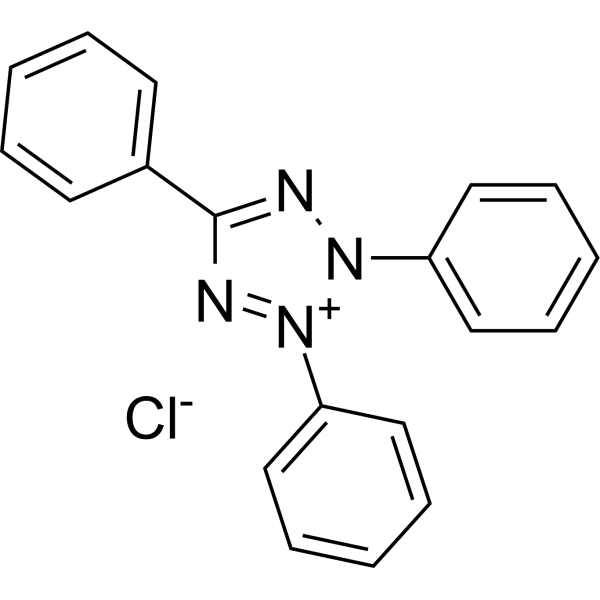
    Tetrazolium Red
    5+ Cited Publications

    2,3,5-Triphenyltetrazolium chloride; TPTZ; TTC

    Biochemical Assay Reagents Cardiovascular Disease
    Tetrazolium Red (2,3,5-Triphenyltetrazolium chloride; TTC) is a not brain-penetrant, colorless, water-soluble dye that is reduced by mitochondrial enzymes to a deep red, water-insoluble compound (formazan) mainly in the mitochondria of living cells. Tetrazolium Red is used to observe the activity of dehydrogenase, and it turns colorless to red when exposed to hydrogen. Tetrazolium Red distinguishes between surviving and infarcted brain tissue after stroke. Tetrazolium Red has been used to stain heart tissue to measure the extent of acute lesions and also used to stain brain tissue to detect the size of the infarcted area. The absorption wavelength of Tetrazolium Red is 570 nm .
    Tetrazolium Red
  • HY-W094758A

    Fluorescent Dye Cancer
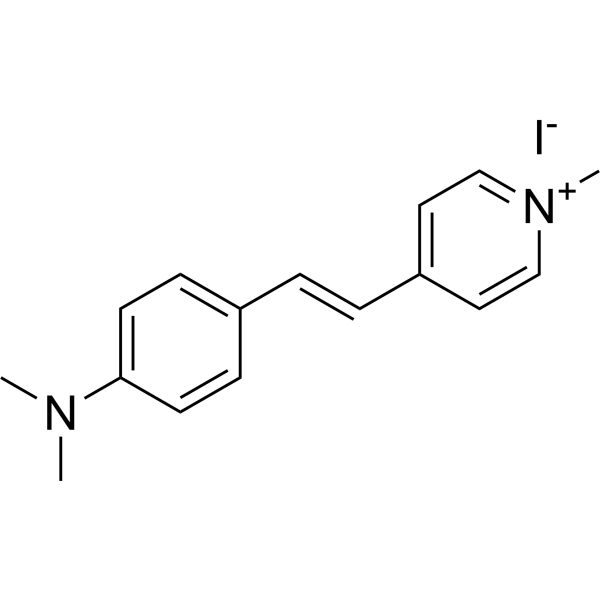
    4-Di-1-ASP is a styryl dye used to stain glioma cells in living brain tissue for analysis of cell structure, viability, proliferation and endocytosis, cytokinesis and phagocytosis, as well as for observation of mitochondrial structures in living cells. 4-Di-1-ASP fluoresces green when imaged microscopically (λexem = 475/606 nm) .
    4-Di-1-ASP
  • HY-148548

    Amyloid-β Neurological Disease
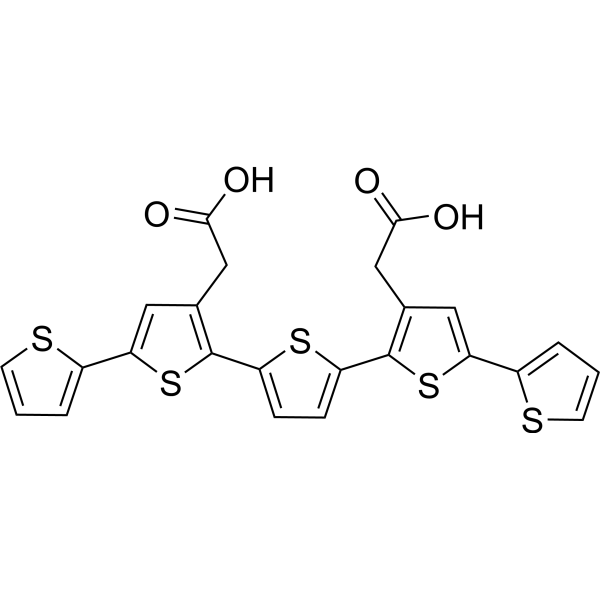
    p-HTAA is a pentamer hydrogen thiophene acetic acid. p-HTAA specifically labels Aβ deposits in the mice living brain .
    p-HTAA
  • HY-111189

    GlyT Neurological Disease
    GSK931145 is a glycine transporter 1 (GlyT1) inhibitor with anti-epileptic activity. GSK931145 exhibits a low minimum effective dose in the maximum electrical stimulation threshold test, indicating that it has a significant anti-epileptic effect. GSK931145 is also suitable as a positron emission tomography (PET) radioligand for quantifying the availability of glycine transporters in the living brain .
    GSK931145
  • HY-D2970

    Fluorescent Dye Neurological Disease
    Golgi-P is a near-infrared Golgi-targeted fluorescent probe specifically used for the detection of Golgi polarity in living cells and living tissues. Golgi-P exhibits a significant polarity-dependent spectral behavior, with its emission wavelength shifting redward with polarity (Ex/Em: 700 nm/780-825 nm). Golgi-P achieves near-infrared fluorescence imaging directly in the brain tissue of depressed mice. Golgi-P combines polarity sensing with Golgi-targeting functionality, providing a new tool for the molecular diagnosis of depression .
    Golgi-P
  • HY-D3179

    Fluorescent Dye BCRP Neurological Disease
    CDg13 is a fluorescent probe that specifically detects living neural stem/progenitor cells. CDg13 localizes to the endoplasmic reticulum via its dihexyl moiety, with no interaction with endoplasmic reticulum biomolecules. CDg13 undergoes selective efflux by active ABCG2 transporters, with increased intracellular accumulation following ABCG2 inhibition or knockdown. CDg13 isolates and enriches self-renewable neural stem/progenitor cells from embryonic mouse brain tissue, stains neural stem/progenitor cells brightly, and sorts ABCG2low cell populations from heterogeneous populations . (Ex/Em = 520/553 nm)
    CDg13

Inquiry Online

Your information is safe with us. * Required Fields.

Salutation


Country or Region *

Applicant Name *


Organization Name *

Department *


Email Address *


Product Name *

Cat. No.


Requested quantity *

Phone Number *


Remarks

Inquiry Online

Inquiry Information

Product Name:
Cat. No.:
Quantity:
MCE Japan Authorized Agent:

