13 Results for "

marine Bacillus

" in MedChemExpress (MCE) Product Catalog:
Products (13)

13 Results for "marine Bacillus" in MCE Product Catalog:

Cat. No.: HY-160238
CAS No.: 95536-41-7
Synonyms: Corynebactin
Target:  

Bacterial Fungal

Bacillibactin (Corynebactin) is a cyclic tricatecholate siderophore. Bacillibactin’s primary function is to facilitate bacterial iron acquisition by chelating iron ions (Fe 3+) from the environment, thereby aiding bacterial survival under iron-limited conditions. Bacillibactin exhibits direct antimicrobial activity, such as inhibition of the growth of the producing bacteria Pseudomonas aeruginosa and Aeromonas veronae, as well as plant pathogens such as Pseudomonas syringae.Bacillibactin can be used in antibacterial and antifungal research .
loading...
    loading...
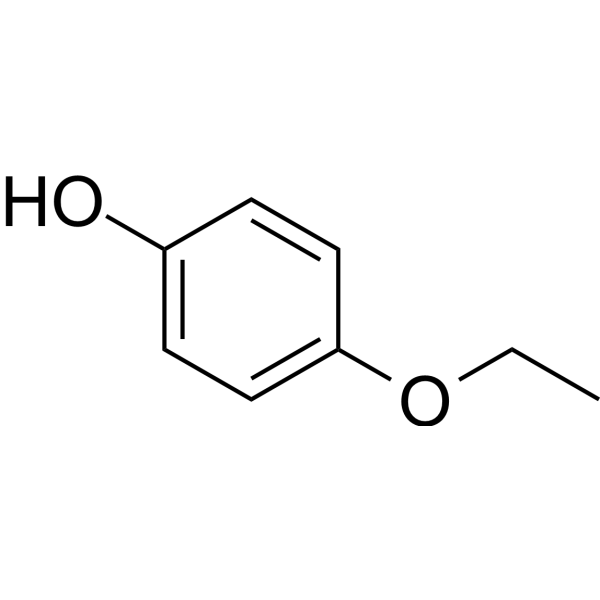
Cat. No.: HY-W015786
CAS No.: 622-62-8
4-Ethoxyphenol is a natural compound isolated from marine gorgonian-associated bacterium Bacillus amyloliquefaciens SCSIO 00856. 4-Ethoxyphenol shows potent antilarval activity towards Bacillus amphitrite larvae with an EC50 value of 24.1 μg/mL .
loading...
    loading...
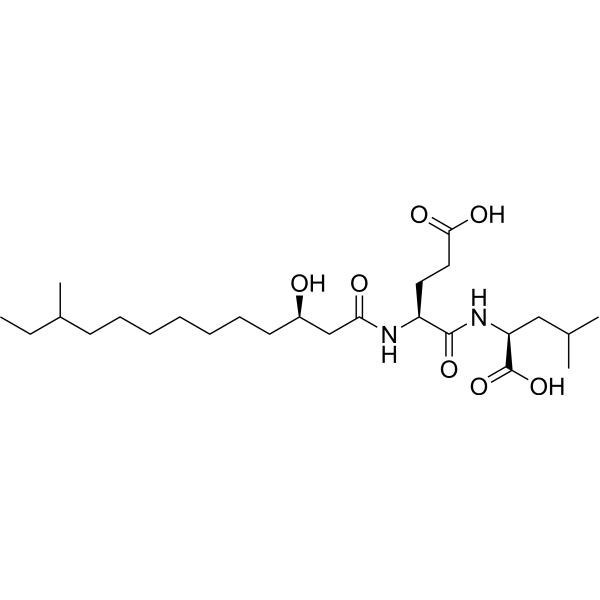
Cat. No.: HY-N16657
CAS No.: 189757-88-8
Synonyms: LI-F 04b
Fusaricidin B (LI-F 04b) is a lipopeptide biosurfactant. Fusaricidin B can be isolated from the culture broth of Bacillus polymyxa KT-8. Fusaricidin B exhibits activity against Gram-positive bacteria (especially Staphylococcus aureus FDA 209P and Micrococcus luteus IFO 3333), but its activity is weaker than that of the mixture of Fusaricidin C and D .
loading...
    loading...
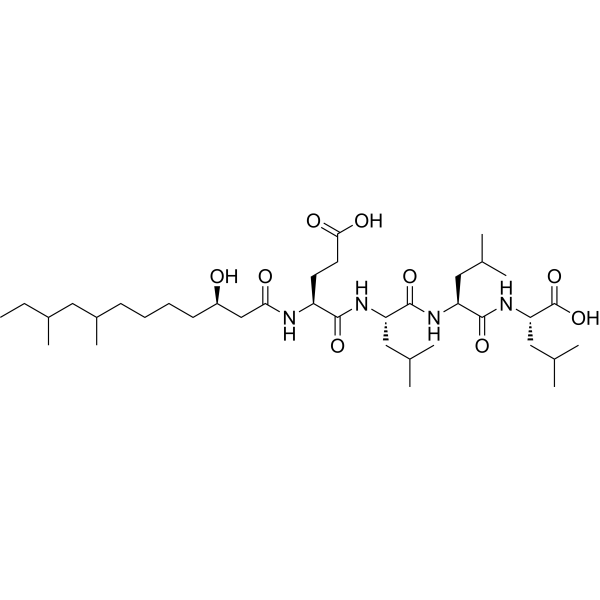
Cat. No.: HY-P5639
CAS No.: 1536405-78-3
Target:  

Fungal

Research Areas:  

Infection

Gageotetrin A is an antimicrobial peptide derived from the marine bacterium Bacillus subtilis. Gageotetrin A has antifungal activity, but none toxic to numerous human cancer cells .
loading...
    loading...
Cat. No.: HY-P5646
CAS No.: 1536405-84-1
Target:  

Bacterial

Research Areas:  

Infection

Gageotetrin C is an antimicrobial peptide derived from the marine bacterium Bacillus subtilis. Gageotetrin C is more active against fungi (MIC value is 0.02-0.04 μM) .
loading...
    loading...
Cat. No.: HY-W971376
CAS No.: 21754-26-7
Target:  

Others

Cyclo(Ala-Tyr) is a cyclic dipeptide that can be isolated from the fermentation broth of the marine microorganism Bacillus marinus B-9987 isolated from the rhizosphere tissue of Suaeda salsa in the intertidal zone of Bohai Bay, China .
loading...
    loading...
Cat. No.: HY-N15359
CAS No.: 919288-75-8
Target:  

Bacterial

Germicidin C is a microbial metabolite with antibacterial activity, which is found in the marine sponge-derived fungus Aspergillus niger. Germicidin C can inhibit the growth of various pathogenic bacteria such as Staphylococcus aureus, Escherichia coli, and Bacillus subtilis with MIC values ranging from 32 to 64 µg/mL .
loading...
    loading...
Cat. No.: HY-N19829
CAS No.: 1173985-69-7
Target:  

Others

Lipoamide B is a lipoic acid amide present in marine Bacillus pumilus (SP21) .
loading...
    loading...
Cat. No.: HY-N19828
CAS No.: 1173985-68-6
Target:  

Others

Lipoamide A is a natural lipoic acid product isolated from marine Bacillus pumilus (SP21) .
loading...
    loading...
Cat. No.: HY-N18050
CAS No.: 545434-89-7
Petrobactin is a bis-catechol α-hydroxy acid siderophore, Fe (III) chelator, and oxidative stress protector. Petrobactin is produced by marine bacteria and Bacillus anthracis Sterne strain under iron-starvation conditions. Petrobactin promotes the biodegradation of petroleum hydrocarbons by microorganisms, as well as the proliferation, virulence exertion, vegetative growth, sporulation efficiency, and spore binding of Bacillus anthracis; it also mediates community iron acquisition in the global ocean. Petrobactin can be used in anthrax-related research .
loading...
    loading...
Cat. No.: HY-K6023

MCE ECM Gentle Dissociation Solution is a gentle ECM-degrading enzyme mixture derived from marine bacteria and Bacillus species, specifically formulated for efficient and low-damage digestion of in-vitro cell systems. It selectively degrades extracellular matrix components while minimizing disruption to the cell membrane and intercellular junctions, thereby significantly reducing mechanical stress during dissociation.

loading...
    loading...
Cat. No.: HY-L254
63 compounds

Bacteria-derived natural products have long been recognized as an important resource for innovative drug discovery due to their remarkable structural diversity and broad spectrum of biological activities. Microorganisms such as actinomycetes, Bacillus species, and marine bacteria can produce a wide range of small molecules with unique chemical scaffolds, showing extensive application potential in anti-infective, anticancer, immunomodulatory, and metabolic disease research. Many classic drugs, including Streptomycin, Tetracycline, and Doxorubicin, are derived from bacteria-related natural products.

Cat. No.: HY-K6022

MCE ECM Gentle Dissociation Solution is a gentle ECM-degrading enzyme mixture derived from marine bacteria and Bacillus species, specifically formulated for efficient and low-damage digestion of in-vitro cell systems. It selectively degrades extracellular matrix components while minimizing disruption to the cell membrane and intercellular junctions, thereby significantly reducing mechanical stress during dissociation. This product is compatible with a wide range of cell types, including stem cell colonies, primary cells, neural cells, and organoids, and is particularly well suited for gentle yet effective dissociation of brain organoids and other complex 3D structures.

loading...
    loading...
  • 1

