
14 Results for "

nanospheres

" in MedChemExpress (MCE) Product Catalog:
Products (14)

14 Results for "nanospheres" in MCE Product Catalog:

3
3 Cited Publications
Cat. No.: HY-111377
CAS No.: 359860-27-8
Purity:  99.79%
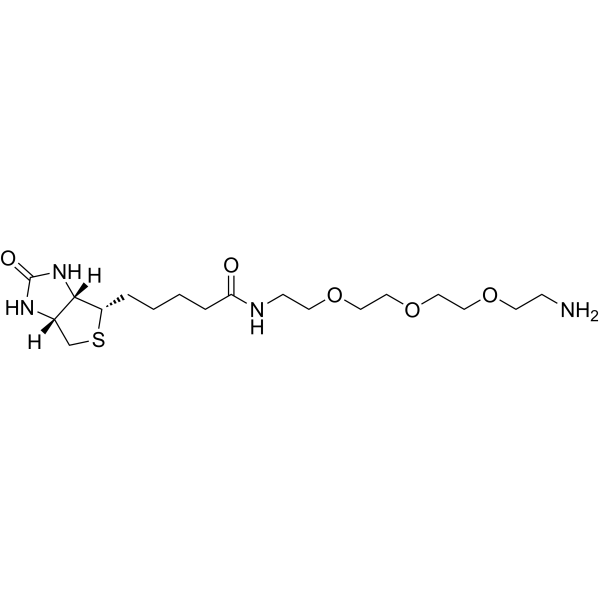
Amine-PEG3-Biotin is a signal amplification label containing a biotin group and a terminal primary amine group .
loading...
    loading...
3
3 Cited Publications
Cat. No.: HY-147081
CAS No.: 301636-59-9
Purity:  99.52%
Synonyms: AGRO-100
Research Areas:  

Cancer

AS 1411 (AGRO-100) is an oligonucleotide aptamer targeting nucleoproteins. AS 1411 inhibits tumor cell proliferation by affecting the activity of nucleoprotein-containing complexes and can be used as a carrier to precisely deliver nanoparticles, oligonucleotides and small molecules to cancer cells. AS 1411 reduces PRMT5 expression to inhibit tumor growth in DU145 prostate cancer cells. AS 1411 works by blocking the binding of nucleoproteins to bcl-2 mRNA in MCF-7 breast cancer cells. AS 1411-coupled Jin nanospheres can inhibit breast cancer cell proliferation in vitro and in mouse models, has the ability to cross the blood-brain barrier with low tissue toxicity .
loading...
    loading...
3
3 Cited Publications
Cat. No.: HY-147081A
Synonyms: AGRO-100 sodium
Research Areas:  

Cancer

AS 1411 (AGRO-100) sodium is an oligonucleotide aptamer targeting nucleoproteins. AS 1411 sodium inhibits tumor cell proliferation by affecting the activity of nucleoprotein-containing complexes and can be used as a carrier to precisely deliver nanoparticles, oligonucleotides and small molecules to cancer cells. AS 1411 sodium reduces PRMT5 expression to inhibit tumor growth in DU145 prostate cancer cells. S 1411 sodium works by blocking the binding of nucleoproteins to bcl-2 mRNA in MCF-7 breast cancer cells. S 1411 sodium-coupled Jin nanospheres can inhibit breast cancer cell proliferation in vitro and in mouse models, has the ability to cross the blood-brain barrier with low tissue toxicity
loading...
    loading...
Cat. No.: HY-116673
CAS No.: 709676-56-2
Purity:  99.39%
Research Areas:  

Neurological Disease

TTK21 is an activator of the histone acetyltransferases CBP/p300. TTK21 passes the blood–brain barrier, induces no toxicity, and reaches different parts of the brain when conjugated to glucose-based carbon nanosphere (CSP). TTK21 has beneficial implications for the brain functions of neurogenesis and long-term memory .CSP-TTK21 can ameliorate Aβ-impaired long-term potentiation (LTP). CSP-TTK21 may enhance the transcription of genes that promote synaptic health and cognitive function . CSP-TTK21 is orally effective and leads to improvements in motor functions, histone acetylation dynamics in a spinal injury rat model .
loading...
    loading...
Cat. No.: HY-117401
CAS No.: 107827-77-0
Purity:  99.32%
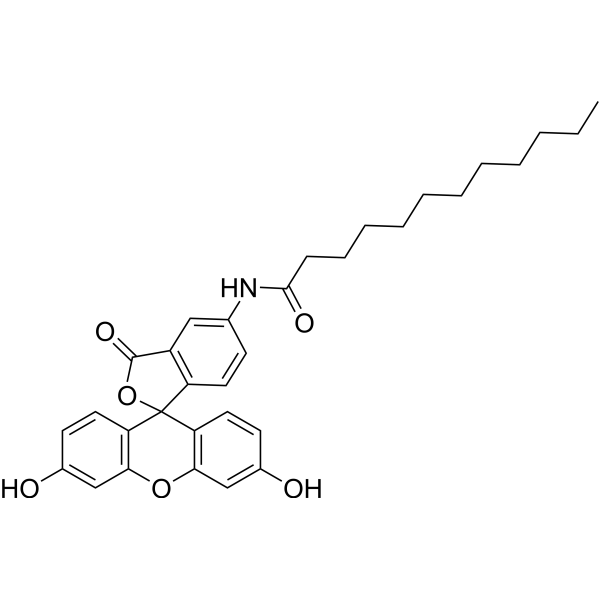
5-Dodecanoylaminofluorescein is an amphipathic (amphoteric) fluorescent probe (Ex/Em = 485 nm/515-535 nm), which consists of a hydrophilic fluorescein core and a hydrophobic dodecanoyl group (C12 fatty acid chain) linked by an amide bond. 5-Dodecanoylaminofluorescein is mainly used as an interface-localized radical trapping/indicator probe. Dodecanoylaminofluorescein can be used for the determination of the antioxidant properties of emulsions, or can serve as a lipophilic drug model for the study of passive skin penetration when encapsulated in tyrosine-derived nanospheres .
loading...
    loading...
Cat. No.: HY-140646
CAS No.: 24991-53-5
Purity:  99.39%
Synonyms: Poly(ethylene glycol)-bis-amine 2000
Research Areas:  

Cancer

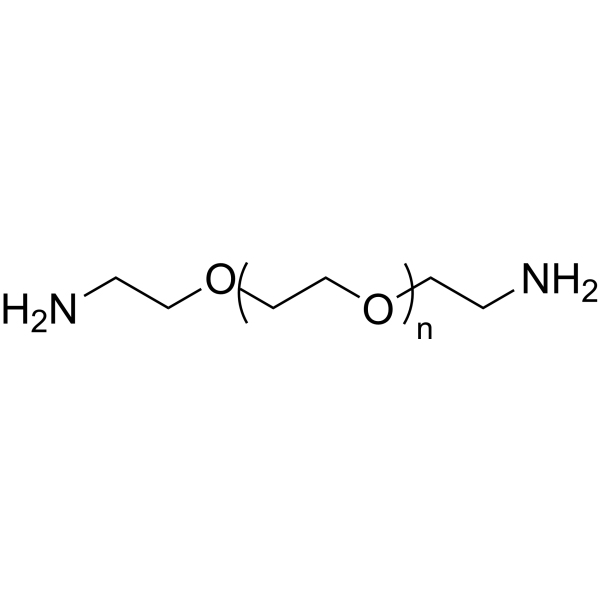
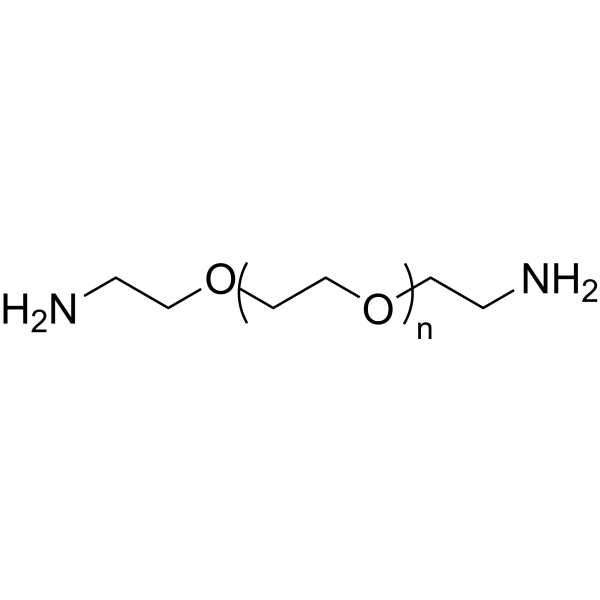
PEG2000-bis-amine (Poly(ethylene glycol)-bis-amine 2000) is a diamine-terminated polyethylene glycol and conjugate linker. PEG2000-bis-amine endows the surface of carbon capsules with stealth properties, biocompatibility, and free amino groups for antibody conjugation. PEG2000-bis-amine acts as a reducing agent and passivating agent to promote the formation and assembly of silver nanoparticles on silica nanospheres, and increases the number of silver nanoparticles on the silica surface .
loading...
    loading...
Cat. No.: HY-140649
CAS No.: 24991-53-5
Purity:  ≥98.0%
Synonyms: Poly(ethylene glycol)-bis-amine 20000
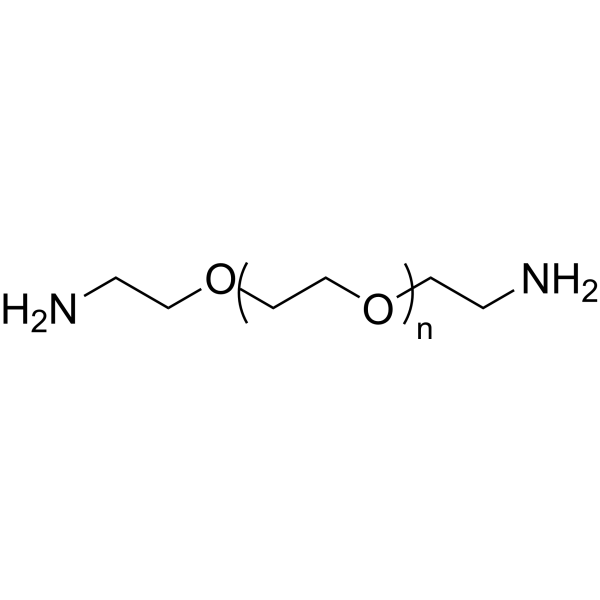
PEG20000-bis-amine (Poly(ethylene glycol)-bis-amine 20000) is a diamine-terminated polyethylene glycol and conjugate linker. PEG20000-bis-amine endows the surface of carbon capsules with stealth properties, biocompatibility, and free amino groups for antibody conjugation. PEG20000-bis-amine acts as a reducing agent and passivating agent to promote the formation and assembly of silver nanoparticles on silica nanospheres, and increases the number of silver nanoparticles on the silica surface.
loading...
    loading...
Cat. No.: HY-140647
CAS No.: 24991-53-5
Synonyms: Poly(ethylene glycol)-bis-amine 3400
PEG3400-bis-amine (Poly(ethylene glycol)-bis-amine 3400) is a diamine-terminated polyethylene glycol and conjugate linker. PEG3400-bis-amine endows the surface of carbon capsules with stealth properties, biocompatibility, and free amino groups for antibody conjugation. PEG3400-bis-amine acts as a reducing agent and passivating agent to promote the formation and assembly of silver nanoparticles on silica nanospheres, and increases the number of silver nanoparticles on the silica surface.
loading...
    loading...
Cat. No.: HY-140339
CAS No.: 60117-35-3
Purity:  98.02%
Research Areas:  

Others Cancer

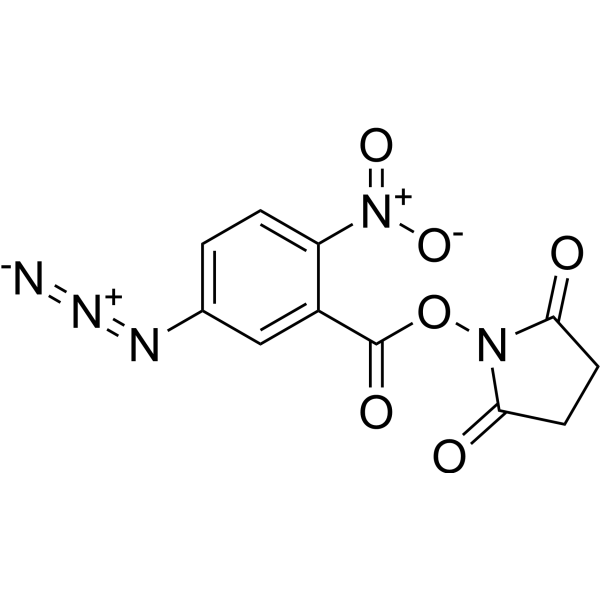
ANB-NOS is a heterobifunctional crosslinker with lipophilic, uncharged properties suitable for intracellular conjugation. ANB-NOS contains an amine-reactive Nhydroxysuccinimide (NHS) ester and a photoactivatable nitrophenyl azide. ANB-NOS can be used for the research of fibrosarcoma and mammary adenocarcinoma .
loading...
    loading...
Cat. No.: HY-172351A
CAS No.: 24991-53-5
PEG6000-bis-amine is a diamine-terminated polyethylene glycol (MW≈6000) and conjugate linker. PEG6000-bis-amine endows the surface of carbon capsules with stealth properties, biocompatibility, and free amino groups for antibody conjugation. PEG6000-bis-amine acts as a reducing agent and passivating agent to promote the formation and assembly of silver nanoparticles on silica nanospheres, and increases the number of silver nanoparticles on the silica surface .
loading...
    loading...
Cat. No.: HY-172351
CAS No.: 24991-53-5
PEG400-bis-amine is a diamine-terminated polyethylene glycol and conjugate linker. PEG400-bis-amine endows the surface of carbon capsules with stealth properties, biocompatibility, and free amino groups for antibody conjugation. PEG400-bis-amine acts as a reducing agent and passivating agent to promote the formation and assembly of silver nanoparticles on silica nanospheres, and increases the number of silver nanoparticles on the silica surface.
loading...
    loading...
Cat. No.: HY-111377R
CAS No.: 359860-27-8
Research Areas:  

Others

Amine-PEG3-Biotin (Standard) is the analytical standard of Amine-PEG3-Biotin (HY-111377). This product is intended for research and analytical applications. Amine-PEG3-Biotin is a signal amplification label containing a biotin group and a terminal primary amine group .
loading...
    loading...
Cat. No.: HY-D3557
ICG PS (300 nm) is a polystyrene (PS) fluorescent nanosphere supported on Indocyanine green (ICG) (HY-D0711), with a particle size of 300 nm and a concentration of 10 mg/mL. Indocyanine green fluorophores are commonly used in applications such as immunolabeling, nucleic acid labeling, fluorescence microscopy, and flow cytometry (Ex/Em=785/813 nm).
loading...
    loading...
Cat. No.: HY-174906A
Research Areas:  

Others

Bis-PEG2000-COOH is a dicarboxyl-terminated polyethylene glycol and surface modification reagent with hydrophilic, biocompatible properties. Bis-PEG2000-COOH coats superparamagnetic iron oxide nanoparticles to prepare carriers for conjugating antigen p210 and adjuvant CpG oligodeoxynucleotides in nanovaccine formulation .
loading...
    loading...
  • 1

