
16 Results for "

orphan disease

" in MedChemExpress (MCE) Product Catalog:
Products (16)

16 Results for "orphan disease" in MCE Product Catalog:

6
6 Cited Publications
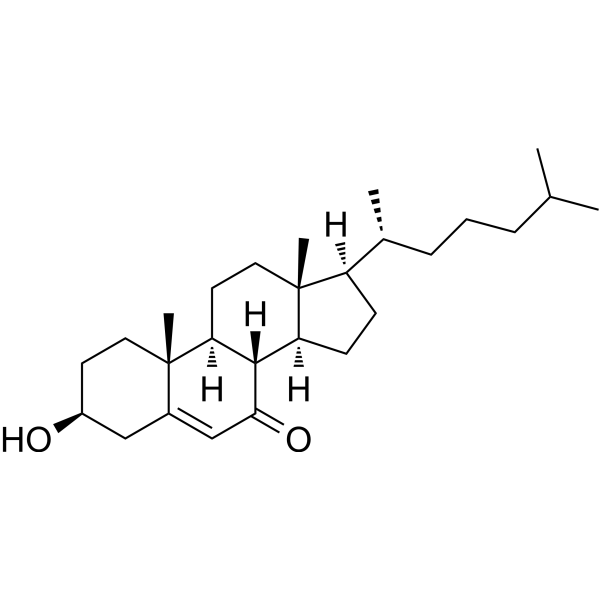
Cat. No.: HY-113342
CAS No.: 566-28-9
Purity:  99.87%
7-Ketocholesterol is an oxidation product of cholesterol, widely present in atherosclerotic plaques, and has a stronger atherogenic effect than cholesterol. 7-Ketocholesterol can inhibit the rate-limiting enzymes involved in bile acid and cholesterol synthesis, such as cholesterol 7α-hydroxylase and HMG-CoA reductase. 7-Ketocholesterol exhibits pro-inflammatory effects both in vivo and in vitro and can induce cell apoptosis (apoptosis) .
loading...
    loading...
1
1 Cited Publications
Cat. No.: HY-P1438
CAS No.: 412938-75-1
Research Areas:  

Neurological Disease

Neuropeptide S (Rat) is an endogenous ligand of a previously orphan G-protein-coupled receptor now named NPS receptor. Neuropeptide S (Rat) can be used for the research of nervous system disease .
loading...
    loading...
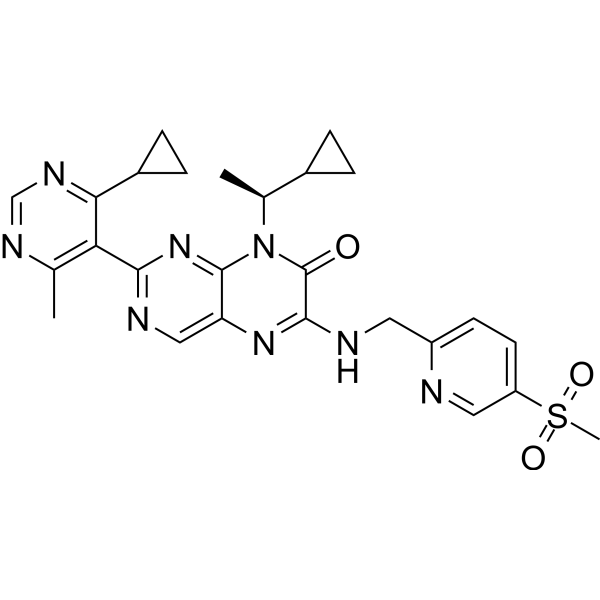
Cat. No.: HY-132810
CAS No.: 1817773-66-2
Purity:  99.54%
Synonyms: BI 730357
Target:  

ROR

Research Areas:  

Inflammation/Immunology Cancer

Bevurogant (BI 730357) is a retinoid-related orphan receptor-gamma t (RORγt) antagonist. Bevurogant can be used for the research of chronic inflammatory diseases .
loading...
    loading...
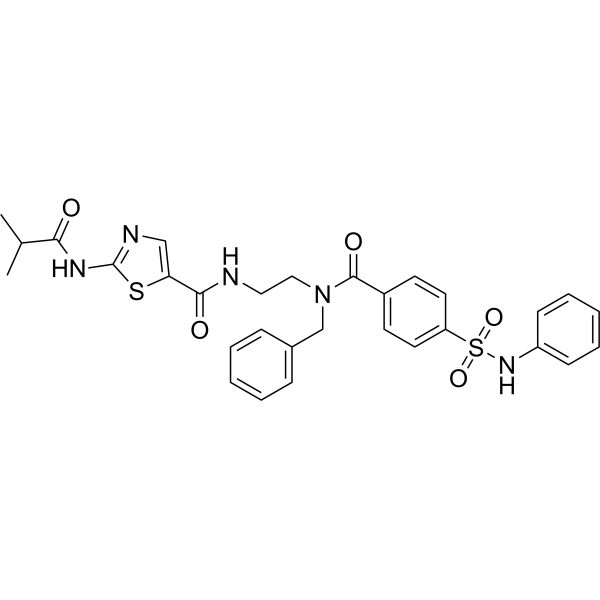
Cat. No.: HY-151539
CAS No.: 2834739-51-2
Purity:  99.57%
Target:  

LIM Kinase (LIMK)

Research Areas:  

Neurological Disease

TH470 is a highly selective LIMK1/2 (LIM kinase1/2) inhibitor (LIMK1 IC50=9.8 nM; LIMK2 IC50=13 nM), and can be used in orphan disease research .
loading...
    loading...
Cat. No.: HY-W150866
CAS No.: 1083-27-8
Synonyms: Hexylparaben
Target:  

ROR

Research Areas:  

Inflammation/Immunology

Hexyl 4-hydroxybenzoate (Hexylparaben) is a retinoic acid-related orphan receptor RORγ(t) agonist with an EC50 of 144 nM. Hexyl 4-hydroxybenzoate is used in the study of autoimmune diseases .
loading...
    loading...
Cat. No.: HY-111323
CAS No.: 837404-68-9
Purity:  99.23%
Target:  

ROR

Research Areas:  

Neurological Disease

ASN06917370 is a former orphan receptor GPR17 ligand for the study of neurodegenerative diseases. ASN06917370 has an EC50 of 268 pM in [35S]GTPyS experiments .
loading...
    loading...
Cat. No.: HY-120785
CAS No.: 1386439-51-5
Purity:  99.69%
Target:  

ROR

Research Areas:  

Inflammation/Immunology

SR1555 is a specific retinoic acid receptor-related orphan nuclear receptor γ (RORγ) inverse agonist with an IC50 value of 1 μM. SR1555 not only inhibits TH17 cell development and function but also increases the frequency of T regulatory cells, as well as inhibits the expression of IL-17. SR1555 can be used for researching autoimmune diseases .
loading...
    loading...
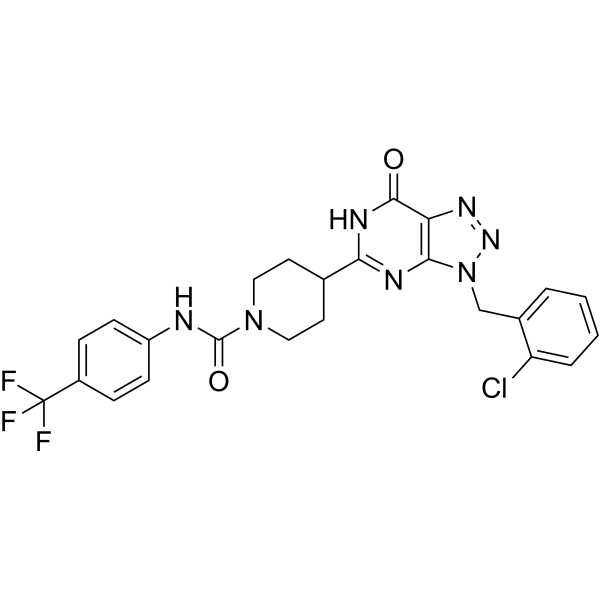
Cat. No.: HY-125111
CAS No.: 1399049-81-0
Purity:  99.36%
PSB-SB-487 is a potent GPR55 antagonist and CB2 agonist with an IC50 value of 0.113 µM for GPR55, and a Ki value of 0.292 µM for human CB2. PSB-SB-487 can be used for researching diabetes, Parkinson’s disease, neuropathic pain, and cancer .
loading...
    loading...
Cat. No.: HY-175490
CAS No.: 1242610-59-8
Target:  

ROR

Research Areas:  

Inflammation/Immunology

RORγ inverse agonist 2 (Compound 15) is a potent inverse agonist of the retinoic acid receptor-related orphan receptor RORγ, with IC50 values of 0.4 and 0.9 μM for Gal4-RORγ and full-length RORγ, respectively. RORγ inverse agonist 2 is useful in the study of autoimmune diseases .
loading...
    loading...
Cat. No.: HY-142936
CAS No.: 2230877-38-8
Target:  

ROR

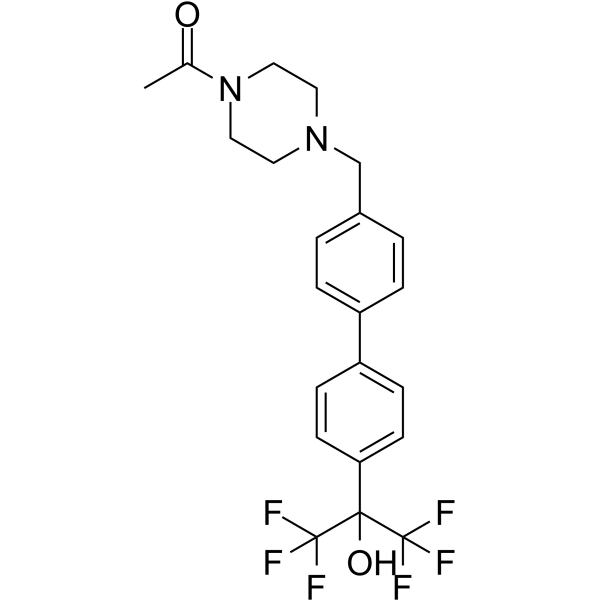
RORγt modulator 3 (Compound 23) is a modulator of retinoid-related orphan receptor γt (RORγt). RORγt modulator 3 can be used for the research of RORyt mediated diseases such as, e.g., pain, inflammation, COPD, asthma, rheumatoid arthritis, colitis, multiple sclerosis, psoriasis, neurodegenerative diseases and cancer .
loading...
    loading...
Cat. No.: HY-142935
CAS No.: 2247083-47-0
Target:  

ROR

RORγt modulator 2 (Compound 21) is a modulator of retinoid-related orphan receptor γt (RORγt) with the IC50 of <50 nM. RORγt modulator 2 can be used for the research of RORyt mediated diseases such as, e.g., pain, inflammation, COPD, asthma, rheumatoid arthritis, colitis, multiple sclerosis, psoriasis, neurodegenerative diseases and cancer .
loading...
    loading...
Cat. No.: HY-113342R
CAS No.: 566-28-9
7-Ketocholesterol (Standard) is the analytical standard of 7-Ketocholesterol. This product is intended for research and analytical applications. 7-Ketocholesterol is an oxidation product of cholesterol, widely present in atherosclerotic plaques, and has a stronger atherogenic effect than cholesterol. 7-Ketocholesterol can inhibit the rate-limiting enzymes involved in bile acid and cholesterol synthesis, such as cholesterol 7α-hydroxylase and HMG-CoA reductase. 7-Ketocholesterol exhibits pro-inflammatory effects both in vivo and in vitro and can induce cell apoptosis (apoptosis) .
loading...
    loading...
Cat. No.: HY-120785A
CAS No.: 2309312-90-9
Target:  

ROR

Research Areas:  

Inflammation/Immunology

SR1555 hydrochloride is the hydrochloride salt form of SR1555 (HY-120785). SR1555 hydrochloride is an inverse agonist for retinoic acid receptor-related orphan nuclear receptor γ (RORγ) with an IC50 of 1 μM. SR1555 hydrochloride inhibits the development and function of pro-inflammatory TH17 cell, increases the frequency of anti-inflammatory T regulatory (Treg) cells. SR1555 hydrochloride can be used for research about autoimmune diseases .
loading...
    loading...
Cat. No.: HY-L097
52 compounds

Animal disease models are used in a variety of settings in basic research, such as studies on mechanisms of disease progression and evaluation new drugs. Animal models can be broadly classified into five categories: 1) experimental, 2) spontaneous, 3) negative, 4) orphan, 5) genetically engineered. Experimental models, which are induced artificially in the laboratory, are most common. Some small molecular compounds are usually used as inducers for animal models, such as Ceruletide for inflammatory model, Azoxymethane for tumor model. These inducers are useful tool in building animal models.

MCE offers a unique collection of 52 animal model inducers, involving inflammatory model, tumor model, nervous disease model, etc. MCE Animal Disease Model library is a powerful tool for the establishment of animal disease models.

Cat. No.: HY-L102
1,898 compounds

Rare diseases are an important public-health issue and a challenge for the medical community. Most rare diseases are genetic disorders, which are often severely disabling, substantially affect life expectancy, and impair physical and mental abilities. Currently, there are about 7,000 identified rare diseases, together affecting 10% of the population. However, fewer than 6% of all rare diseases have an approved treatment option, highlighting their tremendous unmet needs in drug development. The process of repurposing drugs for new indications, compared with the development of novel orphan drugs, is a time-saving and cost-efficient method resulting in higher success rates, which can therefore drastically reduce the risk of drug development for rare diseases.

MCE carefully collects a unique of 1,898 compounds studied in preclinical, clinical trials or approved used in rare diseases treatment. MCE rare diseases drug library is a useful tool for the research of rare diseases. All compounds can provide corresponding indications for rare diseases.

Cat. No.: HY-P11408
CAS No.: 349657-39-2
Target:  

Bombesin Receptor

Research Areas:  

Neurological Disease Cancer

[D-Cys6,Asn7,D-Ala11,Cys14]-Bombesin (6-14), a synthetic peptide, is a non-selective bombesin receptor agonist. [D-Cys6,Asn7,D-Ala11,Cys14]-Bombesin (6-14) has preferred pEC50 values of 8.06 for the neurotrophin B bombesin receptor (BB1), 8.69 for the gastrin-releasing peptide bombesin receptor (BB2), and 6.71 for the orphan receptor (BB3). [D-Cys6,Asn7,D-Ala11,Cys14]-Bombesin (6-14) can be used to study diseases related to bombesin receptors, such as cancer and neurological disorders .
loading...
    loading...
  • 1

