1. Search Result
Search Result
Results for "

oxidation of ammonia

" in MedChemExpress (MCE) Product Catalog:

10

Inhibitors & Agonists

1

Biochemical Assay Reagents

3

Natural
Products

Cat. No. Product Name Target Research Areas Chemical Structure
  • HY-B1142
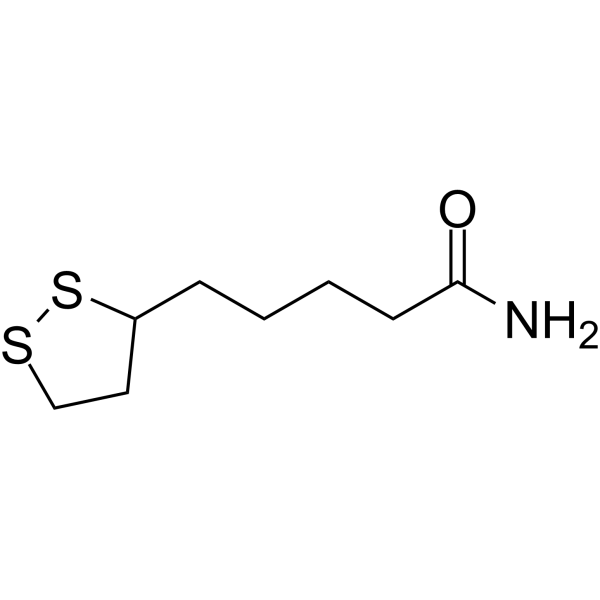
    Lipoamide
    Maximum Cited Publications
    9 Publications Verification

    (±)-α-Lipoamide; DL-Lipoamide; DL-6,8-Thioctamide

    NO Synthase Others
    Lipoamide ((±)-α-Lipoamide) is a monocarboxylic acid derivative of a neutral amide, formed by the condensation of the carboxyl group of lipoic acid and ammonia. Lipoamide protects against oxidative stress-mediated neuronal cell damage and also acts as a coenzyme to transfer acetyl groups and hydrogen during pyruvate deacylation. Lipoamide also stimulates mitochondrial biogenesis in adipocytes through the endothelial NO synthase-cGMP-protein kinase G signaling pathway .
    Lipoamide
  • HY-N10574
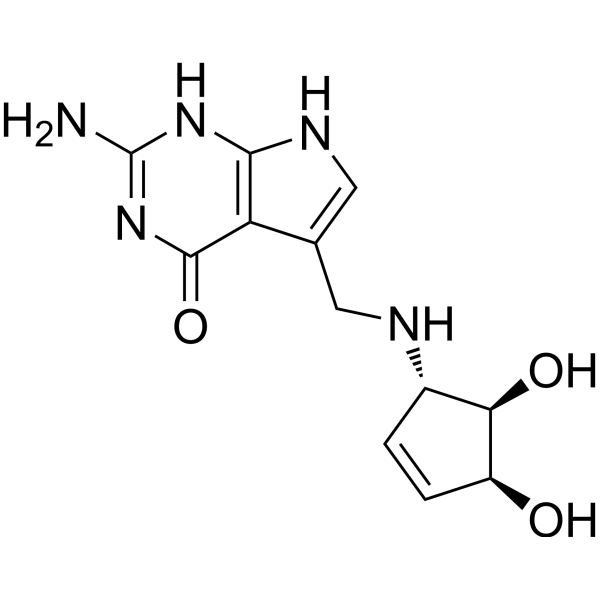
    Queuine
    1 Publications Verification

    Bacterial Metabolic Disease Cancer
    Queuine is a selective substrate for tRNA guanine transglycosylase (TGT) and can be incorporated into eukaryotic tRNA. Queuine promotes tRNA modification, affecting mitochondrial function and Warburg metabolic phenotype. If Queuine is deficient, aerobic glycolysis can be enhanced, oxidative phosphorylation can be inhibited, and Warburg metabolism can be promoted, accompanied by increased ammonia and lactate production and increased lactate dehydrogenase activity. Queuine can be used for autoimmune diseases (such as experimental models of multiple sclerosis) and cancer metabolic regulation, and its deficiency is associated with low tRNA modification in tumor cells .
    Queuine
  • HY-B0543

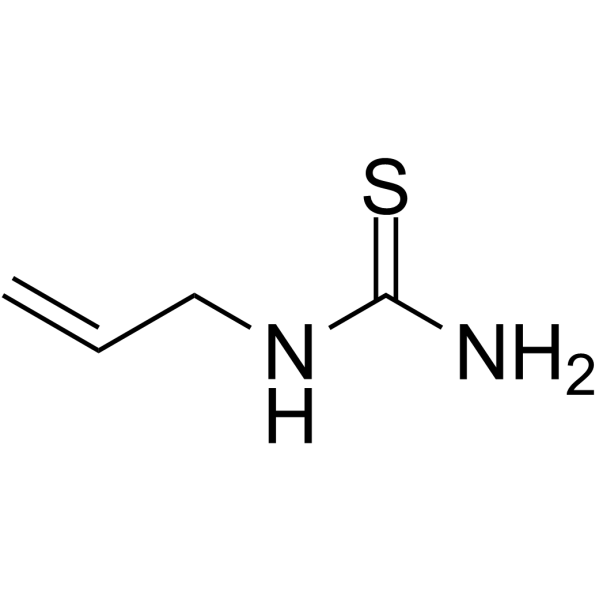
    Thiosinamine; N-Allylthiourea

    Reactive Oxygen Species (ROS) Cancer
    Allylthiourea can selectively inhibit the oxidation of ammonia. Allylthiourea is commonly used to inhibit nitrification by targeting ammonia monooxygenase and chelating copper in the active site to suppress its activity. Allylthiourea also exhibits anticancer activity, showing cytotoxicity against the MCF-7 cell line with an IC50 of 5.22 mM. Allylthiourea can be utilized in research related to micropollutant biodegradability and cancer studies .
    Allylthiourea
  • HY-Y0286

    Hartshorn salt, 99%

    Environmental Pollutants Biochemical Assay Reagents Others
    Ammonium carbonate (Ammonium carbonate), 99% is a solid amino compound that functions as a buffer, pH regulator, pore-forming agent, and electrocatalytic oxidation substrate. Ammonium carbonate, 99% is a GRAS-grade direct food additive with no restricted daily intake specified by FAO/WHO, and it shows no acute skin toxicity, clinical signs of toxicity, or effects on body weight in rats. Ammonium carbonate, 99% undergoes electrocatalytic oxidation in alkaline solutions with a Pt/C catalyst (carbonate adsorption interferes with activity). Ammonium carbonate, 99% can serve as a fuel for low-temperature polymer fuel cells and anion exchange membrane fuel cells (with performance superior to pure ammonia), and can also form pores in the carrier-free Pt cathode catalyst layer after low-temperature decomposition, thereby enhancing catalyst activity under low-humidity conditions and the performance of proton exchange membrane fuel cells .
    Ammonium carbonate, 99%
  • HY-P2987

    Endogenous Metabolite Amino Acid Oxidase Metabolic Disease
    L-Amino acid oxidase is a homodimeric proteins containing flavin adenine dinucleotide. L-Amino acid oxidase can catalyze the stereospecific oxidative deamination of L-amino acids to α-keto acids and ammonia .
    L-Amino acid oxidase
  • HY-N10574A
    Queuine dihydrochloride
    1 Publications Verification

    Others Metabolic Disease Cancer
    Queuine dihydrochloride is a selective substrate for tRNA guanine transglycosylase (TGT) and can be incorporated into eukaryotic tRNA. Queuine dihydrochloride promotes tRNA modification, affecting mitochondrial function and Warburg metabolic phenotype. If Queuine dihydrochloride is deficient, aerobic glycolysis can be enhanced, oxidative phosphorylation can be inhibited, and Warburg metabolism can be promoted, accompanied by increased ammonia and lactate production and increased lactate dehydrogenase activity. Queuine dihydrochloride can be used for autoimmune diseases (such as experimental models of multiple sclerosis) and cancer metabolic regulation, and its deficiency is associated with low tRNA modification in tumor cells .
    Queuine dihydrochloride
  • HY-E70003A

    NADH Dehydrogenase Others
    Glutamate Dehydrogenase, Bovine Liver (EC 1.4.1.4) catalyzes the reversible oxidative deamination of glutamate to alpha-ketoglutarate and ammonia.
    Glutamate Dehydrogenase, Bovine Liver
  • HY-B0543R

    Thiosinamine (Standard); N-Allylthiourea (Standard)

    Reference Standards Reactive Oxygen Species (ROS) Cancer
    Allylthiourea (Standard) is the analytical standard of Allylthiourea. This product is intended for research and analytical applications. Allylthiourea can selectively inhibit the oxidation of ammonia. Allylthiourea is commonly used to inhibit nitrification by targeting ammonia monooxygenase and chelating copper in the active site to suppress its activity. Allylthiourea also exhibits anticancer activity, showing cytotoxicity against the MCF-7 cell line with an IC50 of 5.22 mM. Allylthiourea can be utilized in research related to micropollutant biodegradability and cancer studies [4].
    Allylthiourea (Standard)
  • HY-E70519B

    Biochemical Assay Reagents Metabolic Disease
    Tyramine oxidase, Arthrobacter sp. (EC 1.4.3.6) is a class of enzymes that catalyze the oxidation of various biogenic amines, including many neurotransmitters, histamine, and exogenous amines. Tyramine oxidase, Arthrobacter sp. (EC 1.4.3.6) catalyzes the oxidation of primary amines to aldehydes, releasing ammonia and hydrogen peroxide. Each subunit of this reaction requires a copper ion, with topiramate as a cofactor.
    Tyramine Oxidase, Arthrobacter sp.
  • HY-W009690

    Tetraacetylethylenediamine; TAED

    Others
    N,N,N',N'-Tetraacetylethylenediamine (Tetraacetylethylenediamine; TAED) is a disinfectant and bleach activator. N,N,N',N'-Tetraacetylethylenediamine is a common bleach activator in phosphorus-free laundry detergent formulations, which acts to activate sodium perborate and improve bleaching efficiency at low temperatures. N,N,N',N'-Tetraacetylethylenediamine reacts with sodium percarbonate in water to produce peracetic acid with strong oxidative bactericidal activity. This reaction is environmentally friendly, and the final degradation products are sodium carbonate, acetic acid, ammonia, carbon dioxide, oxygen and water .
    N,N,N',N'-Tetraacetylethylenediamine

Inquiry Online

Your information is safe with us. * Required Fields.

Salutation


Country or Region *

Applicant Name *


Organization Name *

Department *


Email Address *


Product Name *

Cat. No.


Requested quantity *

Phone Number *


Remarks

Inquiry Online

Inquiry Information

Product Name:
Cat. No.:
Quantity:
MCE Japan Authorized Agent:

