4 Results for "

protac sa

" in MedChemExpress (MCE) Product Catalog:
Products (4)

4 Results for "protac sa" in MCE Product Catalog:

Cat. No.: HY-155684
CAS No.: 3058085-76-7
Research Areas:  

Cancer

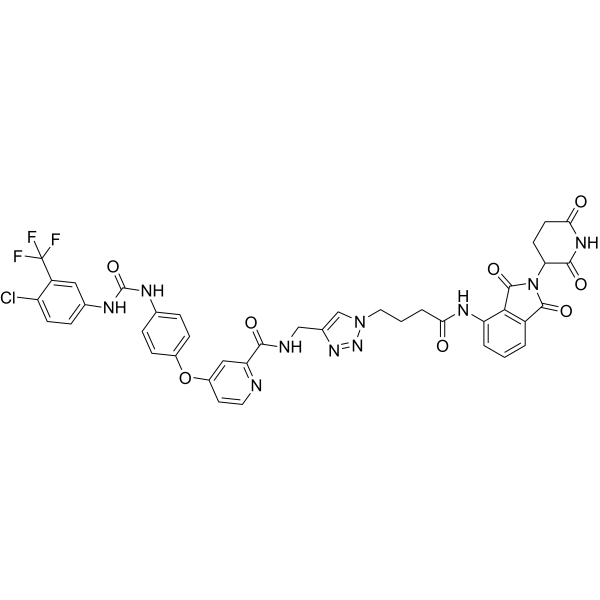
SA-PA is an intracellular self-assembling CRBN-recruiting PROTAC composed of an alkynylated Sorafenib precursor (SA) and an azidated Pomalidomide precursor (PA). SA-PA promotes the ubiquitination and proteasomal degradation of VEGFR-2, EphB4, and PDGFR-β, and exhibits inhibitory activity against U87 and A549 cell proliferation. SA-PA is used in cancer-related research, such as glioblastoma and non-small cell lung cancer .
loading...
    loading...
Cat. No.: HY-158331
CAS No.: 3055593-64-8
Gal-ARV-771 is a galactose-modified derivative of ARV-771 (HY-100972). Gal-ARV-771 is activated in cells expressing SA-β-Gal, thereby releasing ARV-771. Gal-ARV-771 selectively induces Apoptosis. ARV-771 is a BET PROTAC degrader. Gal-ARV-771 can be used in the research of lung adenocarcinoma (Gal+linker: Gal-PAB (HY-188142); PROTAC: ARV-771 (HY-100972)) .
loading...
    loading...
Cat. No.: HY-177945
CAS No.: 3055593-63-7
Synonyms: Gal-MS99
Research Areas:  

Cancer

MS99-β-Gal (Gal-MS99) is a galactose-modified NPM-ALK PROTAC degrader. MS99-β-Gal is only hydrolyzed by SA-β-gal and esterase in senescent cancer cells, releasing MS99, which specifically degrades the NPM-ALK fusion protein. MS99-β-Gal shows an IC50 of 454.8 nM for aging Karpas 299 cells, significantly lower than that of normal Karpas 299 cells (IC50 = 2.162 μM). MS99-β-Gal can be used for the research of cancer .
loading...
    loading...
Cat. No.: HY-155685
CAS No.: 3058085-77-8
Research Areas:  

Cancer

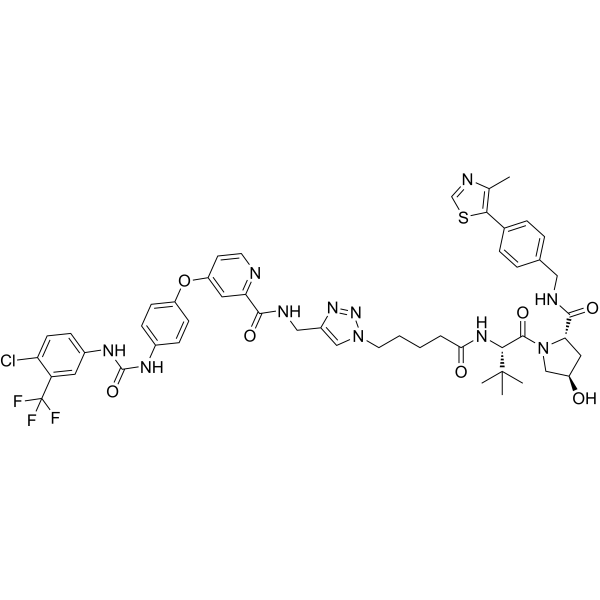
SA-VA is a heterobifunctional PROTAC molecule generated in situ via click chemistry, and acts as a degrader for VEGFR-2 and EphB4. SA-VA is self-assembled from the alkynyl precursor SA and the azide precursor VA through a copper ion-mediated intracellular click chemistry reaction, recruits the E3 ubiquitin ligase VHL to mediate the ubiquitination of target proteins, and triggers degradation via the proteasome pathway. SA-VA induces cell cycle arrest and apoptosis in U87 glioma cells. SA-VA can be used in cancer-related research .
loading...
    loading...

