



sEH/HDAC6-IN-1
Based on 1 publication(s) in Google Scholar
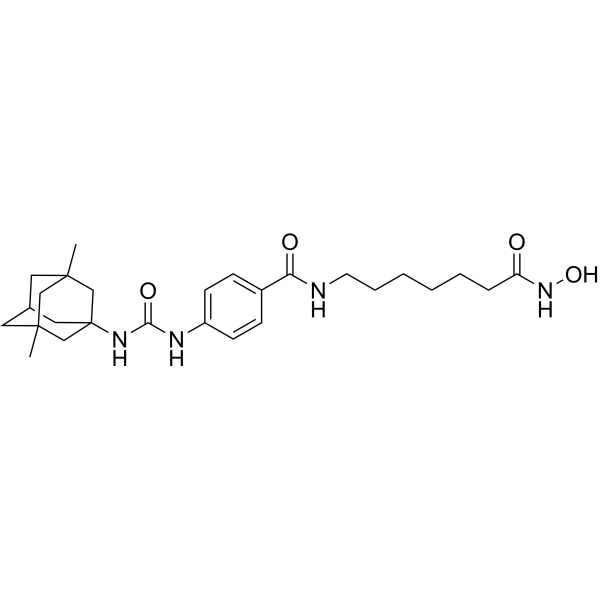
sEH/HDAC6-IN-1 (compound M9) is a selective, orally active dual inhibitor for sEH and HDAC6, with IC50s of 2 nM, 0.72 nM and 5 nM, for human sEH, murine sEH and HDAC6, respectively. sEH/HDAC6-IN-1 reveals analgesic and anti-inflammatory effects.
For research use only. We do not sell to patients.
- CAS No.: 2847838-67-7
- Formula: C27H40N4O4
- Molecular Weight:484.63
-
Storage:
Please store the product under the recommended conditions in the Certificate of Analysis.

To place orders, for customer services and technical support, please contact: MedChemExpress USA
Tel: 609-228-6898 E-mail: [email protected] [email protected]


-
 Biological Activity
-
Chemical Information
- Protocols
- Purity & Documentation
- References
-
 Help & FAQs


Publications Citing Use of MedChemExpress (MCE) sEH/HDAC6-IN-1
More

Biological Activity
Description
IC50 & Target
|
murine sEH 0.72 nM (IC50) |
human sEH 2 nM (IC50) |
HDAC6 5 nM (IC50) |
HDAC1 0.2731 μM (IC50) |
HDAC2 0.8 μM (IC50) |
HDAC3 0.49 μM (IC50) |
HDAC11 0.3142 μM (IC50) |
In Vitro
sEH/HDAC6-IN-1 (1-2 μM, 24 h) inhibits cell growth of THP-1 with IC50 of 3.2 μM[1].
sEH/HDAC6-IN-1 (100 μM) reveals microsomal stability in human, rat and mouse liver microsomes, with half-times of 4.07, 1.76 and 1.39 h[1].
MedChemExpress (MCE) has not independently confirmed the accuracy of these methods. They are for reference only. Further protocols information, click here.
-
Cell Line:THP-1
-
Concentration:1-2 μM
-
Incubation Time:24 h
-
Result:Increased the levels of acetylated α-tubulin
In Vivo
sEH/HDAC6-IN-1 (p.o., 100 mg/kg, 7 days) reveals analgesic effects in SNI mice[1].
sEH/HDAC6-IN-1 (5 mg/kg, i.p., 4-12 h) inhibits LPS induced inflammation and the release of IL-6, TNF-α and MCP-5 in C57BL/6 mice[1].
sEH/HDAC6-IN-1 (i.v.:10 mg/kg, p.o.:100 mg/kg) reveals a pharmacokinetics profils in SD rats[1]:
Pharmacokinetic Analysis of sEH/HDAC6-IN-1 in SD rats[1]
| route | Dose (mg/kg) | Tmax (h) | Cmax (μM) | T1/2 (h) | CL (L/h/kg) | VZ (L/kg) | AUC0-8 (μM·h) | AUC0-∞ (μM·h) | F (%) |
| iv | 10 | 0.03 | 261.20 | 1.58 | 0.21 | 0.43 | 36.76 | 38.10 | 10.82 |
| po | 100 | 0.50 | 13.09 | 1.31 | 1.80 | 3.43 | 19.89 | 22.85 | - |
MedChemExpress (MCE) has not independently confirmed the accuracy of these methods. They are for reference only.
-
Animal Model:alleviating spared nerve injury (SNI)-induced neuropathic pain in C57BL/6 mice[1]
-
Dosage:100 mg/kg
-
Administration:oral administration for 7 days
-
Result:decreased PWT values.
-
Animal Model:LPS induced acute inflammation in C57BL/6 mice[1]
-
Dosage:5 mg/kg
-
Administration:i.p., 4-12 h
-
Result:Survived 66.7% mice at 28 h, 44.44% mice at 35 h, 22.22% mice at 72 h.


Chemical Information
-
CAS No. 2847838-67-7
-
Molecular Weight 484.63
-
Formula C27H40N4O4
-
SMILES
O=C(NC(C=C1)=CC=C1C(NCCCCCCC(NO)=O)=O)N[C@@](C[C@]2(C3)C)(C[C@H]3C4)C[C@]4(C2)C
-
Shipping
Room temperature in continental US; may vary elsewhere.
-
Storage
Please store the product under the recommended conditions in the Certificate of Analysis.


Publications (1)
-
Journal Impact Factor
-
Most Recent

Protocols
-
Research Protocol for Inflammation-related Diseases
The NLRP3 inflammasome is a cytosolic innate immune signaling platform that integrates priming signals and danger-signal activation to promote caspase-1 activation, maturation of IL-1β and IL-18, and gasdermin D-mediated pyroptotic cell death. The core experimental logic is to determine whether inflammatory disease phenotypes are driven by increased NLRP3 expression, ASC-containing inflammasome assembly, caspase-1 cleavage, GSDMD cleavage, and extracellular release of IL-1β/IL-18 rather than by nonspecific cell injury alone. The pathway is strongly linked to inflammation-related disease phenotypes because monosodium urate crystals activate NALP3/NLRP3 inflammasome signaling in gout-like crystal inflammation, cholesterol crystals activate NLRP3 inflammasomes in atherogenesis models, and DSS-induced intestinal inflammation has been reported to involve NLRP3 inflammasome activity. However, experimental colitis studies also show context-dependent protective effects of NLRP3 inflammasome co


Purity & Documentation
References

Calculators
Concentration (start) × Volume (start) = Concentration (final) × Volume (final)


sEH/HDAC6-IN-1 Related Classifications
HY-163207 Related Classifications
 Powered by Bioz