



Teleocidin A1
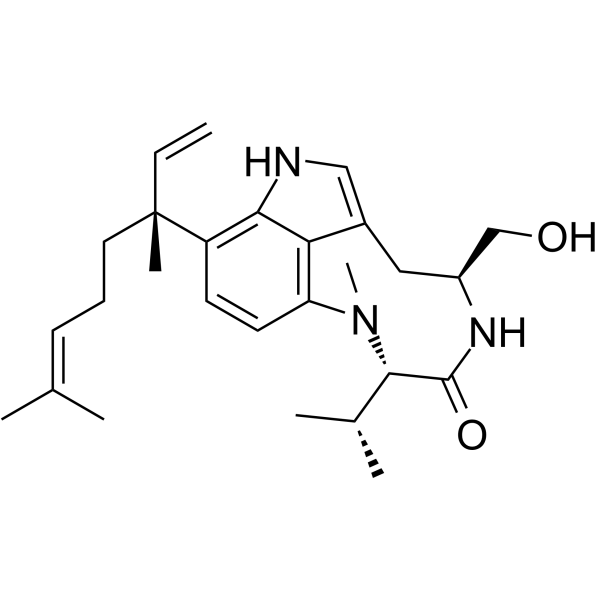
Teleocidin A1 (Lyngbyatoxin A) is a PKC activator with a Ki value of 0.11 nM for binding to the PKCδ-C1B peptide. Teleocidin A1 exhibits anticancer activity against cervical cancer and leukemia. Teleocidin A1 can induce seaweed dermatitis, food poisoning and local skin toxicity. Teleocidin A1 can be used in studies related to cervical cancer, seaweed dermatitis and food poisoning.
商品は「研究用試薬」です。人や動物の医療用・臨床診断用・食品用の製品ではありません。
研究用途以外に使用した場合、当社は一切の責任を負いかねます。
- CAS 番号: 70497-14-2
- 分子式: C27H39N3O2
- 分子量:437.62
-
保管条件:
Please store the product under the recommended conditions in the Certificate of Analysis.

To place orders, for customer services and technical support, please contact: MedChemExpress USA
Tel: 609-228-6898 E-mail: [email protected] [email protected]


-
 生物活性
生物活性
-
化学情報
- プロトコル
- 純度とドキュメンテーション
- 参考文献
-
 Help & FAQs





生物活性
製品説明
IC50 & Target
[2]|
PKCδ-C1B 0.11 nM (Ki) |
Cellular Effect
|
Cell Line

|
Type | Value | Description | References |
|---|---|---|---|---|
| L1210 | IC50 |
8.1 μM
Compound: 25
|
Cytotoxicity against mouse L1210 cells assessed as inhibition of cell growth
Cytotoxicity against mouse L1210 cells assessed as inhibition of cell growth
|
[PMID: 32652435] |
体外実験
Teleocidin A1 (incubated for 48 h) potently inhibits the proliferation of HeLa cervical cancer cells, with an IC50 value of 9.2 nM[1].
Teleocidin A1 (incubated for 24 h) inhibits the proliferation of L1210 mouse leukemia cells, with an IC50 value of 8.1 μM[2].
Teleocidin A1 binds to the PKCδ-C1B peptide segment with high affinity, with a Ki value of 0.11 nM for the inhibition of [3H]PDBu, a result that confirms the aforementioned binding characteristics[2].
Lyngbyatoxin A (26 μg/cm2; 1-48 h) rapidly penetrates the abdominal skin of ex vivo male Hartley guinea pigs, reaching a peak of 23% of the administered dose within 1 hour, with no significant changes in the penetration amount at subsequent time points[3].
MedChemExpress (MCE) has not independently confirmed the accuracy of these methods. They are for reference only.
体内実験
MedChemExpress (MCE) has not independently confirmed the accuracy of these methods. They are for reference only.
-
Animal Model:Palaemon paucidens (average weight 0.5 g)[2]
-
Dosage:0.6 mg/kg
-
Administration:injection
-
Result:Reached an LD33 value of 0.6 mg/kg.
Was approximately 150-times more potent than compound 1 (LD33 89 mg/kg).
Was 40-times more potent than compound 2 (LD33 25 mg/kg).


化学情報
-
CAS 番号 70497-14-2
-
分子量 437.62
-
分子式 C27H39N3O2
-
SMILES
C/C(C)=C\CC[C@@](C)(C1=C2C3=C(C=C1)N([C@H](C(N[C@@H](CC3=CN2)CO)=O)C(C)C)C)C=C
-
別名
Lyngbyatoxin A
-
Structure Classification
-
Initial Source
Streptomyces
-
輸送条件
Room temperature in continental US; may vary elsewhere.
-
保管条件
Please store the product under the recommended conditions in the Certificate of Analysis.


純度とドキュメンテーション
参考文献
[1]. Youssef DT, et al. 2,3-seco-2,3-dioxo-lyngbyatoxin A from a Red Sea strain of the marine cyanobacterium Moorea producens. Nat Prod Res. 2015;29(8):703-9. [Content Brief]
[2]. Jiang W, et al. Two new lyngbyatoxin derivatives from the Cyanobacterium, Moorea producens. Mar Drugs. 2014;12(12):5788-5800. Published 2014 Dec 1. [Content Brief]
[3]. Stafford RG, et al. Comparison of the partition coefficient and skin penetration of a marine algal toxin (lyngbyatoxin A). Food Chem Toxicol. 1992;30(9):795-801. [Content Brief]

Calculators
濃度 (開始) × 体積 (開始) = 濃度 (終了) × 体積 (終了)


Teleocidin A1 関連分類
HY-118834 関連分類
 Powered by Bioz
Keywords
- Teleocidin A1
- 70497-14-2
- Lyngbyatoxin A
- Teleocidin A 1
- Teleocidin A-1
- PKC
- Streptomyces mediocidicus
- Palaemon paucidens
- protein kinase C
- PKCδ-C1B peptide
- human abdominal cadaver skin
- L1210 mouse leukemia cells
- male Hartley guinea pig ventral skin
- cervical cancer
- PKC C1 domains
- HeLa cervical cancer cells
- Inhibitor
- inhibitor
- inhibit