



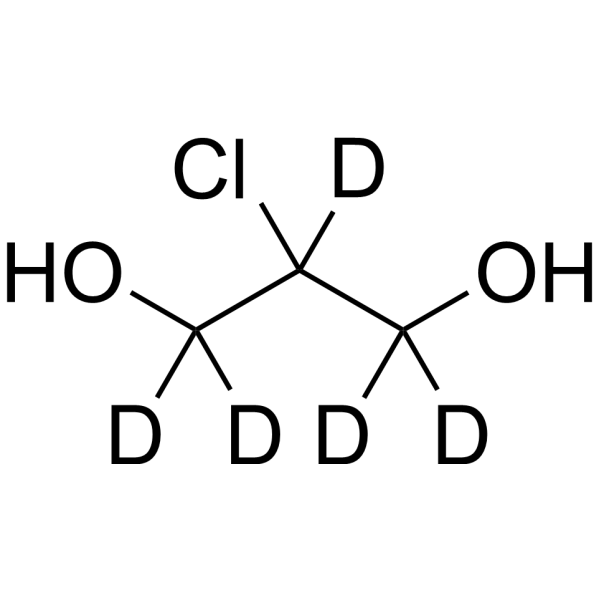
2-Chloro-1,3-propanediol-d5

Based on 1 Customer Validation
2-Chloro-1,3-propanediol-d5 (2-MCPD-d5) is the deuterated-labeled 2-Chloro-1,3-propanediol (HY-W585827). 2-Chloro-1,3-propanediol (2-MCPD) is a pharmaceutical intermediate. 2-Chloro-1,3-propanediol is a common glycerol-derived chemical intermediate and also a food processing contaminant. 2-Chloro-1,3-propanediol can cross the intestinal barrier model via paracellular diffusion. 2-Chloro-1,3-propanediol induces renal and testicular toxicity in animal models. 2-Chloro-1,3-propanediol can be used in research related to organic synthesis.
For research use only. We do not sell to patients.
- CAS No.: 1216764-05-4
- Formula: C3H2D5ClO2
- Molecular Weight:115.57
-
Storage:
Please store the product under the recommended conditions in the Certificate of Analysis.

To place orders, for customer services and technical support, please contact: MedChemExpress USA
Tel: 609-228-6898 E-mail: [email protected] [email protected]


-
 Biological Activity
-
Chemical Information
- Purity & Documentation
- References
-
 Help & FAQs




Biological Activity
Description
Application
1. This compound can be used as a tracer
2. This compound can be used as an internal standard for quantitative analysis by NMR, GC-MS, or LC-MS.


Chemical Information
-
CAS No. 1216764-05-4
-
Unlabeled CAS 497-04-1
-
Molecular Weight 115.57
-
Formula C3H2D5ClO2
-
SMILES
[2H]C([2H])(O)C([2H])(Cl)C([2H])(O)[2H]
-
Synonyms
2-MCPD-d5
-
Shipping
Room temperature in continental US; may vary elsewhere.
-
Storage
Please store the product under the recommended conditions in the Certificate of Analysis.


Purity & Documentation
-
Data Sheet (270 KB)
-
SDS (252 KB)
- Français - FR (252 KB)
- Deutsch - DE (252 KB)
- Norwegian - NO (252 KB)
- Español - ES (252 KB)
- Swedish - SV (252 KB)
- Italian - IT (252 KB)
- Korean - KR (252 KB)
- Portuguese - PT (252 KB)
-
Handling Instructions (2659 KB)
References
[1]. Buhrke T, et al. 2-Chloro-1,3-propanediol (2-MCPD) and its fatty acid esters: cytotoxicity, metabolism, and transport by human intestinal Caco-2 cells. Archives of toxicology. 2015 Dec;89(12):2243-51. [Content Brief]
[2]. Ozluk G, et al. Chloropropanols and Their Esters in Food: An Updated Review. Foods (Basel, Switzerland). 2024 Sep 11;13(18):2876. [Content Brief]

Calculators
Concentration (start) × Volume (start) = Concentration (final) × Volume (final)


2-Chloro-1,3-propanediol-d5 Related Classifications
HY-W585827S Related Classifications
 Powered by Bioz