



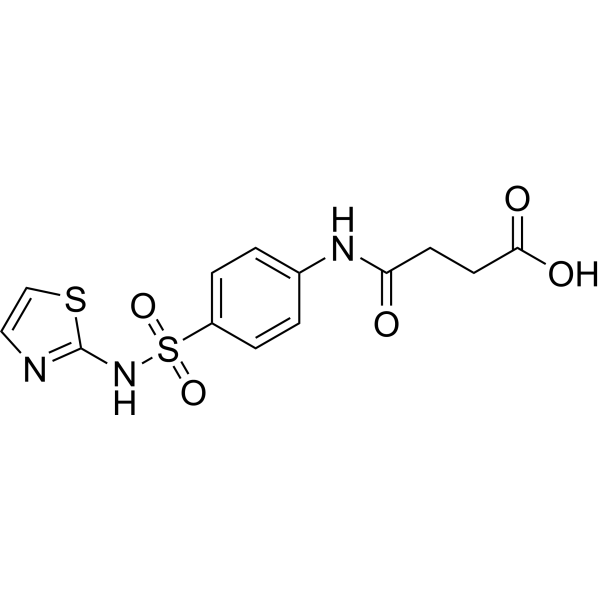
Succinylsulfathiazole
Based on 1 publication(s) in Google Scholar
Succinylsulfathiazole (Succinylsulphathiazole) is a long-acting sulfonamide antibiotic with localized gut-specific antibacterial activity and is orally active. Succinylsulfathiazole inhibits bacterial folate synthesis, reduces coliform counts, suppresses intestinal bacterial growth and vitamin biosynthesis, and depletes gut folate-producing bacteria. Succinylsulfathiazole modulates hepatic mTOR signaling, diminishes cecal fermentation, decreases hepatic folate levels and total folate excretion, elevates nitrogen excretion and reduces the fermentability of certain dietary fibers. Succinylsulfathiazole induces folate deficiency and triggers biotin- and folate-related nutritional deficiency symptoms in rats and C57BL/6 mice.
Nur für Forschungszwecke. Wir verkaufen nicht an Patienten.
- Reinheit : 99.75%
- CAS. Nr.: 116-43-8
- Formel: C13H13N3O5S2
- Molecular Weight:355.39
-
Speicherung:Powder -20°C, 3 years , 4°C, 2 years ; In solvent -80°C, 2 years , -20°C, 1 year

To place orders, for customer services and technical support, please contact: MedChemExpress USA
Tel: 609-228-6898 E-mail: [email protected] [email protected]


-
 Biologische Aktivität
-
Chemical Information
-
Lösungsmittel & Löslichkeit
- Protokoll
- Reinheit & Dokumentation
- Verweise
-
 Help & FAQs



Publications Citing Use of MedChemExpress (MCE) Succinylsulfathiazole
MoreAlle Antibiotic Isoform-spezifische Produkte anzeigen
More

Biologische Aktivität
Beschreibung
IC50 & Target
[1]|
mTOR |
In Vivo
Succinylsulfathiazole (2%) reduces fecal excretion of biotin, folic acid, and pantothenic acid compared to unsupplemented stock or purified diets in Sunny Hill strain piebald rats[3].
Succinylsulfathiazole (2%; 3 days) reduces fecal coliform counts, with no significant changes in total aerobic organisms, total anaerobic organisms, or anaerobic spore counts in Albino Farms strain rats[3].
Succinylsulfathiazole (1%; oral consumption; daily; 21 weeks) modulates key components of the PI3K/AKT/mTOR signaling pathway and energy metabolism regulators in C57BL/6 mouse liver (with differential effects on REDD1 expression in folate adequate vs. depleted mice)[1].
Succinylsulfathiazole (5 g/kg; oral; ad libitum; 27-29 days) reduces fecal folate excretion, lowers liver folate stores, decreases markers of bacterial growth, and alters cecal short-chain fatty acid production in folate-depleted Sprague-Dawley rats during folate repletion[2].
Succinylsulfathiazole (2% w/w; oral; continuous feeding; 119 days) reduces fecal coliform counts, lowers fecal biotin and folic acid excretion, and induces leukopenia[3].
Succinylsulfathiazole (0.5-2% w/w; oral; continuous feeding) reduces fecal coliform counts[3].
MedChemExpress (MCE) has not independently confirmed the accuracy of these methods. They are for reference only.
-
Animal Model:C57BL/6 (male, specific pathogen-free, 6 weeks at purchase, studied at 4 months)[1]
-
Dosage:1% (incorporated into purified isoenergetic diets, folate adequate: 2 mg folate/kg diet; folate depleted: 0 mg folate/kg diet)
-
Administration:oral consumption; daily; 21 weeks
-
Result:Showed no significant difference in body weight gain or food consumption over 21 weeks.
Exhibited no significant differences in folate levels across serum, liver and colon tissues versus untreated controls.
In folate-adequate mice: significantly reduced PDK1 expression and mTORc1 phosphorylation at Ser2448, elevated REDD1 expression, and lowered the ADP/ATP ratio and AMPK phosphorylation.
In folate-depleted mice: significantly decreased REDD1 expression, the ADP/ATP ratio and AMPK phosphorylation.
Reduced 4E-BP1 phosphorylation in both dietary groups.Showed no significant effects on AKT expression, mTORc1 autophosphorylation at Ser2481, S6K1 phosphorylation, autophagy-related proteins (Beclin, ATG5, LC3 cleavage), the NAD+/NADH ratio or SIRT1 expression in either group.
-
Animal Model:Sprague-Dawley (male weanling, initial weight 45.3 g, folate-depleted by low-folacin AIN93G basal diet for 28 days)[2]
-
Dosage:5 g/kg diet
-
Administration:oral; ad libitum; 27-29 days
-
Result:Reduced total folate excretion from 13.8 to 4.8 nmol/d (pooled diets).
Lowered mean liver folate concentration from 11.6 to 7.5 nmol/g (pooled diets); this reduction was significant in rats fed standard, ground corn, wheat germ, inulin and polydextrose diets, but not in those fed wheat bran or oat bran diets.
Decreased diaminopimelic acid and muramic acid excretion, and increased nitrogen excretion (pooled diets).
Reduced fermentability of oat bran, ground corn, and wheat germ fibers; had no effect on wheat bran fiber, inulin, or polydextrose fermentability.
Lowered cecal acetic acid and propionic acid contents overall, with a diet×antibiotic interaction for propionic acid.
-
Animal Model:Sunny Hill strain piebald rats (~75 days old when placed on succinylsulfathiazole diet)[3]
-
Dosage:2% w/w
-
Administration:oral; continuous feeding; 119 days
-
Result:Dropped fecal coliform counts immediately, with one rat averaging 105 per gram feces, another averaging 103 per gram feces with wide fluctuation (0-108), and the third having feces almost entirely devoid of coliforms until near the end of the experiment when counts rose to 104 per gram.
Showed no significant change in total aerobic and anaerobic organism counts, and anaerobic spore counts compared to pre-drug diet levels.
Reduced fecal excretion of biotin to 0.28 μg/gm feces and 0.39 μg/day, and folic acid to 2.5 μg/gm feces and 4.2 μg/day, significantly lower than in rats fed stock or purified diets without succinylsulfathiazole.
Induced low total leucocyte counts prior to vitamin supplementation.
-
Animal Model:Albino Farms strain rats (~60 days old when placed on succinylsulfathiazole diet)[3]
-
Dosage:0.5% w/w; 2% w/w
-
Administration:oral; continuous feeding
-
Result:Reduced fecal coliform counts to a low level with 2% w/w diet, though this reduction occurred more slowly than with an equivalent level of phthalylsulfathiazole.
Resulted in fecal coliform counts < 104 per gram feces after 3 days of feeding with 0.5% w/w diet.
Showed no significant change in total aerobic and anaerobic organism counts, and anaerobic spore counts compared to pre-drug diet levels.


Chemical Information
-
CAS. Nr. 116-43-8
-
Appearance Solid
-
Molecular Weight 355.39
-
Formel C13H13N3O5S2
-
Color White to off-white
-
SMILES
O=C(O)CCC(NC1=CC=C(S(=O)(NC2=NC=CS2)=O)C=C1)=O
-
Synonyms
Succinylsulphathiazole
-
Versand
Room temperature in continental US; may vary elsewhere.
-
Speicherung
Powder -20°C 3 years 4°C 2 years In solvent -80°C 2 years -20°C 1 year


Publications (1)
-
Journal Impact Factor
-
Most Recent


Lösungsmittel & Löslichkeit
In Vitro:
DMSO : 100 mg/mL (281.38 mM; Need ultrasonic; Hygroscopic DMSO has a significant impact on the solubility of product, please use newly opened DMSO)
H2O : 1 mg/mL (2.81 mM; ultrasonic and warming and heat to 80°C)
Please refer to the solubility information to select the appropriate solvent. Once prepared, please aliquot and store the solution to prevent product inactivation from repeated freeze-thaw cycles.
Storage method and period of stock solution: -80°C, 2 years; -20°C, 1 year. When stored at -80°C, please use it within 2 years. When stored at -20°C, please use it within 1 year.
* Note: If you choose water as the stock solution, please dilute it to the working solution, then filter and sterilize it with a 0.22 μm filter before use.
Please refer to the solubility information to select the appropriate solvent. Once prepared, please aliquot and store the solution to prevent product inactivation from repeated freeze-thaw cycles.
Storage method and period of stock solution: -80°C, 2 years; -20°C, 1 year. When stored at -80°C, please use it within 2 years. When stored at -20°C, please use it within 1 year.
* Note: If you choose water as the stock solution, please dilute it to the working solution, then filter and sterilize it with a 0.22 μm filter before use.
Konzentration (Stammlösung) × Volumen (Stammlösung) = Konzentration (Ziellösung) × Volumen (Ziellösung)
In Vivo:
Select the appropriate dissolution method based on your experimental animal and administration route.
- For the following dissolution methods, please ensure to first prepare a clear stock solution using an In Vitro approach and then sequentially add co-solvents:
- To ensure reliable experimental results, the clarified stock solution can be appropriately stored based on storage conditions. As for the working solution for In Vivo experiments, it is recommended to prepare freshly and use it on the same day.
- The percentages shown for the solvents indicate their volumetric ratio in the final prepared solution. If precipitation or phase separation occurs during preparation, heat and/or sonication can be used to aid dissolution.
Add each solvent one by one: 10% DMSO 40% PEG300 5% Tween-80 45% Saline
Solubility: ≥ 2.5 mg/mL (7.03 mM); Clear solution
This protocol yields a clear solution of ≥ 2.5 mg/mL (saturation unknown).
Taking 1 mL working solution as an example, add 100 μL DMSO stock solution (25.0 mg/mL) to 400 μL PEG300, and mix evenly; then add 50 μL Tween-80 and mix evenly; then add 450 μL Saline to adjust the volume to 1 mL.
Preparation of Saline: Dissolve 0.9 g sodium chloride in ddH₂O and dilute to 100 mL to obtain a clear Saline solution.
Add each solvent one by one: 10% DMSO 90% (20% SBE-β-CD in Saline)
Solubility: ≥ 2.5 mg/mL (7.03 mM); Clear solution
This protocol yields a clear solution of ≥ 2.5 mg/mL (saturation unknown).
Taking 1 mL working solution as an example, add 100 μL DMSO stock solution (25.0 mg/mL) to 900 μL 20% SBE-β-CD in Saline, and mix evenly.
Preparation of 20% SBE-β-CD in Saline (4°C, storage for one week): 2 g SBE-β-CD powder is dissolved in 10 mL Saline, completely dissolve until clear.
In Vivo Dissolution Calculator
Please enter the basic information of animal experiments:
-
-
-
-
Recommended: Prepare an additional quantity of animals to account for potential losses during experiments.
Please enter your animal formula composition:
-
%DMSO +
Recommended: Keep the proportion of DMSO in working solution below 2% if your animal is weak.
-
%+
-
+%Tween-80 + +
-
%Saline +
The co-solvents required include: DMSO, . All of co-solvents are available by MedChemExpress (MCE). , Tween 80. All of co-solvents are available by MedChemExpress (MCE).
Working solution concentration: 0.22 mg/mL
Method for preparing stock solution: mg drug dissolved in μL DMSO. Stock solution concentration: mg/mL.
1. Take μL DMSO stock solution;
2. Add μL .
μL , mix evenly;
3. Then add μL Tween 80, mix evenly;
4. Then add μL
Please ensure that the stock solution in the first step is dissolved to a clear state, and add co-solvents in sequence. You can use ultrasonic heating (ultrasonic cleaner, recommended frequency 20-40 kHz), vortexing, etc. to assist dissolution.

Protokoll
-
Research Protocol for Infectious Diseases
Infectious-disease experiments test how pathogens interact with host barriers, innate immune receptors, inflammatory signaling, pathogen replication, and tissue injury; pattern-recognition receptors such as TLRs, RIG-I-like receptors, NOD-like receptors, and inflammasomes detect microbial molecules and activate NF-κB, interferon, and cytokine responses. The central hypothesis is that infection severity reflects the balance between pathogen burden and host response: protective inflammation restricts pathogen growth, whereas excessive or mislocalized inflammation contributes to tissue damage and disease phenotype. Unresolved questions include which host pathways are protective versus pathogenic, why some infection models fail to translate to human disease, and which combined readouts best predict clinically relevant infection outcomes.
-
Aerobic Bacterial Batch Culture on Broth/Agar
Aerobic bacterial batch culture grows a closed inoculated population in broth or on agar without continuous medium replacement; growth readouts include turbidity/OD for total suspended biomass and colony-forming units for viable cells able to form colonies on agar. OD-based growth curves reflect light scattering by cells, but OD is instrument-, pathlength-, species-, cell-size-, and density-dependent, so OD should be calibrated or interpreted alongside viable counts when quantitative cell density is required.
-
Bacterial live/dead nucleic-acid viability staining
The LIVE/DEAD bacterial viability staining method is based on differential permeability of nucleic-acid-binding fluorescent dyes, most commonly SYTO 9 and propidium iodide (PI), which enables discrimination of bacterial populations with intact versus compromised cytoplasmic membranes. SYTO 9 penetrates both intact and damaged bacterial membranes and binds nucleic acids to produce green fluorescence, whereas propidium iodide penetrates only cells with compromised membranes and fluoresces red while also reducing SYTO 9 signal through competitive binding and fluorescence interactions. The resulting fluorescence pattern is interpreted as a proxy for membrane integrity, which is widely used as an indicator of bacterial viability in microscopy, flow cytometry, and spectroscopic platforms. However, mechanistic studies show that SYTO 9 and PI interactions involve displacement and fluorescence resonance energy transfer effects, which can influence signal interpretation depending on dye ratios a


Reinheit & Dokumentation
-
Data Sheet (290 KB)
-
SDS (396 KB)
- English - EN (396 KB)
- Français - FR (396 KB)
- Deutsch - DE (396 KB)
- Norwegian - NO (396 KB)
- Español - ES (396 KB)
- Swedish - SV (396 KB)
- Italian - IT (396 KB)
- Korean - KR (396 KB)
- Portuguese - PT (396 KB)
-
Handling Instructions (2659 KB)
Verweise
[1]. Beydoun S, et al. Succinylsulfathiazole modulates the mTOR signaling pathway in the liver of c57BL/6 mice via a folate independent mechanism. Exp Gerontol. 2021;150:111387. [Content Brief]
[2]. Sepehr E, et al. Folate derived from cecal bacterial fermentation does not increase liver folate stores in 28-d folate-depleted male Sprague-Dawley rats. J Nutr. 2003 May;133(5):1347-54. [Content Brief]


Complete Stock Solution Preparation Table
Please refer to the solubility information to select the appropriate solvent. Once prepared, please aliquot and store the solution to prevent product inactivation from repeated freeze-thaw cycles.
Storage method and period of stock solution: -80°C, 2 years; -20°C, 1 year. When stored at -80°C, please use it within 2 years. When stored at -20°C, please use it within 1 year.
| Optional Solvent | Concentration Solvent Mass | 1 mg | 5 mg | 10 mg | 25 mg |
|---|---|---|---|---|---|
| H2O / DMSO | 1 mM | 2.8138 mL | 14.0691 mL | 28.1381 mL | 70.3453 mL |
| DMSO | 5 mM | 0.5628 mL | 2.8138 mL | 5.6276 mL | 14.0691 mL |
| 10 mM | 0.2814 mL | 1.4069 mL | 2.8138 mL | 7.0345 mL | |
| 15 mM | 0.1876 mL | 0.9379 mL | 1.8759 mL | 4.6897 mL | |
| 20 mM | 0.1407 mL | 0.7035 mL | 1.4069 mL | 3.5173 mL | |
| 25 mM | 0.1126 mL | 0.5628 mL | 1.1255 mL | 2.8138 mL | |
| 30 mM | 0.0938 mL | 0.4690 mL | 0.9379 mL | 2.3448 mL | |
| 40 mM | 0.0703 mL | 0.3517 mL | 0.7035 mL | 1.7586 mL | |
| 50 mM | 0.0563 mL | 0.2814 mL | 0.5628 mL | 1.4069 mL | |
| 60 mM | 0.0469 mL | 0.2345 mL | 0.4690 mL | 1.1724 mL | |
| 80 mM | 0.0352 mL | 0.1759 mL | 0.3517 mL | 0.8793 mL | |
| 100 mM | 0.0281 mL | 0.1407 mL | 0.2814 mL | 0.7035 mL |
* Note: If you choose water as the stock solution, please dilute it to the working solution, then filter and sterilize it with a 0.22 μm filter before use.


Succinylsulfathiazole Related Classifications
HY-B0921 Related Classifications
 Powered by Bioz
Keywords
- Succinylsulfathiazole
- 116-43-8
- Succinylsulphathiazole
- Antibiotic
- Bacterial
- Dihydrofolate reductase (DHFR)
- mTOR
- Albino Farms strain rats
- PI3K/AKT/mTOR signaling pathway
- Sprague-Dawley rats
- Sunny Hill strain piebald rats
- coliform bacteria
- sulfonamide antibiotic
- mTOR signaling pathway
- folate synthesis
- c57Bl/6 mice
- intestinal bacteria
- Inhibitor
- inhibitor
- inhibit