



AChE
Acetylcholinesterase (AChE) is the principal cholinergic enzyme that rapidly hydrolyzes acetylcholine at cholinergic synapses and neuromuscular junctions, thereby terminating neurotransmission and maintaining synaptic signaling fidelity[1]. Mechanistically, AChE regulates cholinergic pathway activity through efficient acetylcholine clearance, a process that is essential for normal neuronal communication and neuromuscular function[1]. Beyond its catalytic role, AChE displays multiple molecular forms and has been implicated in cellular interactions, neuronal activity modulation, and pathological states, supporting broader biological functions outside classical neurotransmission[1]. In neurodegenerative disease models, particularly Alzheimer’s disease (AD), altered cholinergic signaling is closely associated with cognitive impairment, and cholinesterase inhibition remains a major symptomatic therapeutic strategy[2][3]. Compared with the related isoform butyrylcholinesterase (BChE), AChE is the predominant cholinesterase in the brain and plays a primary role in synaptic acetylcholine hydrolysis, whereas BChE may compensate when AChE activity is reduced and exhibits distinct pathological changes during AD progression[3][4]. For experimental and translational applications, reversible and dual AChE/BChE inhibitors, including rivastigmine, are widely used to enhance cholinergic neurotransmission and investigate mechanisms underlying neurodegeneration and cognitive dysfunction[2][3].
References:
- [1]. Massoulié J, et al. Structure and functions of acetylcholinesterase and butyrylcholinesterase. Prog Brain Res. 1993;98:139-46. [Content Brief]
- [2]. Walczak-Nowicka ŁJ, et al. Acetylcholinesterase Inhibitors in the Treatment of Neurodegenerative Diseases and the Role of Acetylcholinesterase in their Pathogenesis. Int J Mol Sci. 2021 Aug 27;22(17):9290. [Content Brief]
- [3]. Nordberg A, et al. A review of butyrylcholinesterase as a therapeutic target in the treatment of Alzheimer's disease. Prim Care Companion CNS Disord. 2013;15(2):PCC.12r01412. [Content Brief]
- [4]. Geula C, et al. Butyrylcholinesterase, cholinergic neurotransmission and the pathology of Alzheimer's disease. Drugs of Today (Barcelona, Spain : 1998). 2004 Aug;40(8):711-721. [Content Brief]
-
AChE Related Products (442)
Related Products (442)

-
Vescalagin
 0 ImagesCat. No.: HY-N19401CAS No.: 36001-47-5Vescalagin is a hexahydroxyphenol. Vescalagin is isolable from Camu-camu (Myrciaria dubia) and immature wax apple fruits. Vescalagin exhibits inhibitory activity against a variety of enzymes, with a Ki value of 5.87 nM against AChE, 3.89 nM against BChE, 11.75 nM against hCA I, 16.23 nM against hCA II, and 16.08 nM against α-glucosidase. Vescalagin inhibits hCA I, hCA II and α-glucosidase in a non-competitive manner. Vescalagin downregulates JNK/p38 MAPK to protect pancreatic β-cells and improve insulin secretion in methylglyoxal-treated rats. Vescalagin reduces hyperglycemia and hypertriglyceridemia in rats fed a high-fructose diet. Vescalagin possesses anti-inflammatory and antioxidant properties.
-
Thunberginol C
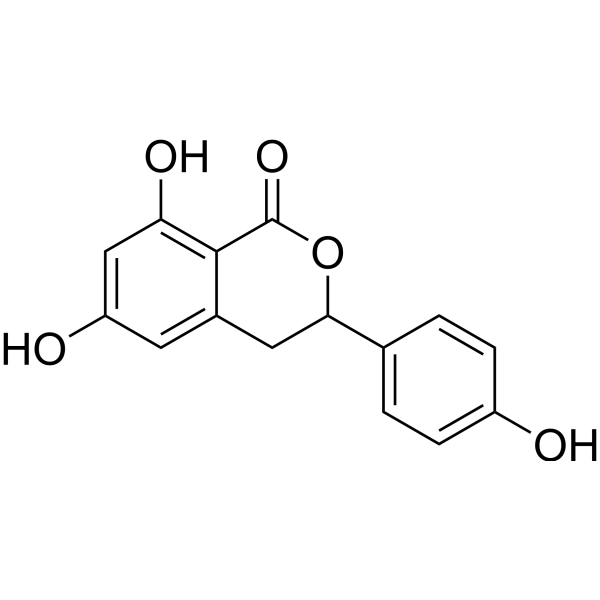 0 ImagesCat. No.: HY-N1151CAS No.: 147517-06-4Thunberginol C is an orally active, selective, and non-competitive inhibitor of AChE and BChE, with IC50 values of 41.96 and 42.36 μM, respectively. Thunberginol C exerts cytoprotective, pro-collagen type I restorative, MMP-1 inhibitory, hyaluronic acid restorative, anti-photoaging effects in skin cells. Thunberginol C exerts neuroprotective, anxiolytic, TNF-α inhibitory, neuroinflammation inhibitory, and oxidative stress inhibitory effects. Thunberginol C can be used for the research of Alzheimer’s disease, UVB-induced skin photoaging, allergic reactions, oral bacterial infections, and stress-induced anxiety.
-
Buxbodine B
 0 ImagesCat. No.: HY-N2971CAS No.: 390362-51-3Buxbodine B is an inhibitor for acetylcholinesterase (AChE) with an IC50 of 50 μM. Buxbodine B can be used in research of Alzheimer's disease.
-
AL284
 0 ImagesCat. No.: HY-169173CAS No.: 2270876-07-6AL284 is a potent anopheles gambiae acetylcholinesterase 1 (AgAChE1) inhibitor. AL284 interactions with Tyr489Ag in the α-helix next to loop 2, and Trp441Ag at the top of the gorge. AL284 has the potential for the research of disease-transmitting mosquitoes.
-
4'-O-Methylcatechin
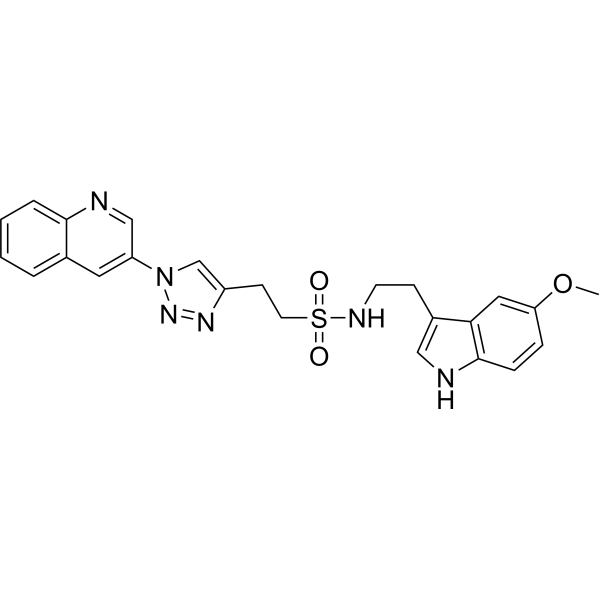
 0 ImagesCat. No.: HY-W740798CAS No.: 69912-75-04'-O-Methylcatechin acts as a lipase and acetylcholinesterase inhibitor, with an IC50 of 149.93 μM against lipase and an IC50 of 230.89 μM against electric eel-derived acetylcholinesterase. 4'-O-Methylcatechin possesses free radical scavenging activity and can be used in studies on antioxidation, antilipase activity and dementia.
-
Heptenophos
 0 ImagesCat. No.: HY-120042CAS No.: 23560-59-0Heptenophos is an inhibitor of AChE and plasma carboxylesterase (CES). By inhibiting AChE activity, Heptenophos causes the accumulation of acetylcholine at cholinergic synapses, thereby triggering typical symptoms of organophosphate poisoning. Heptenophos exhibits rapid lethal toxicity in male albino mice, but its toxic effects are effectively antagonized by obidoxime, and Memantine (HY-B0591) further enhances the detoxification efficacy of obidoxime. Therefore, Heptenophos is commonly used in studies related to the mechanism of organophosphate poisoning and detoxification strategies.
-
7-Methoxytacrine
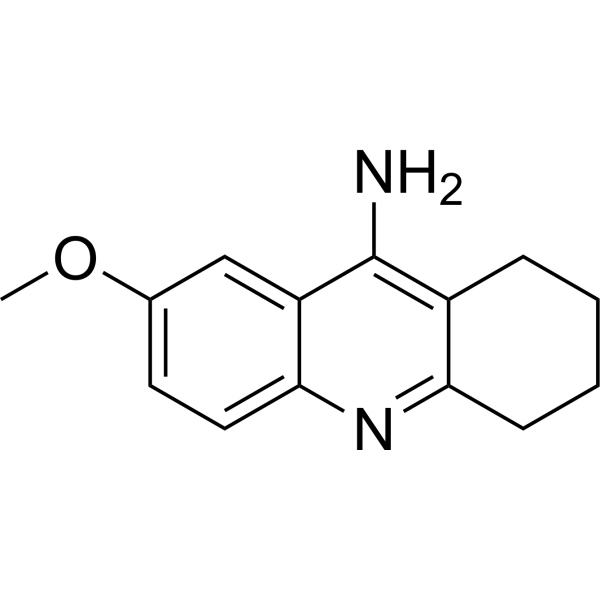 0 ImagesCat. No.: HY-W049312CAS No.: 5778-80-3Synonyms: 7-MEOTA7-Methoxytacrine (7-MEOTA) is an inhibitor of human acetylcholinesterase (hAChE) with an IC50 value of 10 μM, and can be used for the research of Alzheimer's disease (AD).
-
ZINC12613047
 0 ImagesCat. No.: HY-113905CAS No.: 1069521-64-7ZINC12613047 is a selective BChE inhibitor with an IC50 of 0.021 μM against huBChE. ZINC12613047 can be used for the research of Alzheimer's disease.
-
Trimyristin (Standard)
 0 ImagesTrimyristin (Standard) is the analytical standard of Trimyristin (HY-N2511). This product is intended for research and analytical applications. Trimyristin is an orally active compound. Trimyristin can be isolated from the seeds of nutmeg (Myristica fragrans). Trimyristin inhibits the activities of acetylcholinesterase (AChE), ACP and ALP, with IC50 values of 0.11, 0.16 and 0.18 mM, respectively. Trimyristin exerts competitive-noncompetitive inhibition on acetylcholinesterase, uncompetitive inhibition on ACP, and competitive/noncompetitive inhibition on ALP. Trimyristin restores the downregulated acetylcholinesterase concentration in the cerebral cortex of rats exposed to sodium arsenite. Trimyristin can be used in studies related to fascioliasis and neurotoxicity.
-
Demeton-S
 0 ImagesCat. No.: HY-W332450CAS No.: 126-75-0Demeton-S is an organophosphate insecticide. Demeton-S inhibits butyrylcholinesterase and acetylcholinesterase activity.
-
Tyrosinase-IN-47
 0 ImagesCat. No.: HY-180506Tyrosinase-IN-47 (compound 6a) is a potent competitive tyrosinase inhibitor with an IC50 of 1.43 µM and a Ki of 0.1142 μM. Tyrosinase-IN-47 also shows inhibition activity in α-Glucosidase (IC50 = 36.26 μM) and acetylcholinesterase (IC50 = 8.26 μM). Tyrosinase-IN-47 exhibits in vitro antioxidant activity, with good scavenging ability for DPPH (IC50 = 4.75 μM) and ABTS (IC50 = 0.04 μM). Tyrosinase-IN-47 displays anti-browning effect on freshly cut potatoes. Tyrosinase-IN-47 can be used for pharmaceutical research.
-
Phorate sulfone
 0 ImagesCat. No.: HY-W588214CAS No.: 2588-04-7Phorate sulfone, Phorate metabolite, is an insecticide. Phorate sulfone shows inhibitory activity aainst acetylcholinesterase with an IC50 of 40 μM, leading to acetylcholine accumulation at cellular and subcellular levels. Phorate sulfone can be used for the research of severe phorate poisoning.
-
AChE/nAChR-IN-1
 0 ImagesCat. No.: HY-175607CAS No.: 59417-09-3

-
Dihydrokaempferol-3-O-β-D-glucoside
 0 ImagesCat. No.: HY-N12833CAS No.: 31049-08-8Dihydrokaempferol-3-O-β-D-glucoside (Compound 3) is a compound that can be isolated from the bark of Cudrania tricuspidata (Carr.) Bur. . Dihydrokaempferol-3-O-β-D-glucoside is an inhibitor of acetylcholinesterase (AChE).
-
Anabasamine
 0 ImagesCat. No.: HY-116041CAS No.: 20410-87-1
-
Galactamine
 0 ImagesGalactamine is an AChE inhibitor. Galactamine can be used in the research of Alzheimer's disease.
-
Ganstigmine
 0 ImagesCat. No.: HY-183403CAS No.: 457075-21-7Synonyms: CHF 2819 free baseGanstigmine (CHF 2819 free base) is a potent, orally active, blood-brain barrier-permeable acetylcholinesterase (AChE) inhibitor, with an IC50 value of 65 nM against human AChE, 310 nM against human butyrylcholinesterase (BChE), and 5.12 μM against Torpedo californica AChE. Ganstigmine increases extracellular acetylcholine levels in the brain of rodents without altering the concentrations of other neurotransmitters, stimulates cholinergic transmission, and induces the release of soluble non-amyloidogenic amyloid precursor protein. Ganstigmine exhibits neuroprotective activity independent of cholinesterase inhibition, prevents neuronal death, alleviates β-amyloid-induced neurodegeneration, rescues cholinergic neuron loss, and reverses Scopolamine (HY-N0296)-induced amnesia and memory deficits. Ganstigmine shows cholinesterase inhibition-independent neuroprotective effects against growth factor deprivation and Aβ25-35 toxicity. Ganstigmine can be used in research on Alzheimer's disease, cholinergic dysfunction, and neuroprotection.
-
AD-35 free base
 0 ImagesCat. No.: HY-117710ACAS No.: 1531586-58-9AD-35 free base is an orally active, blood-brain barrier-permeable acetylcholinesterase inhibitor with an IC50 of 793 nM. AD-35 free base inhibits metal-induced amyloid-β aggregation and disassembles preformed amyloid-β aggregates. In rat models of cognitive impairment, AD-35 free base attenuates Aβ25-35-induced astrocyte activation, TNF-α and IL-1β release, inhibits ERK phosphorylation, and alleviates learning and memory deficits. AD-35 free base can be used for research on Alzheimer's disease.



