



Apoptosis
Apoptosis
Apoptosis is a distinctive form of cell death exhibiting specific morphological and biochemical characteristics, including cell membrane blebbing, chromatin condensation, genomic DNA fragmentation, and exposure of specific phagocytosis signaling molecules on the cell surface. Cells undergoing apoptosis differ from those dying through necrosis. Necrotic cells are usually recognized by the immune system as a danger signal and, thus, resulting in inflammation; in contrast, apoptotic death is quiet and orderly.
There are two major pathways of apoptotic cell death induction: The intrinsic pathway, also called the Bcl-2-regulated or mitochondrial pathway, is activated by various developmental cues or cytotoxic insults, such as viral infection, DNA damage and growth-factor deprivation, and is strictly controlled by the BCL-2 family of proteins. The extrinsic or death-receptor pathway is triggered by ligation of death receptors (members of the tumor necrosis factor (TNF) receptor family, such as Fas or TNF receptor-1 (TNFR1)) that contain an intracellular death domain, which can recruit and activate caspase-8 through the adaptor protein Fas-associated death domain (FADD; also known as MORT1) at the cell surface. This recruitment causes subsequent activation of downstream (effector) caspases, such as caspase-3, -6 or -7, without any involvement of the BCL-2 family.
Studies suggest that alterations in cell survival contribute to the pathogenesis of a number of human diseases, including cancer, viral infections, autoimmune diseases, neurodegenerative disorders, and AIDS (acquired immunodeficiency syndrome). Treatments designed to specifically alter the apoptotic threshold may have the potential to change the natural progression of some of these diseases.
All Product Categories
-
Apoptosis Inhibitors
(870)
View all products
-
Apoptosis Agonists
(7)
View all products
-
Apoptosis Antagonists
(9)
View all products
-
Apoptosis Activators
(362)
View all products
-
Apoptosis Modulators
(57)
View all products
-
Apoptosis Inducers
(7674)
View all products
-
Apoptosis Degrader
(1)
View all products
-
Apoptosis Controls
(33)
View all products
-
Apoptosis Produits associés (9557)
Produits associés (9557)

-
Anticorps (120)
-
Schisantherin B (Standard)
 0 ImagesCat. No.: HY-N0695RCAS No.: 58546-55-7Synonyms: Gomisin-B (Standard); Wuweizi ester-B (Standard); Schisantherin-B (Standard)Schisantherin B (Gomisin-B) (Standard) is the analytical standard of Schisantherin B. This product is intended for research and analytical applications. Schisantherin B is a lignan compound and one of the active components of Schisandra chinensis. Schisantherin B activates the PI3K/AKT signaling pathway, restores the activity of GSK3β, and reduces the hyperphosphorylation of tau protein in hippocampal and cerebral cortical tissues. Schisantherin B upregulates the level of GLT-1, decreases the expression of pro-inflammatory cytokines TNF-α/IL-1β/IL-6, upregulates the expression of IL-10, and inhibits cell apoptosis. Schisantherin B is applicable to the research of spinal cord injury, Alzheimer's disease and depression.
-
Phosphocreatine dipotassium
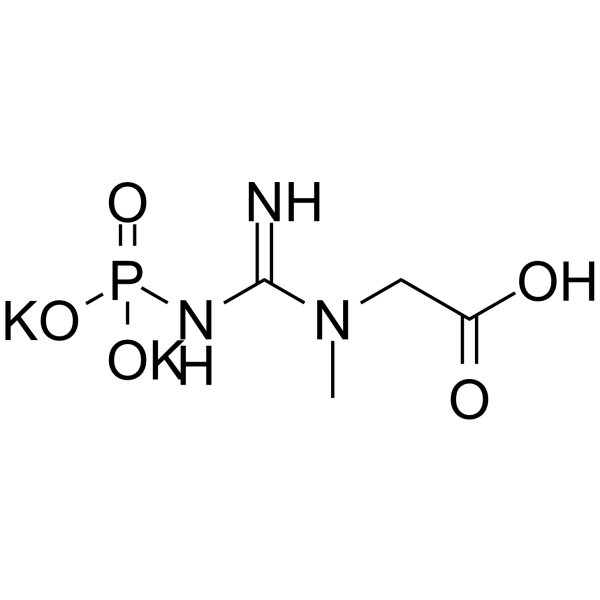 0 ImagesCat. No.: HY-D0885CCAS No.: 18838-38-5Synonyms: Creatine phosphate dipotassium; Creatinephosphoric acid dipotassiumPhosphocreatine (creatine phosphate) is an organic compound found in vertebrate skeletal muscles. Phosphocreatine enhances antioxidant activity, and activates the TAK1 pathway to protect the heart. Phosphocreatine normalizing mitochondrial function and reducing oxidative stress via Akt mediated Nrf2/HO-1 pathway. Phosphocreatine provides renal protection by suppressing Apoptosis and ROS (Reactive Oxygen Species) generation through ERK mediated mediated Nrf-2/HO-1 pathway..
-
GYY4137 (Standard)
 0 ImagesCat. No.: HY-107632RCAS No.: 106740-09-4GYY4137 (Standard) is the analytical standard of GYY4137 (HY-107632). This product is intended for research and analytical applications. GY4137 is a sustained-release H2S donor possessing vasodilatory, antihypertensive, and anti-inflammatory activities. GY4137 can inhibit cell growth, induce apoptosis, and cause cell cycle arrest by blocKing the STAT3 pathway, demonstrating potent anticancer activity.
-
Barasertib (Standard)
 0 ImagesCat. No.: HY-10127RCAS No.: 722543-31-9Synonyms: AZD1152 (Standard)Barasertib (Standard) is the analytical standard of Barasertib. This product is intended for research and analytical applications. Barasertib (AZD1152), a pro-drug of Barasertib-hQPA, is a highly selective Aurora B inhibitor with an IC50 of 0.37 nM in a cell-free assay. Barasertib (AZD1152) induces growth arrest and apoptosis in cancer cells.
-
C8 D-threo Ceramide (d18:1/8:0)
 0 ImagesCat. No.: HY-169795CAS No.: 175892-43-0C8 D-threo Ceramide (d18:1/8:0) is a sphingolipid analog that can effectively induce apoptosis in U937 cells and cause fragmentation of nucleosomal DNA.
-
Pitavastatin Calcium (Standard)
 0 ImagesSynonyms: NK-104 hemicalcium (Standard); Pitavastatin hemicalcium (Standard)Pitavastatin (Calcium) (Standard) is the analytical standard of Pitavastatin (Calcium). This product is intended for research and analytical applications. Pitavastatin Calcium (NK-104 hemicalcium) is a potent hydroxymethylglutaryl-CoA (HMG-CoA) reductase inhibitor. Pitavastatin Calcium (NK-104 hemicalcium) inhibits cholesterol synthesis from acetic acid with an IC50 of 5.8 nM in HepG2 cells. Pitavastatin Calcium is an efficient hepatocyte low-density lipoprotein-cholesterol (LDL-C) receptor inducer. Pitavastatin Calcium also possesses anti-atherosclerotic, anti-asthmatic, anti-osteoarthritis, antineoplastic, neuroprotective, hepatoprotective and reno-protective effects.
-
Meisoindigo (Standard)
 0 ImagesSynonyms: Dian III (Standard); N-Methylisoindigotin (Standard); Natura-α (Standard)Meisoindigo (Standard) is the analytical standard of Meisoindigo. This product is intended for research and analytical applications. Meisoindigo (Dian III), a derivative of Indirubin (HY-N0117), halts the cell cycle at the G0/G1 phase and induces apoptosis in primary acute myeloid leukemia (AML) cells. Meisoindigo exhibits high antitumor activity.
-
NU9056 (Standard)
 0 ImagesCat. No.: HY-110127RCAS No.: 1450644-28-6NU9056 (Standard) is the analytical standard of NU9056 (HY-110127). This product is intended for research and analytical applications. NU9056 is a potent and selective Tip60 (KAT5) histone acetyltransferase inhibitor with an of 2 μM. NU9056 shows >16-fold selectivity for Tip60 over PCAF, p300 and GCN5. NU9056 induces apoptosis of prostate cancer cells.
-
YO-2
 0 ImagesCat. No.: HY-183877CAS No.: 288254-44-4YO-2 is a plasmin inhibitor and TP53 upregulator with anti-tumor and apoptosis-inducing activities. YO-2 upregulates the expression of TP53 and the tumor-suppressive miR-103/107, downregulates LRP1, and induces cellular DNA fragmentation and caspase cascade activation. YO-2 effectively blocks the growth of melanoma. YO-2 has been widely used in studies related to melanoma and colon cancer.
-
Dihexyl phthalate (Standard)
 0 ImagesDihexyl phthalate (Standard) is the analytical standard of Dihexyl phthalate (HY-W011215). This product is intended for research and analytical applications. Dihexyl phthalate is one of the commonly used phthalate esters in various plastics and consumer products. Dihexyl phthalate is classified as a priority pollutant and an endocrine disruptor. Dihexyl phthalate can induce reactive oxygen species (ROS) accumulation, promote inflammation, and lead to significant increases in apoptosis and inflammation-related gene expression levels. Dihexyl phthalate can cause testicular atrophy and is a reproductive toxicant.
-
Petunidin-3-O-glucoside chloride (Standard)
 0 ImagesPetunidin-3-O-glucoside chloride (Standard) is the analytical standard of Petunidin-3-O-glucoside chloride (HY-N7832). This product is intended for research and analytical applications. Petunidin-3-O-glucoside chloride is a blood-brain barrier-penetrating tyrosinase inhibitor with an IC50 of 10.3 μM and a Ki of 9.0 μM. Petunidin-3-O-glucoside also acts as an α-glucosidase inhibitor with an IC50 of 218.2 µM. Petunidin-3-O-glucoside chloride inhibits the SIRT3/p53-mediated mitochondrial pathway and the PI3K/Akt-ERK pathway, suppresses glycolysis, and induces cell apoptosis. Petunidin-3-O-glucoside chloride scavenges ROS to exert antioxidant activity. It can be used in research related to glioblastoma multiforme, skin anti-aging and whitening, as well as obesity.
-
Quizartinib (Standard)
 0 ImagesSynonyms: AC220 (Standard)Quizartinib (AC220) (Standard) is the analytical standard of Quizartinib (HY-13001). This product is intended for research and analytical applications. Quizartinib is an orally active, potent and selective FLT3 inhibitor. Quizartinib inhibits kinase activity of mutant-FLT3, -PDGFRA and -KIT isoforms and inhibits autophosphorylation. Quizartinib inhibits cellular proliferation, induces apoptosis in cancer cells. Quizartinib can be used for the research of cancer.
-
Urolithin C (Standard)
 0 ImagesCat. No.: HY-135897RCAS No.: 165393-06-6Urolithin C (Standard) is the analytical standard of Urolithin C. This product is intended for research and analytical applications. Urolithin C, a gut-microbial metabolite of Ellagic acid, is a glucose-dependent activator of insulin secretion. Urolithin C is a L-type Ca2+ channel opener and enhances Ca2+ influx. Urolithin C induces cell apoptosis through a mitochondria-mediated pathway and also stimulates reactive oxygen species (ROS) formation.
-
IR-58
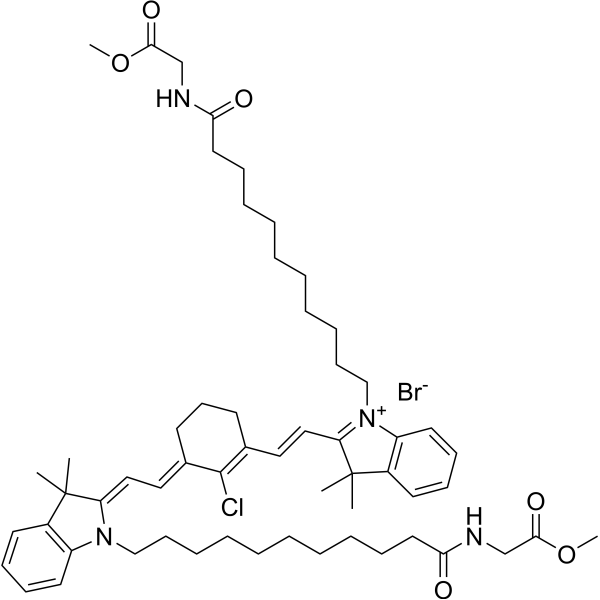 0 ImagesCat. No.: HY-D2227CAS No.: 2374274-85-6IR-58, a mitochondria-targeting near-infrared (NIR) fluorophore, is an autophagy enhancer. IR-58 kills tumour cells and induces apoptosis via inducing excessive autophagy, which is mediated through the reactive oxygen species (ROS)-Akt-mTOR pathway.
-
Vildagliptin-d3
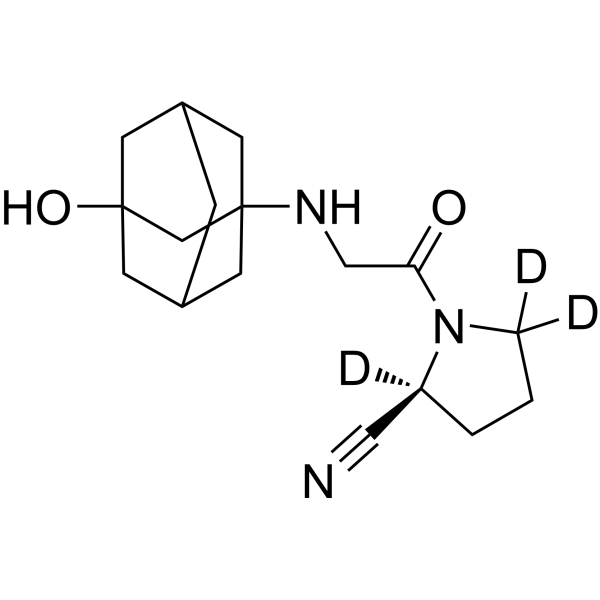 0 ImagesCat. No.: HY-14291SCAS No.: 1217546-82-1Synonyms: LAF237-d3; NVP-LAF 237-d3Vildagliptin-d3 is the deuterium labeled Vildagliptin. Vildagliptin (LAF237) is a potent, stable, selective dipeptidyl peptidase IV (DPP-IV) inhibitor with an IC50 of 3.5 nM in human Caco-2 cells. Vildagliptin possesses excellent oral bioavailability and potent antihyperglycemic activity.
-
Simmitecan
 0 ImagesCat. No.: HY-107133ACAS No.: 951290-31-6Simmitecan is a potent topoisomerase I (TOP1) inhibitor, which is a 9-substituted lipophilic camptothecin (Camptothecin (HY-16560)) derivative. Simmitecan blocks DNA replication and transcription, thereby inducing tumor cell apoptosis by inhibiting the activity of TOP1. Simmitecan can be used in the research of cancers such as liver cancer.
-
Tandutinib sulfate
 0 ImagesCat. No.: HY-10202BCAS No.: 387867-14-3Tandutinib (MLN518) sulfate is a potent and selective inhibitor of the FLT3 with an IC50 of 0.22 μM, and also inhibits c-Kit and PDGFR with IC50s of 0.17 μM and 0.20 μM, respectively. Tandutinib sulfate can be used for acute myelogenous leukemia (AML). Tandutinib sulfate has the ability to cross the blood-brain barrier.


-
NPS-1034 (Standard)
 0 ImagesCat. No.: HY-100509RCAS No.: 1221713-92-3




