



HIV
Human immunodeficiency virus
HIV (Human immunodeficiency virus) is a lentivirus (a subgroup of retrovirus) that causes the acquired immunodeficiency syndrome (AIDS), a condition in humans in which progressive failure of the immune system allows life-threatening opportunistic infections and cancers to thrive. Infection with HIV occurs by the transfer of blood, semen, vaginal fluid, pre-ejaculate, or breast milk. Within these bodily fluids, HIV is present as both free virus particles and virus within infected immune cells. HIV infects vital cells in the human immune system such as helper T cells (specifically CD4+ T cells), macrophages, and dendritic cells. HIV infection leads to low levels of CD4+ T cells through a number of mechanisms, including apoptosis of uninfected bystander cells, direct viral killing of infected cells, and killing of infected CD4+ T cells by CD8 cytotoxic lymphocytes that recognize infected cells. When CD4+ T cell numbers decline below a critical level, cell-mediated immunity is lost, and the body becomes progressively more susceptible to opportunistic infections.
HIV Isoform Specific Products
All Product Categories
-
HIV Inhibitors
(1208)
View all products
-
HIV Antagonists
(4)
View all products
-
HIV Activators
(19)
View all products
-
HIV Modulator
(1)
View all products
-
HIV Inducers
(2)
View all products
-
HIV Degrader
(1)
View all products
-
HIV Controls
(4)
View all products
-
HIV Ligand
(1)
View all products
-
HIV Proteins
(26)
View all products
-
HIV Related Products (1380)
Related Products (1380)

-
Recombinant Proteins (26)
-
Antibodies (6)
-
HIV Isoform Comparison
-
R-95845
 0 ImagesCat. No.: HY-187616CAS No.: 163435-77-6R-95845 is a non-nucleoside HIV-1 reverse transcriptase (RT) inhibitor. R-95845 is specific to HIV-1 RT and acts as a functionally non-competitive inhibitor with respect to nucleotide incorporation. R-95845 binds to the non-nucleoside inhibitor binding pocket of HIV-1 RT in a butterfly-like conformation, forms hydrogen bonds with Tyr 188 and Val 189, and engages in hydrophobic interactions with surrounding residues. R-95845 can be used in studies related to HIV-1 infection and acquired immunodeficiency syndrome.
-
HIV-1 inhibitor-75
 0 ImagesCat. No.: HY-169064HIV-1 inhibitor-75 is a human immunodeficiency virus 1 (HIV-1) inhibitor, with an EC50 value ranging from 0.0039 to 0.338 μM. The binding target of HIV-1 inhibitor-75 is reverse transcriptase, with an IC50 value of 0.055 μM. HIV-1 inhibitor-75 shows good in vitro metabolic stability, exhibiting moderate clearance rates and a longer half-life in human plasma and liver microsomes.

-
Vesatolimod (Standard)
 0 ImagesCat. No.: HY-15601RCAS No.: 1228585-88-3Synonyms: GS-9620 (Standard)Vesatolimod (Standard) is the analytical standard of Vesatolimod. This product is intended for research and analytical applications. Vesatolimod (GS-9620) is a potent, selective and orally active agonist of Toll-Like Receptor (TLR7) with an EC50 of 291 nM.
-
ddCTP tetrasodium
 0 ImagesCat. No.: HY-137697AddCTP tetrasodium is a type of chain-terminating deoxynucleotide. ddCTP tetrasodium can be incorporated into the extension primer chain that lacks the 3'-hydroxyl group, thereby terminating primer extension, viral genome replication, and DNA synthesis. ddCTP tetrasodium can distinguish almost identical RNA through distinguishable extension products in primer extension inhibition experiments. ddCTP tetrasodium is the active metabolite of Zalcitabine (HY-17392), which can competitively inhibit HIV reverse transcriptase, terminate the synthesis of viral DNA chains, and thereby inhibit HIV replication.
-
V-165
 0 ImagesCat. No.: HY-135210CAS No.: 223393-69-9V-165 is an inhibitor of HIV Integrase and HIV Reverse transcriptase, with an IC50 value of 3.8 μM against HIV integrase and an IC50 value of 4.8 μM against HIV reverse transcriptase. V-165 inhibits HIV-1 replication. V-165 can be used in studies related to immunodeficiency virus infections.
-
Flavopiridol (Standard)
 0 ImagesSynonyms: HMR-1275 (Standard); Alvocidib (Standard); L86-8275 (Standard)Flavopiridol (Standard) is the analytical standard of Flavopiridol (HY-10005). This product is intended for research and analytical applications. Flavopiridol (Alvocidib) is a broad spectrum and competitive inhibitor of CDKs, inhibiting CDK1, CDK2, CDK4 with IC50s of 30, 170, 100 nM, respectively.

-
Darunavir (Standard)
 0 ImagesSynonyms: TMC114 (Standard); UIC-94017 (Standard)Darunavir (Standard) is the analytical standard of Darunavir. This product is intended for research and analytical applications. Darunavir (TMC114), an orally active next generation HIV protease inhibitor, has a similar antiviral activity against the mutant and the wild-type viruses. Darunavir (TMC114) is potent against laboratory HIV-1 strains and primary clinical isolates (IC50 = 0.003 μM; IC90 = 0.009 μM) with minimal cytotoxicity.
-
MK-0536
 0 ImagesCat. No.: HY-123883CAS No.: 865298-81-3MK-0536 is a highly potent HIV-1 integrase inhibitor that effectively suppresses the replication of wild-type viruses. MK-0536 retains significant antiviral activity against multiple key drug-resistant mutants such as Y143R and N155H, and shows no toxicity to uninfected cells. MK-0536 selectively blocks the strand transfer reaction of integrase by chelating magnesium ions at the active site and interacting with viral DNA and enzyme residues. MK-0536 is applicable to the study of HIV infection mechanisms.
-
BIT-225 (Standard)
 0 ImagesCat. No.: HY-106282RCAS No.: 917909-71-8BIT-225 (Standard) is the analytical standard of BIT-225 (HY-106282). This product is intended for research and analytical applications. BIT-225 is an inhibitor for Vpu protein through block of Vpu ion channel, and thus inhibits the release of HIV-1, especially in monocyte-derived macrophages (EC50 is 2.25 μM), without significant cytotoxicity (TC50 is 284 μM).

-
cis-ICeD-2
 0 ImagesCat. No.: HY-151871Acis-ICeD-2 is the cis isomer of ICeD-2 (HY-151871). ICeD-2 is a cell death inducer that induces cell death in HIV-1-infected cells. ICeD-2-mediated killing of HIV-1-infected cells is dependent on HIV-1 protease activity. ICeD-2 effectively blocks the hydrolysis of Gly-Pro-AMC by the dipeptidyl peptidases DPP8 and DPP9. ICeD-2 demonstrates strong stability against DPP9 in PBMCs..
-
Herbacitrin
 0 ImagesCat. No.: HY-N15438CAS No.: 35815-07-7Herbacitrin is a HIV-1 reverse transcriptase and integrase inhibitor with IC50 values of 21.5 μM and 2.15 μM, respectively. Herbacitrin inhibits the growth of normal mouse embryonic cells, hybridoma HF cells, and ras/myc-transformed SFME cells, regulates the growth of ras-transformed SFME cells, and exhibits cytotoxic activity against hybridoma HF cells. Herbacitrin can be used in studies related to HIV-1 infection.
-
HIV-1-IN-87
 0 ImagesCat. No.: HY-178031HIV-1-IN-87 (Compound 11x) is a dual-site HIV-1 inhibitor targeting the non-nucleoside reverse transcriptase inhibitor binding pocket (NNIBP) and its adjacent site (NNIAS). HIV-1-IN-87 has potent antiviral activities against wild-type and mutant strains (such as L100I, K103N and Y181C) (EC50: 4.1-150 nM). HIV-1-IN-87 can be used for HIV-1 infections like acquired immune deficiency syndrome (AIDS) research.
-
ZK-316
 0 ImagesCat. No.: HY-173427SCAS No.: 3027894-30-7ZK-316 is a potent and broad-spectrum NNRTI inhibitor with an EC50s ranging from 0.99 to 75.1 nM. ZK-316 can be used in the study of HIV.
-
Globotriaosylceramide (porcine RBC)
 0 ImagesCat. No.: HY-149125CAS No.: 71965-57-6Synonyms: Ceramide trihexosides (porcine)Globotriaosylceramide porcine RBC is a trihexosylceramide (Gb3) in porcine erythrocytes. Globotriaosylceramide porcine RBC is a natural resistance factor against HIV-1 infection. The synthetase α-galactosyltransferase (A4GALT) of Globotriaosylceramide porcine RBC is associated with HIV-1 resistance.
-
Stachybotrylactam
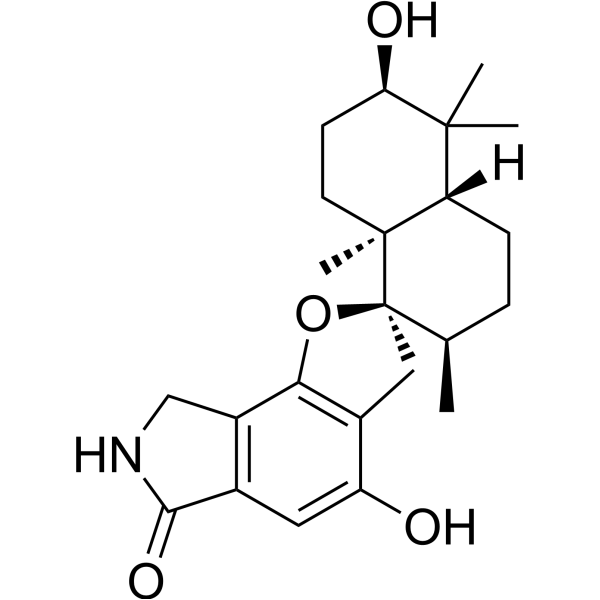 0 ImagesCat. No.: HY-124477CAS No.: 163391-76-2Stachybotrylactam (17) is a phenylspirodrimane isolated from Stachybotrys chartarum with antihyperlipidemic activity. Stachybotrylactam also has antiviral activity.
-
Curromycin A
 0 ImagesCat. No.: HY-N14095CAS No.: 97412-76-5Curromycin A has antibacterial activity against Gram-positive bacteria such as Bacillus subtilis. Curromycin A can inhibit the replication of human immunodeficiency virus (HIV), inhibit mouse melanoma B16 and leukemia P388 cells.
-
Raltegravir-d4 potassium
 0 ImagesCat. No.: HY-10353AS2Synonyms: MK 0518-d4 potassiumRaltegravir-d4 (potassium) (MK 0518-d4 (potassium)) is deuterium labeled Raltegravir (potassium). Raltegravir (MK 0518) potassium is a potent integrase (IN) inhibitor, used to treat HIV infection.




