



Globotriaosylceramide (porcine RBC)
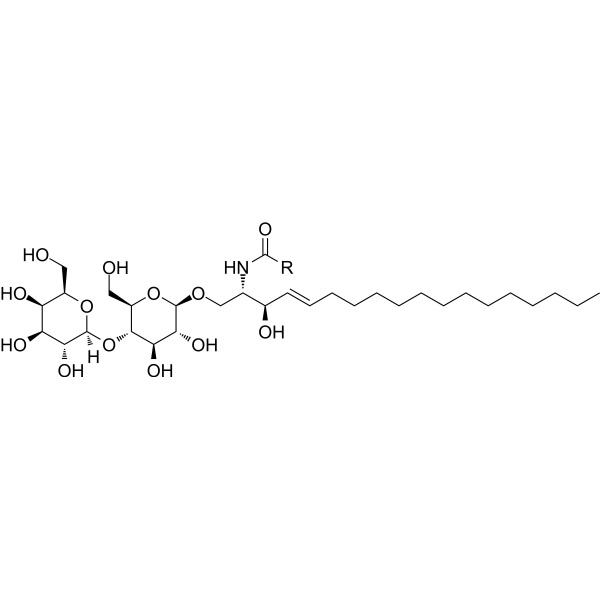
Globotriaosylceramide porcine RBC (Ceramide trihexosides porcine) is a neutral glycosphingolipid belonging to the globoside series of erythrocytes, primarily isolated and extracted from porcine RBC. Globotriaosylceramide porcine RBC is a natural resistance factor against HIV-1 infection. Globotriaosylceramide porcine RBC blocks viral binding to CXCR4/CCR5 co-receptors through competitive binding to the V3 loop region of HIV-1 gp120, thereby inhibiting viral fusion and entry. Globotriaosylceramide porcine RBC is the major cell surface receptor for Shiga toxin. Globotriaosylceramide porcine RBC can be used for research on hemolytic uremic syndrome, HIV-1 infection, and Fabry disease.
For research use only. We do not sell to patients.
- CAS No.: 71965-57-6
-
Storage:
Please store the product under the recommended conditions in the Certificate of Analysis.


To place orders, for customer services and technical support, please contact: MedChemExpress USA
Tel: 609-228-6898 E-mail: [email protected] [email protected]


-
 Biological Activity
-
Chemical Information
- Protocols
- Purity & Documentation
- References
-
 Help & FAQs


-

HY-137873
4-Methylumbelliferyl-α-D-GlucopyranosideFluorescent Substrate -

HY-165035
Glucosylceramide (gaucher's spleen)Sphingolipid/Gaucher Disease Biomarker -
HY-154921
Lactosylceramide (bovine buttermilk)Glycosphingolipid -
HY-124477
StachybotrylactamPhenylspirodrimane -

HY-156209
Gb3(d18:1/16:0)Pk Antigen -
HY-15899
Des(benzylpyridyl) AtazanavirHIV Protease Inhibitor -
HY-P2200
Siamycin IHIV Inhibitor -

HY-N11142
Gb3(18:1/18:0)Ester Product
All Endogenous Metabolite Isoforms
More

Biological Activity
Description
IC50 & Target
[4]|
HIV-1 |
In Vitro
Globotriaosylceramide porcine RBC (Ceramide trihexosides porcine) and its analogs bind HIV-1 gp120 and significantly inhibit the fusion and entry of X4, R5, and dual-tropic HIV-1 viruses in T cell lines[4].
MedChemExpress (MCE) has not independently confirmed the accuracy of these methods. They are for reference only. Further protocols information, click here.


Chemical Information
-
CAS No. 71965-57-6
-
SMILES
O[C@H]1[C@@H]([C@H](O[C@H]([C@@H]1O)OC[C@@H]([C@@H](/C=C/CCCCCCCCCCCCC)O)NC([R])=O)CO)O[C@@]2(O[C@@H]([C@@H]([C@@H]([C@H]2O)O)O[C@@]3([C@@H]([C@H]([C@H]([C@H](O3)CO)O)O)O)[H])CO)[H]
-
Synonyms
Ceramide trihexosides (porcine)
-
Shipping
Room temperature in continental US; may vary elsewhere.
-
Storage
Please store the product under the recommended conditions in the Certificate of Analysis.

Protocols
-
Research Protocol for Infectious Diseases
Infectious-disease experiments test how pathogens interact with host barriers, innate immune receptors, inflammatory signaling, pathogen replication, and tissue injury; pattern-recognition receptors such as TLRs, RIG-I-like receptors, NOD-like receptors, and inflammasomes detect microbial molecules and activate NF-κB, interferon, and cytokine responses. The central hypothesis is that infection severity reflects the balance between pathogen burden and host response: protective inflammation restricts pathogen growth, whereas excessive or mislocalized inflammation contributes to tissue damage and disease phenotype. Unresolved questions include which host pathways are protective versus pathogenic, why some infection models fail to translate to human disease, and which combined readouts best predict clinically relevant infection outcomes.


Purity & Documentation
References

Calculators
Concentration (start) × Volume (start) = Concentration (final) × Volume (final)


Globotriaosylceramide (porcine RBC) Related Classifications
HY-149125 Related Classifications
 Powered by Bioz