



c-Myc
Myc
The transcription factor c-Myc is a member of the basic helix-loop-helix leucinezipper (bHLHZip) protein family. The target genes of the c-MYC protein participate in different cellular functions, including cell cycle, survival, protein synthesis, cell adhesion, and micro-RNA expression. c-Myc is also one of the four factors used in reprogramming somatic cells to induce pluripotent stem (iPS) cells and is implicated in maintaining cancer stem-like cells (CSCs). Most biological functions of c-Myc require heterodimerization with its activation partner Max.
c-Myc is also part of a dynamic network whose members interact selectively with one another and with various transcriptional coregulators and histone-modifying enzymes. Deregulated expression of c-MYC caused by gene amplification, retroviral insertion, or chromosomal translocation is associated with tumorigenesis. c-Myc has been identified as a highly promising target for cancer therapy.
All Product Categories
-
c-Myc Related Products (257)
Related Products (257)

-
Antibodies (12)
-
PROTAC BET Degrader-14
 0 ImagesCat. No.: HY-179588PROTAC BET Degrader-14 is a highly efficient PROTAC targeting BET (bromodomain and extra-terminal domain). PROTAC BET Degrader-14 can degrade all BET (BRD2, BRD3, BRD4) family proteins. PROTAC BET Degrader-14 potently degrades BET proteins in U2OS osteosarcoma cell lines (BRD4 DC50 = 130 nM) and KYSE180 esophageal squamous cell carcinoma cell lines (DC50 = 40 nM). PROTAC BET Degrader-14’s dependence on the ubiquitin-proteasome system. PROTAC BET Degrader-14 decreases levels of BET-regulated gene products c-Myc, RUNX2, and KRT14. PROTAC BET Degrader-14 can be used for the study of osteosarcoma.
-
4-O-Methyl-ascochlorin
 0 ImagesCat. No.: HY-N15121CAS No.: 38561-40-94-O-Methyl-ascochlorin (Compound MAC) is a derivative of Ascochlorin (HY-101021). 4-O-Methyl-ascochlorin can selectively induce apoptosis of K562 leukemia cells, cause G1 phase arrest and downregulate c-Myc expression. 4-O-Methyl-ascochlorin can promote the phosphorylation of AMPK and inhibit the phosphorylation of mTOR and its target proteins, including p70S6 K and 4E-BP-1. 4-O-Methyl-ascochlorin can be used for research of leukemia.
-
c-Myc inhibitor 13
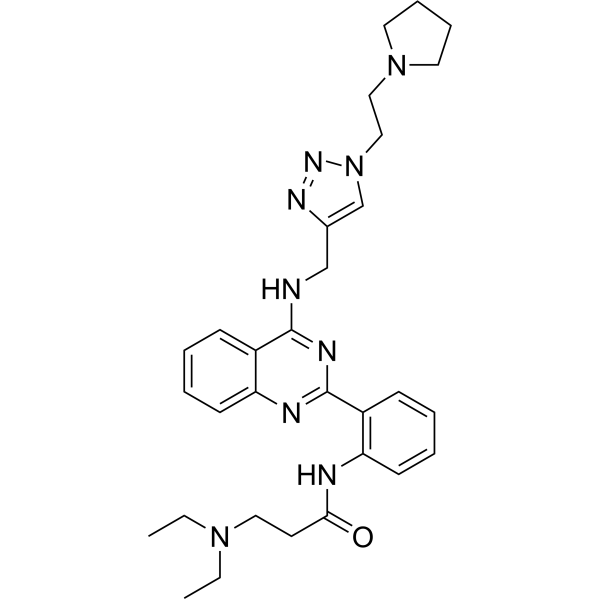 0 ImagesCat. No.: HY-162294c-Myc inhibitor 13 (compound A6) is a c-MYC transcription inhibitor. c-Myc inhibitor 13 selectively stabilizes c-MYC G4 and inhibits G4-associated c-MYC transcription.
-
Briciclib sodium
 0 ImagesCat. No.: HY-16366ACAS No.: 865784-01-6Synonyms: ON 014185 sodiumBriciclib (ON 014185) sodium is a eukaryotic translation initiation factor 4E (eIF4E) inhibitor. Briciclib sodium exhibits broad-spectrum anti-cancer activity, including in mantle cell leukemia, breast cancer, gastric cancer, and esophageal cancer cells. Briciclib sodium reduces the expression of cyclin D1 and c-Myc, and enhances the expression of P53 and Cleaved Caspase 3 pro-apoptotic proteins. Briciclib sodium can be used for the study of hematological system tumors and solid tumors.
-
MYC-MAX-IN-1
 0 ImagesCat. No.: HY-175964CAS No.: 911714-36-8MYC-MAX-IN-1 is a ligands for target protein for PROTAC. MYC-MAX-IN-1 can be used to synthesize PROTAC MDEG-541 (HY-150259).
-
N-Myc-IN-1
 0 ImagesCat. No.: HY-186247CAS No.: 885986-52-7N-Myc-IN-1 is a selective N-Myc inhibitor/degrader with a Kd value of 1.47 μM. N-Myc-IN-1 promotes phosphorylation of N-Myc at threonine-58, triggers N-Myc degradation via the ubiquitin-proteasome pathway, and suppresses the expression of N-Myc target genes. N-Myc-IN-1 reduces the viability of MYCN-dependent tumor cells and induces apoptosis. N-Myc-IN-1 can be used in the research of neuroblastoma.
-
MNK/PIM-IN-2
 0 ImagesCat. No.: HY-182957CAS No.: 3081482-46-1MNK/PIM-IN-2 is a Mnk/Pim kinase inhibitor with an IC50 of 32 nM for Mnk1, 3 nM for Mnk2, and 37 nM for Pim1. MNK/PIM-IN-2 reduces the levels of p-eIF4E and p-4EBP1. MNK/PIM-IN-2 induces cell cycle arrest, apoptosis (apoptosis) and exerts antiproliferative effects in leukemia cells. MNK/PIM-IN-2 can be used in studies related to leukemia.
-
BIIB021 mesylate
 0 ImagesCat. No.: HY-10212ACAS No.: 1225041-97-3Synonyms: CNF2024 mesylateBIIB021 (CNF2024) mesylate is the mesylate of BIIB021 (HY-10212). BIIB021 is an orally active Hsp90 inhibitor. BIIB021 inhibits the proliferation of chronic myeloid leukemia (CML) cells, with IC50 values of K562, K562/G, 32Dp210, and 32Dp210-T315I cells are 513.99, 603.53, 110.08, and 148.07 nM, respectively. BIIB021 degrades BCR-ABL protein and inhibits the β-catenin/c-Myc pathway. BIIB021 can also induce autophagy in CML cells. BIIB021 can be used for the research of CML.
-
Ro 31-7837
 0 ImagesCat. No.: HY-121917CAS No.: 120280-33-3APTO-253 (LOR-253) hydrochloride is a small molecule that inhibits c-Myc expression, stabilizes G-quadruplex DNA, and induces cell cycle arrest and apoptosis in acute myeloid leukemia cells. APTO-253 hydrochloride mediates anticancer activity via induction of Kruppel-like factor 4 (KLF4) tumor suppressor. APTO-253 hydrochloride exhibits antiarthritic activity.
-
KI-MS2-008
 0 ImagesCat. No.: HY-159756BKI-MS2-008 is a selective Max binder. KI-MS2-008 results in the stabilization of Max homodimers and the attenuation of Myc. KI-MS2-008 has anticancer activity against Myc-dependent cancer.
-
c-Myc inhibitor 9
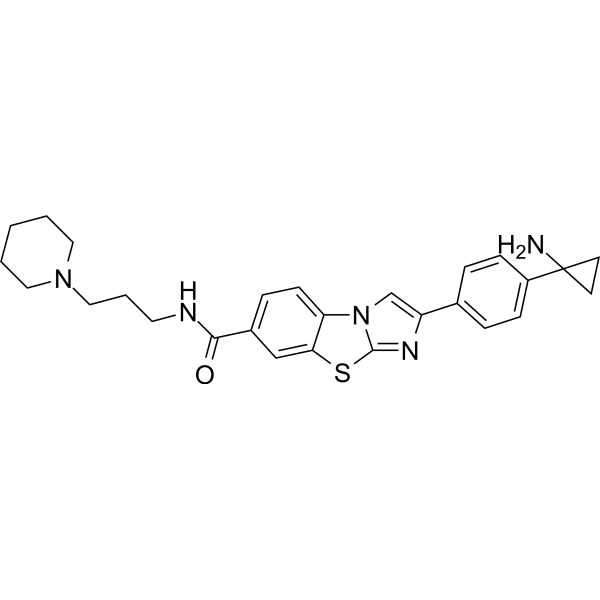 0 ImagesCat. No.: HY-148839CAS No.: 2799717-96-5c-Myc inhibitor 9 (compound 332) is a c-Myc inhibitor with an logEC50 of ≥6. c-Myc inhibitor 9 inhibits tumor growth in nude mouse models. c-Myc inhibitor 9 can be used for cancer research.
-
c-Myc inhibitor 16 iodide
 0 ImagesCat. No.: HY-176066ACAS No.: 3061380-62-6c-Myc inhibitor 16 iodide (Compound W11) is a selective c-Myc G-quadruplex (c-Myc G4) inhibitor. c-Myc inhibitor 16 iodide inhibits the transcription and translation of the c-Myc gene, disrupts the tumor cell cycle, arrests cell growth in the G0/G1 phase and activates the mitochondrial apoptosis pathway to induce early apoptosis of cancer cells. c-Myc inhibitor 16 iodide is promising for research of breast cancer.
-
c-Myc inhibitor 4
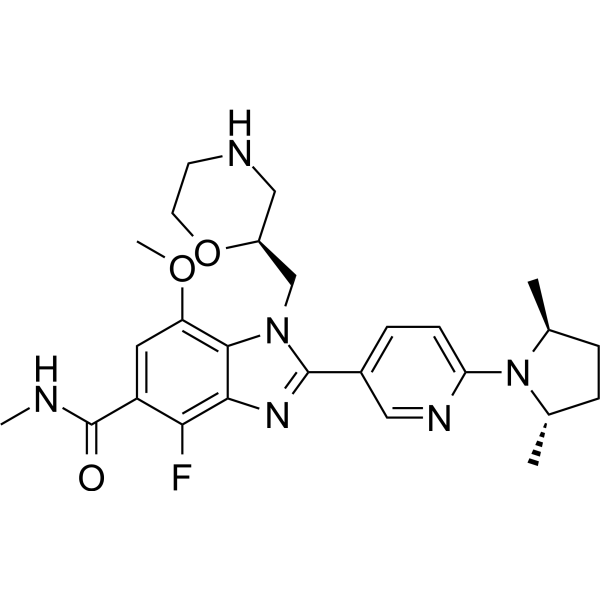 0 ImagesCat. No.: HY-139885CAS No.: 2763366-92-1c-Myc inhibitor 4 is a potent, orally bioavailable c-MYC-reducing compound.
-
EP12
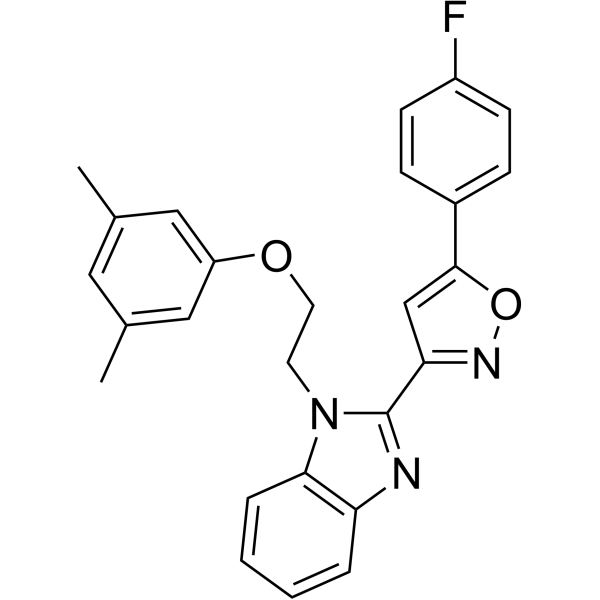 0 ImagesCat. No.: HY-149513CAS No.: 2882916-73-4
-
PROTAC FLT3/CHK1 Degrader-1
 0 ImagesCat. No.: HY-178858PROTAC FLT3/CHK1 Degrader-1 is a PROTAC FLT3/CHK1 degrader, with DC50 values of 5.88 nM (FLT3) and 4.17 nM (CHK1), respectively. PROTAC FLT3/CHK1 Degrader-1 can inhibit the phosphorylation of FLT3 downstream signaling effectors STAT5 (Tyr694), AKT (Ser473), and ERK (Tyr204), downregulate the protein level of c-Myc and maintain the expression of p53 protein. PROTAC FLT3/CHK1 Degrader-1 induces apoptosis in MV-4-11 cells. PROTAC FLT3/CHK1 Degrader-1 shows significant anti-tumor efficacy in mice bearing MV-4-11 subcutaneous xenografts. PROTAC FLT3/CHK1 Degrader-1 can be used for the study of acute myeloid leukemia (AML).
-
JR4-187
 0 ImagesCat. No.: HY-182241CAS No.: 2446965-01-9JR4-187 is an orally active, copper-dependent anticancer agent. JR4-187 downregulates genes involved in oxidative phosphorylation, MYC targets and E2F targets in cancer cells, while upregulates genes involved in the TNF-α signaling pathway, p53 pathway and KRAS signaling pathway, and downregulates CTR1 protein. JR4-187 induces ROS production, apoptosis, copper-dependent cytotoxicity, and exhibits selective cytotoxicity against KRAS-mutant cancer cells. JR4-187 is well tolerated in mouse models of pancreatic cancer. JR4-187 can be used in research related to cancers such as pancreatic ductal adenocarcinoma, colon cancer and rectal cancer.
-
PROTAC BET Degrader-18
 0 ImagesCat. No.: HY-184335CAS No.: 3097564-20-7PROTAC BET Degrader-18 is a PROTAC targeting BET, with a DC50 of 0.676 nM in HEK293-BRD4-HiBiT-KI cells. PROTAC BET Degrader-18 mainly targets and degrades BRD4 (EC50 = 59.91 nM), and exhibits weak degradation activity against BRD2. PROTAC BET Degrader-18 inhibits the expression of downstream oncoprotein c-Myc, thereby inducing cell cycle arrest and apoptosis, while suppressing oncoprotein expression. PROTAC BET Degrader-18 shows antiproliferative activity against acute myeloid leukemia cells and triple-negative breast cancer cells. PROTAC BET Degrader-18 demonstrates antitumor efficacy in xenograft mouse models. PROTAC BET Degrader-18 can be used for the research of acute myeloid leukemia and triple-negative breast cancer.
-
MKI-2 hydrochloride
 0 ImagesCat. No.: HY-185310APurity: 99.57%MKI-2 hydrochloride is a selective MASTL inhibitor with an IC50 of 37.44 nM. MKI-2 hydrochloride induces mitotic catastrophe resulting from the modulation of the MASTL-PP2A axis in breast cancer cells. MKI-2 hydrochloride reduces phospho-ENSA, total, phospho-c-Myc levels. MKI-2 hydrochloride inhibts cancer cells proliferation, migration and induces DNA damage. MKI-2 hydrochloride inhibits germinal vesicle breakdown in mouse oocytes. MKI-2 hydrochloride can be used for the research of cancer, such as breast cancer.
-
NSC308848
 0 ImagesCat. No.: HY-139118CAS No.: 69408-82-8NSC308848 is a potent apoptosis inducer in a Myc-dependent manner. NSC308848 inhibits Myc transactivation and interferes with the DNA-binding activity of Myc family proteins.
-
Soyasaponin Ba (Standard)
 0 ImagesCat. No.: HY-N0309RCAS No.: 114590-20-4Soyasaponin Ba (Standard) is the analytical standard of Soyasaponin Ba (HY-N0309). Soyasaponin Ba is a soyasaponin that can be isolated from Phaseolus vulgaris, acts as an aldose reductase inhibitor (ARI). Soyasaponin Ba activates Akt/GSK3β/β-catenin signaling pathway, reduces lipid accumulation, lowers ROS generation, improves mitochondrial membrane potential, ATP levels, and morphology, and inhibits apoptosis. Soyasaponin Ba can be used for the research of lipid accumulation and secondary diabetic complications.




