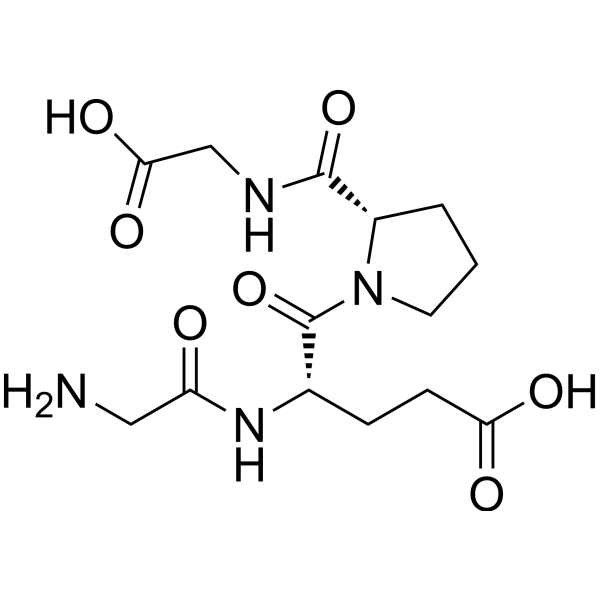
Collagen II
Collagen II is the major collagen synthesized by chondrocytes and a core structural component of articular cartilage, vitreous humour, inner ear, and nucleus pulposus[1]. Mechanistically, COL2A1 suppresses articular chondrocyte hypertrophy and osteoarthritis progression by promoting integrin β1-SMAD1 interaction and regulating BMP-SMAD1 signaling[2]. In disease models, COL2A1 loss accelerates chondrocyte hypertrophy, while degenerative human articular cartilage shows reduced COL2A1 with increased hypertrophic markers and BMP-SMAD1 activity[2]. Type II collagen degradation can also expose a cryptic peptide sequence that induces collagenase activity, MMP-13, and chondrocyte hypertrophy in articular cartilage explants[3]. Compared with type X collagen, which marks hypertrophic chondrocytes in osteoarthritis, collagen II better reflects the stable hyaline cartilage phenotype[4]. Compared with collagen I devices, collagen II biomaterials more directly match cartilage extracellular matrix composition and support cartilage engineering research[5]. For experimental applications, collagen II scaffolds help maintain or rejuvenate hyaline chondrocyte phenotype through Wnt-related mechanisms, supporting use in cartilage tissue engineering models[6].
References:
- [1]. Norhalifah HK, et al. The genetic history of Peninsular Malaysia. Gene. 2016 Jul 15;586(1):129-35. [Content Brief]
- [2]. Lian C, et al. Collagen type II suppresses articular chondrocyte hypertrophy and osteoarthritis progression by promoting integrin β1-SMAD1 interaction. Bone Res. 2019 Mar 6;7:8. [Content Brief]
- [3]. van der Kraan PM, et al. Chondrocyte hypertrophy and osteoarthritis: role in initiation and progression of cartilage degeneration? Osteoarthritis Cartilage. 2012 Mar;20(3):223-32. [Content Brief]
- [4]. Wu Z, et al. Collagen type II: From biosynthesis to advanced biomaterials for cartilage engineering. Biomater Biosyst. 2021 Nov 22;4:100030. [Content Brief]
- [5]. Zhou H, et al. Rejuvenating Hyaline Cartilaginous Phenotype of Dedifferentiated Chondrocytes in Collagen II Scaffolds: A Mechanism Study Using Chondrocyte Membrane Nanoaggregates as Antagonists. ACS Nano. 2024 Jan 23;18(3):2077-2090. [Content Brief]
All Product Categories
-
Collagen II Related Products (3)
Related Products (3)

-
WYRGRL
 0 ImagesWYRGRL is a selective, high-affinity collagen type II-binding peptide with a IC50 of 140 nM. Collagen type II is the most abundant and specific structural protein in the extracellular matrix of articular cartilage. WYRGRL can precisely target small-molecule compounds such as Dexamethasone (HY-14648) and nanocarrier-engineered exosomes to cartilage, significantly enhancing their therapeutic effects on osteoarthritis.
-
DSPE-PEG2000-WYRGRL
 0 ImagesCat. No.: HY-172696DSPE-PEG2000-WYRGRL is a PEG compound which composed of DSPE and a cartilage-targeting peptide (WYRGRL). WYRGRL is a collagen II-targeting peptide that can bind to collagen II α1. DSPE-PEG2000-WYRGRL can be used for drug delivery.