



Liposome
Liposomes (NPs typically 100–500 nm in diameter) are fabricated from the self-assembly of phospholipids, which consist of a polar phosphate head group and hydrophobic lipid tails. In aqueous environments, the hydrophobic tails self-orient, resulting in a spherical structure comprised of an aqueous core surrounded by a lipophilic bilayer membrane. Liposomes are both biocompatible and biodegradable (e.g., at certain pH and temperature), which can be controlled by modifying the lipid composition. Furthermore, liposomes are amenable to various modifications that improve their efficacy as drug delivery carriers.
All Product Categories
-
Liposome Verwandte Produkte (1263)
Verwandte Produkte (1263)

-
Polyoxyethylene (20) stearyl ether
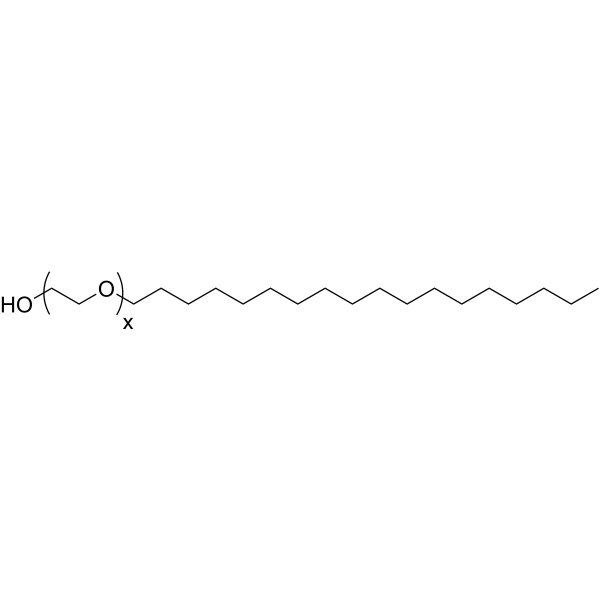 0 ImagesArt. -Nr.: HY-W250183BCAS. Nr.: 9005-00-9Synonyms: Polyethylene glycol octadecyl ether (n~20)Polyoxyethylene (20) stearyl ether (Polyethylene glycol octadecyl ether (n~20)) is a PEGylated lipid surfactant. Polyoxyethylene (20) stearyl ether is used in studies on the formation and stabilization of lipid nanoparticles.
-
Stearic acid-PEG2000-Mal
 0 ImagesArt. -Nr.: HY-W440950Stearic acid-PEG2000-Mal enables surface modification of various substrate through reaction between hydroxyl and ethoxyl silane. The polymer can be used for click chemistry with alkyne containing molecule.
-
C23 Phytoceramide
 0 ImagesC23 Phytoceramide is a long-chain sphingolipid, which is found in C. sinensis.
-
Cholesterol-PEG1000-acid
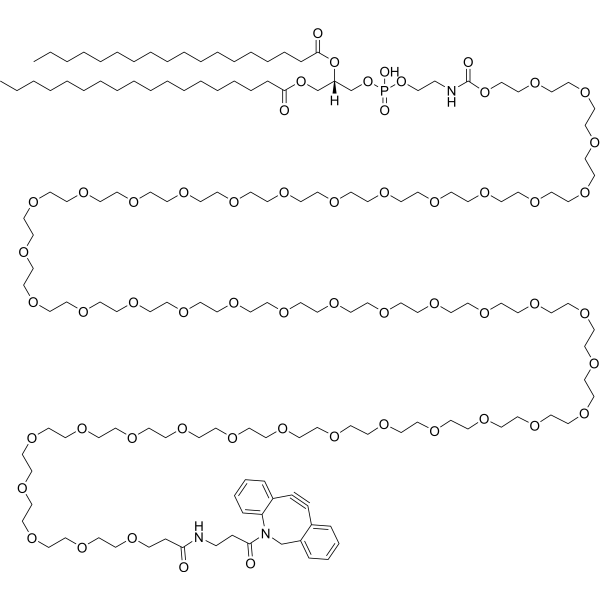
 0 ImagesArt. -Nr.: HY-W591891Cholesterol-PEG1000-acid is a cholesterol PEG derivative that can form micelles through molecular self-assembly and has a longer half-life in vivo. Cholesterol-PEG1000-acid can be used in drug delivery research.
-
SM-102 (GMP)
 0 ImagesArt. -Nr.: HY-134541GCAS. Nr.: 2089251-47-6SM-102 (GMP) is SM-102 (HY-134541) produced by using GMP guidelines. GMP small molecules works appropriately as an auxiliary reagent for cell therapy manufacture. SM-102 is an amino cationic lipid useful in the formation of lipid nanoparticles (LNPs). SM-102 has higher transfection efficiency. SM-102 plays an important role in the effectiveness of lipid nanoparticles (LNPs) in delivering mRNA therapeutics and vaccines.
-
DSPE-PEG5000-CHO
 0 ImagesArt. -Nr.: HY-176509CDSPE-PEG5000-CHO is a linear heterobifunctional PEGylation reagent with DSPE phospholipids and aldehyde groups. PEG linkers have good hydrophilicity and water solubility. Aldehyde-polyethylene glycol (DSPE) is one of the most commonly used reactive phospholipids to bind antibodies, peptides or other ligands to the surface of liposomes and other lipid-polyethylene glycol nanoparticles. DSPE-PEG5000-CHO can be used for drug delivery.
-
Cholesterol-PEG2000-alcohol
 0 ImagesArt. -Nr.: HY-W440706Reinheit: 99.91%Cholesterol-PEG2000-alcohol is a pegylated lipids which can be used for preparation of liposome or nanoparticle. The lipophilic moiety can encapsulate hydrophobic drugs whereas the hydrophilic PEG chain helps the overal water solubility of the micelles. The amine can react with an activated NHS ester to form a stable amide bond.
-
DSPE-PEG8-OH
 0 ImagesArt. -Nr.: HY-185404DSPE-PEG8-OH is a monodisperse lipid-polyethylene glycol conjugate featuring a hydrophobic 1,2-distearoyl-sn-glycero-3-phosphoethanolamine (DSPE) anchor, an 8-unit discrete (PEG8) spacer, and a terminal hydroxyl (-OH) group. DSPE-PEG8-OH is primarily used in liposome formulation, nanoparticle surface modification, and targeted drug delivery systems.
-
Heptadecan-9-yl 8-bromooctanoate
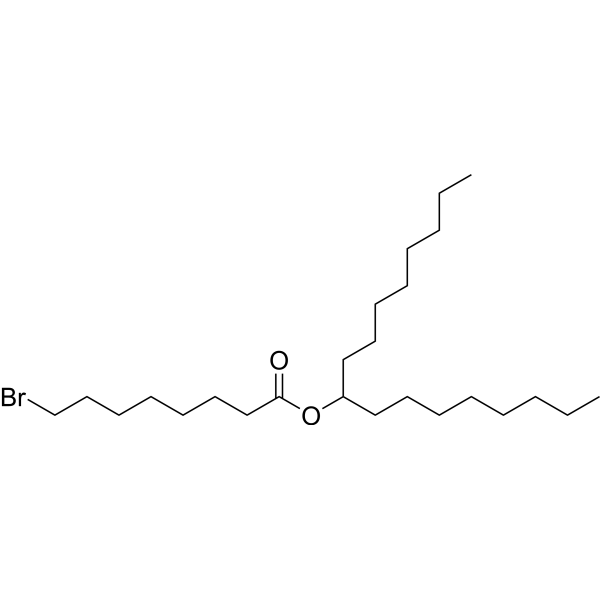 0 ImagesArt. -Nr.: HY-W440813CAS. Nr.: 2089253-22-3Heptadecan-9-yl 8-bromooctanoate can be useful for the building or modification of lipid nanoparticles.
-
DSPE-PEG3400-THRPPMWSPVWP
 0 ImagesArt. -Nr.: HY-172690ADSPE-PEG3400-THRPPMWSPVWP is a PEG compound which composed of DSPE and a transferrin receptor (TfR) peptide (THRPPMWSPVWP). THRPPMWSPVWP binds to the TfR and is subsequently internalized into TfR-expressing cells.
-
18:1 PEG5000 PE ammonium
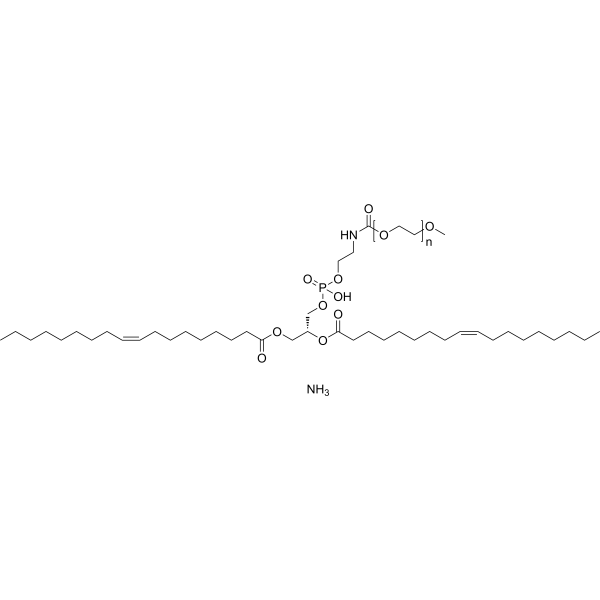 0 ImagesSynonyms: DOPE-PEG5000 ammonium; 1,2-Dioleoyl-sn-glycero-3-phosphoethanolamine-N-[methoxy(polyethylene glycol)-5000] ammonium18:1 PEG5000 PE ammonium (DOPE-PEG5000 ammonium) is a PEG lipid functional end group used in the synthesis of liposomes (LPs) for the design of conjugated polymer nanoparticles. Through biotin modification and carboxyl terminus, lipid nanoparticles (LNPs) further coupling with other biomolecules can be achieved. Functionalized nanoparticles can be used for targeted labeling of specific cellular proteins. With streptavidin as a linker, biotinylated PEG lipid-conjugated polymer nanoparticles are able to bind to biotinylated antibodies on cell surface receptors, yielding the utility of fluorescence-based imaging and sensing.
-
VC1052
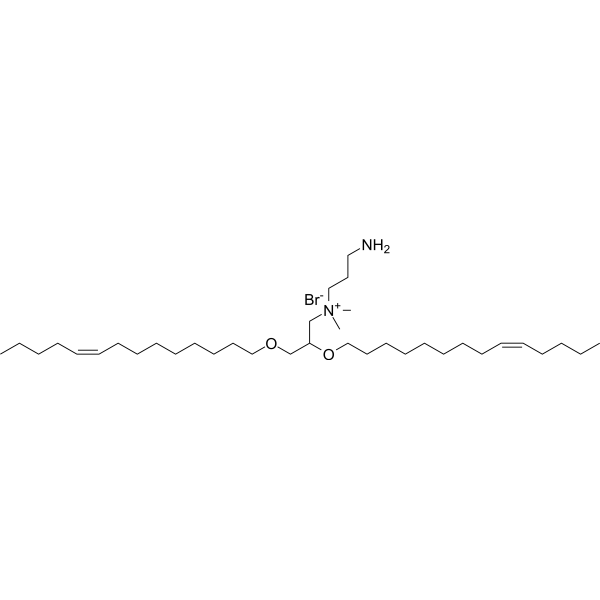 0 ImagesVC1052 is a dialkoxypropylammonium-based material and is the core cationic lipid component of the cationic lipid adjuvant Vaxfectin (HY-142998). Vaxfectin consists of VC1052 and lipid DPyPE (HY-112766) in a 1:1 molar ratio. Vaxfectin can be used as a vaccine adjuvant for the preparation of plasmid DNA and protein vaccines.
-
DSPE-PEG3400-MTP
 0 ImagesArt. -Nr.: HY-182100BDSPE-PEG3400-MTP is a PEG compound which composed of DSPE and a muscle-targeting peptide (MTP). MTP is a muscle-targeting peptide with the property of targeting muscle tissue. DSPE-PEG3400-MTP can be used for drug delivery.
-
DSPE-PEG5000-TAT
 0 ImagesArt. -Nr.: HY-172279BDSPE-PEG5000-TAT is a PEG compound which composed of DSPE and a cell-penetrating peptide (TAT) (HY-P0281). DSPE-PEG5000-TAT can be used for drug delivery.
-
LP-371-p
 0 ImagesLP-371-p is a lipid that can specifically and efficiently deliver oligonucleotide compounds to the fat tissues in the body (especially fat cells). LP-371-p can be used in research on diseases related to fat, such as obesity and type 2 diabetes.

-
1,3-Dipalmitoyl-glycero-2-phosphoethanolamine
 0 ImagesSynonyms: 1,3-DPPE; 1,3-Dipalmitoyl-sn-glycero-2-PE1,3-Dipalmitoyl-glycero-2-phosphoethanolamine is a phospholipid containing the saturated long-chain (16:0) stearic acid inserted at the sn-1 and sn-3 positions and PE at the sn-2 site. It can be used in the generation of micelles, liposomes, and other types of artificial membranes.
-
DSPE-PEG2000-CTP
 0 ImagesArt. -Nr.: HY-182095ADSPE-PEG2000-CTP is a PEG compound which composed of DSPE and a Cardiac-targeting peptide CTP (HY-P4094). CTP molecules that specifically recognize cardiac tissue and is primarily used for targeted drug delivery. CTP effectively recognizes and binds to specific receptors on the surface of cardiac cells, thereby achieving precise localization of drug molecules. DSPE-PEG2000-CTP can be used for drug delivery.



