



Based on 1 Customer Validation
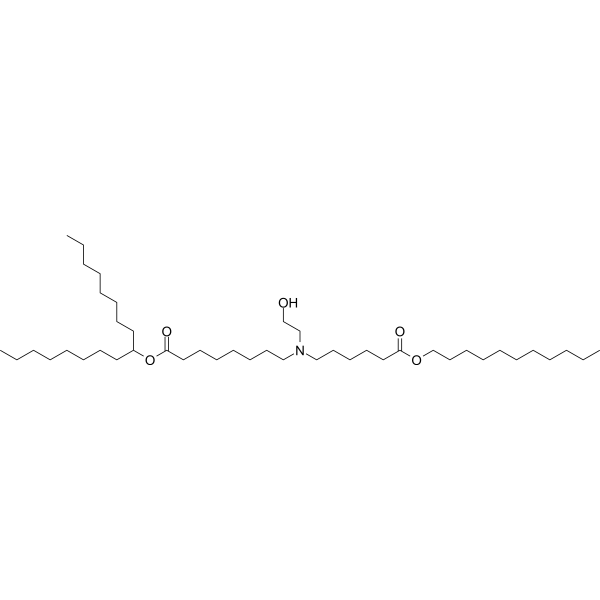
SM-102 (GMP) is SM-102 (HY-134541) produced by using GMP guidelines. GMP small molecules works appropriately as an auxiliary reagent for cell therapy manufacture. SM-102 is an amino cationic lipid useful in the formation of lipid nanoparticles (LNPs). SM-102 has higher transfection efficiency. SM-102 plays an important role in the effectiveness of lipid nanoparticles (LNPs) in delivering mRNA therapeutics and vaccines.
For research use only. We do not sell to patients.
- CAS No.: 2089251-47-6
- Formula: C44H87NO5
- Molecular Weight:710.17
-
Storage:
Please store the product under the recommended conditions in the Certificate of Analysis.


To place orders, for customer services and technical support, please contact: MedChemExpress USA
Tel: 609-228-6898 E-mail: [email protected] [email protected]


-
 Biological Activity
-
Chemical Information
- Protocols
- Purity & Documentation
- References
-
 Help & FAQs


-
HY-134541
SM-102Ionizable Amino Lipid -
HY-112251
D-Lin-MC3-DMAsiRNA Delivery Vehicle -
HY-138170
ALC-0315Lipid Nanoparticle Component -

HY-134541GL
SM-102 (GMP Like)Amino Cationic Lipid -
HY-112758
DLin-KC2-DMAIonizable Cationic Lipid -
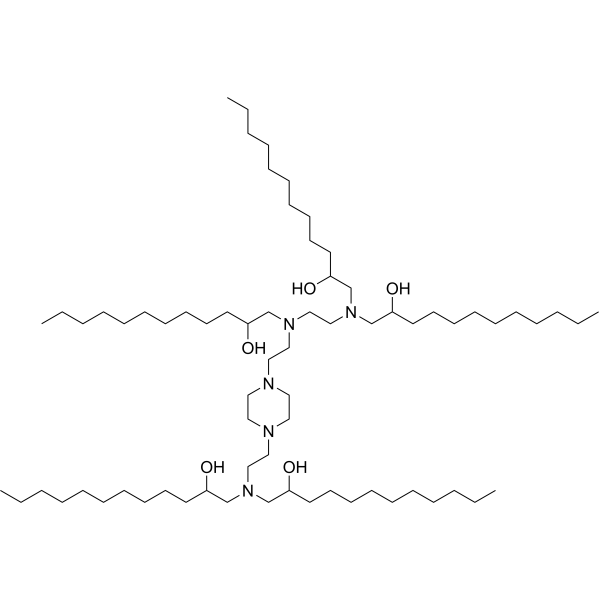
HY-145405
C12-200Cationic Lipidoid -
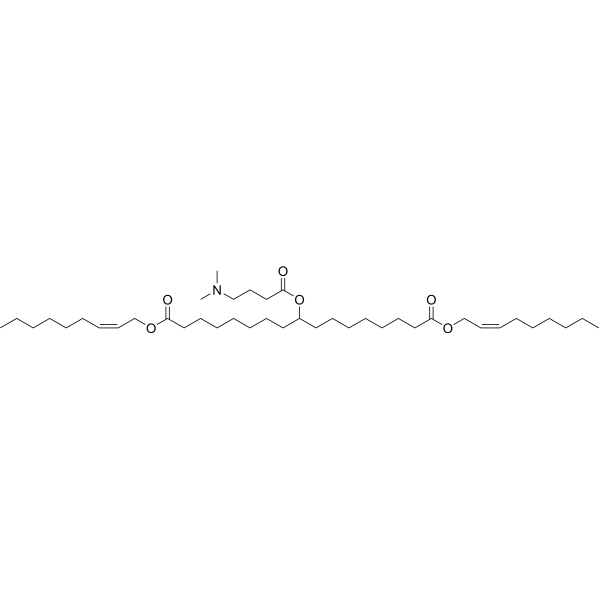
HY-139298
L319Cationic Lipidoid -
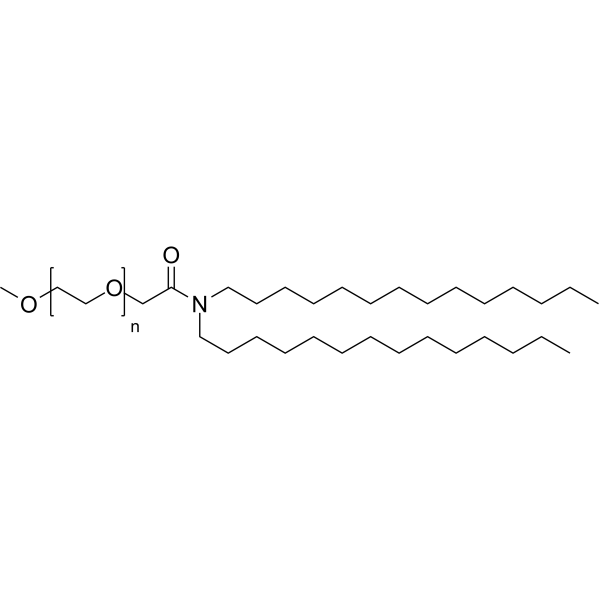
HY-138300
ALC-0159Liposome -

HY-138170GL
ALC-0315 (GMP Like)Ionisable Aminolipid -
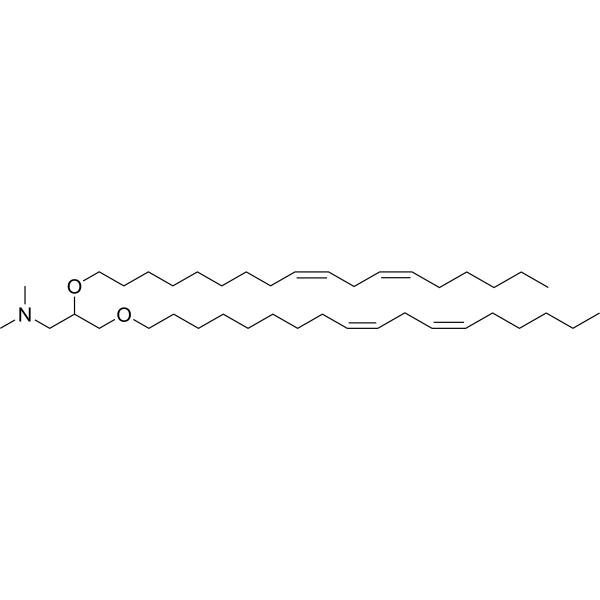
HY-112757
DLinDMAIonizable Cationic Lipid -
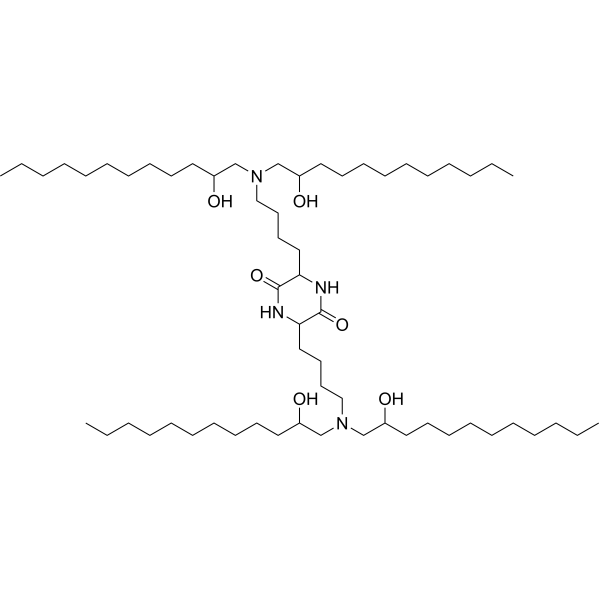
HY-134781
CKK-E12Ionizable Lipid -

HY-112251GL
D-Lin-MC3-DMA (GMP Like)Liposome


Biological Activity
Description
In Vitro
Preparation of Lipid Nanoparticles[3][4]
Here we provide lipid molar ratios for LNPs in FDA-approved mRNA-1273 (a COVID-19 mRNA vaccine). The molar ratio of lipids in this formulation is SM-102 : DSPC : Cholesterol : DMG-PEG 2000 = 50 : 10 : 38.5 : 1.5[1], and RNA to lipid weight ratio is 0.05 (wt/wt).
A. Lipid Mixture Preparation
1. Dissolve lipids in ethanol and prepare 10 mg/mL stock solutions. The lipid stock solutions can be stored at 20°C for later use.
Note 1: The ionizable lipid is usually a liquid. Due to the viscosity, it should always be weighed rather than relying on the autopipette volume.
Note 2: Cholesterol in solution should be kept warm (>37°C) to maintain fluidity. Transfer the cholesterol solution promptly to avoid cooling.
2. Prepare the lipid mixture solution as described. For each mL of lipid mixture add the following: 572 μL of 10 mg/mL SM-102 (HY-134541), 240 μL of 10 mg/mL Cholesterol (HY-N0322), 127 μL of 10 mg/mL DSPC (HY-W040193), and 61 μL of DMG-PEG 2000 (HY-112764). Mix the solutions thoroμghly to achieve a clear solution. This mixture contains 10 mg of total lipid.
Note 3: The choice of lipids and ratios may be changed as desired and this will affect the LNP properties (size, polydispersity, and efficacy) and the amount of mRNA required.
B. mRNA Preparation
1. Prepare a 166.7 μg/mL mRNA solution with 100 mM pH 5 sodium acetate buffer.
Note 4: The lipid:mRNA weight ratio influences the encapsulation efficiency. Other weight ratios may be prepared as alternative formulations and should be adjusted accordingly by user.
C. Mixing
There are three commonly used methods to achieve rapid mixing of the solutions: the pipette mixing method, the vortex mixing method, and the microfluidic mixing method. All these mixing methods can be used for various applications.
It is important to note that pipette mixing method and vortex mixing method may yield more heterogeneous LNPs with lower encapsulation efficiencies and is prone to variability. Microfluidic devices enable rapid mixing in a highly controllable, reproducible manner that achieves homogeneous LNPs and high encapsulation efficiency. Within these devices, the ethanolic lipid mixture and aqueous solution are rapidly combined in individual streams. LNPs are formed as the two streams mix and are then collected into a single collection tube.
1. Pipette Mixing Method:
1.1. Pipette 3 mL of the mRNA solution and quickly add it into 1 mL of the lipid mixture solution (A 1:3 ratio of ethanolic lipid mixture to aqueous buffer is generally used.) Pipette up and down rapidly for 20-30 seconds.
1.2. Incubate the resulting solution at room temperature for up to 15 minutes.
1.3. After mixing, the LNPs were dialyzed against PBS (pH 7.4) for 2 h, sterile filtered using 0.2 μm filters, and stored at 4°C.
2. Vortex Mixing Method:
1.1. Vortex 3 mL of mRNA solution at a moderate speed on the vortex mixer. Then, Quickly add 1 mL of the lipid mixture solution into the vortexing solution (A 1:3 ratio of ethanolic lipid mixture to aqueous buffer is generally used.). Continue vortexing the resulting dispersion for another 20-30 seconds.
1.2. Incubate the resulting solution at room temperature for up to 15 minutes.
1.3. After mixing, the LNPs were dialyzed against PBS (pH 7.4) for 2 h, sterile filtered using 0.2 μm filters, and stored at 4°C.
3. Microfluidic Mixing Method:
1.1 The 3 mL of mRNA buffer solution and 1 mL of the lipid mixture solution were mixed at a total flow rate of 12 mL/min in a microfluidic device (A 1:3 ratio of ethanolic lipid mixture to aqueous buffer is generally used.).
Note 5: Parameters such as the flow rate ratio and total flow rate can be altered to fine-tune LNPs.
1.2. After mixing, the LNPs were dialyzed against PBS (pH 7.4) for 2 h, sterile filtered using 0.2 μm filters, and stored at 4°C.
MedChemExpress (MCE) has not independently confirmed the accuracy of these methods. They are for reference only.


Chemical Information
-
CAS No. 2089251-47-6
-
Appearance Liquid
-
Molecular Weight 710.17
-
Formula C44H87NO5
-
Color Light yellow to yellow
-
SMILES
O=C(OC(CCCCCCCC)CCCCCCCC)CCCCCCCN(CCO)CCCCCC(OCCCCCCCCCCC)=O
-
Shipping
Room temperature in continental US; may vary elsewhere.
-
Storage
Please store the product under the recommended conditions in the Certificate of Analysis.


Purity & Documentation
-
Data Sheet (271 KB)
-
SDS (252 KB)
- English - EN (252 KB)
- Français - FR (252 KB)
- Deutsch - DE (252 KB)
- Norwegian - NO (252 KB)
- Español - ES (252 KB)
- Swedish - SV (252 KB)
- Italian - IT (252 KB)
- Korean - KR (252 KB)
- Portuguese - PT (252 KB)
-
Handling Instructions (2659 KB)
References
[1]. Escalona-Rayo O, et al. In vitro and in vivo evaluation of clinically-approved ionizable cationic lipids shows divergent results between mRNA transfection and vaccine efficacy. Biomed Pharmacother. 2023 Sep;165:115065. [Content Brief]
[2]. Cho HY, et al. Effective Perturbations on the Amplitude and Hysteresis of Erg-Mediated Potassium Current Caused by 1-Octylnonyl 8-[(2-hydroxyethyl)[6-oxo-6(undecyloxy)hexyl]amino]-octanoate (SM-102), a Cationic Lipid. Biomedicines. 2021 Oct 1;9(10):1367. [Content Brief]
[3]. Mashima R, et al. Lipid Nanoparticles: A Novel Gene Delivery Technique for Clinical Application. Curr Issues Mol Biol. 2022 Oct 19;44(10):5013-5027. [Content Brief]
[4]. McKenzie RE, et al. mRNA Synthesis and Encapsulation in Ionizable Lipid Nanoparticles. Curr Protoc. 2023 Sep;3(9):e898. [Content Brief]

Calculators
Concentration (start) × Volume (start) = Concentration (final) × Volume (final)


SM-102 (GMP) Related Classifications
HY-134541G Related Classifications
 Powered by Bioz