



p97
VCP; Cdc48
p97 (also referred to as VCP) is a highly conserved and abundant AAA+ (ATPases associated with diverse cellular activities) ATPase that plays an essential role in cellular proteostasis. p97 participates in a large number of important cellular activities, including (i) proteasomal degradation, through its roles in extracting proteins from membranes or molecular complexes; (ii) lysosomal degradation via autophagy and endolysosomal sorting; (iii) membrane fusion; and (iv) regulation of intracellular signaling, cell proliferation, and survival. These diverse cellular functions are powered by the chemical energy from ATP hydrolysis and coordinated through the interaction of p97 with as many as 40 cofactors that recruit it to specific subcellular locations and to designated substrates for their remodeling and processing.
Mutations in p97 have been linked to a number of neurodegenerative diseases, and overexpression of wild type p97 is observed in numerous cancers. Furthermore, p97 activity has been shown to be essential for the replication of certain viruses, including poliovirus, herpes simplex virus (HSV), cytomegalovirus (CMV), and influenza. These observations highlight the potential for targeting p97 as a therapeutic approach in neurodegeneration, cancer, and certain infectious diseases.
All Product Categories
-
p97 Related Products (35)
Related Products (35)

-
Antibodies (1)
- 1
- 2
-
VCP/p97 inhibitor-1
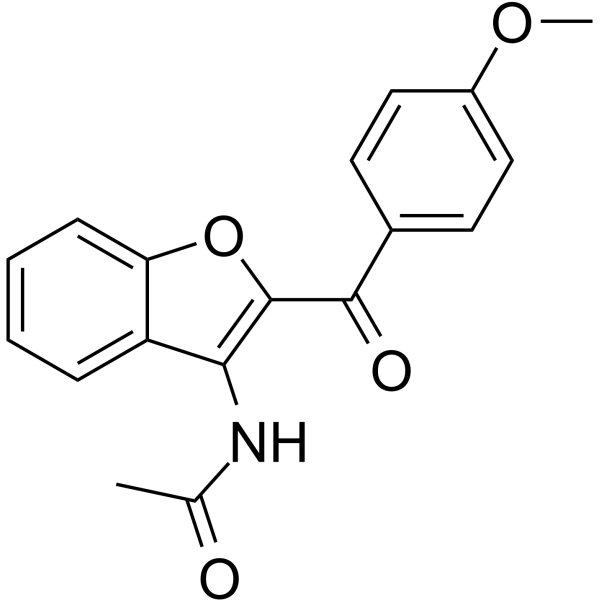
 0 ImagesVCP/p97 inhibitor-1 is a potent inhibitor of VCP/p97 (also called Cdc48, CDC-. 48, or Ter94) with an IC50 of 54.7 nM. VCP/p97 inhibitor-1 causes the dysregulation of protein homeostasis and disturbs the degradation of misfolded polypeptides by the ubiquitin-proteasome system (UPS).
-
NW 1028
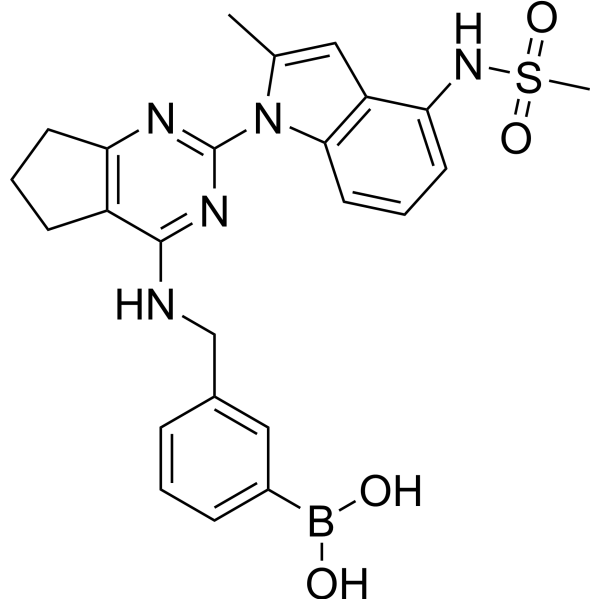
 0 ImagesCat. No.: HY-148122CAS No.: 2749599-78-6NW 1028 is a potent VCP/p97 inhibitor. NW 1028 targets the ND1L domain of p97 and inhibits the degradation of a p97-dependent reporter. NW 1028 has good binding affinity with Kd values of 100 and 285 nM for ND1L and full length p97, respectively. NW 1028 has the function of regulating the mitotic spindle of cells.
-
VCP/p97 IN-2
 0 ImagesCat. No.: HY-174847CAS No.: 3007658-94-5VCP/p97 IN-2 (Compound V13) is a VCP/p97 inhibitor with IC50 of 32 nM for p97. VCP/p97 IN-2 has excellent antitumor activities and significantly inhibits tumor growth in Molm-13 xenograft mice model. VCP/p97 IN-2 can be used for acute myeloid leukemia (AML) research.

-
VCP/p97 IN-3
 0 ImagesCat. No.: HY-174984CAS No.: 3098437-66-9VCP/p97 IN-3 is a VCP/p97 allosteric inhibitor. VCP/p97 IN-3 shows the inhibitory activity against the VCP proteins with an IC50 of 9 nM and the mutant VCP proteins with IC50 of 12 nM (N660K) and 19 nM (V474A/D649A). VCP/p97 IN-3 increases K48-linked ubiquitination and the level of cleaved caspase-3. VCP/p97 IN-3 activates ER-stress and the UPR. VCP/p97 IN-3 inhibits tumor growth in RPMI-8226 cell subcutaneous xenograft mouse models. VCP/p97 IN-3 can be used for the study of multiple myeloma.
-
p97-IN-1
 0 ImagesCat. No.: HY-174844CAS No.: 3007658-96-7p97-IN-1 is an orally active p97 inhibitor (IC50 = 26 nM). p97-IN-1 can significantly inhibit the proliferation of tumor cells. p97-IN-1 can be used for research on acute myeloid leukemia (AML).
-
NSC804515
 0 ImagesCat. No.: HY-168007NSC804515 is an inhibitor of wild-type and R155H mutant p97/VCP ATPase, with an IC50 of about 15 nM for both targets. NSC804515 acts as an antiproliferative agent, disrupts the function of the ubiquitin-proteasome system, induces UbG76V-GFP accumulation, and shows reduced inhibitory potency against p97 variants carrying P510S, K512N, N616F and F618S mutations. NSC804515 can be used in research related to cancer, inclusion body myopathy with early-onset Paget's disease and frontotemporal dementia, as well as familial amyotrophic lateral sclerosis.

-
LC-1310
 0 ImagesCat. No.: HY-183920CAS No.: 2322268-24-4LC-1310 is an antiviral agent that targets and inhibits p97, and it suppresses the in vitro replication of human cytomegalovirus (HCMV) with an EC50 value of 0.3 μM. LC-1310 targets the D2 ATP-binding site of p97, downregulates the expression of early viral proteins, thereby blocking the transcription and proliferation of early viral genes. LC-1310 can be used for research on human cytomegalovirus infection.
-
p97-IN-2
 0 ImagesCat. No.: HY-179257CAS No.: 1346527-45-4
-
Eeyarestatin I (Standard)
 0 ImagesCat. No.: HY-110078RCAS No.: 412960-54-4Eeyarestatin I (Standard) is the analytical standard of Eeyarestatin I (HY-110078). This product is intended for research and analytical applications. Eeyarestatin I, a potent endoplasmic reticulum-associated protein degradation (ERAD) inhibitor, is a potent protein translocation inhibitor. Eeyarestatin I inhibits Sec61 translocon. Eeyarestatin I targets the p97-associated deubiquitinating process (PAD) and inhibits atx3-dependent deubiquitination. Eeyarestatin I interferes at a step prior to proteasomal degradation. Eeyarestatin I induces cell death via the proapoptotic protein NOXA and has anticancer effects.
-
ML240 (Standard)
 0 ImagesML240 (Standard) is the analytical standard of ML240. This product is intended for research and analytical applications. ML240 is a potent p97 inhibitor, inhibiting p97 ATPase with IC50 value of 100 nM.
-
ACJI-99C
 0 ImagesCat. No.: HY-118460CAS No.: 1135195-64-0Synonyms: VCP/p97-IN-PPAACJI-99C (VCP/p97-IN-PPA) is a selective covalent p97/VCP ATPase inhibitor with an IC50 value of 0.6 μM. ACJI-99C binds with p97 active site residues to block ATPase activity. ACJI-99C irreversibly blocks degradation of p97-dependent protein in cells. ACJI-99C inhibits proliferation of cancer cells, including p97 inhibitor-resistant lines. ACJI-99C can be used for the research of colorectal cancer.
- 1
- 2




