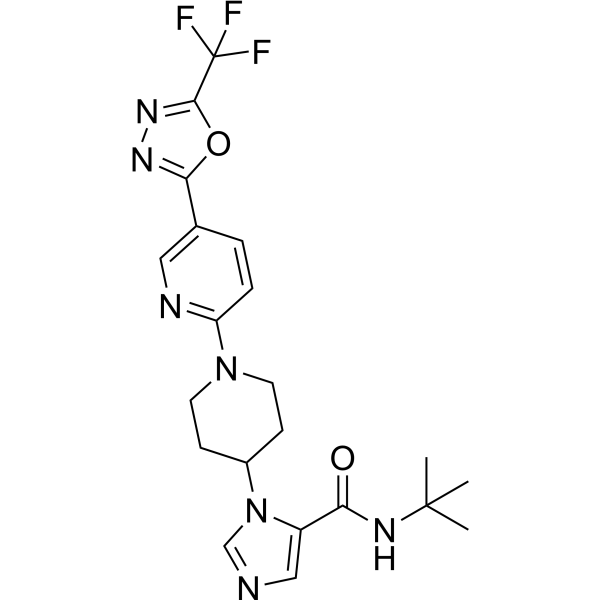
WNK2
WNK2 is a with-no-lysine (K) serine/threonine kinase within the mammalian WNK1-4 family, whose members regulate ion homeostasis, cell volume, epithelial transport, and cancer-related signaling[1]. Mechanistically, WNK isoforms signal through SPAK/OSR1 and cation-chloride cotransporters, while full-length WNK2 can directly phosphorylate WNK1 Ser382 in vitro, supporting isoform cross-regulation by T-loop trans-autophosphorylation[2]. In glioma models, WNK2 is recurrently silenced by promoter methylation, shows autophosphorylation and kinase activity enhanced by hypertonic conditions, and suppresses glioma colony formation in a kinase-independent manner[3]. In meningioma, WNK2 CpG-island methylation occurs frequently in grade II-III tumors, associates with decreased expression, and methylation-inhibitor treatment can reactivate WNK2 expression in a methylated meningioma cell line[4]. In glioma cells lacking WNK2, increased JNK activation, MMP2 expression, and MMP2 activity link WNK2 loss to invasion-relevant matrix remodeling[5]. Compared with WNK1 and WNK4, which have established roles in inherited hypertension, WNK2 evidence more strongly centers on tumor suppressor biology, epigenetic silencing, MAPK/JNK signaling, and glioma or meningioma experimental models[1][3][4][5]. WNK2-focused inhibitor or agonist applications remain insufficiently defined in these retrieved studies.
References:
- [1]. McCormick JA, et al. The WNKs: atypical protein kinases with pleiotropic actions. Physiol Rev. 2011 Jan;91(1):177-219. [Content Brief]
- [2]. Thastrup JO, et al. SPAK/OSR1 regulate NKCC1 and WNK activity: analysis of WNK isoform interactions and activation by T-loop trans-autophosphorylation. Biochem J. 2012 Jan 1;441(1):325-37. [Content Brief]
- [3]. Hong C, et al. Epigenome scans and cancer genome sequencing converge on WNK2, a kinase-independent suppressor of cell growth. Proc Natl Acad Sci U S A. 2007 Jun 26;104(26):10974-9. [Content Brief]
- [4]. Jun P, et al. Epigenetic silencing of the kinase tumor suppressor WNK2 is tumor-type and tumor-grade specific. Neuro Oncol. 2009 Aug;11(4):414-22. [Content Brief]
- [5]. Costa AM, et al. Silencing of the tumor suppressor gene WNK2 is associated with upregulation of MMP2 and JNK in gliomas. Oncotarget. 2015 Jan 30;6(3):1422-34. [Content Brief]
All Product Categories
-
WNK2 Related Products (1)
Related Products (1)