WNK4
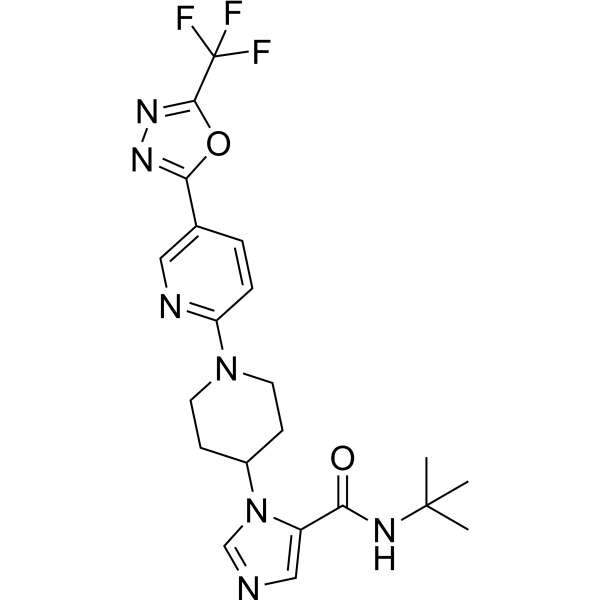
WNK4, a serine/threonine kinase lacking a catalytic lysine, functions as a key regulator of electrolyte transport in the distal nephron[1][2]. It modulates the activity of epithelial ion channels and transporters, including the thiazide-sensitive Na+-Cl- cotransporter (NCC) and the renal outer medullary potassium channel (ROMK), influencing both chloride reabsorption and potassium secretion[3][4][5]. Mechanistically, WNK4 inhibits NCC by promoting its lysosomal degradation but can switch to a stimulatory role under angiotensin II signaling or in the presence of kidney-specific WNK1 isoforms (KS-WNK1), which activate WNK4 via protein-protein interactions without changing intracellular chloride[4][6][7]. WNK4 also regulates TRPV4 and BK channel surface expression through pathways involving ERK and p38 MAPK, highlighting its role in renal osmosensing and potassium homeostasis[8][9]. Disease relevance is evidenced by familial hyperkalemic hypertension (FHHt), where WNK4 mutations disrupt transporter regulation, causing salt-sensitive hypertension and hyperkalemia[1][10][5]. Compared with related isoforms, WNK4 exhibits unique COOH-terminal coiled-coil and degron motifs that enable differential interactions with KLHL3/2, distinguishing it from WNK1, WNK2, and WNK3 in substrate specificity and oligomerization[11][12]. Experimental applications include the use of ATP-competitive inhibitors such as WNK463, which target WNK4 with isoform-specific binding and phosphorylation-dependent conformational stabilization, providing tools for dissecting kinase signaling in renal physiology and hypertension models[13][12].
References:
- [1]. Schumacher FR, et al. Structural and biochemical characterization of the KLHL3-WNK kinase interaction important in blood pressure regulation. Biochem J. 2014 Jun 1;460(2):237-46. [Content Brief]
- [2]. Fu Y, et al. WNK kinases influence TRPV4 channel function and localization. Am J Physiol Renal Physiol. 2006 Jun;290(6):F1305-14. [Content Brief]
- [3]. Kahle KT, et al. WNK kinases: molecular regulators of integrated epithelial ion transport. Curr Opin Nephrol Hypertens. 2004 Sep;13(5):557-62. [Content Brief]
- [4]. Thorn CF, et al. PharmGKB summary: Diuretics pathway, pharmacodynamics. Pharmacogenet Genomics. 2013 Aug;23(8):449-53. [Content Brief]
- [5]. Cope G, et al. WNK kinases and the control of blood pressure. Pharmacol Ther. 2005 May;106(2):221-31. [Content Brief]
- [6]. Argaiz ER, et al. Kidney-specific WNK1 isoform (KS-WNK1) is a potent activator of WNK4 and NCC. Am J Physiol Renal Physiol. 2018 Sep 1;315(3):F734-F745. [Content Brief]
- [7]. Lashway J, et al. The interplay between calcineurin inhibitors (CNIs) and WNK bodies. Physiology. 2024;39(Suppl 1):722.
- [8]. Guerrera ML, et al. Discovery of undocumented, cancer-specific and pro-inflammatory isoforms of WNK2 that are highly expressed in MYD88 mutated Waldenström’s macroglobulinemia and represent novel therapeutic targets. Blood. 2024;144(Suppl 1):2972.
- [9]. Yue P, et al. WNK4 inhibits Ca(2+)-activated big-conductance potassium channels (BK) via mitogen-activated protein kinase-dependent pathway. Biochim Biophys Acta. 2013 Oct;1833(10):2101-10. [Content Brief]
- [10]. Jabbour E, et al. Targeting the phosphoinositide 3-kinase pathway in hematologic malignancies. Haematologica. 2014 Jan;99(1):7-18. [Content Brief]
- [11]. Chávez-Canales M, et al. WNK-SPAK-NCC cascade revisited: WNK1 stimulates the activity of the Na-Cl cotransporter via SPAK, an effect antagonized by WNK4. Hypertension. 2014 Nov;64(5):1047-53. [Content Brief]
- [12]. Hoorn EJ, et al. WNK kinases and the kidney. Exp Cell Res. 2012 May 15;318(9):1020-6. [Content Brief]
- [13]. Jonniya NA, et al. A comparative study of structural and conformational properties of WNK kinase isoforms bound to an inhibitor: insights from molecular dynamic simulations. J Biomol Struct Dyn. 2022 Feb;40(3):1400-1415. [Content Brief]
All Product Categories
-
WNK4 Related Products (1)
Related Products (1)