



Tizanidine

Based on 1 Customer Validation
Tizanidine, a skeletal muscle relaxant, is an orally effective central α2-adrenoceptor agonist (IC50 = 6.9 nmol). Tizanidine primarily exerts muscle relaxation effects by inhibiting the release of excitatory amino acids (glutamate and aspartate) from the presynaptic terminals of spinal cord interneurons. Tizanidine has anti-injury activity and can inhibit gastrointestinal (GI) transport. Tizanidine can inhibit the proliferation, migration, and invasion of lung cancer cells and induce cell apoptosis by upregulating Nischarin and inhibiting the AKT and Wnt3a/β-catenin signaling pathways. Tizanidine can be used to treat spasticity caused by diseases such as multiple sclerosis (MS), stroke, and spinal cord injury (SCI).
Nos produits utilisent uniquement pour la recherche. Nous ne vendons pas aux patients.
- Pureté : 99.58%
- CAS No.: 51322-75-9
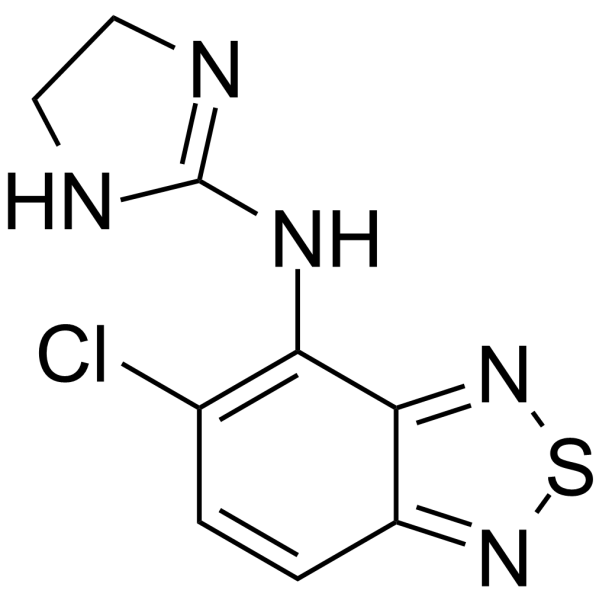
- Formule: C9H8ClN5S
- Masse moléculaire:253.71
-
Stockage:
4°C, protect from light
* In solvent : -80°C, 6 months; -20°C, 1 month (protect from light)

To place orders, for customer services and technical support, please contact: MedChemExpress USA
Tel: 609-228-6898 E-mail: [email protected] [email protected]


-
 Activité biologique
-
Chemical Information
-
Solvant et solubilité
- Protocole
- Pureté et documentation
- Références
-
 Help & FAQs



Voir tous les produits spécifiques à Isoform Adrenergic Receptor
More

Activité biologique
Description
IC50 & Target
|
α adrenergic receptor |
In Vitro
Tizanidine is mainly metabolized by cytochrome CYP1A2 and resultes in time- and NADPH-dependent substrate consumption with a half-life of 50 min in human liver microsomes[2].
Tizanidine (20 μM, 0-72 h) inhibits the proliferation, migration and invasion of A549 cells, and induces apoptosis through the regulation of AKT and Wnt3a/β-catenin pathways mediated by Nischarin[3].
MedChemExpress (MCE) has not independently confirmed the accuracy of these methods. They are for reference only.
-
Cell Line:A549 cells
-
Concentration:20 μM
-
Incubation Time:24 h
-
Result:Decreased the crystal violet-stained cells.
-
Cell Line:A549 cells
-
Concentration:20 μM
-
Incubation Time:24 h
-
Result:Suppressed invasion ability of A549 cells by significant inhibition andmigration ability under the same inhibition.
-
Cell Line:A549 cells
-
Concentration:20 μM
-
Incubation Time:48 h
-
Result:Significantly increased the apoptosis rate of A549 cells.
-
Cell Line:A549 cells
-
Concentration:20 μM
-
Incubation Time:24 h
-
Result:Decreased Bcl-2 expression, while simultaneous expression of Bax was increased.
Significantly increased the expression of Caspase-3.
Was no change in the expressions of AKT and mTOR, while in the phosphorylated forms p-AKT and p-mTOR decreased.
Decreased expressions of P70 and Cyclin D1.
Led to a significant decrease in the levels of Wnt3a and β-catenin, which suggested that Wnt3a/β-catenin pathway was inactivated.
Down-regulated Nischarin.
In Vivo
MedChemExpress (MCE) has not independently confirmed the accuracy of these methods. They are for reference only.
-
Animal Model:Spinal nerve ligation (SNL) model established in female and male Wistar rats (6-7 weeks)[4]
-
Dosage:0.02, 0.2, 2 and 20 mg/kg
-
Administration:Oral administration (p.o.), increasing doses for 14 days
-
Result:Showed dose-dependent analgesic effect, and the magnetic effect is significantly stronger than that in males.
-
Animal Model:Ovarian removal (OVX) model established in female Wistar rats (6-7 weeks)[4]
-
Dosage:2 mg/kg
-
Administration:Oral administration (p.o.), single dose
-
Result:Decreased the TZN AUC in OVX female rats to 90 g·h, which was 50% lower than that of the intact females.
Completed reversal of the OVX effect after E2 replacement therapy.
Essai clinique
| NCT Number | Sponsor | Condition | Start Date |
Phase

|
|---|---|---|---|---|
| NCT01329991 | Plexxikon| | 2011-05 | PHASE1 |


Chemical Information
-
CAS No. 51322-75-9
-
Appearance Solid
-
Masse moléculaire 253.71
-
Formule C9H8ClN5S
-
Color Light yellow to yellow
-
SMILES
ClC1=C(NC2=NCCN2)C3=NSN=C3C=C1
-
Livraison
Room temperature in continental US; may vary elsewhere.
-
Stockage
4°C, protect from light
* In solvent : -80°C, 6 months; -20°C, 1 month (protect from light)


Solvant et solubilité
In Vitro:
DMSO : 22.22 mg/mL (87.58 mM; ultrasonic and adjust pH to 3 with 1M HCl; Hygroscopic DMSO has a significant impact on the solubility of product, please use newly opened DMSO)
Please refer to the solubility information to select the appropriate solvent. Once prepared, please aliquot and store the solution to prevent product inactivation from repeated freeze-thaw cycles.
Storage method and period of stock solution: -80°C, 6 months; -20°C, 1 month (protect from light). When stored at -80°C, please use it within 6 months. When stored at -20°C, please use it within 1 month.
Please refer to the solubility information to select the appropriate solvent. Once prepared, please aliquot and store the solution to prevent product inactivation from repeated freeze-thaw cycles.
Storage method and period of stock solution: -80°C, 6 months; -20°C, 1 month (protect from light). When stored at -80°C, please use it within 6 months. When stored at -20°C, please use it within 1 month.
Concentration (start) × Volume (start) = Concentration (final) × Volume (final)
In Vivo:
Select the appropriate dissolution method based on your experimental animal and administration route.
- For the following dissolution methods, please ensure to first prepare a clear stock solution using an In Vitro approach and then sequentially add co-solvents:
- To ensure reliable experimental results, the clarified stock solution can be appropriately stored based on storage conditions. As for the working solution for In Vivo experiments, it is recommended to prepare freshly and use it on the same day.
- The percentages shown for the solvents indicate their volumetric ratio in the final prepared solution. If precipitation or phase separation occurs during preparation, heat and/or sonication can be used to aid dissolution.
Add each solvent one by one: 10% DMSO 40% PEG300 5% Tween-80 45% Saline
Solubility: ≥ 2.22 mg/mL (8.75 mM); Clear solution
This protocol yields a clear solution of ≥ 2.22 mg/mL (saturation unknown).
Taking 1 mL working solution as an example, add 100 μL DMSO stock solution (22.2 mg/mL) to 400 μL PEG300, and mix evenly; then add 50 μL Tween-80 and mix evenly; then add 450 μL Saline to adjust the volume to 1 mL.
Preparation of Saline: Dissolve 0.9 g sodium chloride in ddH₂O and dilute to 100 mL to obtain a clear Saline solution.
Add each solvent one by one: 10% DMSO 90% (20% SBE-β-CD in Saline)
Solubility: ≥ 2.22 mg/mL (8.75 mM); Clear solution
This protocol yields a clear solution of ≥ 2.22 mg/mL (saturation unknown).
Taking 1 mL working solution as an example, add 100 μL DMSO stock solution (22.2 mg/mL) to 900 μL 20% SBE-β-CD in Saline, and mix evenly.
Preparation of 20% SBE-β-CD in Saline (4°C, storage for one week): 2 g SBE-β-CD powder is dissolved in 10 mL Saline, completely dissolve until clear.
In Vivo Dissolution Calculator
Please enter the basic information of animal experiments:
-
-
-
-
Recommended: Prepare an additional quantity of animals to account for potential losses during experiments.
Please enter your animal formula composition:
-
%DMSO +
Recommended: Keep the proportion of DMSO in working solution below 2% if your animal is weak.
-
%+
-
+%Tween-80 + +
-
%Saline +
The co-solvents required include: DMSO, . All of co-solvents are available by MedChemExpress (MCE). , Tween 80. All of co-solvents are available by MedChemExpress (MCE).
Working solution concentration: 0.22 mg/mL
Method for preparing stock solution: mg drug dissolved in μL DMSO. Stock solution concentration: mg/mL. * In solvent : -80°C, 6 months; -20°C, 1 month (protect from light)
1. Take μL DMSO stock solution;
2. Add μL .
μL , mix evenly;
3. Then add μL Tween 80, mix evenly;
4. Then add μL
Please ensure that the stock solution in the first step is dissolved to a clear state, and add co-solvents in sequence. You can use ultrasonic heating (ultrasonic cleaner, recommended frequency 20-40 kHz), vortexing, etc. to assist dissolution.


Pureté et documentation
-
Fiche technique (286 KB)
-
SDS (252 KB)
- English - EN (252 KB)
- Français - FR (252 KB)
- Deutsch - DE (252 KB)
- Norwegian - NO (252 KB)
- Español - ES (252 KB)
- Swedish - SV (252 KB)
- Italian - IT (252 KB)
- Korean - KR (252 KB)
- Portuguese - PT (252 KB)
-
Instruction de manipulation (2659 KB)
Références
[1]. Kamen L, et al. A practical overview of tizanidine use for spasticity secondary to multiple sclerosis, stroke, and spinal cord injury. Curr Med Res Opin. 2008 Feb;24(2):425-39. [Content Brief]
[2]. Granfors, M. T., et al., (2004). Tizanidine is mainly metabolized by cytochrome p450 1A2 in vitro. British journal of clinical pharmacology, 57(3), 349–353. [Content Brief]
[3]. Zhao L, Zhao G, Xue Q. Tizanidine (Hydrochloride) Inhibits A549 Lung Cancer Cell Proliferation and Motility Through Regulating Nischarin. Onco Targets Ther. 2020 Jan 10;13:291-298. [Content Brief]
[4]. Rodríguez-Palma EJ, et al. Sex-dependent antiallodynic effect of α2 adrenergic receptor agonist tizanidine in rats with experimental neuropathic pain. Eur J Pharmacol. 2022 Apr 5;920:174855. [Content Brief]


Complete Stock Solution Preparation Table
Please refer to the solubility information to select the appropriate solvent. Once prepared, please aliquot and store the solution to prevent product inactivation from repeated freeze-thaw cycles.
Storage method and period of stock solution: -80°C, 6 months; -20°C, 1 month (protect from light). When stored at -80°C, please use it within 6 months. When stored at -20°C, please use it within 1 month.
| Optional Solvent | Concentration Solvent Mass | 1 mg | 5 mg | 10 mg | 25 mg |
|---|---|---|---|---|---|
| DMSO | 1 mM | 3.9415 mL | 19.7075 mL | 39.4151 mL | 98.5377 mL |
| 5 mM | 0.7883 mL | 3.9415 mL | 7.8830 mL | 19.7075 mL | |
| 10 mM | 0.3942 mL | 1.9708 mL | 3.9415 mL | 9.8538 mL | |
| 15 mM | 0.2628 mL | 1.3138 mL | 2.6277 mL | 6.5692 mL | |
| 20 mM | 0.1971 mL | 0.9854 mL | 1.9708 mL | 4.9269 mL | |
| 25 mM | 0.1577 mL | 0.7883 mL | 1.5766 mL | 3.9415 mL | |
| 30 mM | 0.1314 mL | 0.6569 mL | 1.3138 mL | 3.2846 mL | |
| 40 mM | 0.0985 mL | 0.4927 mL | 0.9854 mL | 2.4634 mL | |
| 50 mM | 0.0788 mL | 0.3942 mL | 0.7883 mL | 1.9708 mL | |
| 60 mM | 0.0657 mL | 0.3285 mL | 0.6569 mL | 1.6423 mL | |
| 80 mM | 0.0493 mL | 0.2463 mL | 0.4927 mL | 1.2317 mL |


Tizanidine Related Classifications
HY-B0194 Related Classifications
 Powered by Bioz