



Tizanidine hydrochloride

Based on 1 Customer Validation
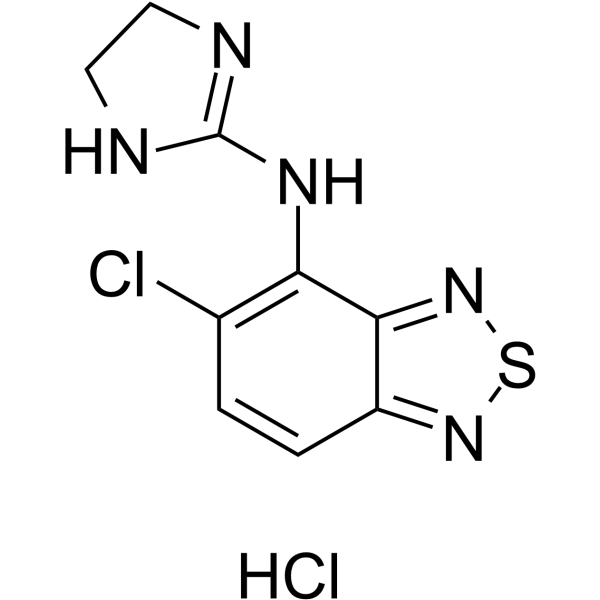
Tizanidine hydrochloride, a skeletal muscle relaxant, is an orally effective central α2-adrenoceptor agonist (IC50 = 6.9 nmol). Tizanidine hydrochloride primarily exerts muscle relaxation effects by inhibiting the release of excitatory amino acids (glutamate and aspartate) from the presynaptic terminals of spinal cord interneurons. Tizanidine hydrochloride has anti-injury activity and can inhibit gastrointestinal (GI) transport. Tizanidine hydrochloride can inhibit the proliferation, migration, and invasion of lung cancer cells and induce cell apoptosis by upregulating Nischarin and inhibiting the AKT and Wnt3a/β-catenin signaling pathways. Tizanidine hydrochloride can be used to treat spasticity caused by diseases such as multiple sclerosis (MS), stroke, and spinal cord injury (SCI).
For research use only. We do not sell to patients.
- Purity : 99.93%
- CAS No.: 64461-82-1
- Formula: C9H9Cl2N5S
- Molecular Weight:290.17
-
Storage:
4°C, sealed storage, away from moisture
* In solvent : -80°C, 6 months; -20°C, 1 month (sealed storage, away from moisture)

To place orders, for customer services and technical support, please contact: MedChemExpress USA
Tel: 609-228-6898 E-mail: [email protected] [email protected]


-
 Biological Activity
-
Chemical Information
-
Solvent & Solubility
- Protocols
- Purity & Documentation
- References
-
 Help & FAQs


-
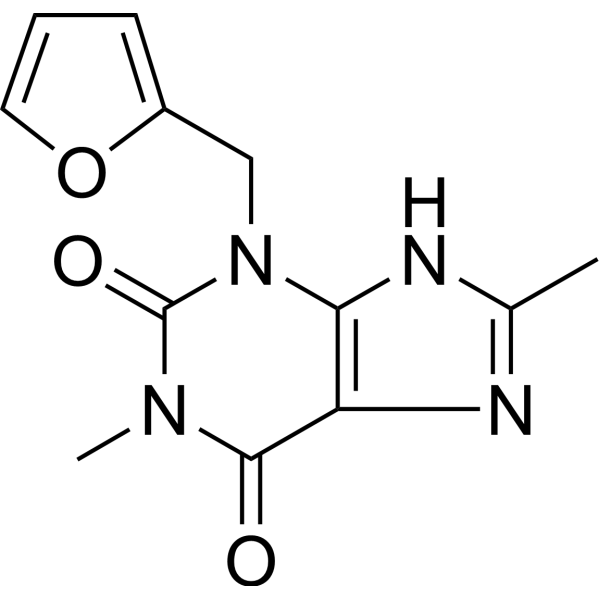
HY-107204
FurafyllineCytochrome P450 Inhibitor -

HY-B0194AR
Tizanidine hydrochloride (Standard)Standard of Tizanidine hydrochloride -
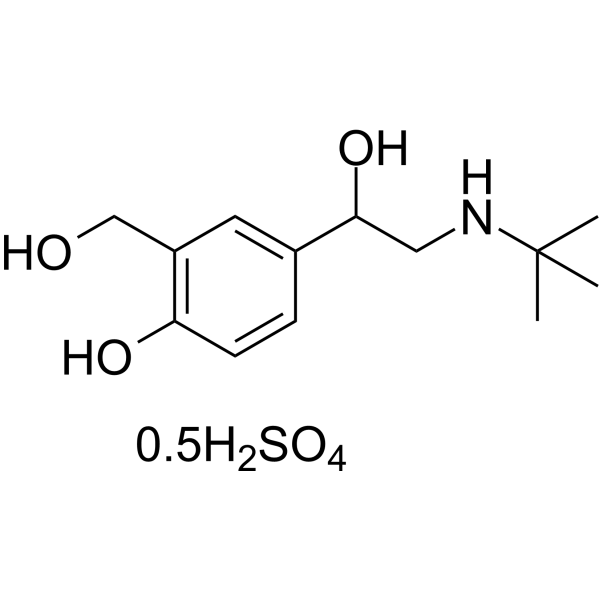
HY-B0436
Salbutamol hemisulfateAdrenergic Receptor Agonist -
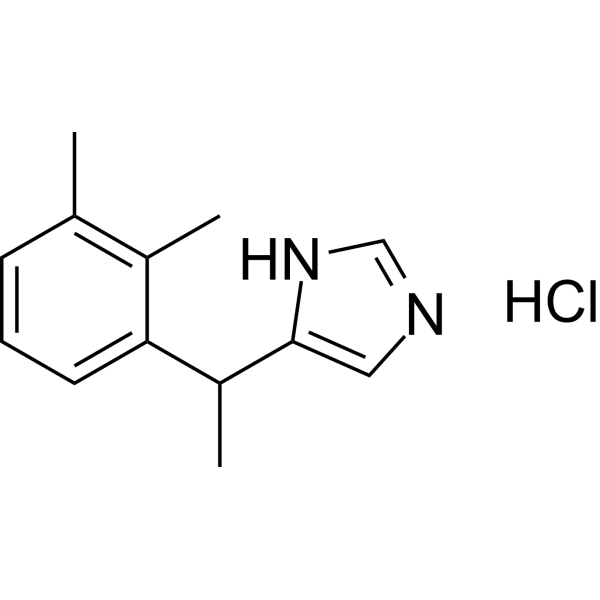
HY-17034B
Medetomidine hydrochlorideα2 Adrenergic Receptor Agonist -

HY-B0436R
Salbutamol hemisulfate (Standard)Standard of Salbutamol hemisulfate -

HY-17034BR
Medetomidine hydrochloride (Standard)α2 Adrenergic Receptor Agonist
All Adrenergic Receptor Isoforms
More

Biological Activity
Description
IC50 & Target
|
α adrenergic receptor |
In Vitro
Tizanidine hydrochloride is mainly metabolized by cytochrome CYP1A2 and resultes in time- and NADPH-dependent substrate consumption with a half-life of 50 min in human liver microsomes[2].
Tizanidine hydrochloride (20 μM, 0-72 h) inhibits the proliferation, migration and invasion of A549 cells, and induces apoptosis through the regulation of AKT and Wnt3a/β-catenin pathways mediated by Nischarin[3].
MedChemExpress (MCE) has not independently confirmed the accuracy of these methods. They are for reference only. Further protocols information, click here.
-
Cell Line:A549 cells
-
Concentration:20 μM
-
Incubation Time:24 h
-
Result:Decreased the crystal violet-stained cells.
-
Cell Line:A549 cells
-
Concentration:20 μM
-
Incubation Time:24 h
-
Result:Suppressed invasion ability of A549 cells by significant inhibition andmigration ability under the same inhibition.
-
Cell Line:A549 cells
-
Concentration:20 μM
-
Incubation Time:48 h
-
Result:Significantly increased the apoptosis rate of A549 cells.
-
Cell Line:A549 cells
-
Concentration:20 μM
-
Incubation Time:24 h
-
Result:Decreased Bcl-2 expression, while simultaneous expression of Bax was increased.
Significantly increased the expression of Caspase-3.
Was no change in the expressions of AKT and mTOR, while in the phosphorylated forms p-AKT and p-mTOR decreased.
Decreased expressions of P70 and Cyclin D1.
Led to a significant decrease in the levels of Wnt3a and β-catenin, which suggested that Wnt3a/β-catenin pathway was inactivated.
Down-regulated Nischarin.
In Vivo
MedChemExpress (MCE) has not independently confirmed the accuracy of these methods. They are for reference only.
-
Animal Model:Spinal nerve ligation (SNL) model established in female and male Wistar rats (6-7 weeks, 140-160 g)[4]
-
Dosage:0.02, 0.2, 2 and 20 mg/kg
-
Administration:Oral administration (p.o.), increasing doses for 14 days
-
Result:Showed dose-dependent analgesic effect, and the magnetic effect is significantly stronger than that in males.
-
Animal Model:Ovarian removal (OVX) model established in female Wistar rats (6-7 weeks, 140-160 g)[4]
-
Dosage:2 mg/kg
-
Administration:Oral administration (p.o.), single dose
-
Result:Decreased the TZN AUC in OVX female rats to 90 g·h, which was 50% lower than that of the intact females.
Completed reversal of the OVX effect after E2 replacement therapy.


Chemical Information
-
CAS No. 64461-82-1
-
Appearance Solid
-
Molecular Weight 290.17
-
Formula C9H9Cl2N5S
-
Color Light yellow to yellow
-
SMILES
ClC1=C(NC2=NCCN2)C3=NSN=C3C=C1.Cl
-
Shipping
Room temperature in continental US; may vary elsewhere.
-
Storage
4°C, sealed storage, away from moisture
* In solvent : -80°C, 6 months; -20°C, 1 month (sealed storage, away from moisture)


Solvent & Solubility
In Vitro:
DMSO : 50 mg/mL (172.31 mM; ultrasonic and warming and heat to 60°C; Hygroscopic DMSO has a significant impact on the solubility of product, please use newly opened DMSO)
H2O : 20 mg/mL (68.93 mM; Need ultrasonic)
Please refer to the solubility information to select the appropriate solvent. Once prepared, please aliquot and store the solution to prevent product inactivation from repeated freeze-thaw cycles.
Storage method and period of stock solution: -80°C, 6 months; -20°C, 1 month (sealed storage, away from moisture). When stored at -80°C, please use it within 6 months. When stored at -20°C, please use it within 1 month.
* Note: If you choose water as the stock solution, please dilute it to the working solution, then filter and sterilize it with a 0.22 μm filter before use.
Please refer to the solubility information to select the appropriate solvent. Once prepared, please aliquot and store the solution to prevent product inactivation from repeated freeze-thaw cycles.
Storage method and period of stock solution: -80°C, 6 months; -20°C, 1 month (sealed storage, away from moisture). When stored at -80°C, please use it within 6 months. When stored at -20°C, please use it within 1 month.
* Note: If you choose water as the stock solution, please dilute it to the working solution, then filter and sterilize it with a 0.22 μm filter before use.
Concentration (start) × Volume (start) = Concentration (final) × Volume (final)
In Vivo:
Select the appropriate dissolution method based on your experimental animal and administration route.
- For the following dissolution methods, please ensure to first prepare a clear stock solution using an In Vitro approach and then sequentially add co-solvents:
- To ensure reliable experimental results, the clarified stock solution can be appropriately stored based on storage conditions. As for the working solution for In Vivo experiments, it is recommended to prepare freshly and use it on the same day.
- The percentages shown for the solvents indicate their volumetric ratio in the final prepared solution. If precipitation or phase separation occurs during preparation, heat and/or sonication can be used to aid dissolution.
Add each solvent one by one: 10% DMSO 40% PEG300 5% Tween-80 45% Saline
Solubility: ≥ 5 mg/mL (17.23 mM); Clear solution
This protocol yields a clear solution of ≥ 5 mg/mL (saturation unknown).
Taking 1 mL working solution as an example, add 100 μL DMSO stock solution (50.0 mg/mL) to 400 μL PEG300, and mix evenly; then add 50 μL Tween-80 and mix evenly; then add 450 μL Saline to adjust the volume to 1 mL.
Preparation of Saline: Dissolve 0.9 g sodium chloride in ddH₂O and dilute to 100 mL to obtain a clear Saline solution.
Add each solvent one by one: 10% DMSO 90% (20% SBE-β-CD in Saline)
Solubility: ≥ 5 mg/mL (17.23 mM); Clear solution
This protocol yields a clear solution of ≥ 5 mg/mL (saturation unknown).
Taking 1 mL working solution as an example, add 100 μL DMSO stock solution (50.0 mg/mL) to 900 μL 20% SBE-β-CD in Saline, and mix evenly.
Preparation of 20% SBE-β-CD in Saline (4°C, storage for one week): 2 g SBE-β-CD powder is dissolved in 10 mL Saline, completely dissolve until clear.
In Vivo Dissolution Calculator
Please enter the basic information of animal experiments:
-
-
-
-
Recommended: Prepare an additional quantity of animals to account for potential losses during experiments.
Working solution concentration: 0.22 mg/mL
This product has good water solubility, please refer to the measured solubility data in water/PBS/Saline for details.

Protocols
-
Apoptosis
Apoptosis, also called programmed cell death, is generally characterized by distinct morphological characteristics.
-
TUNEL staining for apoptotic DNA fragmentation
TUNEL staining detects DNA strand breaks by using terminal deoxynucleotidyl transferase to add labeled nucleotides to exposed 3′-OH DNA termini, generating either microscopic staining in fixed cells or tissue sections, or fluorescence/cytometric signal in cell suspensions. TUNEL positivity reflects DNA fragmentation but should not be interpreted alone as definitive apoptosis, because TUNEL can also label necrotic, autolytic, mechanically damaged, or DNA-repair-associated DNA breaks.
-
Cell Cytotoxicity Assay
Cytotoxicity assays are usually based on the assessment of cell membrane damage, which can also be indirectly detected by measuring cell viability. Detection methods include MTT assay, CKK-8 assay, LDH assay and ATP assay, etc.
-
Annexin V plus membrane-impermeant dye apoptosis staining
Annexin V-based apoptosis assays rely on the detection of phosphatidylserine (PS) externalization from the inner leaflet of the plasma membrane to the outer leaflet, an early biochemical hallmark of apoptosis. Fluorescently labeled Annexin V binds PS in a calcium-dependent manner, enabling identification of early apoptotic cells by flow cytometry or fluorescence microscopy. When combined with a membrane-impermeant DNA-binding dye (e. g. , propidium iodide), this approach allows discrimination between viable (Annexin V−/dye−), early apoptotic (Annexin V+/dye−), and late apoptotic or necrotic (Annexin V+/dye+) cell populations by assessing membrane integrity and PS exposure.
-
Cell migration
Cell migration is a method that plays an important role in wound healing, cell differentiation, embryonic development, etc.
-
Apoptosis Solutions
Apoptosis is a regulated, generally non-lytic cell-death pathway that removes unwanted, damaged, infected, or abnormal cells through coordinated morphological changes, caspase activation, DNA fragmentation, and membrane remodeling. The intrinsic apoptosis pathway is controlled mainly by mitochondrial outer membrane permeabilization, BCL-2 family proteins, cytochrome c release, apoptosome formation, caspase-9 activation, and downstream executioner caspase-3/7 activation. The extrinsic apoptosis pathway is initiated by death receptors such as Fas, TNFR, and TRAIL receptors, which recruit adaptor proteins and activate caspase-8 before engaging executioner caspases or mitochondrial amplification through BID cleavage. Apoptosis is linked to many phenotypes, including cancer cell killing, tissue homeostasis, immune regulation, neurodegeneration, infection response, and treatment-induced cytotoxicity; unresolved questions include how apoptosis interacts with necroptosis, pyroptosis, ferroptos
-
Cell invasion
Cell invasion is the ability of cells to migrate from one area to another via the extracellular matrix. Cell invasion is the response of normal and cancer cells to chemical and mechanical stimuli. Before migrating to a new region, the extracellular matrix is degraded by proteases within the cell. Cell invasion often occurs during wound repair, vascularization and inflammation, abnormal tissue invasion, and tumor cell metastasis.
-
Cell Viability Determination by MTT Colorimetric Assay
The following protocol uses the MTT colorimetric assay as a classic literature-established method for assessing cell viability/metabolic activity in cultured mammalian cells. MTT[3-(4,5-dimethylthiazol-2-yl)-2,5-diphenyltetrazolium bromide] is reduced by metabolically active cells to a colored formazan product; the amount of formazan is quantified spectrophotometrically and provides an indirect measure of metabolically active viable cells. Importantly, MTT reduction reflects cellular oxidoreductase/metabolic activity rather than an absolute direct count of living cells, so changes in cellular metabolism can alter the signal independently of cell number.


Purity & Documentation
-
Data Sheet (284 KB)
-
SDS (394 KB)
- English - EN (394 KB)
- Français - FR (394 KB)
- Deutsch - DE (394 KB)
- Norwegian - NO (394 KB)
- Español - ES (394 KB)
- Swedish - SV (394 KB)
- Italian - IT (394 KB)
- Korean - KR (394 KB)
- Portuguese - PT (394 KB)
-
Handling Instructions (2659 KB)
References
[1]. Kamen L, et al. A practical overview of tizanidine use for spasticity secondary to multiple sclerosis, stroke, and spinal cord injury. Curr Med Res Opin. 2008 Feb;24(2):425-39. [Content Brief]
[2]. Granfors MT, Backman JT, Laitila J, Neuvonen PJ. Tizanidine is mainly metabolized by cytochrome p450 1A2 in vitro. Br J Clin Pharmacol. 2004 Mar;57(3):349-53. doi: 10.1046/j.1365-2125.2003.02028.x. PMID: 14998432; PMCID: PMC1884447. [Content Brief]
[3]. Zhao L, Zhao G, Xue Q. Tizanidine (Hydrochloride) Inhibits A549 Lung Cancer Cell Proliferation and Motility Through Regulating Nischarin. Onco Targets Ther. 2020 Jan 10;13:291-298. [Content Brief]
[4]. Rodríguez-Palma EJ, et al. Sex-dependent antiallodynic effect of α2 adrenergic receptor agonist tizanidine in rats with experimental neuropathic pain. Eur J Pharmacol. 2022 Apr 5;920:174855. [Content Brief]


Complete Stock Solution Preparation Table
Please refer to the solubility information to select the appropriate solvent. Once prepared, please aliquot and store the solution to prevent product inactivation from repeated freeze-thaw cycles.
Storage method and period of stock solution: -80°C, 6 months; -20°C, 1 month (sealed storage, away from moisture). When stored at -80°C, please use it within 6 months. When stored at -20°C, please use it within 1 month.
| Optional Solvent | Concentration Solvent Mass | 1 mg | 5 mg | 10 mg | 25 mg |
|---|---|---|---|---|---|
| H2O / DMSO | 1 mM | 3.4463 mL | 17.2313 mL | 34.4626 mL | 86.1564 mL |
| 5 mM | 0.6893 mL | 3.4463 mL | 6.8925 mL | 17.2313 mL | |
| 10 mM | 0.3446 mL | 1.7231 mL | 3.4463 mL | 8.6156 mL | |
| 15 mM | 0.2298 mL | 1.1488 mL | 2.2975 mL | 5.7438 mL | |
| 20 mM | 0.1723 mL | 0.8616 mL | 1.7231 mL | 4.3078 mL | |
| 25 mM | 0.1379 mL | 0.6893 mL | 1.3785 mL | 3.4463 mL | |
| 30 mM | 0.1149 mL | 0.5744 mL | 1.1488 mL | 2.8719 mL | |
| 40 mM | 0.0862 mL | 0.4308 mL | 0.8616 mL | 2.1539 mL | |
| 50 mM | 0.0689 mL | 0.3446 mL | 0.6893 mL | 1.7231 mL | |
| 60 mM | 0.0574 mL | 0.2872 mL | 0.5744 mL | 1.4359 mL | |
| DMSO | 80 mM | 0.0431 mL | 0.2154 mL | 0.4308 mL | 1.0770 mL |
| 100 mM | 0.0345 mL | 0.1723 mL | 0.3446 mL | 0.8616 mL |
* Note: If you choose water as the stock solution, please dilute it to the working solution, then filter and sterilize it with a 0.22 μm filter before use.


Tizanidine hydrochloride Related Classifications
HY-B0194A Related Classifications
 Powered by Bioz