



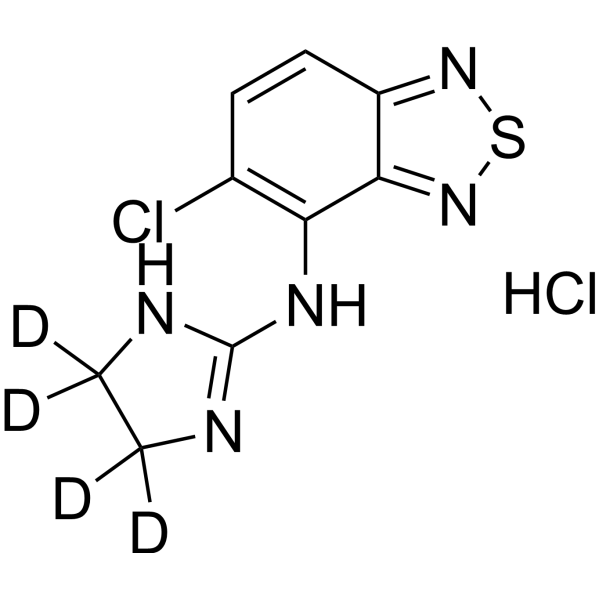
Tizanidine-d4 hydrochloride
Tizanidine-d4 hydrochloride is deuterium labeled Tizanidine hydrochloride (HY-B0194A). Tizanidine hydrochloride, a skeletal muscle relaxant, is an orally effective central α2-adrenoceptor agonist (IC50 = 6.9 nmol). Tizanidine hydrochloride primarily exerts muscle relaxation effects by inhibiting the release of excitatory amino acids (glutamate and aspartate) from the presynaptic terminals of spinal cord interneurons. Tizanidine hydrochloride has anti-injury activity and can inhibit gastrointestinal (GI) transport. Tizanidine hydrochloride can inhibit the proliferation, migration, and invasion of lung cancer cells and induce cell apoptosis by upregulating Nischarin and inhibiting the AKT and Wnt3a/β-catenin signaling pathways. Tizanidine hydrochloride can be used to treat spasticity caused by diseases such as multiple sclerosis (MS), stroke, and spinal cord injury (SCI).
For research use only. We do not sell to patients.
- CAS No.: 1188263-51-5
- Formula: C9H5D4Cl2N5S
- Molecular Weight:294.20
-
Storage:
Please store the product under the recommended conditions in the Certificate of Analysis.

To place orders, for customer services and technical support, please contact: MedChemExpress USA
Tel: 609-228-6898 E-mail: [email protected] [email protected]


-
 Biological Activity
-
Chemical Information
- Purity & Documentation
- References
-
 Help & FAQs


All Adrenergic Receptor Isoforms
More

Biological Activity
Description
Application
1. This compound can be used as a tracer
2. This compound can be used as an internal standard for quantitative analysis by NMR, GC-MS, or LC-MS.


Chemical Information
-
CAS No. 1188263-51-5
-
Unlabeled CAS 64461-82-1
-
Molecular Weight 294.20
-
Formula C9H5D4Cl2N5S
-
SMILES
ClC1=C(C2=NSN=C2C=C1)NC3=NC([2H])([2H])C([2H])([2H])N3.Cl
-
Shipping
Room temperature in continental US; may vary elsewhere.
-
Storage
Please store the product under the recommended conditions in the Certificate of Analysis.


Purity & Documentation
References
[1]. Russak EM, et al. Impact of Deuterium Substitution on the Pharmacokinetics of Pharmaceuticals. Ann Pharmacother. 2019;53(2):211-216. [Content Brief]
[2]. Kamen L, et al. A practical overview of tizanidine use for spasticity secondary to multiple sclerosis, stroke, and spinal cord injury. Curr Med Res Opin. 2008 Feb;24(2):425-39. [Content Brief]

Calculators
Concentration (start) × Volume (start) = Concentration (final) × Volume (final)


Tizanidine-d4 hydrochloride Related Classifications
HY-B0194AS Related Classifications
 Powered by Bioz