



Acridine Orange 10-Nonyl Bromide (solution)
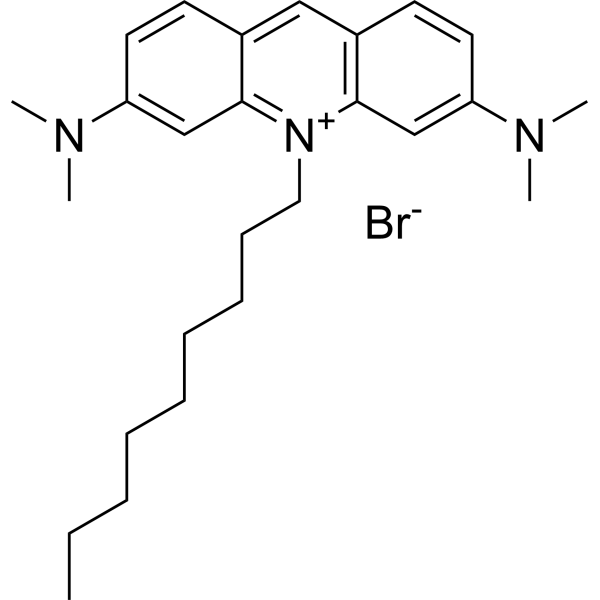
Acridine Orange 10-Nonyl Bromide (solution) is a fluorescent probe for cardiolipin (λex: 489 nm, λem: 525 nm).
Solvent and concentration: DMSO: 10 mM
For research use only. We do not sell to patients.
- CAS No.: 75168-11-5
- Formula: C26H38BrN3
- Molecular Weight:472.52
-
Storage:
Please store the product under the recommended conditions in the Certificate of Analysis.


To place orders, for customer services and technical support, please contact: MedChemExpress USA
Tel: 609-228-6898 E-mail: [email protected] [email protected]


-
 Biological Activity
-
Chemical Information
- Purity & Documentation
- References
-
 Help & FAQs




Biological Activity
Description
Solvent and concentration: DMSO: 10 mM
In Vitro
Acridine Orange 10-Nonyl Bromide is a fluorescent probe for cardiolipin (λex: 489 nm, λem: 525 nm) which can be used to quantify the cardiolipin in isolated mitochondria. In 15 min at 20°C, Acridine Orange 10-Nonyl Bromide at 4.75 μM saturates the mitochondrial binding sites present in 1.5 X 10⁶ cells[1].
When Acridine Orange 10-Nonyl Bromide interacts with cardiolipin, the dye excitation and emission wave lengths shift from 496 and 525 nm to 450 and 640 nm, respectively. Increasing amounts of cardiolipin (0 to 30 μM) and other acidic phospholipids in thin-walled vesicles added to Acridine Orange 10-Nonyl Bromide (45 μM) changes the red fluorescence emission measured at 640 nm according to the liposome composition[2].
MedChemExpress (MCE) has not independently confirmed the accuracy of these methods. They are for reference only.


Chemical Information
-
CAS No. 75168-11-5
-
Molecular Weight 472.52
-
Formula C26H38BrN3
-
SMILES
CCCCCCCCC[N+]1=C2C=C(N(C)C)C=CC2=CC3=C1C=C(N(C)C)C=C3.[Br-]
-
Shipping
Room temperature in continental US; may vary elsewhere.
-
Storage
Please store the product under the recommended conditions in the Certificate of Analysis.


Purity & Documentation
References
[1]. Ratinaud MH, et al. In situ flow cytometric analysis of nonyl acridine orange-stained mitochondria from splenocytes. Cytometry. 1988 May;9(3):206-12. [Content Brief]
[2]. Gallet PF, et al. Direct cardiolipin assay in yeast using the red fluorescence emission of 10-N-nonyl acridine orange. Eur J Biochem. 1995 Feb 15;228(1):113-9. [Content Brief]

Calculators
Concentration (start) × Volume (start) = Concentration (final) × Volume (final)


Acridine Orange 10-Nonyl Bromide (solution) Related Classifications
HY-DY1078 Related Classifications
 Powered by Bioz