



ACSL3 Antibody (YA6455)
(Synonyms: ACS3 antibody; Acsl3 antibody; ACSL3_HUMAN antibody; Acyl CoA synthetase long chain family member 3 antibody; FACL3 antibody; Fatty acid Coenzyme A ligase long chain 3 antibody; LACS 3 antibody; LACS3 antibody; Lignoceroyl CoA synthase antibody; Long chain acyl CoA synthetase 3 antibody; ACS3 antibody; Acsl3 antibody; ACSL3_HUMAN antibody; Acyl CoA synthetase long chain family member 3 antibody; FACL3 antibody; Fatty acid Coenzyme A ligase long chain 3 antibody; LACS 3 antibody; LACS3 antibody; Lignoceroyl CoA synthase antibody; Long chain acyl CoA synthetase 3 antibody; Long chain fatty acid CoA ligase 3 antibody; Long-chain acyl-CoA synthetase 3 antibody; Long-chain-fatty-acid--CoA ligase 3 antibody; PRO2194 antibody; )
Based on 1 Customer Validation
ACSL3 Antibody (YA6455) is a Mouse-derived and non-conjugated IgG1 monoclonal antibody, targeting to ACSL3.
-
Host:
Mouse
-
Isotype:
IgG1
-
Application:
WB, IHC-P
-
Reactivity :
Human
-
Formulation:
Supplied in PBS (pH7.4), 0.1% BSA, 40% Glycerol. Preservative: 0.05% Sodium Azide.
-
Conjugation:
Non-conjugated


To place orders, for customer services and technical support, please contact: MedChemExpress USA
Tel: 609-228-6898 E-mail: [email protected] [email protected]





Applications
| Application |
WB

WB: Western Blot
|
IHC-P
IHC-P: Immunohistochemistry-Paraffin
|
|---|---|---|
| Dilution Ratio | 1:1000 | 1:500 |


Product Details
ACSL3 Antibody (YA6455) is a Mouse-derived and non-conjugated IgG1 monoclonal antibody, targeting to ACSL3.
-
Host Mouse

-
Clonality Recombinant,Monoclonal

-
Species ReactivityHuman
-
Observed Molecular WeightObserved band size: 70 kDa
Note: Due to possible protein modifications or aggregation, the molecular weight should be confirmed by actual measurement, and the predicted value is for reference only.

-
Calculated Molecular Weight Predicted band size: 80 kDa

Recombinant protein within human ACSL3 aa 180-380.
affinity purified.
Non-conjugated
Unmodified
IgG1


Product Properties
-
Appearance
Liquid
-
Formulation
Supplied in PBS (pH7.4), 0.1% BSA, 40% Glycerol. Preservative: 0.05% Sodium Azide.
-
Concentration
Batch-dependent, Please check the COA for the concentration of each lot. Check Lot Concentration
-
Storage & Stability
Stored at -20°C for 1 year. Avoid repeated freeze / thaw cycles.
-
Shipping
Shipping with blue ice.


Verification Images
-
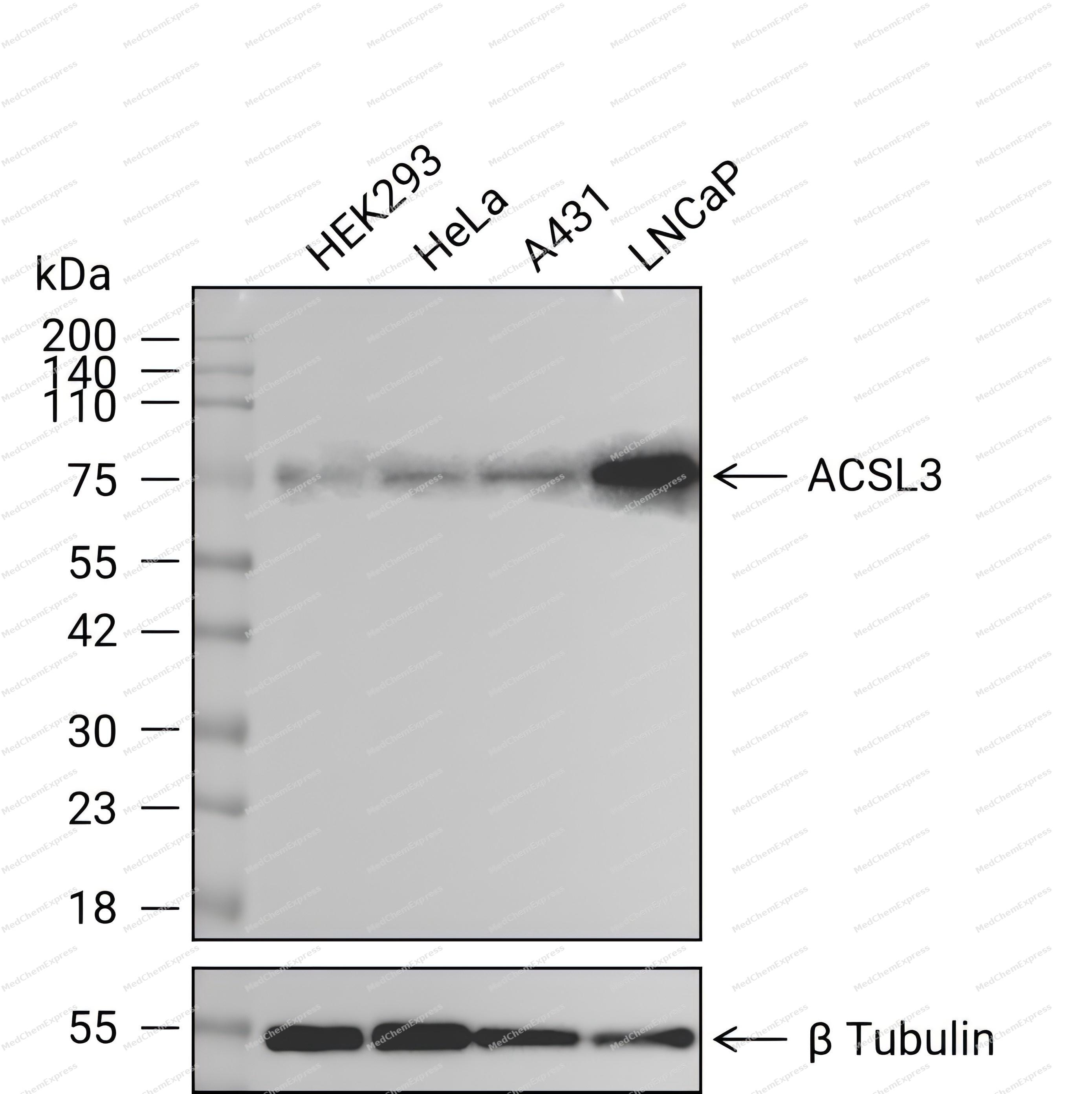 Western blot analysis of extracts from HEK293 (lane 1(20μg)) 、HeLa (lane 2(20μg)) 、A431 (lane 3(20μg)) and LNCaP (lane 4(20μg)) using ACSL3 Antibody (HY-P86762) . Proteins were transferred to a PVDF membrane and blocked with 5% nonfat dry milk in TBST for 1.5 hour at room temperature. The primary antibody (1/1000) and Loading control antibody (β Tubulin, 1/10000) was used in 5% nonfat dry milk in TBST at 4℃ overnight. Goat Anti-Mouse IgG-HRP Secondary Antibody (1/10,000) was used for 1 hour at room temperature.
 -
 Immunohistochemical analysis of paraffin-embedded human skin tissue using ACSL3 Antibody (HY-P86762, 1/500). The section was pretreated using heat mediated antigen retrieval with sodium citrate buffer (pH 6.0) for 8 minutes. The tissues were blocked with quick block buffer for 0.5 hours at room temperature, washed with PBS and PBST, and then incubated with the primary antibody overnight at 4℃. The detection was performed using an HRP conjugated compact polymer system. DAB was used as the chromogen. Tissues were counterstained with hematoxylin and mounted with DPX.
 -
 Immunohistochemical analysis of paraffin-embedded human soft tissue using ACSL3 Antibody (HY-P86762, 1/500). The section was pretreated using heat mediated antigen retrieval with sodium citrate buffer (pH 6.0) for 8 minutes. The tissues were blocked with quick block buffer for 0.5 hours at room temperature, washed with PBS and PBST, and then incubated with the primary antibody overnight at 4℃. The detection was performed using an HRP conjugated compact polymer system. DAB was used as the chromogen. Tissues were counterstained with hematoxylin and mounted with DPX.
 -
 Immunohistochemical analysis of paraffin-embedded human cerebellum tissue using ACSL3 Antibody (HY-P86762, 1/500). The section was pretreated using heat mediated antigen retrieval with sodium citrate buffer (pH 6.0) for 8 minutes. The tissues were blocked with quick block buffer for 0.5 hours at room temperature, washed with PBS and PBST, and then incubated with the primary antibody overnight at 4℃. The detection was performed using an HRP conjugated compact polymer system. DAB was used as the chromogen. Tissues were counterstained with hematoxylin and mounted with DPX.
 -
 Immunohistochemical analysis of paraffin-embedded human heart muscle tissue using ACSL3 Antibody (HY-P86762, 1/500). The section was pretreated using heat mediated antigen retrieval with sodium citrate buffer (pH 6.0) for 8 minutes. The tissues were blocked with quick block buffer for 0.5 hours at room temperature, washed with PBS and PBST, and then incubated with the primary antibody overnight at 4℃. The detection was performed using an HRP conjugated compact polymer system. DAB was used as the chromogen. Tissues were counterstained with hematoxylin and mounted with DPX.
 -
 Immunohistochemical analysis of paraffin-embedded human adrenal gland tissue using ACSL3 Antibody (HY-P86762, 1/500). The section was pretreated using heat mediated antigen retrieval with sodium citrate buffer (pH 6.0) for 8 minutes. The tissues were blocked with quick block buffer for 0.5 hours at room temperature, washed with PBS and PBST, and then incubated with the primary antibody overnight at 4℃. The detection was performed using an HRP conjugated compact polymer system. DAB was used as the chromogen. Tissues were counterstained with hematoxylin and mounted with DPX.
 -
 Immunohistochemical analysis of paraffin-embedded human lymph node tissue using ACSL3 Antibody (HY-P86762, 1/500). The section was pretreated using heat mediated antigen retrieval with sodium citrate buffer (pH 6.0) for 8 minutes. The tissues were blocked with quick block buffer for 0.5 hours at room temperature, washed with PBS and PBST, and then incubated with the primary antibody overnight at 4℃. The detection was performed using an HRP conjugated compact polymer system. DAB was used as the chromogen. Tissues were counterstained with hematoxylin and mounted with DPX.
 -
 Immunohistochemical analysis of paraffin-embedded human tonsil tissue using ACSL3 Antibody (HY-P86762, 1/500). The section was pretreated using heat mediated antigen retrieval with sodium citrate buffer (pH 6.0) for 8 minutes. The tissues were blocked with quick block buffer for 0.5 hours at room temperature, washed with PBS and PBST, and then incubated with the primary antibody overnight at 4℃. The detection was performed using an HRP conjugated compact polymer system. DAB was used as the chromogen. Tissues were counterstained with hematoxylin and mounted with DPX.


Background
-
Function
ACSL3 is an Acyl-CoA synthetases (ACSL) activates long-chain fatty acids for both synthesis of cellular lipids, and degradation via beta-oxidation. Required for the incorporation of fatty acids into phosphatidylcholine, the major phospholipid located on the surface of VLDL (very low density lipoproteins). Has mainly an anabolic role in energy metabolism. Mediates hepatic lipogenesis. Preferentially uses myristate, laurate, arachidonate and eicosapentaenoate as substrates. Both isoforms exhibit the same level of activity[1][2].
-
Subcellular Localization
Mitochondrion outer membrane,Peroxisome membrane,Microsome membrane,Endoplasmic reticulum membrane
-
Isoforms & Post-Translational Modification
O95573: 720 amino acids, molecular weight 80420 Da.
-
SwissProt ID
-
Synonyms
ACS3 antibody; Acsl3 antibody; ACSL3_HUMAN antibody; Acyl CoA synthetase long chain family member 3 antibody; FACL3 antibody; Fatty acid Coenzyme A ligase long chain 3 antibody; LACS 3 antibody; LACS3 antibody; Lignoceroyl CoA synthase antibody; Long chain acyl CoA synthetase 3 antibody; ACS3 antibody; Acsl3 antibody; ACSL3_HUMAN antibody; Acyl CoA synthetase long chain family member 3 antibody; FACL3 antibody; Fatty acid Coenzyme A ligase long chain 3 antibody; LACS 3 antibody; LACS3 antibody; Lignoceroyl CoA synthase antibody; Long chain acyl CoA synthetase 3 antibody; Long chain fatty acid CoA ligase 3 antibody; Long-chain acyl-CoA synthetase 3 antibody; Long-chain-fatty-acid--CoA ligase 3 antibody; PRO2194 antibody;


Documentation
-
Data Sheet (231 KB)
-
SDS (254 KB)
- English - EN (254 KB)
- Français - FR (254 KB)
- Deutsch - DE (254 KB)
- Norwegian - NO (254 KB)
- Español - ES (254 KB)
- Swedish - SV (254 KB)
- Italian - IT (254 KB)
- Korean - KR (254 KB)
- Portuguese - PT (254 KB)
-
User Guide for Antibodies (1077 KB)

 Powered by Bioz
