



AIF Antibody (YA835)
(Synonyms: AIFM1; AIF; PDCD8; Apoptosis-inducing factor 1; mitochondrial; Programmed cell death protein 8)
Based on 1 Customer Validation
AIF Antibody (YA835) is a Mouse-derived and non-conjugated IgG2a monoclonal antibody, targeting to AIF.
-
Host:
Mouse
-
Isotype:
IgG
-
Application:
WB, ICC/IF
-
Reactivity :
Human
-
Formulation:
Supplied in 1*PBS (pH 7.3), 50% glycerol and 0.5% BSA. Preservative: 0.02% sodium azide.
-
Conjugation:
Non-conjugated


To place orders, for customer services and technical support, please contact: MedChemExpress USA
Tel: 609-228-6898 E-mail: [email protected] [email protected]





Applications
| Application |
WB

WB: Western Blot
|
ICC/IF
ICC/IF: Immunocytochemistry/
Immunofluorescence |
|---|---|---|
| Dilution Ratio | 1:500-1:1000 | 1:50-1:200 |


Product Details
AIF Antibody (YA835) is a Mouse-derived and non-conjugated IgG2a monoclonal antibody, targeting to AIF.
-
Host Mouse

-
Clonality Monoclonal

-
Species ReactivityHuman
-
Observed Molecular WeightObserved band size: 67 kDa
Note: Due to possible protein modifications or aggregation, the molecular weight should be confirmed by actual measurement, and the predicted value is for reference only.

-
Calculated Molecular Weight Predicted band size: 67 kDa

Synthetic peptide corresponding to Human AIF.The exact sequence is proprietary to MCE.
Endogenous
affinity purified
Non-conjugated
Unmodified
IgG


Product Properties
-
Appearance
Solution
-
Formulation
Supplied in 1*PBS (pH 7.3), 50% glycerol and 0.5% BSA. Preservative: 0.02% sodium azide.
-
Concentration
Batch-dependent, Please check the COA for the concentration of each lot. Check Lot Concentration
-
Storage & Stability
Stored at -20°C for 1 year. Avoid repeated freeze / thaw cycles.
-
Shipping
Shipping with blue ice.


Verification Images
-
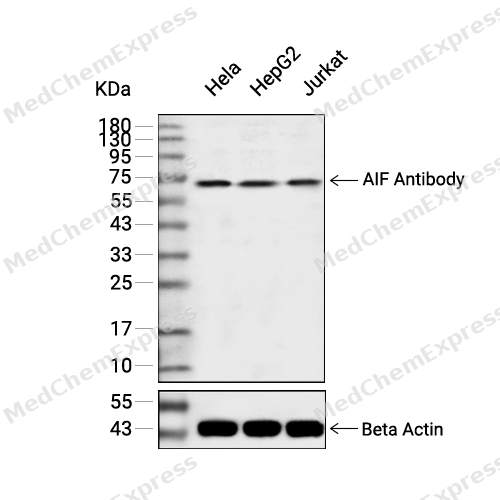 Western blot analysis of extracts from Hela(lane 2(20ug) , HepG2(lane 3(20ug) and Jurkat(lane 4(20ug) using AIF Antibody (HY-P80534) Rabbit mAb. Proteins were transferred to a PVDF membrane and blocked with 5% non-fat milk in TBST for 2 hour at room temperature. The primary antibody (1/1000) and Loading control antibody (Beta Actin, HY-P80438, 1/10000) was used in 5% non-fat milk in TBST at 4°C overnight. Goat Anti-Mouse/Rabbit IgG-HRP Secondary Antibody (1/10000) was used for 1 hour at room temperature.
 -
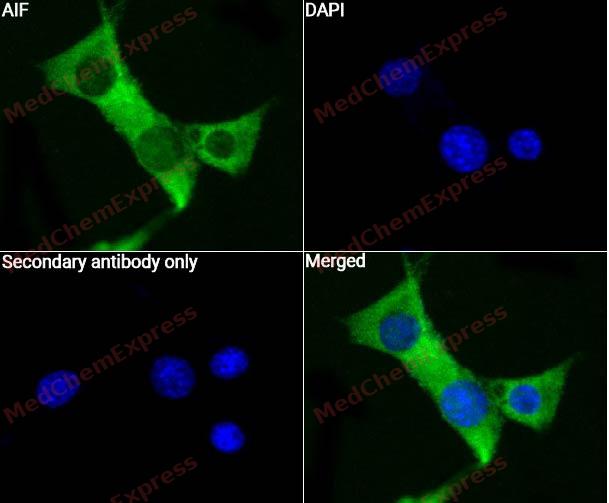 Immunocytochemistry analysis of NIH3T3 cells labeling AIF with AIF Antibody (HY-P80534) at 1/50 dilution. Cells were fixed in 4% paraformaldehyde for 15 minutes at room temperature, permeabilized with 0.1% Triton X-100 for 10 minutes at room temperature, then blocked with QuickBlock™ Blocking Buffer for Immunol Staining for 10 min at room temperature. Cells were then incubated with AIF Antibody (HY-P80534) at 1/50 dilution in QuickBlock™ Blocking Buffer for Immunol Staining at 4 ℃. Alexa Fluor® 488-conjugated AffiniPure Goat Anti-Mouse IgG H&L(HY-P8005, Green) was used as the secondary antibody at 1/1,000 dilution. PBS instead of the primary antibody was used as the secondary antibody only control. The Nuclear counterstain was DAPI (Blue).
 -
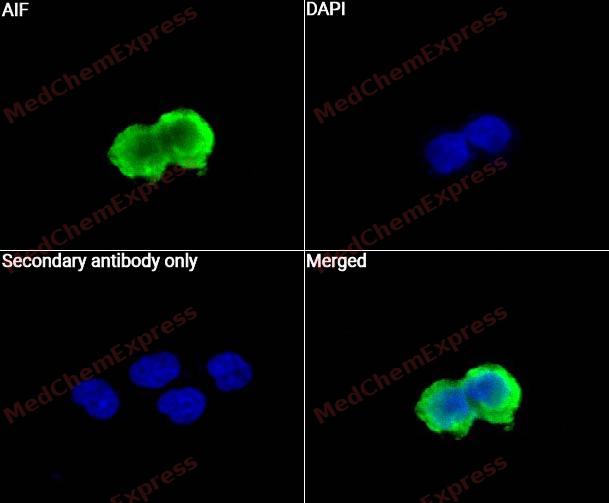 Immunocytochemistry analysis of Hela cells labeling AIF with AIF Antibody (HY-P80534)at 1/50 dilution. Cells were fixed in 4% paraformaldehyde for 15 minutes at room temperature, permeabilized with 0.1% Triton X-100 for 10 minutes at room temperature, then blocked with QuickBlock™ Blocking Buffer for Immunol Staining for 10 min at room temperature. Cells were then incubated with AIF Antibody (HY-P80534) at 1/50 dilution in QuickBlock™ Blocking Buffer for Immunol Staining at 4 ℃. Alexa Fluor® 488-conjugated AffiniPure Goat Anti-Mouse IgG H&L(HY-P8005, Green) was used as the secondary antibody at 1/1,000 dilution. PBS instead of the primary antibody was used as the secondary antibody only control. The Nuclear counterstain was DAPI (Blue).


Background
-
Function
AIF functions both as NADH oxidoreductase and as regulator of apoptosis. In response to apoptotic stimuli, it is released from the mitochondrion intermembrane space into the cytosol and to the nucleus, where it functions as a proapoptotic factor in a caspase-independent pathway. Release into the cytoplasm is mediated upon binding to poly-ADP-ribose chains. The soluble form (AIFsol) found in the nucleus induces 'parthanatos' i.e. caspase-independent fragmentation of chromosomal DNA. Binds to DNA in a sequence-independent manner. Interacts with EIF3G, and thereby inhibits the EIF3 machinery and protein synthesis, and activates caspase-7 to amplify apoptosis. Plays a critical role in caspase-independent, pyknotic cell death in hydrogen peroxide-exposed cells. In contrast, participates in normal mitochondrial metabolism. Plays an important role in the regulation of respiratory chain biogenesis by interacting with CHCHD4 and controlling CHCHD4 mitochondrial import; Has NADH oxidoreductase activity. Does not induce nuclear apoptosis; Pro-apoptotic isoform[1][2][3][4][5][6][7].
-
Subcellular Localization
Mitochondrion intermembrane space; Mitochondrion inner membrane; Cytoplasm; Nucleus; Cytoplasm, perinuclear region; Mitochondrion intermembrane space; Mitochondrion inner membrane; Mitochondrion; Cytoplasm, cytosol; Cytoplasm
-
Expression
Tissue_specificity:Expression was observed in all tested tissues (PubMed: 16644725) . Detected in muscle and skin fibroblasts (protein level) (PubMed: 23217327) . Expressed in osteoblasts (protein level) (PubMed: 28842795) ; brain-specific; expressed in all tested tissues except brain tissue; isoform 5 is frequently downregulated in human cancers.
Induction:Strongly down-regulated in many tumor cells, up-regulated by gamma-irradiation -
Isoforms & Post-Translational Modification
O95831 has 6 isomers: O95831-1: 66901 Da (predicted); O95831-2: 35638 Da (predicted); O95831-3: 66295 Da (predicted); O95831-4: 35384 Da (predicted); O95831-5: 28404 Da (predicted); O95831-6: 4812 Da (predicted).
Under normal conditions, a 54-residue N-terminal segment is first proteolytically removed during or just after translocation into the mitochondrial intermembrane space (IMS) by the mitochondrial processing peptidase (MPP) to form the inner-membrane-anchored mature form (AIFmit). During apoptosis, it is further proteolytically processed at amino-acid position 101 leading to the generation of the mature form, which is confined to the mitochondrial IMS in a soluble form (AIFsol). AIFsol is released to the cytoplasm in response to specific death signals, and translocated to the nucleus, where it induces nuclear apoptosis in a caspase-independent manner;Ubiquitination by XIAP/BIRC4 does not lead to proteasomal degradation. Ubiquitination at Lys-255 by XIAP/BIRC4 blocks its ability to bind DNA and induce chromatin degradation, thereby inhibiting its ability to induce cell death -
Subunit
Monomer (oxidized form). Homodimer (reduced form). Upon reduction with NADH, undergoes dimerization and forms tight, long-lived FADH2-NAD charge transfer complexes (CTC) resistant to oxidation (PubMed:20111043, PubMed:23217327, PubMed:24914854, PubMed:27818101). Also dimerizes with isoform 3 preventing its release from mitochondria (PubMed:20111043). Interacts with XIAP/BIRC4 (PubMed:17967870). Interacts (via N-terminus) with EIF3G (via C-terminus) (PubMed:17094969). Interacts with PRELID1 (PubMed:21364629). Interacts with CHCHD4; the interaction increases in presence of NADH (PubMed:26004228). Interacts with processed form of PARP1 (Poly [ADP-ribose] polymerase 1, processed C-terminus); interaction is mediated with poly-ADP-ribose chains attached to PARP1, promoting translocation into the nucleus (PubMed:33168626)
-
SwissProt ID
-
Synonyms
AIFM1; AIF; PDCD8; Apoptosis-inducing factor 1; mitochondrial; Programmed cell death protein 8
-
Research Field
Cell Biology


Documentation
-
Data Sheet (262 KB)
-
SDS (252 KB)
- English - EN (252 KB)
- Français - FR (252 KB)
- Deutsch - DE (252 KB)
- Norwegian - NO (252 KB)
- Español - ES (252 KB)
- Swedish - SV (252 KB)
- Italian - IT (252 KB)
- Korean - KR (252 KB)
- Portuguese - PT (252 KB)
-
User Guide for Antibodies (1077 KB)
References
[1]. Kim JT, et al. Apoptosis-inducing factor (AIF) inhibits protein synthesis by interacting with the eukaryotic translation initiation factor 3 subunit p44 (eIF3g). FEBS Lett. 2006 Nov 27;580(27):6375-83. [Content Brief]
[2]. Ghezzi D, et al. Severe X-linked mitochondrial encephalomyopathy associated with a mutation in apoptosis-inducing factor. Am J Hum Genet. 2010 Apr 9;86(4):639-49. [Content Brief]
[3]. Rinaldi C, et al. Cowchock syndrome is associated with a mutation in apoptosis-inducing factor. Am J Hum Genet. 2012 Dec 7;91(6):1095-102. [Content Brief]
[4]. Mashimo M, et al. The 89-kDa PARP1 cleavage fragment serves as a cytoplasmic PAR carrier to induce AIF-mediated apoptosis. J Biol Chem. 2021 Jan-Jun;296:100046. [Content Brief]
[5]. Sevrioukova IF, et al. Structure/Function Relations in AIFM1 Variants Associated with Neurodegenerative Disorders. J Mol Biol. 2016 Sep 11;428(18):3650-65. [Content Brief]
[6]. Son YO, et al. Apoptosis-inducing factor plays a critical role in caspase-independent, pyknotic cell death in hydrogen peroxide-exposed cells. Apoptosis. 2009 Jun;14(6):796-808. [Content Brief]
[7]. Hangen E, et al. Interaction between AIF and CHCHD4 Regulates Respiratory Chain Biogenesis. Mol Cell. 2015 Jun 18;58(6):1001-14. [Content Brief]

 Powered by Bioz
