



CARD9 Antibody (YA566)
(Synonyms: Caspase recruitment domain-containing protein 9; hCARD9)
Based on 1 Customer Validation
CARD9 Antibody (YA566) is a Rabbit-derived and non-conjugated IgG monoclonal antibody, targeting to CARD9.
-
Host:
Rabbit
-
Isotype:
IgG
-
Application:
WB
-
Reactivity :
Human
-
Formulation:
Supplied in 50 mM Tris-Glycine (pH 7.4), 0.15 M NaCl, 40% Glycerol and 0.05% BSA. Preservative: 0.01% Sodium azide
-
Conjugation:
Non-conjugated


To place orders, for customer services and technical support, please contact: MedChemExpress USA
Tel: 609-228-6898 E-mail: [email protected] [email protected]





Applications
| Application |
WB

WB: Western Blot
|
|---|---|
| Dilution Ratio | 1:500-1:1000 |


Product Details
CARD9 Antibody (YA566) is a Rabbit-derived and non-conjugated IgG monoclonal antibody, targeting to CARD9.
-
Host Rabbit

-
Clonality Recombinant,Monoclonal

-
Species ReactivityHuman
-
Observed Molecular WeightObserved band size: 62 kDa
Note: Due to possible protein modifications or aggregation, the molecular weight should be confirmed by actual measurement, and the predicted value is for reference only.

-
Calculated Molecular Weight Predicted band size: 62 kDa

Synthetic peptide corresponding to Human CARD9 aa467-480.
Endogenous
affinity purified
Non-conjugated
Unmodified
IgG


Product Properties
-
Appearance
Solution
-
Formulation
Supplied in 50 mM Tris-Glycine (pH 7.4), 0.15 M NaCl, 40% Glycerol and 0.05% BSA. Preservative: 0.01% Sodium azide
-
Concentration
Batch-dependent, Please check the COA for the concentration of each lot. Check Lot Concentration
-
Storage & Stability
Stored at -20°C for 1 year. Avoid repeated freeze / thaw cycles.
-
Shipping
Shipping with blue ice.


Verification Images
-
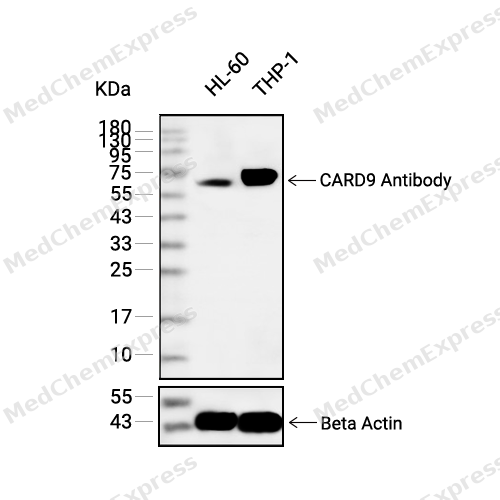 Western blot analysis of extracts from HL-60(lane 2(20ug) , THP-1(lane 3(20ug) using CARD9 Antibody (HY-P80582) Rabbit mAb. Proteins were transferred to a PVDF membrane and blocked with 5% non-fat milk in TBST for 2 hour at room temperature. The primary antibody (1/1000) and Loading control antibody (Beta Actin, HY-P80438, 1/10000) was used in 5% non-fat milk in TBST at 4°C overnight. Goat Anti-Mouse/Rabbit IgG-HRP Secondary Antibody (1/10000) was used for 1 hour at room temperature.


Background
-
Function
CARD9 is an Adapter protein that plays a key role in innate immune response against fungi by forming signaling complexes downstream of C-type lectin receptors. CARD9-mediated signals are essential for antifungal immunity against a subset of fungi from the phylum Ascomycota. Transduces signals in myeloid cells downstream of C-type lectin receptors CLEC7A (dectin-1), CLEC6A (dectin-2) and CLEC4E (Mincle), which detect pathogen-associated molecular pattern metabolites (PAMPs), such as fungal carbohydrates, and trigger CARD9 activation. Upon activation, CARD9 homooligomerizes to form a nucleating helical template that recruits BCL10 via CARD-CARD interaction, thereby promoting polymerization of BCL10 and subsequent recruitment of MALT1: this leads to activation of NF-kappa-B and MAP kinase p38 (MAPK11, MAPK12, MAPK13 and/or MAPK14) pathways which stimulate expression of genes encoding pro-inflammatory cytokines and chemokines. CARD9 signaling in antigen-presenting cells links innate sensing of fungi to the activation of adaptive immunity and provides a cytokine milieu that induces the development and subsequent of interleukin 17-producing T helper (Th17) cells. Also involved in activation of myeloid cells via classical ITAM-associated receptors and TLR: required for TLR-mediated activation of MAPK, while it is not required for TLR-induced activation of NF-kappa-B. CARD9 can also be engaged independently of BCL10: forms a complex with RASGRF1 downstream of C-type lectin receptors, which recruits and activates HRAS, leading to ERK activation and the production of cytokines. Acts as an important regulator of the intestinal commensal fungi (mycobiota) component of the gut microbiota. Plays an essential role in antifungal immunity against dissemination of gut fungi: acts by promoting induction of antifungal IgG antibodies response in CX3CR1(+) macrophages to confer protection against disseminated C.albicans or C.auris infection. Also mediates immunity against other pathogens, such as certain bacteria, viruses and parasites; CARD9 signaling is however redundant with other innate immune responses. In response to L.monocytogenes infection, required for the production of inflammatory cytokines activated by intracellular peptidoglycan: acts by connecting NOD2 recognition of peptidoglycan to downstream activation of MAP kinases (MAPK) without activating NF-kappa-B[1][2][3][4][5][6][7][8][9][10][11][12][13].
-
Subcellular Localization
Cytoplasm
-
Expression
Tissue_specificity:Expression is restricted to several populations of phagocytes, such as macrophages, monocytes, and dendritic cells (PubMed:33548172) . Highly expressed in spleen (PubMed:11053425) . Also detected in liver, placenta, lung, peripheral blood leukocytes and in brain (PubMed:11053425) -
Isoforms & Post-Translational Modification
Q9H257 has 3 isomers: Q9H257-1: 62241 Da (predicted); Q9H257-2: 56667 Da (predicted); Q9H257-3: 42953 Da (predicted).
Phosphorylated at Thr-231 by PRKCD downstream of C-type lectin receptors activation: phosphorylation promotes interaction with BCL10, followed by activation of NF-kappa-B and MAP kinase p38 pathways (By similarity). Phosphorylated at Thr-531 and Thr-533 by CK2 following interaction with VHL, leading to inhibit the ability to activate NF-kappa-B (By similarity);Ubiquitinated at Lys-125 via 'Lys-27'-linked ubiquitin by TRIM62 downstream of C-type lectin receptors activation; leading to CARD9 activation, followed by activation of NF-kappa-B and MAP kinase p38 pathways (PubMed:26488816, PubMed:31296852). Deubiquitinated at Lys-125 by USP15, inhibiting CARD9 (PubMed:33093067) -
Subunit
Monomer (PubMed:30206119). Homodimer; homodimerization is mediated by the CARD domain which forms an extensive interaction with the adjacent linker and coiled-coil regions; leads to an autoinhibited state (PubMed:30206119, PubMed:31296852). Homomultimer; polymerizes following activation, forming a nucleating helical template that seeds BCL10-filament formation via a CARD-CARD interaction (PubMed:31296852).
-
SwissProt ID
-
Synonyms
Caspase recruitment domain-containing protein 9; hCARD9
-
Research Field
Cell Biology


Documentation
-
Data Sheet (263 KB)
-
SDS (251 KB)
- English - EN (251 KB)
- Français - FR (251 KB)
- Deutsch - DE (251 KB)
- Norwegian - NO (251 KB)
- Español - ES (251 KB)
- Swedish - SV (251 KB)
- Italian - IT (251 KB)
- Korean - KR (251 KB)
- Portuguese - PT (251 KB)
-
User Guide for Antibodies (1077 KB)
References
[1]. Alves de Medeiros AK, et al. Chronic and Invasive Fungal Infections in a Family with CARD9 Deficiency. J Clin Immunol. 2016 Apr;36(3):204-9. [Content Brief]
[2]. Imanaka Y, et al. Inherited CARD9 Deficiency in a Child with Invasive Disease Due to Exophiala dermatitidis and Two Older but Asymptomatic Siblings. J Clin Immunol. 2021 Jul;41(5):975-986. [Content Brief]
[3]. Wang X, et al. CARD9 mutations linked to subcutaneous phaeohyphomycosis and TH17 cell deficiencies. J Allergy Clin Immunol. 2014 Mar;133(3):905-8.e3. [Content Brief]
[4]. Lanternier F, et al. Inherited CARD9 deficiency in 2 unrelated patients with invasive Exophiala infection. J Infect Dis. 2015 Apr 15;211(8):1241-50. [Content Brief]
[5]. Lanternier F, et al. Inherited CARD9 deficiency in otherwise healthy children and adults with Candida species-induced meningoencephalitis, colitis, or both. J Allergy Clin Immunol. 2015 Jun;135(6):1558-68.e2. [Content Brief]
[6]. Gavino C, et al. Impaired RASGRF1/ERK-mediated GM-CSF response characterizes CARD9 deficiency in French-Canadians. J Allergy Clin Immunol. 2016 Apr;137(4):1178-1188.e7. [Content Brief]
[7]. Drummond RA, et al. CARD9-Dependent Neutrophil Recruitment Protects against Fungal Invasion of the Central Nervous System. PLoS Pathog. 2015 Dec;11(12):e1005293. [Content Brief]
[8]. Rieber N, et al. Extrapulmonary Aspergillus infection in patients with CARD9 deficiency. JCI Insight. 2016 Oct 20;1(17):e89890. [Content Brief]
[9]. Wang X, et al. Impaired Specific Antifungal Immunity in CARD9-Deficient Patients with Phaeohyphomycosis. J Invest Dermatol. 2018 Mar;138(3):607-617. [Content Brief]
[10]. Bertin J, et al. CARD9 is a novel caspase recruitment domain-containing protein that interacts with BCL10/CLAP and activates NF-kappa B. J Biol Chem. 2000 Dec 29;275(52):41082-6. [Content Brief]
[11]. Cao Z, et al. Ubiquitin Ligase TRIM62 Regulates CARD9-Mediated Anti-fungal Immunity and Intestinal Inflammation. Immunity. 2015 Oct 20;43(4):715-26. [Content Brief]
[12]. Holliday MJ, et al. Structures of autoinhibited and polymerized forms of CARD9 reveal mechanisms of CARD9 and CARD11 activation. Nat Commun. 2019 Jul 11;10(1):3070. [Content Brief]
[13]. Doron I, et al. Human gut mycobiota tune immunity via CARD9-dependent induction of anti-fungal IgG antibodies. Cell. 2021 Feb 18;184(4):1017-1031.e14. [Content Brief]

 Powered by Bioz
