



PD-L1 Antibody (YA4674)
(Synonyms: Programmed cell death 1 ligand 1; PD-L1; PDCD1 ligand 1; Programmed death ligand 1; B7 homolog 1; B7-H1; CD antigen CD274; CD274 nanobody; PD-L1 nanobody; )Based on 1 publication(s) in Google Scholar
PD-L1 Antibody (YA4674) is a Rabbit-derived and non-conjugated IgG monoclonal antibody, targeting to PD-L1.
-
Host:
Rabbit
-
Isotype:
IgG
-
Application:
WB
-
Reactivity :
Human
-
Formulation:
Supplied in PBS (pH7.4), 0.1% BSA, 40% Glycerol. Preservative: 0.05% Sodium Azide.
-
Conjugation:
Non-conjugated


To place orders, for customer services and technical support, please contact: MedChemExpress USA
Tel: 609-228-6898 E-mail: [email protected] [email protected]



Publications Citing Use of MedChemExpress (MCE) PD-L1 Antibody (YA4674)
More

Applications
| Application |
WB

WB: Western Blot
|
|---|---|
| Dilution Ratio | 1:2000 |


Product Details
PD-L1 Antibody (YA4674) is a Rabbit-derived and non-conjugated IgG monoclonal antibody, targeting to PD-L1.
-
Host Rabbit

-
Clonality Monoclonal

-
Species ReactivityHuman
-
Observed Molecular WeightObserved band size: 45-50 kDa
Note: Due to possible protein modifications or aggregation, the molecular weight should be confirmed by actual measurement, and the predicted value is for reference only.

-
Calculated Molecular Weight Predicted band size: 33 kDa

SwissProt: Q9NZQ7 Human
Synthetic peptide within human PD-L1 aa 260-290 (Cytoplasmic).
affinity purified.
Non-conjugated
Unmodified
IgG


Product Properties
-
Appearance
Solution
-
Formulation
Supplied in PBS (pH7.4), 0.1% BSA, 40% Glycerol. Preservative: 0.05% Sodium Azide.
-
Concentration
Batch-dependent, Please check the COA for the concentration of each lot. Check Lot Concentration
-
Storage & Stability
Stored at -20°C for 1 year. Avoid repeated freeze / thaw cycles.
-
Shipping
Shipping with blue ice.


Publications (1)
-
Journal Impact Factor
-
Most Recent


Verification Images
-
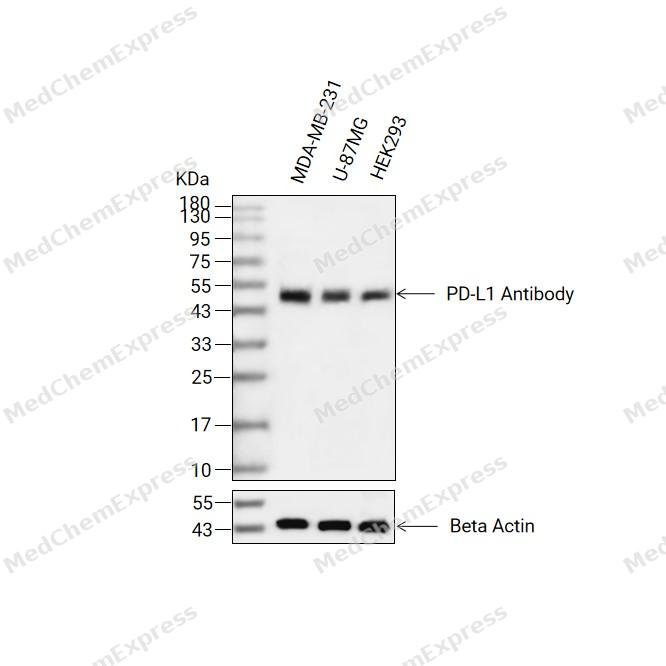 Western blot analysis of extracts from MDA-MB-231(lane 2(20ug) , U-87MG(lane 3(20ug) and HEK293(lane 4(20ug) using PD-L1 Antibody (HY-P84982) Rabbit mAb. Proteins were transferred to a PVDF membrane and blocked with 5% non-fat milk in TBST for 2 hour at room temperature. The primary antibody (1/1000) and Loading control antibody (Beta Actin, HY-P83730, 1/10000) was used in 5% non-fat milk in TBST at 4°C overnight. Goat Anti-Mouse/Rabbit IgG-HRP Secondary Antibody (1/10000) was used for 1 hour at room temperature.


Background
-
Function
CD274 (PD-L1) is an important immune checkpoint ligand protein belonging to the B7 family of immunoregulatory molecules. By binding to PD-1 on the surface of T cells, PD-L1 inhibits T-cell activation and immune responses; it is a key mechanism of tumor immune escape and a major target for current immune checkpoint therapies.
-
Subcellular Localization
Cell membrane,Early endosome membrane,Recycling endosome membrane,Nucleus,Cell membrane,Endomembrane system,Secreted
-
Expression
Tissue_specificity:It is highly expressed in the heart, skeletal muscle, placenta, and lungs. It is weakly expressed in the thymus, spleen, kidneys, and liver. It is expressed on activated T cells and B cells, dendritic cells, keratinocytes, and monocytes; it is widely expressed, with the highest expression in the lungs, liver, pituitary gland, and various peripheral blood cells (including neutrophils and certain subtypes of lymphocytes and myeloid cells) .
Induction:Up-regulated on T- and B-cells, dendritic cells, keratinocytes and monocytes after LPS and IFNG activation. Up-regulated in B-cells activated by surface Ig cross-linking -
Isoforms & Post-Translational Modification
CD274 (PD-L1) has 4 isomers: Q9NZQ7-1: 33275 Da (predicted); Q9NZQ7-2: 20246 Da (predicted); Q9NZQ7-3: 20454 Da (predicted); Q9NZQ7-4: 28050 Da (predicted).
Ubiquitinated; STUB1 likely mediates polyubiquitination of PD-L1/CD274 triggering its degradation. Ubiquitinated by MARCHF8; leading to degradation. Deubiquitinated by USP22; leading to stabilization -
Subunit
Interacts with PDCD1. Interacts (via transmembrane domain) with CMTM4 and CMTM6. Interacts with (phosphorylated) STAT3; promoting nuclear translocation. Interacts with CD80
-
SwissProt ID
-
Synonyms
Programmed cell death 1 ligand 1; PD-L1; PDCD1 ligand 1; Programmed death ligand 1; B7 homolog 1; B7-H1; CD antigen CD274; CD274 nanobody; PD-L1 nanobody;
Documentation
-
Data Sheet (231 KB)
-
SDS (252 KB)
- English - EN (252 KB)
- Français - FR (252 KB)
- Deutsch - DE (252 KB)
- Norwegian - NO (252 KB)
- Español - ES (252 KB)
- Swedish - SV (252 KB)
- Italian - IT (252 KB)
- Korean - KR (252 KB)
- Portuguese - PT (252 KB)
-
User Guide for Antibodies (1077 KB)

 Powered by Bioz
