



CFTR Antibody(YA3569)
(Synonyms: ABC 35 antibody ABC35 antibody ABCC 7 antibody ABCC7 antibody ATP binding cassette sub family C member 7 antibody; cAMP dependent chloride channel antibody; cAMP-dependent chloride channel antibody; CF antibody; CFTR antibody; CFTR/MRP antibody; CFTR_HUMAN antibody; Channel conductance controlling ATPase antibody; Channel conductance-controlling ATPase antibody; Cystic fibrosis transmembrane conductance regulator (ATP-binding cassette sub family C, member 7) antibody; Cystic fibrosis transmembrane conductance regulator antibody; Cystic Fibrosis Transmembrane Regulator antibody; dJ760C5.1 antibody; MRP 7 antibody; MRP7 antibody; TNR CFTR antibody)
Based on 1 Customer Validation
CFTR Antibody(YA3569) is a Rabbit-derived and non-conjugated IgG monoclonal antibody, targeting to CFTR.
-
Host:
Rabbit
-
Isotype:
IgG
-
Application:
WB, IHC-P, IP, IF-Tissue
-
Reactivity :
Human
-
Formulation:
Supplied in PBS (pH7.4), 0.1% BSA, 40% Glycerol. Preservative: 0.05% Sodium Azide.
-
Conjugation:
Non-conjugated


To place orders, for customer services and technical support, please contact: MedChemExpress USA
Tel: 609-228-6898 E-mail: [email protected] [email protected]





Applications
| Application |
WB

WB: Western Blot
|
IHC-P
IHC-P: Immunohistochemistry-Paraffin
|
IF-Tissue
IF-Tissue: Immunofluorescence-Tissue
|
IP
IP: Immunoprecipitation
|
|---|---|---|---|---|
| Dilution Ratio | 1:2000 | 1:200 | 1:500 | 1-2μg/sample |


Product Details
CFTR Antibody(YA3569) is a Rabbit-derived and non-conjugated IgG monoclonal antibody, targeting to CFTR.
-
Host Rabbit

-
Clonality Recombinant,Monoclonal

-
Species ReactivityHuman
-
Observed Molecular WeightObserved band size: 250 kDa
Note: Due to possible protein modifications or aggregation, the molecular weight should be confirmed by actual measurement, and the predicted value is for reference only.

-
Calculated Molecular Weight Predicted band size: 168 kDa

Recombinant protein within human CFTR aa 1,181-1,440.
Affinity Purified
Non-conjugated
Unmodified
IgG


Product Properties
-
Appearance
Solution
-
Formulation
Supplied in PBS (pH7.4), 0.1% BSA, 40% Glycerol. Preservative: 0.05% Sodium Azide.
-
Concentration
Batch-dependent, Please check the COA for the concentration of each lot. Check Lot Concentration
-
Storage & Stability
Stored at -20°C for 1 year. Avoid repeated freeze / thaw cycles.
-
Shipping
Shipping with blue ice.


Verification Images
-
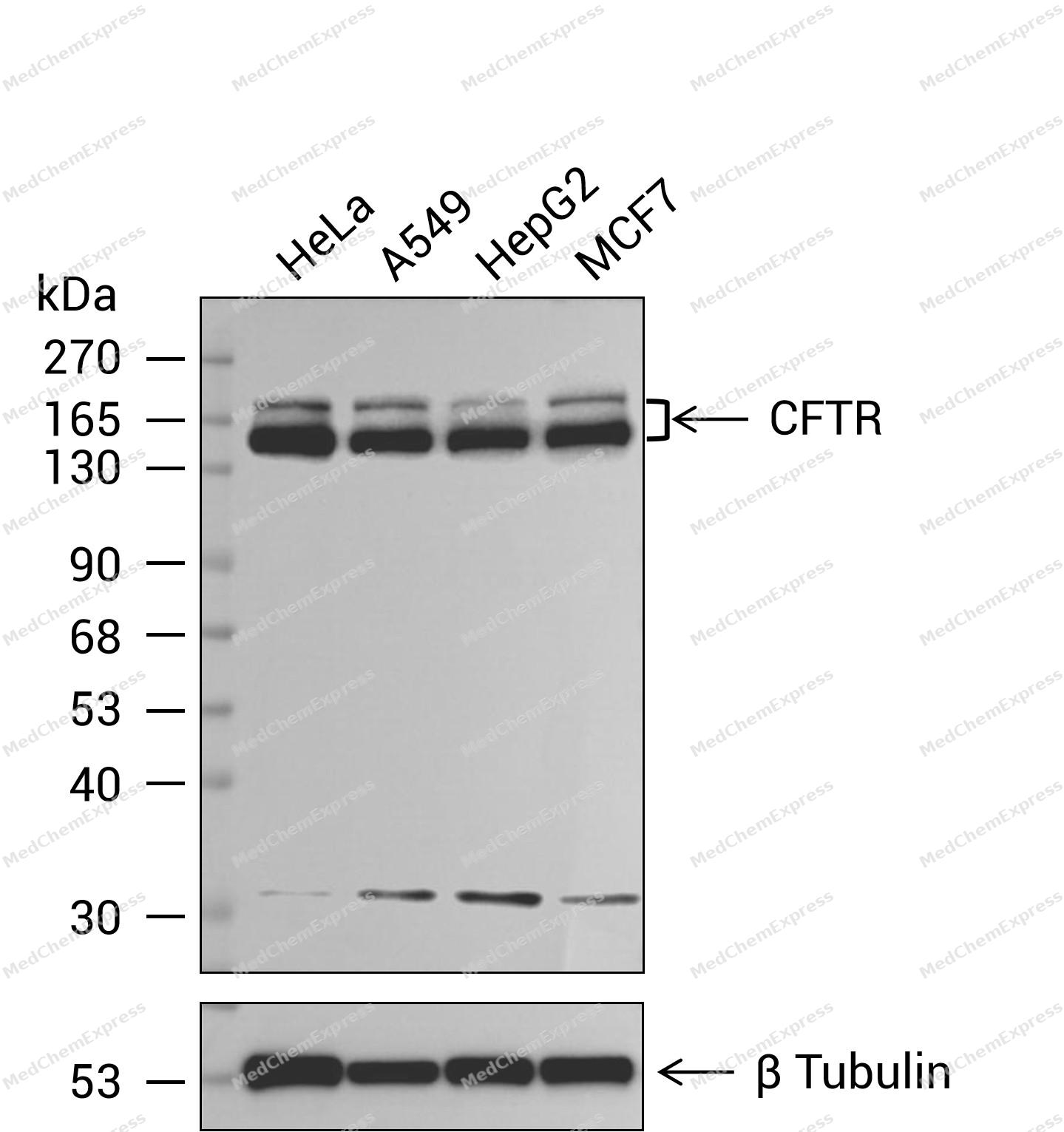 Western blot analysis of extracts from HeLa (lane 1(20μg)) 、A549 (lane 2(20μg)) 、HepG2 (lane 3(20μg)) and MCF7 (lane 4(20μg)) using CFTR Antibody (HY-P83773) . Proteins were transferred to a PVDF membrane and blocked with 5% nonfat dry milk in TBST for 1.5 hour at room temperature. The primary antibody (1/2000) and Loading control antibody (β Tubulin, 1/10000) was used in 5% nonfat dry milk in TBST at 4℃ overnight. Goat Anti-Rabbit IgG-HRP Secondary Antibody (1/10,000) was used for 1 hour at room temperature.
 -
 Immunohistochemical analysis of paraffin-embedded human glioma using CFTR antibody. The section was pre-treated using heat mediated antigen retrieval with EDTA (pH 9.0) for 14 minutes. The tissues were blocked in 5% BSA for 30 minutes at room temperature, washed with TBST, and then probed with the primary antibody (HY-P83773, 1/200) for 1 hour at room temperature. The detection was performed using Polymer HRP-conjugated Goat Anti-Mouse/Rabbit lgG(H&L) secondary antibody (HY-P83652). DAB was used as the chromogen. Tissues were counterstained with hematoxylin and mounted with DPX.
 -
 Immunohistochemical analysis of paraffin-embedded human pancreas using CFTR antibody. The section was pre-treated using heat mediated antigen retrieval with EDTA (pH 9.0) for 14 minutes. The tissues were blocked in 5% BSA for 30 minutes at room temperature, washed with TBST, and then probed with the primary antibody (HY-P83773, 1/200) for 1 hour at room temperature. The detection was performed using Polymer HRP-conjugated Goat Anti-Mouse/Rabbit lgG(H&L) secondary antibody (HY-P83652). DAB was used as the chromogen. Tissues were counterstained with hematoxylin and mounted with DPX.
 -
 Immunohistochemical analysis of paraffin-embedded human ovarian cancer using CFTR antibody. The section was pre-treated using heat mediated antigen retrieval with EDTA (pH 9.0) for 14 minutes. The tissues were blocked in 5% BSA for 30 minutes at room temperature, washed with TBST, and then probed with the primary antibody (HY-P83773, 1/200) for 1 hour at room temperature. The detection was performed using Polymer HRP-conjugated Goat Anti-Mouse/Rabbit lgG(H&L) secondary antibody (HY-P83652). DAB was used as the chromogen. Tissues were counterstained with hematoxylin and mounted with DPX.
 -
 Immunohistochemical analysis of paraffin-embedded human thyroid cancer using CFTR antibody. The section was pre-treated using heat mediated antigen retrieval with EDTA (pH 9.0) for 14 minutes. The tissues were blocked in 5% BSA for 30 minutes at room temperature, washed with TBST, and then probed with the primary antibody (HY-P83773, 1/200) for 1 hour at room temperature. The detection was performed using Polymer HRP-conjugated Goat Anti-Mouse/Rabbit lgG(H&L) secondary antibody (HY-P83652). DAB was used as the chromogen. Tissues were counterstained with hematoxylin and mounted with DPX.
 -
 Immunohistochemical analysis of paraffin-embedded human colon cacner using CFTR antibody. The section was pre-treated using heat mediated antigen retrieval with EDTA (pH 9.0) for 14 minutes. The tissues were blocked in 5% BSA for 30 minutes at room temperature, washed with TBST, and then probed with the primary antibody (HY-P83773, 1/200) for 1 hour at room temperature. The detection was performed using Polymer HRP-conjugated Goat Anti-Mouse/Rabbit lgG(H&L) secondary antibody (HY-P83652). DAB was used as the chromogen. Tissues were counterstained with hematoxylin and mounted with DPX.


Background
-
Function
CFTR (Cystic fibrosis transmembrane conductance regulator), mutations of which cause cystic fibrosis, belongs to the ATP-binding cassette (ABC) transporter family and works as a channel for small anions, such as chloride and bicarbonate. CFTR is composed of two homologous halves, each comprising a transmembrane (TMD) and a nucleotide binding domain (NBD) . CFTR activity is regulated by phosphorylation of its cytosolic regulatory (R) domain, and ATP binding and hydrolysis at two NBDs. CFTR is expressed in many cell types throughout the body, but in the airways it is found mainly in secretory serous cells of the submucosal glands. Transitions between open and closed states of CFTR are regulated by ATP binding and hydrolysis on the cytosolic nucleotide binding domains, which are coupled with the transmembrane (TM) domains forming the pathway for anion permeation. CFTR function is normally tightly controlled as dysregulation can lead to life-threatening diseases such as secretory diarrhoea and cystic fibrosis.
-
Subcellular Localization
Apical cell membrane; Multi-pass membrane protein; Early endosome membrane; Multi-pass membrane protein; Cell membrane; Multi-pass membrane protein; Recycling endosome membrane; Multi-pass membrane protein; Endoplasmic reticulum membrane; Multi-pass membrane protein; Nucleus
-
Expression
Tissue_specificity:Expressed in the respiratory airway, including bronchial epithelium, and in the female reproductive tract, including oviduct (at protein level) (PubMed:15716351, PubMed:22207244) . Detected in pancreatic intercalated ducts in the exocrine tissue, on epithelial cells in intralobular striated ducts in sublingual salivary glands, on apical membranes of crypt cells tH2O2ghout the small and large intestine, and on the reabsorptive duct in eccrine sweat glands (PubMed:1284548, PubMed:28130590) . Detected on the equatorial segment of the sperm head (at protein level) (PubMed:19923167) . Detected in nasal and bronchial superficial epithelium (PubMed:15716351) . Expressed by the central cells on the sebaceous glands, dermal adipocytes and, at lower levels, by epithelial cells (PubMed:28130590) -
Isoforms & Post-Translational Modification
P13569 has 3 isomers: P13569-1: 168142 Da (predicted); P13569-2: 161596 Da (predicted); P13569-3: 69230 Da (predicted).
N-glycosylated;Phosphorylated; cAMP treatment promotes phosphorylation and activates the channel (PubMed:12588899, PubMed:17036051, PubMed:8910473). Dephosphorylation decreases the ATPase activity (in vitro) (PubMed:8910473). Phosphorylation at PKA sites activates the channel (PubMed:10792060, PubMed:12519745, PubMed:12588899, PubMed:25330774). Phosphorylation at PKC sites enhances the response to phosphorylation by PKA (PubMed:12588899). Phosphorylated by AMPK; this inhibits channel activity (PubMed:12519745);Ubiquitinated, leading to its degradation in the lysosome (PubMed:19398555, PubMed:23818989). Deubiquitination by USP10 in early endosomes enhances its endocytic recycling to the cell membrane (PubMed:19398555). Ubiquitinated by RNF185 during ER stress (PubMed:24019521). Ubiquitinated by MARCHF2 (PubMed:23818989) -
Subunit
Monomer; does not require oligomerization for channel activity (PubMed:11524016). May form oligomers in the membrane (PubMed:11524016).
-
SwissProt ID
-
Synonyms
ABC 35 antibody ABC35 antibody ABCC 7 antibody ABCC7 antibody ATP binding cassette sub family C member 7 antibody; cAMP dependent chloride channel antibody; cAMP-dependent chloride channel antibody; CF antibody; CFTR antibody; CFTR/MRP antibody; CFTR_HUMAN antibody; Channel conductance controlling ATPase antibody; Channel conductance-controlling ATPase antibody; Cystic fibrosis transmembrane conductance regulator (ATP-binding cassette sub family C, member 7) antibody; Cystic fibrosis transmembrane conductance regulator antibody; Cystic Fibrosis Transmembrane Regulator antibody; dJ760C5.1 antibody; MRP 7 antibody; MRP7 antibody; TNR CFTR antibody


Documentation
-
Data Sheet (235 KB)
-
SDS (254 KB)
- English - EN (254 KB)
- Français - FR (254 KB)
- Deutsch - DE (254 KB)
- Norwegian - NO (254 KB)
- Español - ES (254 KB)
- Swedish - SV (254 KB)
- Italian - IT (254 KB)
- Korean - KR (254 KB)
- Portuguese - PT (254 KB)
-
User Guide for Antibodies (1077 KB)

 Powered by Bioz
