



Cyclophilin B Antibody (YA787)
(Synonyms: PPIB; CYPB; Peptidyl-prolyl cis-trans isomerase B; PPIase B; CYP-S1; Cyclophilin B; Rotamase B; S-cyclophilin; SCYLP)Based on 1 Customer Validation
Cyclophilin B Antibody (YA787) is a Mouse-derived and non-conjugated IgG1 monoclonal antibody, targeting to Cyclophilin B.
-
Host:
Mouse
-
Isotype:
IgG
-
Application:
WB, IHC-P
-
Reactivity :
Human, Rat, Mouse
-
Formulation:
Supplied in 1*PBS (pH 7.3), 50% glycerol and 0.5% BSA. Preservative: 0.02% sodium azide.
-
Conjugation:
Non-conjugated


To place orders, for customer services and technical support, please contact: MedChemExpress USA
Tel: 609-228-6898 E-mail: [email protected] [email protected]





Applications
| Application |
WB

WB: Western Blot
|
IHC-P
IHC-P: Immunohistochemistry-Paraffin
|
|---|---|---|
| Dilution Ratio | 1:500-1:1000 | 1:50-1:100 |


Product Details
Cyclophilin B Antibody (YA787) is a Mouse-derived and non-conjugated IgG1 monoclonal antibody, targeting to Cyclophilin B.
-
Host Mouse

-
Clonality Monoclonal

-
Species ReactivityHuman, Rat, Mouse
-
Observed Molecular WeightObserved band size: 24 kDa
Note: Due to possible protein modifications or aggregation, the molecular weight should be confirmed by actual measurement, and the predicted value is for reference only.

-
Calculated Molecular Weight Predicted band size: 24 kDa

Entrez Gene: 5479 Human ; 19035 Mouse ; 64367 Rat
SwissProt: P23284 Human ; P24369 Mouse ; P24368 Rat
OMIM: 259440 Human
Synthetic peptide corresponding to Cyclophilin B conjugated with KLH.The exact sequence is proprietary to MCE.
Endogenous
affinity purified
Non-conjugated
Unmodified
IgG


Product Properties
-
Appearance
Solution
-
Formulation
Supplied in 1*PBS (pH 7.3), 50% glycerol and 0.5% BSA. Preservative: 0.02% sodium azide.
-
Concentration
Batch-dependent, Please check the COA for the concentration of each lot. Check Lot Concentration
-
Storage & Stability
Stored at -20°C for 1 year. Avoid repeated freeze / thaw cycles.
-
Shipping
Shipping with blue ice.


Verification Images
-
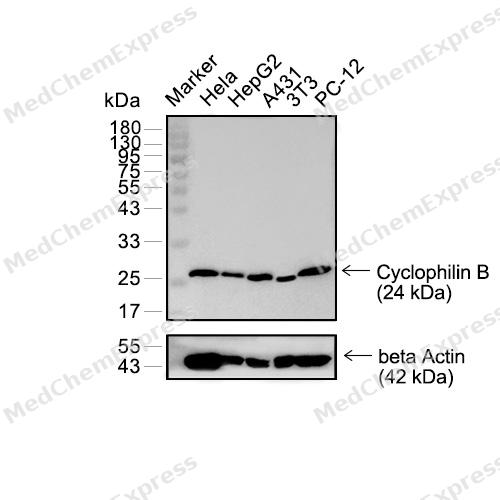 Western blot analysis of extracts from Hela (lane 2(20μg)), HepG2 (lane 3(20μg)), a431 (lane 3(20μg)), 3T3 (lane 3(20μg)) and PC-12 (lane 5(20μg)) using Cyclophilin B Mouse mAb. Proteins were transferred to a PVDF membrane and blocked with 5% non-fat milk in TBST for 2 hour at room temperature. The primary antibody (1/1000) and Loading control antibody (beta Actin, HY-P83730, 1/5000) was used in 5% non-fat milk in TBST at 4°C overnight. Goat Anti-Rabbit/Mouse IgG-HRP Secondary Antibody (1/10000) was used for 1 hour at room temperature.


Background
-
Function
Cyclophilin B (CyPB), encoded by PPIB, is an endoplasmic reticulum (ER) -resident peptidyl-prolyl cis-trans isomerase that catalyzes proline isomerization and supports protein folding within the secretory pathway[1][2]. Mechanistically, CyPB functions as a major folding catalyst for type I collagen by accelerating the rate-limiting cis-trans conversion of proline residues required for triple-helix formation[3][4][5]. CyPB also operates within the P3H1/CRTAP/PPIB complex, which is essential for procollagen folding and prolyl 3-hydroxylation in the ER, linking its enzymatic activity to collagen biosynthesis and extracellular matrix assembly[6][7]. In disease models, PPIB deficiency disrupts collagen post-translational modification, delays procollagen folding, alters collagen cross-linking, and causes recessive osteogenesis imperfecta with defective connective tissue formation[8][9][10][2]. Compared with other rough ER-resident peptidyl-prolyl isomerases, CyPB has a particularly prominent role in collagen maturation because collagen molecules contain abundant proline residues that require efficient isomerization during biosynthesis[5][11]. Structural and biochemical studies further demonstrate that CyPB interacts with calnexin-associated folding machinery and collagen-processing complexes, highlighting its specialized ER chaperone function rather than a generalized folding role[2][6]. For experimental applications, cyclosporin A binds the active site of CyPB and inhibits its isomerase activity, providing a widely used pharmacological tool for investigating collagen folding, ER protein maturation, and connective tissue biology[2][4].
-
Subcellular Localization
Virion; Endoplasmic reticulum lumen; Melanosome
-
Subunit
Interacts with DYM. Interacts with CALR, CLGN and CANX. Part of a large chaperone multiprotein complex comprising DNAJB11, HSP90B1, HSPA5, HYOU, PDIA2, PDIA4, PDIA6, PPIB, SDF2L1, UGGT1 and very small amounts of ERP29, but not, or at very low levels, CALR nor CANX (PubMed:12475965)
-
SwissProt ID
-
Synonyms
PPIB; CYPB; Peptidyl-prolyl cis-trans isomerase B; PPIase B; CYP-S1; Cyclophilin B; Rotamase B; S-cyclophilin; SCYLP
-
Research Field
Immunology


Documentation
-
Data Sheet (263 KB)
-
SDS (252 KB)
- English - EN (252 KB)
- Français - FR (252 KB)
- Deutsch - DE (252 KB)
- Norwegian - NO (252 KB)
- Español - ES (252 KB)
- Swedish - SV (252 KB)
- Italian - IT (252 KB)
- Korean - KR (252 KB)
- Portuguese - PT (252 KB)
-
User Guide for Antibodies (1077 KB)
References
[1]. Cyclophilin B gene information from NCBI.
[2]. Lee MJ, et al. Time to HIV rebound after infusion of long-acting broadly neutralising antibodies 3BNC117-LS and 10-1074-LS and analytical treatment interruption (the RIO trial): a double-blind, randomised, placebo-controlled trial. Lancet HIV. 2026 May 27:S2352-3018(26)00059-7. [Content Brief]
[3]. Li W, et al. The structural basis for the collagen processing by human P3H1/CRTAP/PPIB ternary complex. Nat Commun. 2024 Sep 8;15(1):7844. [Content Brief]
[4]. Ishikawa Y, et al. Ziploc-ing the structure: Triple helix formation is coordinated by rough endoplasmic reticulum resident PPIases. Biochim Biophys Acta. 2015 Oct;1850(10):1983-93. [Content Brief]
[5]. Cabral WA, et al. Abnormal type I collagen post-translational modification and crosslinking in a cyclophilin B KO mouse model of recessive osteogenesis imperfecta. PLoS Genet. 2014 Jun 26;10(6):e1004465. [Content Brief]
[6]. Wu J, et al. Characterization of PPIB interaction in the P3H1 ternary complex and implications for its pathological mutations. Cell Mol Life Sci. 2019 Oct;76(19):3899-3914. [Content Brief]
[7]. Kiros M, et al. Trends in HIV-1 pretreatment drug resistance and HIV-1 variant dynamics among antiretroviral therapy-naive Ethiopians from 2003 to 2018: a pooled sequence analysis. Virol J. 2023 Oct 25;20(1):243. [Content Brief]
[8]. Okada Y, et al. Genome-wide association study for C-reactive protein levels identified pleiotropic associations in the IL6 locus. Hum Mol Genet. 2011 Mar 15;20(6):1224-31. [Content Brief]
[9]. Barnes AM, et al. Lack of cyclophilin B in osteogenesis imperfecta with normal collagen folding. N Engl J Med. 2010 Feb 11;362(6):521-8. [Content Brief]
[10]. Rabezanahary H, et al. Live virus neutralizing antibodies against pre and post Omicron strains in food and retail workers in Québec, Canada. Heliyon. 2024 May 21;10(10):e31026. [Content Brief]
[11]. Koag MC, et al. Structural basis for the inefficient nucleotide incorporation opposite cisplatin-DNA lesion by human DNA polymerase β. J Biol Chem. 2014 Nov 7;289(45):31341-8. [Content Brief]

 Powered by Bioz
