



Daxx Antibody (YA2854)
(Synonyms: DAXX; BING2; DAP6; Death domain-associated protein 6; Daxx; hDaxx; ETS1-associated protein 1; EAP1; Fas death domain-associated protein)
Based on 1 Customer Validation
Daxx Antibody (YA2854) is a Rabbit-derived and non-conjugated IgG monoclonal antibody, targeting to Daxx.
-
Host:
Rabbit
-
Isotype:
IgG
-
Application:
WB, ICC/IF
-
Reactivity :
Human
-
Formulation:
Supplied in 50mM Tris-Glycine(pH 7.4), 0.15M NaCl, 40% Glycerol, 0.01% Sodium azide and 0.05% BSA
-
Conjugation:
Non-conjugated


To place orders, for customer services and technical support, please contact: MedChemExpress USA
Tel: 609-228-6898 E-mail: [email protected] [email protected]





Applications
| Application |
WB

WB: Western Blot
|
ICC/IF
ICC/IF: Immunocytochemistry/
Immunofluorescence |
|---|---|---|
| Dilution Ratio | 1:500-1:1000 | 1:50-1:200 |


Product Details
Daxx Antibody (YA2854) is a Rabbit-derived and non-conjugated IgG monoclonal antibody, targeting to Daxx.
-
Host Rabbit

-
Clonality Recombinant, Monoclonal

-
Species ReactivityHuman
-
Observed Molecular WeightObserved band size: 110 kDa
Note: Due to possible protein modifications or aggregation, the molecular weight should be confirmed by actual measurement, and the predicted value is for reference only.

-
Calculated Molecular Weight Predicted band size: 81 kDa

A synthetic peptide of human Daxx aa253-272.
Endogenous
Affinity Purified
Non-conjugated
Unmodified
IgG


Product Properties
-
Appearance
Liquid
-
Formulation
Supplied in 50mM Tris-Glycine(pH 7.4), 0.15M NaCl, 40% Glycerol, 0.01% Sodium azide and 0.05% BSA
-
Concentration
Batch-dependent, Please check the COA for the concentration of each lot. Check Lot Concentration
-
Storage & Stability
Stored at -20°C for 1 year. Avoid repeated freeze / thaw cycles.
-
Shipping
Shipping with blue ice.


Verification Images
-
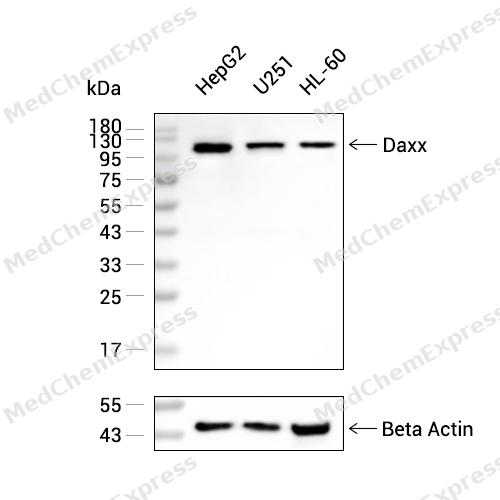 Western blot analysis of extracts from HepG2 (lane 2(20μg), U251 (lane 3(20μg) and HL-60 (lane 4(20μg) using Daxx (HY-P83109) Rabbit mAb. Proteins were transferred to a PVDF membrane and blocked with 5% non-fat milk in TBST for 2 hour at room temperature. The primary antibody (1/1000) and Loading control antibody (Beta Actin, HY-P80438, 1/10000) was used in 5% non-fat milk in TBST at 4°C overnight. Goat Anti-Mouse IgG-HRP Secondary Antibody (1/10000) was used for 1 hour at room temperature.
 -
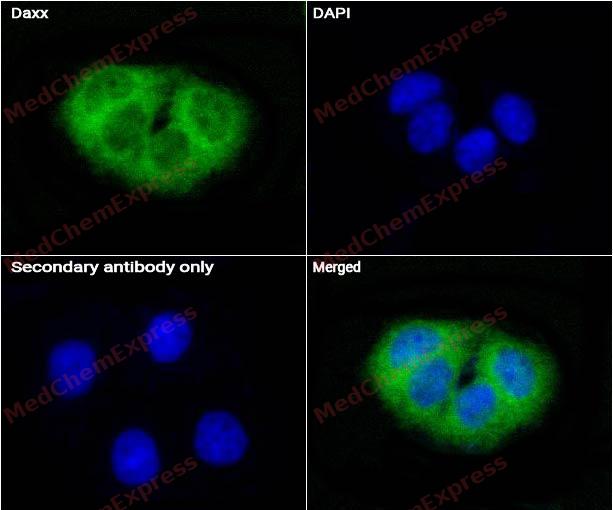 Immunocytochemistry analysis of Hela cells labeling Daxx Antibody (HY-P83109) at 1/50 dilution. Cells were fixed in 4% paraformaldehyde for 15 minutes at room temperature, permeabilized with 0.1% Triton X-100 for 10 minutes at room temperature, then blocked with QuickBlock™ Blocking Buffer for Immunol Staining for 10 min at room temperature. Cells were then incubated with Daxx Antibody (HY-P83109) at 1/50 dilution in QuickBlock™ Blocking Buffer for Immunol Staining at 4 ℃. Alexa Fluor® 488-conjugated AffiniPure Goat Anti-Rabbit IgG H&L(HY-P8002, Green) was used as the secondary antibody at 1/1,000 dilution. PBS instead of the primary antibody was used as the secondary antibody only control. The Nuclear counterstain was DAPI (Blue).
 -
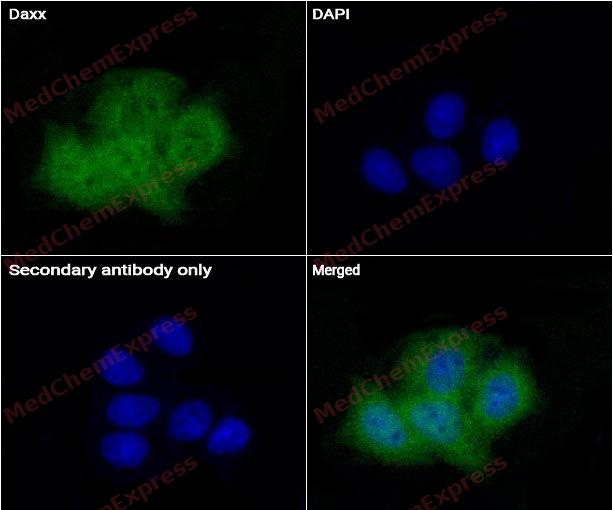 Immunocytochemistry analysis of PANC-1 cells labeling Daxx Antibody (HY-P83109) at 1/50 dilution. Cells were fixed in 4% paraformaldehyde for 15 minutes at room temperature, permeabilized with 0.1% Triton X-100 for 10 minutes at room temperature, then blocked with QuickBlock™ Blocking Buffer for Immunol Staining for 10 min at room temperature. Cells were then incubated with Daxx Antibody (HY-P83109) at 1/50 dilution in QuickBlock™ Blocking Buffer for Immunol Staining at 4 ℃. Alexa Fluor® 488-conjugated AffiniPure Goat Anti-Rabbit IgG H&L(HY-P8002, Green) was used as the secondary antibody at 1/1,000 dilution. PBS instead of the primary antibody was used as the secondary antibody only control. The Nuclear counterstain was DAPI (Blue).


Background
-
Function
Daxx transcription corepressor known to repress transcriptional potential of several sumoylated transcription factors. Down-regulates basal and activated transcription. Its transcription repressor activity is modulated by recruiting it to subnuclear compartments like the nucleolus or PML/POD/ND10 nuclear bodies through interactions with MCSR1 and PML, respectively. Seems to regulate transcription in PML/POD/ND10 nuclear bodies together with PML and may influence TNFRSF6-dependent apoptosis thereby. Inhibits transcriptional activation of PAX3 and ETS1 through direct protein-protein interactions. Modulates PAX5 activity; the function seems to involve CREBBP. Acts as an adapter protein in a MDM2-DAXX-USP7 complex by regulating the RING-finger E3 ligase MDM2 ubiquitination activity. Under non-stress condition, in association with the deubiquitinating USP7, prevents MDM2 self-ubiquitination and enhances the intrinsic E3 ligase activity of MDM2 towards TP53, thereby promoting TP53 ubiquitination and subsequent proteasomal degradation. Upon DNA damage, its association with MDM2 and USP7 is disrupted, resulting in increased MDM2 autoubiquitination and consequently, MDM2 degradation, which leads to TP53 stabilization. Acts as a histone chaperone that facilitates deposition of histone H3.3. Acts as a targeting component of the chromatin remodeling complex ATRX:DAXX which has ATP-dependent DNA translocase activity and catalyzes the replication-independent deposition of histone H3.3 in pericentric DNA repeats outside S-phase and telomeres, and the in vitro remodeling of H3.3-containing nucleosomes. Does not affect the ATPase activity of ATRX but alleviates its transcription repression activity. Upon neuronal activation associates with regulatory elements of selected immediate early genes where it promotes deposition of histone H3.3 which may be linked to transcriptional induction of these genes. Required for the recruitment of histone H3.3:H4 dimers to PML-nuclear bodies (PML-NBs); the process is independent of ATRX and facilitated by ASF1A; PML-NBs are suggested to function as regulatory sites for the incorporation of newly synthesized histone H3.3 into chromatin. In case of overexpression of centromeric histone variant CENPA (as found in various tumors) is involved in its mislocalization to chromosomes; the ectopic localization involves a heterotypic tetramer containing CENPA, and histones H3.3 and H4 and decreases binding of CTCF to chromatin. Proposed to mediate activation of the JNK pathway and apoptosis via MAP3K5 in response to signaling from TNFRSF6 and TGFBR2. Interaction with HSPB1/HSP27 may prevent interaction with TNFRSF6 and MAP3K5 and block DAXX-mediated apoptosis. In contrast, in lymphoid cells JNC activation and TNFRSF6-mediated apoptosis may not involve DAXX. Shows restriction activity towards human cytomegalovirus (HCMV). Plays a role as a positive regulator of the heat shock transcription factor HSF1 activity during the stress protein response[1].
-
Subcellular Localization
Cytoplasm; Nucleus, nucleoplasm; Nucleus, PML body; Nucleus, nucleolus; Chromosome, centromere; Nucleus; Nucleus
-
Expression
Tissue_specificity:general expression
Induction:Upon mitogenic stimulation by concanavalin-A -
Isoforms & Post-Translational Modification
Q9UER7 has 5 isomers: Q9UER7-1: 81373 Da (predicted); Q9UER7-2: 78333 Da (predicted); Q9UER7-3: 73589 Da (predicted); Q9UER7-4: 76326 Da (predicted); Q9UER7-5: 75563 Da (predicted).
Sumoylated with SUMO1 on multiple lysine residues;Phosphorylated by HIPK1 upon glucose deprivation;Polyubiquitinated; which is promoted by CUL3 and SPOP and results in proteasomal degradation. Ubiquitinated by MDM2; inducing its degradation. Deubiquitinated by USP7; leading to stabilize it -
Subunit
Homomultimer. Interacts (via C-terminus) with TNFRSF6 (via death domain). Interacts with PAX5, SLC2A4/GLUT4, MAP3K5, TGFBR2, phosphorylated dimeric HSPB1/HSP27, CENPC, ETS1, sumoylated PML, UBE2I, MCRS1 and TP53. Interacts (via N-terminus) with HIPK2 and HIPK3. Interacts with HIPK1, which induces translocation from PML/POD/ND10 nuclear bodies to chromatin and enhances association with HDAC1. Interacts (non-phosphorylated) with PAX3, PAX7, DEK, HDAC1, HDAC2, HDAC3, acetylated histone H4 and histones H2A, H2B, H3, H3.3 and H4. Interacts with SPOP; mediating CUL3-dependent proteasomal degradation. Interacts with CBP; the interaction is dependent the sumoylation of CBP and suppresses CBP transcriptional activity via recruitment of HDAC2 directly in the complex with TP53 and HIPK2. Interacts with AXIN1; the interaction stimulates the interaction of DAXX with TP53, stimulates 'Ser-46' phosphorylation of TP53 on and induces cell death on UV irradiation. Interacts with MDM2; the interaction is direct. Interacts with USP7; the interaction is direct and independent of MDM2 and TP53. Part of a complex with DAXX, MDM2 and USP7 under non-stress conditions. Interacts (via N-terminus) with RASSF1 (via C-terminus); the interaction is independent of MDM2 and TP53; RASSF1 isoform A disrupts interactions among MDM2, DAXX and USP7, thus contributing to the efficient activation of TP53 by promoting MDM2 self-ubiquitination in cell-cycle checkpoint control in response to DNA damage. Interacts with ATRX to form the chromatin remodeling complex ATRX:DAXX. Interacts with HSF1 (via homotrimeric form preferentially); this interaction relieves homotrimeric HSF1 from repression of its transcriptional activity by HSP90-dependent multichaperone complex upon heat shock (PubMed:15016915). Interacts with SUMO1P1/SUMO5 (PubMed:27211601)
-
SwissProt ID
-
Synonyms
DAXX; BING2; DAP6; Death domain-associated protein 6; Daxx; hDaxx; ETS1-associated protein 1; EAP1; Fas death domain-associated protein
-
Research Field
Cell Biology


Documentation
-
Data Sheet (235 KB)
-
SDS (252 KB)
- English - EN (252 KB)
- Français - FR (252 KB)
- Deutsch - DE (252 KB)
- Norwegian - NO (252 KB)
- Español - ES (252 KB)
- Swedish - SV (252 KB)
- Italian - IT (252 KB)
- Korean - KR (252 KB)
- Portuguese - PT (252 KB)
-
User Guide for Antibodies (1077 KB)

 Powered by Bioz
