



DDX3 Antibody (YA784)(PBS only)
(Synonyms: DBX; DDX3; HLP2; DDX14.)DDX3 Antibody (YA784) is a Mouse-derived and non-conjugated IgG2a monoclonal antibody, targeting to DDX3.
-
Host:
Mouse
-
Isotype:
IgG
-
Application:
WB, ICC/IF, IP, ChIP
-
Reactivity :
Human, Rat, Mouse, Monkey
-
Formulation:
Supplied in PBS, pH 7.4.
-
Conjugation:
Non-conjugated


To place orders, for customer services and technical support, please contact: MedChemExpress USA
Tel: 609-228-6898 E-mail: [email protected] [email protected]





Applications
| Application |
WB

WB: Western Blot
|
ICC/IF
ICC/IF: Immunocytochemistry/
Immunofluorescence |
IP
IP: Immunoprecipitation
|
ChIP
ChIP: Chromatin Immunoprecipitation
|
|---|---|---|---|---|
| Dilution Ratio | 1:500-1:1000 | 1:50-1:200 | 1:20 | 1:20 |


Product Details
DDX3 Antibody (YA784) is a Mouse-derived and non-conjugated IgG2a monoclonal antibody, targeting to DDX3.
-
Host Mouse

-
Species ReactivityHuman, Rat, Mouse, Monkey

-
Observed Molecular WeightObserved band size: 73 kDa
Note: Due to possible protein modifications or aggregation, the molecular weight should be confirmed by actual measurement, and the predicted value is for reference only.

-
Calculated Molecular Weight Predicted band size: 73 kDa

Synthetic peptide corresponding to Human DDX3.The exact sequence is proprietary to MCE.
affinity purified
Non-conjugated
IgG


Product Properties
-
Appearance
Solution
-
Formulation
Supplied in PBS, pH 7.4.
-
Storage & Stability
Stored at -20°C for 1 year. Avoid repeated freeze / thaw cycles.
-
Shipping
Shipping with blue ice.


Verification Images
-
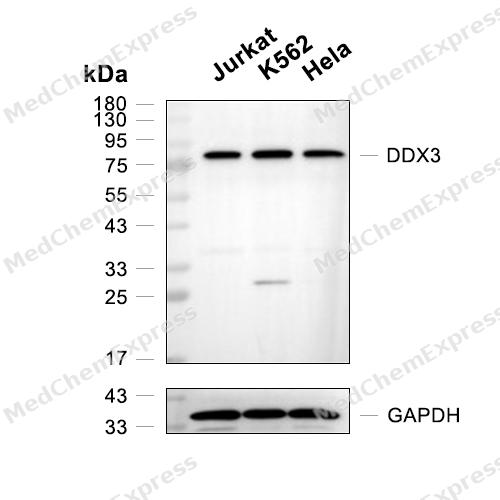 Western blot analysis of extracts from Jurkat(lane 2(20μg) , K562(lane 3(20μg), Hela (lane 4(20μg) ) using DDX3 (HY-P80642) Mouse mAb. Proteins were transferred to a PVDF membrane and blocked with 5% BSA in TBST for 2 hour at room temperature. The primary antibody (HY-P80642, 1/1000) and Loading control antibody (GAPDH, HY-P80954, 1/3000) was used in 5% BSA in TBST at 4°C overnight. Goat Anti-Mouse IgG-HRP Secondary Antibody (HY-P8004, 1/10,000) was used for 1 hour at room temperature.


Background
-
Function
DDX3 multifunctional ATP-dependent RNA helicase. The ATPase activity can be stimulated by various ribo-and deoxynucleic acids indicative for a relaxed substrate specificity. In vitro can unwind partially double-stranded DNA with a preference for 5'-single-stranded DNA overhangs. Binds RNA G-quadruplex (rG4s) structures, including those located in the 5'-UTR of NRAS mRNA. Involved in many cellular processes, which do not necessarily require its ATPase/helicase catalytic activities (Probable). Involved in transcription regulation. Positively regulates CDKN1A/WAF1/CIP1 transcription in an SP1-dependent manner, hence inhibits cell growth. This function requires its ATPase, but not helicase activity. CDKN1A up-regulation may be cell-type specific. Binds CDH1/E-cadherin promoter and represses its transcription. Potentiates HNF4A-mediated MTTP transcriptional activation; this function requires ATPase, but not helicase activity. Facilitates HNF4A acetylation, possibly catalyzed by CREBBP/EP300, thereby increasing the DNA-binding affinity of HNF4 to its response element. In addition, disrupts the interaction between HNF4 and SHP that forms inactive heterodimers and enhances the formation of active HNF4 homodimers. By promoting HNF4A-induced MTTP expression, may play a role in lipid homeostasis. May positively regulate TP53 transcription. Associates with mRNPs, predominantly with spliced mRNAs carrying an exon junction complex (EJC). Involved in the regulation of translation initiation. Not involved in the general process of translation, but promotes efficient translation of selected complex mRNAs, containing highly structured 5'-untranslated regions (UTR). This function depends on helicase activity. Might facilitate translation by resolving secondary structures of 5'-UTRs during ribosome scanning. Alternatively, may act prior to 43S ribosomal scanning and promote 43S pre-initiation complex entry to mRNAs exhibiting specific RNA motifs, by performing local remodeling of transcript structures located close to the cap moiety. Independently of its ATPase activity, promotes the assembly of functional 80S ribosomes and disassembles from ribosomes prior to the translation elongation process. Positively regulates the translation of cyclin E1/CCNE1 mRNA and consequently promotes G1/S-phase transition during the cell cycle. May activate TP53 translation. Required for endoplasmic reticulum stress-induced ATF4 mRNA translation. Independently of its ATPase/helicase activity, enhances IRES-mediated translation; this activity requires interaction with EIF4E. Independently of its ATPase/helicase activity, has also been shown specifically repress cap-dependent translation, possibly by acting on translation initiation factor EIF4E. Involved in innate immunity, acting as a viral RNA sensor. Binds viral RNAs and promotes the production of type I interferon (IFN-alpha and IFN-beta). Potentiate MAVS/RIGI-mediated induction of IFNB in early stages of infection. Enhances IFNB1 expression via IRF3/IRF7 pathway and participates in NFKB activation in the presence of MAVS and TBK1. Involved in TBK1 and IKBKE-dependent IRF3 activation leading to IFNB induction, acts as a scaffolding adapter that links IKBKE and IRF3 and coordinates their activation. Involved in the TLR7/TLR8 signaling pathway leading to type I interferon induction, including IFNA4 production. In this context, acts as an upstream regulator of IRF7 activation by MAP3K14/NIK and CHUK/IKKA. Stimulates CHUK autophosphorylation and activation following physiological activation of the TLR7 and TLR8 pathways, leading to MAP3K14/CHUK-mediated activatory phosphorylation of IRF7. Also stimulates MAP3K14/CHUK-dependent NF-kappa-B signaling. Negatively regulates TNF-induced IL6 and IL8 expression, via the NF-kappa-B pathway. May act by interacting with RELA/p65 and trapping it in the cytoplasm. May also bind IFNB promoter; the function is independent of IRF3. Involved in both stress and inflammatory responses. Independently of its ATPase/helicase activity, required for efficient stress granule assembly through its interaction with EIF4E, hence promotes survival in stressed cells. Independently of its helicase activity, regulates NLRP3 inflammasome assembly through interaction with NLRP3 and hence promotes cell death by pyroptosis during inflammation. This function is independent of helicase activity. Therefore DDX3X availability may be used to interpret stress signals and choose between pro-survival stress granules and pyroptotic NLRP3 inflammasomes and serve as a live-or-die checkpoint in stressed cells. In association with GSK3A/B, negatively regulates extrinsic apoptotic signaling pathway via death domain receptors, including TNFRSF10B, slowing down the rate of CASP3 activation following death receptor stimulation. Cleavage by caspases may inactivate DDX3X and relieve the inhibition. Independently of its ATPase/helicase activity, allosteric activator of CSNK1E. Stimulates CSNK1E-mediated phosphorylation of DVL2, thereby involved in the positive regulation of Wnt/beta-catenin signaling pathway. Also activates CSNK1A1 and CSNK1D in vitro, but it is uncertain if these targets are physiologically relevant. ATPase and casein kinase-activating functions are mutually exclusive. May be involved in mitotic chromosome segregation; (Microbial infection) Facilitates hepatitis C virus (HCV) replication. During infection, HCV core protein inhibits the interaction between MAVS and DDX3X and therefore impairs MAVS-dependent INFB induction and might recruit DDX3X to HCV replication complex; (Microbial infection) Facilitates HIV-1 replication. Acts as a cofactor for XPO1-mediated nuclear export of HIV-1 Rev RNAs. This function is strongly stimulated in the presence of TBK1 and requires DDX3X ATPase activity; (Microbial infection) Facilitates Zika virus (ZIKV) replication; (Microbial infection) Facilitates Dengue virus (DENV) replication; (Microbial infection) Facilitates Venezuelan equine encephalitis virus (VEEV) replication[1][2][3][4][5][6][7][8][9][10][11][12][13][14][15][16][17][18][19][20][21][22][23][24][25][26][27][28][29][30][31][32][33].
-
Subcellular Localization
Cell membrane; Nucleus; Cytoplasm; Cytoplasm, Stress granule; Inflammasome; Cell projection, lamellipodium; Cytoplasm, cytoskeleton, microtubule organizing center, centrosome
-
Expression
Tissue_specificity:Widely expressed (PubMed:15294876) . Expressed in sperm cells in the testes (PubMed:15294876) . Expressed in the epidermis and liver (protein level) (PubMed:16301996, PubMed:16818630) . -
Isoforms & Post-Translational Modification
O00571 has 2 isomers: O00571-1: 73243 Da (predicted); O00571-2: 71355 Da (predicted).
Phosphorylated by TBK1; the phosphorylation is required for the synergistic induction of IFNB mediated by TBK1 and DDX3X (PubMed:18583960). Phosphorylated by IKBKE at Ser-102 after ssRNA viral infection; enhances the induction of INFB promoter by IRF3 (PubMed:18583960, PubMed:23478265). The cytoplasmic form is highly phosphorylated in the G1/S phase of the cell cycle and much less at G2/M (PubMed:22034099). Phosphorylation by CSNK1E may inhibit RNA-stimulated ATPase activity (PubMed:29222110);Upon stimulation of death receptors, including TNFRSF10B, recruited to receptors and cleaved by caspases. Proteolytic fragments remain associated with the receptors. This cleavage presumably inactivates DDX3X anti-apoptotic function;Ubiquitinated by RNF39 via 'Lys-48'-linked ubiquitination; leading to proteasomal degradation -
Subunit
Homodimer; can bind RNA as a monomer and as a dimer/oligomer (PubMed:27546789, PubMed:31300642). Interacts with TDRD3 (PubMed:18632687). Interacts (when phosphorylated at Ser-102) with IRF3; the interaction facilitates the phosphorylation and activation of IRF3 by IKBKE (PubMed:23478265, PubMed:27980081). Directly interacts with XPO1/CRM1 (PubMed:15507209, PubMed:30131165, PubMed:31575075). The interaction with XPO1/CMR1 is dependent on the DDX3X nuclear export signal motif and XPO1 interaction with GTPase RAN in its active GTP-bound form (PubMed:30131165, PubMed:31575075). Weakly interacts with TBKBP1/SINTBAD (PubMed:27980081). Directly interacts with TRAF3; this interaction stimulates TRAF3 'Lys-63' ubiquitination (PubMed:27980081). Interacts with CSNK1E in a Wnt-dependent manner; this interaction greatly enhances CSNK1E affinity for ATP, stimulates its kinase activity and promotes CSNK1E-mediated DVL2 phosphorylation (PubMed:23413191, PubMed:29222110). In the presence of RNA, the interaction is decreased (PubMed:29222110). Also interacts with CSNK1D and stimulates its kinase activity (PubMed:23413191, PubMed:29222110). Interacts with TRPV4; this interaction is decreased when the TRPV4 channel is activated, leading to DDX3X relocalization to the nucleus (PubMed:29899501). Interacts with MAP3K14/NIK (PubMed:30341167). Directly interacts with CHUK/IKKA after physiological activation of the TLR7 and TLR8 pathways; this interaction enhances CHUK autophosphorylation (PubMed:30341167). May associate with EIF4F complex, composed of at least EIF4A, EIF4E and EIF4G1/EIF4G3 (Probable). Directly interacts with EIF4E in an RNA-independent manner; this interaction enhances EIF4E cap-binding ability (PubMed:17667941, PubMed:21883093, PubMed:28733330). Directly interacts with EIF4G1 in an RNA-independent manner (PubMed:22872150). DDX3X competes with EIF4G1 for interaction with EIF4E (PubMed:17667941, PubMed:21883093). Interacts with EIF4A1 and EIF2S1 in an RNA-independent manner (PubMed:18596238, PubMed:22323517). Associates with the eukaryotic translation initiation factor 3 (eIF-3) complex, including with EIF3B and EIF3C subunits (PubMed:18628297, PubMed:22323517). Directly interacts with IKBKE/IKKE; this interaction stimulates IKBKE activating autophosphorylation and is induced upon viral infection (PubMed:18636090, PubMed:20657822, PubMed:23478265, PubMed:27980081). Interacts with TBK1 (PubMed:20375222). Interacts with SP1; this interaction potentiates SP1-induced CDKN1A/WAF1/CIP1 transcription (PubMed:16818630). Interacts with GSK3A and GSK3B (PubMed:18846110). Interacts with several death receptors, inclusing FAS, TNFRSF10A and TNFRSF10B (PubMed:18846110). Recruited to TNFRSF10B in the absence of receptor stimulation. When TNFRSF10B is stimulated, further recruited to the receptor and cleaved by caspases. A large proteolytic fragment remains associated with TNFRSF10B (PubMed:18846110). Interacts (via C-terminus) with NXF1/TAP; this interaction may be partly involved in DDX3X nuclear export and in NXF1 localization to stress granules (PubMed:18596238). Identified in an mRNP complex, composed of at least DHX9, DDX3X, ELAVL1, HNRNPU, IGF2BP1/2, ILF3, PABPC1, PCBP2, PTBP2, STAU1, STAU2, SYNCRIP and YBX1 (PubMed:19029303). The interaction with IGF2BP1/2 is RNA-dependent (PubMed:22323517). Directly interacts with PABPC1/PABP1 in an RNA-independent manner (PubMed:18596238, PubMed:21883093, PubMed:22872150, PubMed:28733330). This interaction increases in stressed cells and decreases during cell recovery (PubMed:21883093). Interacts (via C-terminus) with MAVS/IPS-1; this interaction occurs rapidly, but transiently after Sendai virus infection (PubMed:20127681, PubMed:21170385, PubMed:27980081). The interaction potentiates MAVS-mediated IFNB induction (PubMed:20127681, PubMed:21170385). Interacts with ERCC6/CBS (PubMed:26030138). Interacts with DHX33 in an RNA-independent manner (PubMed:26100019). Interacts with DDX5 in the cytoplasm; this interaction may be more efficient when both proteins are unphosphorylated (PubMed:22034099). Interacts with RIGI/RIG-1 (PubMed:20127681). Interacts with IFIH1/MDA5 (PubMed:20127681). Interacts with NCAPH; this interaction may be important for the NCAPH localization at condensing chromosomes during mitosis (PubMed:21730191). Interacts with NLRP3 (via NACHT domain) under inflammasome-activating conditions (By similarity). Interacts with CAPRIN1 (PubMed:28733330). Interacts with HNF4A and NR0B2/SHP in an RNA-independent manner; this interaction disrupts the interaction between HNF4 and NR0B2 that forms inactive heterodimers and enhances the formation of active HNF4 homodimers (PubMed:28128295). Interacts with CREBBP/CBP (PubMed:28128295). Interacts with EP300/p300 (PubMed:28128295). Interacts with gamma-tubulin (PubMed:28842590). Interacts with phosphorylated TP53 (PubMed:28842590). Directly interacts with RELA/p65; this interaction may trap RELA in the cytoplasm, impairing nuclear relocalization upon TNF activating signals (PubMed:27736973)
-
SwissProt ID
-
Synonyms
DBX; DDX3; HLP2; DDX14.
-
Research Field
Epigenetics and Nuclear Signaling


Documentation
References
[1]. Franca R, et al. Human DEAD-box ATPase DDX3 shows a relaxed nucleoside substrate specificity. Proteins. 2007 Jun 1;67(4):1128-37. [Content Brief]
[2]. Garbelli A, et al. A motif unique to the human DEAD-box protein DDX3 is important for nucleic acid binding, ATP hydrolysis, RNA/DNA unwinding and HIV-1 replication. PLoS One. 2011 May 12;6(5):e19810. [Content Brief]
[3]. Heaton SM, et al. Exportin-1-Dependent Nuclear Export of DEAD-box Helicase DDX3X is Central to its Role in Antiviral Immunity. Cells. 2019 Sep 30;8(10):. [Content Brief]
[4]. Dolde C, et al. A CK1 FRET biosensor reveals that DDX3X is an essential activator of CK1ε. J Cell Sci. 2018 Jan 4;131(1):. [Content Brief]
[5]. Herdy B, et al. Analysis of NRAS RNA G-quadruplex binding proteins reveals DDX3X as a novel interactor of cellular G-quadruplex containing transcripts. Nucleic Acids Res. 2018 Nov 30;46(21):11592-11604. [Content Brief]
[6]. Chao CH, et al. DDX3, a DEAD box RNA helicase with tumor growth-suppressive property and transcriptional regulation activity of the p21waf1/cip1 promoter, is a candidate tumor suppressor. Cancer Res. 2006 Jul 1;66(13):6579-88. [Content Brief]
[7]. Botlagunta M, et al. Oncogenic role of DDX3 in breast cancer biogenesis. Oncogene. 2008 Jun 26;27(28):3912-22. [Content Brief]
[8]. Tsai TY, et al. RNA helicase DDX3 maintains lipid homeostasis through upregulation of the microsomal triglyceride transfer protein by interacting with HNF4 and SHP. Sci Rep. 2017 Jan 27;7:41452. [Content Brief]
[9]. Chen WJ, et al. DDX3 localizes to the centrosome and prevents multipolar mitosis by epigenetically and translationally modulating p53 expression. Sci Rep. 2017 Aug 25;7(1):9411. [Content Brief]
[10]. Merz C, et al. Protein composition of human mRNPs spliced in vitro and differential requirements for mRNP protein recruitment. RNA. 2007 Jan;13(1):116-28. [Content Brief]
[11]. Lai MC, et al. The DEAD-box RNA helicase DDX3 associates with export messenger ribonucleoproteins as well as tip-associated protein and participates in translational control. Mol Biol Cell. 2008 Sep;19(9):3847-58. [Content Brief]
[12]. Shih JW, et al. Candidate tumor suppressor DDX3 RNA helicase specifically represses cap-dependent translation by acting as an eIF4E inhibitory protein. Oncogene. 2008 Jan 24;27(5):700-14. [Content Brief]
[13]. Lee CS, et al. Human DDX3 functions in translation and interacts with the translation initiation factor eIF3. Nucleic Acids Res. 2008 Aug;36(14):4708-18. [Content Brief]
[14]. Soto-Rifo R, et al. DEAD-box protein DDX3 associates with eIF4F to promote translation of selected mRNAs. EMBO J. 2012 Sep 12;31(18):3745-56. [Content Brief]
[15]. Lai MC, et al. DDX3 regulates cell growth through translational control of cyclin E1. Mol Cell Biol. 2010 Nov;30(22):5444-53. [Content Brief]
[16]. Geissler R, et al. The DEAD-box helicase DDX3 supports the assembly of functional 80S ribosomes. Nucleic Acids Res. 2012 Jun;40(11):4998-5011. [Content Brief]
[17]. Adjibade P, et al. DDX3 regulates endoplasmic reticulum stress-induced ATF4 expression. Sci Rep. 2017 Oct 23;7(1):13832. [Content Brief]
[18]. Oshiumi H, et al. DEAD/H BOX 3 (DDX3) helicase binds the RIG-I adaptor IPS-1 to up-regulate IFN-beta-inducing potential. Eur J Immunol. 2010 Apr;40(4):940-8. [Content Brief]
[19]. Oshiumi H, et al. Hepatitis C virus core protein abrogates the DDX3 function that enhances IPS-1-mediated IFN-beta induction. PLoS One. 2010 Dec 8;5(12):e14258. [Content Brief]
[20]. Wang W, et al. RNF39 mediates K48-linked ubiquitination of DDX3X and inhibits RLR-dependent antiviral immunity. Sci Adv. 2021 Mar;7(10):. [Content Brief]
[21]. Soulat D, et al. The DEAD-box helicase DDX3X is a critical component of the TANK-binding kinase 1-dependent innate immune response. EMBO J. 2008 Aug 6;27(15):2135-46. [Content Brief]
[22]. Schröder M, et al. Viral targeting of DEAD box protein 3 reveals its role in TBK1/IKKepsilon-mediated IRF activation. EMBO J. 2008 Aug 6;27(15):2147-57. [Content Brief]
[23]. Oda S, et al. Structural basis for targeting of human RNA helicase DDX3 by poxvirus protein K7. Structure. 2009 Nov 11;17(11):1528-37. [Content Brief]
[24]. Gu L, et al. DDX3 directly regulates TRAF3 ubiquitination and acts as a scaffold to co-ordinate assembly of signalling complexes downstream from MAVS. Biochem J. 2017 Feb 15;474(4):571-587. [Content Brief]
[25]. Gu L, et al. Human DEAD box helicase 3 couples IκB kinase ε to interferon regulatory factor 3 activation. Mol Cell Biol. 2013 May;33(10):2004-15. [Content Brief]
[26]. Fullam A, et al. DDX3 directly facilitates IKKα activation and regulates downstream signalling pathways. Biochem J. 2018 Nov 20;475(22):3595-3607. [Content Brief]
[27]. Xiang N, et al. The DEAD-Box RNA Helicase DDX3 Interacts with NF-κB Subunit p65 and Suppresses p65-Mediated Transcription. PLoS One. 2016;11(10):e0164471. [Content Brief]
[28]. Shih JW, et al. Critical roles of RNA helicase DDX3 and its interactions with eIF4E/PABP1 in stress granule assembly and stress response. Biochem J. 2012 Jan 1;441(1):119-29. [Content Brief]
[29]. Sun M, et al. Identification of an antiapoptotic protein complex at death receptors. Cell Death Differ. 2008 Dec;15(12):1887-900. [Content Brief]
[30]. Cruciat CM, et al. RNA helicase DDX3 is a regulatory subunit of casein kinase 1 in Wnt-β-catenin signaling. Science. 2013 Mar 22;339(6126):1436-41. [Content Brief]
[31]. Pek JW, et al. DEAD-box RNA helicase Belle/DDX3 and the RNA interference pathway promote mitotic chromosome segregation. Proc Natl Acad Sci U S A. 2011 Jul 19;108(29):12007-12. [Content Brief]
[32]. Doñate-Macián P, et al. The TRPV4 channel links calcium influx to DDX3X activity and viral infectivity. Nat Commun. 2018 Jun 13;9(1):2307. [Content Brief]
[33]. Yedavalli VS, et al. Requirement of DDX3 DEAD box RNA helicase for HIV-1 Rev-RRE export function. Cell. 2004 Oct 29;119(3):381-92. [Content Brief]

 Powered by Bioz
