



DDX58 Antibody (YA2318)
(Synonyms: RIG-I-like receptor 1; RLR-1; RLR1; Retinoic acid-inducible gene 1 protein; RIG-1; RIG1; RIG-I; RIGI)
Based on 1 Customer Validation
DDX58 Antibody (YA2318) is a Rabbit-derived and non-conjugated IgG monoclonal antibody, targeting to DDX58.
-
Host:
Rabbit
-
Isotype:
IgG
-
Application:
WB, IP
-
Reactivity :
Human
-
Formulation:
Supplied in 50mM Tris-Glycine(pH 7.4), 0.15M NaCl, 40%Glycerol, 0.01% sodium azide and 0.05% BSA.
-
Conjugation:
Non-conjugated


To place orders, for customer services and technical support, please contact: MedChemExpress USA
Tel: 609-228-6898 E-mail: [email protected] [email protected]





Applications
| Application |
WB

WB: Western Blot
|
IP
IP: Immunoprecipitation
|
|---|---|---|
| Dilution Ratio | 1:500-1:1000 | 1:50 |


Product Details
DDX58 Antibody (YA2318) is a Rabbit-derived and non-conjugated IgG monoclonal antibody, targeting to DDX58.
-
Host Rabbit

-
Clonality Recombinant, Monoclonal

-
Species ReactivityHuman
-
Observed Molecular WeightObserved band size: 107 kDa
Note: Due to possible protein modifications or aggregation, the molecular weight should be confirmed by actual measurement, and the predicted value is for reference only.

-
Calculated Molecular Weight Predicted band size: 107 kDa

A synthesized peptide derived from human DDX58 aa220-450.
Endogenous
Affinity Chromatography
Non-conjugated
Unmodified
IgG


Product Properties
-
Appearance
Liquid
-
Formulation
Supplied in 50mM Tris-Glycine(pH 7.4), 0.15M NaCl, 40%Glycerol, 0.01% sodium azide and 0.05% BSA.
-
Concentration
Batch-dependent, Please check the COA for the concentration of each lot. Check Lot Concentration
-
Storage & Stability
Stored at -20°C for 1 year. Avoid repeated freeze / thaw cycles.
-
Shipping
Shipping with blue ice.


Verification Images
-
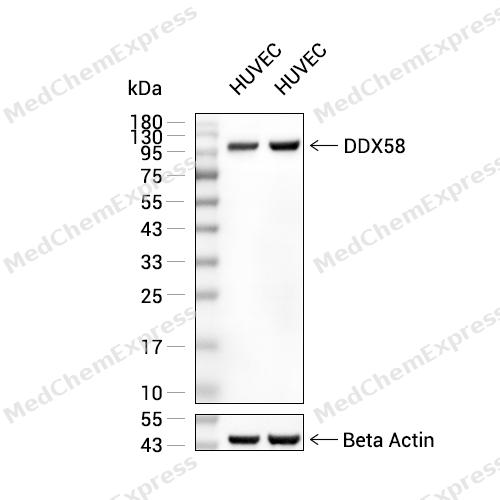 Western blot analysis of extracts from HUVEC (lane 2(20μg), HUVEC (lane 3(40μg), using DDX58 Antibody. Proteins were transferred to a PVDF membrane and blocked with 5% BSA in TBST for 2 hour at room temperature. The primary antibody and Loading control antibody (Beta Actin, HY-P80438, 1/3000) was used in 5% BSA in TBST at 4°C overnight. Goat Anti-Mouse/Rabbit IgG-HRP Secondary Antibody (HY-P8004/HY-P8001, 1/10,000) was used for 1 hour at room temperature.


Background
-
Function
DDX58 is an Innate immune receptor that senses cytoplasmic viral nucleic acids and activates a downstream signaling cascade leading to the production of type I interferons and pro-inflammatory cytokines. Forms a ribonucleoprotein complex with viral RNAs on which it homooligomerizes to form filaments. The homooligomerization allows the recruitment of RNF135 an E3 ubiquitin-protein ligase that activates and amplifies the RIG-I-mediated antiviral signaling in an RNA length-dependent manner through ubiquitination-dependent and -independent mechanisms. Upon activation, associates with mitochondria antiviral signaling protein (MAVS/IPS1) that activates the IKK-related kinases TBK1 and IKBKE which in turn phosphorylate the interferon regulatory factors IRF3 and IRF7, activating transcription of antiviral immunological genes including the IFN-alpha and IFN-beta interferons. Ligands include 5'-triphosphorylated ssRNAs and dsRNAs but also short dsRNAs (<1 kb in length). In addition to the 5'-triphosphate moiety, blunt-end base pairing at the 5'-end of the RNA is very essential. Overhangs at the non-triphosphorylated end of the dsRNA RNA have no major impact on its activity. A 3'overhang at the 5'triphosphate end decreases and any 5'overhang at the 5' triphosphate end abolishes its activity. Detects both positive and negative strand RNA viruses including members of the families Paramyxoviridae: Human respiratory syncytial virus and measles virus (MeV), Rhabdoviridae: vesicular stomatitis virus (VSV), Orthomyxoviridae: influenza A and B virus, Flaviviridae: Japanese encephalitis virus (JEV), hepatitis C virus (HCV), dengue virus (DENV) and west Nile virus (WNV). It also detects rotaviruses and reoviruses. Detects and binds to SARS-CoV-2 RNAs which is inhibited by m6A RNA modifications (Ref.74). Also involved in antiviral signaling in response to viruses containing a dsDNA genome such as Epstein-Barr virus (EBV). Detects dsRNA produced from non-self dsDNA by RNA polymerase III, such as Epstein-Barr virus-encoded RNAs (EBERs). May play important roles in granulocyte production and differentiation, bacterial phagocytosis and in the regulation of cell migration[1][2][3][4][5][6][7][8][9][10][11][12][13][14][15][16][17][18][19][20][21][22].
-
Subcellular Localization
Cytoplasm; Cell projection, ruffle membrane; Cytoplasm, cytoskeleton; Cell junction, tight junction
-
Expression
Tissue_specificity:It exists in vascular smooth muscle cells (protein level) .
Induction:By bacterial lipopolysaccharides (LPS) in endothelial cells. By interferon (IFN) -
Isoforms & Post-Translational Modification
O95786 has 2 isomers: O95786-1: 106600 Da (predicted); O95786-2: 101377 Da (predicted).
Phosphorylated in resting cells and dephosphorylated in RNA virus-infected cells. Phosphorylation at Thr-770, Ser-854 and Ser-855 results in inhibition of its activity while dephosphorylation at these sites results in its activation;Ubiquitinated. 'Lys-63' ubiquitination by RNF135, which occurs after RNA-binding and homodimerization, releases the autoinhibition of the CARD domains by the RLR CTR domain, an essential step in the activation of the RIG-I signaling pathway (PubMed:23950712, PubMed:28469175, PubMed:31006531). Lys-172 is the critical site of ubiquitination for MAVS/IPS1 binding and to induce anti-viral signal transduction (PubMed:17392790, PubMed:30193849). Lys-154, Lys-164 and Lys-172 are shared sites for RNF135-mediated and TRIM4-mediated ubiquitination (PubMed:19017631, PubMed:19484123, PubMed:24755855). Also undergoes 'Lys-48' ubiquitination at Lys-181 by RNF125 that leads to proteasomal degradation (PubMed:17460044, PubMed:26471729). 'Lys-48' ubiquitination follows viral infection and is enhanced by 'Lys-63'-linked ubiquitination of the CARD domains that promotes interaction with VCP/p97 and subsequent recruitment of RNF125 (PubMed:17460044, PubMed:26471729). Within a negative feedback loop involving SIGLEC10 and PTPN11, 'Lys-48' ubiquitination at Lys-812 by CBL also elicits the proteasomal degradation of RIGI (By similarity). Deubiquitinated by CYLD, a protease that selectively cleaves 'Lys-63'-linked ubiquitin chains (PubMed:18636086). Also probably deubiquitinated by USP17L2/USP17 that cleaves 'Lys-48'- and 'Lys-63'-linked ubiquitin chains and positively regulates the receptor (PubMed:20368735). Ubiquitinated by TRIM40 via 'Lys-48'-linked ubiquitination; leading to proteasomal degradation (PubMed:29117565). Deubiquitinated by USP27X that cleaves 'Lys-63'-linked ubiquitin chains and inhibits the innate immune receptor activity (PubMed:32027733). Deubiquitinated by USP3 that also cleaves 'Lys-63'-linked ubiquitin chains and inhibits the innate immune receptor activity (PubMed:24366338). Undergoes 'Lys-48'-linked ubiquitination catalyzed by MARCHF5 at Lys-193 and Lys-203, leading to proteasomal degradation (PubMed:31881323);Phosphorylated at Ser-8 and Thr-170; these phosphorylations suppresse the TRIM25-mediated 'Lys-63'-linked ubiquitination of RIG-I and thereby prevents RIG-I downstream signaling. Dephosphorylated by phosphatases PPP1CA/PPP1CC; this step is essential to activate RIGI and initiate downstream signaling;ISGylated. Conjugated to ubiquitin-like protein ISG15 upon IFN-beta stimulation. ISGylation negatively regulates its function in antiviral signaling response;Sumoylated, probably by MUL1; inhibiting its polyubiquitination;Acetylated in response to RNA virus infection (PubMed:26746851). Deacetylated by HDAC6 in the presence of viral mRNAs which is required for detection of viral RNA by RIGI (PubMed:26746851);(Microbial infection) Deamidated on Asn-495 and Asn-549 by herpes simplex virus 1 protein UL37. These modifications eliminate RIGI detection of viral RNA and restriction of viral replication;Degraded via selective autophagy following interaction with IRGM (PubMed:32715615). IRGM promotes RIGI recruitment to autophagosome membranes, promoting its SQSTM1/p62-dependent autophagic degradation (PubMed:32715615);(Microbial infection) Cleaved by the protease 3C of coxsackievirus B3, poliovirus and enterovirus 71 allowing the virus to disrupt the host type I interferon production;(Microbial infection) Phosphorylated at Ser-8 by herpes simplex virus 1 protein US3 leading to inhibition of critical RIGI activation steps -
Subunit
Monomer; maintained as a monomer in an autoinhibited state. Upon binding of viral RNAs and conformational shift, homooligomerizes and forms filaments on these molecules (PubMed:26471729, PubMed:31881323).
-
SwissProt ID
-
Synonyms
RIG-I-like receptor 1; RLR-1; RLR1; Retinoic acid-inducible gene 1 protein; RIG-1; RIG1; RIG-I; RIGI
-
Research Field
Epigenetics and Nuclear Signaling


Documentation
-
Data Sheet (235 KB)
-
SDS (252 KB)
- English - EN (252 KB)
- Français - FR (252 KB)
- Deutsch - DE (252 KB)
- Norwegian - NO (252 KB)
- Español - ES (252 KB)
- Swedish - SV (252 KB)
- Italian - IT (252 KB)
- Korean - KR (252 KB)
- Portuguese - PT (252 KB)
-
User Guide for Antibodies (1077 KB)

 Powered by Bioz
