



FANCD2 Antibody (YA3102)
(Synonyms: FA D2; FA4; FAC D2; FACD 2; FACD; FACD2; FAD; FAD2; FANCD 2; FANCD; FANCD2; Fanconi anemia group D2 protein; FLJ23826; Protein FACD2; Type 4 Fanconi pancytopenia)
Based on 1 Customer Validation
FANCD2 Antibody (YA3102) is a Rabbit-derived and non-conjugated IgG monoclonal antibody, targeting to FANCD2.
-
Host:
Rabbit
-
Isotype:
IgG
-
Application:
WB, IHC-P, ICC/IF, IP
-
Reactivity :
Human, Mouse, Rat
-
Formulation:
Supplied in 50mM Tris-Glycine(pH 7.4), 0.15M NaCl, 40%Glycerol, 0.01% sodium azide and 0.05% BSA.
-
Conjugation:
Non-conjugated


To place orders, for customer services and technical support, please contact: MedChemExpress USA
Tel: 609-228-6898 E-mail: [email protected] [email protected]





Applications
| Application |
WB

WB: Western Blot
|
IHC-P
IHC-P: Immunohistochemistry-Paraffin
|
ICC/IF
ICC/IF: Immunocytochemistry/
Immunofluorescence |
IP
IP: Immunoprecipitation
|
|---|---|---|---|---|
| Dilution Ratio | 1:500-1:1000 | 1:50-1:100 | 1:50-1:200 | 1:50 |


Product Details
FANCD2 Antibody (YA3102) is a Rabbit-derived and non-conjugated IgG monoclonal antibody, targeting to FANCD2.
-
Host Rabbit

-
Clonality Recombinant,Monoclonal

-
Species ReactivityHuman, Mouse, Rat
-
Observed Molecular WeightObserved band size: 164 kDa
Note: Due to possible protein modifications or aggregation, the molecular weight should be confirmed by actual measurement, and the predicted value is for reference only.

-
Calculated Molecular Weight Predicted band size: 164 kDa

Entrez Gene: 2177 Human ; 211651 Mouse ; 312641 Rat
SwissProt: Q9BXW9 Human ; Q80V62 Mouse ; Q6IV68 Rat
OMIM: 227646 Human
A synthesized peptide derived from human FANCD2 aa200-255/1451.
Endogenous
Affinity Chromatography
Non-conjugated
Unmodified
IgG


Product Properties
-
Appearance
Liquid
-
Formulation
Supplied in 50mM Tris-Glycine(pH 7.4), 0.15M NaCl, 40%Glycerol, 0.01% sodium azide and 0.05% BSA.
-
Concentration
Batch-dependent, Please check the COA for the concentration of each lot. Check Lot Concentration
-
Storage & Stability
Stored at -20°C for 1 year. Avoid repeated freeze / thaw cycles.
-
Shipping
Shipping with blue ice.


Verification Images
-
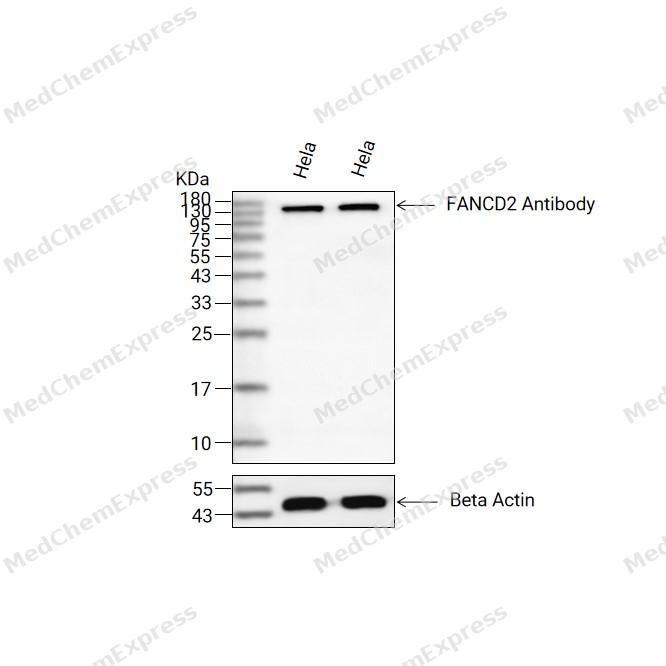 Western blot analysis of extracts from Hela(lane 2(20ug) and Hela(lane 3(40ug) using FANCD2 Antibody (HY-P83357) Rabbit mAb. Proteins were transferred to a PVDF membrane and blocked with 5% non-fat milk in TBST for 2 hour at room temperature. The primary antibody (1/1000) and Loading control antibody (Beta Actin, HY-P83730, 1/10000) was used in 5% non-fat milk in TBST at 4°C overnight. Goat Anti-Mouse/Rabbit IgG-HRP Secondary Antibody (1/10000) was used for 1 hour at room temperature.
 -
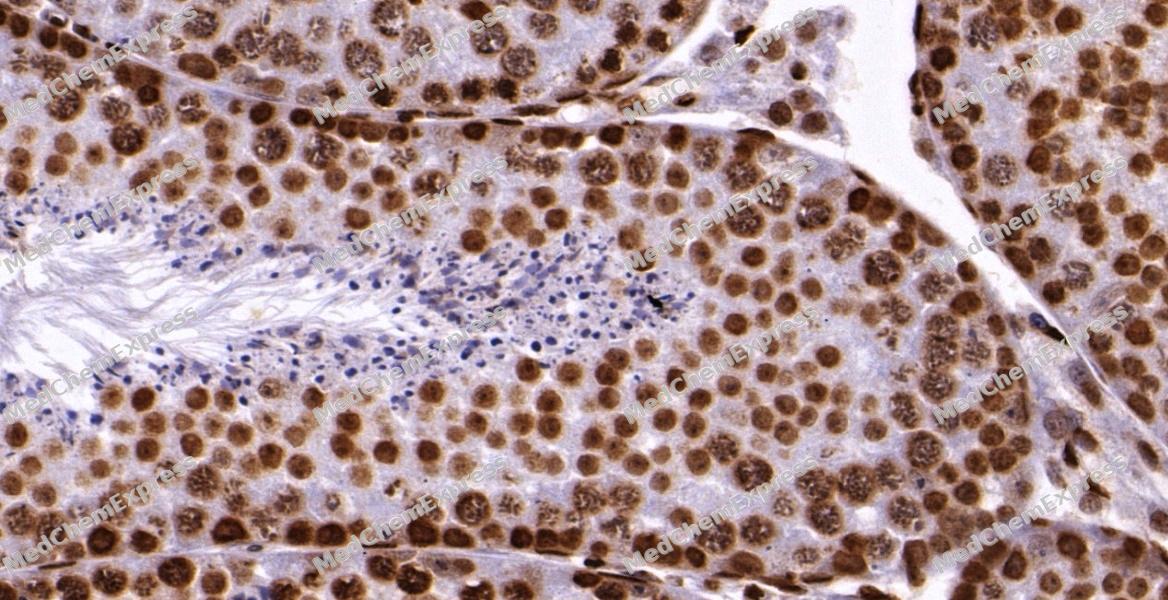 Immunohistochemical analysis of paraffin-embedded mouse testicles tissue using FANCD2 Antibody. The section was pre-treated using heat mediated antigen retrieval with sodium citrate buffer (pH 6.0) for 8 minutes. The tissues were blocked in QuickBlock for 20 minutes at room temperature, washed with ddH2O and PBS, and then probed with the primary antibody at 1/100 dilution in 4℃ overnight. The detection was performed using an HRP conjugated compact polymer system. DAB was used as the chromogen. Tissues were counterstained with hematoxylin and mounted with DPX.
 -
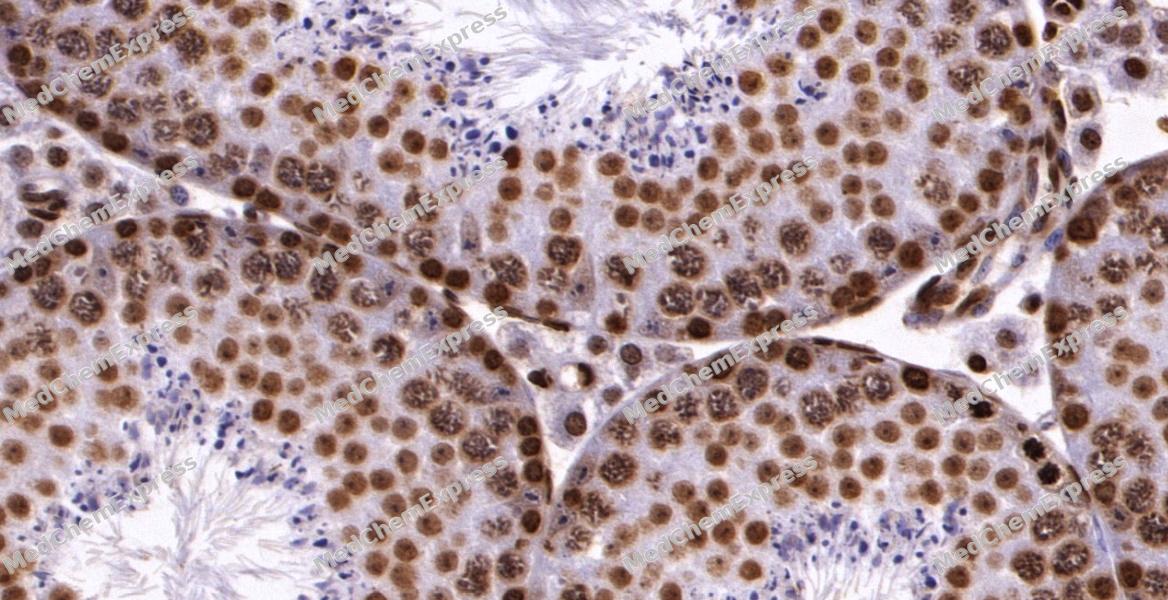 Immunohistochemical analysis of paraffin-embedded mouse testicles tissue using FANCD2 Antibody. The section was pre-treated using heat mediated antigen retrieval with sodium citrate buffer (pH 6.0) for 8 minutes. The tissues were blocked in QuickBlock for 20 minutes at room temperature, washed with ddH2O and PBS, and then probed with the primary antibody at 1/100 dilution in 4℃ overnight. The detection was performed using an HRP conjugated compact polymer system. DAB was used as the chromogen. Tissues were counterstained with hematoxylin and mounted with DPX.
 -
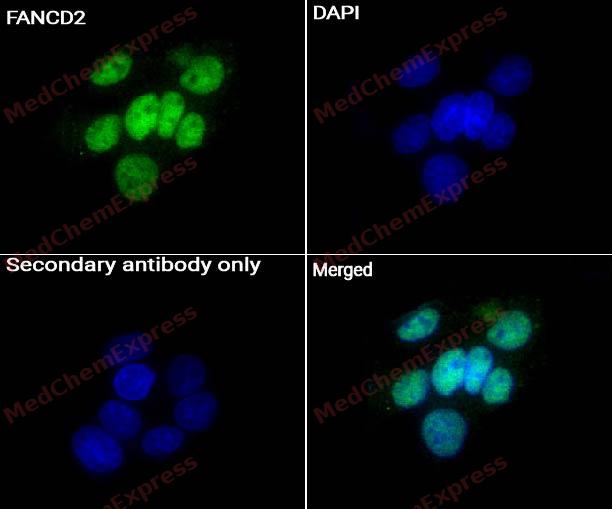 Immunocytochemistry analysis of Hela cells labeling FANCD2 Antibody (HY-P83357) at 1/50 dilution. Cells were fixed in 4% paraformaldehyde for 15 minutes at room temperature, permeabilized with 0.1% Triton X-100 for 10 minutes at room temperature, then blocked with BSA for Immunol Staining for 10 min at room temperature. Cells were then incubated with FANCD2 Antibody (HY-P83357) at 1/50 dilution in BSA for Immunol Staining at 4 ℃ Overnight. AF488-conjugated AffiniPure Goat Anti-Rabbit IgG H&L(HY-P8002, Green) was used as the secondary antibody at 1/1,000 dilution. PBS instead of the primary antibody was used as the secondary antibody only control. The Nuclear counterstain was DAPI (Blue).
 -
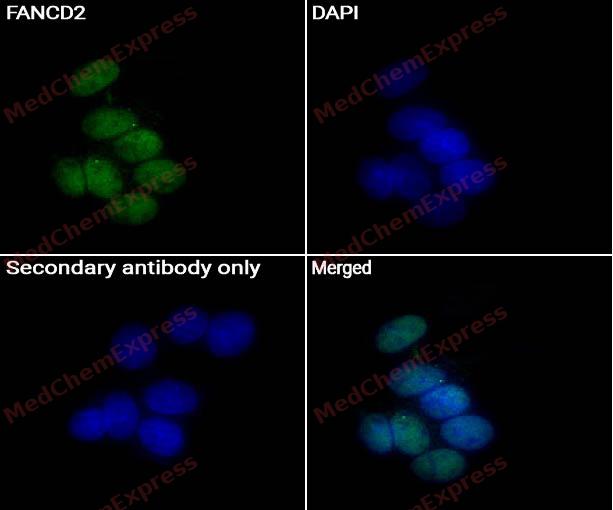 Immunocytochemistry analysis of Hela cells labeling FANCD2 Antibody (HY-P83357) at 1/200 dilution. Cells were fixed in 4% paraformaldehyde for 15 minutes at room temperature, permeabilized with 0.1% Triton X-100 for 10 minutes at room temperature, then blocked with BSA for Immunol Staining for 10 min at room temperature. Cells were then incubated with FANCD2 Antibody (HY-P83357) at 1/200 dilution in BSA for Immunol Staining at 4 ℃ Overnight. AF488-conjugated AffiniPure Goat Anti-Rabbit IgG H&L(HY-P8002, Green) was used as the secondary antibody at 1/1,000 dilution. PBS instead of the primary antibody was used as the secondary antibody only control. The Nuclear counterstain was DAPI (Blue).


Background
-
Function
FANCD2 is required for maintenance of chromosomal stability. Promotes accurate and efficient pairing of homologs during meiosis. Involved in the repair of DNA double-strand breaks, both by homologous recombination and single-strand annealing. The FANCI-FANCD2 complex binds and scans double-stranded DNA (dsDNA) for DNA damage; this complex stalls at DNA junctions between double-stranded DNA and single-stranded DNA. May participate in S phase and G2 phase checkpoint activation upon DNA damage. Plays a role in preventing breakage and loss of missegregating chromatin at the end of cell division, particularly after replication stress. Required for the targeting, or stabilization, of BLM to non-centromeric abnormal structures induced by replicative stress. Promotes BRCA2/FANCD1 loading onto damaged chromatin. May also be involved in B-cell immunoglobulin isotype switching[1][2][3][4][5][6][7][8][9][10][11][12][13][14][15][16].
-
Subcellular Localization
Nucleus
-
Expression
Tissue_specificity:Highly expressed in germinal center cells of the spleen, tonsil, and reactive lymph nodes, and in the proliferating basal layer of squamous epithelium of tonsil, esophagus, oropharynx, larynx and cervix. Expressed in cytotrophoblastic cells of the placenta and exocrine cells of the pancreas (at protein level) . Highly expressed in testis, where expression is restricted to maturing spermatocytes -
Isoforms & Post-Translational Modification
Q9BXW9 has 4 isomers: Q9BXW9-2: 164128 Da (predicted); Q9BXW9-1: 166462 Da (predicted); Q9BXW9-3: 140737 Da (predicted); Q9BXW9-4: 27501 Da (predicted).
Monoubiquitinated on Lys-561 during S phase and upon genotoxic stress by FANCL in complex with E2 ligases UBE2T or UBE2W (isoform 1 and isoform 2) (PubMed:11239454, PubMed:12973351, PubMed:19111657, PubMed:20603015, PubMed:20603016, PubMed:20603073, PubMed:36385258). Deubiquitinated by USP1 as cells enter G2/M, or once DNA repair is completed (PubMed:15694335, PubMed:36385258). Monoubiquitination requires the joint intervention of the FANC core complex, including FANCA, FANCB, FANCC, FANCE, FANCF, FANCG, and FANCM, and proteins involved in cell cycle checkpoints and DNA repair, including RPA1, ATR, CHEK1 and BRCA1, and is mediated by FANCL/PHF9 (PubMed:12973351). Monoubiquitination prevents DNA release from the FANCI-FANCD2 complex (By similarity). FANCD2 is only ubiquitinated in the FANCI-FANCD2 complex and the monoubiquitination of FANCD2 is promoted by phosphorylation of FANCI (By similarity). Ubiquitination is required for binding to chromatin, interaction with BRCA1, BRCA2 and MTMR15/FAN1, DNA repair, and normal cell cycle progression, but not for phosphorylation on Ser-222 or interaction with MEN1 (PubMed:12086603, PubMed:15650050);Phosphorylated in response to various genotoxic stresses by ATM and/or ATR (PubMed:14988723, PubMed:15314022). Upon ionizing radiation, phosphorylated by ATM on Ser-222 and Ser-1404 (PubMed:12086603). Phosphorylation on Ser-222 is required for S-phase checkpoint activation, but not for ubiquitination, foci formation, or DNA repair (PubMed:12086603, PubMed:15650050). In contrast, phosphorylation by ATR on other sites may be required for ubiquitination and foci formation -
Subunit
Homodimer; cannot be ubiquitinated and does not bind DNA (By similarity). Part of a FANCI-FANCD2 heterodimeric complex that binds and scans dsDNA for DNA damage (PubMed:36385258). Interacts directly with FANCE and FANCI (PubMed:12093742, PubMed:12649160, PubMed:17412408, PubMed:17460694). Interacts with USP1 and MEN1 (PubMed:12874027, PubMed:15694335). The ubiquitinated form specifically interacts with BRCA1 and BLM (PubMed:11239454, PubMed:15257300). Both the nonubiquitinated and the monoubiquitinated forms interact with BRCA2; this interaction is mediated by phosphorylated FANCG and the complex also includes XCCR3 (PubMed:15115758, PubMed:15199141, PubMed:18212739). The ubiquitinated form specifically interacts with MTMR15/FAN1 (via UBZ-type zinc finger), leading to recruit MTMR15/FAN1 to sites of DNA damage (PubMed:20603015, PubMed:20603016, PubMed:20603073). Interacts with DCLRE1B/Apollo (PubMed:18469862). Interacts with POLN (PubMed:19995904). Interacts with UHRF1 and UHRF2; these interactions promote FANCD2 activation (PubMed:30335751)
-
SwissProt ID
-
Synonyms
FA D2; FA4; FAC D2; FACD 2; FACD; FACD2; FAD; FAD2; FANCD 2; FANCD; FANCD2; Fanconi anemia group D2 protein; FLJ23826; Protein FACD2; Type 4 Fanconi pancytopenia
-
Research Field
Epigenetics and Nuclear Signaling


Documentation
-
Data Sheet (235 KB)
-
SDS (252 KB)
- English - EN (252 KB)
- Français - FR (252 KB)
- Deutsch - DE (252 KB)
- Norwegian - NO (252 KB)
- Español - ES (252 KB)
- Swedish - SV (252 KB)
- Italian - IT (252 KB)
- Korean - KR (252 KB)
- Portuguese - PT (252 KB)
-
User Guide for Antibodies (1077 KB)

 Powered by Bioz
