



GDF15 Antibody (YA2903)
(Synonyms: GDF15; MIC1; PDF; PLAB; PTGFB; Growth/differentiation factor 15; GDF-15; Macrophage inhibitory cytokine 1; MIC-1; NSAID-activated gene 1 protein; NAG-1; NSAID-regulated gene 1 protein; NRG-1; Placental TGF-beta; Placental bone morphogenetic)Based on 1 Customer Validation
GDF15 Antibody (YA2903) is a Rabbit-derived and non-conjugated IgG monoclonal antibody, targeting to GDF15.
-
Host:
Rabbit
-
Isotype:
IgG
-
Application:
WB
-
Reactivity :
Human
-
Formulation:
Supplied in 50mM Tris-Glycine(pH 7.4), 0.15M NaCl, 40% Glycerol, 0.01% Sodium azide and 0.05% BSA
-
Conjugation:
Non-conjugated


To place orders, for customer services and technical support, please contact: MedChemExpress USA
Tel: 609-228-6898 E-mail: [email protected] [email protected]





Applications
| Application |
WB

WB: Western Blot
|
|---|---|
| Dilution Ratio | 1:500-1:1000 |


Product Details
GDF15 Antibody (YA2903) is a Rabbit-derived and non-conjugated IgG monoclonal antibody, targeting to GDF15.
-
Host Rabbit

-
Clonality Recombinant,Monoclonal

-
Species ReactivityHuman
-
Observed Molecular WeightObserved band size: 34 kDa
Note: Due to possible protein modifications or aggregation, the molecular weight should be confirmed by actual measurement, and the predicted value is for reference only.

-
Calculated Molecular Weight Predicted band size: 34 kDa

A synthetic peptide of human GDF15
Endogenous
Affinity Purified
Non-conjugated
Unmodified
IgG


Product Properties
-
Appearance
Solution
-
Formulation
Supplied in 50mM Tris-Glycine(pH 7.4), 0.15M NaCl, 40% Glycerol, 0.01% Sodium azide and 0.05% BSA
-
Concentration
Batch-dependent, Please check the COA for the concentration of each lot. Check Lot Concentration
-
Storage & Stability
Stored at -20°C for 1 year. Avoid repeated freeze / thaw cycles.
-
Shipping
Shipping with blue ice.


Verification Images
-
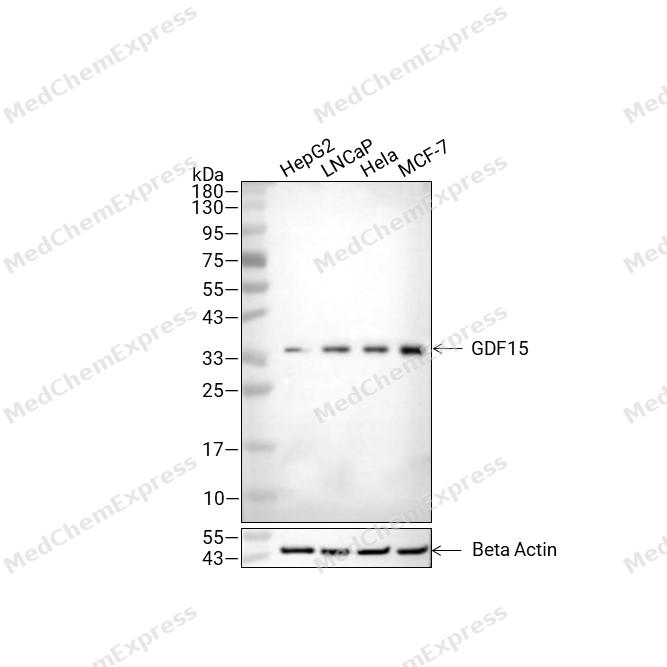 Western blot analysis of extracts from HepG2 (lane2(20μg), LNCaP (lane3(20μg), Hela (lane4(20μg) and MCF-7 (lane5(20μg) using GDF15 Antibody (HY-P83158). Proteins were transferred to a PVDF membrane and blocked with 5% non-fat milk in TBST for 2 hour at room temperature. The primary antibody (1/1000) and Loading control antibody (Beta Actin, HY-P80993, 1/10,000) was used in 5% non-fat milk in TBST at 4°C overnight. Goat Anti-Rabbit IgG-HRP Secondary Antibody (HY-P8001 ,1/10,000) was used for 1 hour at room temperature.


Background
-
Function
GDF15 is a stress-inducible secreted member of the transforming growth factor-β superfamily, originally described as macrophage inhibitory cytokine-1 and later characterized as a liver-injury–induced growth differentiation factor[1][2]. In metabolic and inflammatory stress, GDF15 functions as an endocrine signal that links peripheral tissue injury, nutrient stress, and systemic adaptation rather than acting as a conventional intracellular signaling enzyme[3][4]. Mechanistically, circulating GDF15 engages the hindbrain GFRAL–RET pathway, which controls food intake, body weight, and energy balance, making the GDF15–GFRAL axis a central experimental model for anorexia, cachexia, nausea, and obesity research[4][5]. In disease models, GDF15 supports tissue tolerance during infection and inflammatory injury, while human pregnancy studies link fetal and maternal GDF15 biology to nausea and hyperemesis gravidarum risk[3][6]. Compared with related GDF/TGF-β family ligands, the selected literature distinguishes GDF15 by its divergent sequence identity, stress-responsive expression, and GFRAL-dependent endocrine biology rather than by functionally validated GDF15 isoforms[1][2][4]. For experimental applications, recombinant GDF15 or metformin-induced GDF15 elevation can model pathway activation, whereas anti-GDF15 antibody blockade, including ponsegromab, tests causal involvement in cancer cachexia and appetite-loss phenotypes[5][7].
-
Subcellular Localization
Secreted
-
Expression
Tissue_specificity:Detected in plasma (at protein level) (PubMed:28572090, PubMed:29046435) . Highly expressed in placenta, with lower levels in prostate and colon and some expression in kidney (PubMed:37060902, PubMed:9348093)
Induction:Produced in response to various stresses, such as metabolic and toxin-induced stresses or drugs (PubMed:31402172, PubMed:31875646, PubMed:32694673, PubMed:33207247, PubMed:33589633, PubMed:36001956) . Expression is activated by ATF4 and DDIT3/CHOP transcription factors downstream of the integrated stress response (ISR) (PubMed:30639358) . Expressed in response to inflammatory conditions (PubMed:31402172) . Expression is induced by metformin, a blood-glucose-lowering drug (PubMed:31875646, PubMed:32694673, PubMed:36001956) . Expression is induced by cisplatin anticancer drug (PubMed:33207247) . Also induced by physical activity (PubMed:33589633) . Expression is up-regulated by obesity (PubMed:29046435) . Expression is up-regulated by ketogenic diet (PubMed:38056430) -
Subunit
Homodimer; disulfide-linked (PubMed:29046435, PubMed:31535977). Interacts with GFRAL and RET; ligand of GFRAL, which mediates GDF15 internalization and cellular signaling through interaction with RET via the formation of a 2:2:2 ternary complex composed of GDF15, GFRAL and RET (PubMed:28846097, PubMed:28846098, PubMed:28846099, PubMed:28953886, PubMed:31535977)
-
SwissProt ID
-
Synonyms
GDF15; MIC1; PDF; PLAB; PTGFB; Growth/differentiation factor 15; GDF-15; Macrophage inhibitory cytokine 1; MIC-1; NSAID-activated gene 1 protein; NAG-1; NSAID-regulated gene 1 protein; NRG-1; Placental TGF-beta; Placental bone morphogenetic
-
Research Field
Cell Biology


Documentation
-
Data Sheet (261 KB)
-
SDS (252 KB)
- English - EN (252 KB)
- Français - FR (252 KB)
- Deutsch - DE (252 KB)
- Norwegian - NO (252 KB)
- Español - ES (252 KB)
- Swedish - SV (252 KB)
- Italian - IT (252 KB)
- Korean - KR (252 KB)
- Portuguese - PT (252 KB)
-
User Guide for Antibodies (1077 KB)
References
[1]. Bootcov MR, et al. MIC-1, a novel macrophage inhibitory cytokine, is a divergent member of the TGF-beta superfamily. Proc Natl Acad Sci U S A. 1997;94(21):11514-11519. [Content Brief]
[2]. Hsiao EC, et al. Characterization of growth-differentiation factor 15, a transforming growth factor beta superfamily member induced following liver injury. Mol Cell Biol. 2000;20(10):3742-3751. [Content Brief]
[3]. Luan HH, et al. GDF15 Is an Inflammation-Induced Central Mediator of Tissue Tolerance. Cell. 2019;178(5):1231-1244.e11. [Content Brief]
[4]. Wang D, et al. GDF15: emerging biology and therapeutic applications for obesity and cardiometabolic disease. Nat Rev Endocrinol. 2021;17(10):592-607. [Content Brief]
[5]. Coll AP, et al. GDF15 mediates the effects of metformin on body weight and energy balance. Nature. 2020;578(7795):444-448. [Content Brief]
[6]. Fejzo M, et al. GDF15 linked to maternal risk of nausea and vomiting during pregnancy. Nature. 2024;625(7996):760-767. [Content Brief]
[7]. Groarke JD, et al. Ponsegromab for the Treatment of Cancer Cachexia. N Engl J Med. 2024;391(24):2291-2303. [Content Brief]

 Powered by Bioz
