



HuR Antibody (YA1933)
(Synonyms: HUR; Hua; MelG; ELAV1)
Based on 1 Customer Validation
HuR Antibody (YA1933) is a Rabbit-derived and non-conjugated IgG monoclonal antibody, targeting to HuR.
-
Host:
Rabbit
-
Isotype:
IgG
-
Application:
WB, IHC-P, ICC/IF, IP, FC
-
Reactivity :
Human, Mouse, Rat
-
Formulation:
Supplied in 50mM Tris-Glycine(pH 7.4), 0.15M NaCl, 40%Glycerol, 0.01% sodium azide and 0.05% BSA.
-
Conjugation:
Non-conjugated


To place orders, for customer services and technical support, please contact: MedChemExpress USA
Tel: 609-228-6898 E-mail: [email protected] [email protected]





Applications
| Application |
WB

WB: Western Blot
|
IHC-P
IHC-P: Immunohistochemistry-Paraffin
|
ICC/IF
ICC/IF: Immunocytochemistry/
Immunofluorescence |
IP
IP: Immunoprecipitation
|
FC
FC: Flow Cytometry
|
|---|---|---|---|---|---|
| Dilution Ratio | 1:500-1:1000 | 1:50-1:100 | 1:50-1:200 | 1:40 | 1:50-1:100 |


Product Details
HuR Antibody (YA1933) is a Rabbit-derived and non-conjugated IgG monoclonal antibody, targeting to HuR.
-
Host Rabbit

-
Clonality Recombinant,Monoclonal

-
Species ReactivityHuman, Mouse, Rat
-
Observed Molecular WeightObserved band size: 36 kDa
Note: Due to possible protein modifications or aggregation, the molecular weight should be confirmed by actual measurement, and the predicted value is for reference only.

-
Calculated Molecular Weight Predicted band size: 36 kDa

Entrez Gene: 1994 Human ; 15568 Mouse ; 363854 Rat
SwissProt: Q15717 Human ; P70372 Mouse ;
OMIM: 603466 Human
A synthesized peptide derived from human HuR / ELAVL1
Endogenous
Affinity Chromatography
Non-conjugated
Unmodified
IgG


Product Properties
-
Appearance
Solution
-
Formulation
Supplied in 50mM Tris-Glycine(pH 7.4), 0.15M NaCl, 40%Glycerol, 0.01% sodium azide and 0.05% BSA.
-
Concentration
Batch-dependent, Please check the COA for the concentration of each lot. Check Lot Concentration
-
Storage & Stability
Stored at -20°C for 1 year. Avoid repeated freeze / thaw cycles.
-
Shipping
Shipping with blue ice.


Verification Images
-
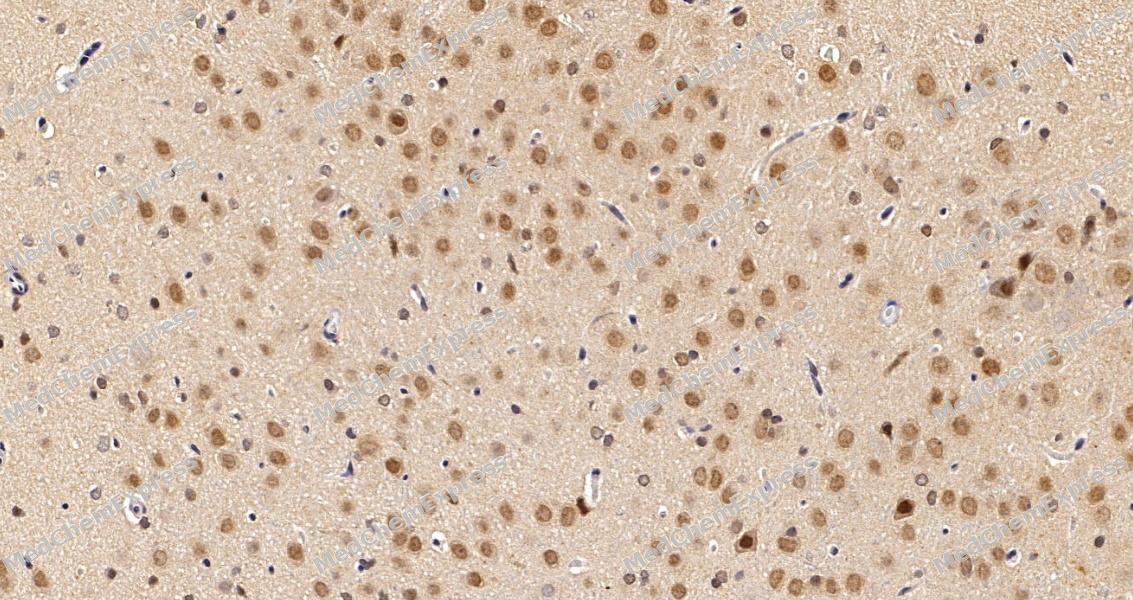 Immunohistochemical analysis of paraffin-embedded rat brain tissue using HuR Antibody. The section was pre-treated using heat mediated antigen retrieval with sodium citrate buffer (pH 6.0) for 8 minutes. The tissues were blocked in QuickBlock for 20 minutes at room temperature, washed with ddH2O and PBS, and then probed with the primary antibody at 1/100 dilution in 4℃ overnight. The detection was performed using an HRP conjugated compact polymer system. DAB was used as the chromogen. Tissues were counterstained with hematoxylin and mounted with DPX.
 -
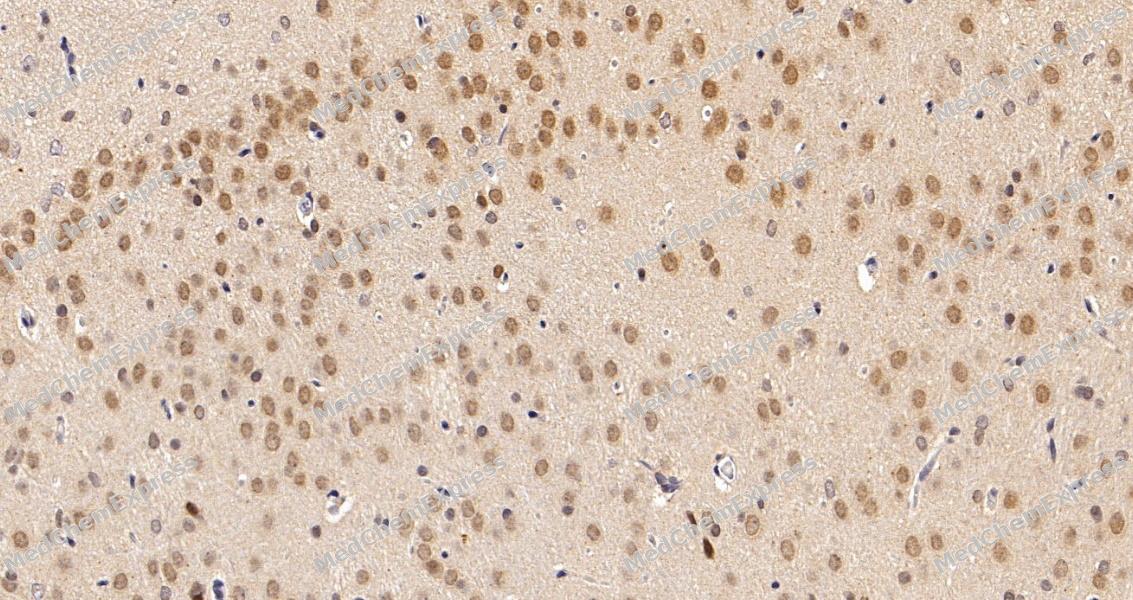 Immunohistochemical analysis of paraffin-embedded rat brain tissue using HuR Antibody. The section was pre-treated using heat mediated antigen retrieval with sodium citrate buffer (pH 6.0) for 8 minutes. The tissues were blocked in QuickBlock for 20 minutes at room temperature, washed with ddH2O and PBS, and then probed with the primary antibody at 1/100 dilution in 4℃ overnight. The detection was performed using an HRP conjugated compact polymer system. DAB was used as the chromogen. Tissues were counterstained with hematoxylin and mounted with DPX.
 -
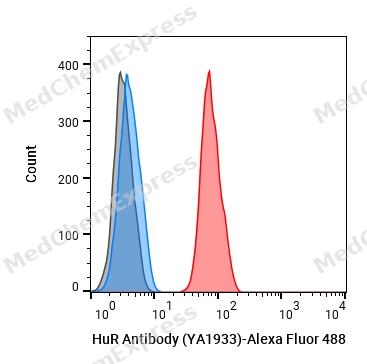 Flow cytometric analysis of 1X10^6 Hela cells labeling HuR Antibody (YA1933) (HY-P82188, red). Cells were fixed with 4% paraformaldehyde and permeabilised with 90% methanol. Then stained with the primary antibody at 1/50 dilution for an hour at 4℃. Alexa Fluor® 488-conjugated AffiniPure Goat Anti-Rabbit IgG H&L (HY-P8002) was used as the secondary antibody at 1/1,000 dilution for 30 minutes at 4℃. Rabbit IgG Isotype Control (HY-P80879, blue) was used as the isotype control, cells without incubation with primary antibody were used as the unlabeled control (black).


Background
-
Function
Human Antigen R (HuR), also known as ELAV-like protein 1 (ELAVL1), is an RNA-binding protein that plays a crucial role in the process of RNA metabolism within cells. HuR enhances the stability of mRNA and guides the mRNA to be transported from the nucleus to the cytoplasm through the nuclear pore complex, ensuring that the mRNA reaches the ribosomes for translation. HuR can also interact with translation initiation factors to promote the binding of ribosomes to mRNA, thereby regulating the translation efficiency of mRNA and affecting protein synthesis. By regulating the stability, transportation, and translation of the mRNAs of related genes, HuR plays an important role in tumors, neurodegenerative diseases, and inflammatory diseases[1][2].
-
Subcellular Localization
Cytoplasm; Nucleus; Cytoplasm, Stress granule; Cytoplasm, P-body
-
Expression
Tissue_specificity:Ubiquitous. Detected in brain, liver, thymus and muscle -
Isoforms & Post-Translational Modification
Q15717 has 2 isomers: Q15717-1: 36092 Da (predicted); Q15717-2: 38996 Da (predicted).
Phosphorylated by MAPKAPK2 (PubMed:14517288). Phosphorylated by PRKCD (PubMed:18285462);Methylated at Arg-217 by CARM1 in macrophages in response to LPS challenge -
Subunit
Monomer and homodimer (in vitro) (PubMed:17632515, PubMed:20219472). Interacts with ANP32A (PubMed:11729309). Interacts with ZNF385A; the interaction is indirect and mRNA-dependent and may regulate p53/TP53 expression (By similarity). Identified in a mRNP complex, at least composed of DHX9, DDX3X, ELAVL1, HNRNPU, IGF2BP1, ILF3, PABPC1, PCBP2, PTBP2, STAU1, STAU2, SYNCRIP and YBX1 (PubMed:19029303). Interacts with AGO1 and AGO2 (PubMed:17932509). Interacts with IGF2BP1; the interaction is enhanced by SEPIN14P20 peptide RBPR (PubMed:29476152, PubMed:32245947). Interacts with IGF2BP2 and IGF2BP3 (PubMed:23640942, PubMed:29476152). Interacts with HNRNPL (PubMed:18161049). Interacts with DHX36; this interaction occurs in a RNA-dependent manner (PubMed:14731398). Interacts with ILF3; this interaction occurs in a RNA-dependent manner (PubMed:14731398). Interacts with PLEKHN1 (PubMed:18191643, PubMed:27616329). Interacts with SHFL; the interaction increases in presence of RNA (PubMed:27974568). Interacts with YBX1; interaction recruits ELAVL1 on C5-methylcytosine (m5C)-containing mRNAs, thereby promoting mRNA stability (PubMed:31358969). Interacts with FXR1 (PubMed:30067974)
-
SwissProt ID
-
Synonyms
HUR; Hua; MelG; ELAV1
-
Research Field
Epigenetics and Nuclear Signaling


Documentation
-
Data Sheet (261 KB)
-
SDS (251 KB)
- English - EN (251 KB)
- Français - FR (251 KB)
- Deutsch - DE (251 KB)
- Norwegian - NO (251 KB)
- Español - ES (251 KB)
- Swedish - SV (251 KB)
- Italian - IT (251 KB)
- Korean - KR (251 KB)
- Portuguese - PT (251 KB)
-
User Guide for Antibodies (1077 KB)
References

 Powered by Bioz
